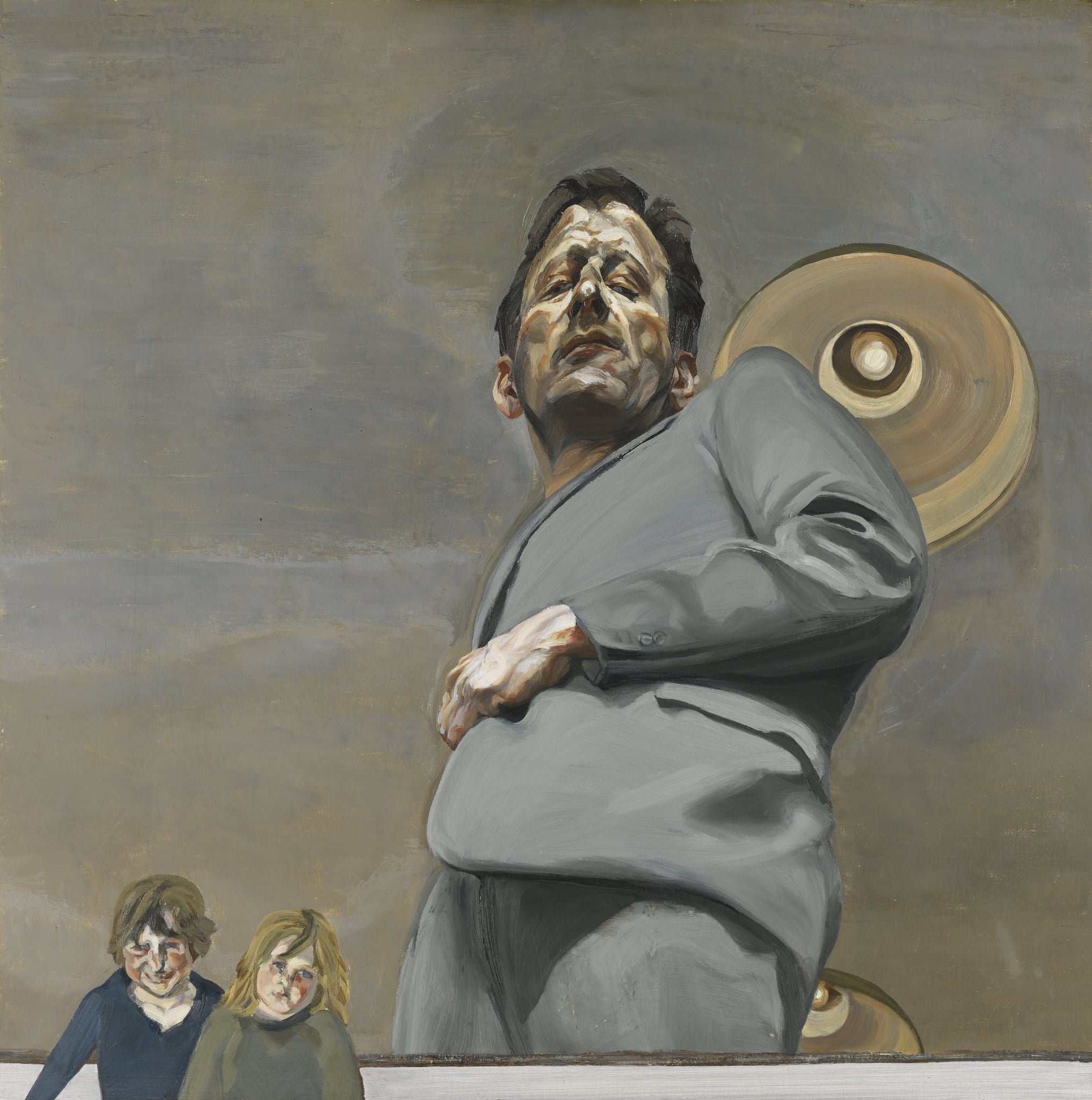
Hand on hip Symbolism
In art, a hand placed on the hip—often called the akimbo pose—signals command, self-possession, and readiness, while it can also read as a defensive brace. By widening the body’s outline and anchoring the torso, the gesture turns stance into rhetoric, long used in portraiture to project authority or containment.
Hand on hip in Reflection with Two Children
In Lucian Freud’s Reflection with Two Children (1965), the self-portrait’s low, vertiginous viewpoint magnifies a suited figure whose hand-on-hip stance reads as deliberate self-assertion. The outward-set arm broadens the body and helps stage the work’s drama of authority, exposure, and accountability, as the artist confronts his own reflection while two children puncture the frame at the bottom edge. Here the gesture functions both as a claim of control and as a bracing posture, holding ground before the mirror’s scrutiny.