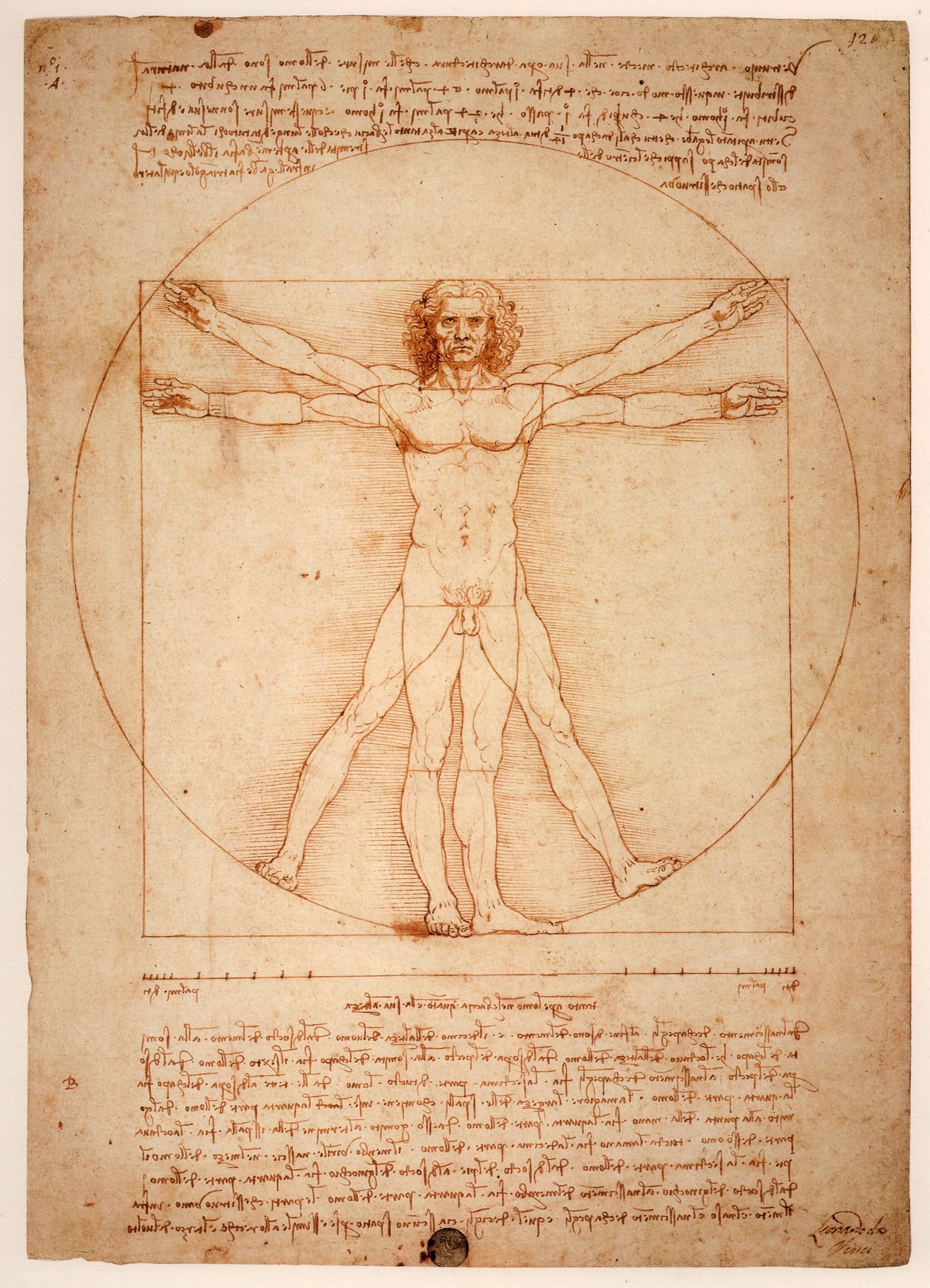
Navel as center Symbolism
The navel has long been treated in art as the body's natural center and an index of origin. From classical theory to the Renaissance, it serves as a fixed point for proportion, often anchoring geometric schemes that measure the human figure.
Navel as center in Vitruvian Man
In Leonardo da Vinci's Vitruvian Man (1498, museum catalog; often cited traditionally as c. 1490), a double-posed male body is inscribed within a circle and a square to test classical rules against measured observation. Within this construction, the navel aligns with the center of the circle, anchoring the composition's radiating measures and marking the body's proportional center—reinforcing the sheet's thesis that the human body is a microcosm ordered by ratio and reason.