Peacock-feather fan Symbolism
Peacock-feather fans in art commonly signal luxury, display, and cultivated sensuality. In 19th-century Orientalist settings, they function as theatrical props that suggest leisurely pleasure and exotic opulence. Their presence often underscores artifice, aligning sumptuous surfaces with idealized beauty.
Peacock-feather fan in Grande Odalisque
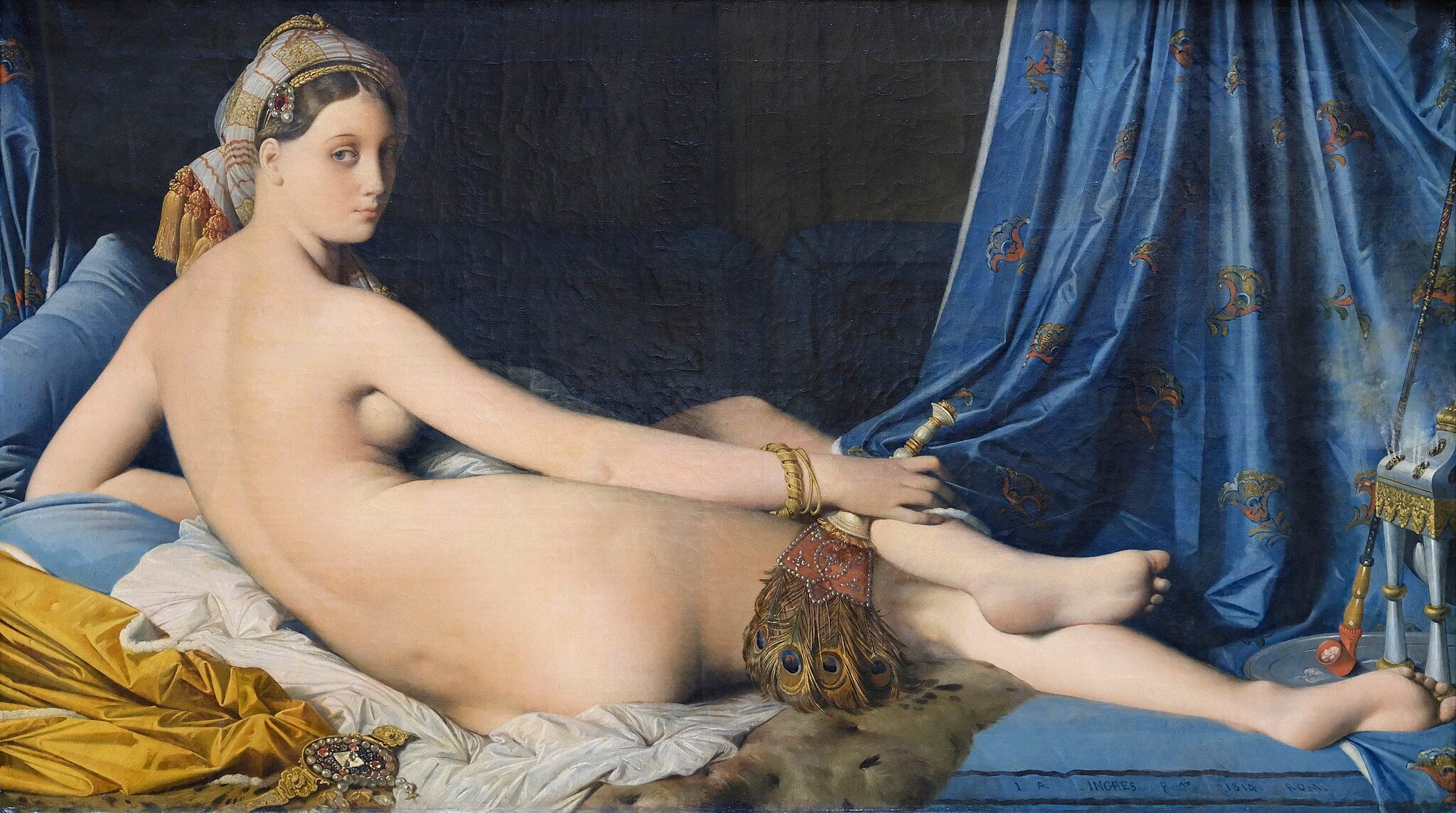
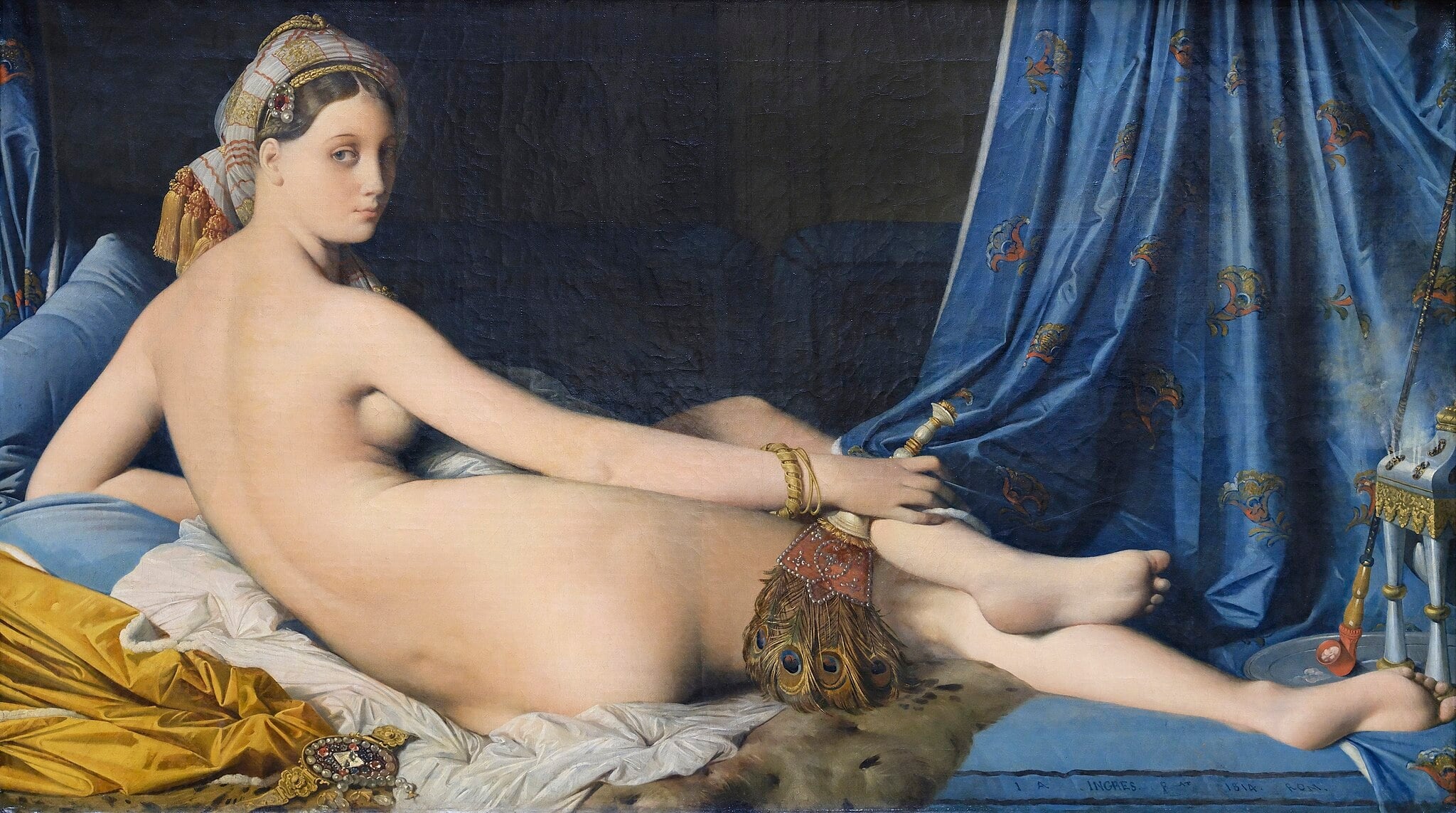
In Jean-Auguste-Dominique Ingres’s The Great Odalisque (1814), a peacock-feather fan appears among Orientalist props—the turban, blue curtain, and hookah—that stage the reclining nude as an idealized, remote vision. As a sign of luxury and idleness, the fan reinforces the painting’s polished, enamel-like finish and its fusion of classical line with erotic fantasy.
In Ingres’s Grande Odalisque (1814), the fan again accompanies the figure’s jeweled turban and bracelets, intensifying the image’s opulent mood while the model turns to meet the viewer. Across both works, the fan operates as a device of display, supporting the artist’s emphasis on artifice and constructed beauty over strict realism.
Common Themes
Artworks Featuring This Symbol
Grande Odalisque
Jean-Auguste-Dominique Ingres (1814)
In Jean-Auguste-Dominique Ingres’s Grande Odalisque (1814), a nude woman reclines against cool satin and a deep blue, patterned curtain, her spine drawn into an elegant, impossible arc. With a jeweled turban, bracelets, and a peacock-feather fan, she turns to meet the viewer’s look, poised yet distant. The image fuses <strong>Neoclassical idealization</strong> with <strong>Orientalist fantasy</strong>, privileging line and artifice over realism <sup>[1]</sup><sup>[2]</sup>.
The Great Odalisque
Jean-Auguste-Dominique Ingres (1814)
Jean-Auguste-Dominique Ingres’s The Great Odalisque (1814) turns a reclining nude into an idealized, remote vision, polished to an <strong>enamel-like finish</strong> and staged with <strong>Orientalist</strong> props—turban, peacock-feather fan, blue curtain, and hookah. Commissioned by Caroline Murat and shown at the <strong>Salon of 1819</strong>, it fuses classical line with erotic fantasy, its elongated back and rotated shoulder declaring beauty as a constructed ideal <sup>[1]</sup><sup>[3]</sup>.