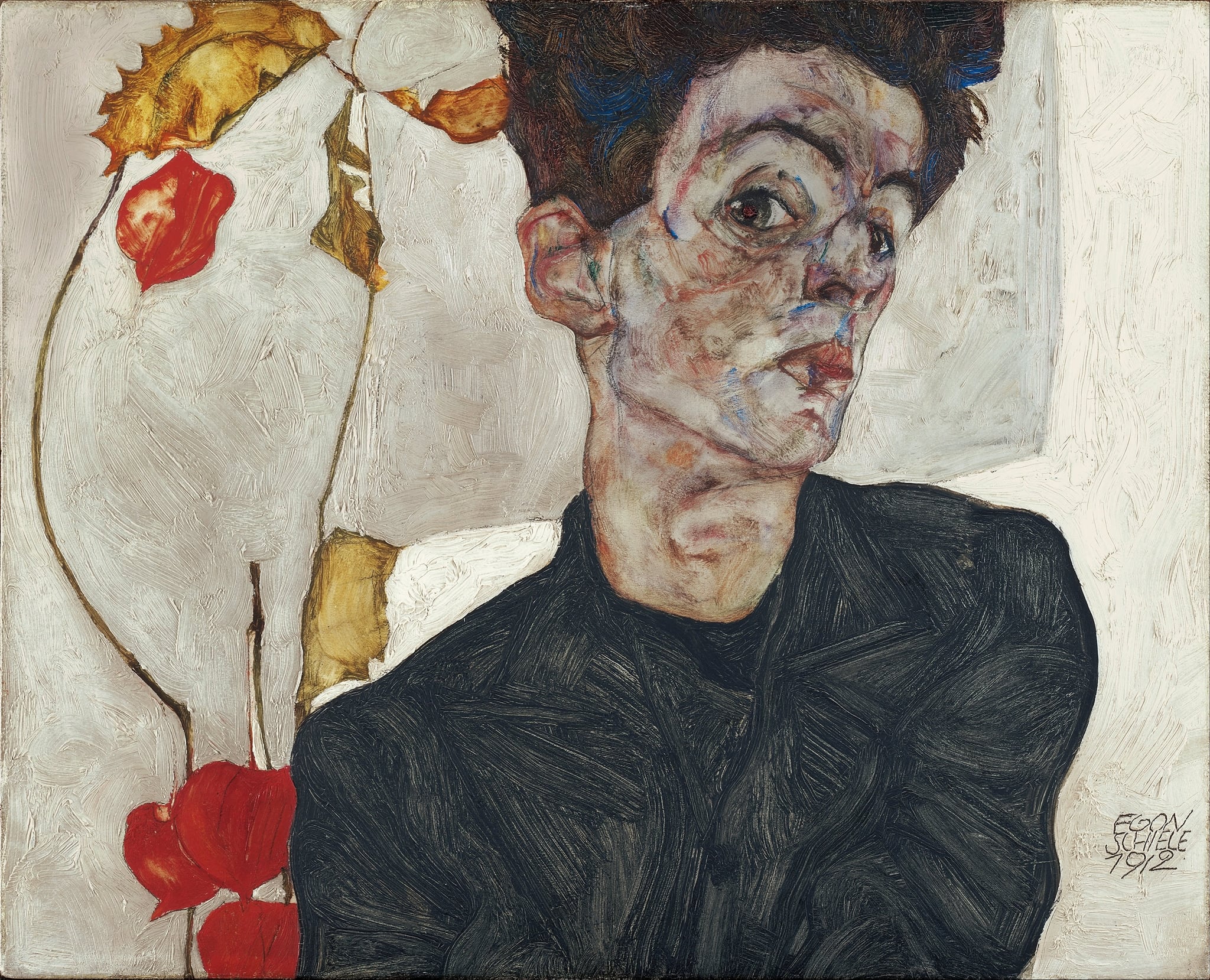
Physalis (Chinese lantern) pods Symbolism
Physalis, or Chinese lantern pods, crystallize the idea of living warmth held within a delicate enclosure. As seen in Egon Schiele’s early twentieth-century portraiture, the motif marks the friction between vitality and decay, turning a small botanical form into a compact emblem of protected yet precarious life.
Physalis (Chinese lantern) pods in Self-Portrait with Physalis
In Self-Portrait with Physalis (1912), Egon Schiele sets red-orange lantern pods beside his sharply linear black jacket and his gaunt, violet- and blue-accented face. Against the scraped, chalky ground, the pods serve as a chromatic counterweight whose concentrated warmth heightens the portrait’s tension between vitality and decline. In this single example from the collection, the pods focus the eye on life that persists, even as the figure’s strained body underscores fragility—an Expressionist calibration of energy and withering held in one frame.