Pitcher/Vessel Symbolism
Pitchers and other vessels in art often signify the act of carrying and the human capacity to bear weight, aligning the body with balance and service. Across Mediterranean and classical traditions, the container also stands for domestic labor and self-possession—portable volume held steady by trained poise. As a symbol, it can mark thresholds or rites, where everyday tasks read as disciplined passage.
Pitcher/Vessel in Les Adolescents
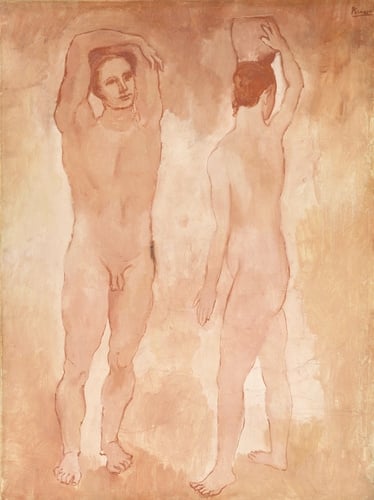
In Pablo Picasso’s Les Adolescents (1906), one youth in profile balances a pitcher while the companion stands frontal with arms raised. Set against a shallow, fresco-like field and modeled in warm rose ochres characteristic of the artist’s Rose Period calm, the vessel concentrates attention on bearing and equilibrium. Its poised weight turns an everyday task into a quiet rite of passage, aligning adolescence with a timeless, classical type. Here the pitcher functions less as a narrative prop than as a measure of self-possession: the figure’s ability to hold and steady the vessel signifies discipline, readiness, and the threshold between youth and adulthood.