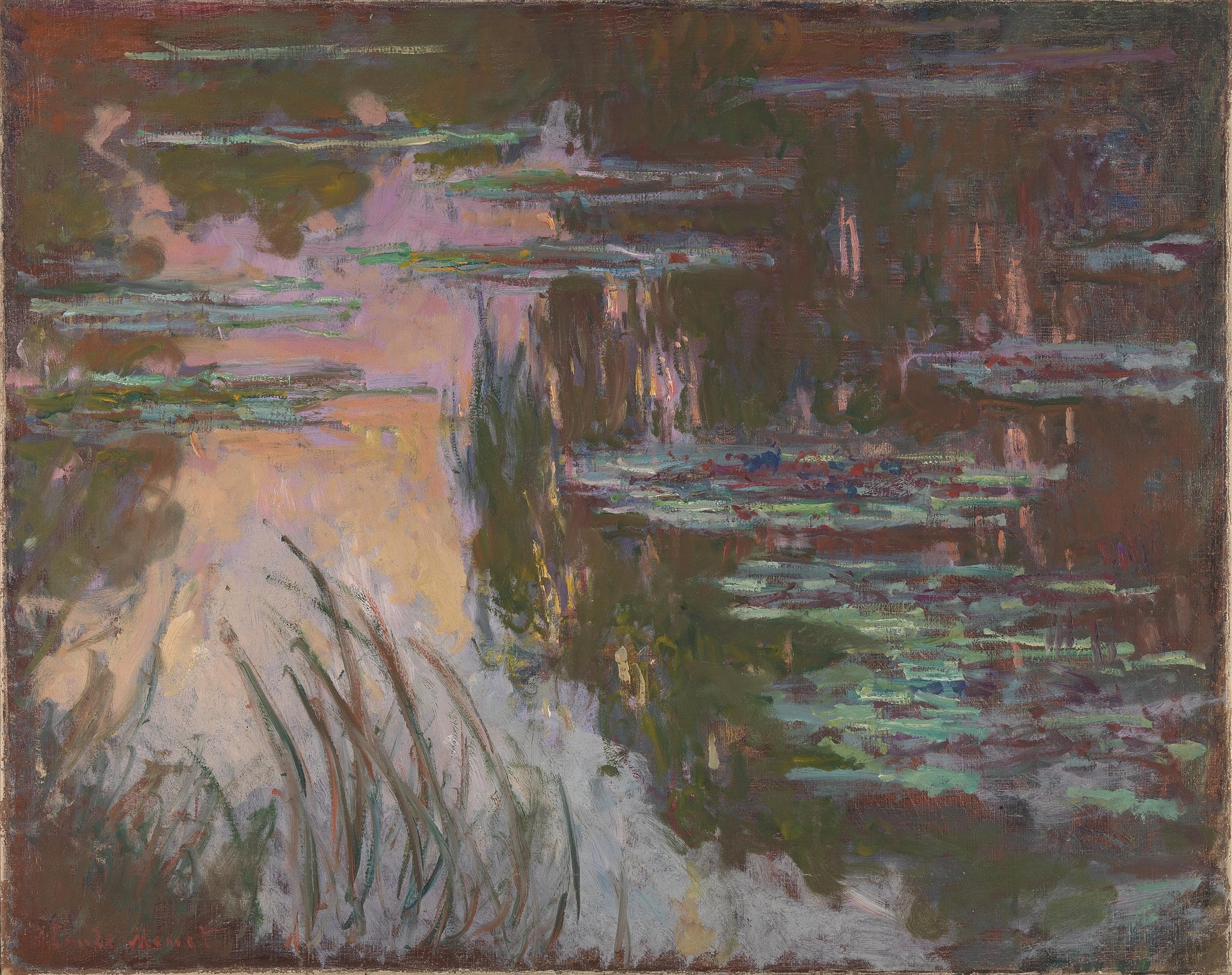
Reeds/grass at the bank Symbolism
Reeds or grasses at a water’s edge have long marked the threshold between land and water in landscape art, giving viewers a firm sense of shoreline and scale. Their upright, linear forms puncture reflective surfaces and establish foreground, helping distinguish surface from depth. Artists often use such bank vegetation to tether atmospheric effects to a tangible margin.
Reeds/grass at the bank in Water-Lilies, Setting Sun
In Claude Monet’s Water-Lilies, Setting Sun (about 1907), reflections overtake solid forms, turning the pond into a nearly continuous field of light. Set against the horizontal lily pads and the central column of sunset color, the painting’s dark, vertical willow traces function like reeds at a bank: they pierce the reflective surface, unsettle depth and horizon, and provide a terrestrial counterpoint that clarifies the orientation between surface and depth within the scene.