Triad of arches and Tuscan columns Symbolism
A triad of arches supported by Tuscan columns signals Roman architectural order and restraint. In art, this sober vocabulary—rooted in the ancient Tuscan (Roman Doric) order—conveys stability, civic virtue, and rational measure, with the tripartite rhythm organizing action and meaning. Neoclassical artists used it to frame exemplary narratives grounded in law and duty.
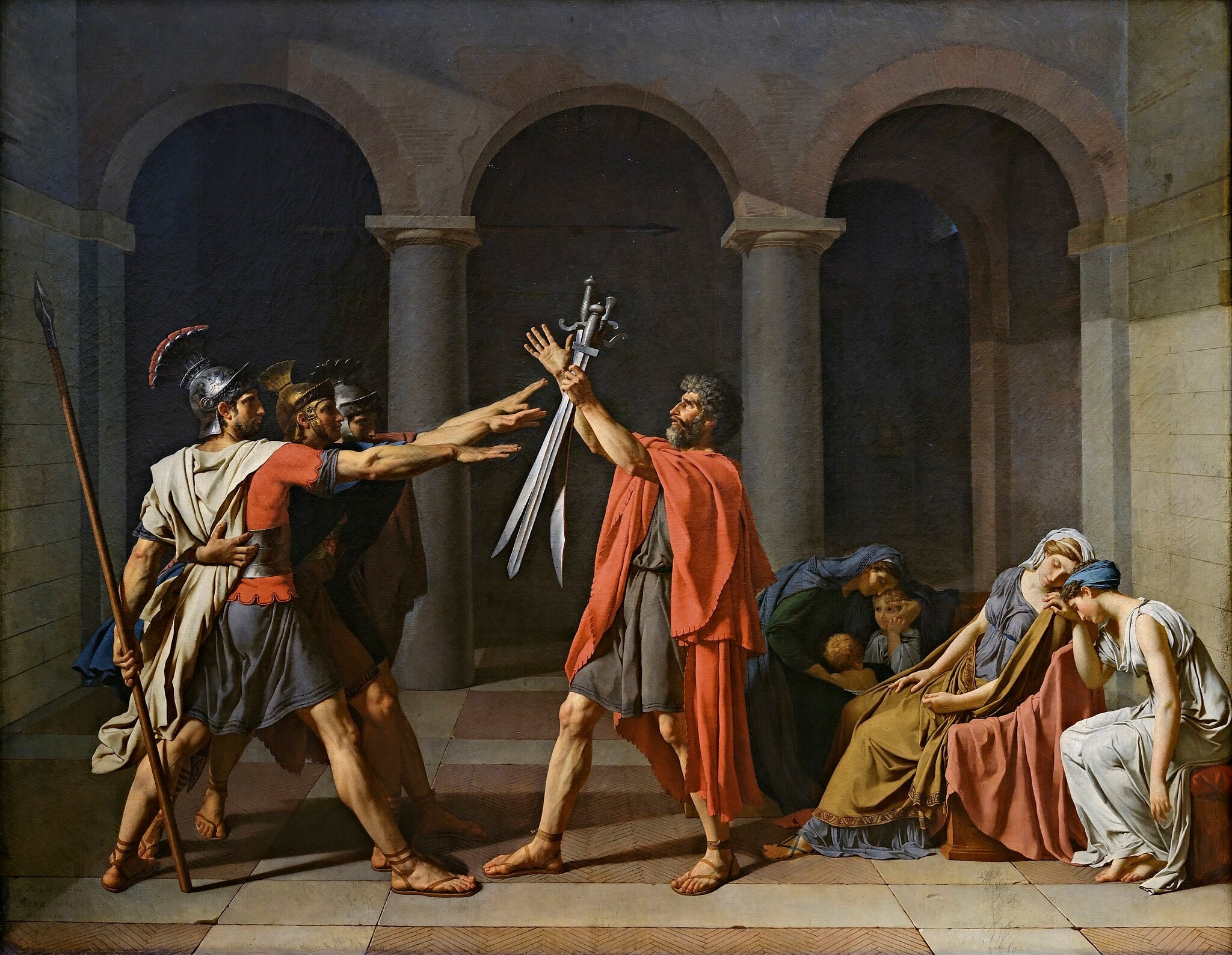
Triad of arches and Tuscan columns in The Oath of the Horatii
In Jacques-Louis David’s The Oath of the Horatii (1784 (exhibited 1785)), a row of Tuscan columns carries three arches that divide the scene into lucid bays. The unfluted shafts and weighty entablature declare Roman austerity, while the central arch fixes the perspectival center where the father lifts the three swords.
This tripartite architecture mirrors the triad of brothers and forges the painting’s severe geometry, reinforcing civic duty over private feeling: the rectilinear men align with the architectural clarity, as the mourning women withdraw into the lateral bays’ shadow. In David’s composition, the triad of arches and Tuscan columns functions not as backdrop but as a structural emblem of Neoclassical virtue and republican resolve.