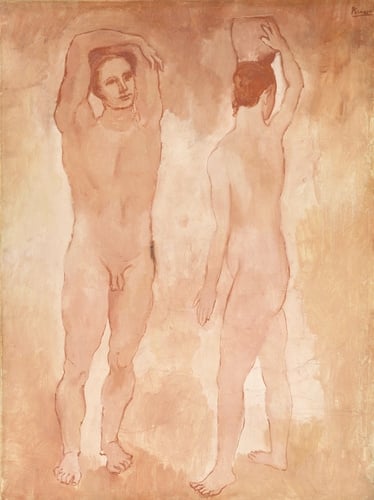
Twinning/Duality of Two Figures Symbolism
Twinning, or the deliberate pairing of two figures, makes relationship visible through symmetry, counterpose, and echoing gesture. The doubled body sets up contrast—such as frontality versus profile or action versus stillness—while binding the pair into a single, legible unit. Across art history, this device often marks balance and transition, turning individuals into types.
Twinning/Duality of Two Figures in Les Adolescents
In Pablo Picasso’s Les Adolescents (1906), twinning structures the composition: two nude youths share a shallow, fresco-like field and are modeled in warm rose ochres associated with his Rose Period calm. Their gestures rhyme yet diverge—one figure frontal with arms raised, the other in profile balancing a pitcher—so the pair reads at once as a unified classical type and as a measured contrast. This quiet doubling stages adolescence as a rite of passage, using front/profile and open arms/carrying vessel to register relation and difference within a frieze-like register.