White towel Symbolism
In art, the white towel is a clear sign of bathing and cleansing, closely linked to ideas of purification and modesty. Like the drapery of classical nudes, it mediates the viewer’s access to the body, marking boundaries between what is revealed and what remains private. Across depictions of bathers, it helps frame the nude as disciplined, orderly, and purified.
White towel in Grande baigneuse
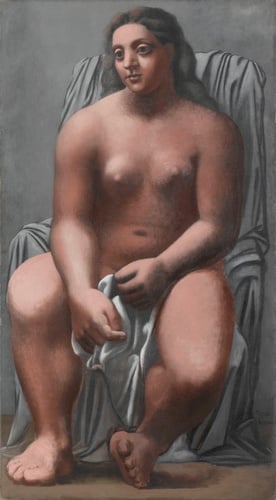
In Pablo Picasso’s Grande baigneuse (1921), the seated nude holds a towel clenched in her hand, an attribute that identifies her as a bather and signals bathing and purification. The towel also functions as a modesty device under the figure’s control, regulating exposure while affirming her composure and self-possession.
Set frontally on a draped, stone-like chair and rendered with antique gravitas, the figure reads as a modernized classical statue. Within this fusion of modern space and classical stability, the towel operates as a classical marker that anchors the timeless, enduring presence of the bather, reinforcing the painting’s assertion of stability after wartime rupture.