How Much Is Four Marlons Worth?
Last updated: February 24, 2026
Quick Facts
- Last Sale
- $69.6M (2014, Christie's New York)
- Methodology
- comparable analysis
Anchored by the 2014 public sale at $69.605 million and calibrated to recent top-tier Warhol comparables, Four Marlons (1966) is valued at $90–110 million today. Its prime-period, near-seven-foot scale, multi-image Brando subject, and raw-linen execution place it just below Marilyns and the most important Disasters, and broadly in line with top Elvis canvases.
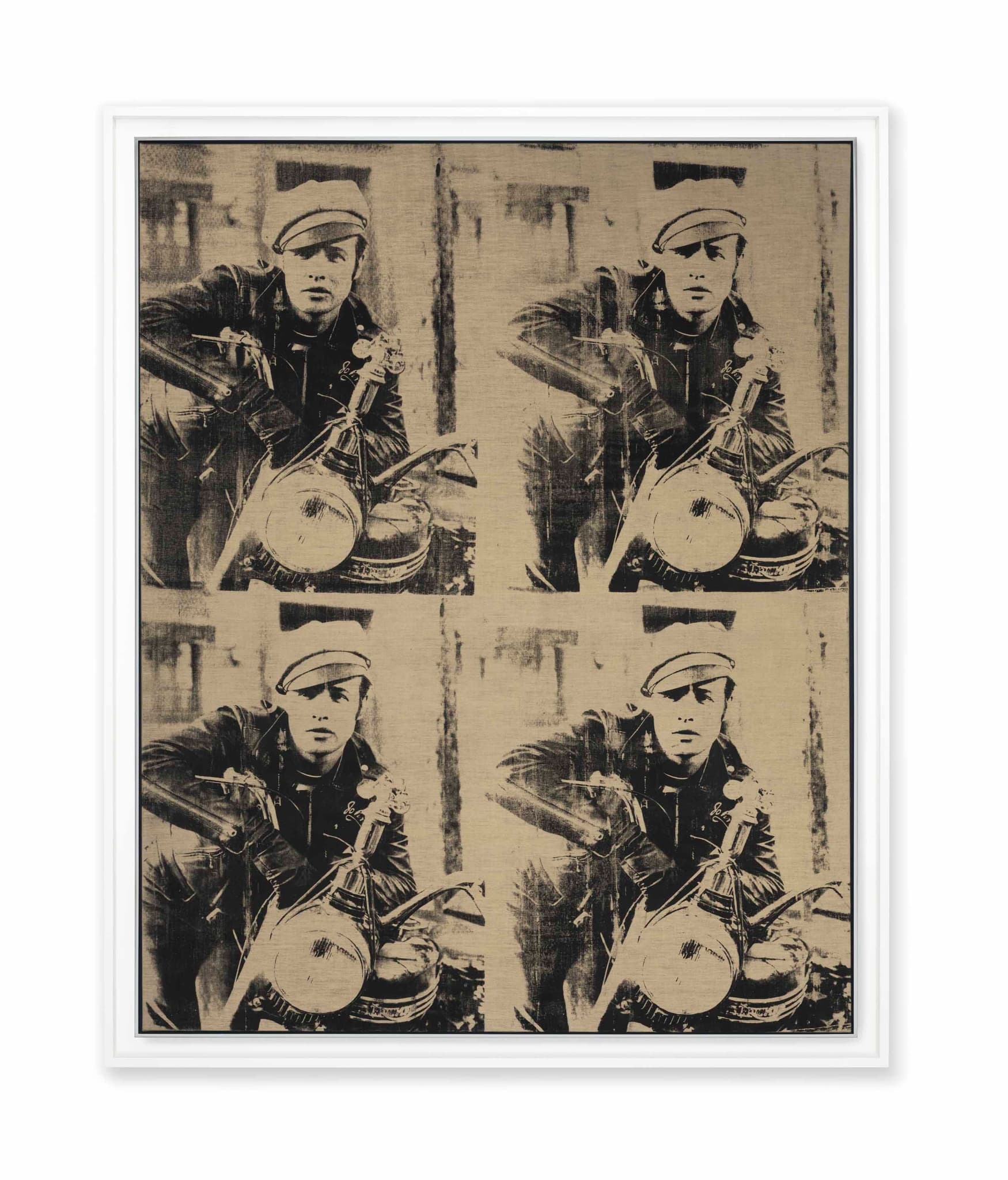
Four Marlons
Andy Warhol, 1966 • Silkscreen ink on unprimed (raw) linen
Read full analysis of Four Marlons →Valuation Analysis
Conclusion. Our current fair‑market value (auction, premium‑inclusive) for Andy Warhol’s Four Marlons (1966) is $90–110 million. The work’s most recent public benchmark is the Christie’s New York sale on 12 November 2014, where it realized $69,605,000 with fees [1]. A simple CPI translation brings that figure into roughly the low‑to‑mid $90 million context in 2025–2026 dollars, before considering art‑market dynamics and the work’s qualitative strengths [5]. Given sustained global demand for prime 1960s Warhol “trophies,” a range modestly above the inflation‑adjusted anchor is defensible.
Closest comparables. The tightest analog is Warhol’s Triple Elvis [Ferus Type], another large, multi‑image male celebrity portrait sold in the very same 2014 Christie’s evening sale for $81,925,000 (fees incl.) [6]. In terms of subject, repetition, scale, and market profile, Four Marlons is directly comparable; its raw, unprimed linen support and relative rarity among major Brando multiples justify parity to a slight premium in today’s conditions.
Recent trophy calibration. At the top end, Warhol’s category ceiling was reset by Shot Sage Blue Marilyn at $195,000,000 in 2022 [3]. While Marilyns command a singular premium, White Disaster (White Car Crash 19 Times) reached $85,350,500 later that year, demonstrating active competition for A++ 1960s canvases in the high‑$80m to low‑$90m band [4]. These prices bracket Four Marlons as a top‑tier (if non‑Marilyn) icon with credible headroom above its inflation‑adjusted 2014 benchmark.
Qualitative drivers. Four Marlons combines nearly all attributes prized by the market: a prime‑period, large‑scale canvas; an A‑list Hollywood subject (Brando in The Wild One); serial repetition; and the sought‑after raw‑linen execution of the mid‑1960s. Its pedigree is elite—passing through Bischofberger, Sperone, and Thomas Ammann—and it has an extensive exhibition record, including the 2001–02 Warhol retrospective circuit (Neue Nationalgalerie/Tate/MOCA LA) [2]. These factors support positioning alongside the best non‑Marilyn celebrity icons.
Market context and risk. After a 2023–24 slowdown at the very high end, bidding has been selective but decisive for singular, high‑quality Pop trophies; a strong 1964 Flowers reached $35.5m in 2024, underscoring continued appetite for prime‑period imagery [7]. For Four Marlons, estimate placement, third‑party guarantee competition, and sale choreography could pull the result toward the midpoint or top of the range. Downside risks include adverse macro sentiment or same‑season supply of an equivalently important 1960s celebrity or Disaster canvas.
Mechanics and next steps. The indicated price band implies a hammer of roughly $80–95m under current premium schedules. A current condition report with high‑resolution imaging and confirmation of conservation history, together with real‑time guidance from the major houses on estimate strategy and guarantee interest, would refine this band further [1][2].
Key Valuation Factors
Art Historical Significance
High ImpactFour Marlons sits squarely in Warhol’s defining project of serial celebrity imagery, translating cinema’s myth-making into the cool, mechanical language of silkscreen. The 1966 date keeps it within his most sought-after, conceptually cohesive decade, while the repeated Brando motif parallels Warhol’s acclaimed Elvis cycle in its meditation on masculinity, fame, and image reproduction. The composition’s stark graphic punch, coupled with Warhol’s appropriation of a canonical film still from The Wild One, positions the work in the top decile of recognizability. As museums and scholars continue to reassess Warhol’s 1960s production, such prime-period, serial portraits remain foundational to his legacy—and to long-term demand.
Rarity, Scale, and Execution
High ImpactLarge, multi-image Marlon canvases are markedly scarcer than many of Warhol’s other celebrity variants. At roughly 81 x 65 inches, Four Marlons offers near-seven-foot presence—the kind of wall power trophy buyers require for marquee spaces. The unprimed/raw linen support, a prized mid-1960s feature, amplifies the image’s immediacy and material allure; collectors consistently ascribe a premium to this execution because it reads as both raw and iconic. Combined with the high-impact fourfold repetition, the work checks scale and rarity boxes that lift it above smaller or single-image Marlons and close the gap to the most coveted serial icons in Warhol’s oeuvre.
Provenance and Exhibition History
High ImpactThe painting’s passage through top-tier dealers—Bruno Bischofberger, Gian Enzo Sperone, and Thomas Ammann—confers impeccable provenance. Its decades-long institutional visibility via WestSpiel’s display and its inclusion in major museum shows, notably the 2001–02 international Warhol retrospective circuit (Neue Nationalgalerie, Tate Modern, MOCA Los Angeles), provide curatorial validation that reduces perceived risk and supports aggressive bidding. Works with such pedigrees are easier to place with leading collectors and institutions, and they tend to perform above median estimates when fresh to the broader market. This exhibition and ownership history is an important price-supportive attribute for Four Marlons.
Market Liquidity and Demand Depth
Medium ImpactWarhol’s market is among the deepest and most global in postwar art, with robust private-sale infrastructure and high auction liquidity across price bands. That said, the trophy tier has been more selective since 2023, with buyers favoring best-in-class, fresh-to-market examples. Recent results—Marilyn at $195m (2022) and White Disaster at $85.35m (2022)—confirm the capacity for very high prices when quality, subject, and scale align. Four Marlons benefits from those attributes, but macro volatility and same-season supply of equally significant 1960s paintings could trim competition. Net, depth is strong, but execution and sale strategy will determine whether the result lands at, or above, midpoint.
Sale History
Christie's New York, Post-War and Contemporary Art Evening Sale
Andy Warhol's Market
Andy Warhol remains a cornerstone of the global blue‑chip market, with unmatched breadth across paintings, works on paper, prints, and photographs. His auction record—Shot Sage Blue Marilyn at $195 million in 2022—reaffirmed the ceiling for postwar icons, while a steady cadence of mid‑tier and print results demonstrates persistent liquidity. Prime 1962–66 paintings tied to celebrity and Death & Disaster themes continue to command the most intense competition and institutional interest. The market is sophisticated and data‑rich, with leading houses ready to structure guarantees for A‑level material. While overall conditions cooled in 2023–24, best‑in‑class Warhols have remained resilient, especially when fresh, well‑publicized, and supported by top-tier provenance and exhibitions.
Comparable Sales
Triple Elvis [Ferus Type]
Andy Warhol
Same artist; prime 1960s; serial male celebrity portrait in large near-7ft format—closest in subject, scale, and 'trophy' profile to Four Marlons; sold in the same 2014 evening sale.
$81.9M
2014, Christie's New York
~$110.1M adjusted
White Disaster (White Car Crash 19 Times)
Andy Warhol
Prime 1963 Death & Disaster series at monumental scale; top-tier 1960s Warhol trophy establishing recent market depth near the $85m level.
$85.4M
2022, Sotheby's New York
~$92.8M adjusted
Silver Car Crash (Double Disaster)
Andy Warhol
Iconic 1963 Death & Disaster diptych at monumental scale; long a benchmark for Warhol’s top end—useful upper-bound trophy comparison.
$105.4M
2013, Sotheby's New York
~$143.9M adjusted
Nine Marilyns
Andy Warhol
Prime 1962 multi-image celebrity portrait; smaller scale than Four Marlons but strong indicator for multi-image 1960s icons.
$47.4M
2021, Sotheby's New York
~$55.6M adjusted
Elvis 2 Times
Andy Warhol
Prime 1963 male celebrity portrait with serial repetition; smaller and less ambitious than Four Marlons but subject-matter adjacency to Brando/Elvis cluster.
$37.0M
2021, Sotheby's New York
~$43.4M adjusted
Shot Sage Blue Marilyn
Andy Warhol
Record-setting 1964 Marilyn—ultimate benchmark for prime 1960s celebrity iconography; sets the ceiling for Warhol trophies.
$195.0M
2022, Christie's New York
~$212.0M adjusted
Current Market Trends
High-end auction sales contracted in 2023–24, pushing more blue‑chip transactions into private channels and making trophy‑level bidding more selective. By late‑2025, marquee appetite showed signs of recovery, though buyers remain price‑disciplined and focused on irreproachable quality. Within Pop Art, prime 1960s works by Warhol still lead, while prints and mid‑tier pieces provide steady liquidity. Estimate discipline, third‑party guarantees, and carefully timed consignments are increasingly decisive. Against this backdrop, a major, fresh‑to‑market Warhol from the 1960s can still attract global competition, but achieving top-of-range outcomes hinges on market staging, condition assurance, and freedom from competing supply in the same season.
Study print
Study this painting as a print
Pair the full artwork with a museum-style study sheet focused on one meaningful detail.
Sources
- Christie's Results: Post-War and Contemporary Art Evening Sale (Nov 12, 2014)
- Christie's Lot Page: Andy Warhol, Four Marlons (1966)
- Christie's Press: Warhol’s Marilyn sells for $195 million (May 9, 2022)
- Sotheby’s Lot Page: White Disaster (White Car Crash 19 Times) (Nov 16, 2022)
- Minneapolis Fed CPI Inflation Calculator
- Los Angeles Times: Warhol’s 'Triple Elvis' and 'Four Marlons' sell at Christie’s (Nov 13, 2014)
- Christie’s Press: 20th Century Evening Sale totals $413.3m (May 16, 2024)