How Much Is Houses of Parliament Worth?
Last updated: January 13, 2026
Quick Facts
- Current Location
- National Gallery of Art, Washington
- Methodology
- comparable analysis
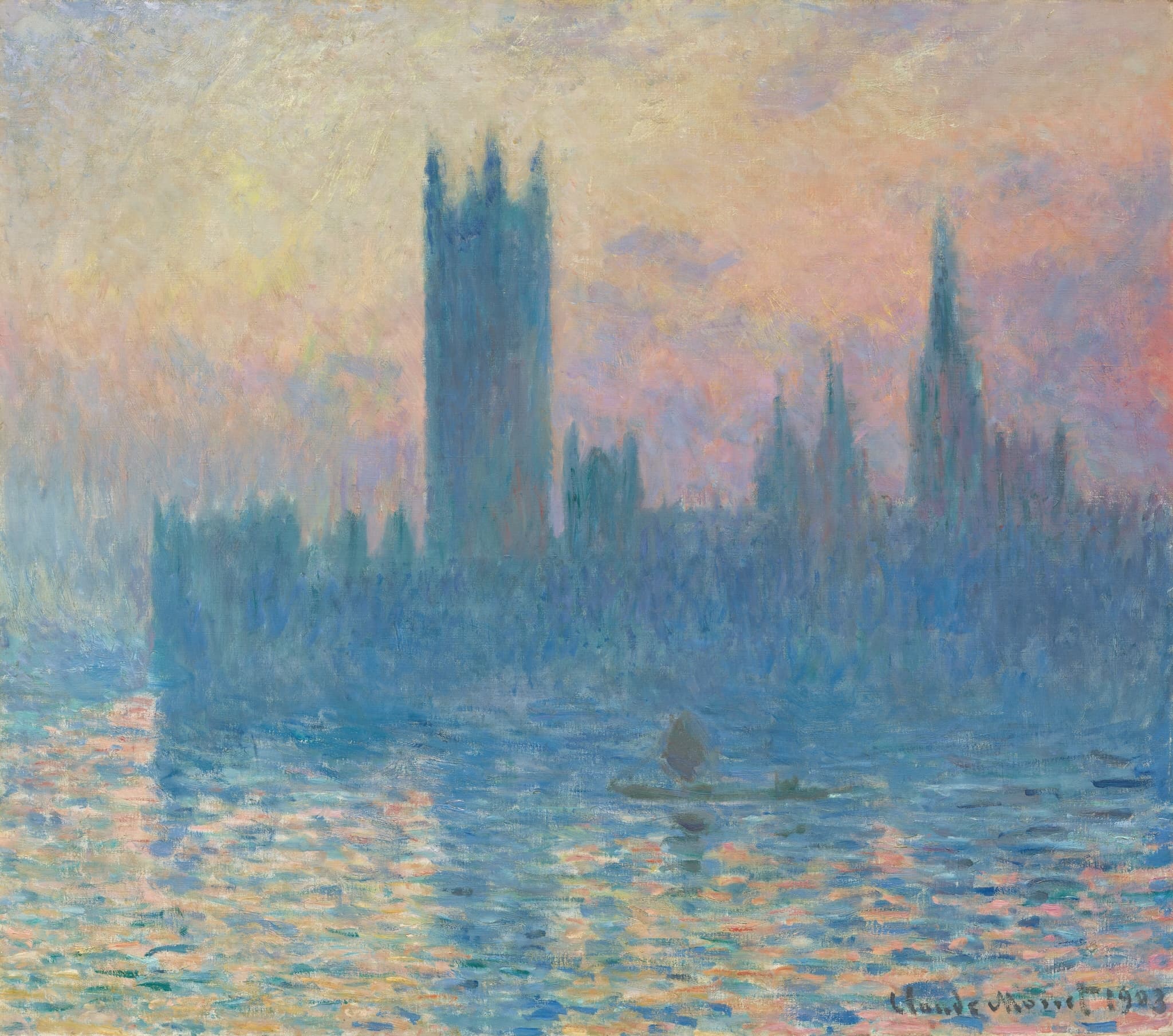
Based on recent, closely comparable sales from Monet’s London series, a prime Houses of Parliament would command approximately $60–100 million today. The NGA’s 1903 sunset variant—if hypothetically available—would likely trade toward the upper half of that range given its palette, series importance, and institutional-grade provenance.
Valuation Analysis
Conclusion: A prudent current market value for Claude Monet’s The Houses of Parliament, Sunset (1903) is $60–100 million, with upside contingent on condition and variant quality. This range is anchored by a marquee, directly comparable sale: Le Parlement, soleil couchant from the same series achieved $75.96 million at Christie’s New York in May 2022, establishing a recent high-water mark for the motif [1]. Given the NGA work’s status as a vivid sunset variant within Monet’s celebrated London cycle and its museum-caliber provenance, it would be expected to perform toward the upper half of this band if hypothetically offered.
Comparable sales and series positioning: Monet’s Houses of Parliament canvases (1900–1904) are among the most coveted of his late serial projects. The 2022 Anne H. Bass example provides the clearest valuation anchor at $75.96 million (hammer $66 million), reflecting robust trophy-level demand for prime coloristic variants in this motif [1]. Adjacent London-series benchmarks corroborate depth at the high end: Waterloo Bridge, effet de brouillard realized $48.45 million at Christie’s New York in 2021, reinforcing consistent appetite for the Vues de Londres as a whole [4]. The NGA painting—documented as a 1903 sunset canvas with distinguished ownership and scholarship—sits squarely within the most commercial subset of the series [3].
Artist market context: Monet remains a blue-chip bellwether with broad global demand. The artist’s record stands at $110.7 million for Meules (2019), underscoring the market’s capacity for exceptional masterpieces [2]. Recent marquee Monet results (notably multiple Water Lilies prices in the $60–75 million range since 2023) indicate sustained top-tier demand for best-in-class works. Against this backdrop, a prime Parliament canvas—rarer in private hands than lilies—justifies a valuation corridor that brackets the 2022 Parliament price and anticipates competitive bidding for an A-quality variant.
Market conditions and risk factors: After a contraction in 2023–24 driven by a scarcity of billion-dollar-level consignments, the high end has stabilized and selectively rebounded, with buyers exhibiting a flight to quality across Modern and Impressionist categories [5]. In this climate, price formation hinges on object quality, freshness, and auction structuring. Assuming excellent condition, intact original surface and impasto, and first-rate publication/exhibition history, the NGA canvas would be positioned to clear near the upper half of $60–100 million; any condition compromises or a cooler, less saturated palette would bias outcomes toward the midpoint.
Why the NGA example trends high within the range: The work is a sunset variant—historically the most commercially potent subgroup—of ideal date and scale for the series, and it carries institutional provenance (Chester Dale; National Gallery of Art), which enhances buyer confidence [3]. These attributes, paired with the 2022 Parliament benchmark and strong adjacent London-series results, support today’s $60–100 million indication for a hypothetical sale.
Key Valuation Factors
Art Historical Significance
High ImpactHouses of Parliament belongs to Monet’s defining London cycle (c. 1900–1904), a cornerstone of his mature serial practice alongside Haystacks, Rouen Cathedral, and Water Lilies. These works distill Monet’s late preoccupations with atmosphere, light, and chromatic vibration, translating London’s fog and sunset effects into some of his most poetic vistas. Within the canon, the Parliament motif is both critically esteemed and broadly recognizable—often featured in museum narratives and survey exhibitions. This dual status (scholarly importance plus cultural visibility) drives durable collector demand and underpins pricing power. As a sunset variant from 1903 with strong institutional provenance, the NGA canvas sits in the series’ most desirable tranche, elevating its standing and value potential.
Variant and Aesthetic Quality
High ImpactVariant matters acutely for this series: saturated “sunset” and luminous “sun-in-fog” effects tend to outperform cooler, more tonally restrained views. Works with pronounced chromatic drama, crisp silhouette of the Palace, and scintillant reflections command premiums. The NGA painting is a sunset canvas of ideal size (c. 81 × 92 cm), aligning with top-performing comparables. In recent seasons, the strongest Parliament result—$75.96 million in 2022—was a closely related sunset variant, demonstrating market preference for high-color, evening atmospherics. Assuming the NGA example retains excellent color freshness, intact surface, and strong light effects, its aesthetic profile supports pricing in the upper half of today’s $60–100 million range.
Provenance and Scholarly Visibility
High ImpactThe NGA canvas descends from the Chester Dale Collection and entered the National Gallery of Art by bequest—provenance that signals rigor, enhances buyer confidence, and typically attracts institutional and top private competition. The museum’s object record documents its variant, dating, ownership, and exhibition history, adding transparency that is crucial at this price level. Works with deep literature and exhibition footprints are preferred by connoisseurs and can justify premiums, especially when tied to leading U.S. institutions. If accompanied by a strong conservation report and a substantive publication record, the painting’s provenance and scholarship would be expected to draw robust interest and support a valuation toward the upper end of the indicated range.
Market Liquidity and Scarcity
High ImpactDirectly comparable Houses of Parliament canvases are scarce in private hands, with many held by major museums. Scarcity has historically supported strong outcomes when prime examples appear. The 2022 Anne H. Bass Parliament at $75.96 million recalibrated expectations for the motif, while related London-series Waterloo Bridges at $48.45 million (2021) validated broader demand. Monet’s market is deep and global, anchored by an artist record of $110.7 million that sets ceiling expectations for masterworks. Although macro cycles affect risk appetite, top-tier Impressionist trophies continue to clear with competition when guarantees and presentation are well-structured. This liquidity profile justifies a $60–100 million band for a top Parliament, with tight bid density around the $75–90 million zone.
Sale History
Houses of Parliament has never been sold at public auction. It has been held by National Gallery of Art, Washington.
Claude Monet's Market
Claude Monet is among the most liquid blue-chip artists, with sustained global demand across North America, Europe, and Asia. His auction record stands at $110.7 million for Meules (2019), a landmark for Impressionism. Since 2023, multiple Water Lilies canvases have realized between roughly $60 million and $75 million, confirming persistent appetite for best-in-class works. The market prizes Monet’s great series—Haystacks, Rouen Cathedral, Water Lilies, and the London views (Houses of Parliament, Waterloo Bridge, Charing Cross Bridge). Series hierarchy matters: high-color, museum-grade variants with pristine condition and strong provenance command the most aggressive bidding. Supply of top-tier examples remains thin, so when masterpieces surface, competition is robust and outcomes are often at or above estimate.
Comparable Sales
Le Parlement, soleil couchant
Claude Monet
Same artist and exact series (Houses of Parliament), 'sunset' variant of near-identical size and date; most recent marquee auction benchmark for the motif.
$76.0M
2022, Christie's New York
~$84.1M adjusted
Le Parlement, soleil couchant
Claude Monet
Same artist and series, 'sunset' variant from 1900–01, very similar dimensions and significance; provides a mid‑2010s price anchor for the motif.
$40.5M
2015, Christie's New York
~$55.3M adjusted
London, the Parliament, Effects of Sun in the Fog
Claude Monet
Same artist and Houses of Parliament motif from 1904; comparable size and period, different atmospheric effect ('fog') illustrating series pricing in the early 2000s.
$20.1M
2004, Christie's New York
~$34.5M adjusted
Waterloo Bridge, effet de brouillard
Claude Monet
Closely related Vues de Londres series painted in the same period; similar scale and market status; useful adjacent benchmark when Parliament canvases are scarce.
$48.5M
2021, Christie's New York
~$57.9M adjusted
Waterloo Bridge, effet de brume
Claude Monet
Another London-series canvas (c. 1900–04), comparable in size and prestige; confirms depth of demand for Monet’s London views adjacent to the Parliament motif.
$36.8M
2022, Christie's London
~$40.7M adjusted
Current Market Trends
The high end of the Modern and Impressionist market contracted in 2023–24 due to a shortage of trophy consignments, but activity stabilized and selectively rebounded in 2025 as buyers pursued quality and houses leaned on guarantees and curated evening sales. Within this environment, established blue-chip names outperformed, with Monet remaining a preferred store of value for cross-border collectors. Price formation is increasingly sensitive to object quality and freshness: A-grade, well-provenanced works clear strongly, while mid-tier material faces more discipline. For Monet’s London series, recent benchmarks and institutional scarcity support resilient pricing, with top examples attracting global competition in New York and London.
Study print
Study this painting as a print
Pair the full artwork with a museum-style study sheet focused on one meaningful detail.
Sources
- Christie’s New York (Anne H. Bass Collection) – Monet, Le Parlement, soleil couchant sells for $75.96m (report)
- Sotheby’s – Monet’s Meules sells for $110.7m (2019 artist record)
- National Gallery of Art – The Houses of Parliament, Sunset (1903) object record
- Christie’s – 20th Century Evening Sale (May 2021) results featuring Monet’s Waterloo Bridge
- Art Basel & UBS – The Art Market Report (2024/2025): auction trends and high-end dynamics