How Much Is Poppies Worth?
Last updated: January 14, 2026
Quick Facts
- Current Location
- Musée d’Orsay, Paris
- Methodology
- comparable analysis
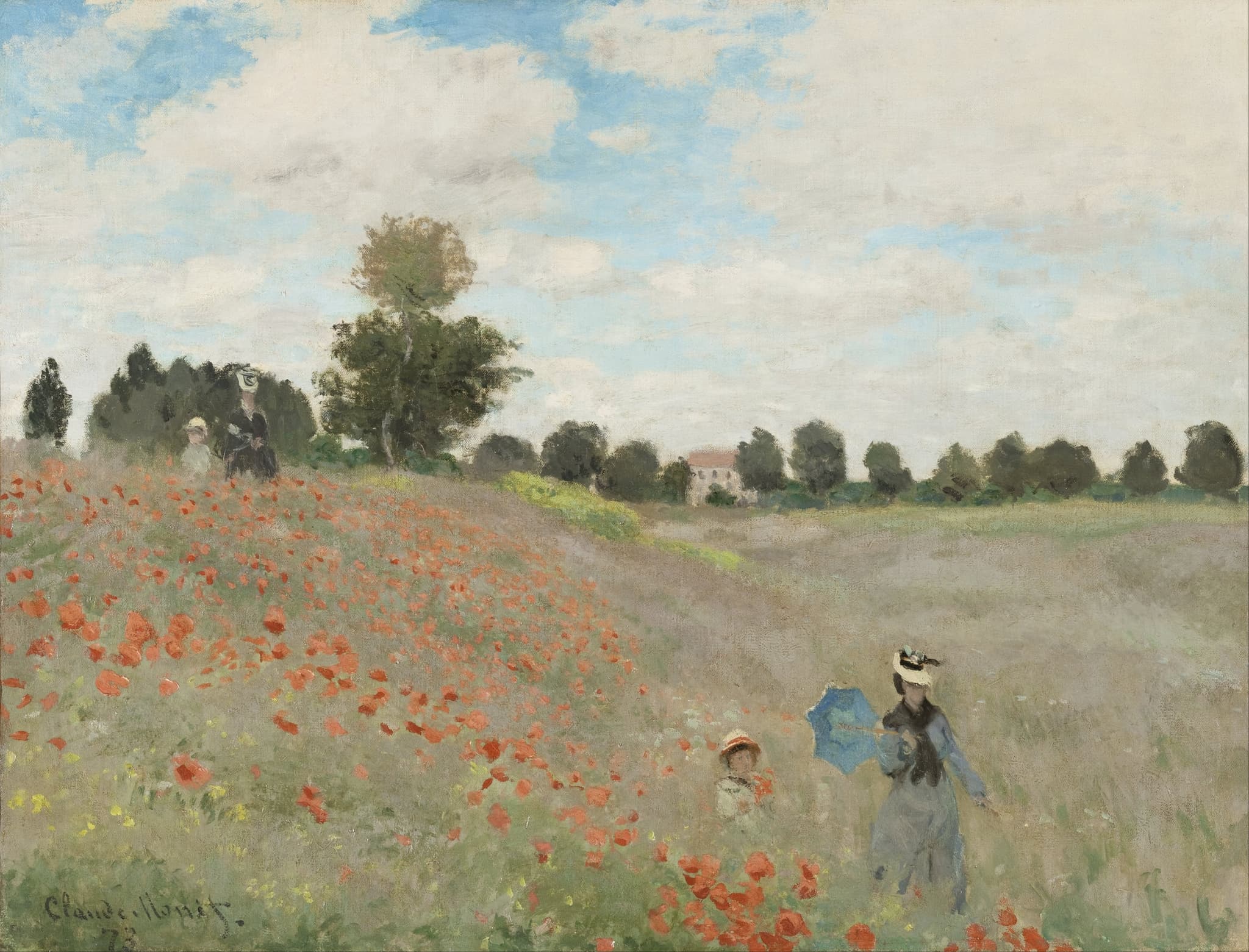
Claude Monet’s Poppies (1873) is a canonical Argenteuil-period masterpiece, exhibited in the first Impressionist exhibition and now in the inalienable French national collection. Benchmarking against Monet’s top auction results—record Haystacks at $110.7m (2019) and recent $65–76m Water Lilies and Parliament works—supports a hypothetical fair-market value of $100–140 million if it were deaccessionable and brought to market.
Valuation Analysis
Work and status. Claude Monet’s Poppies (Les Coquelicots, 1873) is among the most recognizable images of early Impressionism, painted during the Argenteuil years and shown in the inaugural Impressionist exhibition of 1874. It resides in the French national collection at the Musée d’Orsay and is inalienable by law, so it does not trade on the open market [1][6].
Method and comps. The valuation derives from a comparable-sales framework anchored to Monet’s top-tier auction benchmarks. Monet’s standing auction record is Meules (Haystacks) at $110.7 million (Sotheby’s New York, 2019) [2]. Recent blue-chip results reaffirm deep demand for prime Monet series: a late Water Lilies at $74.01 million (Christie’s, Nov 2023) [3]; another Nymphéas at $65.5 million (Sotheby’s, Nov 2024) [4]; and a Houses of Parliament canvas at $75.96 million (Christie’s, May 2022) [5]. In 2025, a Poplars realized $42.96 million (Christie’s, May) [7]. These anchor current liquidity and pricing bands for masterpiece-grade Monets.
Positioning Poppies. Poppies is an early, emblematic statement of the Impressionist project, with extraordinary image recognition and a first-rank exhibition history (1874). While its format (c. 50 × 65 cm) is modest compared with the largest late Nymphéas, its art-historical weight and cultural ubiquity elevate it into the artist’s trophy echelon. Within Monet’s oeuvre, it sits beside other brand-defining icons (e.g., Impression, Sunrise) as a touchstone for the movement’s birth—an attribute that historically commands premiums at auction when works of similar renown appear.
Value conclusion. Calibrating against the $65–76 million band for recent top Monets and the $110.7 million record, and applying an iconography premium for this work’s foundational role in early Impressionism, we conclude a hypothetical fair‑market value of $100–140 million today. The lower bound reflects recent market clearing levels for trophy Monets; the upper bound recognizes that Poppies’ canonical status could plausibly approach the Haystacks record if presented with optimal marketing, guarantees, and competition.
Key caveat. As the painting is part of the French national collection and inalienable, this figure is an explicit market counterfactual: an estimate of what the work would bring under normal auction conditions were a sale legally and practically possible. The estimate assumes sound condition consistent with long-term museum care; material conservation concerns would adjust pricing accordingly [1][6].
Key Valuation Factors
Art Historical Significance
High ImpactPainted in 1873 and exhibited in the first Impressionist exhibition of 1874, Poppies epitomizes Monet’s Argenteuil period and the emergence of Impressionism. The work’s luminous palette, broken brushwork, and modern subject situate it at the movement’s inception, alongside Impression, Sunrise. As one of Monet’s most widely reproduced images, it operates as a cultural shorthand for early Impressionism—conferring a status that collectors prize and institutions canonize. Works that define a movement’s identity consistently command premiums because they are not merely excellent examples; they are the examples through which a broad public understands the artist’s historical contribution.
Provenance and Exhibition History
High ImpactPoppies passed through the hands of leading figures in Monet’s market—Durand‑Ruel, Jean‑Baptiste Faure—and was acquired by Étienne Moreau‑Nélaton before his 1906 gift to the French State. That chain is unimpeachable and institutionally anchored. Exhibition history includes the landmark 1874 Impressionist show and extensive literature references, enhancing scholarly and cultural weight. This deep, clean provenance reduces transactional risk and supports a scarcity premium because collectors and museums can bid assertively when pedigree is both historic and public. Works with comparable depth of documentation and display history often outperform less-published peers at the top of the market.
Market Comparables and Liquidity
High ImpactMonet’s market is among the broadest and deepest for any pre‑war artist. Record pricing of $110.7m for a Haystacks in 2019, plus repeated $65–76m results for masterpiece series (Water Lilies, Parliament) since 2022–2024, demonstrate active, global demand at the highest tier. A 2025 Poplars at $42.96m further confirms strong, estimate‑sensitive liquidity across core series. Against this backdrop, Poppies, as an early icon, logically prices above the recent Water Lilies/Parliament band and can approach the record when competition and guarantee structures align—supporting a $100–140m range in today’s market.
Scarcity and Non‑market Status
High ImpactThe painting resides in the inalienable French national collection (Musée d’Orsay). Its non‑market status intensifies scarcity: collectors cannot acquire this precise image, and close substitutes of comparable fame are exceptionally rare. When museum‑level icons do emerge (or when a hypothetical deaccession is imagined), bidders pay a premium for the opportunity—particularly for works that are foundational to an artist’s narrative. This scarcity premium is a key driver elevating Poppies into a range that overlaps Monet’s record pricing, even though the broader Impressionist category has seen fewer $100m‑plus transactions in recent seasons.
Scale and Condition Considerations
Medium ImpactAt approximately 50 × 65 cm, Poppies is materially smaller than the largest late Nymphéas—an attribute that can moderate price relative to monumental canvases prized for architectural impact. However, its intimate scale is typical of the Argenteuil period and does not diminish its iconic status. While detailed condition data are not public, a museum‑held picture of this stature is presumed to be well conserved; any significant structural or cosmetic issues would lower value tolerance at the top end. The stated range assumes sound condition under museum care; a pristine surface would support the upper band.
Sale History
Poppies has never been sold at public auction. It has been held by Musée d’Orsay, Paris.
Claude Monet's Market
Claude Monet is an ultra blue‑chip cornerstone of the Impressionist market with global depth across categories. His standing auction record is $110.7 million for Meules (Sotheby’s, 2019). Since 2022, top Monets have consistently realized between roughly $42 million and $76 million—led by major Water Lilies, London, and Poplars series canvases—demonstrating resilient appetite at the high end even as estimates have been managed with guarantees and irrevocable bids. Asian and transatlantic participation remains visible. Supply, not demand, is the primary constraint: museum‑quality Monets are scarce, and when they appear with disciplined estimates, competition is strong and outcomes are headline‑driving.
Current Market Trends
Impressionist and Post‑Impressionist auction value contracted in 2023–2024 as trophy supply thinned and houses leaned on guarantees, but 2025 saw a rebound in overall totals and steady absorption of masterpiece‑grade works. Buyers remain highly selective and estimate‑sensitive: blue‑chip, series‑defining Monets continue to command the strongest bidding, while secondary subjects or works with condition issues face resistance. Recent results in the $65–76m band for top Monets confirm healthy liquidity at the apex. Against this backdrop, an early, canonical icon such as Poppies would attract deep, global competition and price at or near the artist’s record range if ever offered.
Study print
Study this painting as a print
Pair the full artwork with a museum-style study sheet focused on one meaningful detail.
Sources
- Musée d’Orsay – Coquelicots (Poppies), 1873
- Sotheby’s – Monet’s Meules achieves $110.7m (artist record), May 2019
- Christie’s – 20th Century Evening Sale results (includes Le bassin aux nymphéas at $74.01m), Nov 2023
- Sotheby’s – Fall 2024 marquee results (includes Nymphéas at $65.5m)
- Salon Privé – Christie’s Spring Marquee Week results (includes Houses of Parliament at $75.96m), May 2022
- Legifrance – Code du patrimoine, L451-5 (inalienability of national collections)
- Christie’s – May 12, 2025 20th Century Evening Sale results (includes Poplars at $42.96m)