How Much Is The Japanese Footbridge Worth?
Last updated: January 13, 2026
Quick Facts
- Current Location
- National Gallery of Art, Washington, DC
- Methodology
- comparable analysis
Based on recent sales of top-tier Monets and subject-specific comparables, the hypothetical open‑market value of Claude Monet’s The Japanese Footbridge (1899, National Gallery of Art) is $70–110 million. The range is anchored by late Giverny Water-Lilies masterworks at $65.5–74.0 million and the Japanese Bridge motif’s historic auction benchmark (inflation-adjusted c.$66 million), with the upper bound informed by Monet’s $110.7 million record.
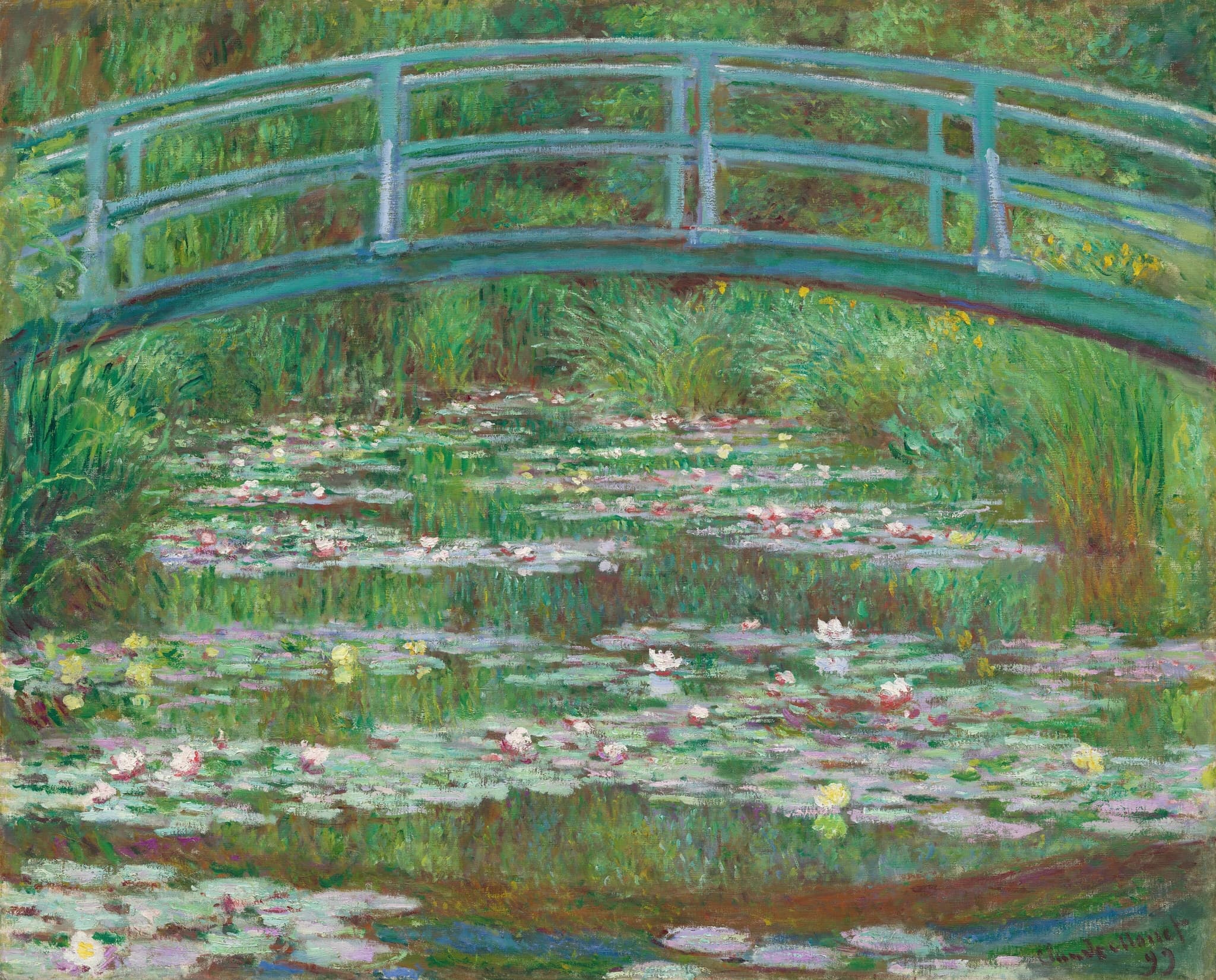
The Japanese Footbridge
Claude Monet, 1899 • Oil on canvas
Read full analysis of The Japanese Footbridge →Valuation Analysis
Conclusion: The Japanese Footbridge (1899) is a prime, canonical Monet from the seminal Giverny garden series. Weighting subject-specific comps, late Giverny benchmarks, and Monet’s record, a confident hypothetical open‑market valuation is $70–110 million. The painting inaugurates one of Monet’s most recognized motifs and is held by the National Gallery of Art, underscoring its art-historical status and institutional validation [1].
Anchor comparables: Recent late Giverny Water-Lilies masterworks—the closest active-market proxies for top Monet garden pictures—realized $74,010,000 at Christie’s New York (Nov 2023) and $65,500,000 at Sotheby’s New York (Nov 2024) [3][4]. These results bracket current trophy-level demand for large, museum-grade late Monets. Given the 1899 bridge canvases’ centrality to the garden project, their importance is commensurate with the high-performing lily ponds. Accordingly, they anchor the lower-to-mid band of this estimate.
Subject-specific evidence: The Japanese Bridge motif has a strong auction precedent: a closely related composition from 1900 made £19.8 million (≈$33 million) at Sotheby’s London in 1998—roughly mid‑$60 millions in today’s dollars—demonstrating deep, long‑standing demand for the bridge images [5]. The NGA canvas, from 1899 and among the earliest, most structured treatments, merits a premium over later, looser iterations. This comp reinforces the lower bound and supports a step-up into the $70m+ zone for a top example.
Ceiling and competitive dynamics: Monet’s all-time auction record—$110,747,000 for Meules (Haystacks) in 2019—defines the series-defining ceiling under peak competition [2]. While Haystacks remain the apex series, the 1899 bridge is an iconic, widely reproduced image that can attract similarly global bidding. In a tightly curated evening sale with robust third‑party support, the best 1899 bridge picture could challenge the low nine figures, justifying the upper bound of $110 million.
Other value drivers: The NGA example’s scale (approximately 32 × 40 inches), blue-chip provenance through Durand‑Ruel, and sustained scholarly/exhibition visibility strengthen market confidence [1]. Museum stewardship implies careful conservation and stability in presentation, both supportive of value perception. In today’s selective but resilient high end, buyers prioritize series-defining subjects with clear provenance and strong coloristic impact; the Japanese Footbridge ticks these boxes. Taken together, these factors, plus active demand across US, Europe, and Asia, position this work squarely within the $70–110 million range.
Key Valuation Factors
Art Historical Significance
High ImpactPainted in 1899 at Giverny, The Japanese Footbridge marks a pivotal point in Monet’s practice, inaugurating the suite of bridge and water‑lily views that culminate in the Grandes Décorations. This image is among the most reproduced and taught in the artist’s oeuvre, signaling a consensus of importance that typically commands a premium. The work’s date places it at the beginning of the bridge motif—before the looser, later treatments—when compositional structure, chromatic clarity, and motif legibility are at their strongest. Its canonical standing ensures deep cross‑category trophy demand from buyers who prize both aesthetic impact and art‑historical weight, a combination that supports sustained nine‑figure interest for prime examples.
Subject Rarity and Iconicity
High ImpactMonet’s Japanese bridge is one of the artist’s most iconic subjects, on par with Haystacks, Rouen Cathedral, and the Water‑Lilies. While multiple versions exist, high‑quality 1899 iterations are scarce in private hands. The motif’s instantly recognizable silhouette, luminous greens, and serene compositional balance make it a perennial “entry point” for global collectors seeking a definitive Monet. Historical scarcity of top-tier bridge pictures at auction amplifies competition when one surfaces, and the motif’s broad appeal across regions (US, Europe, and increasingly Asia) further deepens the bidder pool. This subject premium is a principal reason the valuation clears the mid‑$60m benchmark and supports a $70–110m range.
Provenance, Publication, and Exhibition
High ImpactThe NGA picture traces to Durand‑Ruel and has long institutional ownership, culminating in a gift to a leading US museum. Such provenance reduces attribution and condition uncertainties while maximizing scholarly validation, catalogue inclusion, and public visibility. High‑profile museum stewardship elevates the work’s cultural cachet and signals quality to the market. For trophy buyers—particularly those reliant on advisors and lenders—this combination of clean provenance and publication history is a material value enhancer. In practical terms, this factor both lifts the midpoint of the estimate and narrows downside risk because it assures prospective bidders that the work has been thoroughly vetted, exhibited, and maintained to high standards.
Market Liquidity for Top Monet
High ImpactMonet remains one of the most liquid blue‑chip markets, with late Giverny masterworks consistently achieving eight and nine figures. Recent sales of major Water‑Lilies at $65.5–74.0 million demonstrate durable depth for prime subjects, even amid a more selective, guarantee‑driven market. Monet’s global buyer base includes US and European museums and private collections, alongside robust Asian demand fostered by marquee Hong Kong offerings. This breadth of capital supports competitive bidding when a series‑defining Monet is available. The Japanese bridge, as an emblematic theme, naturally benefits from this liquidity, underpinning a confident $70–110 million valuation and providing credible upside under strong season dynamics.
Sale History
The Japanese Footbridge has never been sold at public auction. It has been held by National Gallery of Art, Washington, DC.
Claude Monet's Market
Claude Monet is a cornerstone of the blue‑chip Impressionist market, with sustained global demand and deep institutional validation. His auction record stands at $110.7 million for Meules (Haystacks) in 2019, a benchmark that frames the ceiling for his most coveted series under peak competition. In the current cycle, late Giverny masterworks continue to perform strongly, with major Water‑Lilies achieving $74.0 million (Christie’s, 2023) and $65.5 million (Sotheby’s, 2024). Liquidity is broad-based across regions, with notable activity in Asia, and pricing is highly subject‑specific: iconic series (Water‑Lilies, Japanese Bridge, Rouen Cathedral, London/Parliament) command outsized premiums. Quality, scale, color, and provenance are decisive determinants of outcomes.
Comparable Sales
Japanese Bridge (Water-Lily Pond and Path by Water), 1900
Claude Monet
Closest subject-matter comp: same artist and motif (Japanese bridge at Giverny) painted one year after the NGA 1899 canvas; similar size and composition from the seminal 1899–1900 bridge set.
$33.0M
1998, Sotheby's London
~$66.0M adjusted
Le Pont japonais, 1918–24
Claude Monet
Same motif (Japanese bridge) by the same artist; later, looser post-1918 treatment—useful for subject but discounted for period/quality relative to 1899.
$15.8M
2014, Sotheby's New York
~$21.8M adjusted
Le bassin aux nymphéas (c. 1917–19, 100 × 200.6 cm)
Claude Monet
Same artist; late Giverny water-lily pond at monumental scale—core trophy subject that defines peak demand for late Monet and brackets top-tier pricing for the garden series.
$74.0M
2023, Christie's New York
~$79.1M adjusted
Nymphéas (1914–17)
Claude Monet
Same artist; late Giverny lilies of strong quality and market appeal; though not the bridge, it’s a prime late subject that anchors current Monet pricing.
$65.5M
2024, Sotheby's New York
~$67.1M adjusted
Le Bassin aux nymphéas (large format)
Claude Monet
Same artist; large, museum-grade lily pond. Serves as a contemporary benchmark for top late Monets in prime condition.
$70.4M
2021, Sotheby's New York
~$84.6M adjusted
Meules (Haystacks), 1890
Claude Monet
Artist auction record and apex series result; not the same subject but establishes the upper bound for top-tier, series-defining Monets under peak competition.
$110.7M
2019, Sotheby's New York
~$141.3M adjusted
Current Market Trends
The high end of the Impressionist market has normalized from 2021–2022 peaks, with fewer $10m+ consignments and greater reliance on guarantees and irrevocable bids. Even so, top‑quality Monets remain highly sought after, reflecting a flight to quality: major late Giverny works continue to fetch $65–75m, while secondary subjects transact more selectively. Institutional offerings and collection reshuffles have intermittently released prime material, and Asia’s engagement with Western blue‑chips has added depth to the bidder pool. Overall, demand for series‑defining Monets is resilient and global; pricing is disciplined but robust for A‑tier subjects with strong provenance, favoring works like the 1899 Japanese Footbridge within a $70–110m range.
Study print
Study this painting as a print
Pair the full artwork with a museum-style study sheet focused on one meaningful detail.
Sources
- National Gallery of Art – The Japanese Footbridge (object entry, provenance, significance)
- Sotheby’s – Monet’s Meules sells for $110.7 million (artist auction record)
- Christie’s – November 2023 New York results (Le bassin aux nymphéas, $74,010,000)
- Wall Street Journal – Monet Water-Lilies sells for $65.5 million (Nov 2024)
- Washington Post – Monet’s ‘Japanese Bridge’ fetches $33 million (June 30, 1998)