How Much Is Woman with a Parasol Worth?
Last updated: January 12, 2026
Quick Facts
- Current Location
- National Gallery of Art, Washington, DC
- Methodology
- comparable analysis
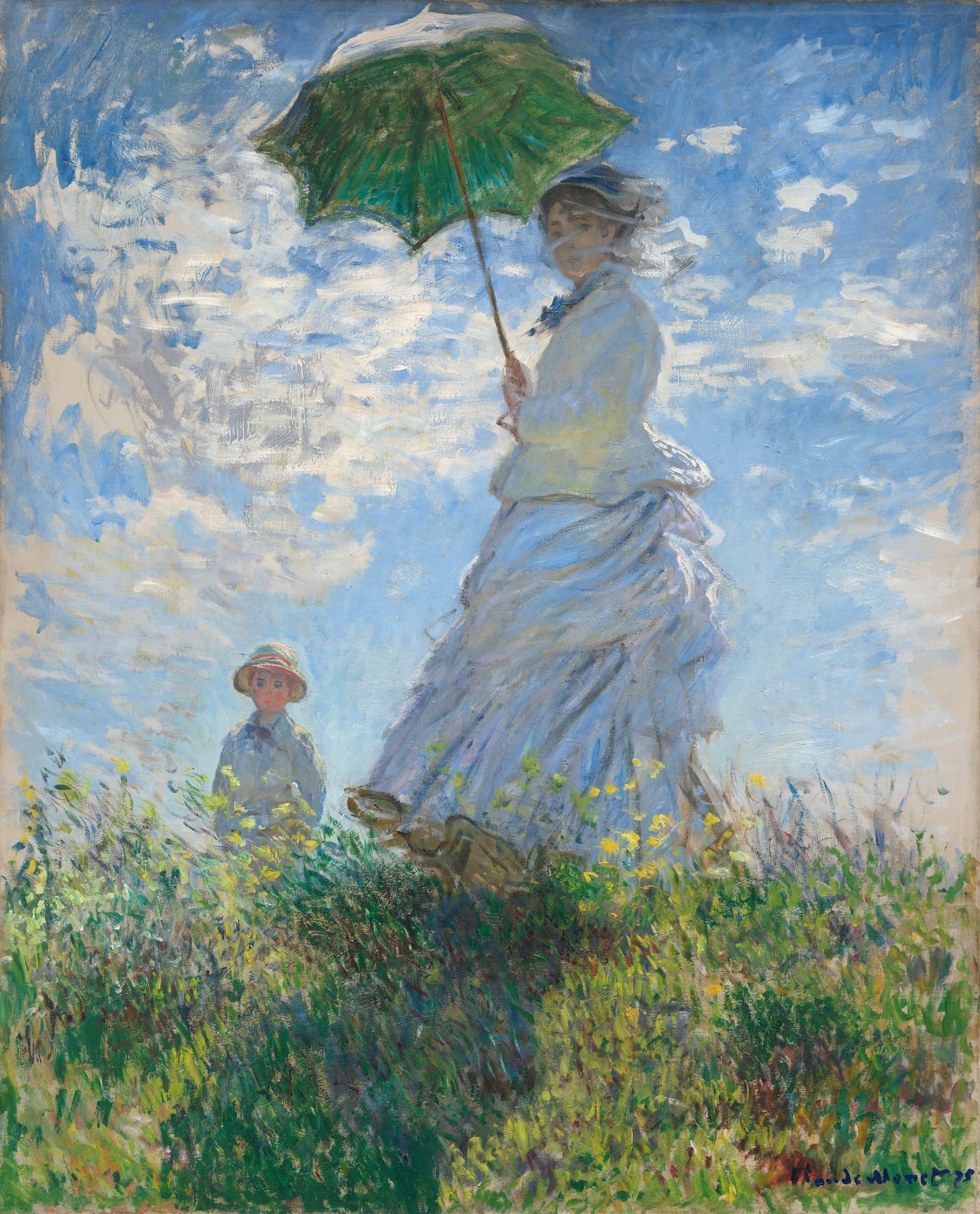
Hypothetical fair-market value for Claude Monet’s Woman with a Parasol – Madame Monet and Her Son (1875) is $120–180 million. The estimate reflects its status as a signature, museum-icon image of early Impressionism with exceptional provenance and recognition. Benchmarks include Monet’s $110.7m auction record and recent $65–74m results for top Water Lilies, supporting a nine-figure ‘iconicity premium’ if ever brought to market.
Valuation Analysis
Conclusion: We estimate Claude Monet’s Woman with a Parasol – Madame Monet and Her Son (1875) at $120–180 million on a hypothetical fair‑market basis. The work is a canonical image of early Impressionism depicting Camille and Jean Monet, prominently exhibited in 1876 and now in the National Gallery of Art; its scholarly standing, provenance, and cultural recognition justify a valuation that sits above most recent Monet results and within striking distance of, or potentially beyond, the artist’s current auction record under optimal conditions [1].
Method and benchmarks: The range is derived from recent top-tier Monet comparables and adjusted for this painting’s unique art-historical status. Monet’s auction record is $110.7 million for Meules (Haystacks) in 2019, the first Impressionist work to cross $100 million at auction [2]. Since then, the strongest public prices have clustered between roughly $65–75 million for A‑caliber late Water Lilies, such as Le bassin aux nymphéas at $74.01 million (Christie’s, 2023) and a Nymphéas at $65.5 million (Sotheby’s, 2024) [3][4]. A prime 1891 Poplars sold for $42.96 million in 2025, underscoring depth for celebrated series works even in selective markets [5].
Positioning Woman with a Parasol: Relative to those benchmarks, this 1875 canvas carries an additional “iconicity premium”: it is arguably the most widely recognized early figure‑in‑landscape by Monet, from the breakthrough Argenteuil years, and among the most reproduced images in Impressionism. Comparable works of this subject and caliber are overwhelmingly in museums, making a fresh‑to‑market example virtually unobtainable. Its provenance—from Monet’s sale to Dr. Georges de Bellio in 1876 to the Paul Mellon acquisition and 1983 gift to the NGA—adds further blue‑chip assurance, alongside a long exhibition and publication record [1].
Market context and risk: The Impressionist/Modern segment has been disciplined since 2023, with fewer $50m+ masterpieces at auction and a tilt toward private transactions; public auction values for the category fell in 2023 and 2024 even as lot counts rose [6]. In this environment, the most iconic, museum‑grade works still catalyze competition, especially with guarantees, global phone bidding (including Asia), and carefully timed marquee offers. We therefore anchor the low end of the range at $120 million—above recent series benchmarks—and allow for a path to the high end ($180 million) if condition is excellent, sale strategy is optimal, and trophy demand converges as it did for the 2019 record [2][3][4].
Key sensitivities: A current conservation report (surface, varnish, and structure) could shift the midpoint up or down; any material condition issues would dampen upside. Deaccession policy and public sentiment can also shape sale format and appetite. Absent such constraints, the painting’s singular cultural resonance, scarcity, and provenance credibly support a nine‑figure result in the stated range [1][2].
Key Valuation Factors
Art Historical Significance
High ImpactPainted in 1875 and exhibited at the 2nd Impressionist Exhibition (1876), Woman with a Parasol – Madame Monet and Her Son is a definitive early Impressionist figure‑in‑landscape by Monet. Depicting Camille and Jean Monet in a windswept field, the canvas encapsulates plein‑air immediacy, high‑key color, and broken brushwork that came to define the movement. The picture is extensively reproduced and taught, making it one of the most recognizable images of 19th‑century art. This status drives a substantial ‘iconicity premium’ over even strong serial landscapes. Within Monet’s oeuvre—dominated at the high end by late Water Lilies and London views—this work stands apart as the pre‑Giverny emblem, a museum cornerstone with broad cross‑collector appeal [1].
Provenance and Exhibition History
High ImpactThe painting’s provenance is exemplary: sold by Monet in 1876 to the pivotal early collector Dr. Georges de Bellio, later owned by Georges Menier, acquired at the Menier sale (Palais Galliera, 1965) for Paul Mellon, and gifted in 1983 to the National Gallery of Art, Washington. This chain of distinguished ownership—spanning an early champion of Impressionism and a 20th‑century American patron—confers exceptional market confidence. The work’s extensive exhibition and publication record further consolidates its scholarly authority and visibility. Such provenance reduces transactional friction, aids due diligence, and typically commands stronger bidding, particularly at the trophy tier where brand‑name collections and museum‑grade histories are prized by global buyers [1].
Rarity and Supply Dynamics
High ImpactMonet’s early, monumental figure‑in‑landscape canvases of this fame are extraordinarily scarce outside institutions. Most close analogues reside in museums; the supply of works with similar subject, date, and recognition is effectively nil. That rarity compounds the painting’s value beyond the already deep demand for Monet generally. In a market where top Monet sales in recent years have concentrated around late serial works (Nymphéas, Parliament, Poplars), a fresh‑to‑market early icon would be a singular event. Scarcity at the $100m+ level—where overall auction volume has contracted—can intensify competition when a true masterpiece emerges, especially with guarantees and global outreach, supporting a premium above standard comparables [3][4][5][6].
Market Benchmarks and Demand
High ImpactRecent pricing establishes a sturdy floor for top Monets: $74.01m for Le bassin aux nymphéas (2023) and $65.5m for a major Nymphéas (2024), while the all‑time Monet auction record remains $110.7m for Meules (2019). A superior Poplars brought $42.96m in 2025, confirming continued depth for A‑quality series paintings. Against this backdrop, Woman with a Parasol carries additional brand recognition and cross‑category appeal, justifying a nine‑figure expectation and a realistic pathway to testing or surpassing the record if conditions align (strong guarantees, optimal sale window, and robust international bidding). The proposed $120–180m range reflects these comparables plus an ‘iconicity premium’ appropriate to this painting’s status [2][3][4][5].
Sale History
Palais Galliera, Paris (Menier sale), lot 121
Acquired by dealer Hector Brame for Paul Mellon; price not publicly available in online sources; see NGA provenance record.
Claude Monet's Market
Claude Monet commands one of the strongest and deepest markets in Impressionism, with a global collector base spanning institutions, long‑term private collectors, and new buyers in the U.S., Europe, and Asia. His public auction record stands at $110.7 million for Meules (Sotheby’s, 2019), and multiple late Water Lilies canvases have sold between roughly $65–75 million since 2021, confirming sustained demand at the high end. Series pictures—Nymphéas, Parliament, London bridges, Poplars, and Haystacks—anchor the market’s upper tiers, while A‑caliber single images with exceptional visibility can command premiums. Even amid selective market conditions, top Monets continue to attract competition and guarantees, reinforcing the artist’s position as a blue‑chip, trophy‑grade cornerstone in Modern collecting [2][3][4][5].
Comparable Sales
Meules (Haystacks)
Claude Monet
Same artist; top-tier, instantly recognizable series and the current auction record—establishes the upper bound for Monet trophies (though later period and different subject).
$110.7M
2019, Sotheby's New York
~$138.4M adjusted
Le Parlement, soleil couchant
Claude Monet
Same artist; iconic London/Parliament series with prime color and atmosphere—recent top-tier benchmark for Monet’s mature serial works.
$76.0M
2022, Christie's New York
~$82.8M adjusted
Le bassin aux nymphéas (c. 1917–19)
Claude Monet
Same artist; major late Water Lilies—core of Monet’s market strength in recent years; establishes current pricing for masterpiece-caliber Monets.
$74.0M
2023, Christie's New York
~$77.7M adjusted
Peupliers au bord de l’Epte, crépuscule
Claude Monet
Same artist; prime 1891 Poplars from a celebrated series—strong 2025 result shows robust demand for A‑quality serial works adjacent to Haystacks.
$43.0M
2025, Christie's New York
Waterloo Bridge, effet de brume
Claude Monet
Same artist; from the sought-after London bridge series—reliable mid–upper tier indicator for major Monets with strong atmosphere and market depth.
$36.8M
2022, Christie's London
~$40.1M adjusted
Moulin de Limetz
Claude Monet
Same artist; earlier (1888) landscape close in era to the Argenteuil/Vétheuil years—useful low-to-mid anchor outside the premium late series.
$21.7M
2024, Christie's New York
~$22.3M adjusted
Current Market Trends
The Impressionist and Modern category has been selective since 2023, with fewer ultra‑high‑value public lots and a tilt toward private channels. Auction values for the segment declined in 2023 and again in 2024 even as lots sold increased, indicating disciplined pricing and a focus on quality over volume. Within this context, best‑in‑class, fresh‑to‑market works still spark competitive bidding, particularly with guarantees and strong Asian and U.S. participation. Monet remains a flight‑to‑quality name: while many sales now cluster in the $30–75 million band, a truly iconic painting can still catalyze nine‑figure outcomes when offered under optimal conditions, justifying an elevated valuation for museum‑grade masterpieces [5][6].
Study print
Study this painting as a print
Pair the full artwork with a museum-style study sheet focused on one meaningful detail.
Sources
- National Gallery of Art (NGA) – Object record: Woman with a Parasol – Madame Monet and Her Son
- Sotheby’s – Monet’s Meules sells for $110.7m (artist record)
- Christie’s Press – 20th Century Evening Sale totals; Monet’s Le bassin aux nymphéas at $74.01m (Nov 9, 2023)
- Sotheby’s – Fall 2024 auction results; Monet Nymphéas at $65.5m
- HENI News – Monet Poplars sells for $42.96m (May 12, 2025)
- Art Basel & UBS – The Art Market Report (auctions down in 2023–2024; private sales up)