How Much Is Women in the Garden Worth?
Last updated: February 26, 2026
Quick Facts
- Methodology
- comparable analysis
Hypothetical open‑market valuation for Claude Monet’s Women in the Garden (1866–67): $120–180 million. The range reflects its monumental scale, canonical status in Monet’s early development, and extreme scarcity, benchmarked against Monet’s top auction results and adjusted for a trophy premium under full international competition.
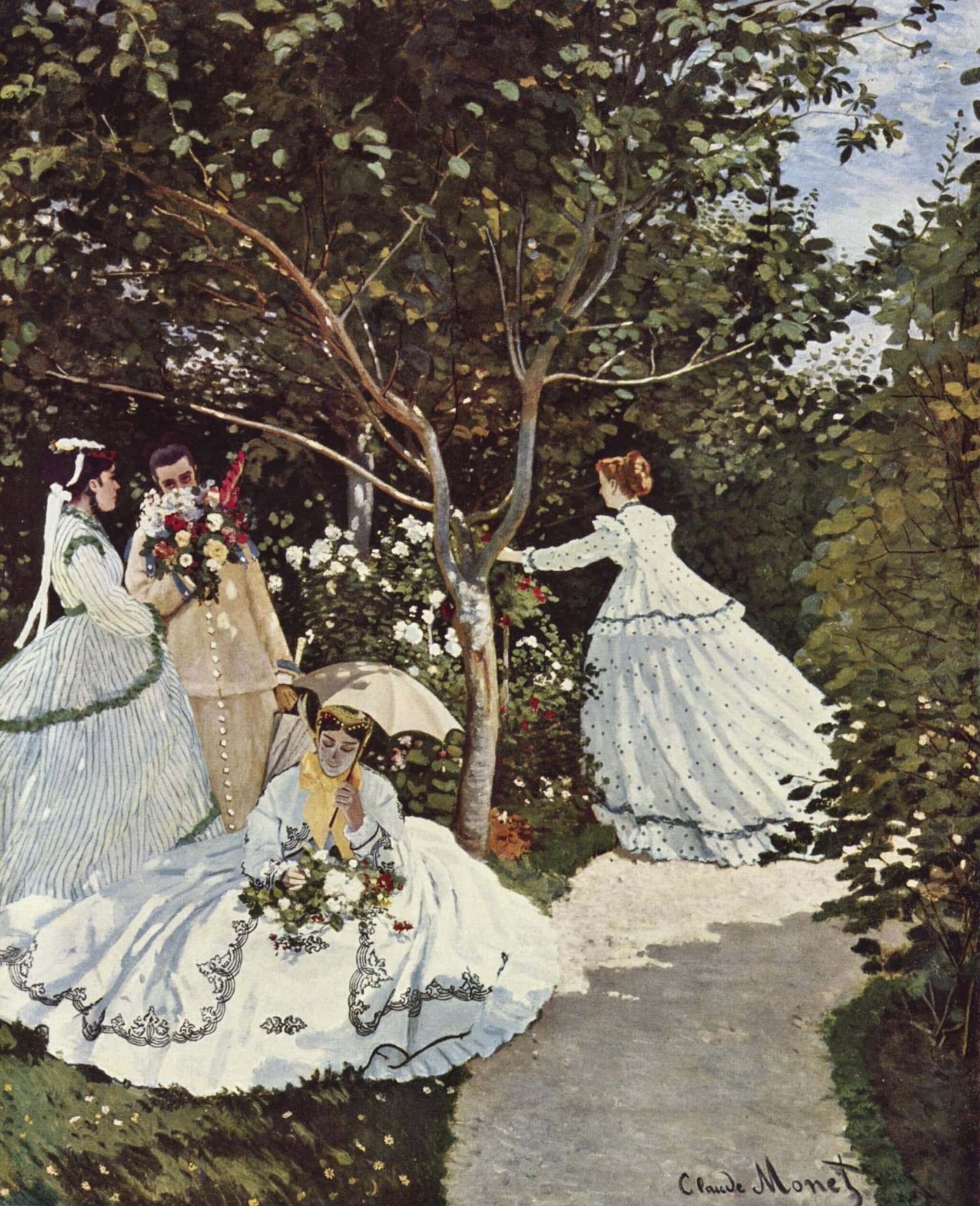
Women in the Garden
Claude Monet, 1866–1867 • Oil on canvas
Read full analysis of Women in the Garden →Valuation Analysis
Work and status. Women in the Garden (1866–67; 255 × 205 cm) is a landmark early Monet in the Musée d’Orsay, Paris. The museum record documents its history from Monet’s circle (Bazille, Manet) through Monet and Durand‑Ruel to the French State in 1921; today it is part of the French national collection [1]. Under the French Code du patrimoine, public‑museum holdings are inalienable, making a market sale effectively impossible; any valuation is therefore hypothetical and comparative only [4].
Market benchmarks. Monet’s auction record stands at $110.7 million for Meules (Haystacks) at Sotheby’s New York in May 2019, which set the ceiling for the artist’s market [2]. Recent marquee results for prime late works show durable depth in the $65–74 million band (Christie’s New York, Nov 2023, Le bassin aux nymphéas at $74.01 million; Sotheby’s New York, Nov 2024, Nymphéas at $65.5 million) [3][5]. These data points confirm strong global demand for best‑in‑class Monets, especially from the iconic serial groups (Water Lilies, London/Parliament).
Positioning Women in the Garden. Although the market’s very top prices concentrate around Monet’s mature series, Women in the Garden is a canonical, monumental early canvas central to the emergence of Impressionism. Its scale, ambition, and art‑historical significance—combined with the near‑total absence of comparable early, large‑format figure‑in‑garden Monets in private hands—would command a significant trophy premium if it could be offered with unrestricted, international competition. Against the $65–74 million recent band for prime late works and the $110.7 million record, a $120–180 million range is defensible for a once‑in‑a‑generation opportunity of this caliber.
Upside and downside drivers. Upward pressure derives from the work’s rarity, museum‑grade visibility, and status within Monet’s development, likely attracting non‑price‑sensitive collectors and institutions. Moderating factors include the market’s preference for instantly recognizable late series imagery, potential buyer selectivity at the $100 million+ tier, and any doubts around condition (a full conservation report would be decisive). Crucially, legal or export constraints can materially depress realized prices by reducing competitive tension.
Conclusion. Using direct Monet trophy comparables and adjusting for Women in the Garden’s unique early‑period significance and scale, the hypothetical open‑market value is estimated at $120–180 million, assuming an unrestricted sale, full global marketing, and robust third‑party guarantee support. This synthesis balances art‑historical primacy against current price signals from Monet’s top auction segment [1][2][3][5].
Key Valuation Factors
Art Historical Significance
High ImpactWomen in the Garden is a keystone in Monet’s early evolution, anticipating Impressionism’s preoccupation with light and atmosphere while retaining ambitious, figure‑rich composition. The Musée d’Orsay identifies it as a pivotal early work with deep scholarly traction and exemplary provenance through Monet’s circle before entering the French State collection. Canonical status typically draws cross‑category buyers and institutions, creating bidding that can exceed the pricing norms of more plentiful late series works. For collectors seeking foundational moments in art history, this canvas is uniquely positioned: it encapsulates the birth of a movement in a single, monumental statement. That centrality merits a high premium relative to Monet’s already blue‑chip late trophies.
Scale and Rarity
High ImpactAt approximately 255 × 205 cm, the painting’s monumental format is exceptional for Monet’s 1860s production. Large, early, multi‑figure garden scenes by Monet of this ambition are vanishingly scarce in private hands; most close peers reside in institutions. Scale matters at the top end: room‑commanding works anchor collections and museum displays, enlarging the pool of trophy‑oriented bidders. Rarity compounds the effect, as collectors cannot simply wait for a comparable example. This scarcity premium is distinct from the late serial markets (e.g., Water Lilies), where substitution exists across dozens of canvases. The combination of size, subject complexity, and institutional caliber argues for pricing above most recent Monet results.
Market Preference and Iconicity
Medium ImpactMonet’s late serial works—Water Lilies, London/Parliament, Poplars, Venice—are the most immediately recognizable “status images,” and recent peaks cluster around $65–74 million for prime examples. Women in the Garden, while art‑historically central, is less aligned with the luminous, abstracted late style many contemporary trophy buyers favor for wall power and brand legibility. This taste dynamic can moderate upside versus a top‑tier Water Lilies or Haystacks of exceptional quality. That said, connoisseurial buyers often pay a premium for foundational works that rewrite art history. Net effect: a moderate discount to the very top of Monet’s series‑driven market is likely, but the painting’s scholarly stature and scale counterbalance a portion of that brand‑iconicity gap.
Legal and Export Constraints
Medium ImpactAs part of France’s public collections, the work is inalienable under the Code du patrimoine. In practical terms, a public auction is not permitted; any hypothetical transaction would require extraordinary legal steps. If an otherwise permissible sale faced export restrictions or jurisdictional limits, competitive tension could be impaired by excluding some international bidders, compressing price discovery. Our stated $120–180 million range explicitly assumes an unrestricted, fully competitive global sale with normal third‑party guarantee support. If meaningful constraints persisted, a material haircut could result—potentially moving the realized price below our midpoint. Conversely, clear, unfettered title and exportability would maximize the buyer pool and support the upper band.
Condition and Provenance
Medium ImpactThe documented provenance—from Bazille and Manet to Monet, Durand‑Ruel, and ultimately the French State—is exemplary and market‑positive, minimizing title risk and reputational drag. Condition, however, is pivotal at the $100 million+ level. While major museums maintain rigorous stewardship, only a current, independent conservation report can confirm the state of the paint surface, any structural interventions, and the stability of prior restorations. A pristine or well‑conserved surface would underpin the high end of the range; significant structural issues, discoloration, or overpaint could reduce value by tens of millions. Our estimate presumes sound, institutionally maintained condition; updated technical imaging and treatment history would refine the band materially.
Sale History
Women in the Garden has never been sold at public auction.
Claude Monet's Market
Claude Monet anchors the blue‑chip Impressionist market, with a deep global collector base and robust institutional demand. The artist’s auction record is $110.7 million (Meules, 2019), and recent top results for prime late works have ranged from roughly $65 million to $74 million in 2023–2024, with additional liquidity for strong Poplars and Venice canvases in the $40–55 million range. Demand is broad across North America, Europe, and Asia, evidenced by a Hong Kong record and high‑value phone bidding from the region. While supply cycles and macro conditions have normalized pricing below the 2019 peak, best‑in‑class Monets with clear provenance and strong exhibition histories continue to attract disciplined, competitive bidding at the top end.
Comparable Sales
Meules (Haystacks)
Claude Monet
Same artist; ultimate trophy benchmark for Monet. Establishes the market ceiling for top-tier canvases despite different subject and later period.
$110.7M
2019, Sotheby's New York
~$141.0M adjusted
Le bassin aux nymphéas (Water Lilies)
Claude Monet
Same artist; late, large-format Water Lilies—core to Monet’s trophy market and a prime reference for pricing museum-grade Monets.
$74.0M
2023, Christie's New York
~$78.7M adjusted
Nymphéas (Water Lilies)
Claude Monet
Same artist; strong late-series canvas with deep global demand. Useful to gauge recent, real-money appetite for top Monets.
$65.5M
2024, Sotheby's New York
~$67.3M adjusted
Le Parlement, soleil couchant (Houses of Parliament, Sunset)
Claude Monet
Same artist; iconic London/Parliament series. A marquee, institutionally central subject that reliably commands top-tier pricing.
$76.0M
2022, Christie's New York
~$84.5M adjusted
Le Grand Canal et Santa Maria della Salute
Claude Monet
Same artist; Venice series trophy with wide buyer recognition—good benchmark for high-visibility Monet cityscapes.
$56.6M
2022, Sotheby's New York
~$62.9M adjusted
Peupliers au bord de l’Epte, crépuscule (Poplars on the Banks of the Epte, Dusk)
Claude Monet
Same artist; major 1891 Poplars series—landscape of high desirability that anchors Monet’s upper market band in the current cycle.
$43.0M
2025, Christie's New York
Current Market Trends
Since 2023, the marquee segment has become more selective, with fewer $10 million‑plus lots and heightened discipline around estimates and guarantees. Impressionist and Modern has proven relatively resilient versus ultra‑contemporary, but peaks are concentrated in the most iconic names and series. Monet remains a bellwether: prime Water Lilies and related late series continue to clear $40–75 million, while broader category recalibration favors historically central, museum‑grade pictures. Regional demand from Asia has added depth at the high end, though global macro uncertainty tempers exuberance. In this environment, rarity, scale, and institutional cachet are decisive catalysts for breakout pricing, whereas legal or export constraints can materially cap competitive tension and realized values.
Study print
Study this painting as a print
Pair the full artwork with a museum-style study sheet focused on one meaningful detail.
Sources
- Musée d’Orsay — Femmes au jardin object record
- Sotheby’s — Monet’s Meules sells for $110.7 million, a new artist record
- Christie’s — 20th Century Evening Sale totals (Nov 9, 2023)
- Legifrance — Code du patrimoine (inalienability of public collections)
- Artnet News — Sotheby’s Modern Evening Auction achieves $65.5m for Monet Nymphéas (Nov 2024)