How Much Is A Bar at the Folies-Bergère Worth?
Last updated: January 13, 2026
Quick Facts
- Last Sale
- $4K (1896, Hôtel Drouot, Paris (Sale of the Collection of Emmanuel Chabrier))
- Current Location
- The Courtauld Gallery, London
- Methodology
- extrapolation
A Bar at the Folies-Bergère is a canonical late masterpiece by Manet and a cornerstone of the Courtauld Gallery. Based on subject-specific comparables, the artist’s auction record, and cross-artist trophy benchmarks, its hypothetical open-market value is estimated at $200–300 million.
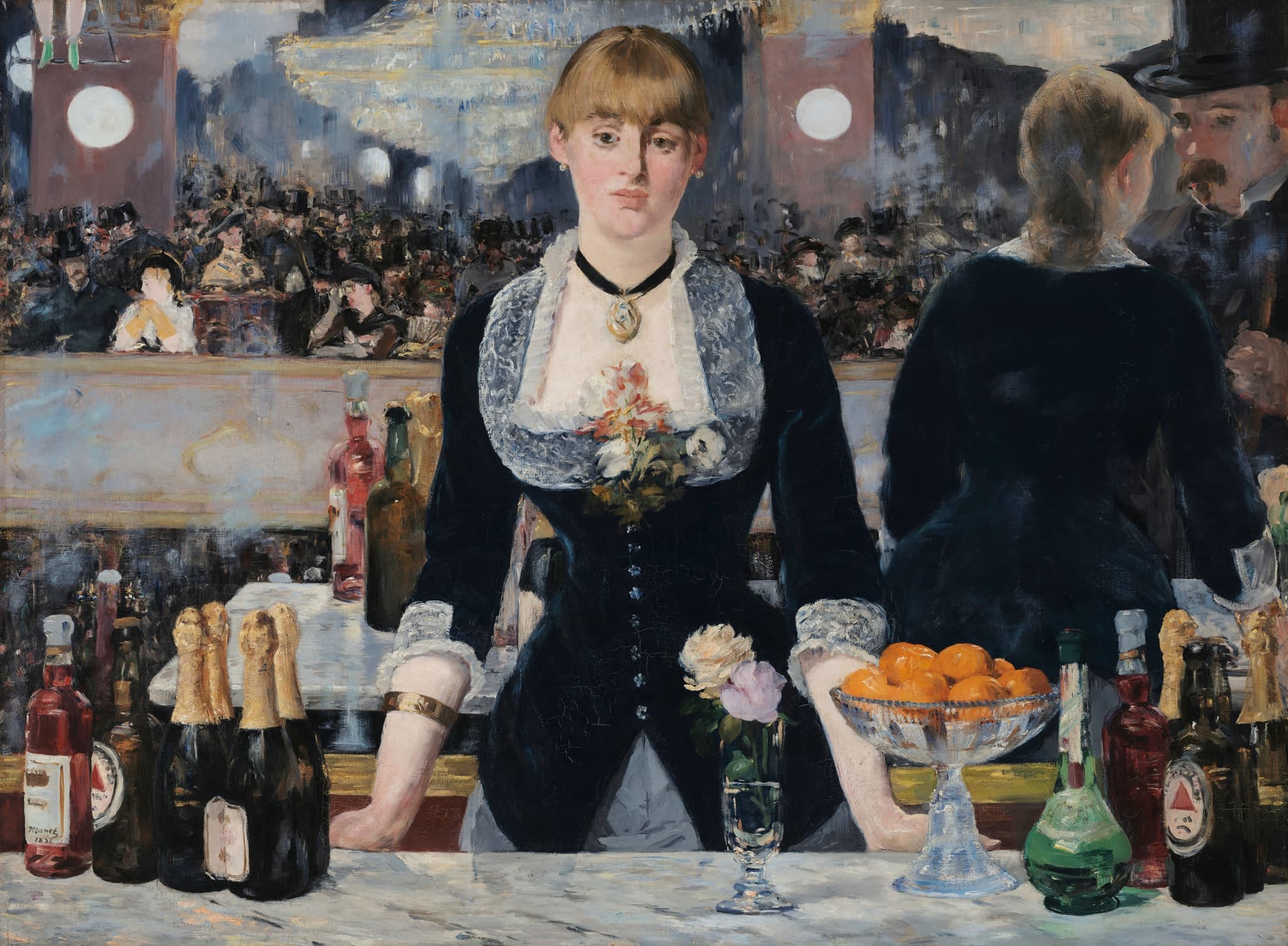
A Bar at the Folies-Bergère
Édouard Manet, 1882 • Oil on canvas
Read full analysis of A Bar at the Folies-Bergère →Valuation Analysis
Conclusion: Édouard Manet’s A Bar at the Folies-Bergère (1882) is valued at $200–300 million on a hypothetical, unencumbered basis. The painting is universally acknowledged as one of Manet’s greatest works—his last major Salon canvas and an emblem of modern life—anchoring the Courtauld’s identity and the canon of 19th‑century modernism [1].
Artist-specific anchors: The closest subject comparator is Manet’s smaller, earlier “first version” of the Folies-Bergère, which sold for £16.95 million (≈$26.8 million) in 2015—at a fraction of the Courtauld canvas’s scale, finish, and art-historical weight [2]. Manet’s public auction record is $65.125 million for Le Printemps (Spring) at Christie’s New York in 2014, underscoring demonstrated capacity for prime, late-period oils with iconic imagery [3]. More recently, a top-tier Manet, Le Grand Canal à Venise, achieved $51.9 million in 2022, confirming robust demand for best-in-class works by the artist [8].
Cross-artist trophy benchmarks: Within the Impressionist and early-Modern trophy cohort, public and reported private results establish the ceiling that museum‑icon works can achieve: Monet’s Meules (Haystacks) reached $110.7 million publicly [4]; Gauguin’s Nafea Faa Ipoipo? has been documented near $210 million privately [6]; and Cézanne’s The Card Players is widely reported around $250 million [5]. On art-historical stature, brand recognition, and cultural impact, the Courtauld Bar belongs in this elite cluster. It is the most commercially magnetic Manet in institutional hands and, were it saleable, would command a large premium over the artist’s $65.1 million record.
Provenance and exhibition standing: The work’s early public appearances—Manet’s 1884 studio sale and the 1896 Chabrier collection sale—establish a secure foundation of ownership and literature history (prices of 5,850 and 23,000 francs, respectively; contemporaneous USD equivalents ≈$1,129 and ≈$4,440) [9][10]. Since entering Samuel Courtauld’s collection (1926) and gift to the Courtauld Gallery (1934), it has sustained an exceptional exhibition profile and scholarly presence, cementing its status as a museum icon [1].
Market context and assumptions: While Modern/Impressionist auctions saw volume-driven contraction in 2023–24, demand for true trophies remained strong; records and marquee results continued when rarity, quality, and provenance aligned [7]. This estimate treats deaccession/export constraints as hypothetically resolved and assumes standard museum condition and presentation. Under those conditions, scarcity at the very top of Manet’s oeuvre, subject primacy, and global trophy-buyer competition justify the $200–300 million range—an upward extrapolation from artist-specific and cross-category benchmarks [2][3][4][5][6][8].
Key Valuation Factors
Art Historical Significance
High ImpactA Bar at the Folies-Bergère is widely regarded as one of Manet’s supreme achievements and his last major Salon painting. Its daring mirror construction, acute psychology, and portrayal of Parisian modern life have made it a touchstone of art history and a staple of museum and academic discourse. This centrality confers a valuation premium because the work transcends connoisseurship niches: it is used in textbooks, exhibitions, and public programming globally, with recognition that rivals Olympia and Le Déjeuner sur l’herbe. That level of cultural saturation is extremely rare within Manet’s oeuvre and places the painting squarely in the “museum-icon” category most likely to galvanize trophy-level competition.
Rarity and Supply
High ImpactMajor Manet masterpieces are overwhelmingly museum-held, and true icons almost never trade. The Courtauld Bar is both a signature image and the culmination of Manet’s late style; there is no realistic substitute on the market. The 1881 smaller “first version” sold strongly in 2015, but its scale and status are far below the Courtauld canvas. This structural illiquidity drives scarcity premia at the top end: when a singular work is effectively unavailable, any hypothetical offering would compress global demand into a single event, often yielding prices well above the artist’s standard auction benchmarks. The rarity of direct substitutes is a primary driver of the $200–300 million range.
Subject and Market Appeal
High ImpactThe Folies-Bergère motif is arguably Manet’s most “market-facing” subject: an instantly recognizable emblem of modern urban life with rich pictorial complexity. Works that combine canonical status, sophisticated composition, and narrative intrigue appeal to the widest spectrum of top buyers—from encyclopedic museums to private foundations and UHNW collectors. The painting’s scale and visual impact also suit trophy collectors’ preferences for statement works. When assessing willingness to pay, this subject’s brand recognition closes the gap between art-historical stature and market value, supporting extrapolation above Manet’s auction record and into the broader Impressionist/early-Modern trophy cohort.
Provenance and Exhibition History
High ImpactFrom the 1884 Manet studio sale through the 1896 Chabrier sale and into the hands of leading dealers and collectors before Samuel Courtauld’s 1926 purchase, the picture’s provenance is distinguished and well-published. Its long tenure in the Courtauld Gallery and frequent inclusion in major exhibitions have reinforced its scholarly and public standing. Such continuous, reputable ownership and rich literature presence mitigate risk for buyers and often lead to aggressive bidding when icons appear. In valuation terms, this impeccable chain is a force multiplier: it ensures buyer confidence, supports premium cataloging, and amplifies the painting’s cultural cachet at the point of sale.
Market Access and Legal Constraints
Medium ImpactThe work is owned by the Samuel Courtauld Trust and housed at the Courtauld Gallery, subject to institutional policies and UK regulations that make deaccession and export highly complex. This valuation treats those constraints as hypothetically resolved to gauge true market appetite. In reality, such constraints are double-edged: they reduce the likelihood of sale (which increases perceived rarity and cachet), yet they can also limit the pool of bidders if timing and logistics are uncertain. On balance, these considerations warrant a medium impact designation—material to feasibility, but not to the intrinsic price potential once market access is assured.
Sale History
Hôtel Drouot, Paris (Manet Studio Sale, lot 7)
Purchased by Emmanuel Chabrier; price shown as contemporaneous 1884 USD equivalent of 5,850 FRF.
Hôtel Drouot, Paris (Collection Emmanuel Chabrier)
Price shown as contemporaneous 1896 USD equivalent of 23,000 FRF; subsequent transfers via leading dealers into Samuel Courtauld’s collection.
Édouard Manet's Market
Édouard Manet is a blue‑chip pillar of 19th‑century modernism with exceptionally limited supply at the top end. His public auction record is $65.125 million for Le Printemps (2014), with other prime oils clustered in the high seven to mid‑eight figures. Recent benchmarks—such as Le Grand Canal à Venise at $51.9 million (2022) and a late still life at $10.1 million (2024)—confirm steady demand for quality works, but underline the rarity of true masterpieces on the market. Institutional ownership of many key pictures constrains turnover, elevating private‑treaty and guarantee interest when first‑tier material appears. For a once‑in‑a‑generation icon, buyers will extrapolate well above the artist’s record.
Comparable Sales
Le Bar aux Folies-Bergère (first version, 1881)
Édouard Manet
Same artist and exact subject (earlier, smaller version). Direct subject/period match; best like-for-like anchor for the Folies-Bergère motif.
$26.8M
2015, Sotheby's London
~$36.2M adjusted
Le Printemps (Spring; Jeanne Demarsy)
Édouard Manet
Same artist; near‑contemporary masterwork (1881) and the public auction record for Manet. Calibrates the modern market’s upper bound for a canonical Manet.
$65.1M
2014, Christie's New York
~$88.0M adjusted
Le Grand Canal à Venise
Édouard Manet
Same artist; major oil from a prime period with pristine provenance (Paul G. Allen). Benchmarks recent demand for first‑tier Manet oils at auction.
$51.9M
2022, Christie's New York
~$56.8M adjusted
Vase de fleurs, roses et lilas
Édouard Manet
Same artist and same year (1882). While a still life, it benchmarks appetite and pricing for late Manet oils proximate in date to the Courtauld Bar.
$10.1M
2024, Sotheby's New York
~$10.4M adjusted
Meules (Haystacks)
Claude Monet
Cross‑artist trophy benchmark within the Impressionist canon. Frames the public market ceiling for a museum‑icon Impressionist painting.
$110.7M
2019, Sotheby's New York
~$138.6M adjusted
Current Market Trends
Impressionist/early‑Modern auctions contracted in value in 2023–24 amid a shortage of trophies, even as lot counts rose. Despite this, landmark works continued to command record or near‑record prices when quality, provenance, and freshness aligned, indicating disciplined but deep demand. Cross‑category results in 2019–2025 (from Monet’s Meules to other marquee Modern trophies) show that the top end remains resilient for icons. Against this backdrop, a museum‑defining Manet would trigger intense global competition, with guarantees and private‑treaty interest likely pre‑empting public sale. The $200–300 million range reflects this trophy dynamic rather than broader mid‑market sentiment.
Study print
Study this painting as a print
Pair the full artwork with a museum-style study sheet focused on one meaningful detail.

Sources
- Courtauld Gallery object record: A Bar at the Folies-Bergère
- The Art Wolf: Sotheby’s London, Impressionist & Modern Art Evening Sale, June 24, 2015
- Artnet News: $65 Million Manet Leads at Christie’s (2014)
- Sotheby’s: Monet’s Meules Sells for $110.7 Million (2019)
- Vanity Fair: Qatar Buys Cézanne’s The Card Players (2012)
- The Boston Globe: Lawsuit reveals Gauguin painting sold for about $210m
- Art Basel & UBS, The Art Market 2024 (Auctions chapter)
- The Art Newspaper: Paul Allen evening sale hits $1.5bn; Manet achieves $51.9m
- Société Cézanne: 1884 Manet Studio Sale (Hôtel Drouot) entry
- Société Cézanne: 1896 Sale of Emmanuel Chabrier collection (Hôtel Drouot) entry