How Much Is Luncheon on the Grass Worth?
Last updated: January 13, 2026
Quick Facts
- Current Location
- Musée d’Orsay, Paris
- Methodology
- extrapolation
Luncheon on the Grass is a canonical, museum‑defining masterpiece by Manet and a cornerstone of modern art. In a legally unconstrained sale, it would command a trophy‑market premium well beyond Manet’s observed record, warranting a synthesized estimate of $650 million to $1.1 billion.
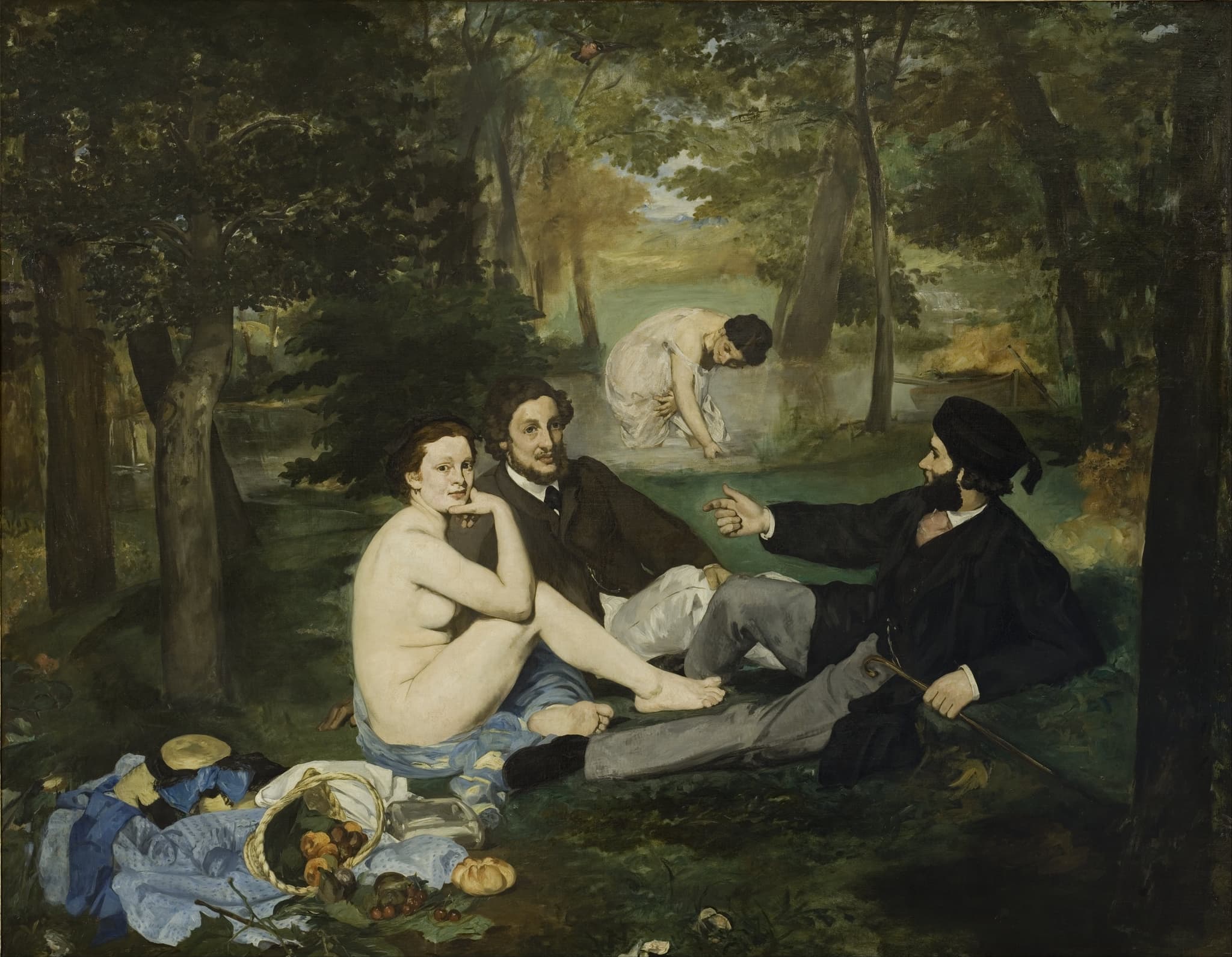
Luncheon on the Grass
Édouard Manet, 1863 • Oil on canvas
Read full analysis of Luncheon on the Grass →Valuation Analysis
Conclusion: In a hypothetical, legally unconstrained sale (i.e., if deaccession, export, and open competition were permitted), Édouard Manet’s Luncheon on the Grass would command approximately $650 million to $1.1 billion. This bracket reflects the work’s singular art‑historical status, extreme supply scarcity of comparable icons, and demonstrated depth at the top of the global trophy market.
Why this work sits at the apex: Déjeuner sur l’herbe is among Manet’s two or three defining masterpieces and a bedrock of modern art. The Musée d’Orsay confirms it as part of France’s national collections, with no-loan status, underscoring its institutional stature and the improbability of actual trade [1]. As a state-held work, it is inalienable under the French Code du patrimoine absent a formal declassement—a process rarely granted for such icons [2]. Our valuation therefore isolates intrinsic demand-side value rather than legal feasibility.
Method and benchmarks: We extrapolate upward from cross‑artist trophy comparables because nothing remotely equivalent by Manet has traded publicly. Manet’s auction record remains $65.1 million (Getty’s acquisition of Le Printemps, 2014) [3]. A major later Manet, Le Grand Canal à Venise, achieved $51.9 million in 2022, reinforcing liquidity for top‑tier but non‑iconic examples [4]. At the true trophy apex, Leonardo’s Salvator Mundi realized $450.3 million in 2017 (≈$600m in today’s terms) [5], while reported private sales for Gauguin (~$300m) and Cézanne (~$250m) establish a benchmark band for 19th‑century canon touchstones [6][7]. Recent market proof of top‑end appetite—e.g., Klimt at $236.4m in 2025—confirms depth for museum-caliber pictures in competitive, guarantee-backed contexts [8].
Positioning the range: Déjeuner’s art‑historical weight and brand recognition are at least on par with, and arguably exceed, these benchmarks. The low end ($650m) anchors to Leonardo’s public record adjusted for inflation and for Déjeuner’s centrality to modernism. The high end ($1.1b) reflects scarcity of equivalent movement‑defining icons, the potential for state-backed or foundation buyers, and escalating trophy competition, even amid selective, quality‑driven markets [9].
Important caveats: Legal inalienability and “no-loan” status lower real-world transactability and limit observable insurance precedents [1][2]. Condition is presumed stable but not publicly documented; any structural issues would adjust the bracket. These constraints inform execution risk—not intrinsic demand value. On pure market desirability, Déjeuner is a once‑in‑a‑lifetime, category‑killing masterpiece that would likely set a new high-water mark for 19th‑century art.
Key Valuation Factors
Art Historical Significance
High ImpactLuncheon on the Grass is a cornerstone of modern art—one of Manet’s most critical works alongside Olympia and A Bar at the Folies-Bergère. Its 1863 scandal at the Salon des Refusés and radical treatment of subject, gaze, and painterly facture helped catalyze the break with academic conventions and paved the way for Impressionism and modernism. This singular status ensures intense global recognition across institutions, scholars, and collectors, driving a trophy premium that transcends standard artist-market metrics. Among 19th-century masterworks, few carry comparable scholarly gravity, and virtually none remain realistically obtainable, making Déjeuner an apex asset by significance alone.
Extreme Rarity and Supply Scarcity
High ImpactThe very best Manets are concentrated in museums; masterpiece‑level pictures almost never trade publicly. This structural scarcity is evidenced by the artist’s auction record—still $65.1m from 2014—and the dearth of comparable offerings since. When high-caliber works have surfaced (e.g., in landmark single-owner sales), demand has been deep, but these are not movement-defining icons. In contrast, Déjeuner is the category’s summit. Such once-in-a-generation supply would attract broad, international competition (private collectors, foundations, and potentially state-backed buyers), pushing pricing beyond intra-artist precedents and into the band set by cross-artist, era-defining trophies.
Legal Status and Marketability
Medium ImpactHeld in France’s national collections at the Musée d’Orsay, the painting is inalienable under the Code du patrimoine and flagged as not for loan or deposit. Practically, this makes a real sale extraordinarily unlikely and suppresses public insurance precedents. However, legal impediments affect transaction feasibility, not intrinsic demand. Our estimate isolates what the work would command if lawfully deaccessioned and exportable. In that scenario, its cultural primacy, rarity, and global name recognition would dominate bidder behavior; the legal status today simply means market value must be modeled via extrapolation from peer trophies rather than direct, within-artist comparables.
Cultural Iconicity and Global Brand
High ImpactDéjeuner is taught worldwide, reproduced in countless surveys, and embedded in public consciousness. This brand-like recognition expands the bidder base beyond specialist connoisseurs to institutions and prestige-driven collectors who seek cultural capital as much as asset diversification. At the ultra‑trophy end, narrative power and recognizability are decisive: works like Leonardo’s Salvator Mundi and Klimt’s late portraits demonstrate how icon status can compress price elasticity. Given Manet’s role in the birth of modern art, Déjeuner’s cultural reach commands a premium multiple that rationalizes an estimate well above the artist’s observed ceiling and within the top tier of auction and private-sale benchmarks.
Condition, Scale, and Exhibition Visibility
Medium ImpactWhile detailed public condition data are scarce, Déjeuner’s continuous museum stewardship suggests robust conservation standards. Its significant scale and complexity heighten logistical risk were it to travel, but they also enhance wall power—critical at the apex of the market. The work’s constant display, scholarship, and non-loan status at the Musée d’Orsay reinforce its aura and desirability. Any newly disclosed structural issues would influence underwriting and possibly the top of the range; absent such findings, the presumption of stable museum care supports the current bracket. In an actual sale, a full technical dossier would be decisive for final pricing and guarantee structuring.
Sale History
Luncheon on the Grass has never been sold at public auction. It has been held by Musée d’Orsay, Paris.
Édouard Manet's Market
Édouard Manet is a blue‑chip pillar of the 19th‑century canon, but his top market is thin because the best works are in museums. The current public auction record is $65.1m for Le Printemps (2014; acquired by the Getty) [3]. Since then, major Manets have been scarce; nonetheless, significant oils can achieve $50m‑plus when offered in marquee contexts, as seen with Le Grand Canal à Venise in 2022 [4]. Private sales occur, often via guarantees, but public confirmation above the record is limited. Overall, demand is deep for high‑quality, fresh oils; works on paper and secondary‑tier oils trade at more modest levels. Déjeuner sits far above anything likely to appear on the open market, necessitating extrapolation from cross‑artist trophies.
Comparable Sales
Jeanne (Spring) [Le Printemps]
Édouard Manet
Artist record; museum-caliber Manet sold publicly to the Getty. Calibrates the observed ceiling for Manet at auction and shows institutional demand.
$65.1M
2014, Christie's New York
~$89.2M adjusted
Le Grand Canal à Venise
Édouard Manet
Recent, high‑value Manet oil in a marquee single‑owner sale. Demonstrates current top‑end liquidity for Manet.
$51.9M
2022, Christie's New York (Visionary: The Paul G. Allen Collection)
~$57.6M adjusted
Salvator Mundi
Leonardo da Vinci (attributed)
All‑time public auction record; illustrates the global trophy ceiling for a canonized, movement‑defining Old Master in the modern market structure.
$450.3M
2017, Christie's New York
~$598.9M adjusted
Nafea faa ipoipo (When Will You Marry?)
Paul Gauguin
Record‑level private sale for a 19th‑century Post‑Impressionist masterpiece; a key benchmark for rarity and art‑historical weight close to Manet’s era.
$300.0M
2015, Private sale (reportedly to the State of Qatar)
~$411.0M adjusted
The Card Players
Paul Cézanne
Movement‑defining 19th‑century masterwork often cited as a cornerstone of modern art; provides a direct benchmark for top‑tier, museum‑icon status.
$250.0M
2011, Private sale (reportedly to the State of Qatar)
~$360.0M adjusted
Portrait of Elisabeth Lederer
Gustav Klimt
Recent high‑water mark for Modern art at auction; shows current trophy market depth for museum‑grade, era‑defining paintings.
$236.4M
2025, Sotheby's New York
Current Market Trends
Top‑end art markets became more selective in 2024 but re‑accelerated for apex masterpieces in late 2025, with guarantees and single‑owner collections catalyzing record outcomes (e.g., Klimt at $236.4m) [8]. The 19th‑/early‑Modern segment remains robust at the top, though supply is thin and quality is paramount. The Art Basel/UBS report highlights a bifurcation: fewer works above $10m traded in 2024, yet demand concentrated around best‑in‑class, institutionally validated pieces [9]. Within this context, a movement‑defining icon like Déjeuner would likely trigger exceptional global competition, resetting the 19th‑century price ceiling should it ever be legally deaccessioned and offered in a competitive sale.
Study print
Study this painting as a print
Pair the full artwork with a museum-style study sheet focused on one meaningful detail.
Sources
- Musée d’Orsay – Le Déjeuner sur l’herbe (object record)
- Code du patrimoine (France), Article L451-5 – Inalienability of museum collections
- LA Times – Getty buys Manet’s ‘Spring’ for record $65.1 million
- The Art Newspaper – Paul G. Allen collection smashes auction record at Christie’s
- Christie’s – Leonardo and Post-War results (Salvator Mundi $450.3m)
- The New York Times – Gauguin Painting Is Said to Be Sold for $300 Million
- The Guardian – Cézanne’s The Card Players ‘sold for more than $250m’ to Qatar
- Wall Street Journal – Klimt portrait sells for $236.4m, near auction record
- Art Basel x UBS – Art Market Report 2025 (summary)