How Much Is The Swing Worth?
Last updated: January 14, 2026
Quick Facts
- Insurance Value
- $160.0M (Internal synthesis; French state indemnity framework (Code du patrimoine))
- Current Location
- Musée d’Orsay, Paris
- Methodology
- comparable analysis
Hypothetical fair market value for Renoir’s The Swing (La balançoire, 1876) is $90–130 million. This range is anchored to the 1876 Au Moulin de la Galette auction record and calibrated to current Renoir demand and broader Impressionist market dynamics. For insurance purposes, we would set an indicative replacement value at $160 million.
Valuation Analysis
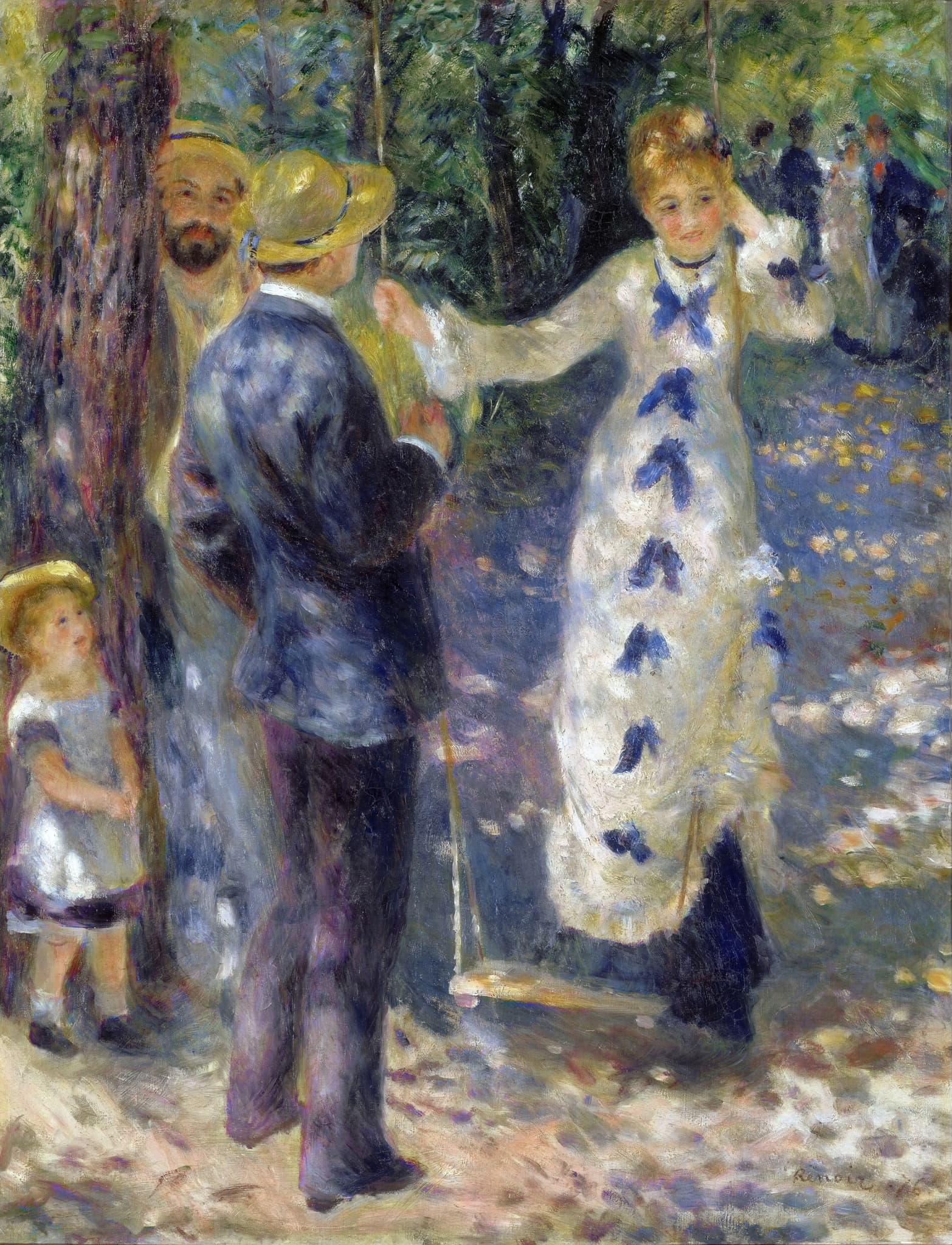
The Swing (La balançoire, 1876) is a museum-icon in the Musée d’Orsay and legally inalienable under French law; any transactional valuation is therefore hypothetical. It is, however, a cornerstone of Renoir’s pivotal 1876 campaign—closely paired in date, subject, and technique with Bal du moulin de la Galette—and one of the artist’s most reproduced works [1][3].
Our $90–130 million fair market value is derived by comparable analysis anchored to Renoir’s key market benchmark: the smaller 1876 version of Au Moulin de la Galette, sold for $78.1 million at Sotheby’s in 1990, a figure that has stood as the artist’s public auction record for decades [2]. While that 1990 price would translate to roughly the high eight to low nine figures in today’s dollars, changes in taste and price leadership within Impressionism (with Monet and Cézanne commanding the very top) argue for a disciplined discount to the inflation-adjusted record. As a prime 1876 picture with signature dappled light, multi-figure outdoor subject, and a central place in scholarship, The Swing belongs near—but below—the Moulin benchmark.
We triangulate this with recent Renoir market data, where top results for strong but non-museum-defining works—prominent portraits and late-1870s scenes—cluster in the mid- to high-eight figures at most, with many high-quality oils transacting in the $6–25 million range over the last several years [5]. The gap between those results and the 1990 Moulin record highlights the extreme scarcity of true 1876 masterpieces in private hands. If The Swing were marketable, its status and period would likely attract deep competition from global blue-chip buyers, supporting a nine-figure outcome in the stated band.
Finally, we overlay current category conditions. The Impressionist segment has seen reduced trophy supply and lower aggregate auction value since 2022, even as lot volumes rose, indicating a supply-driven ceiling rather than a demand collapse [4][6]. In that context, our range reflects both the painting’s extraordinary significance and a prudent reading of today’s pricing power. For insurance/replacement—which must factor uniqueness and the practical impossibility of “replacement”—we set an indicative value of $160 million, acknowledging that France typically relies on state indemnity and does not disclose work-by-work figures [3][4].
Key Valuation Factors
Art Historical Significance
High ImpactThe Swing is among Renoir’s defining 1876 pictures, a celebrated demonstration of his dappled-light technique that crystallized the Impressionist approach to outdoor leisure scenes. Painted in the same breakthrough year as Bal du moulin de la Galette, it is extensively published, frequently exhibited, and central to scholarly narratives about Renoir’s evolution from tighter realism to optical, sun-flecked modernity. Its subject—youthful figures in a Paris garden—embodies the social optimism and sensory immediacy that made Impressionism globally resonant. Within Renoir’s oeuvre, it ranks in the top echelon for both art-historical importance and public recognition, making it a magnet for institutional exhibitions and the kind of masterpiece scarcity that commands a nine-figure valuation.
Rarity and Scarcity of True Peers
High ImpactDirect peers to The Swing—prime 1876, multi-figure, outdoor scenes of comparable ambition—are largely absorbed into museum collections. The smaller 1876 Au Moulin de la Galette set the artist’s auction record decades ago, and in the intervening years, little of equal period-and-quality has surfaced. Recent market leaders for Renoir are more often later portraits, interiors, or smaller-scale works, which do not approach the same cultural weight or price elasticity. This scarcity is a structural driver of value: when museum-caliber Impressionist icons appear, they can vault into nine figures due to pent-up demand from global collectors, institutions, and guarantors, even in mixed macro conditions. The rarity premium materially underpins our $90–130 million range.
Provenance, Legal Status, and Visibility
High ImpactThe Swing entered the French national collection through Gustave Caillebotte’s bequest and is housed at the Musée d’Orsay. Works in French state museums are inalienable by law, effectively removing them from the market and amplifying their aura through constant public display and scholarship. Such institutional anchoring enhances brand recognition and cultural capital—key intangible drivers of value—while also making any valuation necessarily hypothetical. The combination of impeccable provenance, legal protection, and sustained exhibition visibility positions the work as a canonical reference point within Impressionism. In a theoretical sale context, that pedigree would translate into a strong competitive premium and robust underbidding depth.
Market Benchmarks and Taste Dynamics
Medium ImpactRenoir’s nominal auction record ($78.1m in 1990) has not been surpassed, while Monet has repeatedly tested nine figures, reflecting taste that currently favors certain Impressionists over others. Recent Renoir sales cluster in the mid-seven to mid-eight figures for quality but non-iconic works, underscoring both healthy liquidity and the rarity gap to masterpieces. Meanwhile, broader Impressionist auction totals have softened since 2022 on lower trophy supply rather than demand collapse. In this climate, a prime 1876 Renoir of museum stature would likely clear nine figures but may not press the absolute inflation-adjusted ceiling of Renoir’s 1990 record, supporting a calibrated $90–130 million band.
Sale History
The Swing has never been sold at public auction. It has been held by Musée d’Orsay, Paris.
Pierre-Auguste Renoir's Market
Pierre-Auguste Renoir is a foundational Impressionist with a broad, global market. His nominal auction record remains $78.1 million for the smaller 1876 Au Moulin de la Galette (Sotheby’s, 1990). Since then, taste and top-end price leadership have often favored Monet and Cézanne, while Renoir’s market has demonstrated steady liquidity across portraits, domestic scenes, and landscapes. In recent seasons, strong Renoir oils have typically realized mid-seven to mid-eight figures, with exceptional portraits and late-1870s scenes reaching the low to mid-tens of millions. True 1870s masterpieces are exceptionally scarce in private hands, suggesting that when museum-caliber works do become available, they can command significant premiums and attract deep international bidding.
Comparable Sales
Au Moulin de la Galette (smaller version)
Pierre-Auguste Renoir
Same artist; same breakthrough year (1876); open-air multi-figure scene with dappled light; closest market-tested analogue and Renoir’s auction record.
$78.1M
1990, Sotheby's New York
~$192.0M adjusted
Berthe Morisot et sa fille, Julie Manet
Pierre-Auguste Renoir
Same artist; major portrait of key Impressionist figures; later date (1894) but top-tier subject and exhibition stature; helps calibrate upper range for important Renoir portraits.
$24.4M
2022, Christie's New York
~$26.9M adjusted
Square de la Trinité
Pierre-Auguste Renoir
Same artist; close in period (1878–79); Paris urban scene with lively brushwork; indicates pricing for strong late‑1870s oils (though less iconic than The Swing).
$11.9M
2023, Christie's New York
~$12.6M adjusted
Jeune fille à la corbeille de fleurs
Pierre-Auguste Renoir
Same artist; figure painting with strong market appeal; later date (1890) but useful for gauging demand for refined Renoir figuration relative to museum‑caliber 1870s works.
$12.9M
2021, Sotheby's New York
~$15.3M adjusted
Jeune fille endormie (La dormeuse)
Pierre-Auguste Renoir
Same artist; near in date (c. 1880) and luminous handling; intimate single‑figure subject helps set a floor for quality 1870s–80s Renoir figuration.
$6.0M
2023, Christie's London
~$6.3M adjusted
Current Market Trends
The Impressionist segment has been supply-constrained at the trophy level since 2022, with auction values down even as lot counts rose—signaling fewer mega-consignments rather than a collapse in demand. Blue-chip names remain resilient, but nine-figure results are concentrated in the very best examples with top provenance and visibility. Renoir’s market reflects this pattern: consistent liquidity in the lower tiers and selective breakthroughs for fresh, high-quality works. In today’s environment, buyers are price-discerning yet eager for canonical pictures with clear narratives. A museum-icon like The Swing would likely attract strong international competition, though estimates must account for the sector’s measured risk appetite and scarcity-driven pricing.
Study print
Study this painting as a print
Pair the full artwork with a museum-style study sheet focused on one meaningful detail.
Sources
- Musée d’Orsay – La Balançoire (The Swing) object record
- UPI – Renoir draws $78.1 million at Sotheby’s (1990)
- Legifrance – Code du patrimoine, Article L451-5 (inalienability of public museum collections)
- The Art Market 2024 (Art Basel & UBS) – Auction trends
- Sotheby’s – Pierre-Auguste Renoir: Market overview and recent results
- Artnet News – Impressionism’s relative stability amid shifting auction dynamics (2024)