Painting Meanings Essay
Monet’s Pink Parasol, and the Secret It Was Hiding
Start at the edge. In 1882 Monet escaped to a fishing village on the Normandy coast and worked like a man trying to outrun gossip.
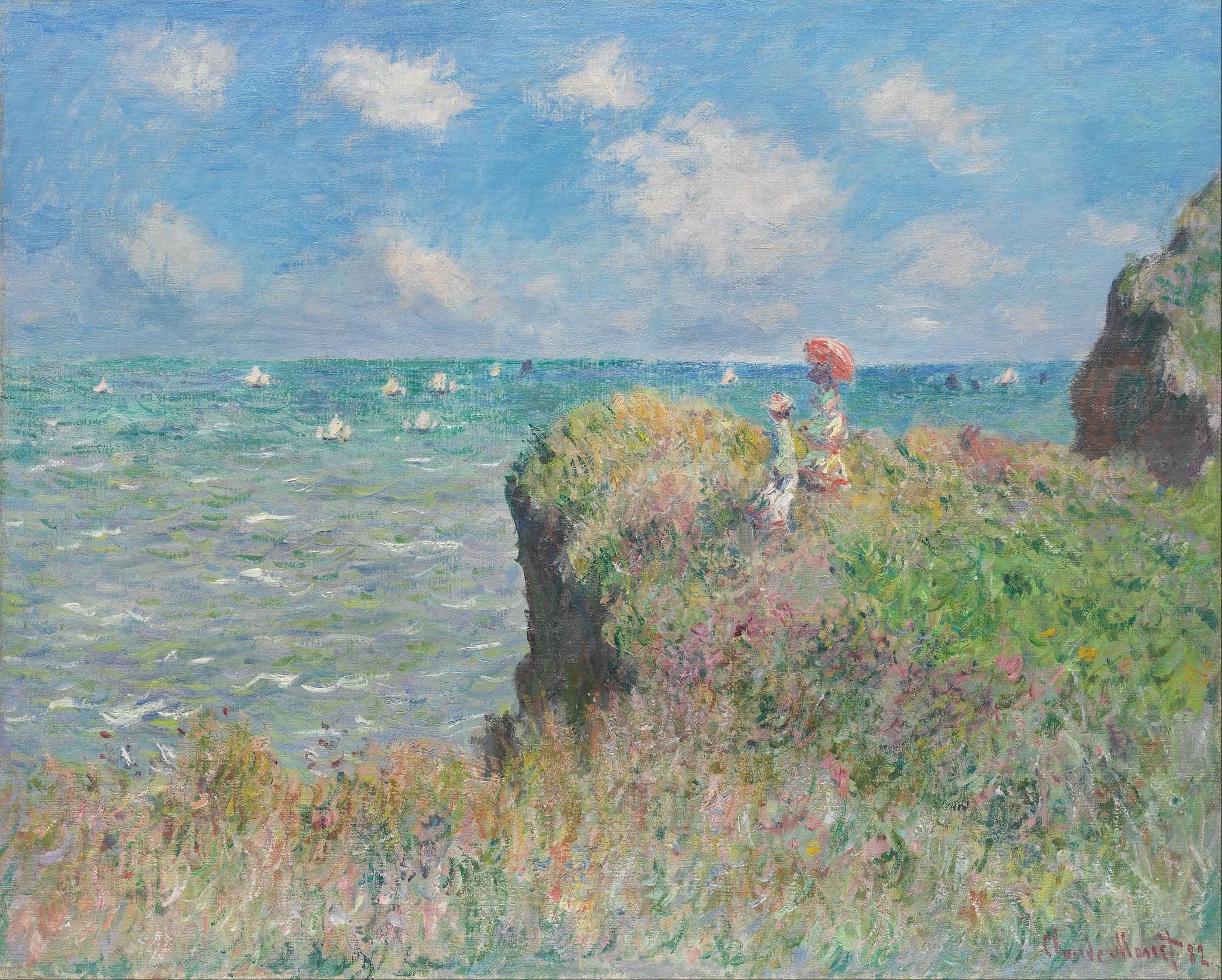
Start at the edge. In 1882 Monet escaped to a fishing village on the Normandy coast and worked like a man trying to outrun gossip. He had fallen in love with Alice Hoschedé, the wife of his former patron Ernest, whose finances had collapsed. Two households had fused into one. The art world was watching, and not kindly 4.
Pourville gave him wind, glare, and a plausible alibi: he could paint the sea and say nothing about the family drama. But he also needed pictures that would sell. Figures—especially fashionable women outdoors—made risky modern landscapes feel polite. The parasol was a ticket to acceptance, a familiar motif he’d used before to soften the shock of blazing light 3.
On this canvas, two walkers hover near a precipice, one under that sweet pink shade. The Art Institute notes that they are probably Alice and one of her daughters, folded into a view that otherwise keeps names out of the frame 12. No title announces them. No signature declares a portrait. It’s just a walk—until you know who’s walking.
The stakes? If Monet flaunted the relationship, he risked more than snide reviews. Ernest Hoschedé was still living; marriage for Monet and Alice would only be possible a decade later. Respectability—sales, stability, a future—hung on keeping the picture’s intimacy private 4.
Monet wrote from Pourville with the adrenaline of a man who had found both a subject and a shelter. He told Alice the coast was irresistible and that work was devouring him 2. Then he went back to the cliff.
"Here I am settled in Pourville… the country is superb." 2
What looks like a spontaneous snapshot wasn’t casual at all. Conservators at the Art Institute pulled the painting into the lab and found a twist: the sea and sky came first—and the figures came later, brushed over dried paint to animate the view [7].
"Technical study indicates the walkers were added after the landscape had set; the pink of the parasol is made from a fugitive red lake that has faded." [7]
Translation: Monet literally inserted the secret. He built a market-ready seascape, then slipped his future family onto the path—present but unnamed, domestic yet deniable. Even the color connived with time; that parasol, now a gentle rose, was once hotter, its dye bright and unstable, a blush that couldn’t last [7].
And the gamble paid. The painting traveled far from the scandal that birthed it, landing in Chicago where it’s one of the city’s breeziest icons, proof that a picture can launder a life story into pure atmosphere 1. Today, it’s introduced to many as a postcard of the modern sublime—two tiny figures measuring the sea’s immensity—without the footnote that the figures likely measured the limits of what Monet could admit aloud [6].
That’s the reversal: Cliff Walk at Pourville isn’t a carefree stroll. It’s a negotiation. Love, livelihood, and legacy lined up on a headland, and Monet painted them so beautifully we barely notice the secrecy written into the grass.
Sources
1 Art Institute of Chicago, object page: https://www.artic.edu/artworks/14620/cliff-walk-at-pourville
2 Art Institute of Chicago, online scholarly catalogue (Monet 1879–1882): https://publications.artic.edu/node/134338
3 National Gallery of Art, Woman with a Parasol – Madame Monet and Her Son: https://www.nga.gov/collection/art-object-page.61379.html
4 National Gallery of Art, Claude Monet — Artist Overview: https://www.nga.gov/collection/artist-info.1726.html
[7] Art Institute of Chicago, technical/conservation notes (print view): https://publications.artic.edu/api/epub/monet/135468/print_view
[6] Painting Meanings — The Cliff Walk at Pourville: /artworks/claude-monet/the-cliff-walk-at-pourville
Sources & Further Reading
The Cliff Walk at Pourville — Claude Monet
The Cliff Walk at Pourville — Claude Monet
The Cliff Walk at Pourville — Claude Monet
The Cliff Walk at Pourville — Claude Monet
The Cliff Walk at Pourville — Claude Monet