Painting Meanings Essay
Renoir’s Fake Date Night
Picture the stakes: Renoir is thirty-three, broke, and rolling the dice on a renegade show the Salon has snubbed—the first Impressionist exhibition. If this painting doesn’t spark attention, he’s not just unfashionable; he’s finished.
Picture the stakes: Renoir is thirty-three, broke, and rolling the dice on a renegade show the Salon has snubbed—the first Impressionist exhibition. If this painting doesn’t spark attention, he’s not just unfashionable; he’s finished.
So he chooses the hottest stage in Paris: an opera box, where status is performed as loudly as the music. As one period maxim had it, “one goes to the theatre to be seen.” (The Met’s survey of fashion and modern life doesn’t mince words about the loge: it’s a showroom as much as a seat.) 3
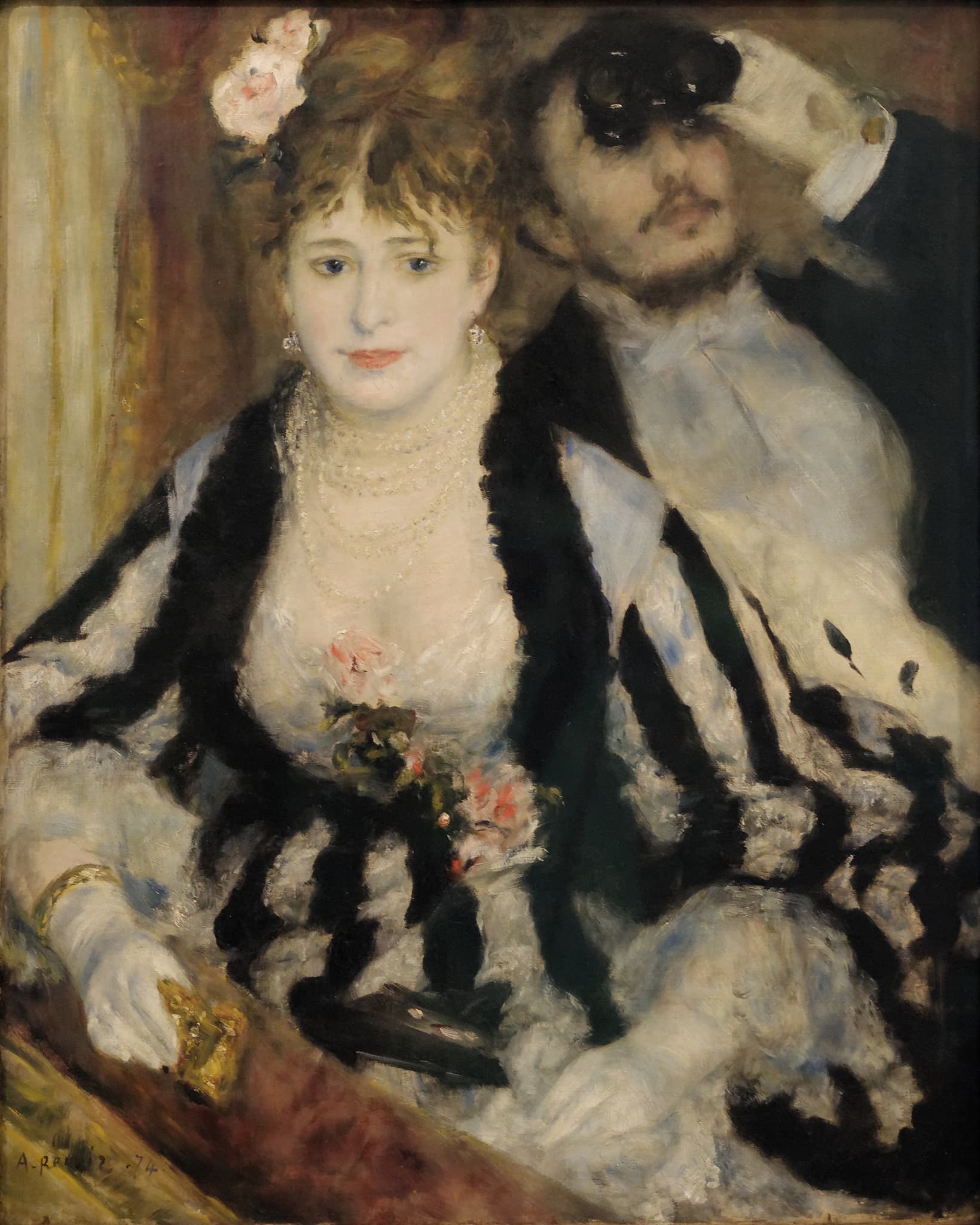
But here’s the twist behind the feathers and pearls. The woman is not a duchess; she’s Nini Lopez, a working model. Her “date” isn’t a suitor; it’s the artist’s brother, Edmond. And the plush perch? Renoir rented it for the pose. None of this was luck or candid chance—it was a set. The Courtauld’s record spells it out, and Smarthistory corroborates the cast and the staged box. 1 2
Renoir wasn’t just painting fashion; he was auditioning for acceptance. Silk, stripes, and pearls were proof-of-work—visual receipts that he could encode modern class on canvas. The opera glasses clinch it: hers lie idle, inviting us in; his are raised, signaling the social scan that defined the venue. The Met frames the loge as the arena where public and private blur. 3
Then he flips the power dynamic. She looks at us. We become the show. Christie’s calls this the “economy of looking,” a market where attention is traded, appraised, and spent. In La Loge, Renoir turns that economy back on the buyer. 4
“Turning spectators into spectacles.” The phrase might sound like a 21st‑century critique of feeds and followers, but it’s also how this painting reads today—see the Painting Meanings entry on The Loge for the cleanest distillation of that idea. [/artworks/pierre-auguste-renoir/the-loge]
Now revisit the faces. She sits fully lit, corsage blooming, a stack of pearls catching the chandelier. He is half-shadowed, more a function than a character: the surveyor, the social radar. Renoir sells the glitter while quietly showing the gears.
This wasn’t harmless chic. For a painter iced out by the gatekeepers, status scenes were survival tech. Staging a society fantasy with a model and a borrowed perch was both savvy and subversive: he delivered exactly what wealthy viewers wanted—the theater of themselves—while exposing how artificial that theater really was. The Courtauld notes its 1874 debut with the Impressionists; in that context, the masquerade reads like a dare. 1
Look long enough and La Loge stops being pretty and starts feeling modern. It’s an early blueprint for our image economy: a crafted setting, a practiced gaze, a performance of self aimed squarely at an audience that completes the work. Or to quote the scholarship that reframed it for a new century: the painting doesn’t just picture pleasure; it prices the act of looking. 4 [8]
That’s the secret: the most glamorous couple in Paris were hired, posed, and lit—so you would see yourself seeing them.
Footnotes:
1 Courtauld Gallery, La Loge (models, rented box, 1874 exhibition): https://gallerycollections.courtauld.ac.uk/object-p-1948-sc-338
2 Smarthistory, Pierre-Auguste Renoir, La Loge (Nini Lopez; Edmond Renoir; staged loge): https://smarthistory.org/auguste-renoir-la-loge/
3 The Met, Impressionism, Fashion & Modernity — Spaces of Modern Life (loge as “see and be seen” arena): https://www.metmuseum.org/en/exhibitions/listings/2013/impressionism-fashion-modernity/gallery-eight
4 Christie’s, contextual essay on La Loge and the “economy of looking”: https://www.christies.com/en/lot/lot-5075582
[8] Renoir at the Theatre: Looking at La Loge (Paul Holberton/Courtauld, 2008): https://search.worldcat.org/title/Renoir-at-the-theatre-%3A-looking-at-La-loge/oclc/213867453
Sources & Further Reading
The Loge — Pierre-Auguste Renoir
The Loge — Pierre-Auguste Renoir
The Loge — Pierre-Auguste Renoir
- [4]Christie’s essay introduces the ‘economy of looking,’ sharpening the painting’s modern implications.
The Loge — Pierre-Auguste Renoir
The Loge — Pierre-Auguste Renoir