Painting Meanings Essay
She Put Down the Fan
Look closely: the props of flirtation lie useless in the grass. The fan is shut.
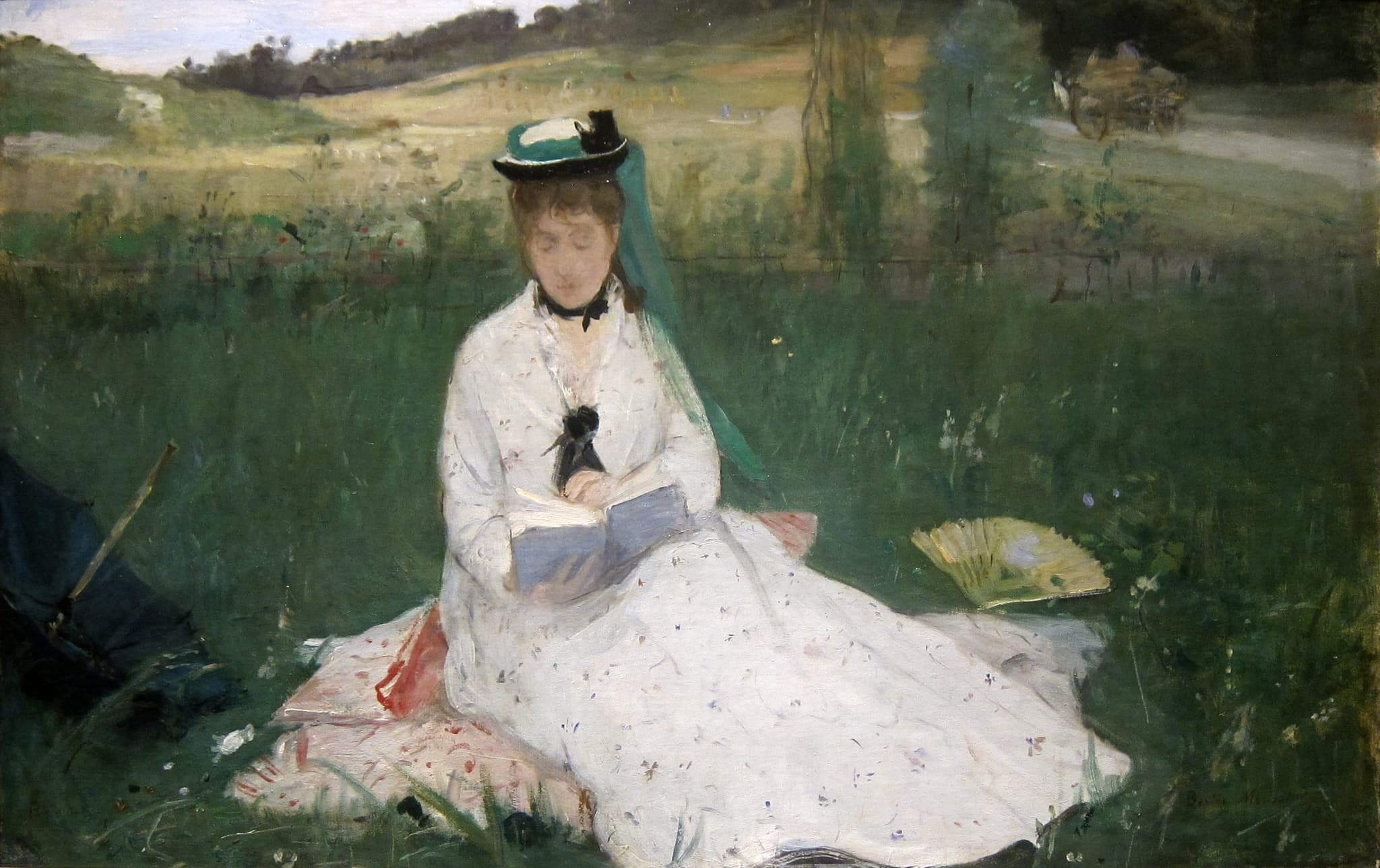
Look closely: the props of flirtation lie useless in the grass. The fan is shut. The green parasol is abandoned. A carriage blurs by in the distance, but the figure never looks up. She reads, and the world waits. Morisot painted this in 1873, her surface quick and alive, the scene almost dissolving around the reader’s concentration. The Cleveland Museum of Art calls it Reading; it’s small, disarming, and dangerously calm 2.
The stakes were not calm. In 1870s Paris, a woman alone outdoors drew rules to follow—shade the skin, manage the gaze, be tasteful, be seen. Morisot knew those codes; she also knew the costs. A book in the hand interrupts the loop of looking. It is a refusal to return the viewer’s stare.
Morisot had skin in this game. She was about to break with the Salon crowd and risk her standing by joining a rogue exhibition that would be mocked as a scandal and later renamed Impressionism. When the group staged its first show in 1874, she was the only woman among them, placing her reputation squarely on the line 3. A bourgeois daughter painting modern life, then stepping outside the academy’s approval system—this was not summer leisure. It was a career bet.
And the picture keeps pointing to the decision she makes. The instruments of being looked at—fan, parasol—sit idle. We love to imagine a secret “language of the fan,” but dress historians have shredded that romantic myth as a twentieth-century confection deployed by marketers, not nineteenth-century women 5. Morisot stages the debunking a half-century early: the fan is not a code; it’s just not in use.
What about the parasol? It once signaled propriety and delicate skin, but Morisot drags it to the edge of the frame, nearly out of sight. The center of the picture is elsewhere.
Here’s the reveal. In a recent wave of reappraisal, critics have argued that Morisot wasn’t a side character to the movement—she was its conscience. Or as one headline put it, she "emerges from the margins." 4
Her subject in Reading isn’t a perfect dress or a sunny field. It’s a woman’s interior life—visible only because the surface threatens to vanish. The meadow churns into brushstrokes; the book anchors the scene. Our own Painting Meanings page says the quiet part out loud: "female intellectual absorption" is "its true subject" 1.
That’s the reversal. The Impressionist trick—paint what light does to things—becomes Morisot’s argument for what thought does to a person. She paints the sensation of attention, the way concentration bleaches edges and lets the peripheral world go soft. The face isn’t a portrait; it’s a mood we recognize: reading as self-possession.
And because she made this a year before stepping into the furnace of 1874, the reading becomes a prelude to her own leap. Pick up a book, pick up a brush, pick up your place in public. She would keep painting women not as ornaments but as decision-makers—at windows, in rooms, in gardens—everywhere interiority could flare up in plain sight 3.
The market didn’t need to scandalize this image for it to be radical. The radical part is that nothing happens—and that counts as everything. The fan’s silence, the parasol’s neglect, the page that holds a mind: these are not social niceties. They’re evidence.
What people get wrong about Reading is assuming it’s about leisure when it’s actually about liberty. The difference is the cost. Leisure is granted; liberty is taken. Morisot took it with speed, with tact, and with nerve—then hung it on a wall. If you want the blueprint for how a picture can argue without a single speech bubble, it’s right here 2.
See the painting, the fan on the grass, the world on hold. Then remember what the title does not say: Performing. Waiting. Looking. It says Reading. That’s the whole story 1.
Sources & Further Reading
Reading — Berthe Morisot
Reading — Berthe Morisot
Reading — Berthe Morisot
Reading — Berthe Morisot
Reading — Berthe Morisot
Continue Exploring
See what else you missed in Morisot’s quiet revolutions: /artworks/berthe-morisot/reading