Painting Meanings Essay
The Audition in Blue: Renoir’s Gamble Behind Girl with a Watering Can
Picture Renoir at 35, debts circling, reputation wobbling after the second Impressionist show. The critics mocked his circle; the market yawned.
Picture Renoir at 35, debts circling, reputation wobbling after the second Impressionist show. The critics mocked his circle; the market yawned. Portrait commissions — the cash engine of Paris — kept going to establishment names. He had to change that or sink. National Gallery, London 2.
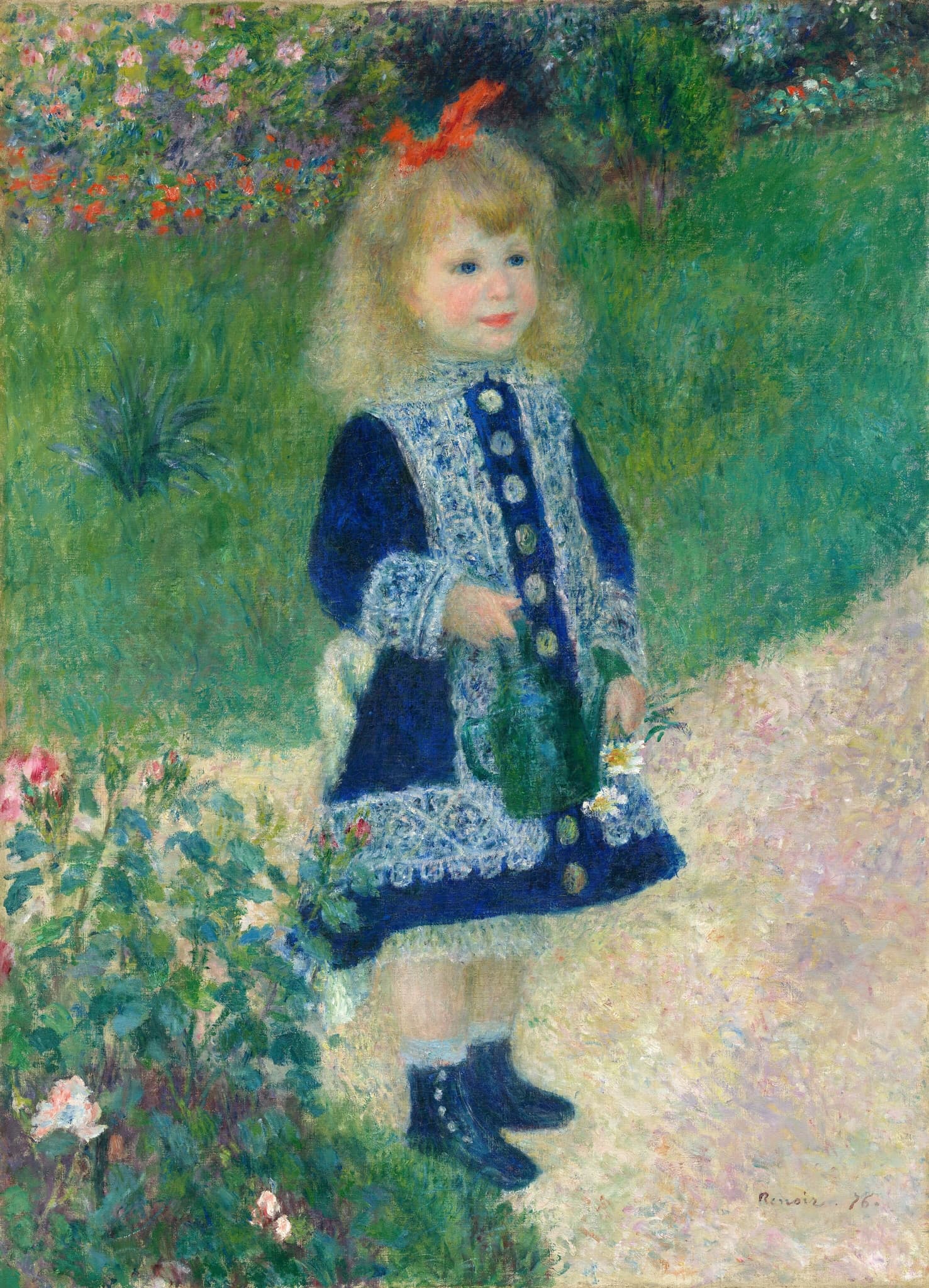
So he borrows a garden. Not just any garden — Claude Monet’s suburban stage in Argenteuil, where middle-class leisure bloomed as aggressively as the roses. Renoir sets a tiny actor center frame: a little girl in a cobalt dress, holding a small green prop. It looks innocent. It reads strategic. The museum’s record is blunt about the setting and the mystery of the model. National Gallery of Art, Washington 1.
What’s at stake? Everything. Portraits of children were the velvet rope into Paris salons and purses — advertising in oil. Get one society mother to talk, and the commissions multiply. Get it wrong, and you’re still the broke Impressionist who paints blurry picnics.
Renoir understood the brief. He tightens the face until it’s porcelain-clear and lets the garden dissolve into confetti, a trick that promises both likeness and fashion. It’s a sales pitch in brushwork: I can please you and be modern. The National Gallery of Art’s entry notes that contrast — the crisply perceived child floating in a haze — which is the whole gambit. NGA 1.
"For me a picture should be a pleasant thing, joyful and pretty—yes, pretty." That’s Renoir talking, not apologizing. He knew the word that opens doors in a patron’s parlor: pretty. National Gallery, London 2.
The watering can isn’t random cuteness either. By the mid‑1800s, the watering can was a sleek, mass‑made emblem of domestic cultivation — a household tool turned badge of taste in the new private gardens. Out of the fields, into the parterre: modern nurture you could buy. Renoir leans on that signal to flatter a class obsessed with improvement. Smithsonian Gardens 4.
"Painted in the garden at Monet’s house in Argenteuil." Read that again — it wasn’t a family backyard, it was a friend’s outdoor studio and social magnet, where appearances were curated. The painting is a stage: costume, prop, backdrop. NGA 1.
Here’s the twist most viewers miss: it’s not a commission. The identity of the child is unknown — likely a neighbor — because the real client isn’t in the frame. The client is the future. Renoir uses a stranger’s child to demonstrate he can immortalize yours.
Two years later, the bet pays: Madame Charpentier and Her Children storms the 1879 Salon, and suddenly Renoir isn’t the scrappy outsider but the portraitist of choice. That single success brought a flood of commissions from the very world this blue dress courted. Smarthistory 3.
Look back at the little hand gripping the can. It’s not watering — it’s holding the possibility of a career. The painting models a new bargain between avant‑garde shimmer and bourgeois certainty: keep the face legible, let the world sparkle. The National Gallery of Art now owns the result, proof that the market eventually bought the pitch. NGA 1.
If you’ve always read Girl with a Watering Can as pure innocence, you’re not wrong — that’s why it works. But the truth is sharper, and better: this is how an Impressionist hacked respectability. Visit the image, linger on the salesmanship, then compare our quick guide to its symbols and color cues here: /artworks/pierre-auguste-renoir/girl-with-a-watering-can 5.
It wasn’t a memory of childhood — it was a business card.
Sources
1 https://www.nga.gov/artworks/46681-girl-watering-can
2 https://www.nationalgallery.org.uk/artists/pierre-auguste-renoir
3 https://smarthistory.org/renoir-charpentier/
4 https://gardens.si.edu/collections/explore/object/hac_1987.024
5 https://paintingmeanings.com/artworks/pierre-auguste-renoir/girl-with-a-watering-can
Sources & Further Reading
Girl with a Watering Can — Pierre-Auguste Renoir
Girl with a Watering Can — Pierre-Auguste Renoir
Girl with a Watering Can — Pierre-Auguste Renoir
Girl with a Watering Can — Pierre-Auguste Renoir
Girl with a Watering Can — Pierre-Auguste Renoir
Continue Exploring
Seen this painting in person? What did you notice first — the face, the dress, or the sales pitch? Reply with your read.