Painting Meanings Essay
The Picnic That Made an Emperor Blink
Start with the stakes: the Paris Salon decided an artist’s fate. Win the jury, you get buyers, critics, immortality.
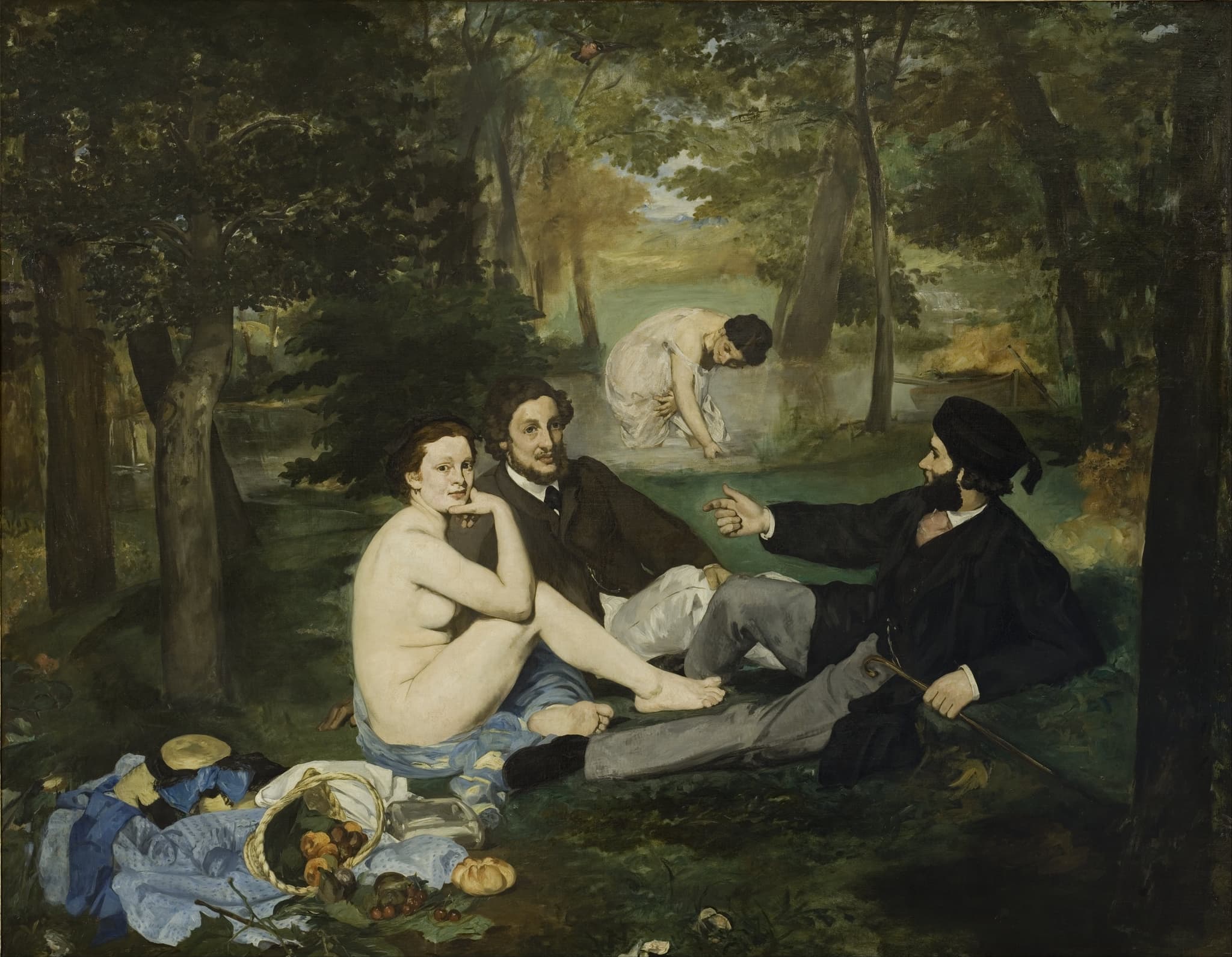
Start with the stakes: the Paris Salon decided an artist’s fate. Win the jury, you get buyers, critics, immortality. Lose, you vanish. That year, the jury rejected an unusually high number of submissions. Among the refusés was a picnic with a stare that wouldn’t look away—Édouard Manet’s Le Déjeuner sur l’herbe, then called Le Bain. The museum that owns it now says flatly: it “caused a scandal.” Musée d’Orsay 1.
Crowds howled. Artists complained to the emperor. Napoleon III did something no ruler had done: he ordered a rival show for the rejects so the public could see what the jury had buried. The Metropolitan Museum’s history of Manet uses the emperor’s own justification:
“so that the public could judge the merit of the rejected works.” The Met [3]
Overnight, a painting the jury tried to smother got a bigger stage—the Salon des Refusés.
Imagine walking in: two respectable young men in dark suits relax on grass; beside them, a nude woman—Victorine Meurent, a working model—meets your gaze without flinch. The men, often identified as Manet’s brother Eugène and his future brother‑in‑law Ferdinand Leenhoff, are dressed like you. That’s the needle prick. No myth, no veil, no alibi. It looked like today, with yesterday’s rules ripped out Smarthistory 2]; [Musée d’Orsay 1.
The backlash got personal. Caricatures mocked the figures. Friends urged caution. Manet had already failed with the Salon once; another public fiasco could brand him a clown. Family reputation, future sales, respect among peers—everything wobbled. He doubled down.
Here’s the reversal: the so‑called indecency was art history, flipped. Manet borrowed a Renaissance composition—Raphael via Marcantonio Raimondi—and a pastoral mood from Titian/Giorgione, then dragged it into modern Paris. Old-master scaffolding with streetlight glare. That was the shock. He wasn’t overthrowing tradition; he was hot‑wiring it Smarthistory 2]; [Musée d’Orsay 1.
Manet’s own stance could fit on a calling card:
“One must be of one’s time and paint what one sees.” The Met [3]
He’d bet his name on it. When the Salon snubbed him again, he built his own pavilion near the 1867 world’s fair—a one-man museum to force the issue, a publicity risk he could barely afford, but one that kept the fight public The Met [3].
And the payoff? The picnic didn’t just scandalize; it reset the referee. Once an emperor opened a show for the outcasts, spectators learned to read against the jury. That reflex—the belief that a picture can be wrong today and right tomorrow—became the oxygen of modern art. A century and a half later, the Musée d’Orsay staged “Picasso/Manet: Le déjeuner sur l’herbe,” tracking how the rebel picnic still provokes giants to wrestle with it Musée d’Orsay Exhibition 5]. Want the image and the nerves that made Paris flinch? See our spotlight on the painting here: [/artworks/douard-manet/luncheon-on-the-grass. [6]
The jury tried to bury a picnic; instead it invented the audience that would dethrone it. Full stop.
Notes
1 Musée d’Orsay, object record for Le Déjeuner sur l’herbe — https://www.musee-orsay.fr/en/artworks/le-dejeuner-sur-lherbe-904
[2] Smarthistory, Manet: Le déjeuner sur l’herbe — https://smarthistory.org/edouard-manet-le-dejeuner-sur-lherbe-luncheon-on-the-grass-2/
[3] The Met, Heilbrunn Timeline (Rebecca Rabinow), Édouard Manet — https://www.metmuseum.org/toah/hd/mane/hod_49.58.2.htm
[5] Musée d’Orsay, exhibition: Picasso / Manet: Le déjeuner sur l’herbe — https://www.musee-orsay.fr/en/whats-on/exhibitions/presentation/picasso-manet-le-dejeuner-sur-lherbe
[6] Painting Meanings: Luncheon on the Grass — /artworks/douard-manet/luncheon-on-the-grass
Sources & Further Reading
Luncheon on the Grass — Édouard Manet