Painting Meanings Essay
The Sunniest Monet Was Painted in a Storm
First glance: a perfect day. Parasols tilt.
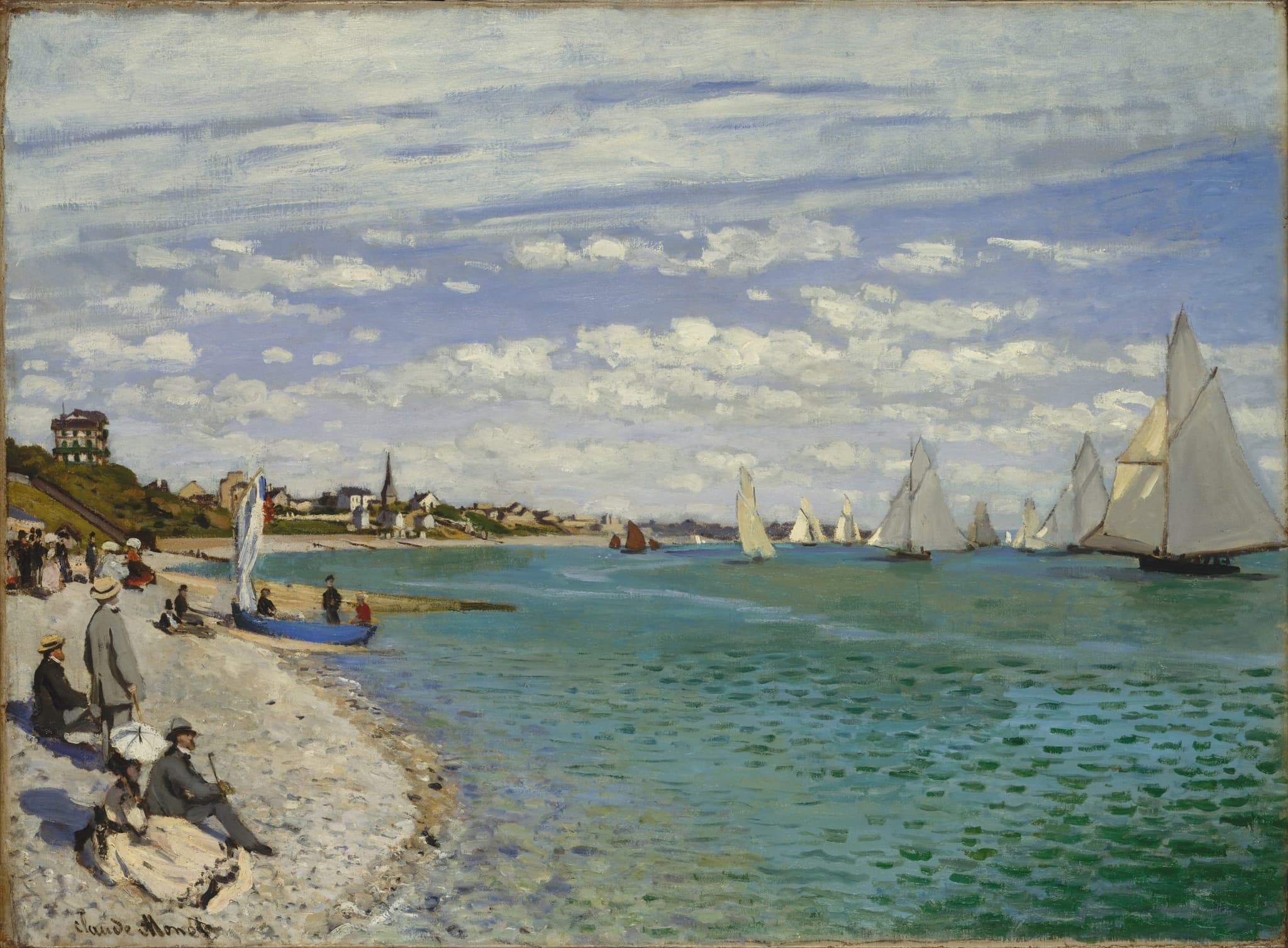
First glance: a perfect day. Parasols tilt. White sails cut the Channel. Sun freckles the water like confetti. It looks like a rich man’s postcard. That’s the trap.
In 1867, Monet was twenty-something, unknown, and already in trouble. His companion Camille had just given birth to their son, Jean. Monet’s family disapproved. Money was scarce, reputation precarious, and he needed help from relatives who liked their painters respectable and their scenes, well, presentable.
So he went home. Or close to it. As the Met puts it:
"Monet spent the summer of 1867 with his family at the resort town of Sainte-Adresse, near Le Havre." 1
On those bright afternoons, yacht races thrilled the seaside crowd. Monet set up on the shingle and painted a view the bourgeois could love—society on holiday, sea-breeze optimism, a France not at war with itself.
Here’s the tension: on that same timeline, Camille and the baby remained in Paris, precarious and mostly invisible in the canvas. The painter who would become the poet of light was, right then, splitting his life in two—public face for the family, private costs for love. The Met’s overview of his early years is blunt about the pressure: "His family disapproved of the liaison," and Monet was scraping by even as he chased the Salon. [2]
Regatta at Sainte-Adresse—now at the Met—reads like success rehearsed in paint: crisp horizon, tidy villas, all those sails like white handkerchiefs waving approval. The brushwork is brisk, but the social message is neat: I can give you modern life, polished and saleable. If the sea flickers with quick strokes, the story feels controlled.
Then comes the flip. A second canvas from the same spot, now at the Art Institute of Chicago, shows gray sky, choppy water, and laborers hauling boats. No parasols. No pageant. Same coastline, different class. The museum lays it out:
"The Beach at Sainte-Adresse and the Met’s Regatta at Sainte-Adresse were probably conceived as a pair, contrasting weather, tide, and social class." [3]
Two views, one vantage—Monet’s split life in stereo.
The pair theory isn’t romantic revisionism; the archival scholarship supports it. The Chicago catalogue maps the sequence, the weather, the local races, and the way Monet toggled between scenes of leisure and work that season. [4] Imagine him calculating: one painting for acceptance, one for truth. Or maybe one to buy groceries, one to keep faith with the world he actually saw.
What’s at stake isn’t paint; it’s belonging. If Regatta were simply a bright day, it wouldn’t burn. But the context charges it. The family he hoped would fund his future gathered on that pebbled beach. The partner he loved wasn’t invited. The regatta sails become stand-ins for a choice—career or conviction—while the artist tries to have both.
That’s why the image hits harder once you know the offstage scene. The diagonals that sweep us toward the bay read like resolve. The serried sails imply a path out of obscurity. And the genteel spectators along the shore—parasol nation—double as an audience Monet must win to survive. The Met’s wall text stresses those yacht races as a seasonal high point; to a young painter on the brink, they were also a stage. 1
The reversal is the lesson: the most carefree painting in the room can be the one painted under maximum pressure. Regatta at Sainte-Adresse isn’t an escape from reality; it’s a negotiation with it. If you want to see the bargain in full, place the Met’s sunlit regatta beside Chicago’s working shore, then read the summer’s backstory. The canvas brightens—and complicates—at once. [3][4]
So yes, it shimmers. But it also testifies. Monet’s breakthrough wasn’t only technical; it was emotional camouflage turned into modern vision. He made a picture everyone could love while telling a story only some would hear. That’s how an artist survives long enough to change the weather.
Key takeaway: the happiest scene in Monet’s Normandy is not carefree—it’s a mask that let him keep painting. Abruptly, that’s the point.
Notes / Sources: 1 The Met, Regatta at Sainte-Adresse object page (background and 1867 summer). https://www.metmuseum.org/art/collection/search/437136. [2] The Met, Claude Monet (1840–1926) timeline essay (family disapproval, early hardship). https://www.metmuseum.org/essays/claude-monet-1840-1926. [3] Art Institute of Chicago, The Beach at Sainte-Adresse (pairing and class contrast). https://www.artic.edu/artworks/14598/the-beach-at-sainte-adresse. [4] AIC Online Scholarly Catalogue, Sainte-Adresse entries (sequence, weather, and race context). https://publications.artic.edu/reader/monetpissarro/section/134367. Plus: Painting Meanings artwork page for image and overview: https://www.paintingmeanings.com/artworks/claude-monet/regatta-at-sainte-adresse.
Sources & Further Reading
Regatta at Sainte-Adresse — Claude Monet
Continue Exploring
See the painting, then read the ‘twin’—and decide which side of Monet’s summer you believe.