The Iron Train Shed in Gare Saint-Lazare
A closer look at this element in Claude Monet's 1877 masterpiece
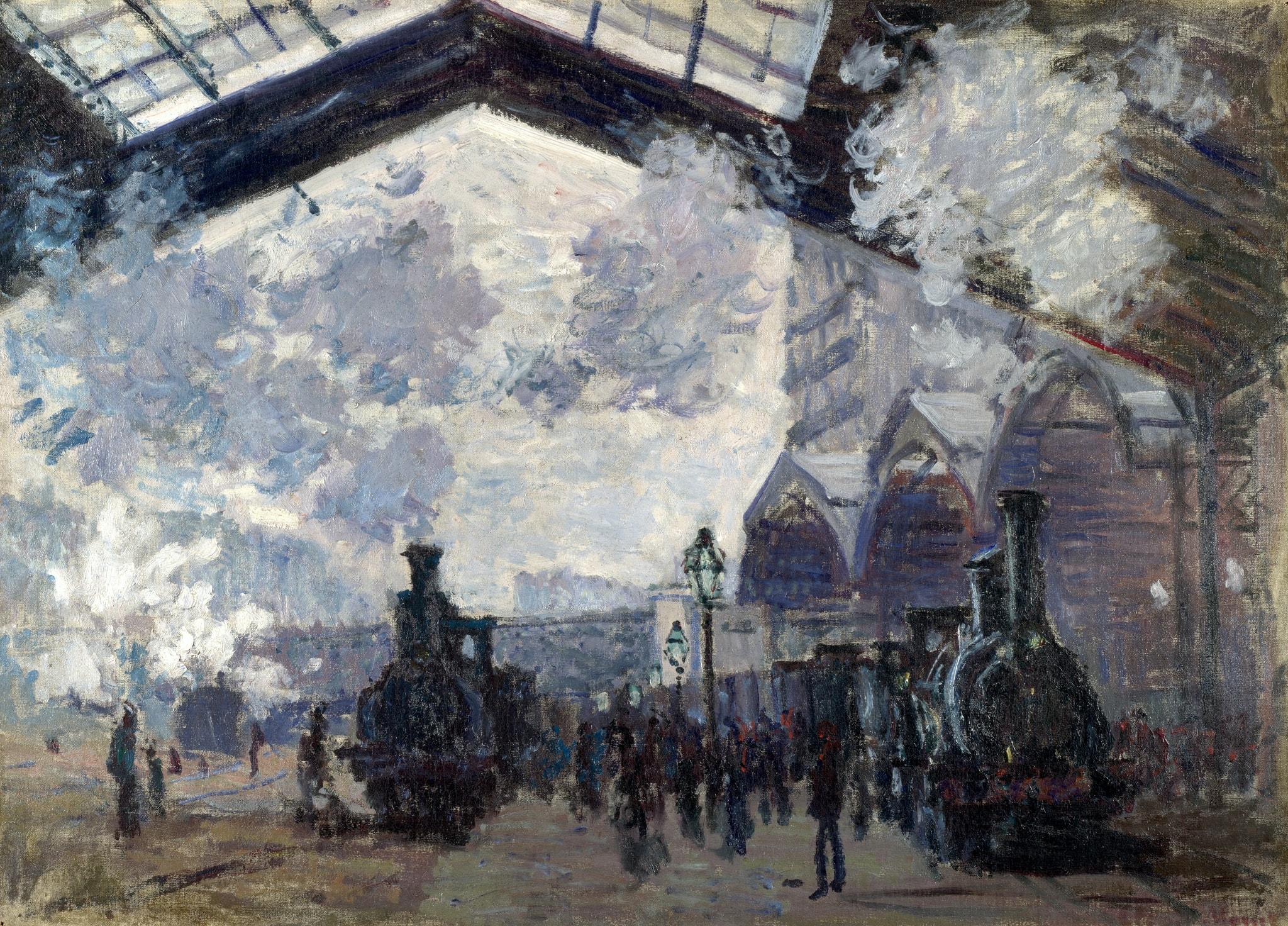
Monet transforms the iron-and-glass train shed of Gare Saint‑Lazare into a man‑made sky, where steam and daylight collide inside an engineered vault. By staging modern optics beneath this canopy, he turns a railway terminal into a new kind of urban landscape and a manifesto of contemporary life.
Historical Context
In early 1877 Monet moved into Paris’s Nouvelle‑Athènes quarter and secured permission to paint directly inside Gare Saint‑Lazare. Over several winter months he worked in front of arriving and departing engines, seeking a subject that united vapor, glare, and motion with the city’s newest iron‑and‑glass architecture. The station’s vast shed—long spans of trussed iron glazed with glass—offered a ready‑made atmospheric theater, which Monet repeatedly set high in the frame so its panes and girders became the scene’s luminous “ceiling.” 12
The site itself embodied the modern capital. Enlarged in the 1850s to designs by engineer Eugène Flachat, Saint‑Lazare’s celebrated spans (about forty meters) sheltered a traffic hub serving millions of riders annually—an emblem of Parisian progress that Monet treated as both subject and structure. He painted the series intensely from January to March 1877 and presented seven canvases at the Third Impressionist Exhibition that April, asserting an art devoted to the present tense of the city and to the optical drama generated by the station’s iron train shed. 12
Symbolic Meaning
The shed functions as a concise emblem of industrial modernity. Its engineered trusses and glass fields announce the materials and methods that remade nineteenth‑century Paris, while the locomotives below advertise the speed and connectivity of a new urban order. Critics and museums alike have long read Monet’s station scenes as icons of modern life, where industrial structure and pictorial sensation coincide. By enclosing steam and daylight within a closed roof, Monet internalizes effects once reserved for landscape and makes technology itself the generator of atmosphere. 14
The canopy also encodes a modern regime of time discipline. Railways synchronized clocks, timetables, and human movement; the station’s roof, strung with signals and oriented to regularized flows, frames Monet’s “instant” within that standardized temporal grid. Recent scholarship ties the Gare Saint‑Lazare campaign directly to this transformation, reading the iron‑and‑glass hall as both subject and instrument of modern time. In this light, the shed’s rigid geometry and the dissolving eddies of vapor enact a dialectic between the measured and the fugitive—the engineered span versus evanescent perception—so that the painting becomes a portrait of perception under industrial time. 76
Artistic Technique
Monet builds a clear opposition between structure and atmosphere: dark, angular girders articulate the canopy while calligraphic swirls of steam churn beneath, turning the shed into a crisp armature for optical play. He avoids dead black, constructing deep tones by mixing vivid nineteenth‑century pigments—synthetic blues and red lakes—then modulating them across panes, ribs, and shadows to keep the ironwork alive in light. 15 In several canvases he sets the roof’s apex high and diagonal, guiding the eye down the platforms and into the haze. Close analysis records thick impasto dabs to suggest individual glass panes and passages where he paints over thin tie‑rods, subordinating literal detail to atmospheric unity. The roof thus reads not as dry description but as a vibrating screen for steam and daylight. 34
Connection to the Whole
Compositionally, the shed is the painting’s scaffold. Monet often laid in the architecture first, using its spanning trusses to organize platforms, engines, workers, and passengers, so that light and vapor could register against a stable grid. By replacing open sky with a glass canopy, he redefines the work as an interior landscape of the modern city—an urban weather system contained by engineering. 1
Across the series, the constant canopy permits variations of traffic, light, and steam, anticipating Monet’s later serial method with haystacks and cathedrals. Because Saint‑Lazare linked Paris to Argenteuil and Normandy, the shed also anchors a nexus of personal routes and metropolitan growth, binding private geography to public infrastructure. In every version, the iron train shed is both framework and theme: the architecture that holds the picture together and the modernity the picture declares. 46
Explore More from This Painting
This detail is one part of Gare Saint-Lazare. Use the links below to return to the full interpretation, browse the full set of details, or view the painting's valuation if available.
Sources
- National Gallery, London — Claude Monet, The Gare St‑Lazare (object page and essay)
- Musée d’Orsay — La Gare Saint‑Lazare (object page)
- Harvard Art Museums — The Gare Saint‑Lazare: Arrival of a Train (object page)
- Art Institute of Chicago — Arrival of the Normandy Train, Gare Saint‑Lazare (object page and scholarly catalogue)
- National Gallery Technical Bulletin — A. Roy, "The Palettes of Three Impressionist Paintings"
- National Gallery of Art — Juliet Wilson‑Bareau, Manet, Monet, and the Gare Saint‑Lazare (publication)
- The Art Bulletin — "Impressionism and the Standardization of Time: Claude Monet at Gare Saint‑Lazare" (2020)