The Locomotive in Gare Saint-Lazare
A closer look at this element in Claude Monet's 1877 masterpiece
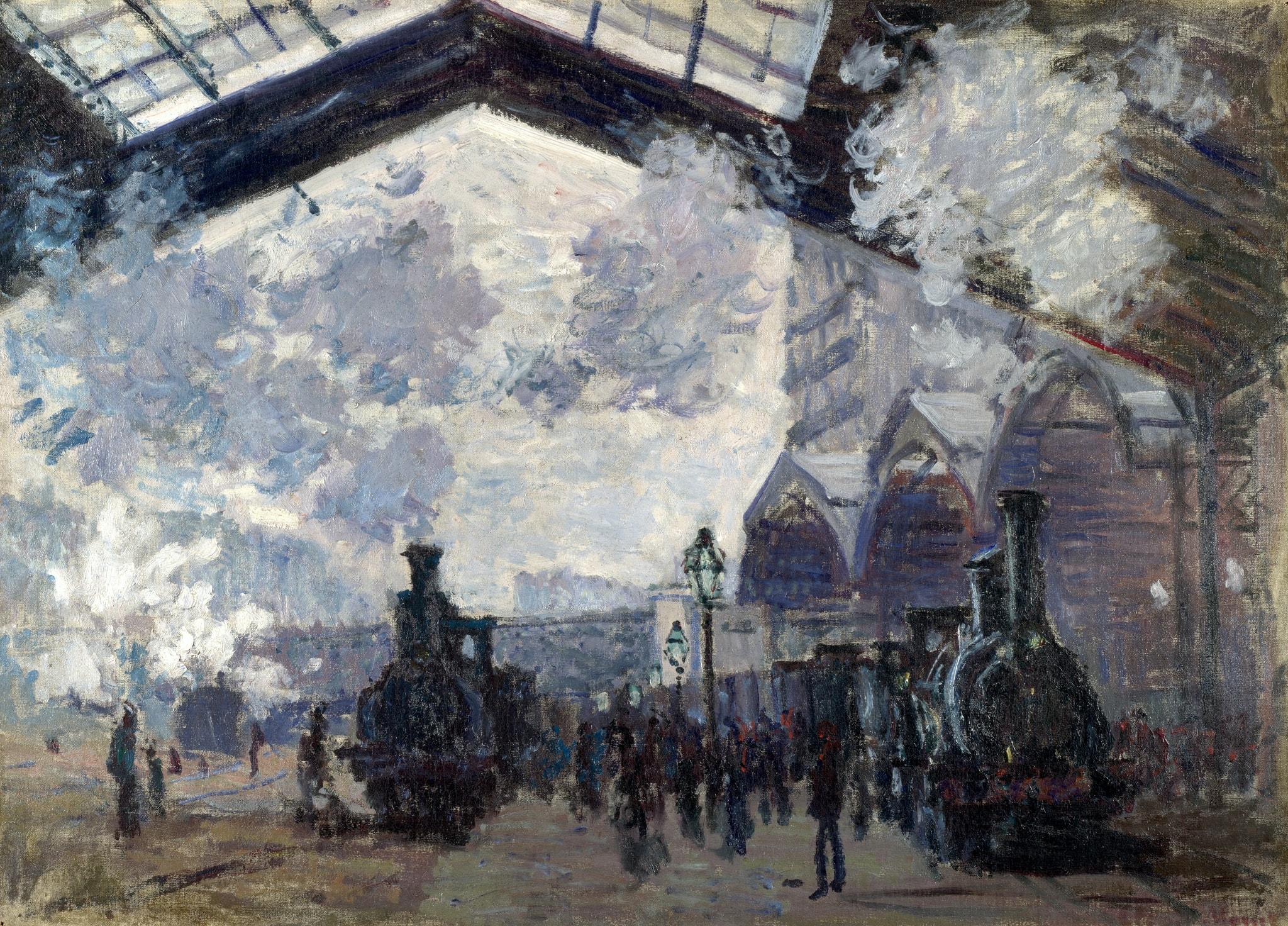
Monet’s locomotive is both subject and generator: a dark, compact engine that exhales the vapor turning the iron-and-glass shed into a luminous interior sky. By making the machine the source of atmosphere, Monet fuses modern industry with Impressionist vision, converting steam, iron, and light into a drama of color and time.
Historical Context
In early 1877 Claude Monet secured permission to work inside Paris’s Gare Saint‑Lazare, then one of Europe’s busiest terminals. Over several weeks he painted a campaign of views—arrivals, departures, and platforms under the vast shed—and exhibited a group of them at the third Impressionist exhibition that spring. The station offered what he sought in the city: mutable light, moving crowds, and the striking conjunction of iron, glass, and steam. The locomotive anchors that program as a new kind of motif, at once mechanical and atmospheric. In the National Gallery’s version, two engines sit at the buffers, their bulk legible through silhouette and pricks of color while vapor swallows detail; further trains dissolve into haze beyond the canopy 1.
Monet’s choice answered contemporary calls to depict modern life and aligned with Paris’s transformation after Haussmann and the rise of rail travel. By bringing his easel inside a working terminus, he treated the station as a modern landscape in which engineered structure replaces horizon and sky, and the engine’s breath supplies the clouds—a radical turn for 1877 painting 2.
Symbolic Meaning
The locomotive operates as an emblem of modernity—speed, industry, and engineered light. Critics and curators have long read Saint‑Lazare’s engines and shed as icons of the new urban world, where iron trusses, glass roofs, and steam reorder visual experience. Monet intensifies that meaning by placing the engine at the center of perception: the machine generates the vapor that becomes the painting’s true subject, so technology itself produces the spectacle of light and color 1. This aligns his work with a broader nineteenth‑century narrative in which railways transformed mobility, leisure, and the city’s rhythms 3.
Scholars also link the series to the standardization of national time brought by the rail network. Within that frame, the locomotive’s regulated arrivals and departures figure a society newly governed by timetables and precision; the pulsing clouds can be read as visualizations of modern, synchronized time 8. As a public, mixed space where classes intersected, the station made those forces visible and shared; the engine marks that transitional, collective urban experience 9. Finally, Monet’s locomotive converses with a pictorial lineage—from Turner’s Rain, Steam and Speed to Impressionist seriality—recasting the industrial engine as a vehicle for perceiving flux rather than merely a feat of engineering 15.
Artistic Technique
Monet renders the engine’s mass without resorting to flat black. Technical study shows he builds deep tones from mixtures—purples enriched with red lake, cobalt‑blue highlights riding the boiler, and lead white structuring the steam and sky—so that what seems gray is in fact chromatically alive 14. Conservation of related canvases records an initial lay‑in that reserved the steam’s volumes; later passes let vapor overrun iron tie rods and edges, making smoke the active shaper of form 5.
Compositionally, he opposes the shed’s rigid lattice to the locomotive’s drifting plumes, raising the roof’s apex to read as an interior “sky” while engines and crowd sit low, bound by haze. Other versions underscore the same device: a large black engine arrives in puffs that animate the space, confirming the engine as both object and atmosphere-maker 6.
Connection to the Whole
The locomotive is the painting’s hinge between narrative and perception. It supplies the plot—arrival and departure—while exhaling the vapor that lets Monet turn a terminus into a weather event. Its dark, compact silhouette anchors the lower register so that the iron canopy can expand overhead like a sky, the eye moving from dense mass to dissolving light 15.
Across the 1877 campaign the same engine motif powers Monet’s serial method: repeated view, shifting hour, changing plume. In this way the locomotive literalizes the series’ engine—converting industrial power into color and time, and binding structure (signals, trusses, schedules) to flux (steam, crowds, moments). The result is a modern landscape painted indoors, with the machine making the image possible both pictorially and thematically 27.
Explore More from This Painting
This detail is one part of Gare Saint-Lazare. Use the links below to return to the full interpretation, browse the full set of details, or view the painting's valuation if available.
Sources
- National Gallery, London — Claude Monet, The Gare St‑Lazare (in‑depth entry)
- Musée d’Orsay — La Gare Saint‑Lazare
- The Met — Impressionism: Art and Modernity
- National Gallery, London — How did new pigment technologies drive the Impressionist movement?
- Art Institute of Chicago — Arrival of the Normandy Train, Gare Saint‑Lazare (scholarly catalogue)
- Harvard Art Museums — The Gare Saint‑Lazare: Arrival of a Train
- National Gallery of Art (Washington) — Manet, Monet, and the Gare Saint‑Lazare
- The Art Bulletin — Impressionism and the Standardization of Time: Claude Monet at Gare Saint‑Lazare
- Smarthistory — Monet, The Gare Saint‑Lazare