The Steam Clouds in Gare Saint-Lazare
A closer look at this element in Claude Monet's 1877 masterpiece
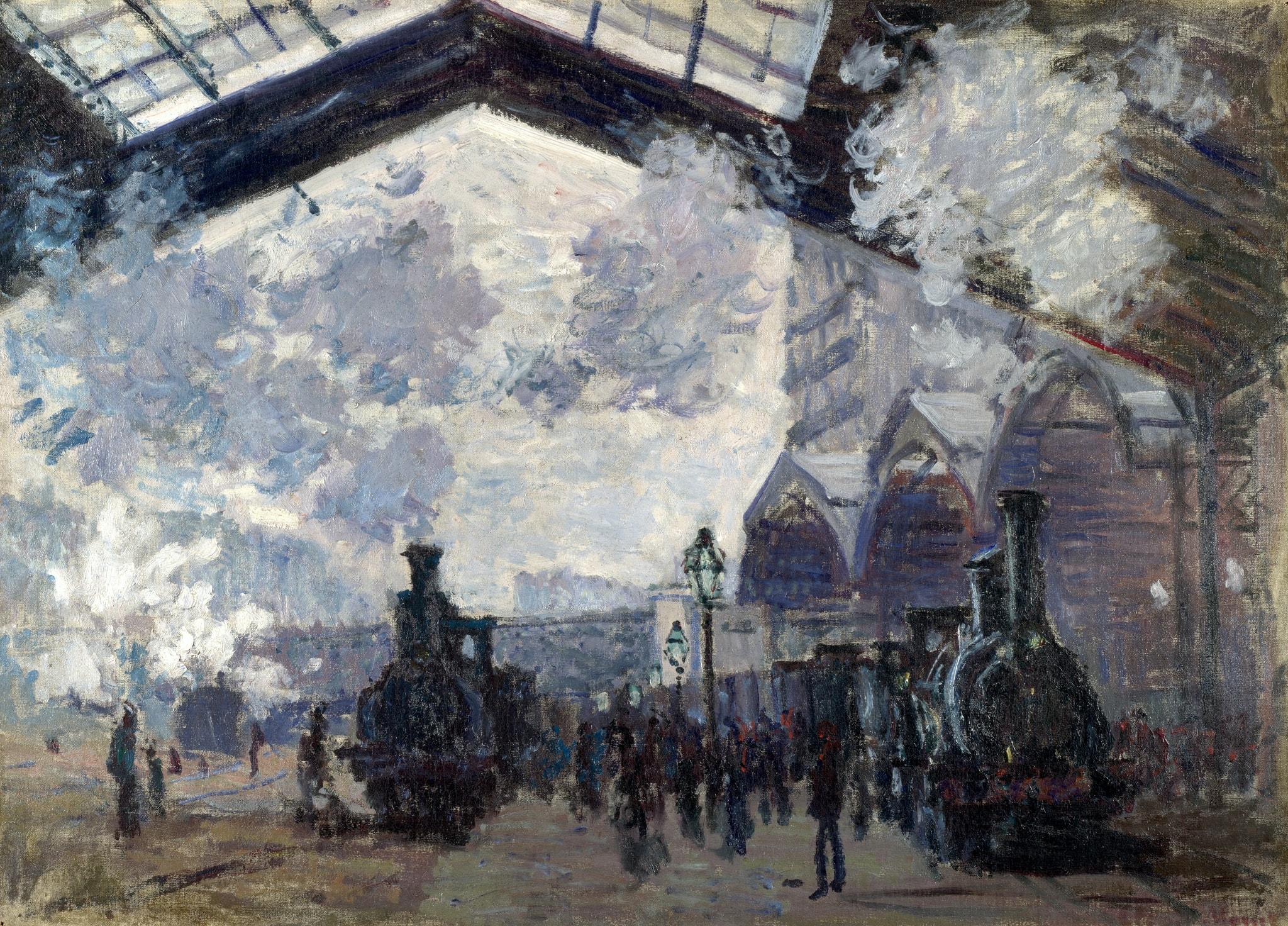
In Monet’s Gare Saint‑Lazare series, the steam clouds are not background—they are the protagonist. Billowing under the iron-and-glass roof, they turn a working station into an “interior sky,” fusing modern industry with Impressionism’s obsession with light and fleeting sensation [2]. Through steam, Monet makes modern Paris’s motion, noise, and time visible [1][3].
Historical Context
In early 1877, newly settled back in Paris, Monet secured permission to work inside the Gare Saint‑Lazare, a showcase of Haussmann-era engineering and commuter traffic. Across roughly January to March he produced a dozen canvases, repeatedly staging the station’s iron vaults and the locomotives’ vapor as the drama of the scene. The Musée d’Orsay notes that Monet deliberately sought the site for its changing light, mobility, and, crucially, its “nuages de vapeur,” the mutable substance that would let him pursue an urban equivalent of plein‑air atmosphere 1.
The National Gallery underscores the subject’s modernity: by 1870 Saint‑Lazare handled around 11 million passengers annually, making it an emblem of speed, schedules, and industrial power. Monet inverted landscape convention by translating outdoor light and cloud into a manufactured, indoor environment—an engineered sky contained by glass and iron 2. When he exhibited several of the paintings together at the Third Impressionist Exhibition (April–May 1877), critics like Émile Zola praised their capture of the station’s excitement and torrents of smoke, registering steam as both motif and experience 3.
Symbolic Meaning
The steam clouds read as an emblem of modernity. They visualize the industrial city’s mobility and power while granting Impressionism a new arena for studying transient perception: light broken, diffused, and remade by vapor. The National Gallery describes the steam as an “interior sky,” a modern inversion of landscape tradition in which the sky’s mutable weather now occurs under a roof—clouds engineered by locomotives and staged by iron trusses 2. In this sense, the station becomes a modern landscape where the classical concerns of light and air are transposed into an industrial register 12.
Steam also figures the temporality of the age. As André Dombrowski argues, the Gare Saint‑Lazare pictures the standardization and acceleration of time: schedules, departures, and punctuality made palpable through plumes that surge, thin, and dissipate—moments measured in minutes rather than in pastoral cycles 6. Smarthistory adds that the vapor dissolves engines and architecture into haze, privileging sensation over description and staging an industrial sublime in which atmosphere overwhelms structure 4. Across the series, steam thus mediates between technology and vision, making modern time, speed, and perception the true subjects of the pictures 26.
Artistic Technique
Monet renders steam without resorting to soot-black. Technical studies show he avoided pure blacks and earths, constructing darks chromatically, while the vapor itself is built largely from lead white modulated with blues and violets to calibrate thickness, light, and temperature 2. New 19th‑century pigments—cerulean and cobalt among them—helped him inflect the seemingly gray haze with unexpected color, so the visually dark station becomes, in fact, awash with chroma 7.
Process mattered: working wet‑in‑wet, Monet reserved broad passages for the main plume, then revised structure around it, even veiling previously indicated iron tie‑rods with later strokes of gray steam. The cloud is not an afterthought but an active compositional layer that shapes legibility and rhythm across the canvas 3.
Connection to the Whole
The steam organizes both composition and meaning. It fuses distant façades, roof trusses, engines, and the crowd into a single atmospheric field, subordinating individual figures to the movement of light and vapor. In doing so, it articulates the station’s choreography—arrivals, departures, and split‑second decisions—what curators describe as modern urgency materialized as mist 3.
By importing an exterior phenomenon into a glass‑and‑iron hall, Monet recasts the station as a new kind of landscape—modernity’s cathedral—where Impressionism’s core aims (light, color, instantaneous vision) play out indoors 12. Exhibited as a cluster in 1877, the canvases cohere around their clouds: steam both masks and reveals, binding the series into a meditation on perception and time in the industrial city 23.
Explore More from This Painting
This detail is one part of Gare Saint-Lazare. Use the links below to return to the full interpretation, browse the full set of details, or view the painting's valuation if available.
Sources
- Musée d’Orsay – La Gare Saint‑Lazare (collection entry)
- National Gallery, London – Claude Monet, The Gare St‑Lazare (object page and notes)
- Art Institute of Chicago – Online Scholarly Catalogues: Arrival of the Normandy Train, Gare Saint‑Lazare
- Smarthistory – Monet, The Gare Saint‑Lazare
- Harvard Art Museums – The Gare Saint‑Lazare: Arrival of a Train
- André Dombrowski, “Impressionism and the Standardization of Time: Claude Monet at Gare Saint‑Lazare,” The Art Bulletin (2020)
- National Gallery Stories/Google Arts & Culture – How new pigments drove Impressionism (Monet, Gare Saint‑Lazare)