How Much Is La Japonaise (Camille Monet in Japanese Costume) Worth?
Last updated: February 26, 2026
Quick Facts
- Last Sale
- $45K (1956, Duveen Brothers (to Museum of Fine Arts, Boston))
- Current Location
- Museum of Fine Arts, Boston
- Methodology
- comparable analysis
Hypothetical fair market value for Claude Monet’s La Japonaise (1876) is estimated at $55–85 million if offered in a top-tier evening sale today. The range reflects its museum-grade stature, exceptional scale, and iconic status within Japonisme, tempered by market preference for Monet’s late serial landscapes.
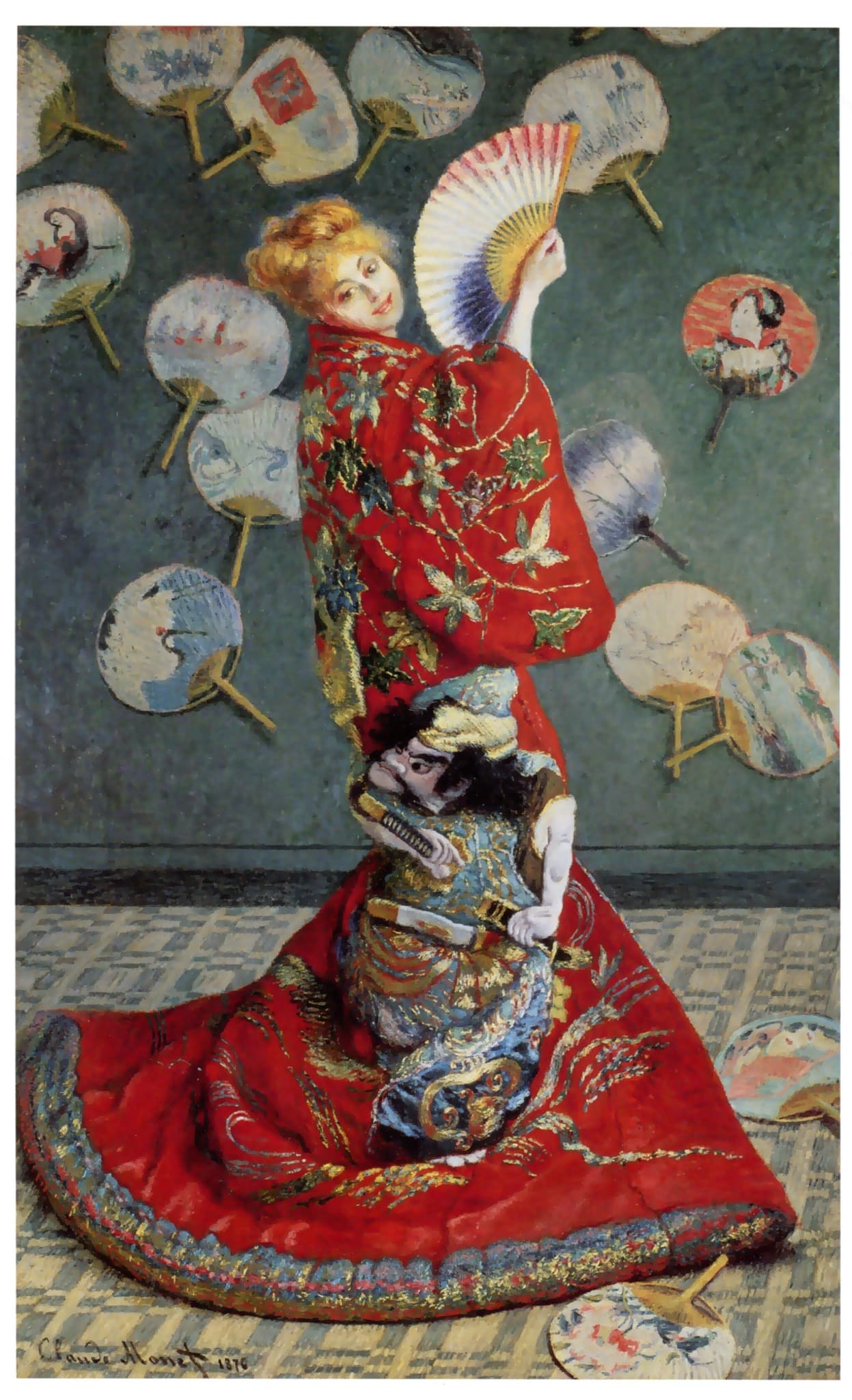
La Japonaise (Camille Monet in Japanese Costume)
Claude Monet, 1876 • Oil on canvas
Read full analysis of La Japonaise (Camille Monet in Japanese Costume) →Valuation Analysis
Conclusion: If deaccessioned and marketed as a marquee lot, Claude Monet’s La Japonaise (Camille Monet in Japanese Costume), 1876, would plausibly achieve $55–85 million. This estimate synthesizes recent top-tier Monet auction benchmarks with the work’s singular art-historical stature, outsized scale (231.8 × 142.3 cm), and public profile in the Museum of Fine Arts, Boston’s collection [1].
Comparable benchmarks: Monet’s market remains among the most robust in the Modern category, with the artist’s auction record standing at $110.7 million for Meules (2019) [2]. In the current cycle, large late Water Lilies—a prime barometer for blue‑chip Monet demand—have repeatedly achieved $65.5–$74.0 million (Christie’s 2023 Le bassin aux nymphéas at $74.01m; Sotheby’s 2024 Nymphéas at $65.5m) [3][4]. Beyond lilies, series masterpieces continue to perform: Poplars set a fresh series record at $42.96 million in 2025, indicating durable depth just below the apex tier [5]. Against these anchors, La Japonaise merits a premium to mid‑tier series results due to its image iconicity and scale, while logically pricing below the strongest late serial landscapes.
Subject, significance, and rarity: La Japonaise is a landmark of French Japonisme and one of Monet’s most widely reproduced early figure paintings, depicting Camille Monet in a flamboyant kimono. Figure subjects are rarer in the Monet market and, while they do not command the same systematic premiums as the late serial landscapes, an exceptional, canonical picture with outsized presence can draw trophy bidding. The work’s bold palette, theatrical composition, and cultural resonance elevate it within the non‑series cohort.
Provenance, condition, and museum stature: The painting’s chain of ownership is distinguished, culminating in the MFA Boston’s 1956 acquisition from Duveen Brothers; there has been no modern-era auction test for this exact canvas [1]. The MFA undertook a year‑long conservation campaign beginning in 2013, indicating careful stewardship; a current independent condition report would be essential to calibrate the top of the range [1]. Museum ownership underscores institutional validation but also means valuation must be inferred from comparables.
Market climate and timing: At the category level, the high end has seen fewer >$10m trades since 2023, but best‑in‑class Monets continue to elicit strong, global competition when fresh to market and suitably guaranteed [6]. The Monet centenary (2026) concentrates institutional programming and media attention, a supportive backdrop for a trophy-sale launch. Balanced against this are macro selectivity and the market’s structural premium for late serial landscapes, which together argue for a confident but disciplined $55–85 million range.
Bottom line: With impeccable presentation, third‑party support, and positive condition findings, La Japonaise would likely command bidding in the mid‑to‑upper tens of millions—pricing consistent with a museum-grade Monet of exceptional fame outside the apex Water Lilies/Parliament tier [3][4][5].
Key Valuation Factors
Art Historical Significance
High ImpactLa Japonaise is a canonical statement of Japonisme within French Impressionism and one of Monet’s most reproduced early figure paintings. It features Camille Monet in an elaborate kimono, capturing late-19th‑century Paris’s fascination with Japanese aesthetics. This art-historical centrality and fame create a "trophy" profile beyond typical non-series Monets. While not aligned with the late serial innovations that dominate Monet’s price apex, the picture’s scholarly and cultural prominence—including sustained museum display and contemporary discourse—supports strong global demand among collectors who value historical narrative and image iconicity, often translating into a measurable valuation premium.
Subject/Series Positioning
Medium ImpactMonet’s market leadership is defined by late serial landscapes (Water Lilies, Parliament, Poplars, Venice, Haystacks). Figure paintings—especially from the 1870s—are rarer but historically price below the strongest serial works. La Japonaise is an outlier: a large, flamboyant, instantly recognizable figure composition that commands attention akin to series pictures. The estimate positions it below apex Water Lilies and Houses of Parliament benchmarks yet above typical non-series results, recognizing that subject hierarchy remains a key driver for Monet’s pricing even when the individual work is exceptionally iconic and well-known.
Scale and Aesthetic Impact
High ImpactAt roughly 91 × 56 inches, the canvas is monumental by Monet standards, with saturated reds, gilded details, and a theatrical, full-length figure. Scale, color, and visual immediacy matter at the marquee level: buyers consistently pay premiums for pictures that command a room and reproduce powerfully in catalogues. This work’s composition checks those boxes decisively. In a market where competition intensifies around best-in-class, large-format images, La Japonaise’s physical presence is a core pillar of the $55–85 million valuation, particularly in comparison with mid‑scale series works that have set floors in the $35–45 million range.
Provenance, Exhibition, and Condition
Medium ImpactThe painting’s provenance—from 19th‑century Drouot appearances to Paul Rosenberg, Philip Lehman, Duveen, and the MFA Boston—confers exceptional credibility. Museum ownership since 1956, plus a documented conservation campaign beginning in 2013, suggests careful stewardship, though a current independent condition report would be determinative at the top of the range. A deep exhibition and literature record supports demand, but the absence of modern auction testing introduces some uncertainty about elasticity above $70m+. These factors collectively support strong pricing while advocating for diligence on structure, retouching, and surface before finalizing a guarantee.
Market Liquidity and Timing
Medium ImpactRecent marquee-season data show selective strength for blue-chip Impressionism: late Water Lilies have sold for $65.5–$74.0 million since 2021–2024, while Poplars achieved $42.96 million in 2025. Category-wide, a reduction in >$10m trades since 2023 reflects supply and macro caution more than demand collapse. The Monet centenary (2026) heightens institutional focus, potentially broadening the bidder pool. Against this, buyers are disciplined, and serial landscapes retain a structural premium. In balanced conditions—especially with a third‑party guarantee and global marketing—the environment is supportive of a mid‑to‑upper eight‑figure outcome for this work.
Sale History
Hôtel Drouot, Paris
Hôtel Drouot, Paris
Private/dealer
Private/dealer
Duveen Brothers
Duveen Brothers
Claude Monet's Market
Claude Monet is an undisputed blue-chip artist with sustained, global demand. His auction record stands at $110.7 million (Meules, 2019), and during the 2021–2025 window, multiple top-tier Monets—especially large late Water Lilies and other serial subjects—have realized $56–$76 million. The market is strongly stratified: best-in-class, large-format works with pristine provenance and broad visual appeal attract deep international bidding, while mid-tier or modestly scaled examples are priced more cautiously. Asian participation has been notable at the top end. Overall, Monet remains one of the most liquid names in the Modern category, with reliable performance when quality and presentation are optimal.
Comparable Sales
Le bassin aux nymphéas (c. 1917–19)
Claude Monet
Same artist; late, large-scale trophy from Monet’s most in-demand series. While subject differs (landscape vs. figure), it anchors the top end of Monet’s market for iconic, museum-grade pictures that draw global bidding.
$74.0M
2023, Christie's New York
~$81.1M adjusted
Nymphéas (c. 1914–17)
Claude Monet
Same artist; late Water Lilies of major scale and impact. Serves as a near-term pricing benchmark for Monet masterpieces at the marquee level.
$65.5M
2024, Sotheby's New York
~$67.5M adjusted
Le Parlement, soleil couchant (1900–03, Houses of Parliament)
Claude Monet
Same artist; late serial masterpiece with iconic subject and deep demand. Although smaller than La Japonaise, it is a top-tier reference point for Monet prices near the $75m–$90m zone.
$76.0M
2022, Christie's New York
~$88.7M adjusted
Le Grand Canal et Santa Maria della Salute (1908)
Claude Monet
Same artist; top example from the Venice series—among Monet’s best-performing late subjects. Useful for bracketing a high but sub-record valuation for a major, visually impactful Monet.
$56.6M
2022, Sotheby's New York
~$66.1M adjusted
Peupliers au bord de l’Epte, crépuscule (1891)
Claude Monet
Same artist; record-setting Poplars example. While a different subject, it’s a fresh, instantly recognizable series picture that establishes a recent floor for blue-chip Monets below the Water Lilies/Parliament tier.
$43.0M
2025, Christie's New York
Meules à Giverny (1893)
Claude Monet
Same artist; strong mid‑to‑upper tier example from a coveted motif, though not one of the very top serial masterpieces. Helps define the lower bound for major Monets versus an iconic, larger-than-life canvas like La Japonaise.
$34.8M
2024, Sotheby's New York
~$35.8M adjusted
Current Market Trends
At the high end of the Modern market, 2024–2025 saw fewer lots above $10 million and softer category totals, driven by limited trophy supply and macro caution. Nevertheless, standout consignments continue to clear robust prices with support from guarantees and deep, selective demand. Within Impressionism, quality and scale are paramount: large, iconic Monets from favored series still achieve $65m–$74m, while strong non‑apex works cluster in the $30m–$45m bracket. The Monet centenary in 2026 provides a positive visibility catalyst. In this environment, exceptional, museum-grade works like La Japonaise can command competitive bidding, though premiums remain most pronounced for late serial landscapes.
Study print
Study this painting as a print
Pair the full artwork with a museum-style study sheet focused on one meaningful detail.
Sources
- Museum of Fine Arts, Boston — Collection: La Japonaise (Camille Monet in Japanese Costume)
- Sotheby’s — Monet’s Meules sells for $110.7 million (2019), new artist record
- Christie’s — 20th Century Evening Sale (Nov 9, 2023) results; Monet Le bassin aux nymphéas $74,010,000
- The Art Newspaper — Sotheby’s New York: Nymphéas sells for $65.5m (Nov 18, 2024)
- Christie’s — Press release (May 12, 2025): Poplars record at $42,960,000
- Art Basel & UBS — The Art Market 2025: Auctions