How Much Is Automat Worth?
Last updated: May 1, 2026
Quick Facts
- Methodology
- comparable analysis
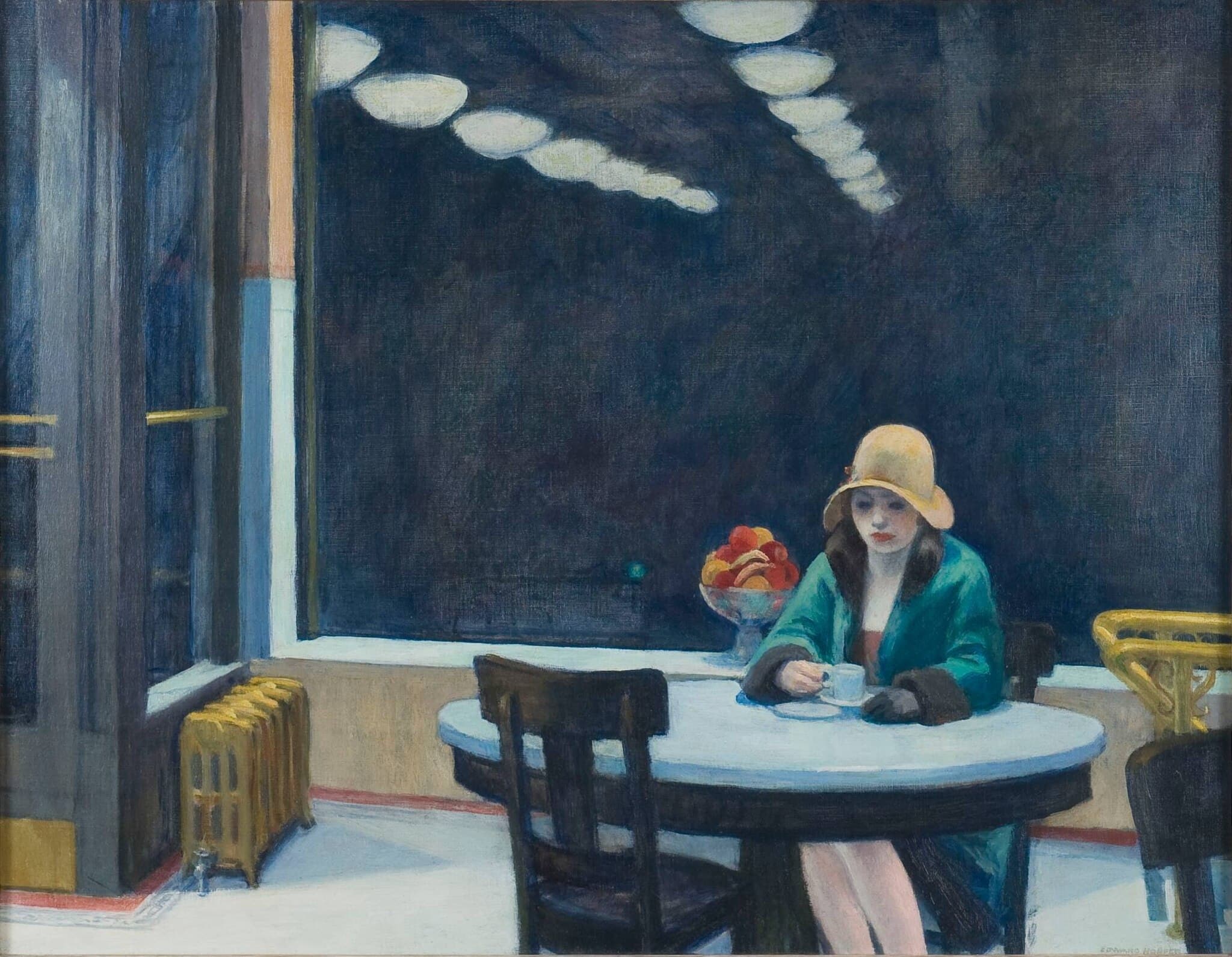
Automat (1927) is an iconic, museum‑quality Edward Hopper oil in the Des Moines Art Center; it has no modern auction record. Based on auction precedents for top Hopper oils (most notably Chop Suey, 2018) and the rarity of comparable museum canvases, a reasoned open‑market valuation range is $60–95 million, subject to confirmation of condition, provenance restrictions, and sale mechanics.
Valuation Analysis
Automat (1927) is an iconic Edward Hopper oil painting in the permanent collection of the Des Moines Art Center and therefore has not appeared on the modern auction market [1]. Based on public auction precedent for museum‑quality Hopper oils, the painting’s canonical status, and the extreme scarcity of comparable works appearing for sale, my open‑market valuation range for Automat is $60,000,000–$95,000,000. This is a hypothetical, market‑based estimate intended to reflect likely hammer/realized outcomes under competitive sale conditions rather than an insured or replacement valuation [2].
The principal market anchor is the 2018 Christie’s sale of Chop Suey (realized ≈ $91.9M), which sets a practical ceiling for Hopper interiors and demonstrates the price level top collectors will reach for a canonical image [2]. Secondary comparable sales—East Wind Over Weehawken, Hotel Window and several other high‑quality oils—have realized in the tens of millions and support the band’s midpoint and lower bound. Because Automat is among Hopper’s most reproduced and discussed images, it would be positioned to compete with those examples for institutional and private buyers, but one must treat the Chop Suey precedent as a single‑lot high watermark rather than a routine expectation.
Upside factors include the painting’s strong art‑historical profile, museum provenance (which increases buyer confidence), and the possibility that presentation in a major sale catalogue and related exhibition would concentrate bidder interest. Conversely, downside drivers include potential donor or institutional restrictions on deaccession, the absence of a publicly available conservation report, and market volatility—factors that can materially lower or constrain competitive bidding. Museum‑held status both elevates the work’s desirability and adds procedural friction to any potential sale.
Sale mechanics will materially affect a realized price. An auction offering timed to a major season with competitive guarantees and a high‑profile catalogue can push results toward the top of the band; a negotiated private sale or constrained deaccession could realize below market estimates. For a firm, court‑ready valuation I recommend three immediate steps: (1) confirm current ownership and any restrictions with the Des Moines Art Center; (2) obtain a full condition and conservation report; and (3) solicit written, hypothetical pre‑sale estimates from the major auction house American‑art specialists and leading private dealers. With those inputs the estimate above can be tightened into a narrower reserve and carry more forensic certainty.
Overall, treating this as a hypothetical market exercise and recognizing both the extreme scarcity of museum‑quality Hoppers in private hands and the potential for one‑off auction dynamics to create outsized results, the $60–95M band is a reasoned appraisal: it sits below the adjusted ceiling implied by the Chop Suey sale yet above the typical upper‑mid market outcomes for non‑canonical works. Should the work be deaccessioned and marketed aggressively, the result could land at the high end or modestly exceed it; conversely, legal/ethical constraints or conservation defects could push the outcome materially lower.
Key Valuation Factors
Art Historical Significance
High ImpactAutomat is one of Edward Hopper’s most recognizable and frequently reproduced images, embodying his central themes of urban solitude, interior/exterior tension, and modern anonymity. Painted in 1927, it sits at a formative moment in Hopper’s career and appears regularly in monographs, exhibitions, and academic literature. That cultural prominence translates directly into market value: canonical images carry institutional weight, are actively sought by museums and high‑net‑worth collectors for public display and collection narratives, and usually attract competitive bidding when they appear on the market. In short, the painting’s art‑historical status is a primary reason to treat it as a top‑tier Hopper rather than a mid‑market example.
Provenance & Museum Ownership
High ImpactAutomat’s long‑standing presence in the Des Moines Art Center collection materially affects its market profile. Museum provenance increases buyer confidence and typically supports higher realizations because institutions and reputable buyers prize works already vetted and published. At the same time, museum ownership creates practical constraints: deaccession procedures, donor restrictions, and public scrutiny can delay or limit sale options, and institutional sales may be structured (or constrained) in ways that reduce competitive tension. If deaccession is possible and the museum markets the work aggressively, provenance will be an upside; if restrictions apply, provenance can become a liquidity limiter.
Comparables & Auction Precedent
High ImpactThe strongest market benchmark is Chop Suey (Christie’s, 2018, ≈$91.9M realized), which establishes a practical ceiling for canonical Hopper interiors. Other high‑quality Hopper oils have sold in the tens of millions, creating a band of precedent for top‑tier results. Because only a small number of canonical oils reach the evening‑sale stratum where Chop Suey appeared, any estimate for Automat must balance that single headline precedent against several lower but still substantial comparables. The chosen $60–95M band intentionally positions Automat below an outlier ceiling while reflecting the readily demonstrable willingness of buyers to pay in the tens of millions for museum‑quality Hoppers.
Condition & Conservation
Medium ImpactCondition and conservation history materially influence buyer confidence and price. A pristine, well‑documented surface and an uncontroversial conservation record can attract top dollar and reduce buyer hesitation, whereas evidence of major restorations, relining, in‑painting, or structural issues will lead to measurable discounts. Because no public, recent technical report is available, this factor introduces material uncertainty; an independent condition survey could either validate the full estimate band or justify a downward adjustment. Conservational transparency is therefore a gating factor for final pricing.
Market Liquidity & Buyer Demand
High ImpactLiquidity for high‑end Hopper oils is constrained by supply—many canonical works are museum‑held—and by a concentrated buyer pool composed of major U.S. museums, select foundations, and wealthy private collectors. When multiple qualified buyers are engaged (often after a high‑visibility exhibition or sale season), competition can drive prices toward the top of the band. Conversely, macroeconomic softness, reduced museum budgets, or diminished philanthropic support can limit realized prices. Recent museum deaccessions show the market can absorb additional supply but may price selectively; liquidity is therefore strong for truly canonical works and more variable for secondary offerings.
Sale History
Automat has never been sold at public auction.
Edward Hopper's Market
Edward Hopper is a blue‑chip, museum‑collectible artist in twentieth‑century American art. His auction record (Chop Suey, Christie’s 2018, ≈$91.9M) demonstrates the ceiling for canonical oils; other major canvases routinely realize in the tens of millions while watercolors, drawings and prints trade materially lower. The market is characterized by limited supply of museum‑quality oils, strong institutional demand, and a concentrated bidder pool. Hopper remains highly collectible, but outcomes are selective: canonical masterpieces and works with strong exhibition/provenance histories command premiums, while less iconic pieces show more variable performance.
Comparable Sales
Chop Suey
Edward Hopper
Iconic interior/café scene by Hopper from the same late‑1920s/early‑1930s milieu; museum‑quality, directly comparable in subject matter and market cachet; represents the artist's auction ceiling.
$91.9M
2018, Christie's New York
~$113.0M adjusted
East Wind Over Weehawken
Edward Hopper
Major museum‑quality oil by Hopper from a similar period (1930s) and scale; demonstrates strong demand for top‑tier Hopper oils even when not the single most famous image.
$40.5M
2013, Christie's New York
~$57.7M adjusted
Hotel Window
Edward Hopper
High‑quality Hopper oil sold in the mid‑2000s; useful for understanding how strong Hopper oil results from earlier cycles escalates when inflation‑adjusted and to benchmark mid‑market top oils vs. masterpieces.
$26.9M
2006, Sotheby's New York
~$47.2M adjusted
October on Cape Cod
Edward Hopper
Notable Christie’s online/Live sale demonstrating realized pricing for important Hopper oils outside the very top echelon; helps define the lower bound of high‑quality Hopper oil pricing in secondary market contexts.
$9.6M
2012, Christie's (online / Live)
~$14.1M adjusted
Current Market Trends
Since the 2018 Chop Suey record the Hopper market has bifurcated: genuine masterpieces remain capable of commanding very high prices, while the broader mid‑market has shown selective strength and occasional softness. Museum deaccessions and periodic exhibitions affect short‑term supply and demand; macroeconomic conditions and philanthropic funding trends also influence institutional buying. In the current environment, top‑quality, canonical Hoppers continue to attract international interest, but realized prices are sensitive to sale timing, presentation, and the number of competing bidders.