How Much Is Chop Suey Worth?
Last updated: May 1, 2026
Quick Facts
- Last Sale
- $91.9M (2018, Christie's New York)
- Methodology
- recent sale
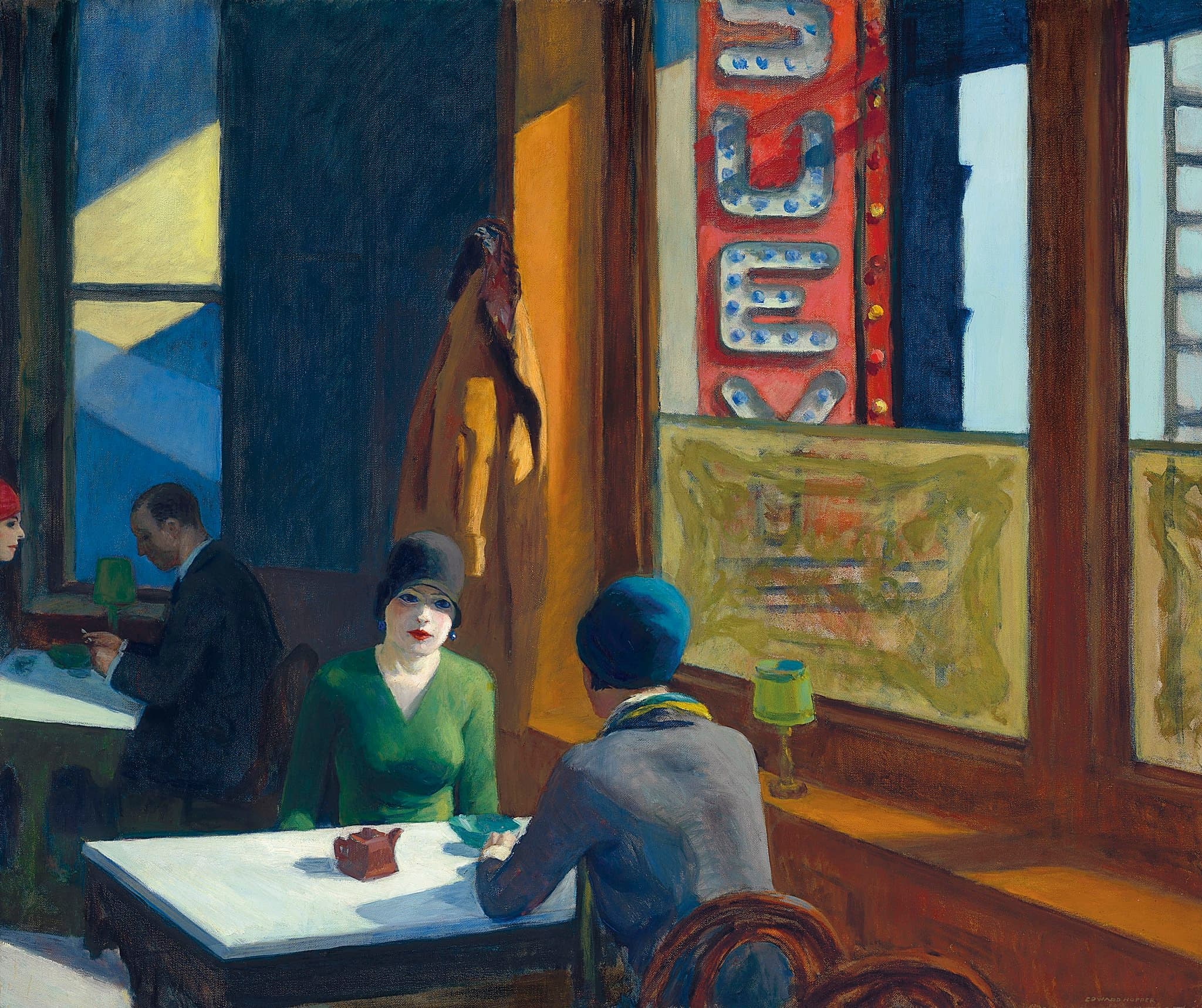
Anchored to the work’s definitive auction result (Christie’s, Nov 13, 2018), this appraisal places Edward Hopper’s Chop Suey at an estimated market range of $90–130 million. The 2018 sale ($91.875M) is the primary market datum; the range reflects likely outcomes today depending on sale mechanics, condition and buyer competition.
Valuation Analysis
Primary anchor: Edward Hopper’s Chop Suey realized $91,875,000 (including premium) at Christie’s New York on 13 November 2018 and that result is the decisive market datum for present valuation [1]. Because that price is a recent, high‑visibility, public auction result for the exact work under appraisal, it serves as the baseline for a contemporary opinion of market value. Using that sale as the anchor and allowing for nominal market movement, auction dynamics and sale mechanics, a reasoned market window today is $90–130 million.
Why that range? The lower bound (≈$90M) brackets the 2018 realized total and reflects a conservative stance if the work were offered under neutral to soft bidding conditions, in a private treaty sale, or with title/condition uncertainties. The upper bound (≈$130M) reflects an optimal public evening‑sale scenario: a single‑owner trophy lot marketed to global collectors and institutions, with competitive bidding, strong guarantees and heavy press/exhibition support. Pre‑2018 high results for Hopper (e.g., East Wind Over Weehawken, 2013) show the historical ceiling before Chop Suey reset the market and underline how a single canonical work can leapfrog older comparables [2].
Key value drivers and adjustments: Chop Suey’s canonical status, exhibition history and high‑quality single‑owner provenance (Barney A. Ebsworth) materially elevate demand relative to routine Hopper lots. Post‑sale market conditions for blue‑chip modern and American masters have been selective but supportive; museum interest and concentrated capital at the top end generally sustain or modestly increase headline prices since 2018. Inflation and art‑market momentum since 2018 could justify nominal upward movement from the realized price, but the precise premium is highly sale‑specific and driven by whether the lot is placed in an internationally marketed evening sale with guarantees versus a private treaty or constrained offering.
Caveats and recommended next steps: This opinion assumes clear title and no material condition issues. A formal, certifiable appraisal would require the Christie’s 2018 catalogue/condition report, a current conservation assessment, confirmation of any donor or lender restrictions, and knowledge of the intended sale venue. For transacting parties: secure the lot condition report, obtain independent conservation input, and if selling, structure marketing and guarantees to maximize competitive bidding. If you want I can pull the 2018 lot catalogue page and Christie’s condition notes and incorporate them into a formal written appraisal.
Key Valuation Factors
Art Historical Significance
High ImpactChop Suey is widely regarded as one of Edward Hopper’s canonical paintings from his mature period (1920s–1930s). Its composition, urban subject matter and frequent reproduction in scholarship and exhibition place it in the top tier of Hopper’s oeuvre alongside works like Nighthawks and Early Sunday Morning. Canonical status translates directly into market scarcity at the highest level: when such an iconic canvas appears for sale, institutional and top‑tier private demand concentrates, often producing outsized results relative to less famous works. That significance is the single strongest qualitative value driver for this work.
Provenance & Exhibition History
High ImpactStrong, documented provenance (long‑term ownership by Barney A. Ebsworth and prominent exhibition/loan history) increases buyer confidence and marketability. Chop Suey’s association with a named, well‑regarded private collection and its publicity as a marquee lot in a single‑owner dispersal magnified competitive bidding in 2018. Museum‑quality exhibition history (cataloguing, loans) enhances value by verifying authenticity and scholarship; conversely, donor restrictions or complex title/deaccession history would depress realized value. Confirming provenance and exhibition records is therefore essential to a firm valuation.
Market Precedent & Price Realization
High ImpactThe realized $91.875M 2018 auction price is the primary empirical precedent and establishes the artist’s public auction ceiling. Prior top results (for example East Wind Over Weehawken in 2013) were materially lower, illustrating how a single canonical sale can reset market expectations. Market precedent is the most objective input in this appraisal: the 2018 result anchors the lower end of the current range while allowing for variance due to inflation, macro conditions, and sale mechanics. Any formal valuation must reference the 2018 sale catalogue and condition report.
Condition & Title / Deaccession Risk
Medium ImpactPhysical condition, restoration history, and any encumbrances materially affect price. A pristine condition report can sustain or lift top‑end bids; significant conservation issues can reduce competition and realized value. If the work is or becomes museum‑held, institutional deaccession restrictions or donor covenants can limit sale options or introduce reputational/legal complexity that lowers marketability. A current, independent conservation assessment and clean title documentation are therefore prerequisites to realizing the full market potential outlined here.
Sale Mechanics & Market Liquidity
High ImpactSale venue (major evening auction), guarantee arrangements, marketing, and timing determine whether the work attains the upper bound of the range. High‑visibility evening sales with guarantees and multi‑platform international bidding maximize competitive pressure and headline price potential. Private treaty sales or poorly marketed consignments can yield discounts to public auction highs. Liquidity for top‑tier Hopper oils is limited by rarity; when a canonical work appears, liquidity is strong but concentrated, meaning sale preparation and auction strategy are critical value drivers.
Sale History
Edward Hopper's Market
Edward Hopper is a leading American modernist whose market is characterized by a small supply of museum‑quality oils and strong institutional/collector demand for canonical works. The artist’s secondary‑market ceiling was reset by Chop Suey’s 2018 sale and top‑tier oils now trade in the high‑tens to low‑hundreds of millions when offered under optimal conditions. Works on paper, watercolors and prints remain the most liquid segments, trading at much lower price bands. Collectors are predominantly museums and major private collectors seeking exhibition‑grade pieces with clean provenance.
Comparable Sales
Chop Suey
Edward Hopper
Direct market datum — the subject work itself; canonical Hopper oil, offered from a major single-owner collection and that sale establishes the auction ceiling for the artist.
$91.9M
2018, Christie's New York
~$113.0M adjusted
East Wind Over Weehawken
Edward Hopper
High-end Hopper oil sold at evening auction; similar stature as a museum-quality canonical Hopper (1930s period) and therefore a strong market comparable for top-tier Hopper oils.
$40.5M
2013, Christie's New York
~$57.7M adjusted
Hotel Window
Edward Hopper
Earlier high-result Hopper oil (mid‑20th century work) sold at a major house — useful as an older high‑end comparable after inflation adjustment; shows pre‑2018 ceilings for Hopper oils.
$26.9M
2006, Sotheby's New York
~$47.2M adjusted
Chair Car
Edward Hopper
Reported mid‑2000s sale of a Hopper oil; lower than museum‑quality headline works but useful to show the range below the top tier and how prices have inflated since mid‑2000s.
$14.0M
2005, Auction (reported in press)
~$25.3M adjusted
Coast Guard Cove (watercolor)
Edward Hopper
Different medium (watercolor) but recent, well‑publicized sale (Paul Allen dispersal) showing continued institutional/collector demand for museum‑quality Hopper works; provides context at lower price bands.
$2.0M
2023, Christie's New York
~$2.1M adjusted
Current Market Trends
The high end of the market remains selective and concentrated: museum‑quality, canonical works attract most buyer interest while mid‑tier offerings see fewer bidders. Blue‑chip moderns have held value since the pandemic correction, and focused museum exhibitions (Whitney 2022–23) have reinforced institutional appetite. Overall, top‑tier Hopper works maintain strength but outcomes are highly sale‑specific.
Sources
- Christie's press: 'An American Place — The Barney A. Ebsworth Collection (results)' (Chop Suey sale, 13 Nov 2018)
- Christie's press: 'East Wind Over Weehawken' result (5 Dec 2013)
- Whitney Museum: 'Edward Hopper New York' exhibition (Oct 2022–Mar 2023)
- The Art Newspaper: coverage of the Chop Suey sale (14 Nov 2018)
- Seattle Times: report on Chop Suey sale and Ebsworth / Seattle Art Museum context
- Sotheby's lot listing: 'Hotel Window' (2006 sale)