How Much Is Gas Worth?
Last updated: May 1, 2026
Quick Facts
- Current Location
- The Museum of Modern Art (MoMA)
- Methodology
- comparable analysis
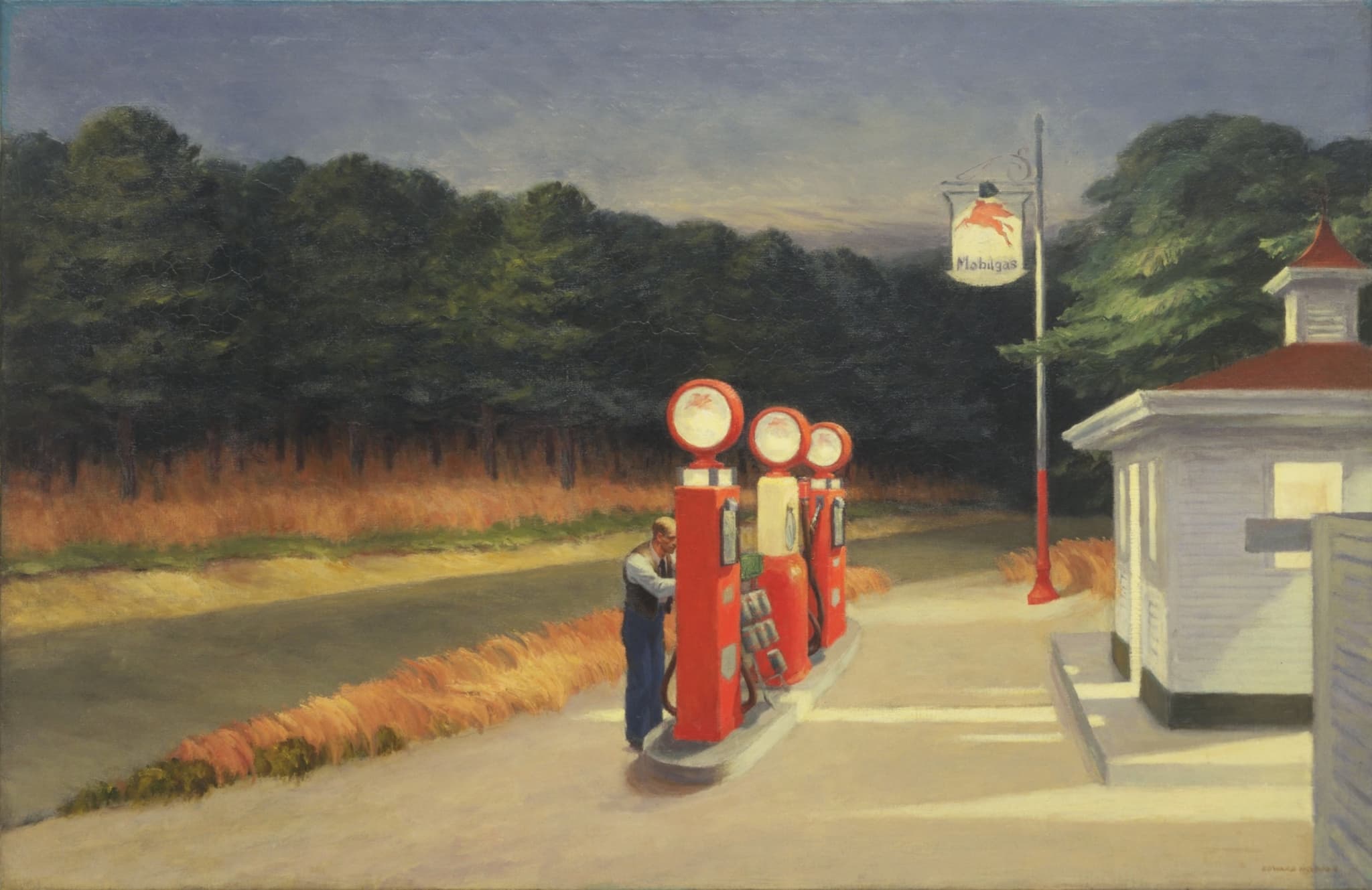
Gas (1940) is in the Museum of Modern Art’s permanent collection and is not for sale; any monetary estimate is therefore hypothetical. Based on auction comparables for mature Edward Hopper oils, museum provenance, and current market conditions, a realistic conservative market range if offered would be $8–15 million (broader plausible range $5–30M depending on sale structure and institutional interest).
Valuation Analysis
Overview and headline valuation: Edward Hopper’s Gas (1940) is held by the Museum of Modern Art (accession 577.1943), so a market price is theoretical rather than transactional [1]. Treating the work as a museum‑quality, mature‑period Hopper oil comparable to other late 1930s–1940s canvases, and weighting for the strength of Hopper comparables at auction, I place a conservative market value at $8–15 million, with a wider contextual range of $5–30 million under highly competitive sale circumstances [2][3].
Comparables that inform the range: Hopper’s auction record and top comparables are highly skewed by a few trophy canvases: Chop Suey (2018) established an outlier ceiling (~$91.9M) while East Wind Over Weehawken (2013) and other mature oils show a strong mid‑ to high‑eight figure market tier [2][3]. Mid‑market mature oils have historically realized in the low‑ to mid‑single‑digit millions (for example lower‑mid comparables such as October on Cape Cod in earlier years), while watercolors and drawings typically trade in the mid‑six to low‑seven figures. Positioning Gas in the mid‑range (not a singular icon like Chop Suey but a canonical, exhibited Hopper) supports the $8–15M conservative interval.
Key value drivers and discounts: The primary upward drivers are the painting’s art‑historical importance, MoMA provenance, and sustained institutional exhibition/publication. Downside adjustments could arise from sale mechanics (deaccession stigma, lack of buyer competition), revealed condition issues, or legal/export complications. Museum ownership both elevates the painting’s pedigree and makes an actual market transaction unlikely; if MoMA were to deaccession, the sale would be subject to institutional policy and market perceptions that can push realized price above or below the estimate depending on buyer appetite and guarantees [1][4][5].
Market context: The Hopper market remains strong but selective: blockbuster, canonical canvases are exceptional and fetch outsized sums; more commonly, museum‑quality oils that surface sell in the mid‑single to low‑double‑digit millions, particularly when provenance and exhibition history are robust [2][3]. The 2022–2024 market normalization increased buyer selectivity, making pre‑sale marketing, guarantees, and institutional interest determinative for realized price.
Practical conclusion: For practical purposes, treat $8–15M as the conservative realized expectation if Gas ever entered the open market under favorable conditions. To refine this estimate to a formal appraisal, obtain (1) a current MoMA conservation/condition report, (2) a full catalogue‑raisonné citation and exhibition bibliography, and (3) clarity on any institutional restrictions or deaccession plans. With those documents a sale house or qualified appraiser could give a firm pre‑sale estimate or reserve strategy.
Key Valuation Factors
Art Historical Significance
High ImpactGas is a textbook example of Hopper’s late‑mature themes — nocturnal architecture, isolated commercial vernacular, and controlled theatrical light — and thus holds strong curatorial and scholarly value. The painting is widely reproduced in Hopper literature and taught as representative of his 1940s output. This kind of canonical subject matter drives institutional interest and collector recognition, making the work more desirable than an unsigned study or lesser studio canvas. The intellectual and cultural salience of the image supports a premium relative to minor works of similar size.
Provenance & Ownership
High ImpactMoMA ownership since 1943 is the single most important provenance factor: it confirms authenticity, continuous institutional stewardship, and substantial exhibition history. Museum provenance both enhances market value (by signaling vetted authenticity and prestige) and reduces liquidity because works in a major museum rarely appear on the market. If MoMA were ever to deaccession, the institutional context would shape buyer behavior — major collectors and museums may compete, or conversely reputational concerns could depress bidding; nonetheless, clear, long‑term museum provenance typically supports a higher realized price than comparable privately held works.
Condition & Conservation
Medium ImpactA current conservation assessment is essential. Works held by MoMA are generally maintained to museum standards, which implies good condition; that said, any evidence of heavy restoration, relining, or inpainting would materially reduce buyer confidence and price. Condition impacts buyer willingness in the multi‑million band especially: visible retouching or structural issues invite discounts and complicate export/loan potential. Conversely, a pristine, original surface with thorough conservation documentation will help sustain or increase the top of the estimated range.
Exhibition & Publication History
High ImpactGas has an extensive institutional exhibition history and is documented in major museum collections and catalogues, with preparatory materials held in other institutions — evidence that the painting is embedded in Hopper scholarship. Strong exhibition and publication records increase market value by demonstrating the work’s canonical status, reproducibility in catalogues, and desirability for future institutional loans. A well‑documented exhibition record therefore functions as a multiplier on the base market estimate.
Market Scarcity & Demand
High ImpactMature Hopper oils of museum quality are scarce at auction; scarcity combined with steady institutional demand concentrates buying power and supports higher prices. The top tier of Hopper canvases (e.g., Chop Suey) produce outlier results, but most museum‑quality oils trade in the mid‑single to low‑double‑digit millions when offered. Market selectivity since 2023 means the sale mechanism (evening sale, guarantees, institutional bidding) strongly influences final price; scarcity therefore remains a leading upward pressure on valuation.
Sale History
Gas has never been sold at public auction. It has been held by The Museum of Modern Art (MoMA).
Edward Hopper's Market
Edward Hopper is one of the most collected and institutionally represented American painters of the 20th century. His auction record is concentrated in a handful of trophy canvases that set high ceilings (Chop Suey, East Wind), while a larger group of mature oils and high‑provenance drawings/watercolors trade in the mid‑six to low‑eight figures. Institutional demand, scarcity of museum‑quality oils, and strong scholarly interest underpin persistent market strength. However, realized outcomes vary widely by iconography, provenance and sale structure.
Comparable Sales
Chop Suey
Edward Hopper
Artist's auction record and an iconic, mature oil — establishes the top-end trophy ceiling for Hopper canvases and demonstrates extreme institutional/collector demand for canonical works.
$91.9M
2018, Christie's New York
~$115.7M adjusted
East Wind Over Weehawken
Edward Hopper
Mature-period oil/urban landscape by Hopper that realized a high eight-figure price — a strong mid-to-high tier comparable for scale, medium and market demand among major oils.
$40.5M
2013, Christie's New York
~$54.9M adjusted
October on Cape Cod
Edward Hopper
Mature oil of a coastal subject sold into the market at a mid‑eight‑figure level (2012) — a useful mid-market oil comparable for subject/scale; helps define the realistic lower‑mid range for a museum‑quality Hopper oil.
$9.6M
2012, Christie's (LIVE / online sale)
~$13.2M adjusted
Gloucester Roofs
Edward Hopper
High-provenance work on paper from a major private collection — indicates demand and realized levels for Hopper watercolors/drawings (mid‑six to low‑seven figures), useful for assessing the lower bound of Hopper market liquidity.
$2.0M
2022, Christie's (Paul G. Allen collection dispersal)
~$2.1M adjusted
Coast Guard Cove
Edward Hopper
Another Paul G. Allen watercolor/drawing lot; reinforces market levels for high‑provenance works on paper and the liquidity/price gap between such pieces and major oils.
$1.6M
2022, Christie's (Paul G. Allen collection dispersal)
~$1.7M adjusted
Current Market Trends
Since 2022 the art market has become more selective at the very top; Art Basel/UBS reporting and major auction activity indicate a cooldown from the immediate post‑2018 surge. For Hopper specifically, institutional exhibitions and occasional deaccessions have been the primary supply drivers; private guarantees and negotiated sales increasingly determine outcomes for high‑value lots. In this environment, strong provenance and exhibition history matter more than ever.
Sources
- Museum of Modern Art — Collection: Edward Hopper, Gas (1940)
- Artsy coverage — Chop Suey sale (Christie’s, 2018)
- Christie’s press release / sale coverage — East Wind Over Weehawken (2013)
- Whitney Museum — Edward Hopper’s New York (exhibition)
- Sotheby’s — Whitney deaccession lot listings (May 2023 dispersal)