How Much Is Room in New York Worth?
Last updated: July 5, 2026
Quick Facts
- Methodology
- comparable analysis
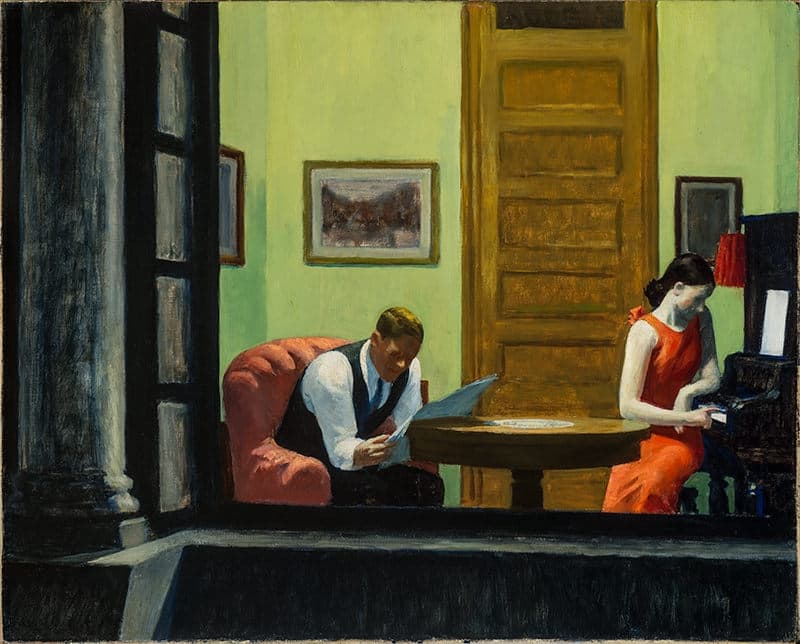
Room in New York (1932) is a canonical Edward Hopper interior held by the Sheldon Museum of Art, long recognized as a top-tier work from the artist’s peak New York period. Based on best-in-class comparables—most notably Chop Suey at $91.875m in 2018—and the extreme scarcity of mature interiors with figures, a fair-market estimate today is $95–125 million, subject to standard condition confirmations.
Valuation Analysis
Work and status. Edward Hopper’s Room in New York (1932, oil on canvas) is a signature interior scene from his mature period, held since 1936 by the Sheldon Museum of Art, University of Nebraska–Lincoln. As a work in a U.S. public collection, any valuation is hypothetical; however, for insurance or a deaccession scenario, it ranks among the artist’s most desirable subjects and dates [1].
Comparable sales and anchoring benchmark. The clearest market anchor is Hopper’s Chop Suey (1929), a closely related two‑figure urban interior that realized $91,875,000 at Christie’s in November 2018, the standing record for the artist and a landmark for pre‑war American art [2]. Another mature urban benchmark, East Wind Over Weehawken (1934), achieved $40,485,000 in 2013, underscoring the premium assigned to 1930s New York subjects even when they are not interiors with figures [3]. Together, these results define the high end of Hopper’s market, with interiors from the late 1920s–mid‑1930s commanding the apex.
Subject premium and scarcity. Recent sales reaffirm how subject and period stratify Hopper’s prices. Non‑iconic oils, such as Cobb’s Barns, South Truro (1930–33), sold for $7.29m in 2023—useful not as a direct comp but as a yardstick for the steep premium reserved for best‑known urban interiors with figures [4]. Market momentum for quality Hopper oils remained evident into 2026, when a small early coastal oil, Monhegan Lighthouse, led Sotheby’s Modern Day sale at $4.146m, signaling robust depth of demand across formats when quality and freshness align [5].
Market context and inflation. Since 2018, the global auction market has cycled through cooler conditions in 2023 and a measured recovery by 2025–26, with buyers concentrating capital on museum‑caliber, historically significant works. The Art Basel & UBS Global Art Market Report 2026 describes Modern art’s renewed stability and a quality bias at the top end—conditions that typically favor Hopper’s canonical interiors [6]. In today’s dollars, Chop Suey’s 2018 price effectively places prime 1930s interiors into the nine‑figure bracket, providing a credible ceiling for valuation.
Conclusion and range. Room in New York is a textbook Hopper interior from 1932, celebrated in scholarship and popular iconography, and held in a major public collection—attributes that align with the most valuable, competition‑rich segment of his market. Balancing the record benchmark, scarcity of comparable interiors in private hands, and current market selectivity, the indicated fair‑market range is $95–125 million, presuming sound condition and a well‑structured sale (e.g., marquee evening placement with third‑party guarantee support). Upside beyond this band is plausible in a peak‑demand season; downside risk primarily relates to unforeseen condition or consignment constraints rather than demand for the image type itself [2][3][6].
Key Valuation Factors
Art Historical Significance
High ImpactRoom in New York distills Hopper’s central themes—urban solitude, psychological distance, and the voyeuristic gaze—at the height of his New York period. The painting’s compositional clarity, cinematic framing through the window, and tense figure relationship make it one of the most reproduced and discussed interiors in the Hopper literature. As such, it is not merely representative but emblematic of his contribution to American modernism. Works that encapsulate an artist’s signature themes tend to command a significant premium, especially when they are part of the cultural canon and widely recognized by a broad audience beyond specialist circles.
Subject and Period Quality
High ImpactAmong Hopper’s subjects, late‑1920s to mid‑1930s New York interiors with figures form the peak value tier. This canvas, dated 1932, sits squarely in that sweet spot: a mature-period urban interior with two figures, rendered with the crisp lighting, restrained palette, and psychological charge prized by collectors. Direct comparables are exceedingly rare; the closest market anchor, Chop Suey (1929), set the artist’s record. The date and subject align with the small cluster of Hopper’s most coveted works, supporting a valuation near the artist’s price ceiling when considered in today’s market context.
Provenance and Institutional Visibility
Medium ImpactThe painting has been in the Sheldon Museum of Art’s collection since 1936, following its gallery handling in the artist’s lifetime. Long institutional ownership confers strong provenance, scholarly visibility, and a presumption of responsible care. While deaccession optics can require careful sale strategy, museum provenance typically enhances buyer confidence. The work’s consistent presence in scholarship and public discourse further elevates its desirability, reinforcing its status as a museum‑grade icon should it ever be offered to the market.
Scarcity and Competitive Dynamics
High ImpactTop‑tier Hopper interiors with figures from the 1928–35 window are extraordinarily scarce in private hands and appear at auction perhaps once in a generation. This supply constraint, combined with a deep global buyer pool for American modernist icons, fosters aggressive competition when a best‑in‑class example surfaces. Recent results for lesser subjects establish a baseline, but the true demand curve for marquee interiors is defined by the 2018 record and enduring institutional interest, which together point to sustained nine‑figure potential in a well‑timed marquee sale.
Condition and Scale
Medium ImpactAt approximately 29 × 36 5/8 inches, the work has a commanding but domestic scale ideal for private collections. The estimate assumes sound, unrestored condition consistent with long‑term museum care. In this price band, subtle condition variables—surface quality, original color balance, and any conservation history—can swing outcomes by tens of millions. A pristine report and strong technical imaging would support the top of the range; any material condition reservations would argue for pricing closer to the midpoint.
Sale History
Room in New York has never been sold at public auction.
Edward Hopper's Market
Edward Hopper is a blue‑chip, supply‑constrained pillar of American modernism. Auction offerings of major oils are rare, and interiors from the late 1920s–mid‑1930s are the most valuable segment. The artist’s standing record is Chop Suey (1929) at $91,875,000 (Christie’s, 2018), and key urban subjects such as East Wind Over Weehawken (1934) at $40.485m further anchor the upper tier. Recent seasons reaffirm healthy demand across formats—from small, early oils to high‑quality watercolors—while underscoring the steep premium for canonical urban interiors with figures. When museum‑grade examples emerge fresh to market, they attract global competition and are positioned to test or approach the artist’s price ceiling.
Comparable Sales
Chop Suey
Edward Hopper
Closest subject match: a two-figure urban interior from Hopper’s peak New York period (1929), comparable in scale and iconic status.
$91.9M
2018, Christie's New York
~$118.9M adjusted
East Wind Over Weehawken
Edward Hopper
Major 1930s urban oil (1934) from nearly the same period; while not an interior with figures, it’s a top-tier urban subject benchmark.
$40.5M
2013, Christie's New York
~$56.5M adjusted
Hotel Window
Edward Hopper
Interior with a solitary figure (1955). Later period than 1932 but same high-value subject category (urban interior).
$26.9M
2006, Sotheby's New York
~$43.4M adjusted
Cobb’s Barns, South Truro
Edward Hopper
Early-1930s oil (1930–33) showing market depth for non-iconic subjects; good for bracketing value by subject premium.
$7.3M
2023, Sotheby's New York
~$7.8M adjusted
Spurwink Church
Edward Hopper
Watercolor (1927) from a related timeframe; demonstrates current demand for strong works on paper versus oils.
$1.0M
2025, Sotheby's New York
Current Market Trends
The 2025–26 market shows renewed stability for Modern art, with buyers concentrating on museum‑quality trophies and fresh‑to‑market icons. After a more selective 2023, liquidity and confidence improved, and price formation increasingly rewards historical importance, provenance, and condition. In this environment, canonical works by established masters—like Hopper’s mature New York interiors—enjoy a quality premium and global demand, especially when placed in marquee evening sales with strategic guarantees. While broader volatility persists, the combination of scarcity and brand‑level recognition continues to support nine‑figure pricing for the most significant American modernist pictures.
Sources
- Sheldon Museum of Art – Room in New York (collection page)
- The Art Newspaper – Record $91.9m sale of Edward Hopper's 'Chop Suey' (2018)
- Christie’s – East Wind Over Weehawken sells for $40.5m (press release)
- ArtsJournal/CultureGrrl – Whitney deaccessions and Sotheby’s 2023 results (incl. Hopper)
- Portland Press Herald – Edward Hopper's 'Monhegan Lighthouse' sells for more than $4m (May 20, 2026)
- Art Basel & UBS – The Art Market Report 2026 (Modern sector overview)