How Much Is The Channel of Gravelines, Grand Fort-Philippe Worth?
Last updated: May 7, 2026
Quick Facts
- Last Sale
- $25.2M (1995, Private sale (Heinz Berggruen to the National Gallery, London))
- Methodology
- comparable analysis
Anchored by the 2018 sale of a same‑size mature Seurat seascape at $34.06m and the 2022 reset of Seurat’s market with a $149.2m record, a prime, finished 65 × 81 cm Gravelines canvas justifies a $60–100 million auction equivalent today. This painting is a cornerstone of Seurat’s late period, with exemplary provenance and institutional stature at the National Gallery, London.
Valuation Analysis
Conclusion: A prime, finished 65 × 81 cm seascape from Georges Seurat’s 1890 Gravelines series warrants an auction‑equivalent valuation of $60–100 million today. This view synthesizes direct artist comparables, the post‑2022 re‑rating of Seurat’s market, and the work’s scholarly and institutional profile.
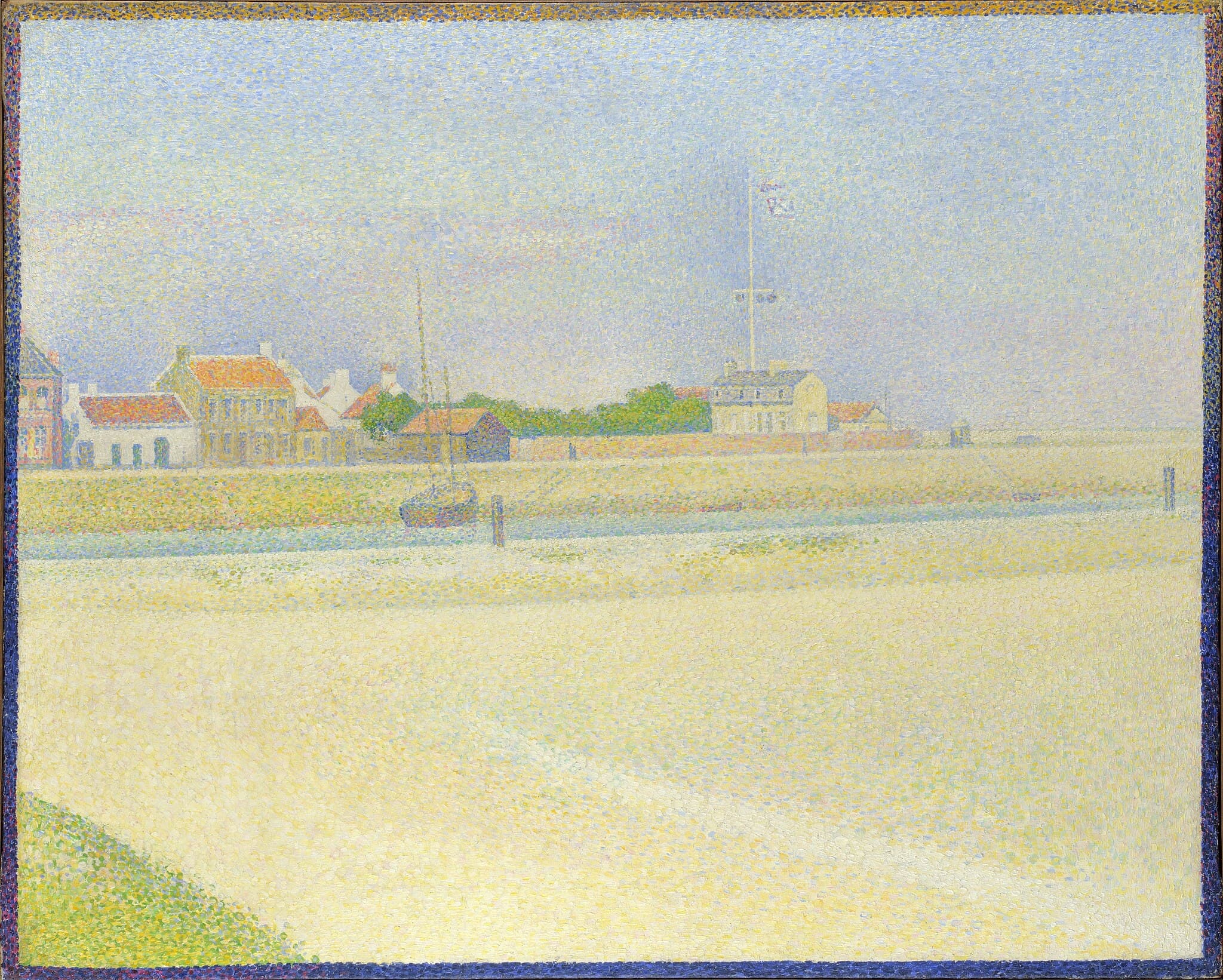
Object and standing: The Channel of Gravelines, Grand Fort‑Philippe (1890; oil on canvas, 65 × 81 cm) is held by the National Gallery, London, acquired in 1995 from Heinz Berggruen and widely reproduced in the literature [1]. It is a consummate late Seurat seascape—an academically central series distilling his divisionist color and light investigations into a serene maritime geometry. The painting’s stature is enhanced by impeccable provenance (from Seurat’s family to Bignou, Reid & Lefevre, Samuel Courtauld, Berggruen, and then the National Gallery) and ongoing scholarly visibility, including its role in the Courtauld’s 2026 exhibition dedicated to Seurat and the sea [1][5].
Market anchors: The closest public price analogue is Seurat’s La rade de Grandcamp (Le port de Grandcamp), a mature, essentially identical‑size seascape (65 × 81 cm) that realized $34.06 million at Christie’s New York in 2018 (premium‑inclusive) [4]. Since then, the top of Seurat’s market has reset decisively: in 2022, Les Poseuses, Ensemble (Petite version) achieved $149.24 million, establishing a new auction record and confirming the depth of demand for blue‑chip Seurat oils [3]. Adjusting for that step‑change in confidence, persistent scarcity of paintings, and the academic primacy of the late seascapes, a high‑eight‑ to low‑nine‑figure range is warranted for a finished Gravelines canvas.
Institutional acquisition history: When this painting last changed hands (privately) in 1995, the National Gallery reportedly paid about £16–16.3 million (≈$25 million at contemporaneous FX), aided by an £8 million Heritage Lottery Fund grant—an exceptional commitment and a strong historic price for the period [2]. Although not a public auction, that figure substantiates the work’s top‑tier status within Seurat’s oeuvre.
Drivers of the estimate: (1) Series importance and finish: the Gravelines pictures are keystones of Seurat’s late style, and a fully resolved 65 × 81 cm canvas commands a substantial premium over panels and studies [1]. (2) Rarity: true Seurat oils appear extremely infrequently; institutional ownership dominates supply, magnifying scarcity premiums [3]. (3) Provenance/exhibition pedigree: the Courtauld/Berggruen/National Gallery chain is as strong as it gets, supporting pricing at the upper band [1][2]. (4) Market context: the 2018 Grandcamp benchmark and the 2022 record jointly frame a re‑rated demand curve that comfortably supports $60–100 million for a prime late seascape [3][4].
Positioning: Within Seurat’s market hierarchy, a finished Gravelines canvas ranks just below the most iconic, large‑scale figural masterpieces linked to La Grande Jatte yet well above oil studies and croquetons. On that basis—and given current connoisseur and institutional focus on Seurat’s maritime works—the indicated $60–100 million range is decisively supported by comparables and scarcity dynamics [1][3][5].
Key Valuation Factors
Art Historical Significance
High ImpactPainted in 1890, the Gravelines series distills Seurat’s Neo‑Impressionist project into a rigorously structured maritime idiom, crystallizing his investigations of optical mixing, interval, and tonal balance. This canvas represents the culmination of his late style, where composition is pared to essentials and chromatic vibration is orchestrated with scientific precision. Within Seurat’s oeuvre, the late seascapes sit just below the most iconic figural masterpieces in broad fame but are academically central. Their importance has been reinforced by sustained scholarly attention and dedicated exhibitions, ensuring enduring demand among top collectors and institutions. The work’s presence in the National Gallery further cements its canonical status.
Rarity and Supply
High ImpactSeurat died at 31, leaving an exceptionally small body of mature oils. Most finished canvases reside in major museums, and true market‑level supply appears only rarely. This structural scarcity produces a pronounced replacement value premium: when a prime Seurat oil does surface, competition is intense and pricing can reset quickly. Relative to the abundant availability of works by many Impressionists, Seurat’s market is extraordinarily thin, which amplifies the price impact of any late, finished canvas. A 65 × 81 cm seascape is an especially constrained subtype, with few direct substitutes across the artist’s output.
Quality, Scale, and Finish
High ImpactAt 65 × 81 cm, the format is the classic mid‑size Seurat exhibition canvas—substantially more important than small croquetons or pochades. The Gravelines composition is fully resolved, with the artist’s signature divisionist touch and carefully modulated palette intact, situating it well above studies in the quality hierarchy. This level of finish aligns closely with the strongest landscape comparables and supports placement in the high‑eight to low‑nine figure range. The work’s pictorial clarity and chromatic poise speak to Seurat at his most refined, which is precisely what the market prizes at the top end.
Provenance and Exhibition History
High ImpactThe ownership chain—Seurat’s family; Galerie Bignou/Reid & Lefevre; Samuel Courtauld; Heinz Berggruen; National Gallery, London—is exemplary. Such a lineage reduces transactional friction and boosts lender confidence, while repeated exhibition and literature citations embed the work in the canon. The National Gallery’s 1995 acquisition, supported by the UK Heritage Lottery Fund, testifies to its institutional caliber. Continued visibility, including the Courtauld’s 2026 Seurat and the Sea presentation, sustains scholarly and market attention. This pedigree justifies pricing at the upper end of the range and minimizes discounting for uncertainty.
Market Benchmarks and Momentum
Medium ImpactThe 2018 sale of Seurat’s La rade de Grandcamp (same size; mature seascape) at $34.06m provides a direct starting point, while the 2022 auction record of $149.24m for Les Poseuses proves present‑day demand for top Seurat oils. With supply exceptionally tight since 2022, pricing for a prime late seascape lines up credibly in the $60–100m band. This range reflects both the series’ art‑historical weight and the scarcity premium that has intensified post‑record. The estimate positions the work below flagship multi‑figure masterpieces yet clearly above minor sketches and panels, consistent with observed buyer behavior.
Sale History
Private sale (Heinz Berggruen to the National Gallery, London)
Acquired with an £8m Heritage Lottery Fund grant; price reported at approx. £16–16.3m (≈$25m at contemporaneous FX).
Georges Seurat's Market
Georges Seurat’s market is among the most rarefied of the late‑19th century. Because the number of finished oils is small and most reside in museums, turnover is sporadic and price discovery occurs in infrequent, highly competitive moments. The current auction record is $149.24 million (Christie’s New York, 2022) for Les Poseuses, which reset expectations for top‑tier Seurat works. Mature, finished oils—especially those linked to major series—command high‑eight to low‑nine figures. Works on paper form the majority of public offerings and typically range from mid‑six to low‑seven figures, with exceptional drawings exceeding that. Overall demand is deep among global connoisseurs and institutions, with a pronounced scarcity premium.
Comparable Sales
La rade de Grandcamp (Le port de Grandcamp)
Georges Seurat
Same artist; mature pointillist seascape of essentially identical size (65 × 81 cm); widely cited benchmark for late Seurat landscapes.
$34.1M
2018, Christie's New York
~$43.9M adjusted
Les Poseuses, Ensemble (Petite version)
Georges Seurat
Same artist; late 1880s masterpiece that set Seurat’s auction record; not a seascape but anchors the top of Seurat’s market and demonstrates current demand for prime oils.
$149.2M
2022, Christie's New York
~$165.7M adjusted
Paysage, l’Île de la Grande Jatte
Georges Seurat
Same artist; mid-size landscape from a pivotal project (Grande Jatte); important reference point for pricing substantial Seurat landscape oils.
$35.2M
1999, Sotheby's New York
~$68.6M adjusted
Concarneau, calme du matin (Opus no. 219, Larghetto)
Paul Signac
Closest high-profile style peer sale: landmark Neo‑Impressionist coastal scene by Signac. Corroborates depth of demand for pointillist seascapes at the very top end.
$39.0M
2022, Christie's New York
~$43.3M adjusted
Le port au soleil couchant, Opus 236 (Saint‑Tropez)
Paul Signac
Style peer; prime Neo‑Impressionist harbor scene sold recently in London. Supports pricing for top coastal subjects in the divisionist idiom.
$10.2M
2023, Christie's London
~$10.8M adjusted
Current Market Trends
The Impressionist/Post‑Impressionist segment has remained resilient through recent market cycles, with buyers concentrating capital on canonical names and museum‑grade examples. After the 2022 peak in several categories, collectors have grown more selective at the ultra‑high end, but blue‑chip works with impeccable provenance and strong exhibition histories continue to clear at premium levels. For Neo‑Impressionism, the 2022 Seurat record and strong Signac results affirmed robust demand for pointillist masterworks. Given the paucity of supply in Seurat oils, any late, finished canvas would benefit from a scarcity tailwind, while renewed scholarly focus—especially on the seascapes—supports sustained depth of bidding.
Sources
- National Gallery, London — Object page: The Channel of Gravelines, Grand Fort‑Philippe
- The Independent — Lottery funds help gallery buy masterpiece for £16m (1995)
- CNBC — Paul Allen Collection: Seurat sets $149.2m record (Nov 2022)
- Christie’s (reported via ArtzLine) — La rade de Grandcamp (2018) $34.06m
- The Courtauld — 2026 exhibition programme (Seurat and the Sea)