Giant Strawberries in The Garden of Earthly Delights
A closer look at this element in Hieronymus Bosch's c.1490–1500 masterpiece
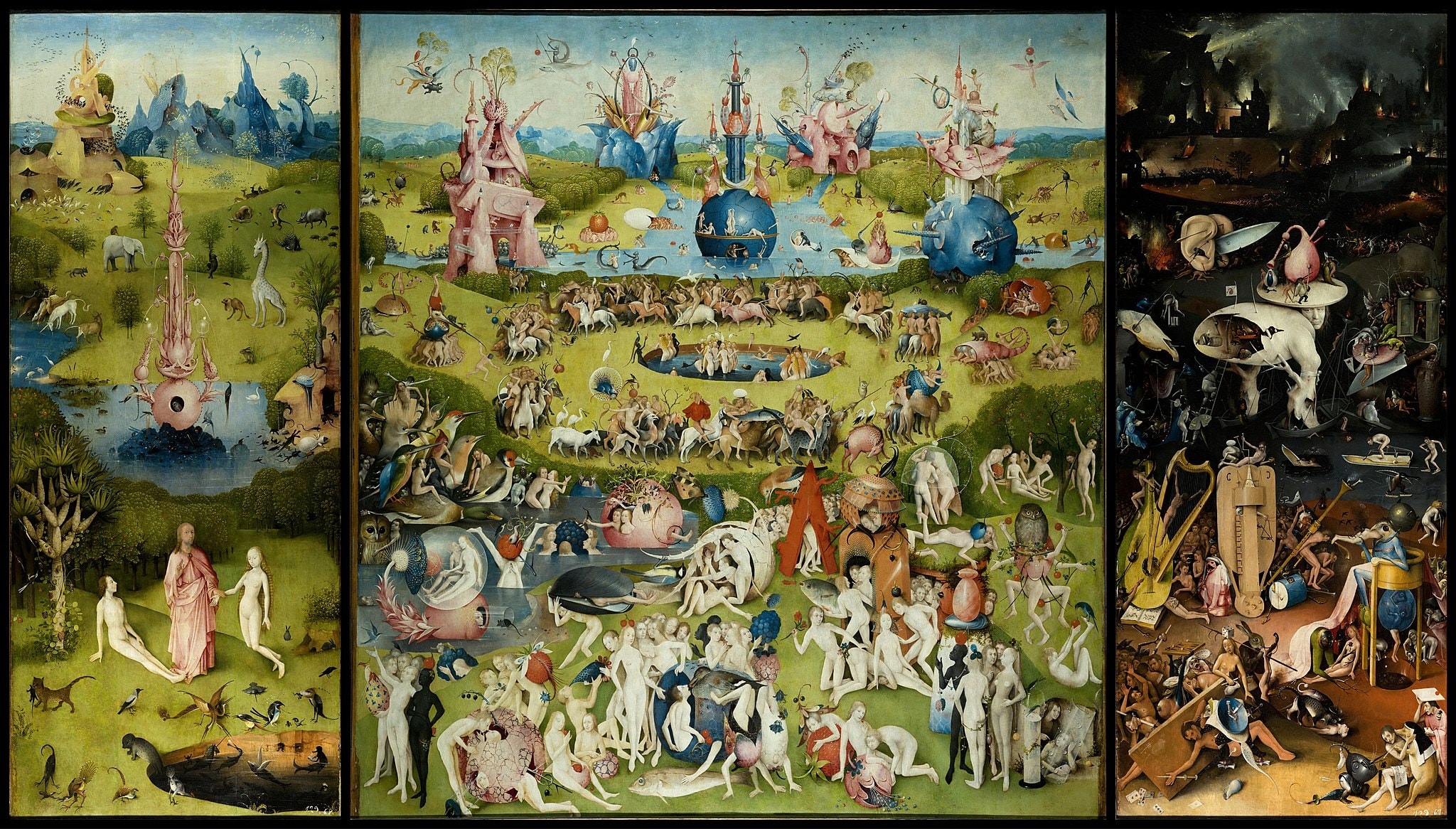
Across the center panel of Bosch’s triptych, nude revelers heft, taste, and lounge upon impossibly large strawberries—lustrous red beacons scattered through a green, sunlit expanse. These giant berries crystallize the panel’s conceit: irresistible, season‑sweet pleasures whose brevity and excess signal the moral slide that culminates in the Hell at right.
Historical Context
Painted circa 1490–1500 for a Burgundian‑Habsburg courtly milieu, The Garden of Earthly Delights was conceived as a sophisticated moral spectacle—its radiant interior panels opposing the subdued grisaille exterior. Curators at the Museo del Prado describe the central scene as a "Paradise that deceives the senses", where visual abundance and playful disproportion invite contemplation of human desire and its consequences 1.
Early records confirm that contemporaries fastened on the fruit as a defining feature: a 1593 inventory in Spain dubbed the work “el Madroño” (the strawberry tree), while later descriptions referred to it as the “strawberry painting,” indicating that viewers read the berries as central to the theme of worldly delight. Within a princely setting—likely tied to the House of Nassau—such imagery functioned as a polished instrument for debate, a “mirror” in which courtiers weighed pleasure against virtue. Modern scholarship situates the triptych in this environment of humanist discourse and court entertainment, where outsized fruit could operate as immediately legible emblems of seduction, vanity, and extravagance 2.
Symbolic Meaning
Bosch’s strawberries fuse two strands of late medieval meaning. On one hand, they figure ephemerality: the berry is sweet, thin‑skinned, and quickly spoils—apt shorthand for delights that flare and fade. Canonical summaries gloss the strawberries as signs of the “unsubstantial quality of fleshly pleasure,” matching the Prado’s reading of the center as a deceptive garden of sensual allure 51.
On the other, they point to eroticism. In Netherlandish speech and proverb, “plucking fruit” carried sexual overtones; scholars such as Dirk Bax and Paul Vandenbroeck connect Bosch’s repeated motifs of handling, feeding, and bearing fruit to coded depictions of lust and amorous play 3. The strawberry thus condenses appetitive sweetness and sexual pursuit in a single, memorable emblem.
Bosch intensifies this tension by overturning a familiar positive valence. In devotional art, strawberries could signal Marian purity and virtuous “good works,” the tri‑lobed leaf echoing the Trinity 6. Here, those associations are repurposed: what looks paradisal is merely bait. Walter S. Gibson argues that Bosch’s berries epitomize alluring surfaces that hide danger, a lure whose path is completed in the right‑panel Hell 4. Together, these readings make the strawberry the painting’s clearest badge of pleasure’s brevity and peril.
Artistic Technique
Executed in oil on oak, the triptych leverages oil’s capacity for precision and glow. Bosch punctuates the green landscape with saturated reds and pinks, staging the strawberries as rhythmic visual magnets that stitch miniature episodes across a continuous, high‑horizon vista 1. Close views reveal minute seeds, wet highlights, and rosy glazes that make the fruit simultaneously tactile and unreal in scale, sharpening the sense of overabundance 8.
Technical study with infrared reflectography and X‑rays shows Bosch refining placements through underdrawing and adjustments, calibrating the berries to guide the eye through clusters of figures and toward key vignettes of tasting, carrying, and reclining 9. The result is a deliberately seductive surface: meticulous, bright, and irresistibly consumable—just like the pleasures the berries signify.
Connection to the Whole
The strawberries are the central panel’s leitmotif, tying micro‑scenes of feasting and flirtation into a single field that bridges Eden on the left and the infernal punishments on the right. They advertise a “Paradise that deceives,” signaling delights that blossom in the middle panel only to curdle into penalty next door 1.
Even the painting’s early titles—“strawberry painting,” “el Madroño”—show that viewers grasped this device, reading the berries as the work’s emblem and moral key 72. Pedagogical syntheses likewise present the fruit as the picture’s portable thesis: temptation made visible, sweet but transient, scaled up so no viewer can miss the warning 10. As such, the strawberries anchor both the composition’s visual rhythm and the triptych’s narrative arc from innocence to indulgence to retribution.
Explore More from This Painting
This detail is one part of The Garden of Earthly Delights. Use the links below to return to the full interpretation, browse the full set of details, or view the painting's valuation if available.
Sources
- Museo Nacional del Prado – The Garden of Earthly Delights (object entry and curatorial essay)
- Edizioni Ca’ Foscari – Contemporary Adventures with The Garden of Earthly Delights (context, 1593 inventory, court milieu)
- OpenEdition/ESSAIS – Bax and Vandenbroeck on fruit as sexual metaphor; “to pluck fruit” euphemism
- Walter S. Gibson – The Strawberries of Hieronymus Bosch (synthesis via JSTOR Daily)
- Web Gallery of Art – Detail note on strawberries symbolizing unsubstantial pleasure
- Getty Museum (The Iris) – Christian symbolism of strawberries in Renaissance art
- Wikipedia – The Garden of Earthly Delights (early titles; descriptive overview, cross-checked)
- Wikimedia Commons – High-resolution strawberry detail from the central panel
- Museo del Prado – Technical study video (IRR/X-rays) of The Garden of Earthly Delights
- Learner.org – Art Through Time: Dreams and Visions (synthesis of themes and symbolism)