The Garden of Earthly Delights

by Hieronymus Bosch

The Garden of Earthly Delights unfolds a three‑act moral narrative—innocence, seduction, and retribution—from Eden to a punitive Musical Hell. Bosch binds the scenes through recurring emblems (notably the owl) and by echoing Eden’s crystalline fountain in the center’s fragile, candy‑colored architectures, then in Hell’s broken bodies and instruments. The work dazzles with invention while insisting that sweet, ephemeral pleasures end in ruin [1].

Fast Facts

Year
c.1490–1500
Medium
Oil on oak panels (grisaille on exterior wings)
Dimensions
H 185.8 cm; W 325.5 cm open (center 172.5 cm; each wing 76.5 cm)
Location
Museo Nacional del Prado, Madrid (Room 056A; on permanent loan from Patrimonio Nacional)
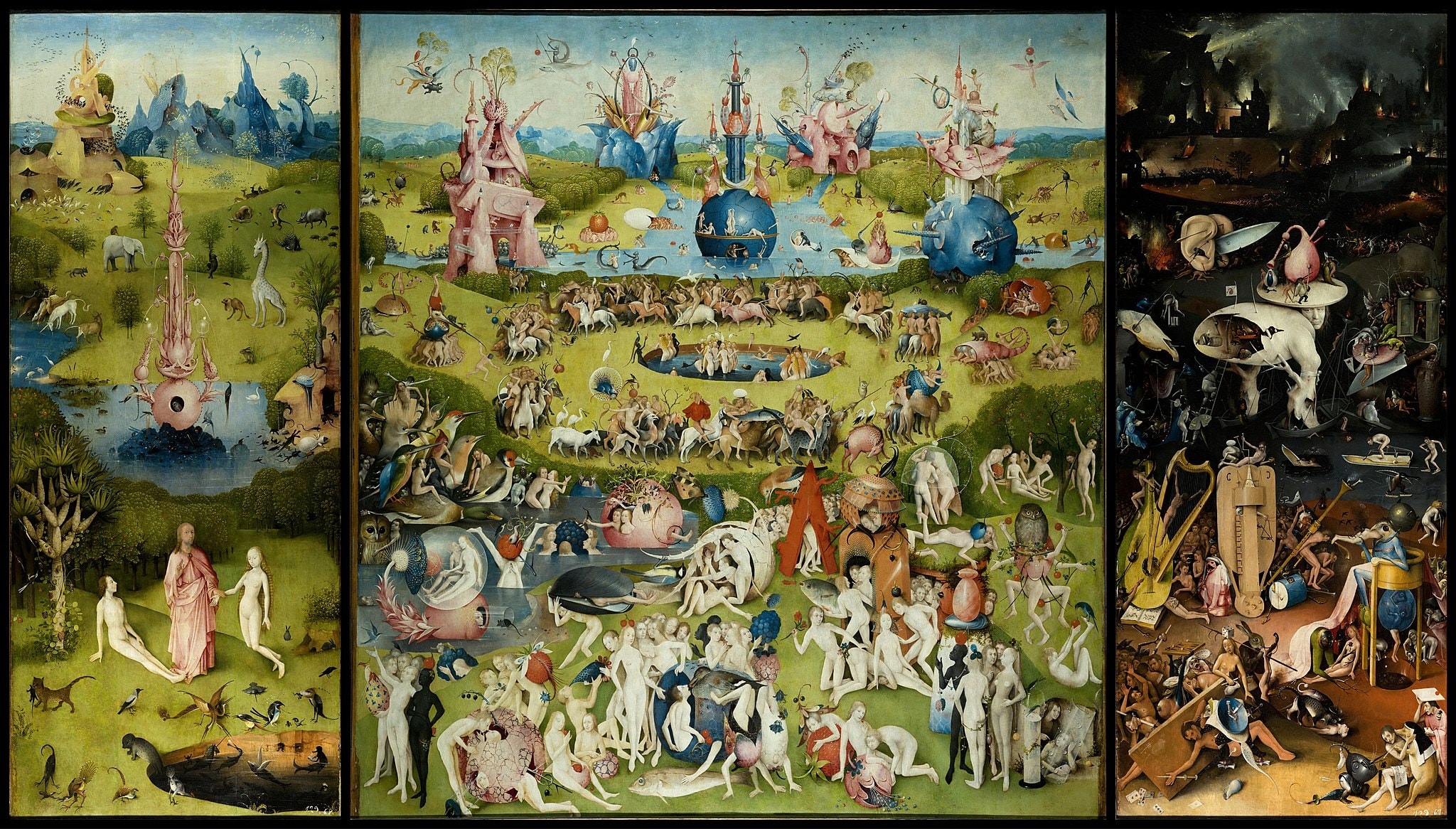
The Garden of Earthly Delights by Hieronymus Bosch (c.1490–1500) featuring Owl, Edenic Fountain/Crystal Tower, Oversized Fruit (strawberries, cherries, berries), Glassy Bubbles and Shells

Click on any numbered symbol to learn more about its meaning

Meaning & Symbolism

Bosch structures the triptych as a continuous landscape so that ethical causality reads across the hinges. In Eden (left), God takes Eve’s wrist and joins her to Adam, instituting ordered love; the nearby pink, organic fountain rises over limpid waters crossed by the Four Rivers, while exotic beasts—giraffe, elephant, unicorn‑like forms—amble in calm procession. Crucially, an owl peers from the fountain’s cavity: a compact emblem of corrupted or ominous knowledge intruding into innocence. The owl’s presence does not break Paradise yet, but it seeds the theme that vision and wisdom can sour into error when severed from God 13. The dragon tree at lower left—linked to the Tree of Life—anchors this panel’s promise of durability, setting a baseline against which the center’s delights will look fatally fragile 1. The center panel performs seduction through imitation. Its five delicate aqua‑pink structures rhyme with Eden’s fountain but look thinner, more brittle, as if grown from spun sugar and glass. Human bodies, now unchaperoned, play at harmony: riders circle a pool of women in an enticing geometry, suggesting order without obedience; pairs and clusters taste, carry, or are carried by oversized strawberries and cherries, literalizing the sweetness and perishability of lust. Transparent bubbles and shells become habitation and stage—beautiful but ready to burst. Owls reappear, now facing us directly, their stare implicating the beholder in the spectacle. Bosch’s point is not merely that people indulge, but that they confuse the sign for the thing: fruit for fulfillment, procession for virtue, nature for paradise. The scene is buoyant, funny, and meticulously designed, yet its physics feel unstable; blossoms become traps, and pleasures slide toward compulsion. This is a false paradise, a world that looks like Eden but runs on appetite 14. Hell (right) strips the masquerade. The same cultural pursuits that animated the center—music, feasting, games, sex—are retooled as instruments of torture. A lute, harp, and giant drum pinion the damned; musical notation is branded onto flesh; a pig in a nun’s veil cajoles a man into signing, fusing lust and coercion; the famous bird‑headed demon devours sinners on a latrine‑like throne and excretes them into a pit, parodying consumption as endless waste. The hollow‑bodied Tree‑Man houses a tavern inside his abdomen, a grotesque anatomy lesson on gluttony and self‑consumption. In the distance, a city burns under a black sky; the glowing horizon that once promised dawn now guarantees no escape. Bosch completes the moral syllogism: what Eve received as gift becomes, through misdirected desire, a marketplace of bodies, then a factory of punishments where each vice meets its form. The triptych’s brilliance is not in a single allegory but in a system of echoes—fountain to filigree pavilion to broken instrument; calm beasts to circular riders to predatory hybrids; discreet owl to accusatory stare—that make the consequences of delight legible and felt. That is why The Garden of Earthly Delights remains a touchstone: it advocates for rightly ordered love by making disordered love terrifyingly persuasive and unforgettable 124.

Explore Deeper with AI

Ask questions about The Garden of Earthly Delights

Popular questions:

Powered by AI • Get instant insights about this artwork

💬 Ask questions about this artwork!

Interpretations

Courtly Reception & Moral Play (Falkenburg)

Rather than a single sermon, Bosch’s triptych can operate as a late‑medieval “conversation piece” for a Burgundian‑Habsburg milieu, inviting elite beholders to test their likeness or unlikeness to God. The continuous landscape behaves like a discursive field: viewers trace correspondences (fountain to fragile pavilions; processions to predation) and calibrate their own responses to pleasure, spectacle, and judgment. The work’s deliberate ambiguities—its buoyant comedy and exquisite craft—provoke debate rather than close it, making ethical reflection an aristocratic pastime. In this reading, the painting is not less moral but more interactive: a courtly ethics engine whose puzzles measure the viewer’s spiritual acuity as much as the figures’ vices 41.

Source: Reindert Falkenburg (Brill), with Prado curatorial context

Iconography of Marriage & Gendered Desire

The left panel’s unusual subject—God presenting Eve to Adam—links the triptych to nuptial iconography and ordered procreation. Bosch’s gesture vocabulary (God grasping Eve’s wrist) formalizes marital institution, while the dragon tree and Four Rivers frame fidelity as cosmically rooted. The center panel then shows desire decoupled from ordinance: women as a static pool encircled by riders; bodies instrumentalized by fruit, shell, and bubble; and, in Hell, a pig‑nun coercing a man to sign, fusing lust with clerical hypocrisy. Across the wings, gendered scripts move from covenant to commodification to coercion, a critique sharpened by the shift from divine choreography to market‑like circulation of bodies 13.

Source: Museo del Prado; Margaret A. Sullivan, Oud Holland (2014)

Exotica, Travel Lore, and Early Global Imaginaries

Bosch salts Eden with a dracaena (dragon tree), giraffe, elephant, and unicorn‑like forms sourced from travel lore and encyclopedic compilations, signaling a courtly appetite for the exotic. This is not neutral description: the calm procession of beasts embodies a created order that the center panel parodies through hybrid predators and instrumentalized animals. For a patron in the Nassau orbit, such imagery flattered cosmopolitan curiosity while warning that wonder, severed from wisdom, becomes spectacle and prey. The painting thus stages a pre‑colonial global imaginary in which the world’s marvels are both courtly capital and spiritual test—objects of knowledge that can devolve into consumables when desire rules 12.

Source: Museo del Prado; Britannica (Bosch biography/context)

Musical Hell and the Ethics of Entertainment

Bosch’s “musical Hell” anatomizes secular leisure by literalizing the moral weight of sound and festivity. Lutes, harps, and a drum immobilize the damned; notation is seared onto flesh; taverning reappears inside the Tree‑Man’s hollow body. Pleasure’s infrastructure—song, dance, conviviality—becomes the very apparatus of judgment. This is not merely punitive spectacle: it is a sophisticated commentary on habitus, where cultural refinements mask disciplinary power that ultimately binds. By matching instrument, pastime, and penalty, Bosch fixes vice to its material culture, making entertainment’s form the vehicle of its reckoning 1.

Source: Museo del Prado (curatorial analysis of Musical Hell)

Metapictorial Address: Seeing, Knowing, and Being Seen

Owls in Eden and the center panel thread a theory of vision through the triptych. First tucked within the fountain (knowledge latent within creation), they later face us frontally, staging a return gaze that implicates viewers as voyeurs and potential dupes of spectacle. Transparent globes, shells, and mirrors of water function as optical allegories—seductive, reflective, and brittle—while the grisaille exterior’s glassy Earth sets a medium‑to‑world analogy from the outset. Bosch positions painting itself as a test of discernment: do we prize shimmer over truth and mistake semblance for salvation? The work teaches seeing by dramatizing how sight drifts toward appetite 145.

Source: Museo del Prado; Reindert Falkenburg; CODART/BRCP

Process, Underdrawing, and Compositional Echo

Technical studies and restoration accounts show Bosch revising forms and leveraging close-knit echoes to bind the triptych’s logic. The five delicate aqua‑pink structures in the center are not mere fantasy: they are calibrated variations on Eden’s fountain, thinned to fragility to visualize moral attenuation. Underdrawing adjustments and the seamless horizon reinforce narrative continuity, ensuring that the viewer reads causality across hinges. Far from improvisatory grotesque, the painting’s comic excess sits atop a rigorous, almost architectural plan—proof that its moral effects are engineered via repetition, inversion, and controlled instability, rather than piled-on marvels alone 15.

Source: Museo del Prado; CODART (BRCP overview)

Related Themes

About Hieronymus Bosch

Hieronymus Bosch (c.1450–1516), active in ’s‑Hertogenbosch and a member of the Brotherhood of Our Lady, pioneered fantastical yet theologically pointed imagery for elite and devotional patrons. His oeuvre habitually links everyday vices to apocalyptic consequences, making him a central voice in Northern Renaissance moral painting [2].
View all works by Hieronymus Bosch