The Pool of Lust in The Garden of Earthly Delights
A closer look at this element in Hieronymus Bosch's c.1490–1500 masterpiece
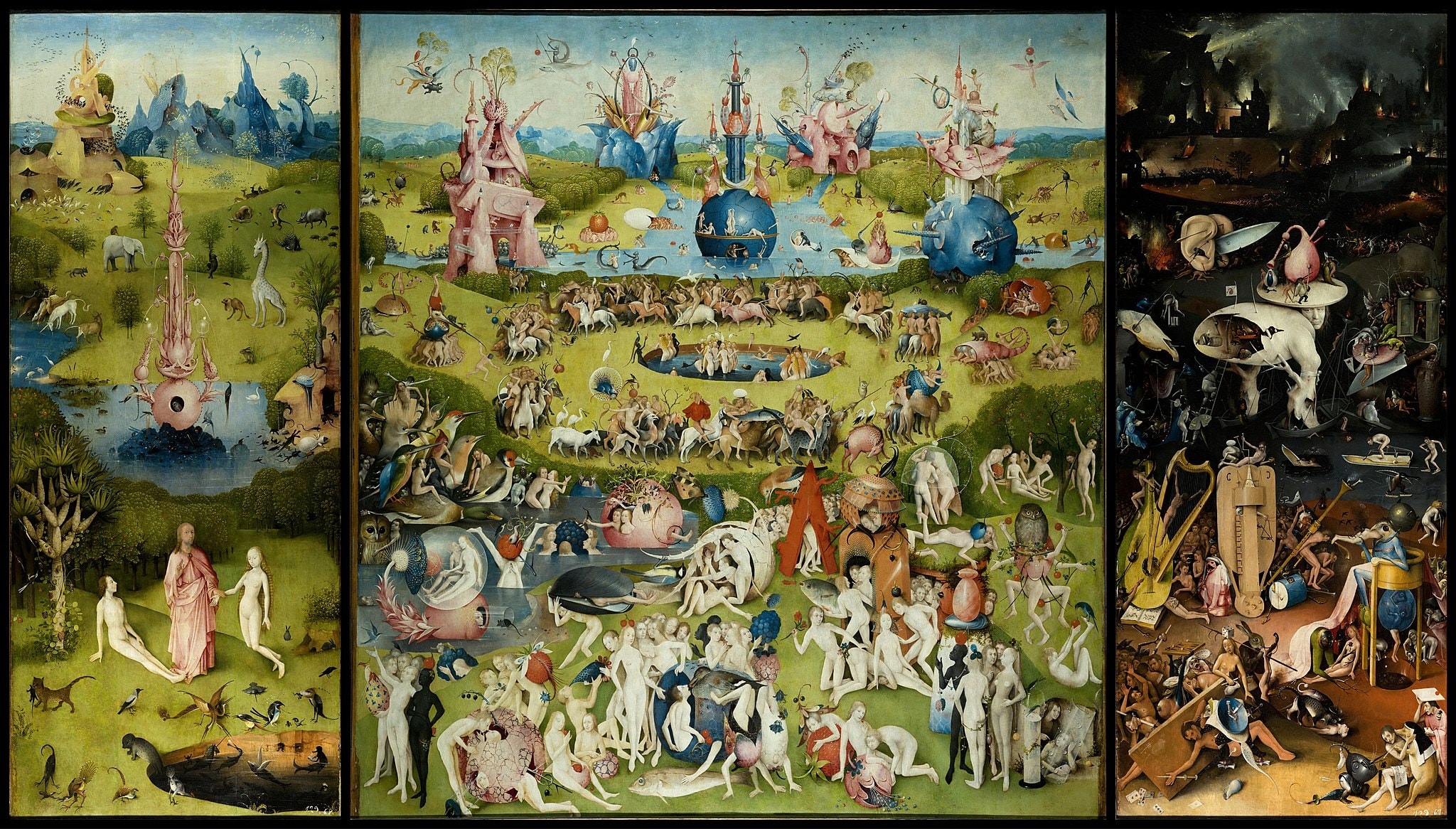
In the center of Bosch’s Garden of Earthly Delights, a circular bath of nude women is ringed by naked men who ride exotic beasts in an anticlockwise pageant. Often called the Pool of Lust, this choreographed pursuit turns desire into spectacle. As the painting’s structural axle, it crystallizes the triptych’s passage from innocence to consequence.
Historical Context
Painted for a Burgundian-court milieu around 1500, The Garden of Earthly Delights follows a familiar triptych logic in the Low Countries: Eden on the left, humanity’s pleasures and temptations at center, and Hell on the right. Prado curators identify lust as the center panel’s dominant theme; at its heart stands a circular pool filled with women while men circle on horseback and hybrid beasts in an anticlockwise cavalcade, a staging of pursuit that concentrates the panel’s subject matter 1.
Contemporary viewers would have recognized the pool as a designed spectacle. Smarthistory notes its alignment on the painting’s main vertical axis and describes the riders’ feats as a deliberate display of courtship prowess, turning the middle distance into an organized arena that contrasts with the teeming foreground 2. Within the triptych’s left-to-right narrative, this ordered theater of desire operates as the hinge between the paradisal fountain and the punishments ahead, clarifying why Bosch places this element at the compositional center of the work 12.
Symbolic Meaning
The pool condenses Bosch’s meditation on lust and the ephemerality of pleasure. Prado highlights the center panel’s oversized red and blue fruits—sweet but perishable—as an index of fleeting delights; behind the pool, the fractured water-architecture echoes Eden’s pristine fountain, signaling fragility and moral drift 1. The anticlockwise cavalcade literalizes an erotic chase: nude men ride exotic and hybrid mounts—visual emblems in late medieval moral imagery for being carried by one’s animal appetites—while the women in the water form the spectacle’s focal prize 135. As a social scene, the mixed-bathing setting recalls late medieval bath culture, widely associated with amorous dalliance and moral anxiety, sharpening the pool’s charge as a stage for seduction 7.
Scholars have widened the frame beyond simple condemnation. Reindert Falkenburg proposes that the center operates as a sophisticated “conversation piece,” a mirror for elite viewers to reflect on desire’s allure and ambiguities rather than a single-message warning 6. JHNA authors likewise stress the panel’s cool, pre-moral atmosphere—figures act without overt shame—complicating a purely punitive reading 4. Britannica aptly calls the center a “theater” of ephemeral pleasures, a formulation that accommodates both moral program and worldly spectacle 3. Modern labels—from Pool of the Maidens to Pool of Prostitutes—underscore how cataloging itself encodes these interpretive stances 28.
Artistic Technique
Bosch secures the pool on the composition’s main axis and articulates it with crisp, circular geometry: a ring of riders encircles a clear, dark oval of water, creating a legible node amid swarming episodes 2. The scene is bathed in even, high-key light; pale bodies gleam against saturated greens, while punctuating reds and blues—especially in fruit and ornaments—guide the eye around the circuit 15. Bosch’s small, controlled strokes keep contours sharp and forms readable at a distance, so the cavalcade reads instantly as an organized pageant rather than a crowd. The result is ornamental clarity wedded to moral focus: a meticulously rendered carousel that locks the viewer’s gaze at the very center of the vast panel 52.
Connection to the Whole
The pool functions as the triptych’s pictorial and thematic hinge. Aligned with the central axis, it anchors the continuous horizon shared with Eden to the left, while the broken, crystalline fountain behind it pointedly echoes and inverts Eden’s intact source of purity 21. As Britannica notes, the center is a public theater of ephemeral pleasures; the pool’s cyclical motion models how desire becomes ordered, repeatable, and contagious before giving way to the punishments of Hell on the right 31. Concentrating the panel’s lust motif into a single, legible device, the pool is both emblem and engine for the work’s progression from creation to consequence.
Explore More from This Painting
This detail is one part of The Garden of Earthly Delights. Use the links below to return to the full interpretation, browse the full set of details, or view the painting's valuation if available.
Sources
- Museo Nacional del Prado — collection entry for The Garden of Earthly Delights
- Smarthistory — Hieronymus Bosch, The Garden of Earthly Delights
- Encyclopaedia Britannica — overview of The Garden of Earthly Delights
- Journal of Historians of Netherlandish Art — Jheronimus Bosch and the Issue of Origins
- Web Gallery of Art — central panel overview and commentary
- Oud Holland (Brill) — review context for Reindert Falkenburg’s monograph
- Clio, Women, Gender, History — The Fountain of Youth: bathing and youthfulness (14th–16th c.)
- University of Michigan Library Digital Collections — catalog record using “Pool of Prostitutes”