Bird-Headed Demon in The Garden of Earthly Delights
A closer look at this element in Hieronymus Bosch's c.1490–1500 masterpiece
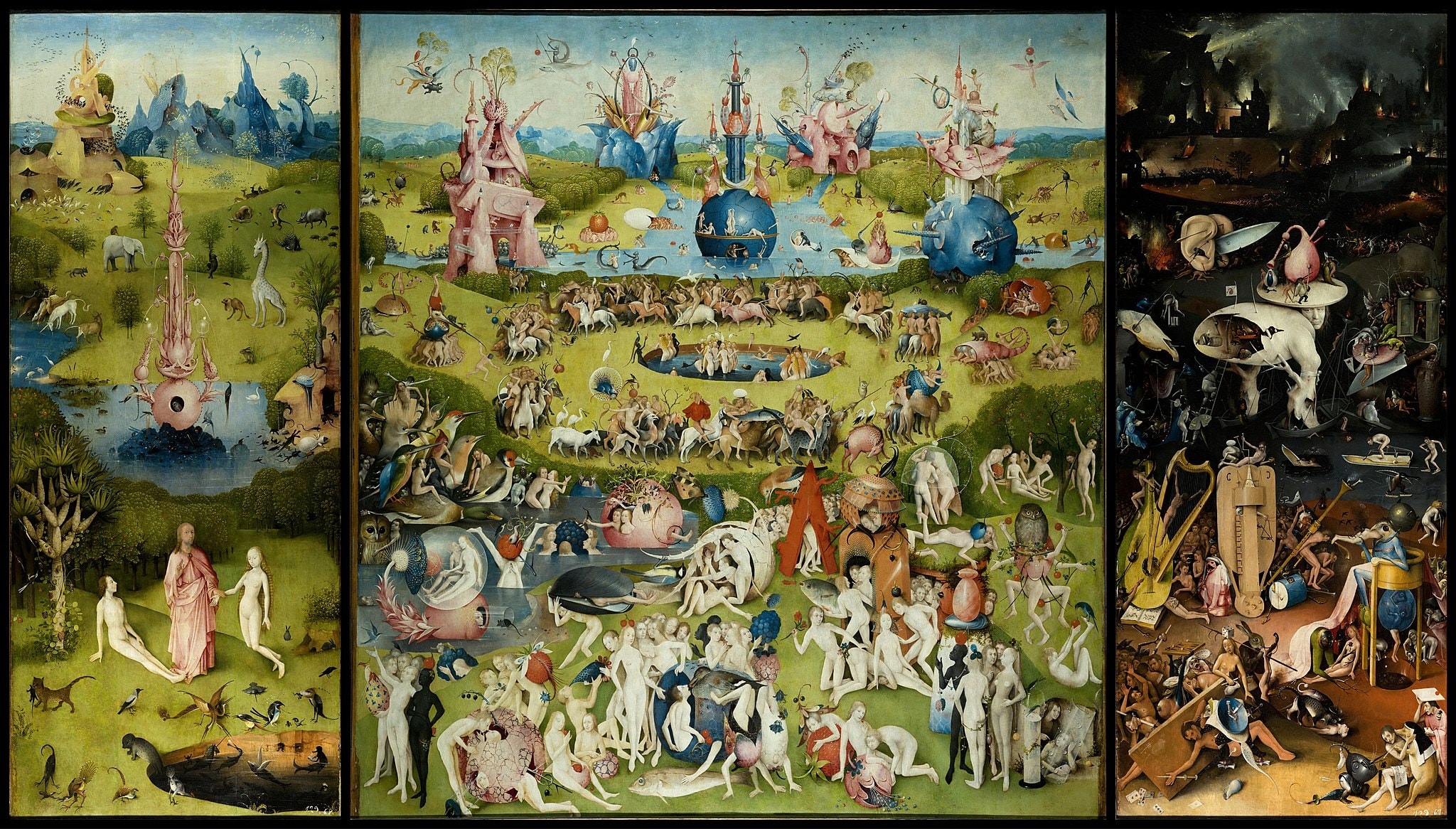
Bosch’s Bird-Headed Demon, enthroned on a latrine in the Hell panel of The Garden of Earthly Delights, devours the damned and voids them into a glass chamber-pot below. This grotesque sovereign—often called the Prince of Hell—condenses the painting’s vision of moral retribution, where corrupt appetites return upon the sinner in a cold, nocturnal inferno.
Historical Context
Painted in oil on oak around 1490–1505 in the Netherlands, The Garden of Earthly Delights belongs to a late medieval Christian culture that expected art to teach through vivid exempla. The right wing’s nightmarish Hell stages punishments tailored to the capital vices; within it, the Bird‑Headed Demon sits on a potty‑throne, ingesting sinners and excreting them into a cesspit—an unmistakable emblem of infernal justice 1.
Curatorial readings at the Museo del Prado identify this demon as an owl‑type theriomorphic figure whose actions target greed and corrupt exchange, while nearby scenes lampoon false vows and bad contracts. Smarthistory underscores how Bosch harnesses the era’s didactic visual language to make sin’s consequences legible: purgation replaces pleasure, and mock‑royal pageantry masks degradation 12. The figure’s enthroned posture, cold illumination, and proximity to legal‑clerical satire signpost a sophisticated audience attuned to moralized narratives and to the shock of seeing earthly hierarchies inverted in Hell 2.
Symbolic Meaning
The Bird‑Headed Demon personifies avarice and corrupt exchange. Seated on a latrine‑throne and wearing a pot like a debased crown, the figure parodies sovereignty while presiding over a cycle of ingestion and expulsion—a filth‑ridden economy befitting the greedy who consumed unjustly in life 15. As Smarthistory notes, Hell in Bosch functions as a system of purgation: bodies vomit, defecate, and disgorge, inverting pleasures into penalties with clinical clarity 2.
Iconographic details radiate this theme. The transparent chamber‑pot literalizes moral transparency: what went in now comes out, stripped of glamour. Coins and cesspits around the pit reinforce the linkage of wealth to waste, while the adjacent “pig‑nun” coaxing a signature—backed by a beaked devil with an inkpot—satirizes fraudulent vows and coercive contracts, extending the demon’s dominion to deceitful transactions 13.
Comparisons to the widely read Visio Tnugdali (Vision of Tundale) clarify Bosch’s topos: medieval vision literature famously features giant devils who swallow and excrete souls, making this punishment instantly recognizable to contemporary viewers 4. Across the triptych, owl imagery signals hidden evil; here, that latent threat culminates in an avenging, owl‑headed ruler of Hell, completing a trajectory from temptation to damnation 1.
Artistic Technique
Bosch renders the demon with Netherlandish precision: tight contours, jewel‑like glazes, and miniaturist detail that invite close viewing. The right wing’s nocturnal setting uses a cold palette punctured by fires, throwing the bluish, bird‑headed sovereign and his glass chamber‑pot into stark relief against smoky blacks and ember reds 12.
Compositionally, the figure anchors the lower right as a processing node: diagonals lead from swallowed bodies to the pot and cesspit, then outward to linked vignettes like the pig‑nun contract. Technical work at the Prado confirms layered execution and the triptych’s calibrated chromatic arc—Eden’s clarity, the center’s allure, and Hell’s chill—within which the demon’s throne‑latrine reads as a lucid focal device 16.
Connection to the Whole
The triptych narrates humanity’s course from Creation to seduction and, finally, retribution. The Bird‑Headed Demon crystallizes that endpoint: appetites cultivated in the central garden are mechanized into endless consumption and expulsion in Hell. By enthroning a scatological sovereign, Bosch collapses pleasure, power, and punishment into a single emblem 12.
Iconographically, the demon completes a cross‑panel logic. Owls that lurk amid the garden’s delights reappear as an owl‑headed ruler whose court stages clerical and legal mockeries—the pig‑nun’s contract chief among them—binding lust, greed, and fraud into a unified economy of sin 1. As a compositional pivot, the demon organizes surrounding torments and guides the viewer’s eye along a moral conveyor belt, from intake to waste, that mirrors the triptych’s overarching warning about transient delights and their irrevocable consequences 2.
Explore More from This Painting
This detail is one part of The Garden of Earthly Delights. Use the links below to return to the full interpretation, browse the full set of details, or view the painting's valuation if available.
Sources
- Museo del Prado, The Garden of Earthly Delights (object entry)
- Smarthistory, Bosch’s Garden of Earthly Delights and Hell-panel overview
- Web Gallery of Art, right-wing details (pig-nun and legal contract)
- Early Music Muse, Bosch and the Vision of Tundale (analysis with translated passages)
- Wikipedia, The Garden of Earthly Delights (overview and Prince of Hell synopsis)
- Museo del Prado, Technical study of The Garden of Earthly Delights