Musical Hell in The Garden of Earthly Delights
A closer look at this element in Hieronymus Bosch's c.1490–1500 masterpiece
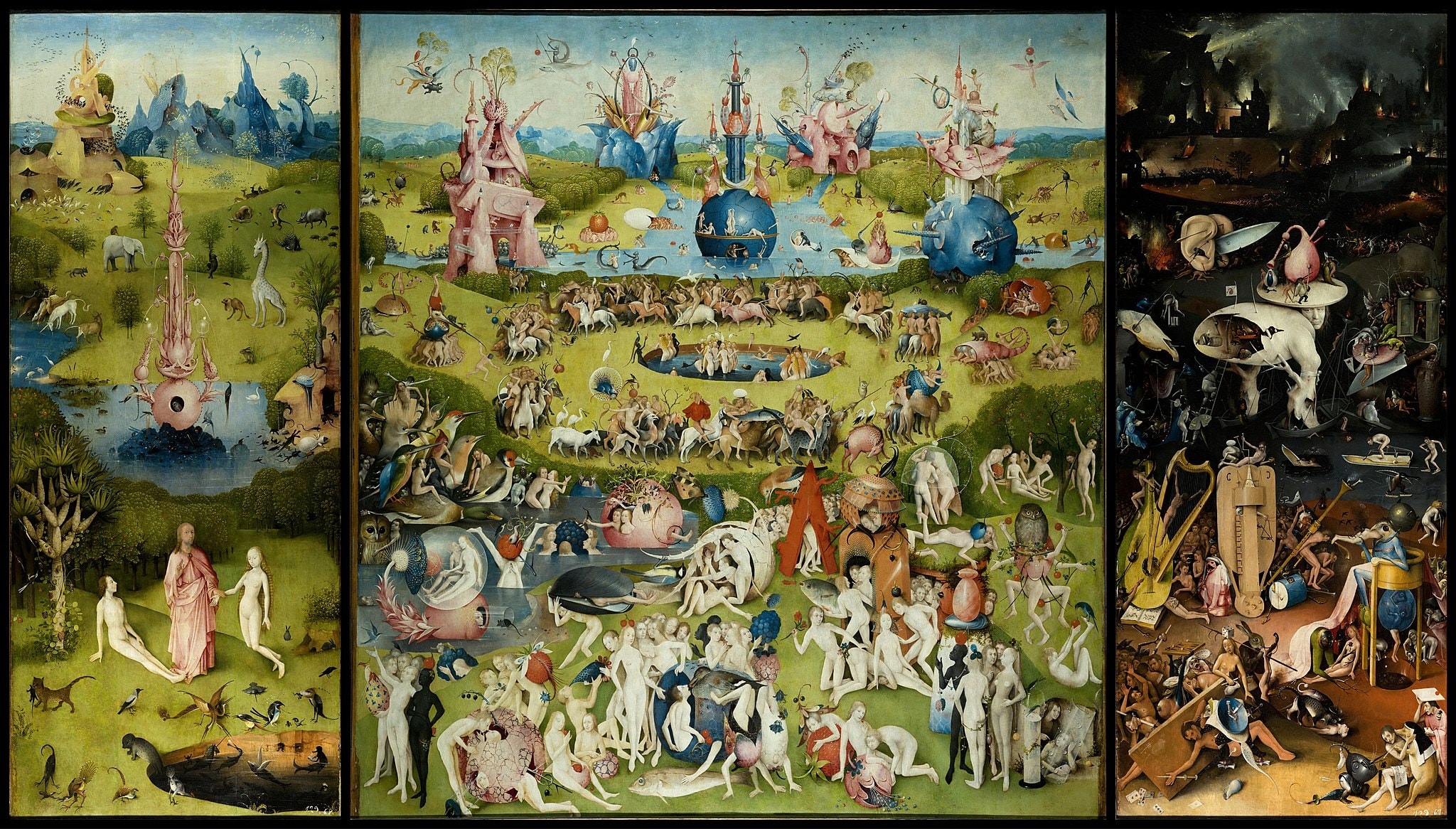
“Musical Hell” is the unforgettable knot of giant instruments and tormented singers in the right wing of Bosch’s The Garden of Earthly Delights. Here, harps, lutes, and bagpipes become engines of punishment—a dark joke aimed at worldly pleasure that reads instantly across the panel. The scene crystallizes Bosch’s moral drama: earthly delights curdle into infernal, unholy sound.
Historical Context
Painted around 1490–1500 for the Burgundian–Habsburg courtly milieu, The Garden of Earthly Delights belonged to the Nassau collection and is documented at the Coudenberg palace in Brussels by 1517. The Prado’s catalogue connects the triptych’s commission to Engelbert II of Nassau and emphasizes its intended princely audience—viewers used to sophisticated entertainment and moralizing wit 1. In this setting, Bosch’s hell of instruments reads as pointed admonition: courtiers who revel in secular pastimes confront their grotesque afterlife.
Reindert Falkenburg argues that Bosch crafted the work as a conversation piece for such elite viewers, turning familiar court music and banquet culture into a courtly parody. The Hell musicians invert refined performance into punishment, while also dialoguing with the triptych’s exterior psalm texts that frame music’s proper, God‑oriented use 2. In short, the “Musical Hell” crystallizes late‑medieval suspicion of sensual sound within a witty court context—simultaneously entertaining, learned, and admonitory 12.
Symbolic Meaning
The nickname “Musical Hell” comes from the cluster where outsized harp, lute/viol, shawm, hurdy‑gurdy, drum, bagpipes, and trumpet become devices of torture. Victims are stretched across strings, crushed in soundboxes, or forced to sing from notes scrawled on naked flesh—details inventoried by scholars and reference catalogues 14. The ensemble dramatizes late‑medieval anxieties about secular music: sound aimed at bodily pleasure is recast as demonic cacophony, a punishment fitting the sin 13.
Instruments long carried erotic overtones in Netherlandish imagery; Bosch presses that symbolism to the edge. Bagpipes, often read as phallic, crown the Tree‑Man’s tabletop procession, turning festivity into vice; the monumental ears skewered by a blade mock the senses that once chased delight 3. The cruciform body strung on the harp parodies sacred salvation and the psalmic ideal of music praising God—now inverted into anti‑music in Hell 2. Modern reconstructions of Bosch’s depicted instruments suggest they would sound “horrible” and effectively unplayable, underscoring that the point is not harmony but weaponized noise 6. The result is a theologically charged satire of the “music of the flesh,” at once specific in its iconography and expansive in moral scope 37.
Artistic Technique
Bosch paints in oil on oak within a triptych format: a luminous, continuous panorama on the left and center gives way to a nocturnal Hell whose palette turns ashen and firelit 15. In the “musicians’” knot at lower left/center of the right panel, he compacts instruments and bodies into a dense, legible cluster that reads at distance like a visual blast of sound 14.
Cold moonlight and sulfurous oranges carve sharp silhouettes; pallid flesh replaces the warm, rosy bodies of the center panel 5. Miniaturist precision—glazed highlights on string pegs, taut cords, and drum skins—heightens the tactile cruelty of the devices. Bosch’s controlled, enamel‑like surfaces make the tortures disturbingly lucid, the better to condemn them.
Connection to the Whole
The triptych moves from Eden (left) through a carnival of sensuality (center) to retribution (right). “Musical Hell” anchors the final stage by corrupting the very pleasures that animate the center—sight, touch, and especially sound—into pain 35. Its tightly packed orchestra of torment provides a concrete, memorable counter‑image to the airy, circulating dances and games across the middle panel 1.
Falkenburg’s reading ties this inversion to the exterior wings’ psalm inscriptions: music rightly praises the Creator, but in the interior, courtly entertainments devolve into infernal noise 2. Thus the musical complex functions as both narrative climax and theological hinge, sharpening the work’s overarching argument about human likeness to God lost through indulgence.
Explore More from This Painting
This detail is one part of The Garden of Earthly Delights. Use the links below to return to the full interpretation, browse the full set of details, or view the painting's valuation if available.
Sources
- Museo del Prado collection entry: The Garden of Earthly Delights
- HNA review of Reindert Falkenburg, The Land of Unlikeness
- Smarthistory: Bosch, The Garden of Earthly Delights and musical symbolism
- Web Gallery of Art: Right panel detail descriptions
- Encyclopaedia Britannica: Overview and tonal contrasts
- BBC Music Magazine: Cacophonous instruments recreated from Bosch
- Wikipedia: The Garden of Earthly Delights (cross-checked details)