The Fountain of Life in The Garden of Earthly Delights
A closer look at this element in Hieronymus Bosch's c.1490–1500 masterpiece
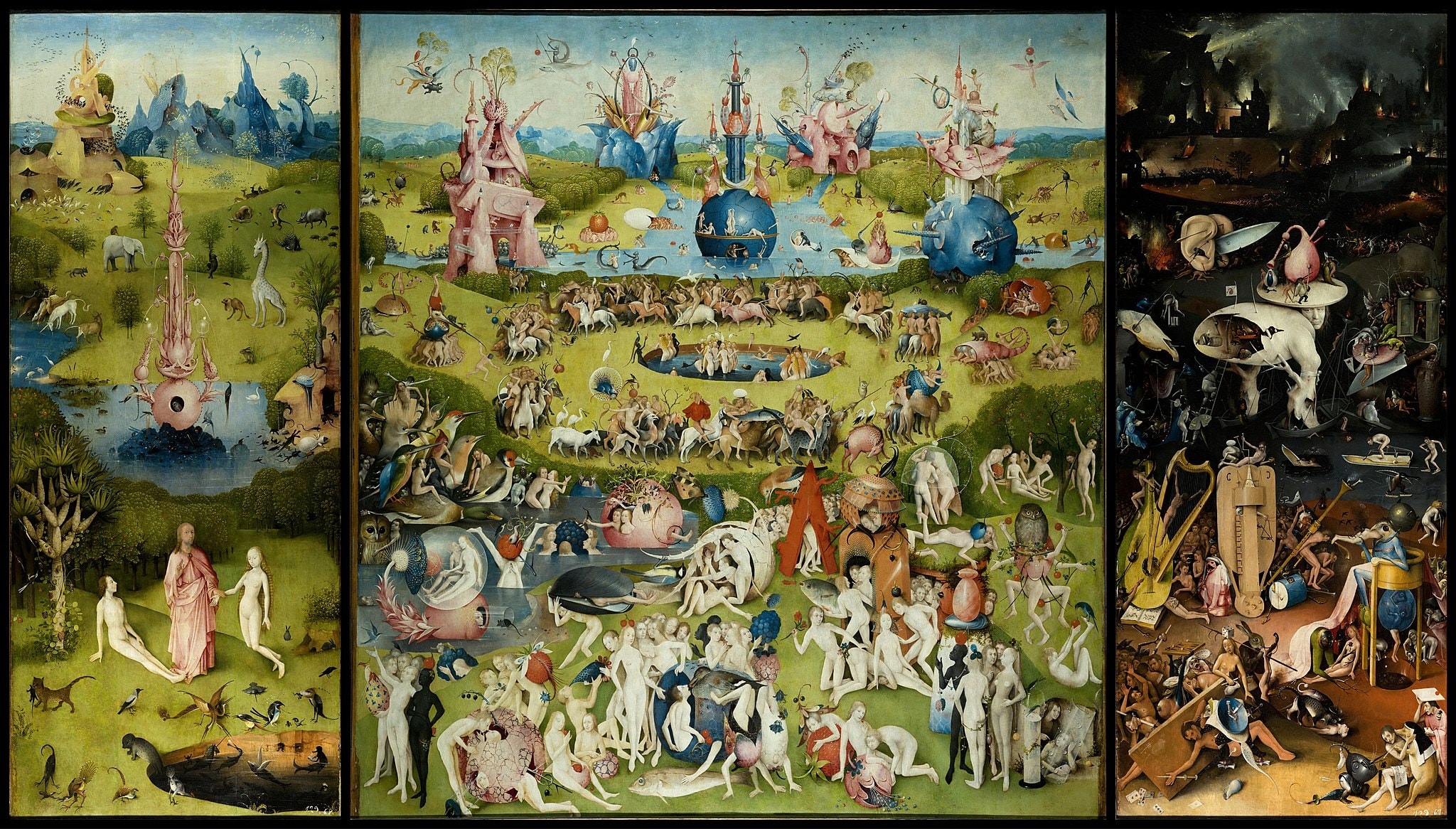
In the Paradise panel, a rose‑pink, tabernacle‑like tower rises from a lake—the Edenic Fountain of Life, source of the Four Rivers. An owl peers from its base, a Boschian sign of evil that shadows Eden and primes the triptych’s moral arc. The fountain anchors the left wing theologically while foreshadowing the false, broken fountains of the central panel.
Historical Context
Painted in the Northern Netherlands around 1490–1510, The Garden of Earthly Delights opens with Paradise, where Bosch situates a centralized water‑architecture identified by the Museo del Prado as the “fountain of the Four Rivers in Paradise” or Fountain of Life. This motif was a familiar medieval shorthand for Eden’s wellspring from which the four biblical rivers flow (Pishon, Gihon, Tigris, Euphrates), and Bosch uses it to anchor the scene both visually and theologically 12.
The Prado’s curators further link the left panel’s rare subject—God presenting Eve to Adam—to the institution of marriage and legitimate procreation, themes that set the moral terms for what follows across the triptych 12. Bosch intensifies the motif’s didactic charge by placing an owl inside the fountain’s base, a species he repeatedly deploys as an emblem of moral blindness and evil, thereby darkening the Edenic source at the very outset 1. The result is a richly codified opening image that draws on late medieval iconographic convention while cueing the drama of human lapse that unfolds in the subsequent panels 12.
Symbolic Meaning
The fountain functions as Eden’s fons vitae—the life‑giving source that, in Christian imagery, conflates the Genesis rivers with baptismal “living water.” Across medieval art, this current of meaning runs from late antique depictions to Netherlandish practice, and Bosch’s pink tower participates in that visual theology: a sign of grace, creation’s freshness, and sacramental renewal 167. The Web Gallery of Art underscores its tabernacle character—an architectural vessel befitting the idea of sacred source 4.
Into this orthodox emblem Bosch inserts an owl at the fountain’s base. The Prado calls special attention to the bird as an emblem of evil in Bosch’s oeuvre; its presence within Eden’s wellspring marks an ominous intrusion of darkness into a site of light, signaling humanity’s imminent fall 1. The baptismal resonance deepens the warning: when the source meant to purify already harbors corruption, the coming disorder is not a surprise but a consequence. Medieval baptismal fonts—often adorned with personifications of the Four Rivers—confirm how viewers of Bosch’s time would have read the nexus of river, fountain, and grace, making the owl’s placement all the more pointed as a sign of grace threatened or misused 56.
Artistic Technique
Bosch fashions the fountain as a fantastical Gothic tabernacle: filigreed arches, spirelets, and organic excrescences merge architecture with living forms—a signature hybrid that lends the structure both delicacy and otherworldly presence 4. Its roseate hue matches the bright pink of Christ’s robe below, a chromatic tether that visually links divine agency to Eden’s source and helps stitch color accents across the triptych’s open wings 3.
Compositorially, the fountain occupies the middle ground near the vertical axis beneath a high, continuous horizon. This axial placement creates a visual “hinge” echoed by central water‑towers in the adjoining panel, establishing a structural rhyme that guides the eye through Bosch’s narrative of creation, seduction, and consequence 13.
Connection to the Whole
The Paradise fountain is the template against which the center panel’s cracked, eroticized water‑architecture is measured. The Prado explicitly notes the similarity: what is intact and life‑giving in Eden becomes a fragile, deceptive engine of pleasure in the world’s “false paradise,” where figures replace the owl within a ruptured structure 1.
Smarthistory observes that Bosch reinforces this link through a continuous horizon and repeating pink accents, tying Eden’s authentic source to its worldly parody and, ultimately, to Hell’s retribution 3. Read across the triptych, the left‑panel fountain is both origin and warning: theologically secure at creation, already shadowed by the owl, and formally designed to propel the viewer toward the consequences of misdirected desire 13.
Explore More from This Painting
This detail is one part of The Garden of Earthly Delights. Use the links below to return to the full interpretation, browse the full set of details, or view the painting's valuation if available.
Sources
- Museo del Prado – Object page: The Garden of Earthly Delights (identification, owl symbolism, panel links)
- Museo del Prado Encyclopedia (ES) – Entry on El Jardín de las Delicias (fountain of the Four Rivers, program of the wings)
- Smarthistory – Bosch, The Garden of Earthly Delights (color relationships, composition)
- Web Gallery of Art – Left Wing (stylistic description: Gothic tabernacle, identification as Fountain of Life)
- The Met Museum – Baptismal Font with personifications of the Four Rivers (iconographic tradition)
- Wikipedia – Fountain of Life (overview of iconography and Christian symbolism)
- Wikipedia – Rivers of Paradise (Pishon, Gihon, Tigris, Euphrates in Genesis imagery)