Mortality & transience (memento mori)
Featured Artworks
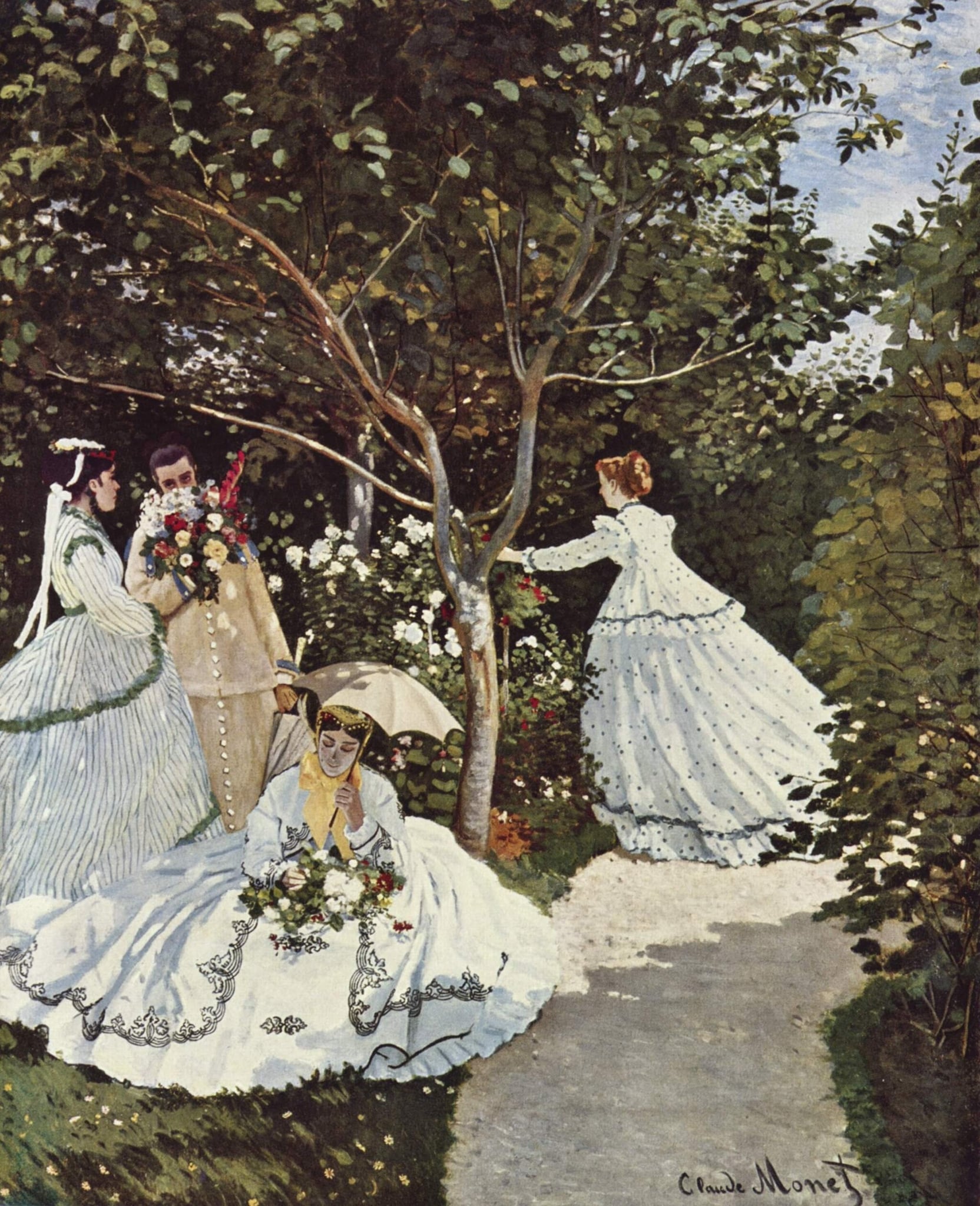
Women in the Garden
Claude Monet (1866–1867)
Claude Monet’s Women in the Garden choreographs four figures in a sunlit bower to test how <strong>white dresses</strong> register <strong>dappled light</strong> and shadow. The path, parasol, and clipped flowers frame a modern ritual of leisure while turning fashion into an instrument of <strong>perception</strong>. The scene reads less as portraiture than as a manifesto for painting the <strong>momentary</strong> outdoors <sup>[1]</sup><sup>[3]</sup>.
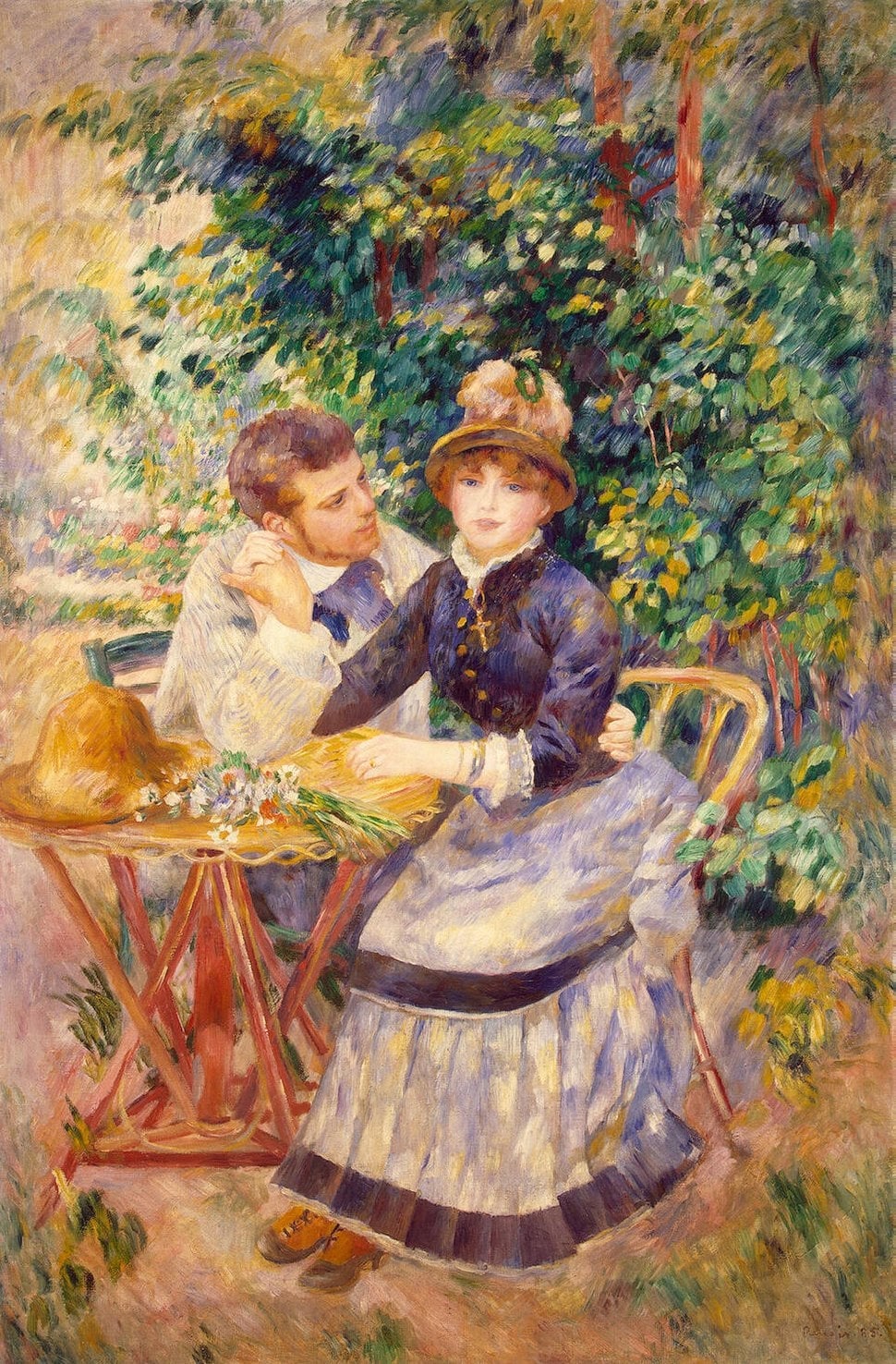
In the Garden
Pierre-Auguste Renoir (1885)
In the Garden presents a charged pause in modern leisure: a young couple at a café table under a living arbor of leaves. Their lightly clasped hands and the bouquet on the tabletop signal courtship, while her calm, front-facing gaze checks his lean. Renoir’s flickering brushwork fuses figures and foliage, rendering love as a <strong>transitory, luminous sensation</strong> <sup>[1]</sup><sup>[3]</sup>.
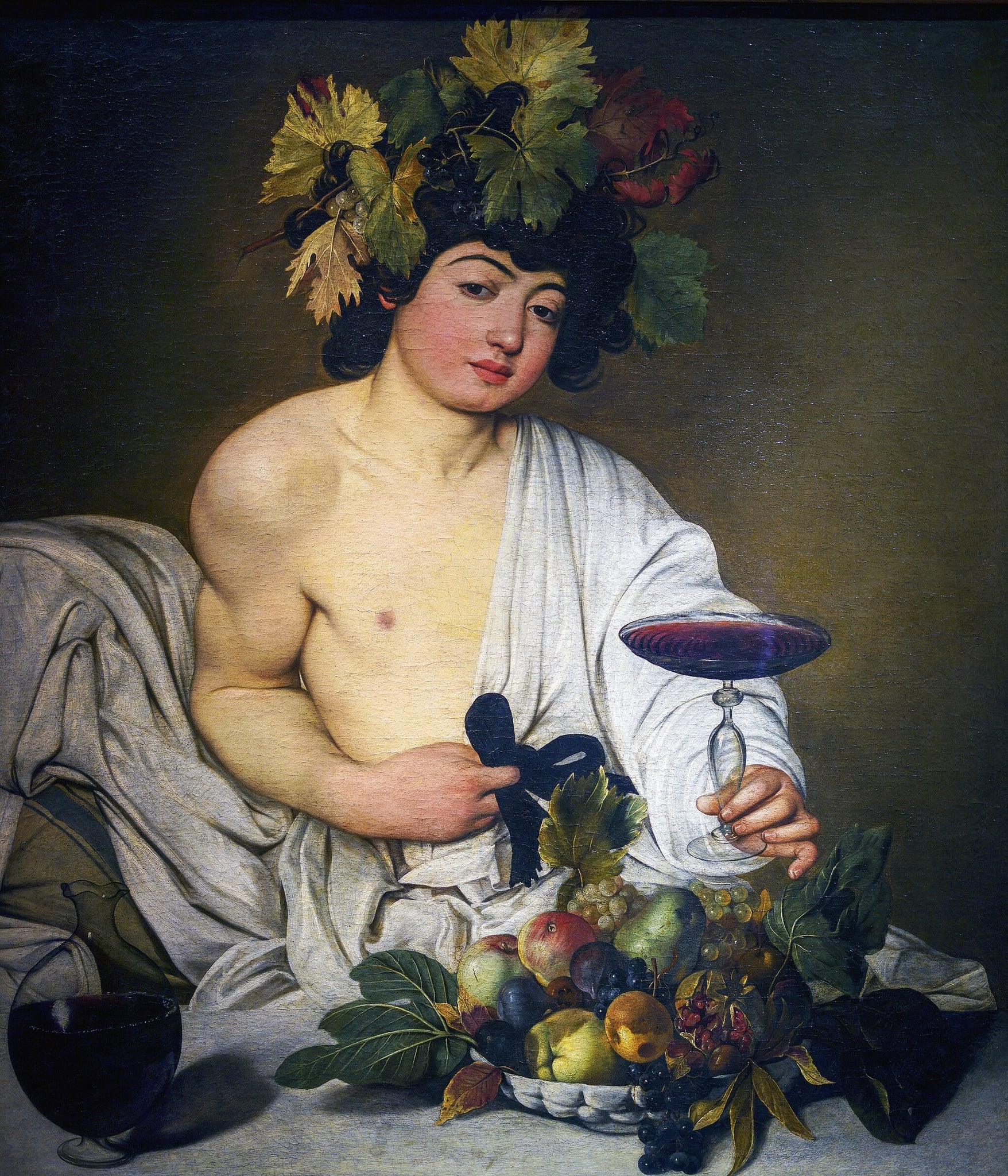
Bacchus
Caravaggio (c. 1598)
Caravaggio’s Bacchus stages a human-scaled god who offers wine with disarming immediacy, yoking <strong>sensual invitation</strong> to <strong>vanitas</strong> warning. The tilted goblet, blemished fruit, and wilting leaves insist that abundance and youth are <strong>precarious</strong>. A private Roman milieu under Cardinal del Monte shaped this refined, provocative image <sup>[1]</sup><sup>[2]</sup>.
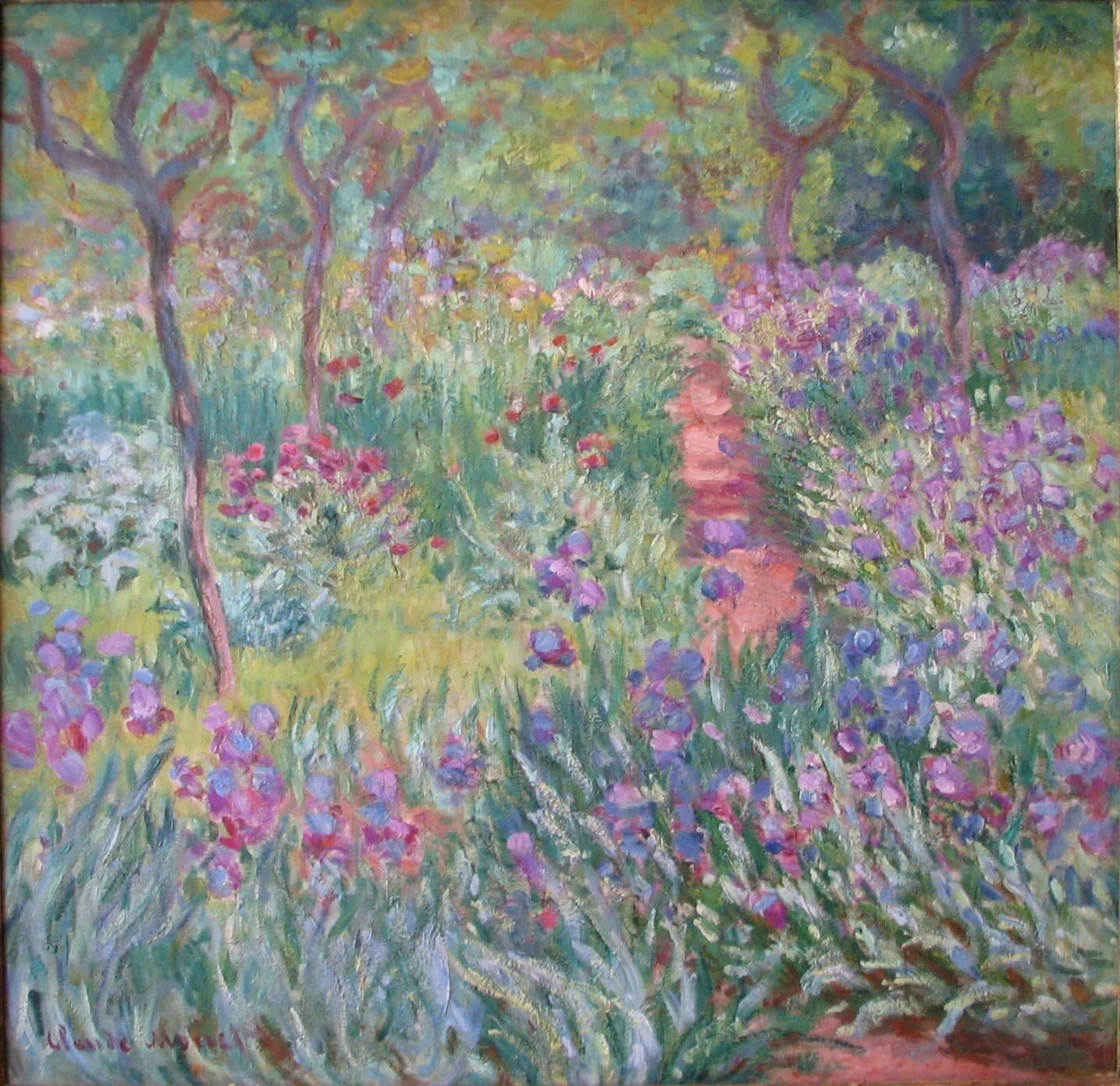
The Artist's Garden at Giverny
Claude Monet (1900)
In The Artist's Garden at Giverny, Claude Monet turns his cultivated Clos Normand into a field of living color, where bands of violet <strong>irises</strong> surge toward a narrow, rose‑colored path. Broken, flickering strokes let greens, purples, and pinks mix optically so that light seems to tremble across the scene, while lilac‑toned tree trunks rhythmically guide the gaze inward <sup>[1]</sup><sup>[3]</sup>.
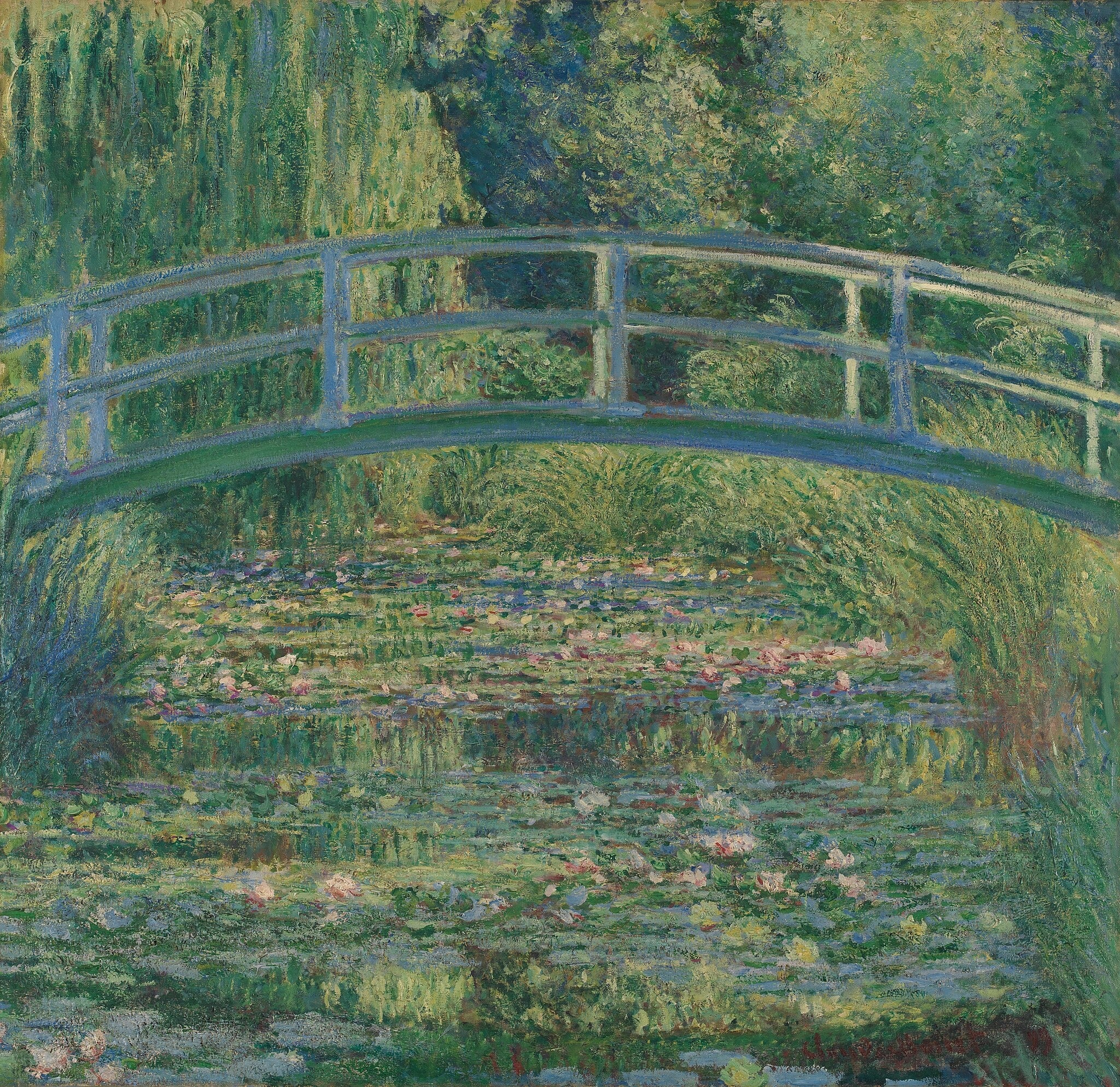
Water Lilies
Claude Monet (1899)
<strong>Water Lilies</strong> centers on an arched <strong>Japanese bridge</strong> suspended over a pond where lilies and rippling reflections fuse into a single, vibrating surface. Monet turns the scene into a study of <strong>perception-in-flux</strong>, letting water, foliage, and light dissolve hard edges into atmospheric continuity <sup>[1]</sup><sup>[3]</sup>.
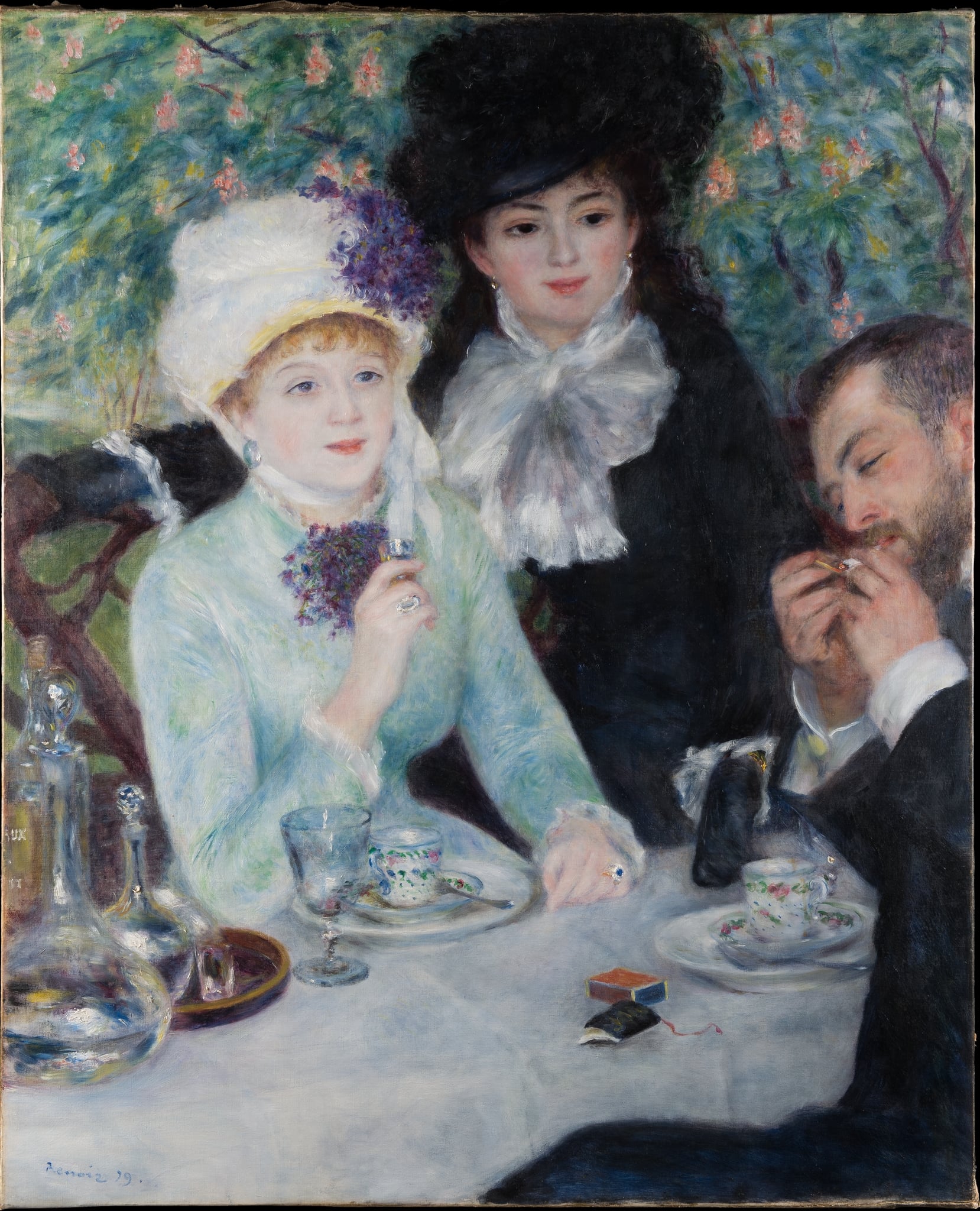
After the Luncheon
Pierre-Auguste Renoir (1879)
After the Luncheon crystallizes a <strong>suspended instant</strong> of Parisian leisure: coffee finished, glasses dappled with light, and a cigarette just being lit. Renoir’s <strong>shimmering brushwork</strong> and the trellised spring foliage turn the scene into a tapestry of conviviality where time briefly pauses.
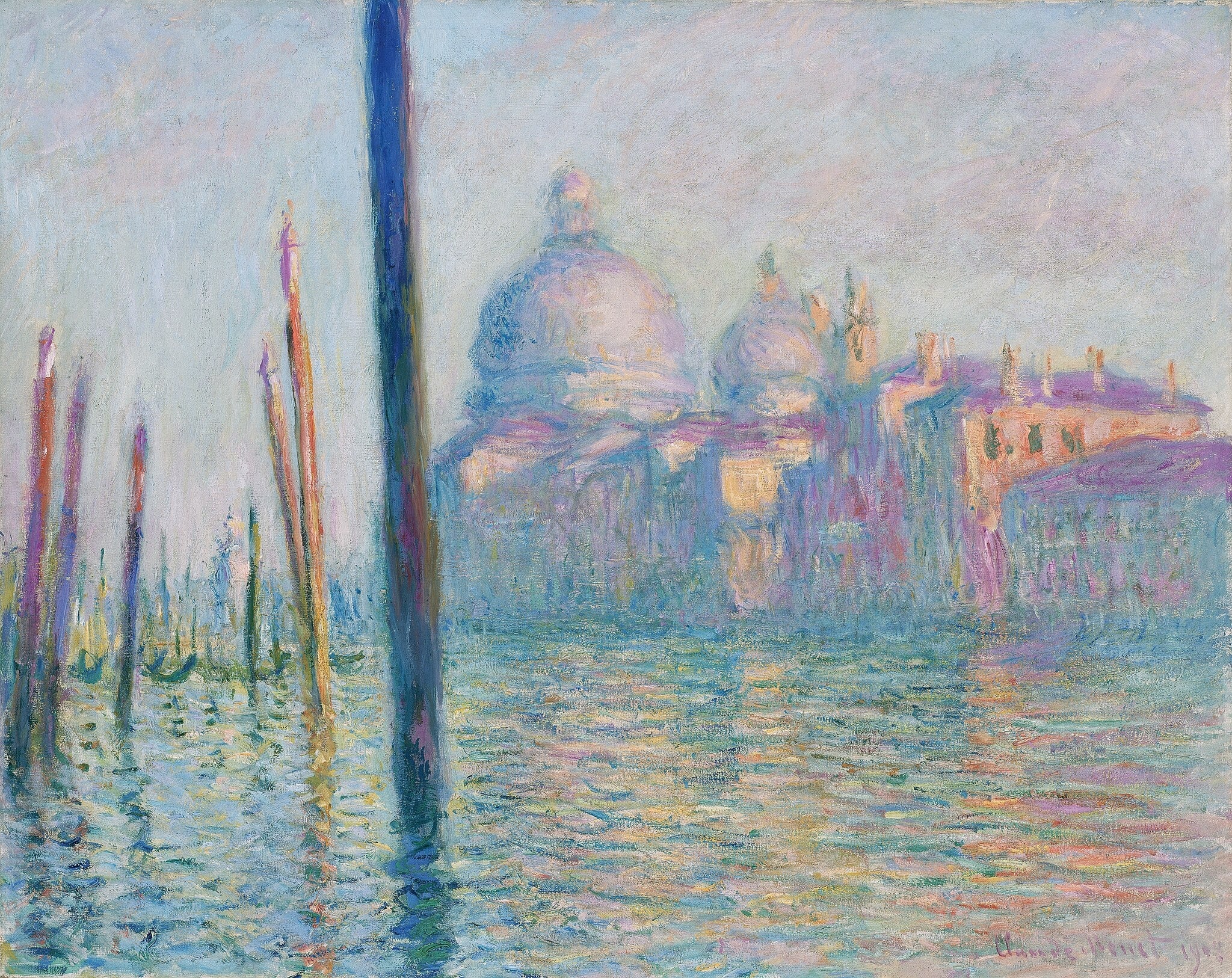
The Grand Canal
Claude Monet (1908)
Claude Monet’s The Grand Canal turns Venice into <strong>pure atmosphere</strong>: the domes of Santa Maria della Salute waver at right while a regiment of <strong>pali</strong> stands at left, their verticals reverberating in the water. The scene asserts <strong>light over architecture</strong>, transforming stone into memory and time into color <sup>[2]</sup><sup>[3]</sup>.
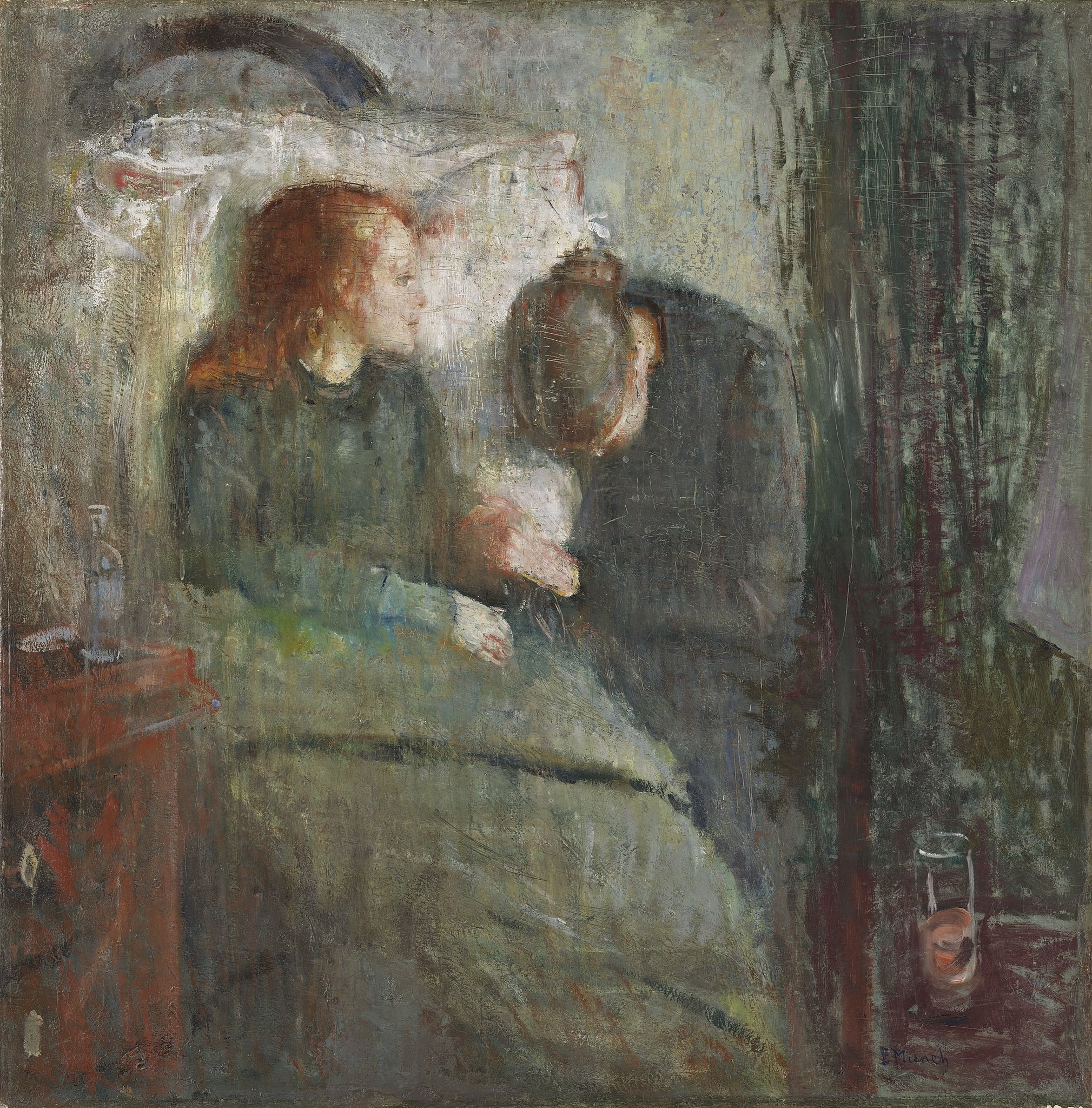
The Sick Child
Edvard Munch (1885–86)
The Sick Child condenses a bedside vigil into a stark drama of <strong>love and helplessness</strong>. A pale, copper-haired girl glows against a chalky pillow while a bowed caregiver clasps her hand; the scraped, striated paint makes grief feel <strong>present and eroding</strong> at once <sup>[1]</sup><sup>[2]</sup>. Sparse props—a bottle, a glass, a thin red line—stand as mute emblems of medicine’s limits.
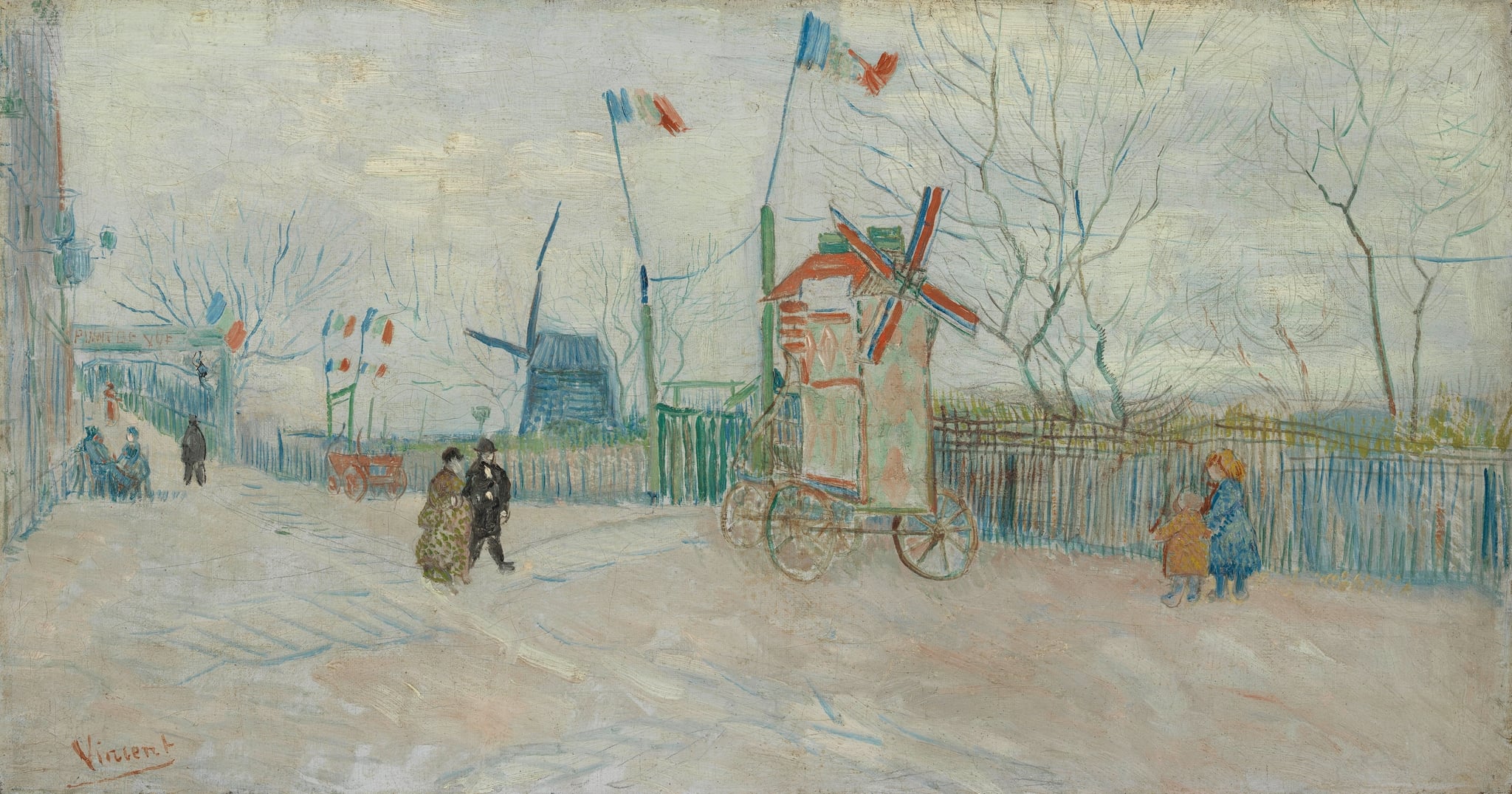
Impasse des Deux Frères in Montmartre
Vincent van Gogh (1887)
Van Gogh’s Impasse des Deux Frères in Montmartre crystallizes a <strong>threshold</strong> between rustic mills and a city turning to <strong>modern leisure</strong>. Tricolor flags, a wheeled “windmill” kiosk, and sketchlike figures animate a broad, chalky lane under pale winter light, declaring a neighborhood—and an artist—mid‑transition <sup>[1]</sup><sup>[3]</sup>.
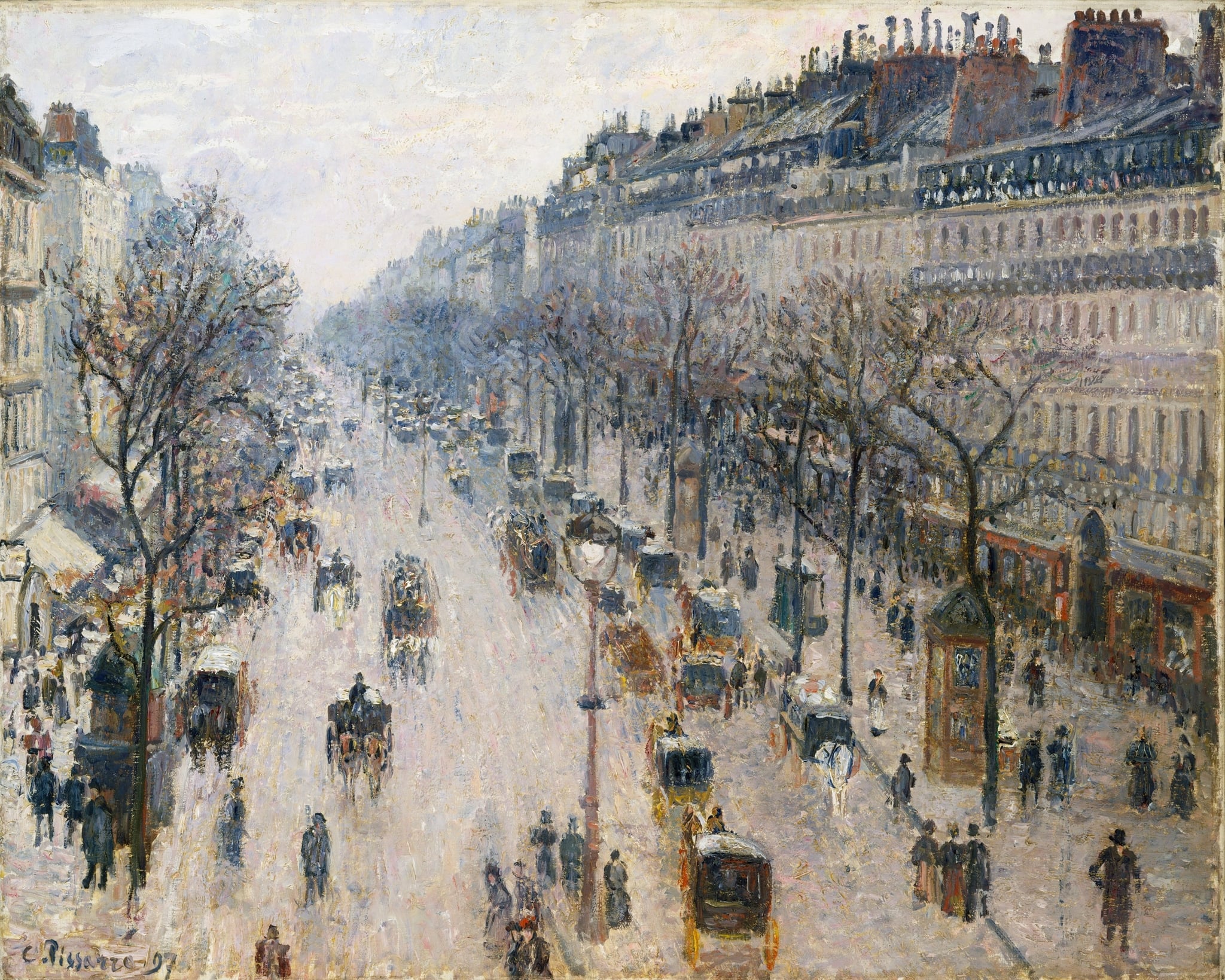
The Boulevard Montmartre on a Winter Morning
Camille Pissarro (1897)
From a high hotel window, Camille Pissarro renders Paris as a living system—its Haussmann boulevard dissolving into winter light, its crowds and vehicles fused into a soft, <strong>rhythmic flow</strong>. Broken strokes in cool grays, lilacs, and ochres turn fog, steam, and motion into <strong>texture of time</strong>, dignifying the city’s ordinary morning pulse <sup>[1]</sup><sup>[3]</sup>.
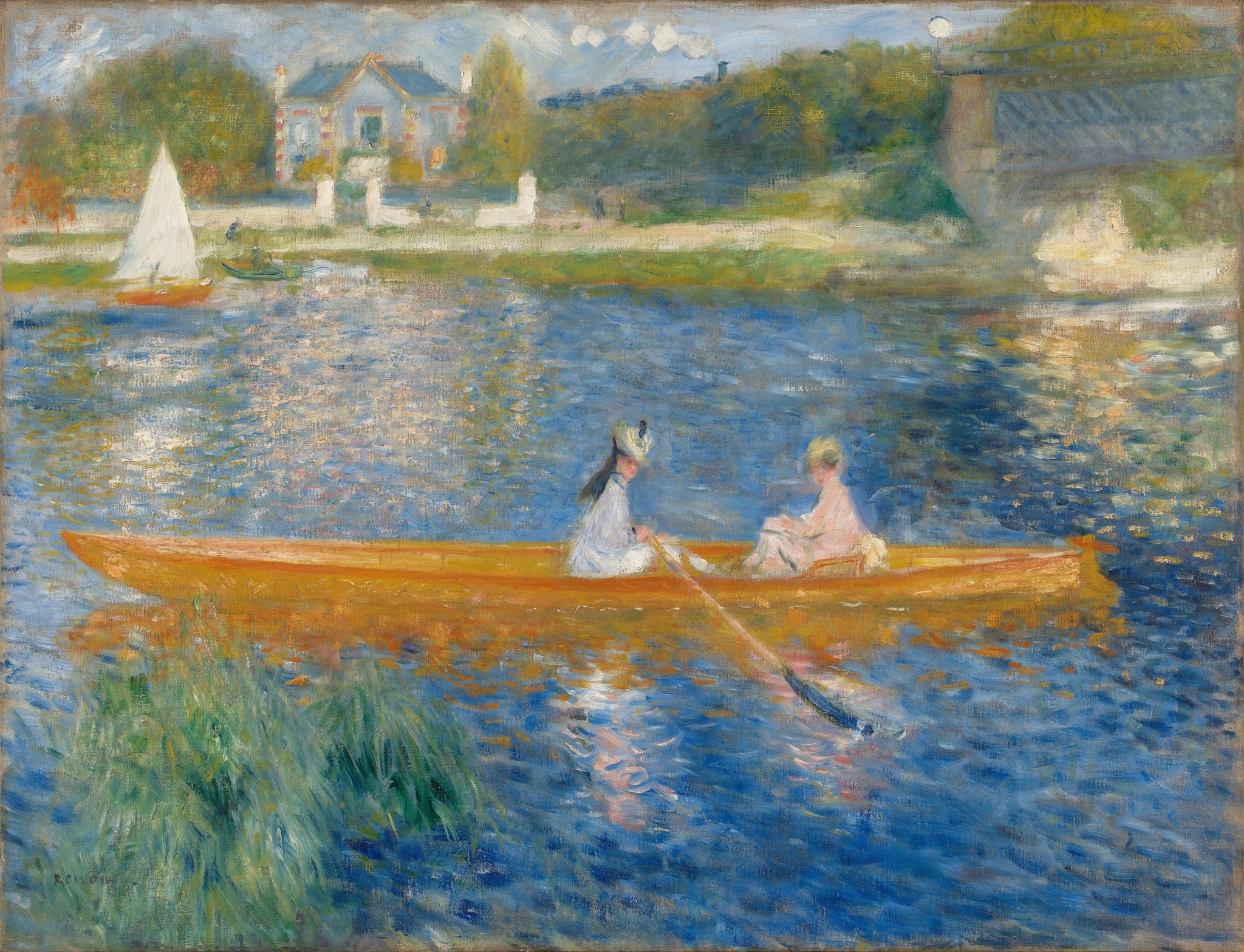
The Skiff (La Yole)
Pierre-Auguste Renoir (1875)
In The Skiff (La Yole), Pierre-Auguste Renoir stages a moment of modern leisure on a broad, vibrating river, where a slender, <strong>orange skiff</strong> cuts across a field of <strong>cool blues</strong>. Two women ride diagonally through the shimmer; an <strong>oar’s sweep</strong> spins a vortex of color as a sailboat, villa, and distant bridge settle the scene on the Seine’s suburban edge <sup>[1]</sup>. Renoir turns motion and light into a single sensation, using a high‑chroma, complementary palette to fuse human pastime with nature’s flux <sup>[1]</sup><sup>[2]</sup>.
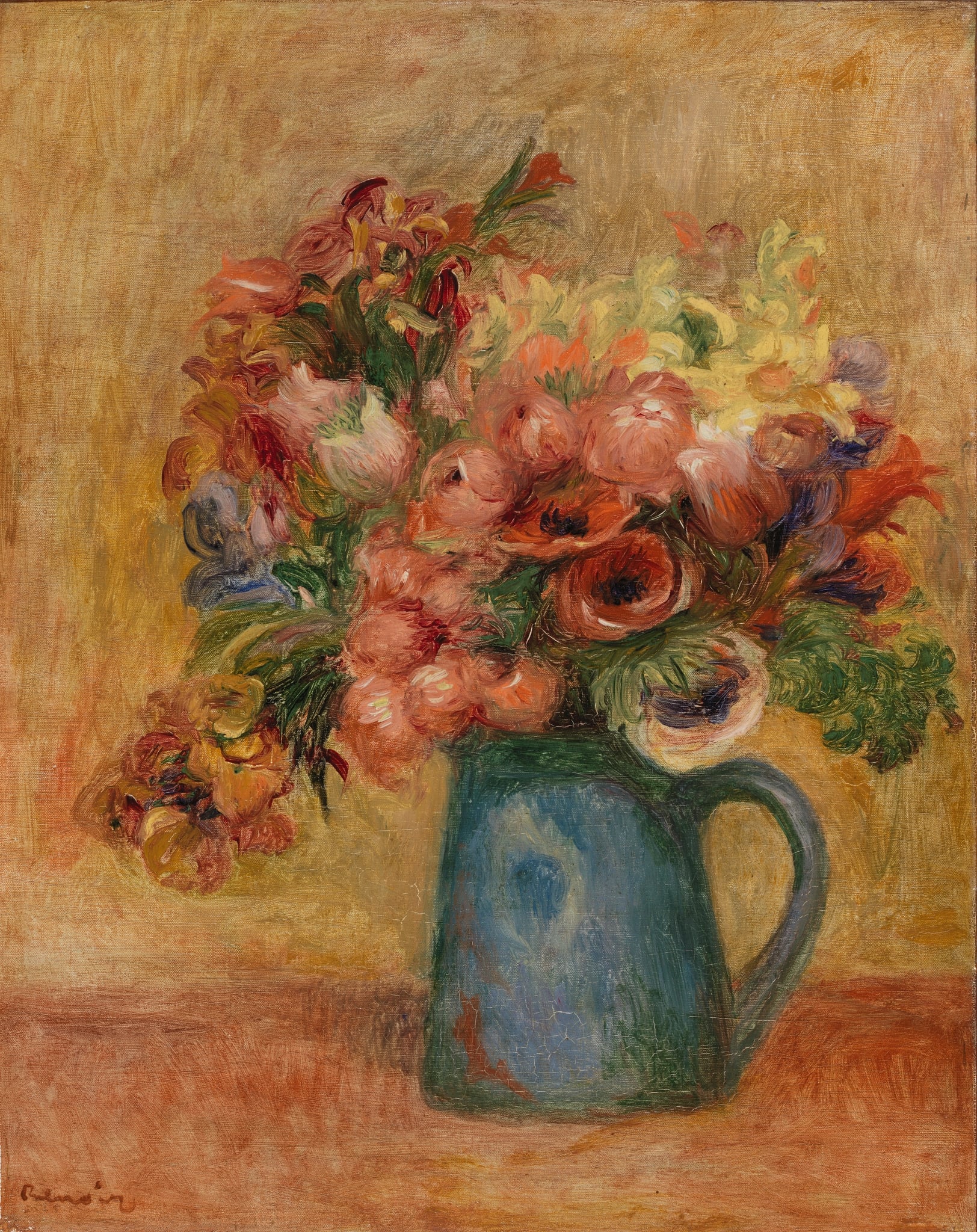
Vase of Flowers
Pierre-Auguste Renoir (c. 1889)
Vase of Flowers is a late‑1880s still life in which Pierre-Auguste Renoir turns a humble blue‑green jug and a tumbling bouquet into a <strong>laboratory of color and touch</strong>. Against a warm ocher wall and reddish tabletop, coral and vermilion blossoms flare while cool greens and violets anchor the mass, letting <strong>color function as drawing</strong> <sup>[1]</sup><sup>[4]</sup>. The work affirms Renoir’s belief that flower painting was a space for bold experimentation that fed his figure art.
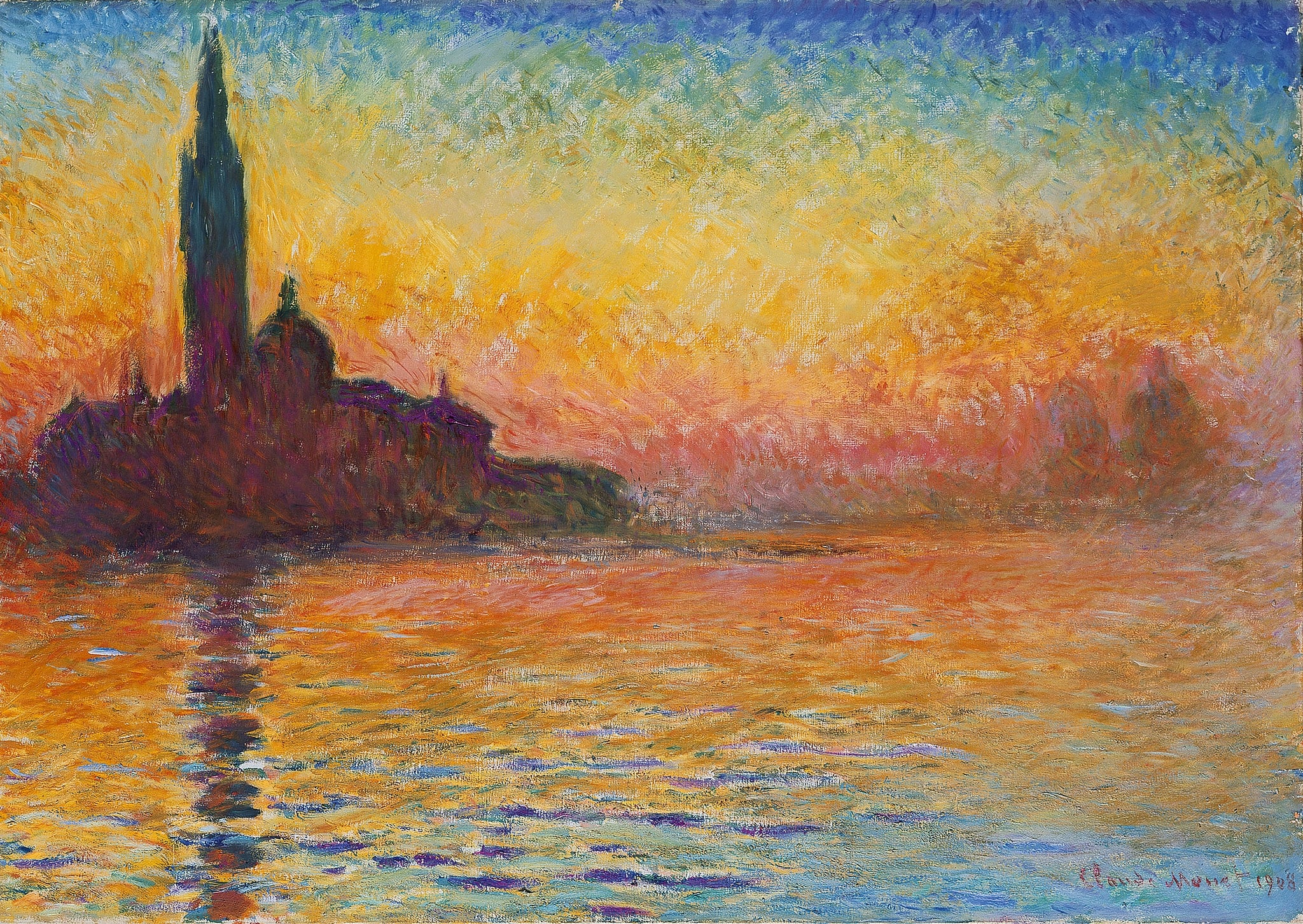
San Giorgio Maggiore at Dusk
Claude Monet (1908–1912)
Claude Monet’s San Giorgio Maggiore at Dusk fuses the Benedictine church’s dark silhouette with a sky flaming from apricot to cobalt, turning architecture into atmosphere. The campanile’s vertical and its wavering reflection anchor a sea of trembling color, staging a meditation on <strong>permanence</strong> and <strong>flux</strong>.
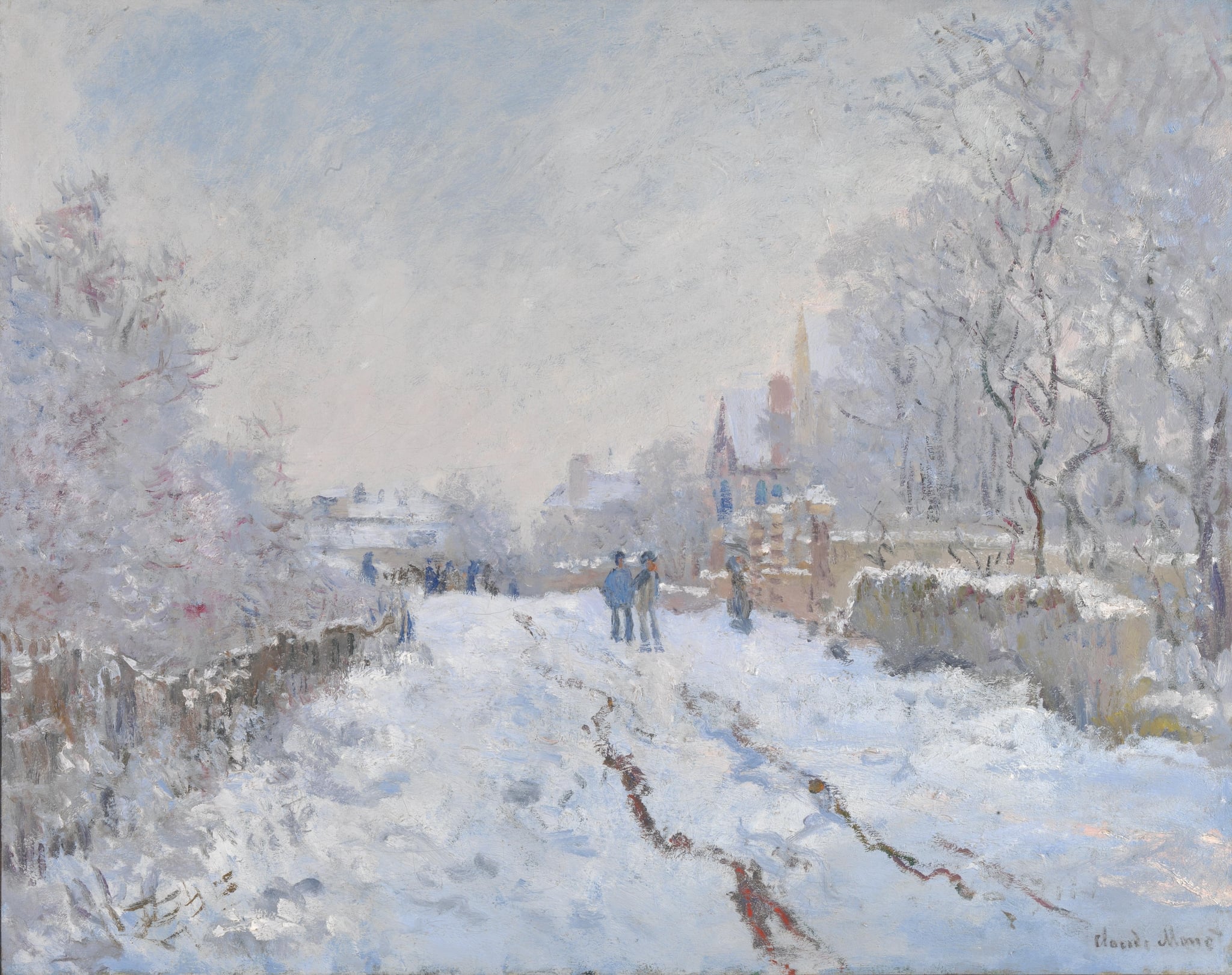
Snow at Argenteuil
Claude Monet (1875)
<strong>Snow at Argenteuil</strong> renders a winter boulevard where light overtakes solid form, turning snow into a luminous field of blues, violets, and pearly pinks. Reddish cart ruts pull the eye toward a faint church spire as small, blue-gray figures persist through the hush. Monet elevates atmosphere to the scene’s <strong>protagonist</strong>, making everyday passage a meditation on time and change <sup>[1]</sup><sup>[2]</sup>.
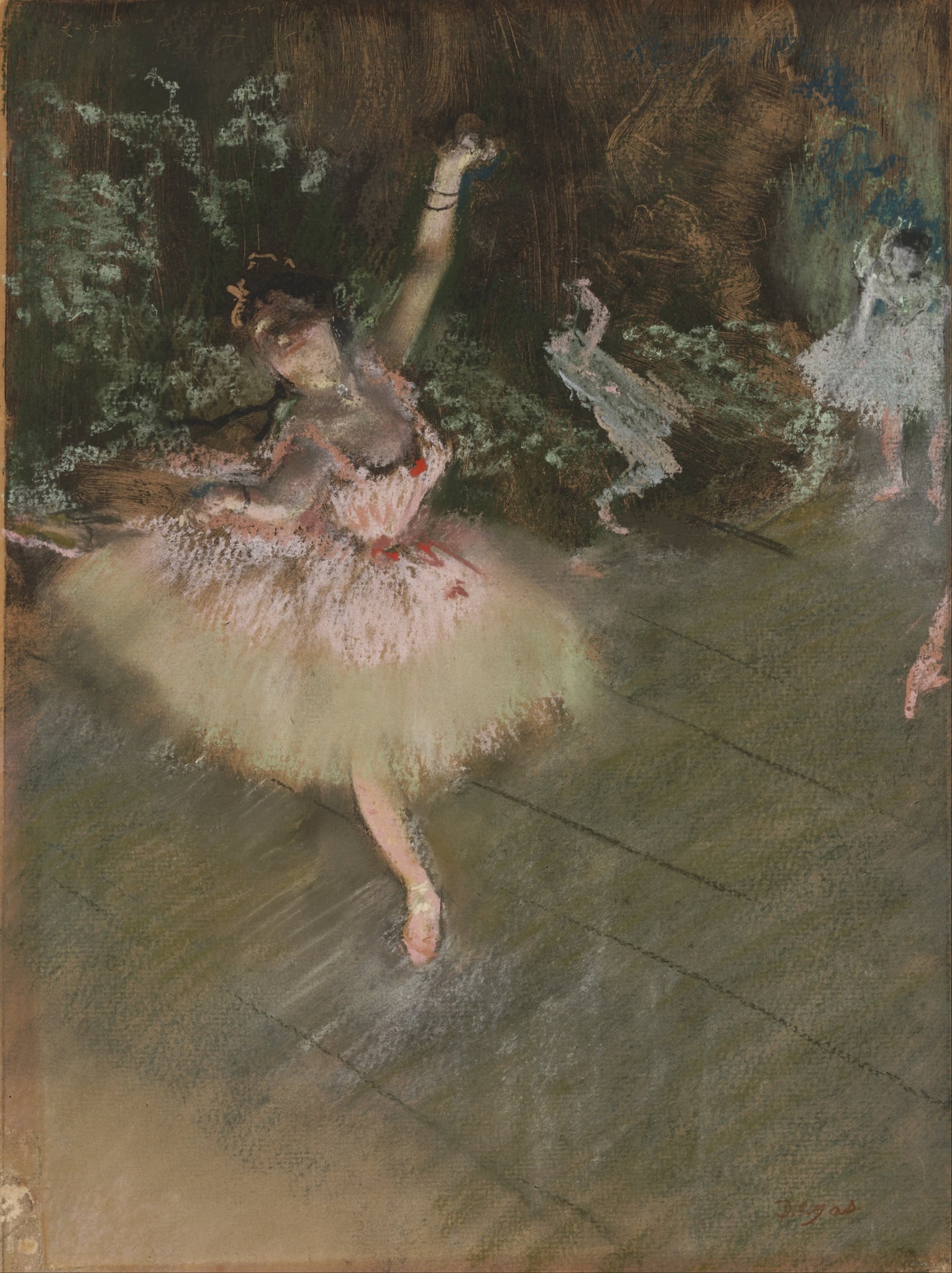
The Star
Edgar Degas (c. 1876–1878)
Edgar Degas’s The Star shows a prima ballerina caught at the crest of a pose, her tutu a <strong>vaporous flare</strong> against a <strong>murky, tilted stage</strong>. Diagonal floorboards rush beneath her single pointe, while pale, ghostlike dancers linger in the wings, turning triumph into a scene of <strong>radiant isolation</strong> <sup>[2]</sup><sup>[5]</sup>.
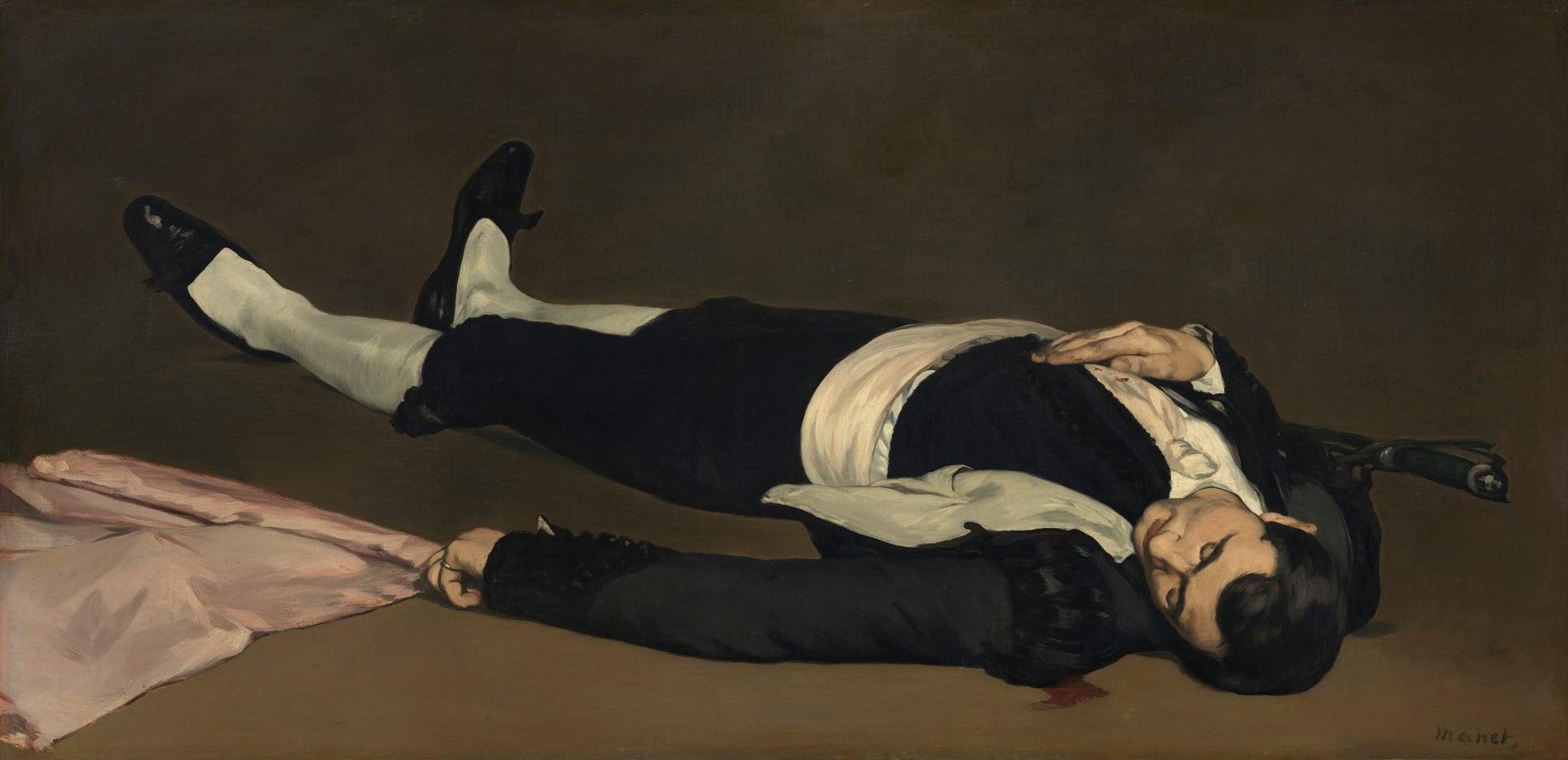
The Dead Toreador
Édouard Manet (probably 1864)
Manet’s The Dead Toreador isolates a matador’s corpse in a stark, horizontal close‑up, replacing the spectacle of the bullring with <strong>silence</strong> and <strong>abrupt finality</strong>. Black costume, white stockings, a pale pink cape, the sword’s hilt, and a small <strong>pool of blood</strong> become the painting’s cool, modern vocabulary of death <sup>[1]</sup>.
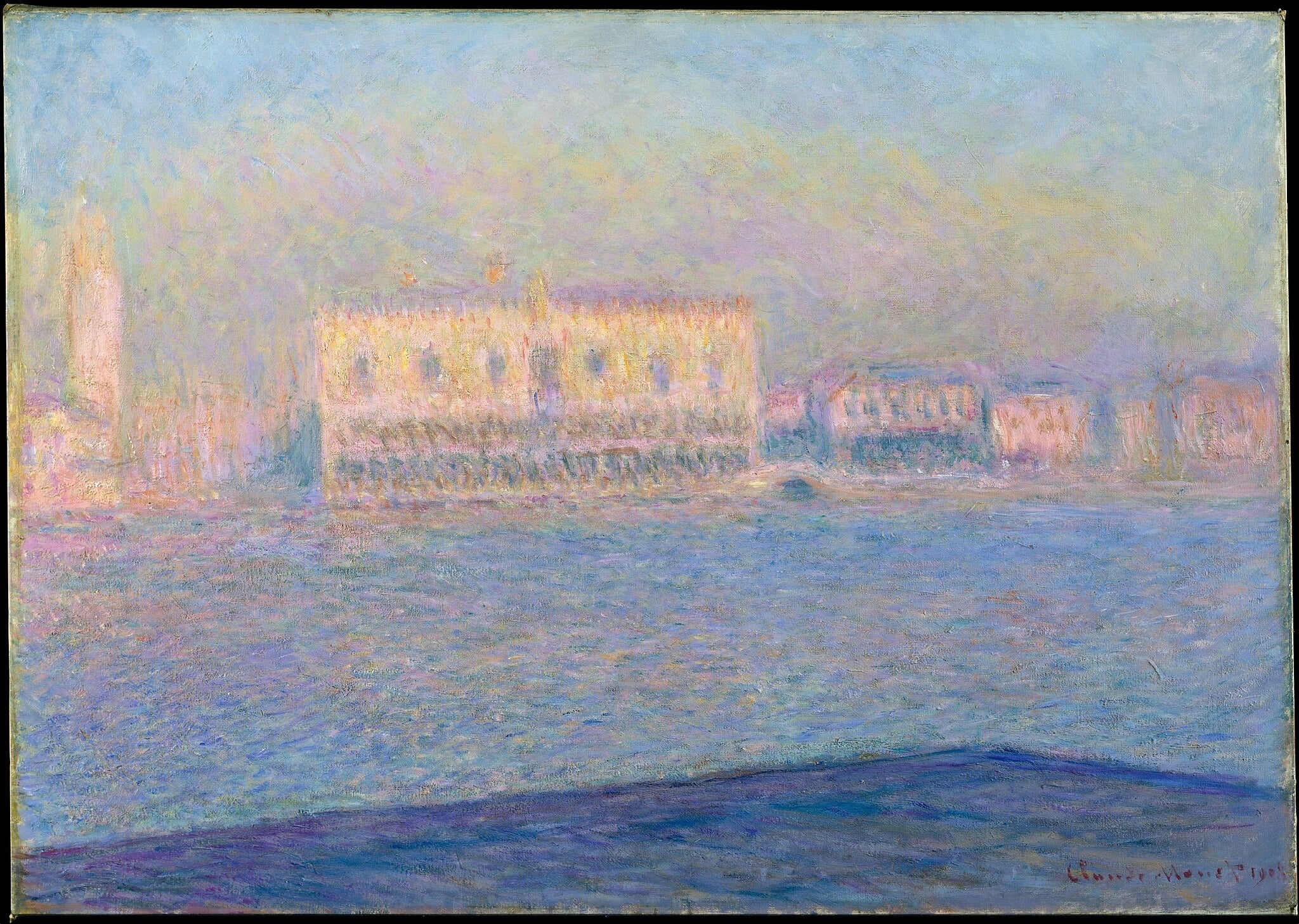
The Palazzo Ducale, Seen from San Giorgio Maggiore
Claude Monet (1908)
In The Palazzo Ducale, Seen from San Giorgio Maggiore, Claude Monet turns Venice into a theater of <strong>light and time</strong>. The Doge’s Palace glows as a pale, honeyed rectangle while the <strong>lagoon’s rippling violets and blues</strong> swallow stone into shimmer. A <strong>dark triangular quay</strong> in the foreground steadies the eye, making the city seem to hover above water.
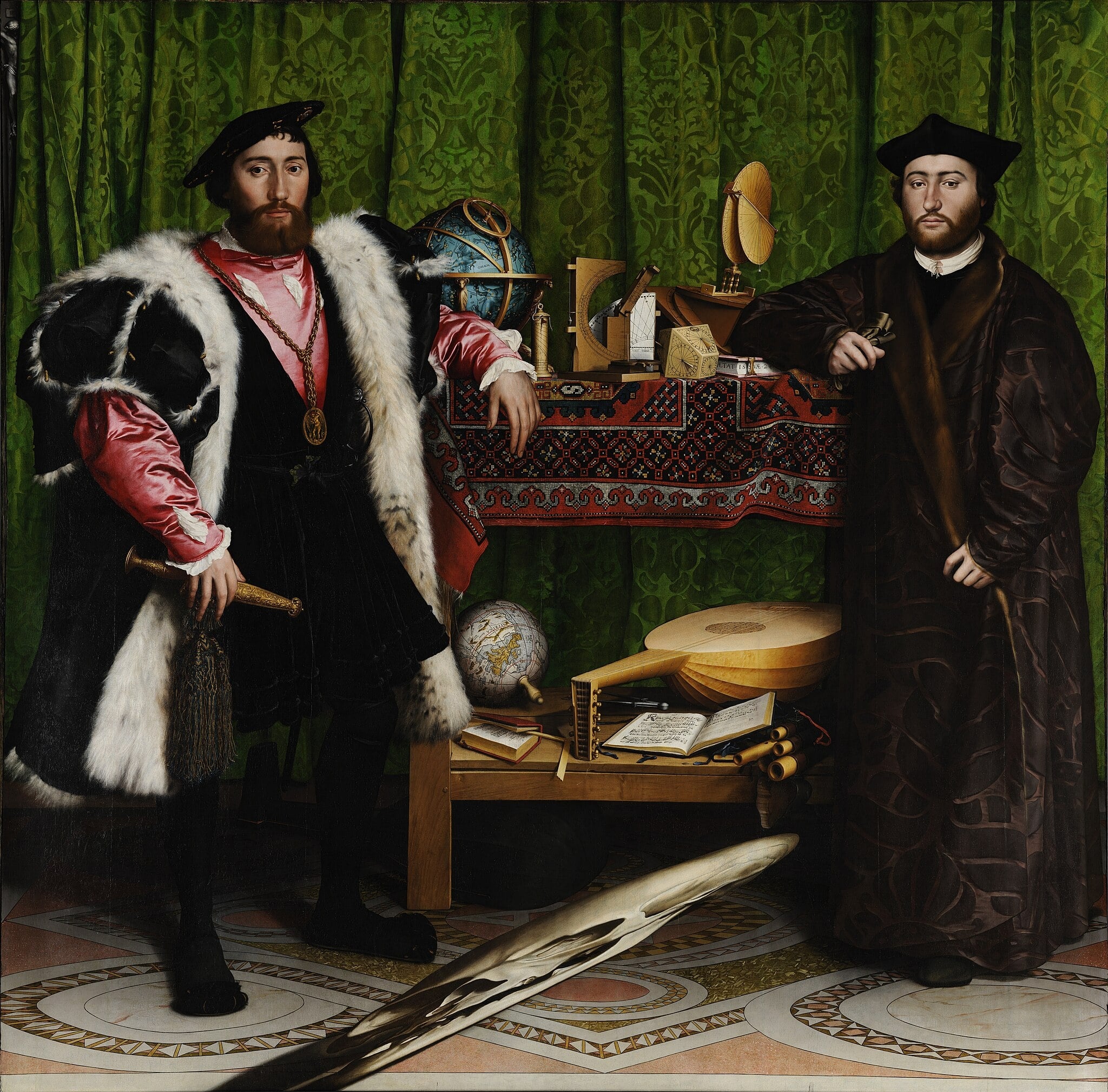
The Ambassadors
Hans Holbein the Younger (1533)
Holbein’s The Ambassadors is a double-portrait staged before a green curtain, where shelves of scientific instruments, books, and musical devices enact <strong>Renaissance learning</strong> while an anamorphic <strong>skull</strong> and a veiled <strong>crucifix</strong> counter it with mortality and salvation <sup>[1]</sup><sup>[2]</sup>. The work balances worldly status—fur, velvet, Oriental carpet—with a sober theology of limits amid the <strong>Reformation’s discord</strong> <sup>[1]</sup><sup>[2]</sup>.
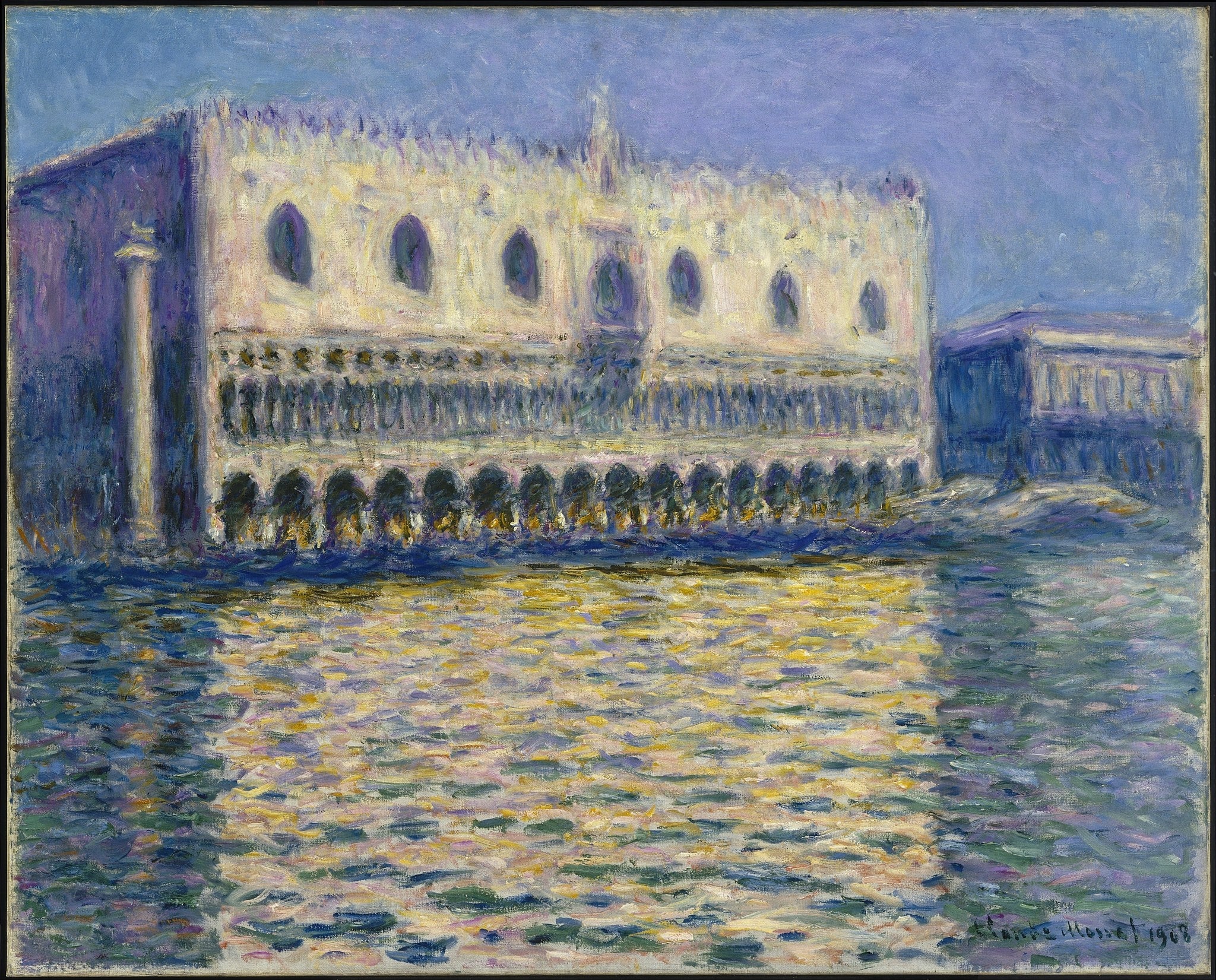
The Doge's Palace
Claude Monet (1908)
Monet’s The Doge’s Palace translates Venice’s emblem of authority into an <strong>atmospheric drama</strong> of lilac, cream, and ultramarine. Architecture becomes a <strong>screen for light</strong>, as the ogival windows and double arcades blur into vibrating strokes mirrored by the lagoon’s <strong>second architecture</strong>—its reflection <sup>[1]</sup><sup>[4]</sup>.
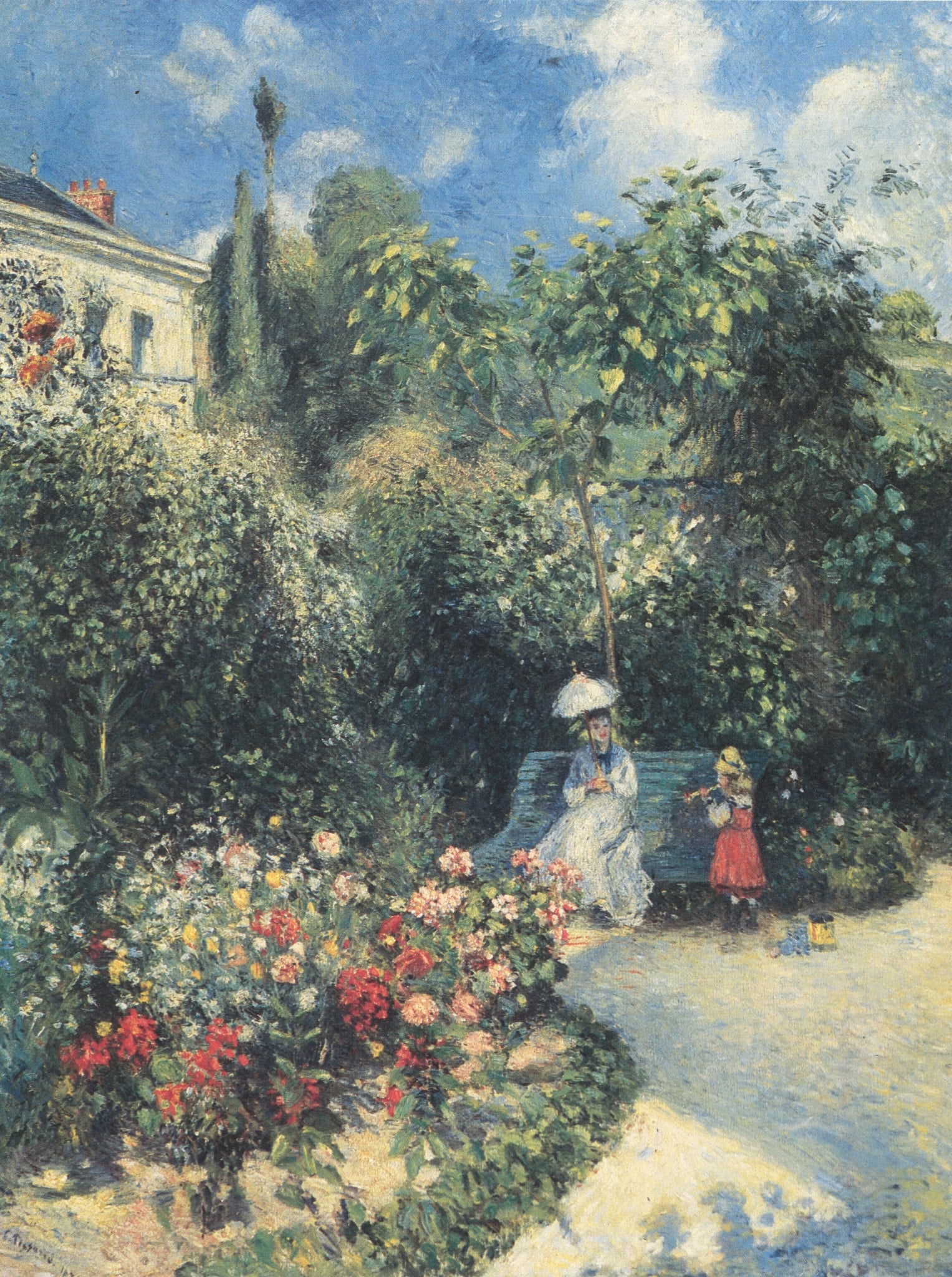
The Garden of Pontoise
Camille Pissarro (1874)
In The Garden of Pontoise, Camille Pissarro turns a modest suburban plot into a stage for <strong>modern leisure</strong> and <strong>fugitive light</strong>. A woman shaded by a parasol and a child in a bright red skirt punctuate the deep greens, while a curving sand path and beds of red–pink blossoms draw the eye toward a pale house and cloud‑flecked sky. The painting asserts that everyday, cultivated nature can be a <strong>modern Eden</strong> where time, season, and social ritual quietly unfold <sup>[1]</sup><sup>[3]</sup>.
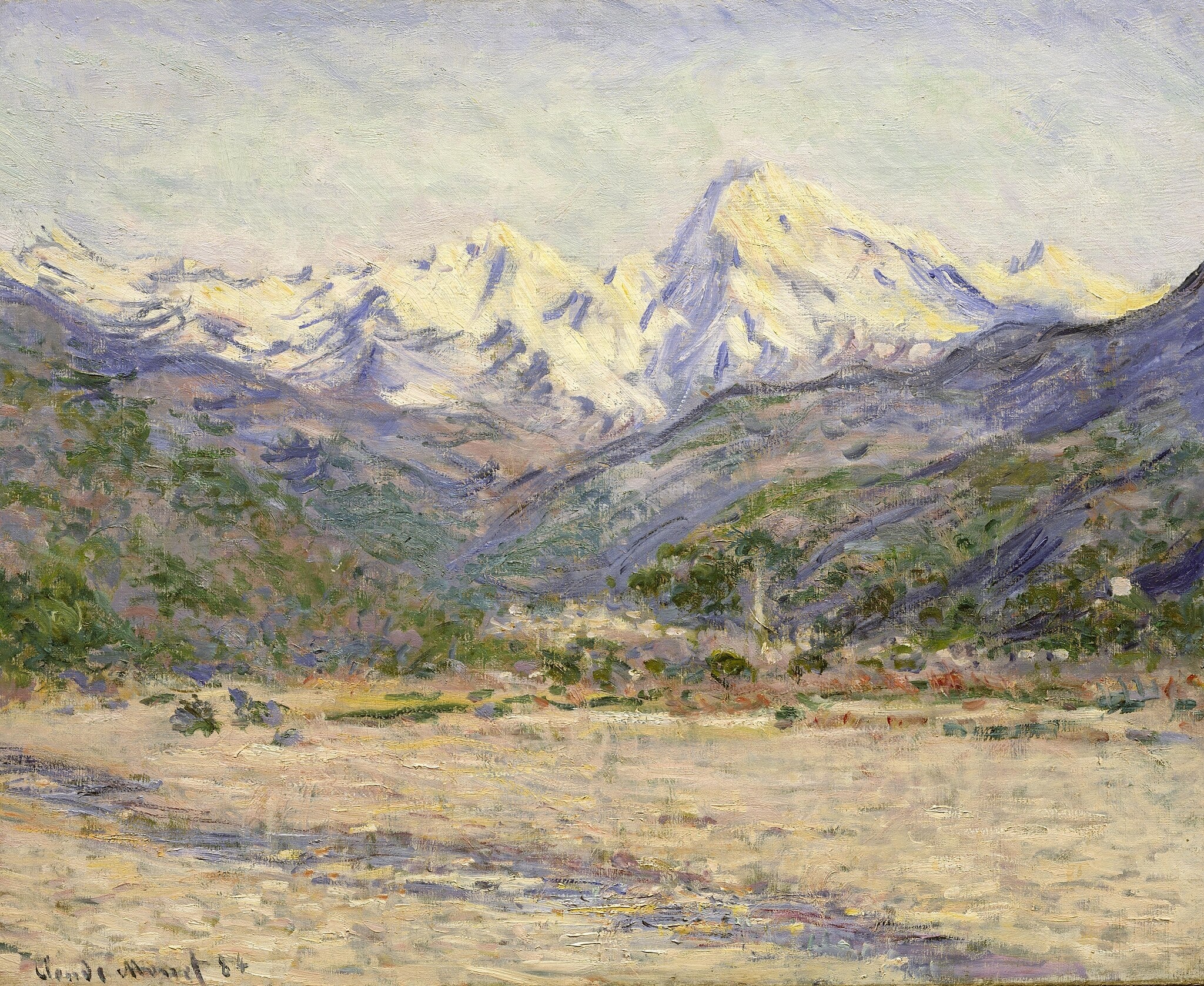
The Valley of the Nervia
Claude Monet (1884)
Claude Monet’s The Valley of the Nervia is a high‑key meditation on <strong>atmosphere as structure</strong>: snow‑lit Maritime Alps rise above a pale, stony riverbed, their mass defined by air and light rather than contour. Through quick, broken strokes of <strong>violet, blue, and lemon</strong>, Monet fuses fleeting afternoon shimmer with the valley’s geologic permanence <sup>[1]</sup><sup>[2]</sup>.
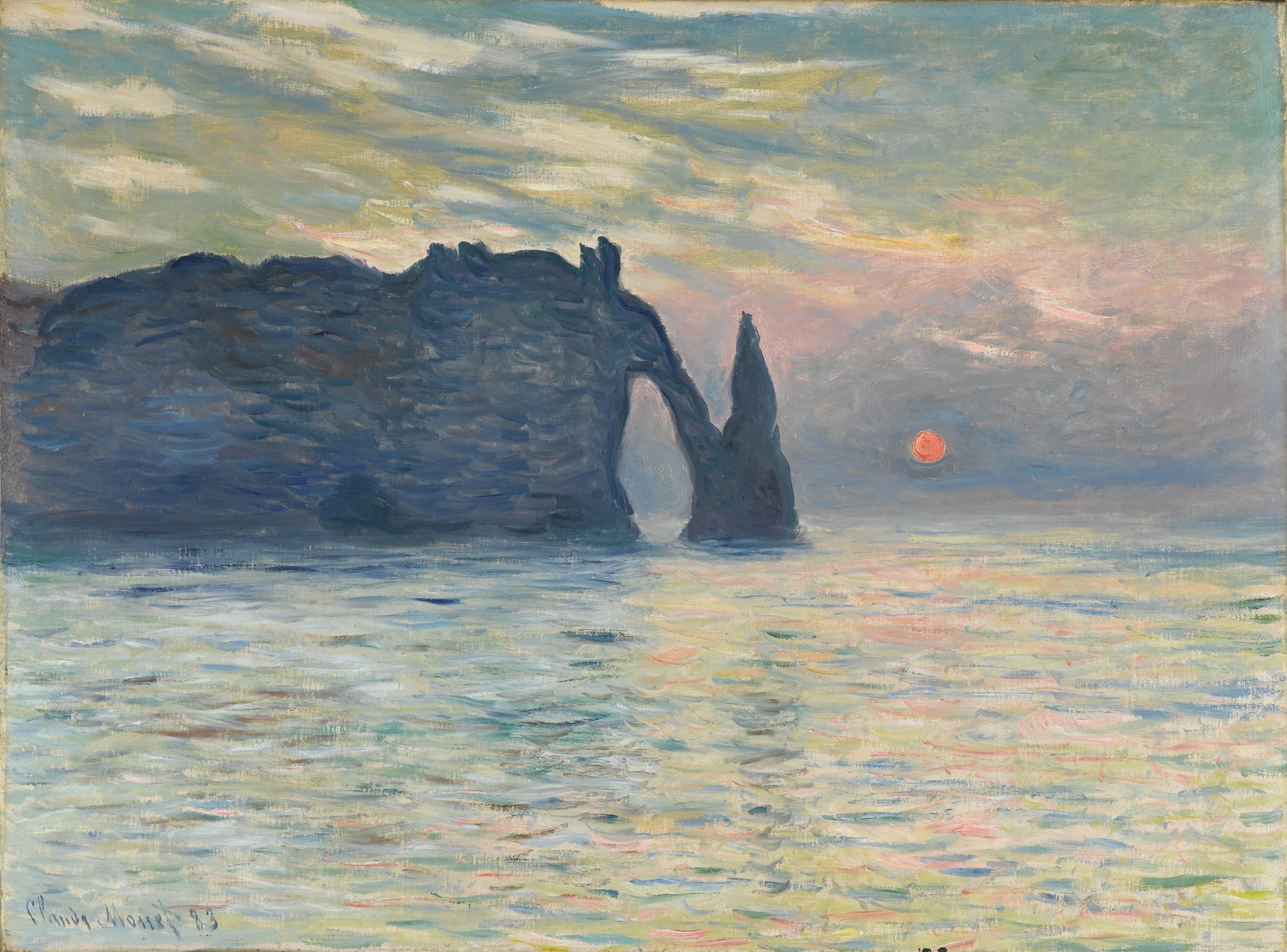
The Cliff, Etretat
Claude Monet (1882–1883)
<strong>The Cliff, Etretat</strong> stages a confrontation between <strong>permanence and flux</strong>: the dark mass of the arch and needle holds like a monument while ripples of coral, green, and blue light skate across the water. The low <strong>solar disk</strong> fixes the instant, and Monet’s fractured strokes make the sea and sky feel like time itself turning toward dusk. The arch reads as a <strong>threshold</strong>—an opening to the unknown that organizes vision and meaning <sup>[1]</sup><sup>[2]</sup>.
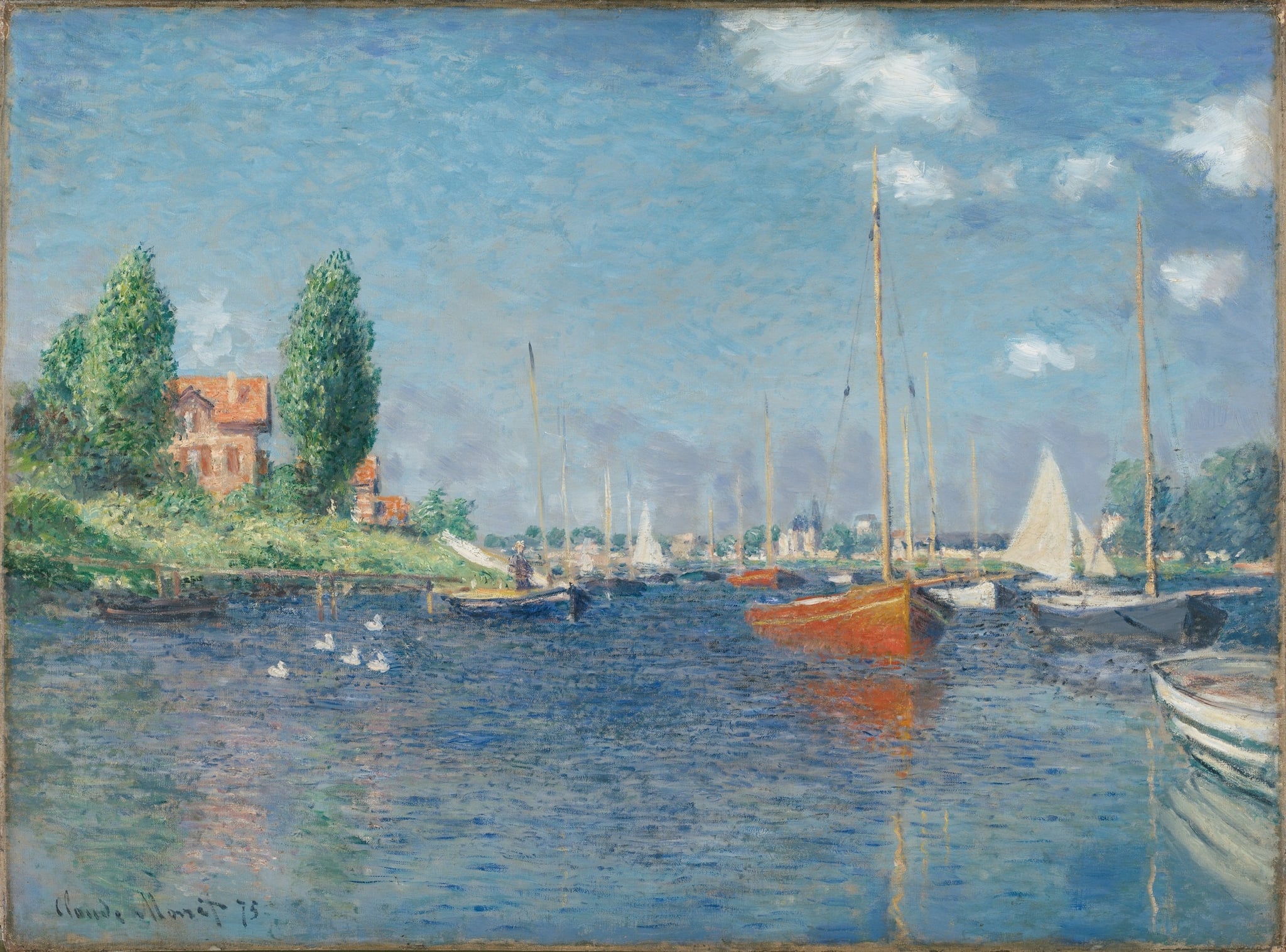
The Red Boats, Argenteuil
Claude Monet (1875)
Claude Monet’s The Red Boats, Argenteuil crystallizes a luminous afternoon on the Seine, where two <strong>vermilion hulls</strong> anchor a scene of leisure and light. The tremoring <strong>reflections</strong> and vertical <strong>masts/poplars</strong> weave nature and modern recreation into a single atmospheric field <sup>[1]</sup>.
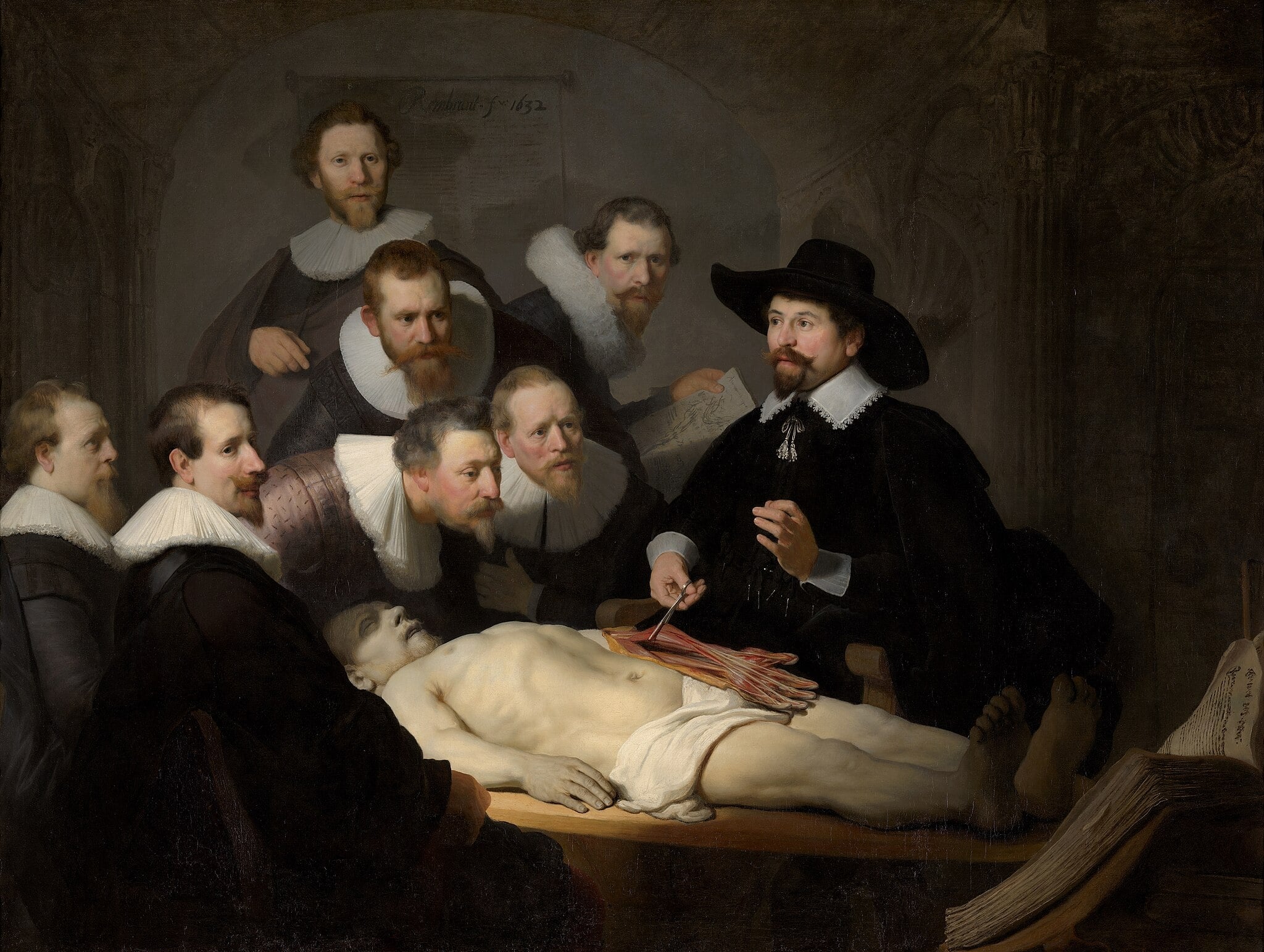
The Anatomy Lesson of Dr. Nicolaes Tulp
Rembrandt van Rijn (1632)
Rembrandt van Rijn turns a civic commission into a drama of <strong>knowledge made visible</strong>. A cone of light binds the ruff‑collared surgeons, the pale cadaver, and Dr. Tulp’s forceps as he raises the <strong>forearm tendons</strong> to explain the hand. Book and body face each other across the table, staging the tension—and alliance—between <strong>textual authority</strong> and <strong>empirical observation</strong> <sup>[1]</sup><sup>[2]</sup>.
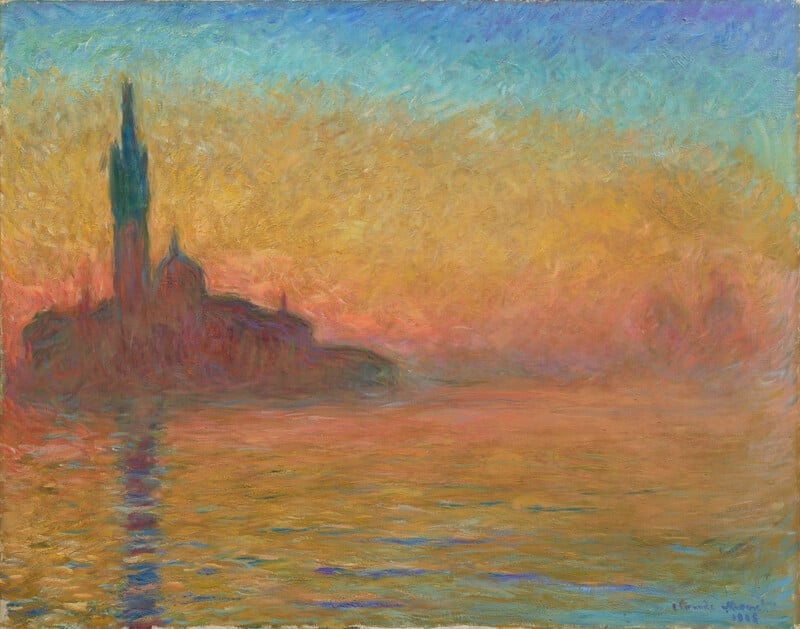
San Giorgio Maggiore by Twilight
Claude Monet (1908)
Claude Monet’s San Giorgio Maggiore by Twilight turns Venice into a <strong>luminous threshold</strong> where stone, air, and water merge. The dark, melting silhouette of the church and its vertical reflection anchor a field of <strong>apricot–rose–violet</strong> light that drifts into cool turquoise, making permanence feel provisional <sup>[1]</sup>. Monet’s subject is not the monument, but the <strong>enveloppe</strong> of atmosphere that momentarily creates it <sup>[4]</sup>.
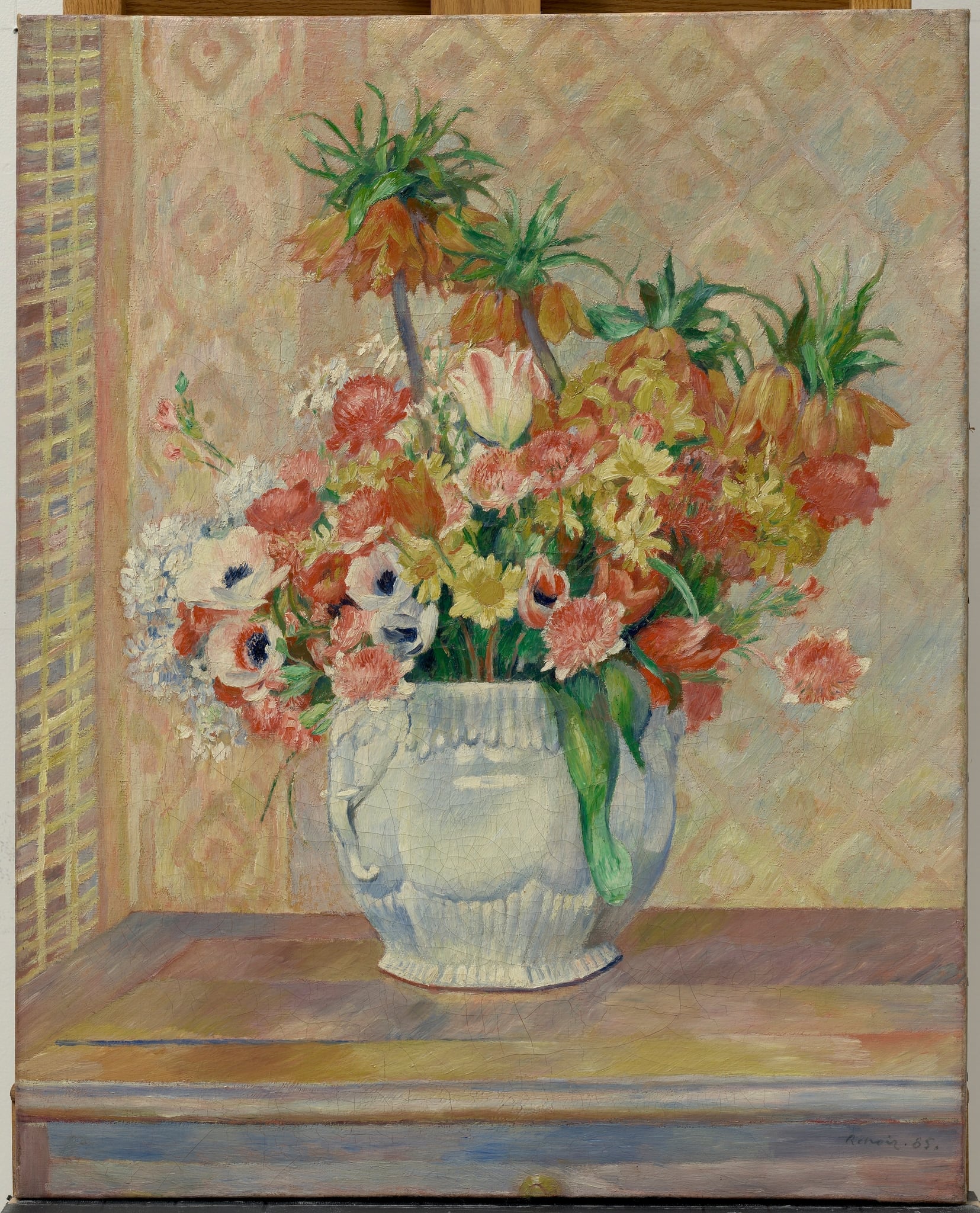
Still Life with Flowers
Pierre-Auguste Renoir (1885)
Pierre-Auguste Renoir’s Still Life with Flowers (1885) sets a jubilant bouquet in a pale, crackled vase against softly dissolving wallpaper and a wicker screen. With quick, clear strokes and a centered, oval mass, the painting unites <strong>Impressionist color</strong> with a <strong>classical, post-Italy structure</strong> <sup>[1]</sup><sup>[2]</sup><sup>[4]</sup>. The slight droop of blossoms turns the domestic scene into a gentle <strong>vanitas</strong>—a savoring of beauty before it fades <sup>[5]</sup>.
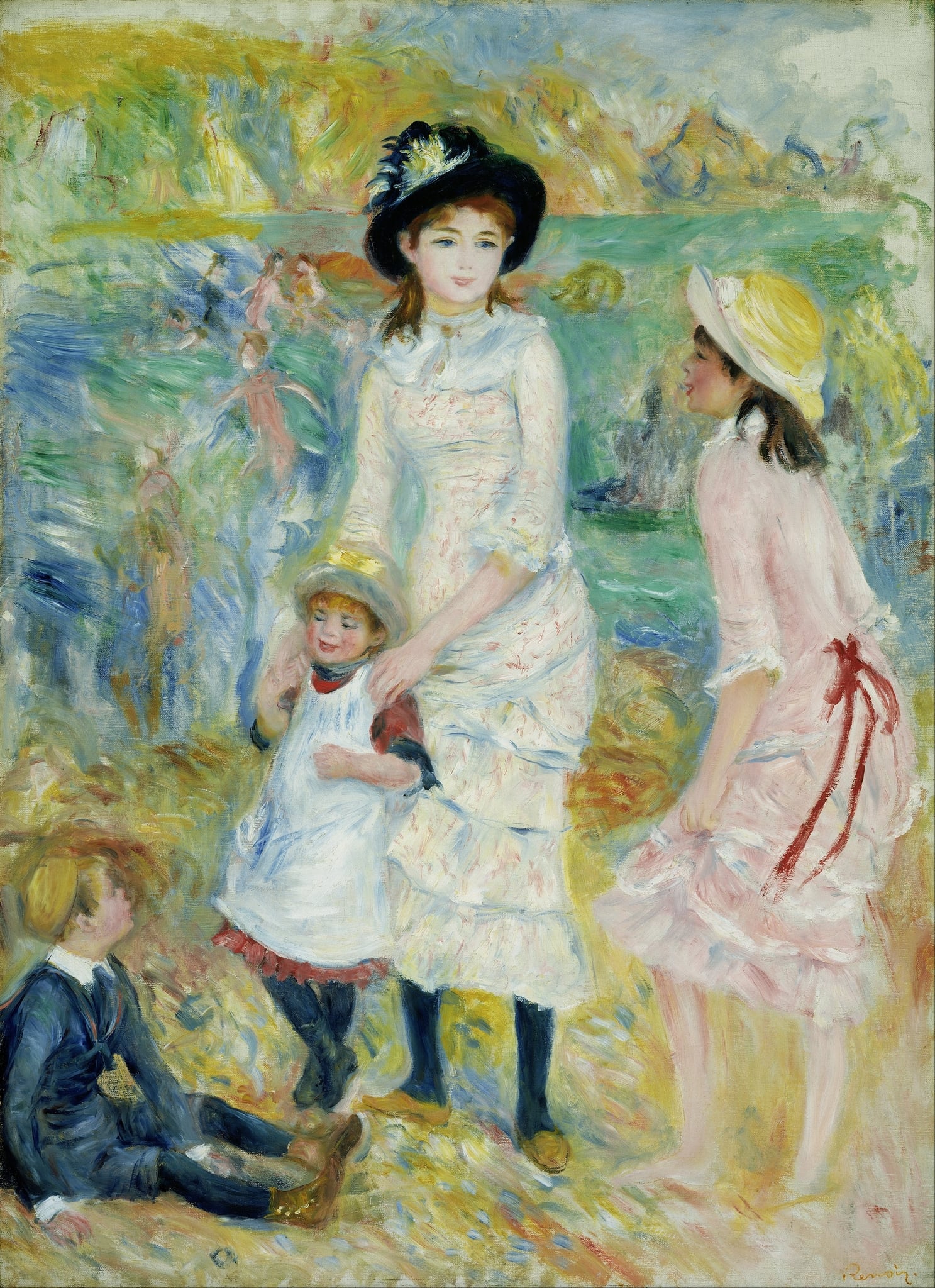
Children on the Seashore, Guernsey
Pierre-Auguste Renoir (about 1883)
Renoir’s Children on the Seashore, Guernsey crystallizes a wind‑bright moment of modern leisure with <strong>flickering brushwork</strong> and a gently choreographed group of children. The central girl in a white dress and black feathered hat steadies a toddler while a pink‑clad companion leans in and a sailor‑suited boy rests on the pebbles—an intimate triangle set against a <strong>shimmering, populated sea</strong>. The canvas makes light and movement the protagonists, dissolving edges into <strong>pearly surf and sun‑washed cliffs</strong>.
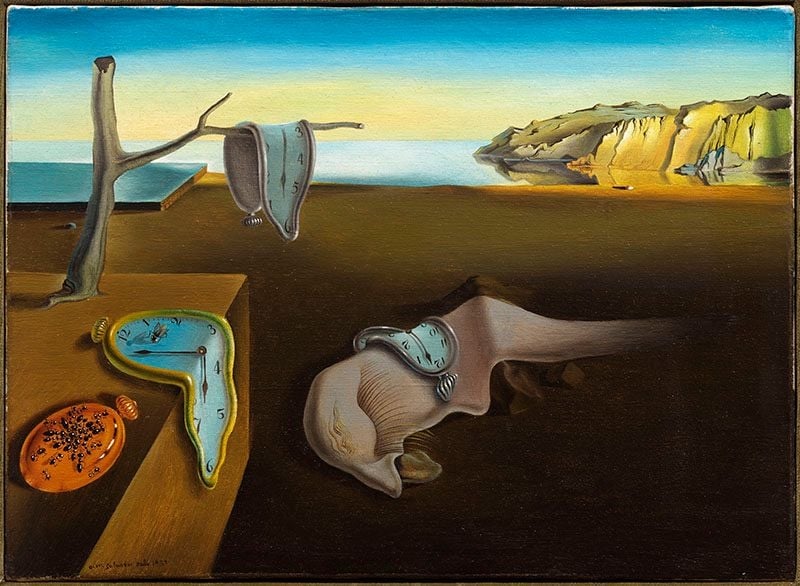
The Persistence of Memory
Salvador Dali (1931)
Salvador Dali’s The Persistence of Memory turns clock time into <strong>soft, malleable matter</strong>, staging a dream in which chronology buckles and the self dissolves. Four pocket watches droop across a barren platform, a dead branch, and a lash‑eyed biomorph, while ants overrun a hard, closed watch—a sign of <strong>decay</strong> and the futility of mechanical order <sup>[1]</sup><sup>[2]</sup>.
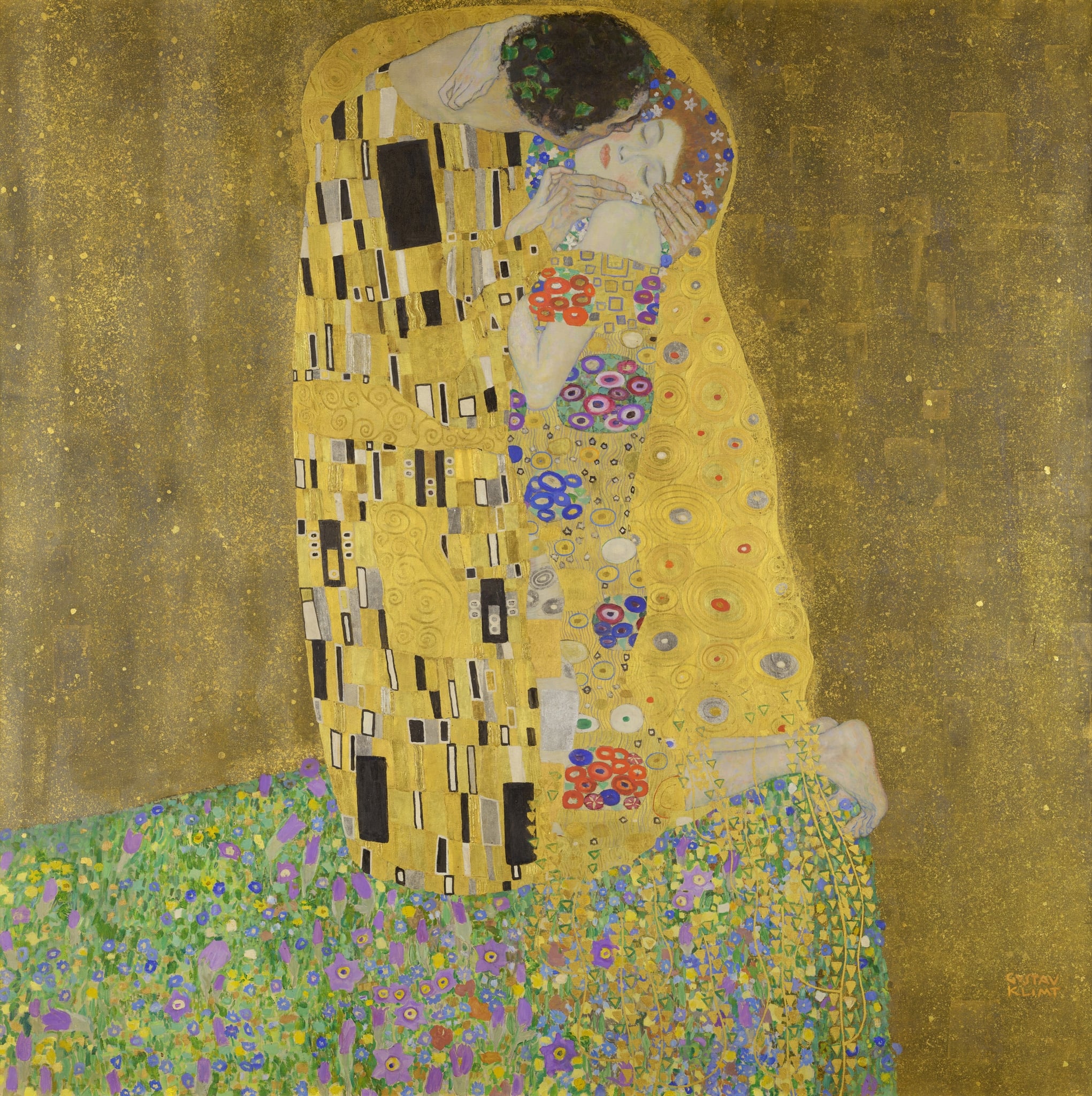
The Kiss
Gustav Klimt (1908 (completed 1909))
The Kiss stages human love as a <strong>sacred union</strong>, fusing two figures into a single, gold-clad form against a timeless field. Klimt opposes <strong>masculine geometry</strong> (black-and-white rectangles) to <strong>feminine organic rhythm</strong> (spirals, circles, flowers), then resolves them in radiant harmony <sup>[1]</sup><sup>[2]</sup>.
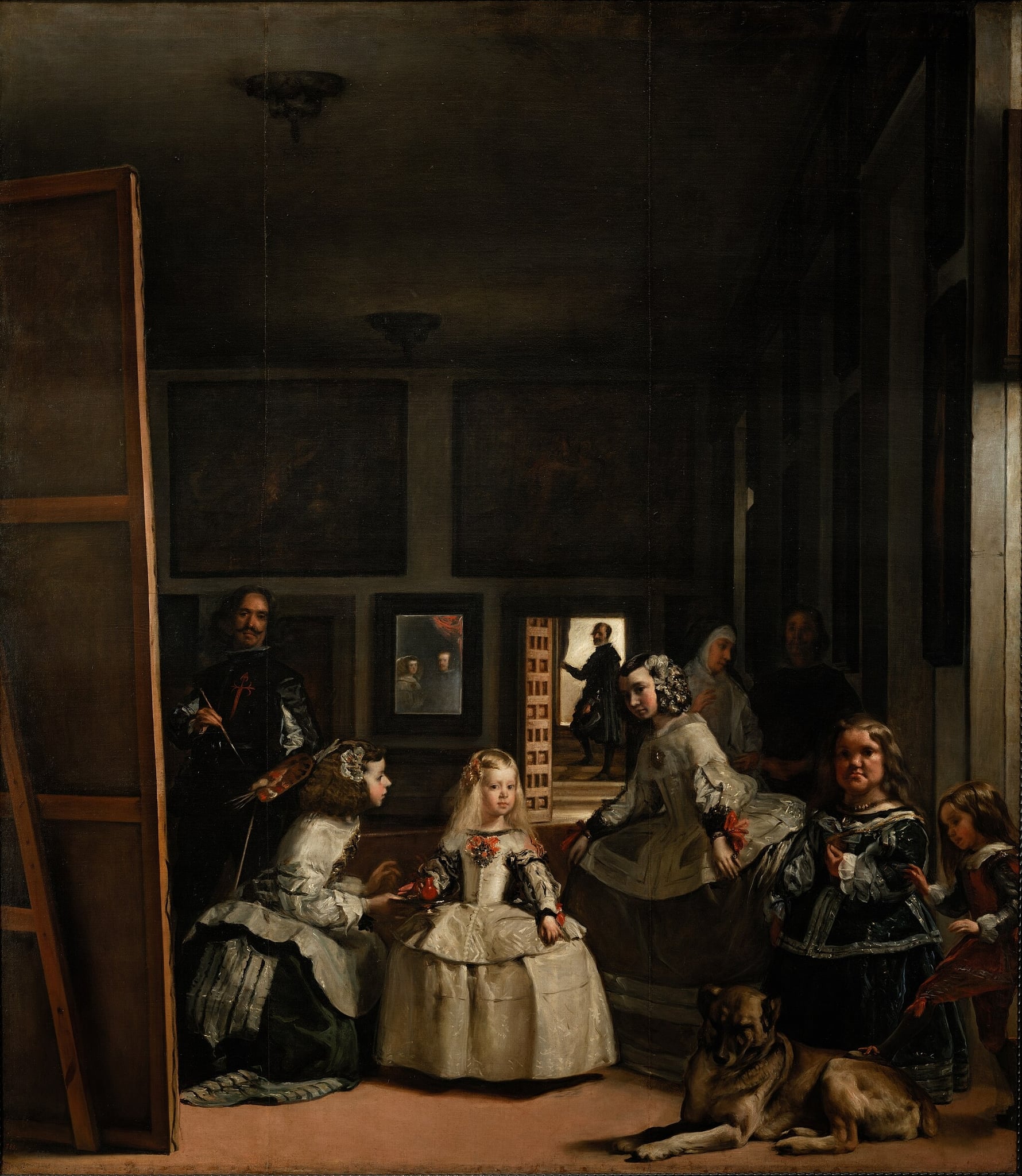
Las Meninas
Diego Velazquez (1656)
In Las Meninas, a luminous Infanta anchors a shadowed studio where the painter pauses at a vast easel and a small wall mirror reflects the monarchs. The scene folds artist, sitters, and viewer into one reflexive tableau, turning court protocol into a meditation on <strong>seeing and being seen</strong> <sup>[1]</sup><sup>[3]</sup>. A bright doorway at the rear deepens space and time, as if someone has just entered—or is leaving—the picture we occupy <sup>[1]</sup><sup>[5]</sup>.
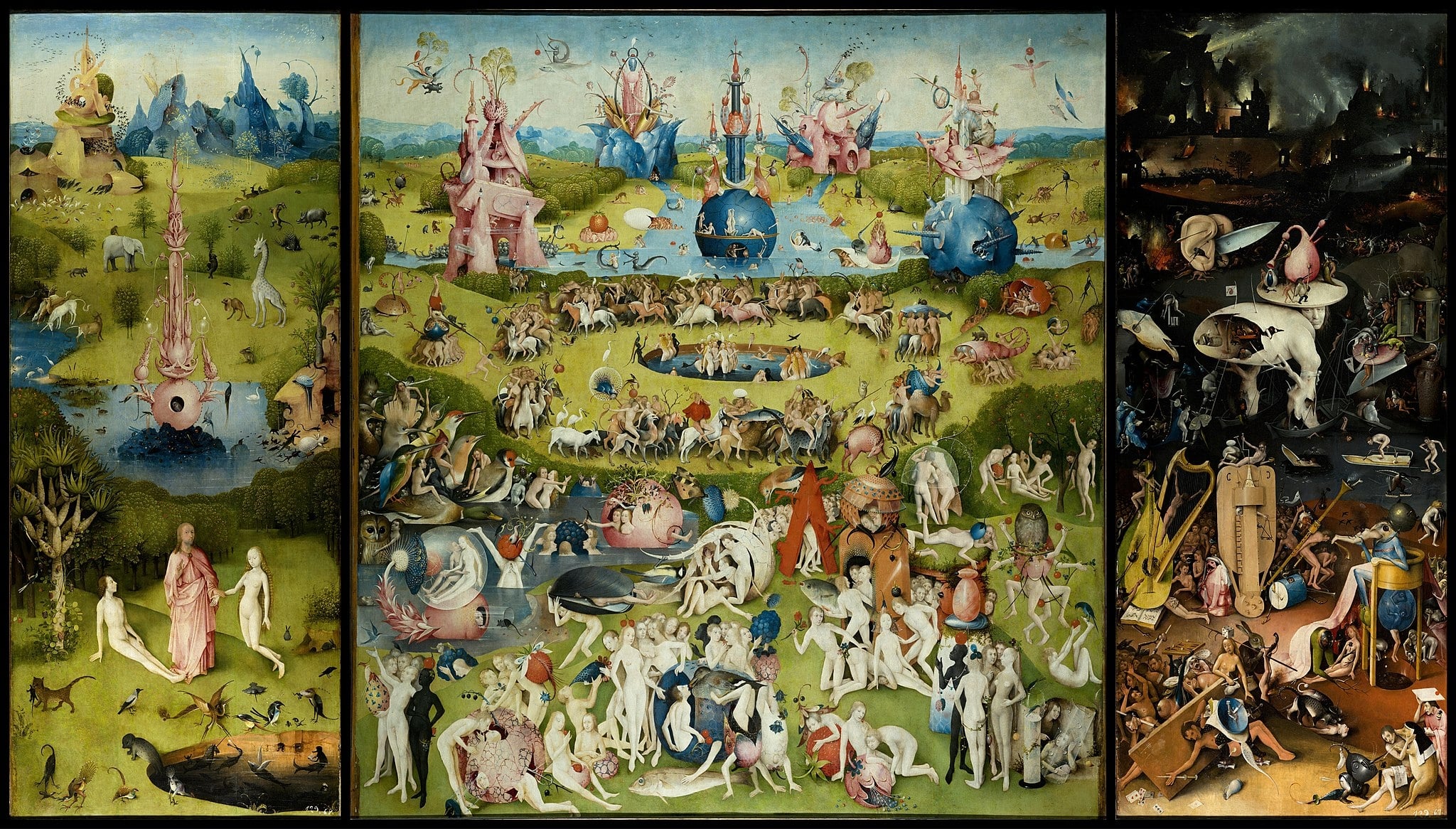
The Garden of Earthly Delights
Hieronymus Bosch (c.1490–1500)
The Garden of Earthly Delights unfolds a three‑act moral narrative—<strong>innocence</strong>, <strong>seduction</strong>, and <strong>retribution</strong>—from Eden to a punitive <strong>Musical Hell</strong>. Bosch binds the scenes through recurring emblems (notably the <strong>owl</strong>) and by echoing Eden’s crystalline fountain in the center’s fragile, candy‑colored architectures, then in Hell’s broken bodies and instruments. The work dazzles with invention while insisting that <strong>sweet, ephemeral pleasures</strong> end in ruin <sup>[1]</sup>.
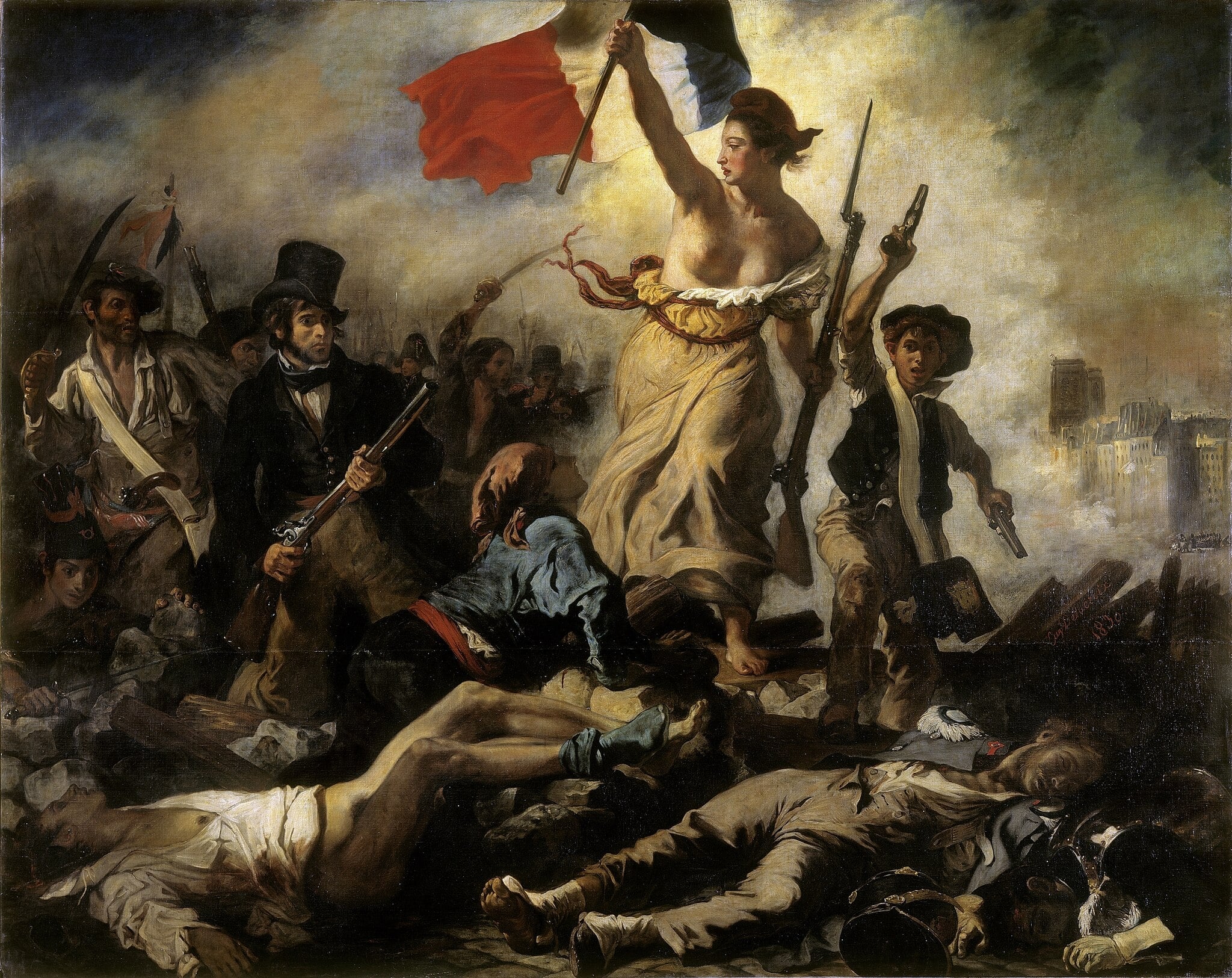
Liberty Leading the People
Eugene Delacroix (1830)
<strong>Liberty Leading the People</strong> turns a real street uprising into a modern myth: a bare‑breasted Liberty in a <strong>Phrygian cap</strong> thrusts the <strong>tricolor</strong> forward as Parisians of different classes surge over corpses and rubble. Delacroix binds allegory to eyewitness detail—Notre‑Dame flickers through smoke, a bourgeois in a top hat shoulders a musket, and a pistol‑waving boy keeps pace—so that freedom appears as both idea and action <sup>[1]</sup><sup>[2]</sup>. After its 2024 cleaning, sharper blues, whites, and reds re‑ignite the painting’s charged color drama <sup>[4]</sup>.
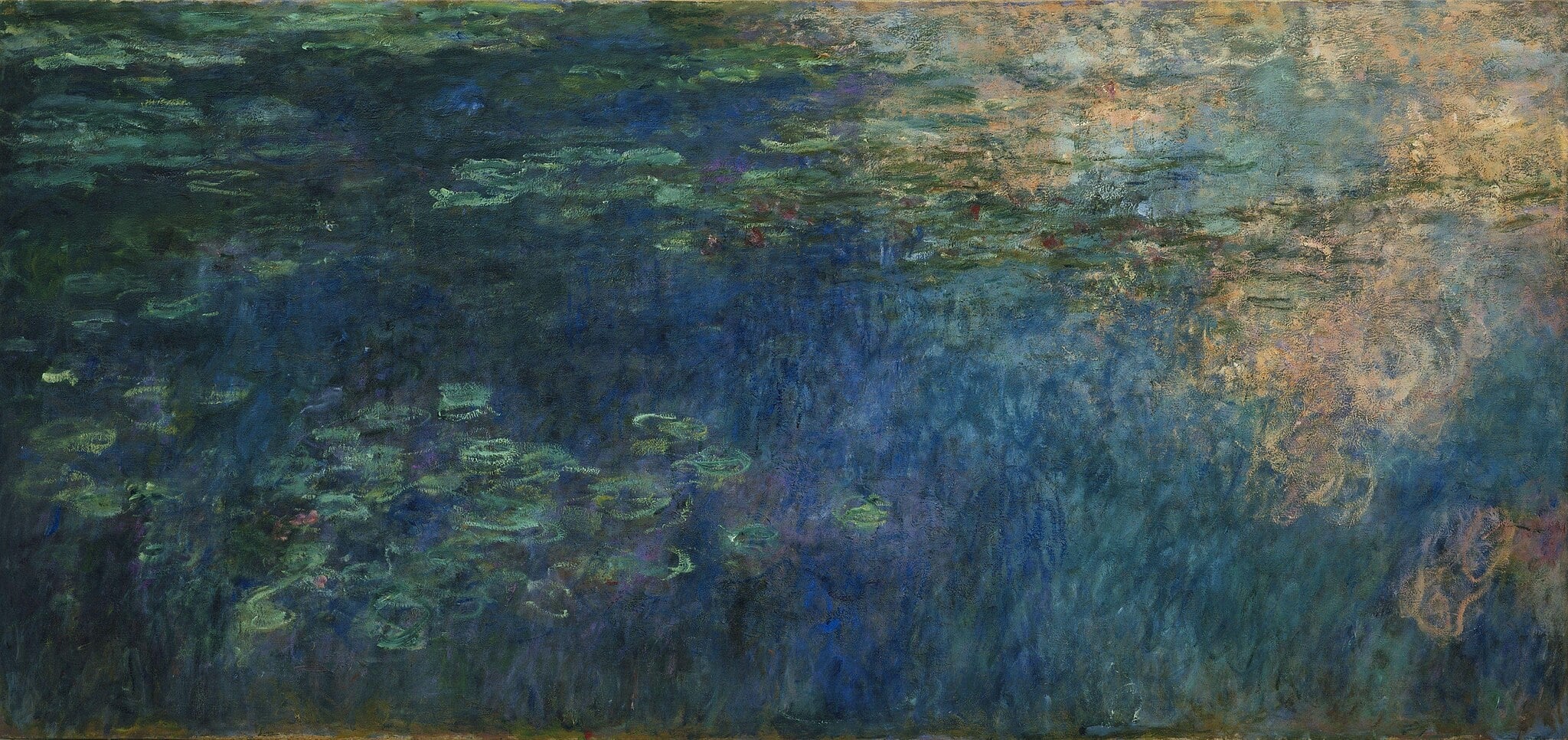
Water Lilies (triptych)
Claude Monet (1914–1926)
Water Lilies (triptych) dissolves banks and horizon into an <strong>immersive field</strong> of reflected sky and water. Across three mural‑scale panels, <strong>layered blues and greens</strong> are punctuated by floating pads while <strong>peach‑lavender light</strong> gathers at the right, turning the pond into a living mirror <sup>[1]</sup><sup>[3]</sup>.
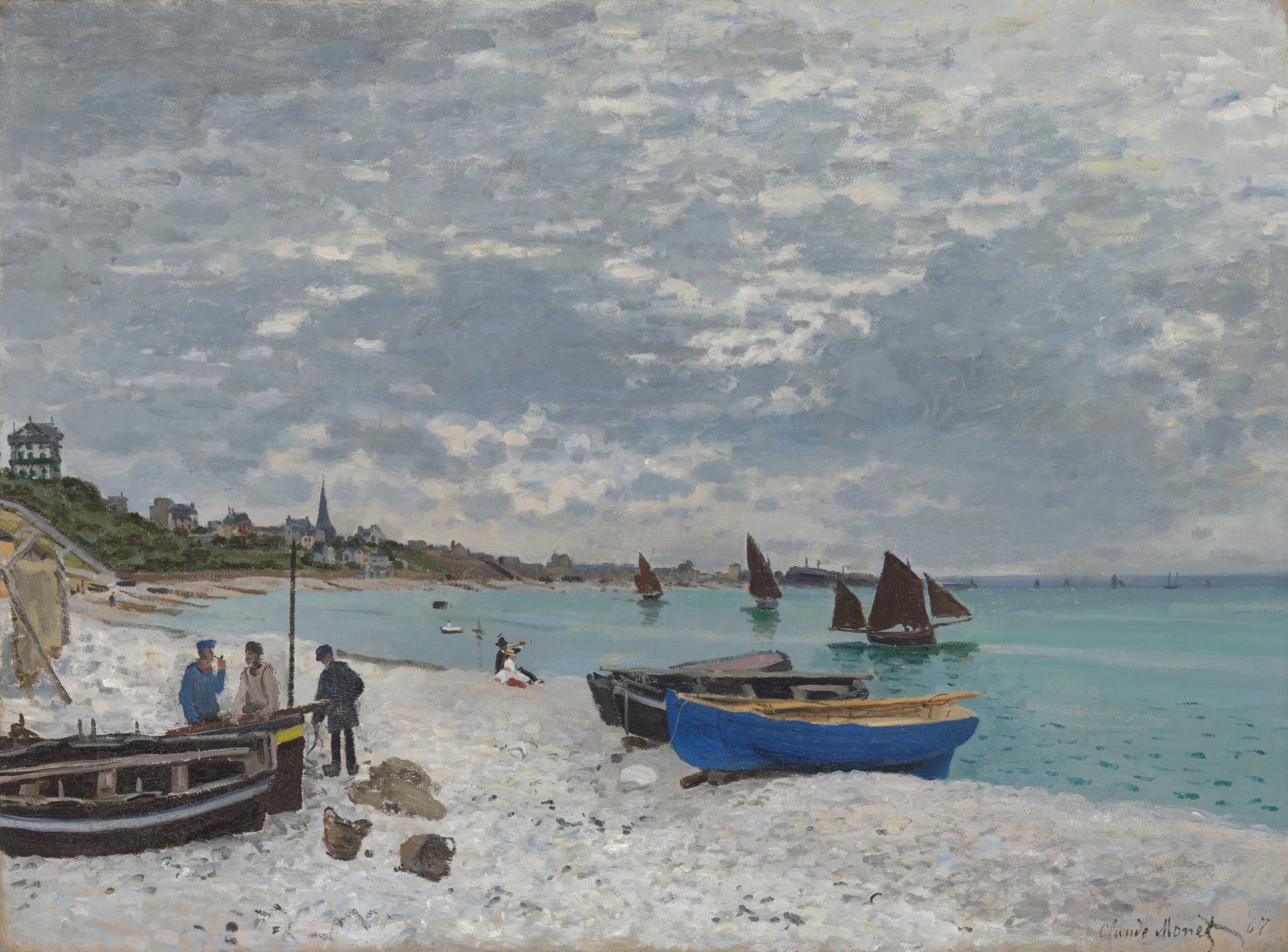
The Beach at Sainte-Adresse
Claude Monet (1867)
In The Beach at Sainte-Adresse, Claude Monet stages a modern shore where <strong>labor and leisure intersect</strong> under a broad, changeable sky. The bright <strong>blue beached boat</strong> and the flotilla of <strong>rust-brown working sails</strong> punctuate a turquoise channel, while a fashionably dressed pair sits mid-beach, spectators to the traffic of the port. Monet’s brisk, broken strokes make the scene feel <strong>caught between tides and weather</strong>, a momentary balance of work, tourism, and atmosphere <sup>[1]</sup><sup>[2]</sup>.
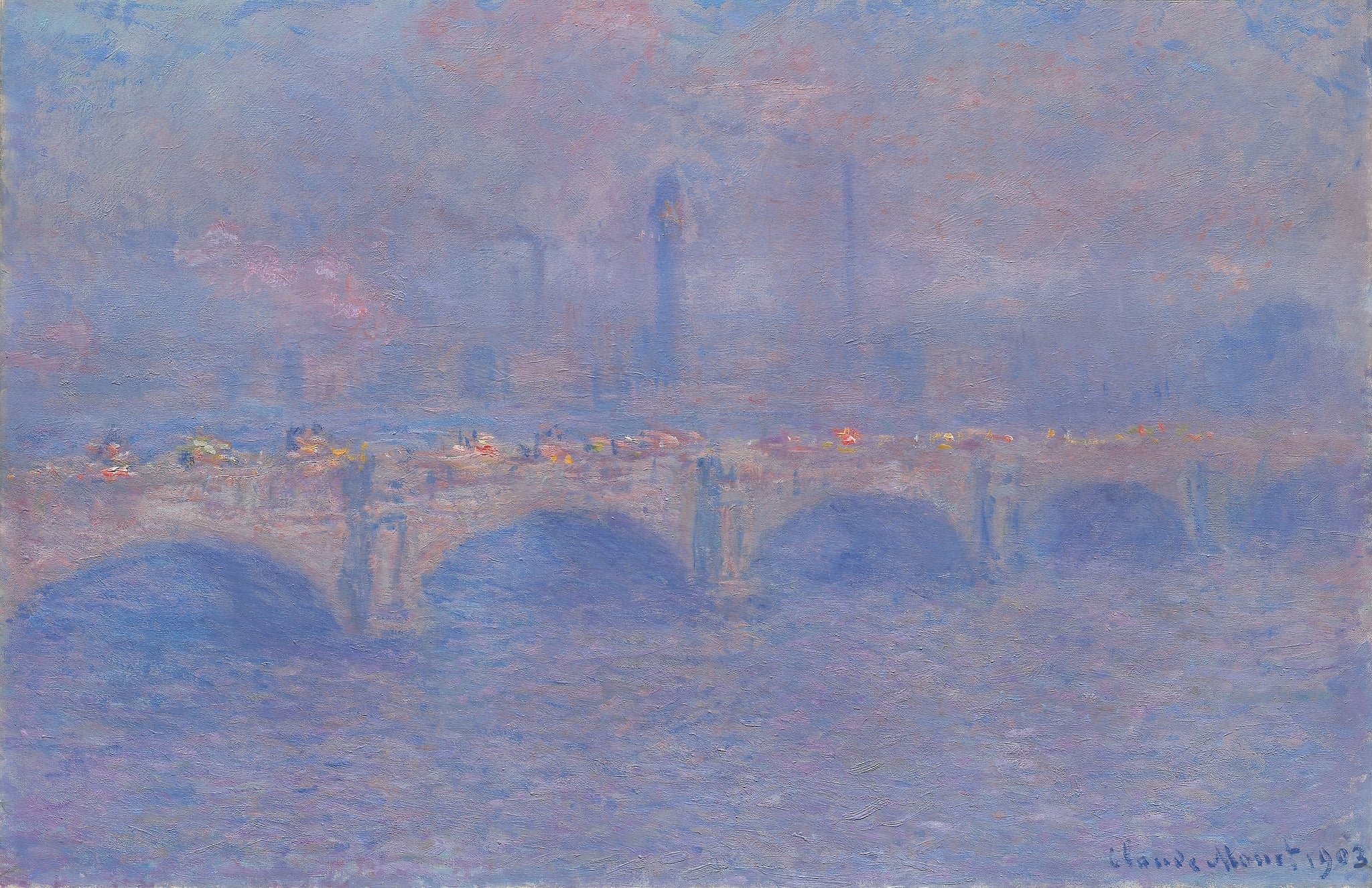
Waterloo Bridge, Sunlight Effect
Claude Monet (1903 (begun 1900))
Claude Monet’s Waterloo Bridge, Sunlight Effect renders London as a <strong>lilac-blue atmosphere</strong> where form yields to light. The bridge’s stone arches persist as anchors, yet the span dissolves into mist while <strong>flecks of lemon and ember</strong> signal modern traffic crossing a city made weightless <sup>[1]</sup><sup>[2]</sup>. Vertical hints of chimneys haunt the distance, binding industry to beauty as the Thames shimmers with the same notes as the sky <sup>[1]</sup><sup>[3]</sup>.
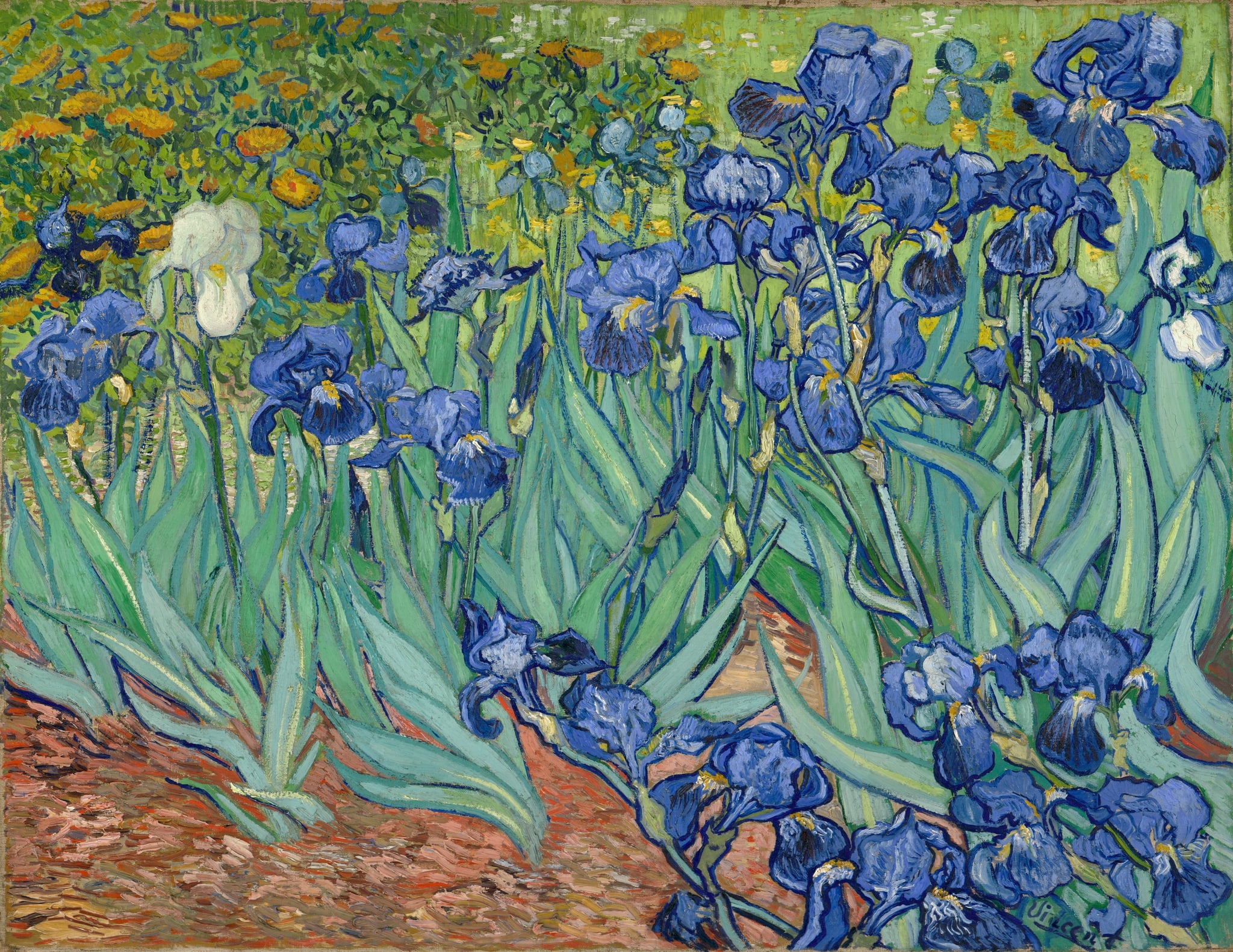
Irises
Vincent van Gogh (1889)
Painted in May 1889 at the Saint-Rémy asylum garden, Vincent van Gogh’s <strong>Irises</strong> turns close observation into an act of repair. Dark contours, a cropped, print-like vantage, and vibrating complements—violet/blue blossoms against <strong>yellow-green</strong> ground—stage a living frieze whose lone <strong>white iris</strong> punctuates the field with arresting clarity <sup>[1]</sup><sup>[2]</sup>.
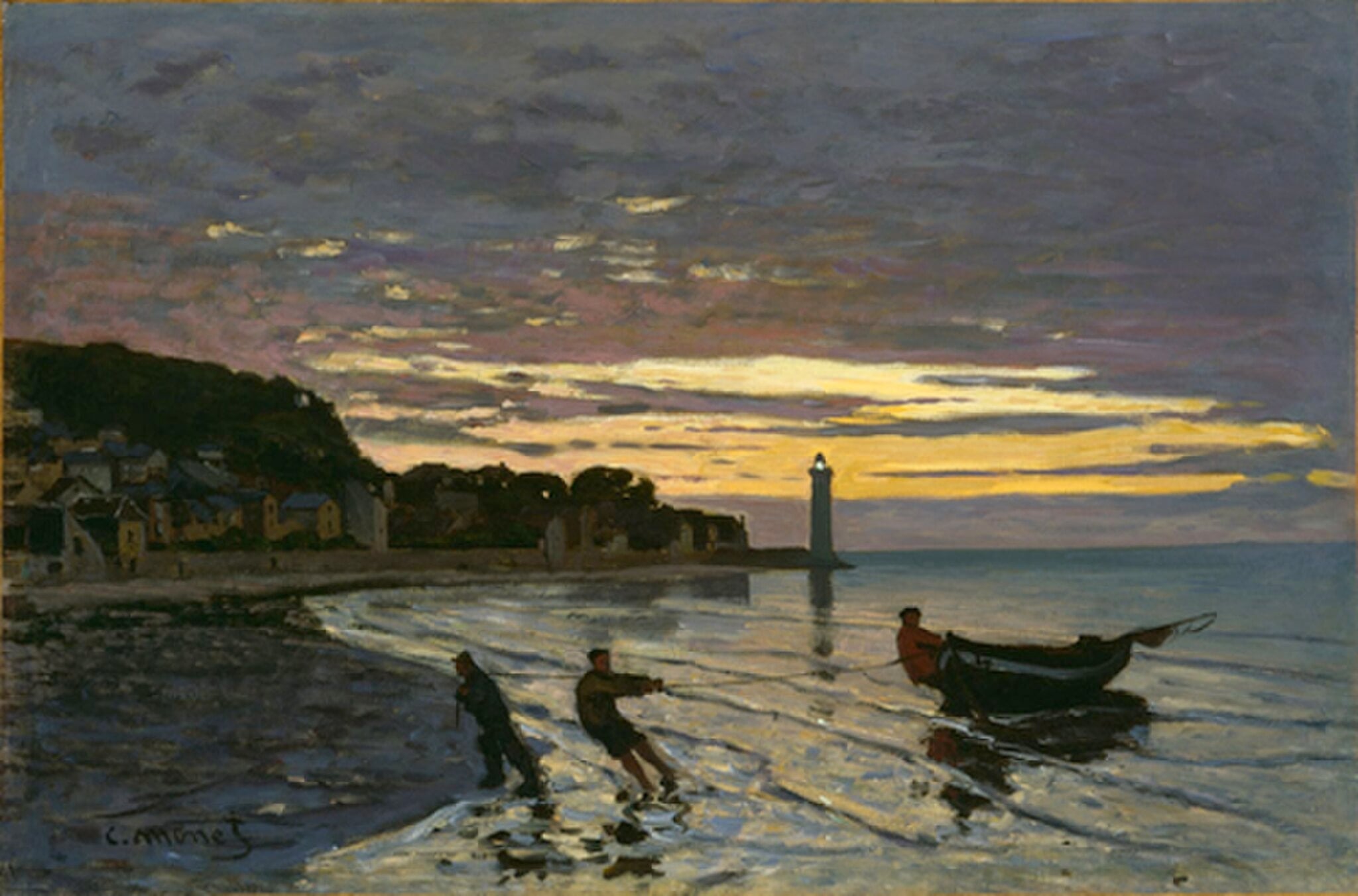
Towing a Boat, Honfleur
Claude Monet (1864)
Claude Monet’s Towing a Boat, Honfleur frames coastal labor against a dusk of <strong>fugitive light</strong> and <strong>reflective sands</strong>, where three figures strain on taut ropes as a lighthouse holds steady on the horizon. The canvas turns a routine task into a meditation on <strong>endurance, guidance, and time’s passage</strong>.
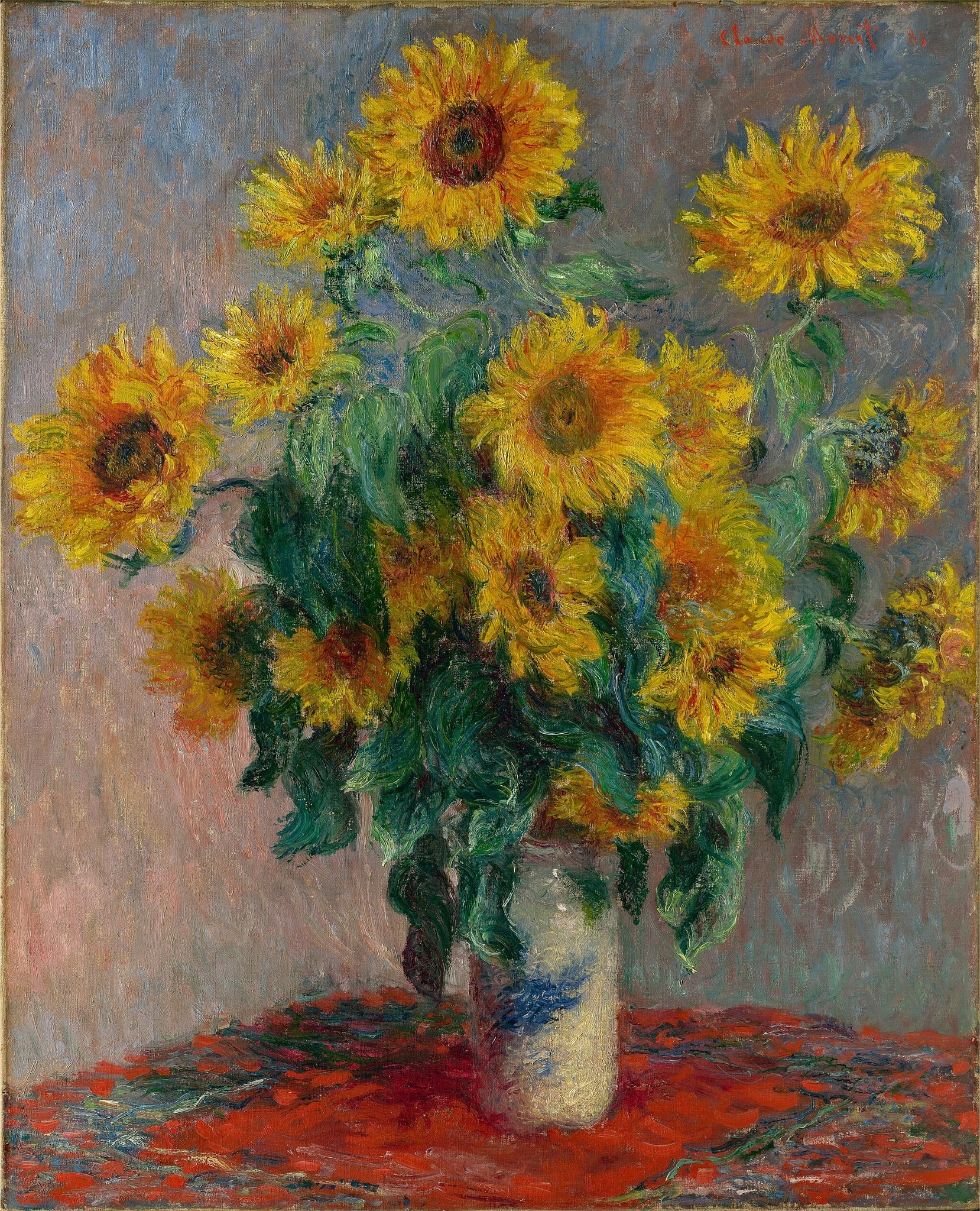
Bouquet of Sunflowers
Claude Monet (1881)
Claude Monet’s Bouquet of Sunflowers detonates with <strong>solar color</strong> and <strong>restless brushwork</strong>: yellow heads flare from a pale vase, thrust forward by a blazing red cloth against a cool, lilac‑gray wall. The painting converts a domestic bouquet into an arena where <strong>light, time, and touch</strong> supersede contour, staging blooms from vigor to fray in a single, pulsing image <sup>[1]</sup><sup>[2]</sup>.
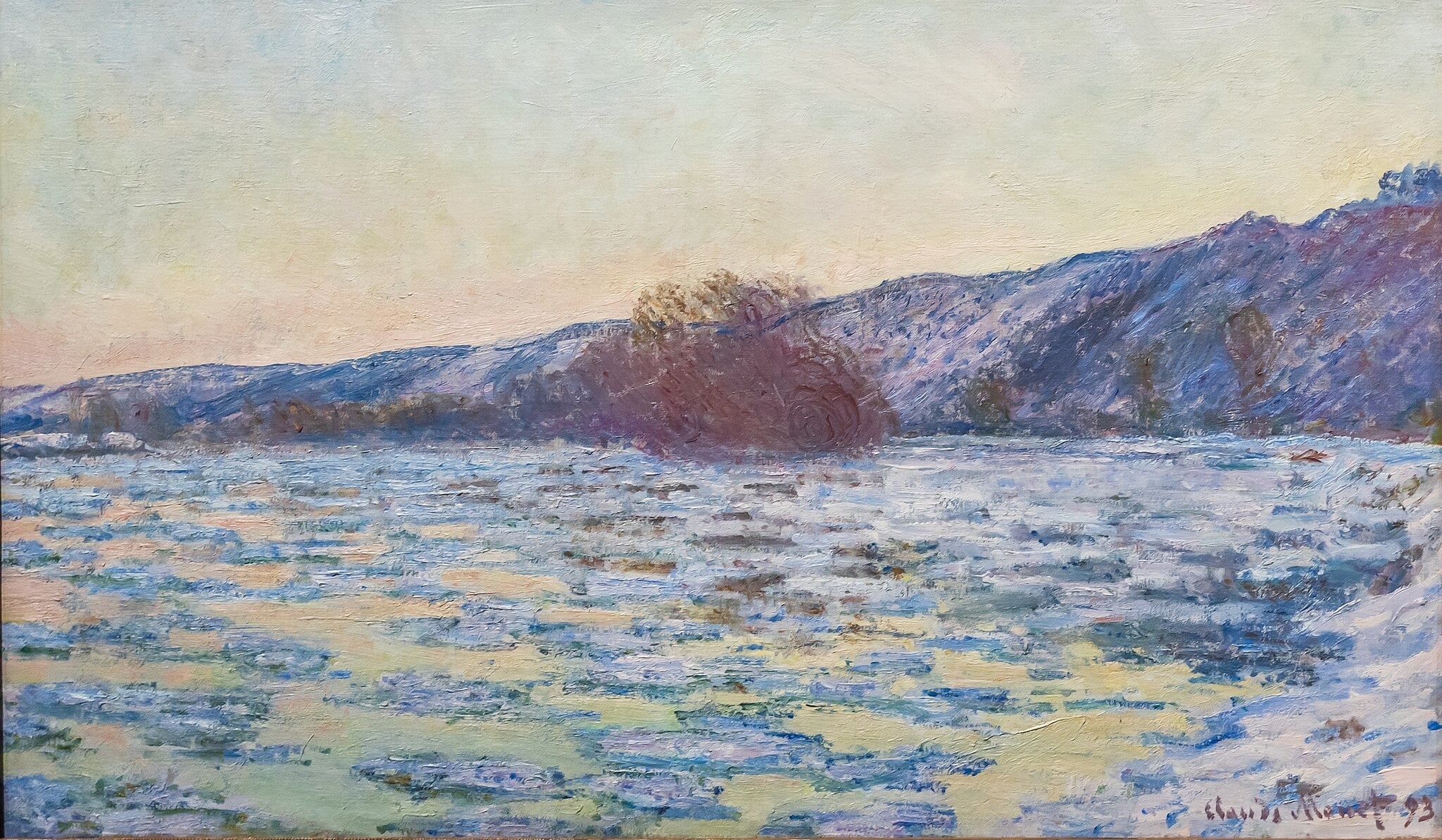
Ice Floes
Claude Monet (1893)
Claude Monet’s Ice Floes turns a thawing Seine into a <strong>theater of transition</strong>: pale ice plates drift over mint‑green water beneath a <strong>high horizon</strong> and a <strong>russet clump of trees</strong> that warms the scene’s chill palette. With short, glancing strokes, Monet makes the floes <strong>shimmer between stillness and motion</strong>, converting a winter morning into a meditation on change and endurance.
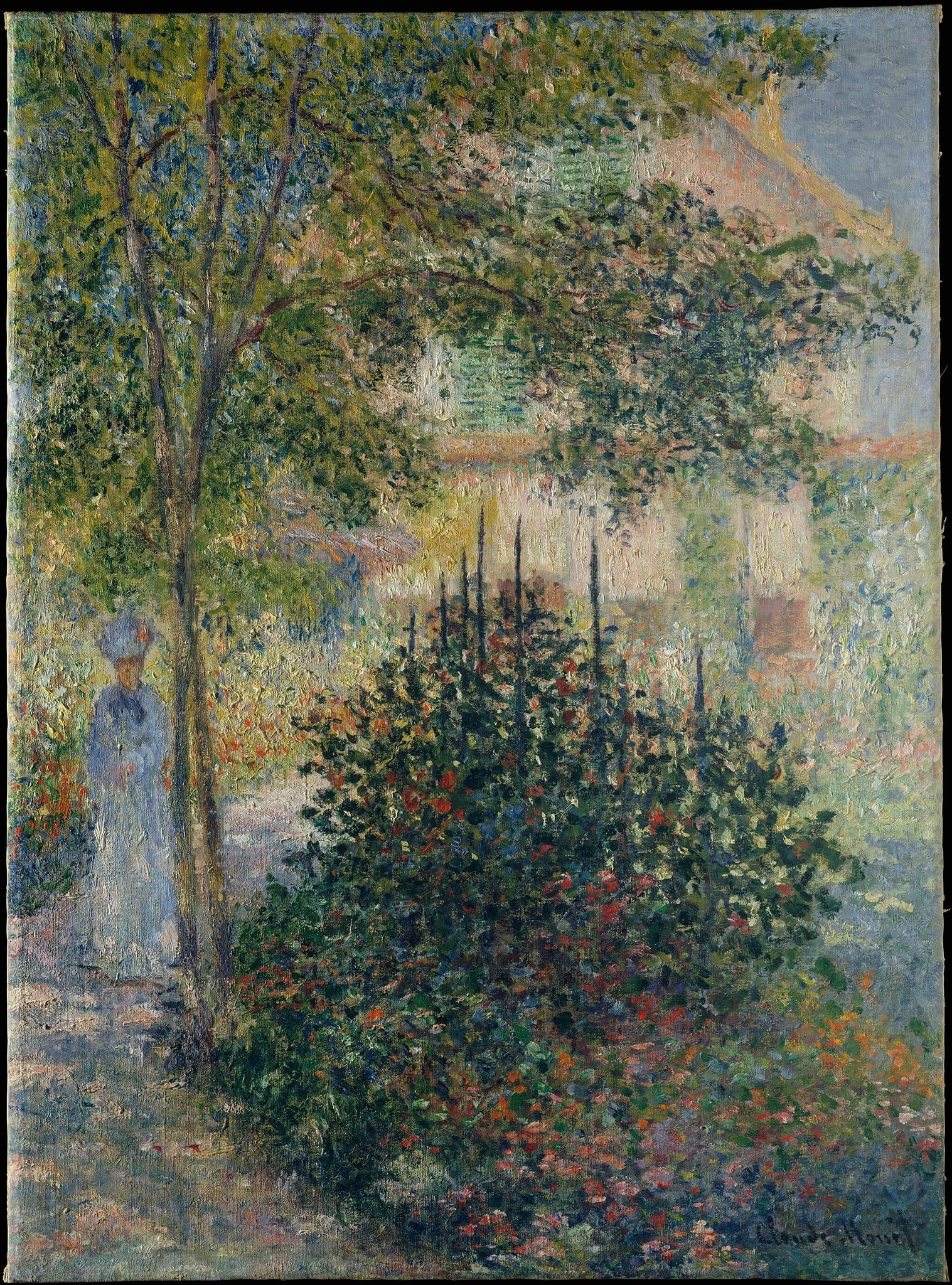
Camille Monet (1847–1879) in the Garden at Argenteuil
Claude Monet (1876)
Claude Monet’s Camille Monet (1847–1879) in the Garden at Argenteuil captures a fleeting, sunstruck interval where a blue‑clad figure hovers at the shaded path while a <strong>corbeille</strong> of spiked flowers ignites the foreground. The pink house with <strong>green shutters</strong> flickers through a veil of leaves, its surfaces dissolved into vibrating strokes of light. Monet subordinates likeness to the <strong>sensation of air and color</strong>, turning the garden into a living field of time and perception <sup>[1]</sup><sup>[2]</sup>.
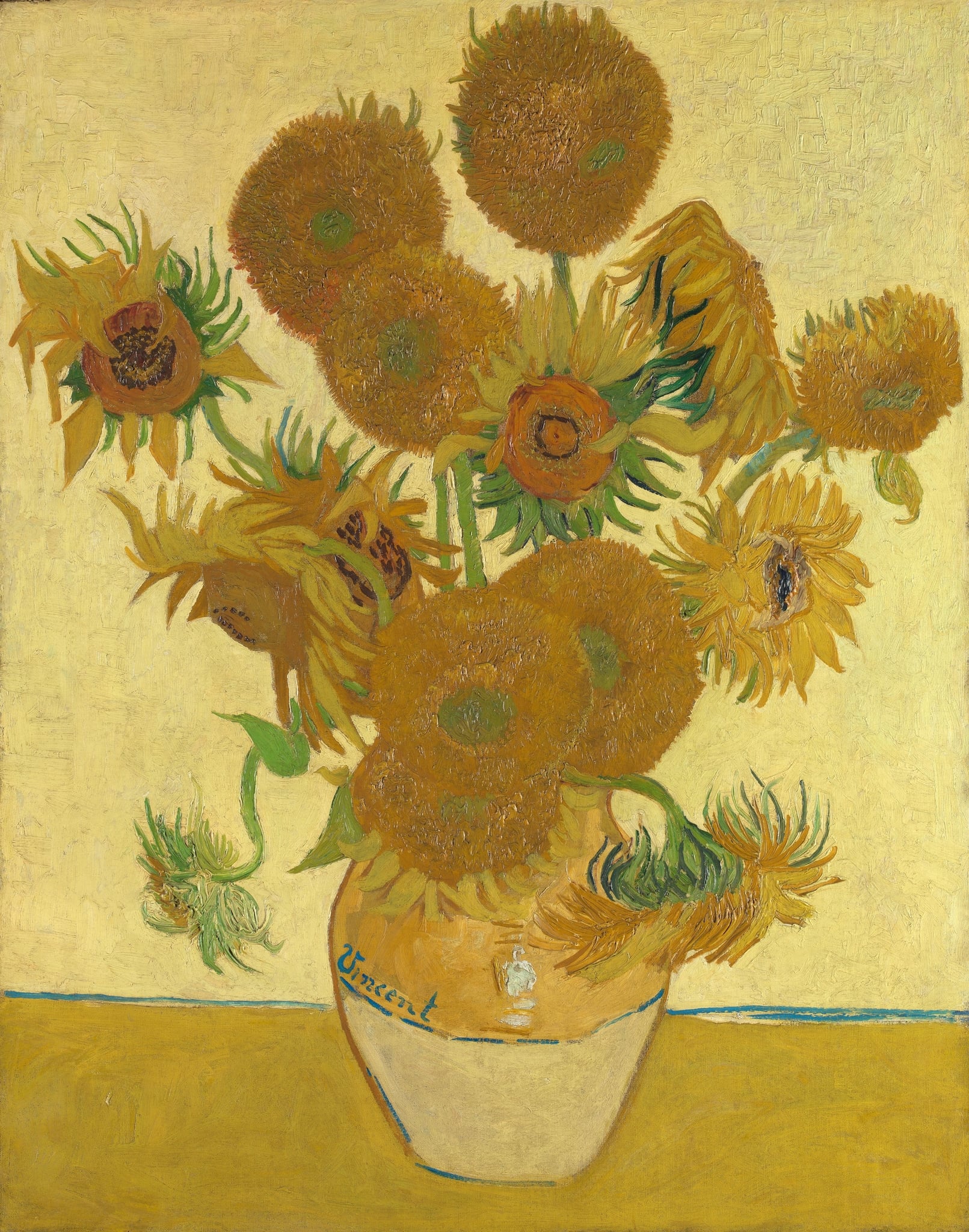
Sunflowers
Vincent van Gogh (1888)
Vincent van Gogh’s Sunflowers (1888) is a <strong>yellow-on-yellow</strong> still life that stages a full <strong>cycle of life</strong> in fifteen blooms, from fresh buds to brittle seed heads. The thick impasto, green shocks of stem and bract, and the vase signed <strong>“Vincent”</strong> turn a humble bouquet into an emblem of endurance and fellowship <sup>[1]</sup><sup>[2]</sup>.
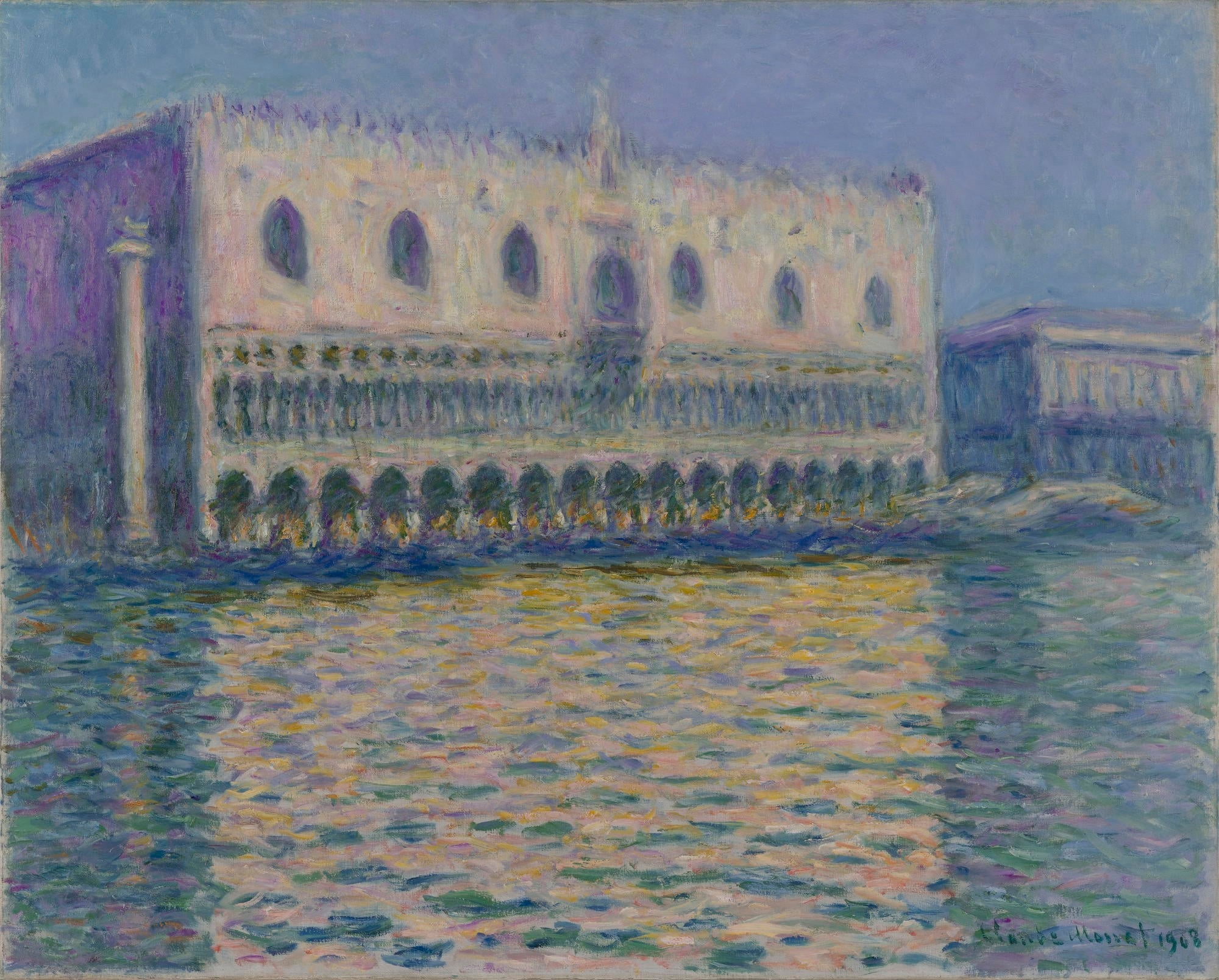
The Palazzo Ducale (The Doge’s Palace)
Claude Monet (1908)
Claude Monet’s The Palazzo Ducale (The Doge’s Palace) converts Venice’s seat of power into an apparition of <strong>light and atmosphere</strong>. The lilac-and-rose façade dissolves into rhythmic brushwork while its <strong>broken reflection</strong> braids golds and violets across the canal. Monument becomes <strong>sensation</strong>, authority becomes shimmer.
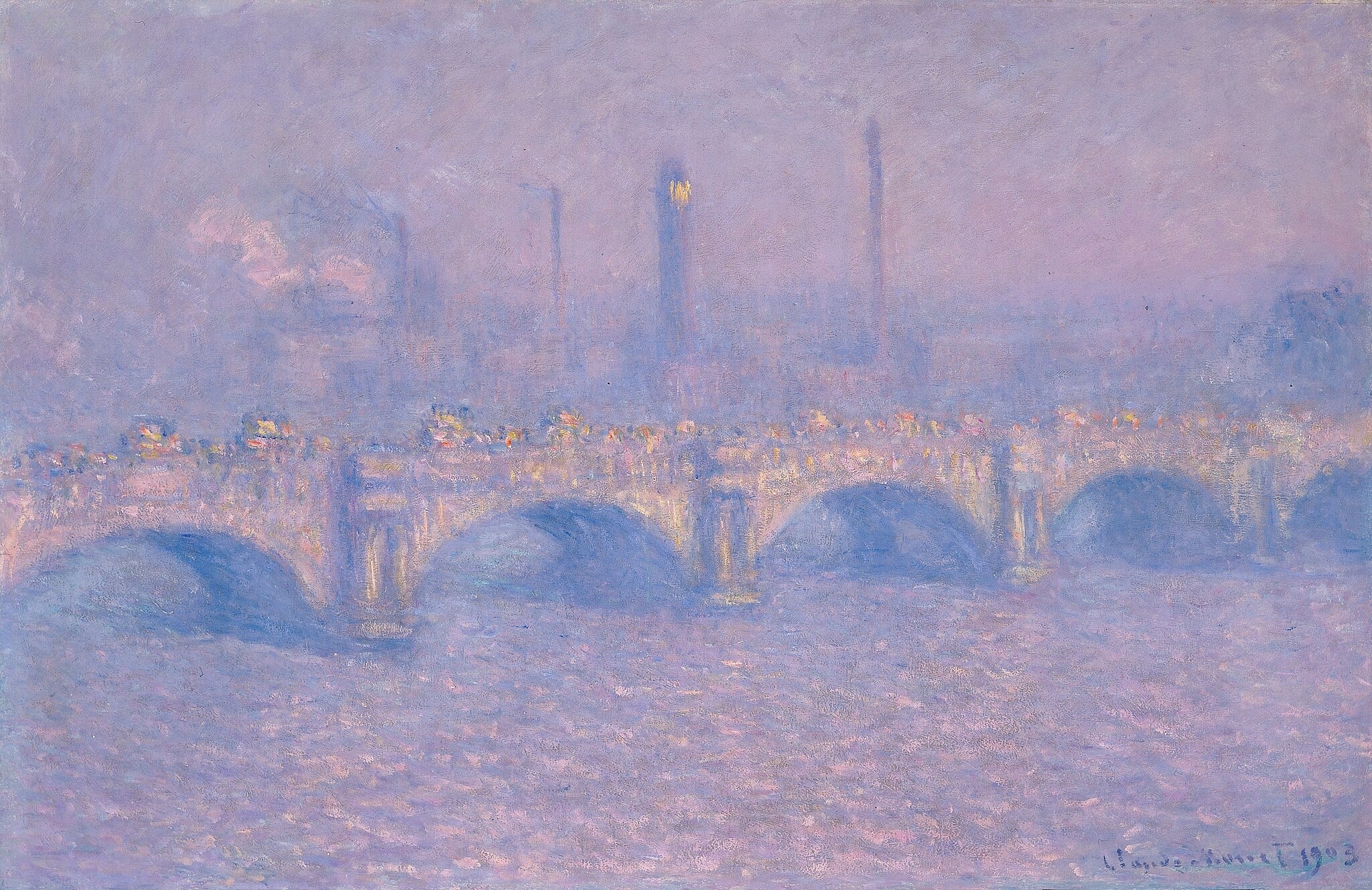
Waterloo Bridge, Veiled Sun
Claude Monet (1903)
Claude Monet’s Waterloo Bridge, Veiled Sun renders London as a field of vibrating color where <strong>atmosphere</strong> overtakes architecture. The bridge’s cool violet arches and the tiny <strong>veiled sun</strong>—a gold pin of light above the parapet—stage a dialogue between urban <strong>modernity</strong> and shifting light.
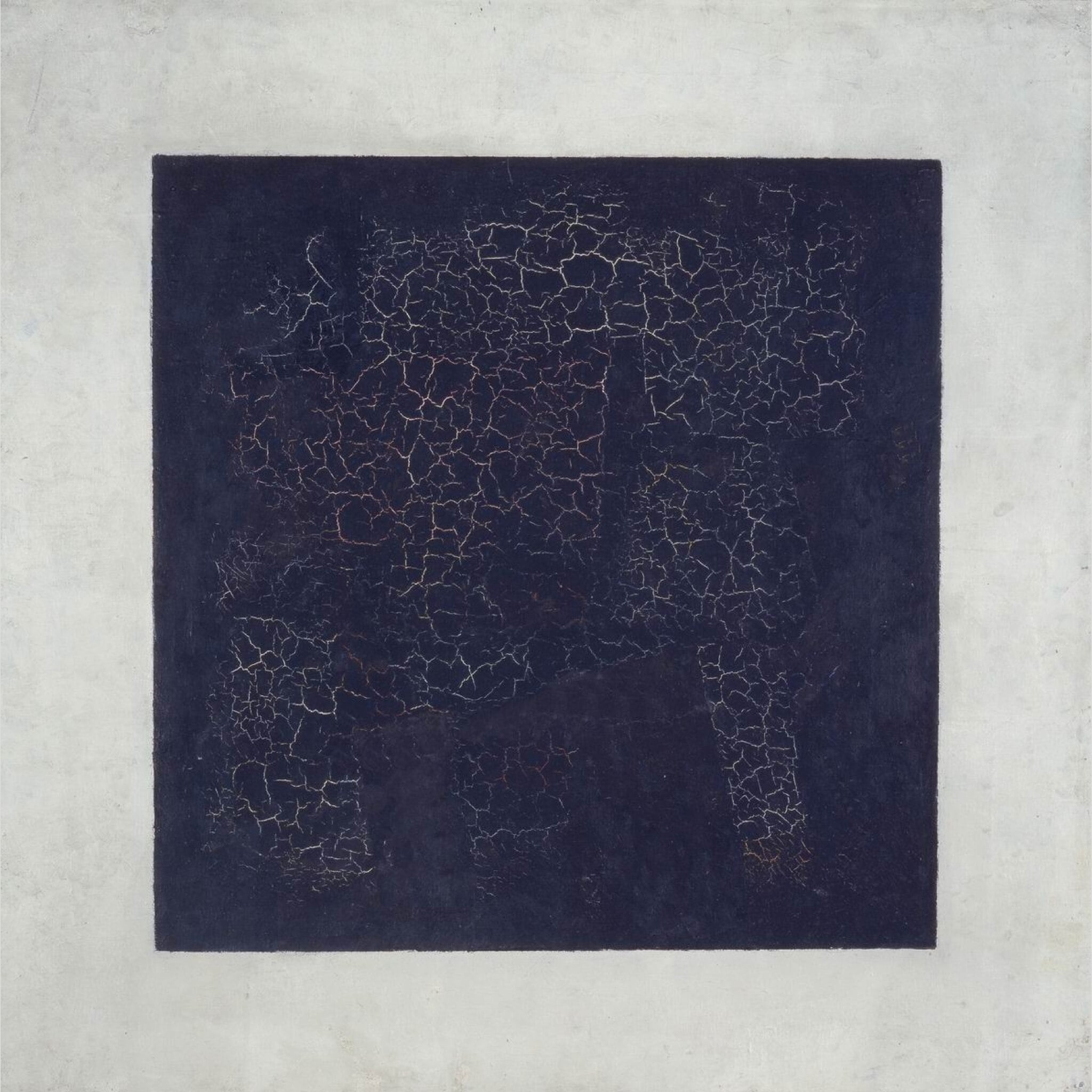
Black Square
Kazimir Malevich (1915)
Kazimir Malevich’s Black Square declares a radical reset: a hand-painted, slightly irregular black form set on a chalky white field, presented as an artistic <strong>zero</strong> and a new spiritual-conceptual space. The hairline craquelure that webs across the dark surface counters any idea of a perfect void, binding utopian claim to material time.
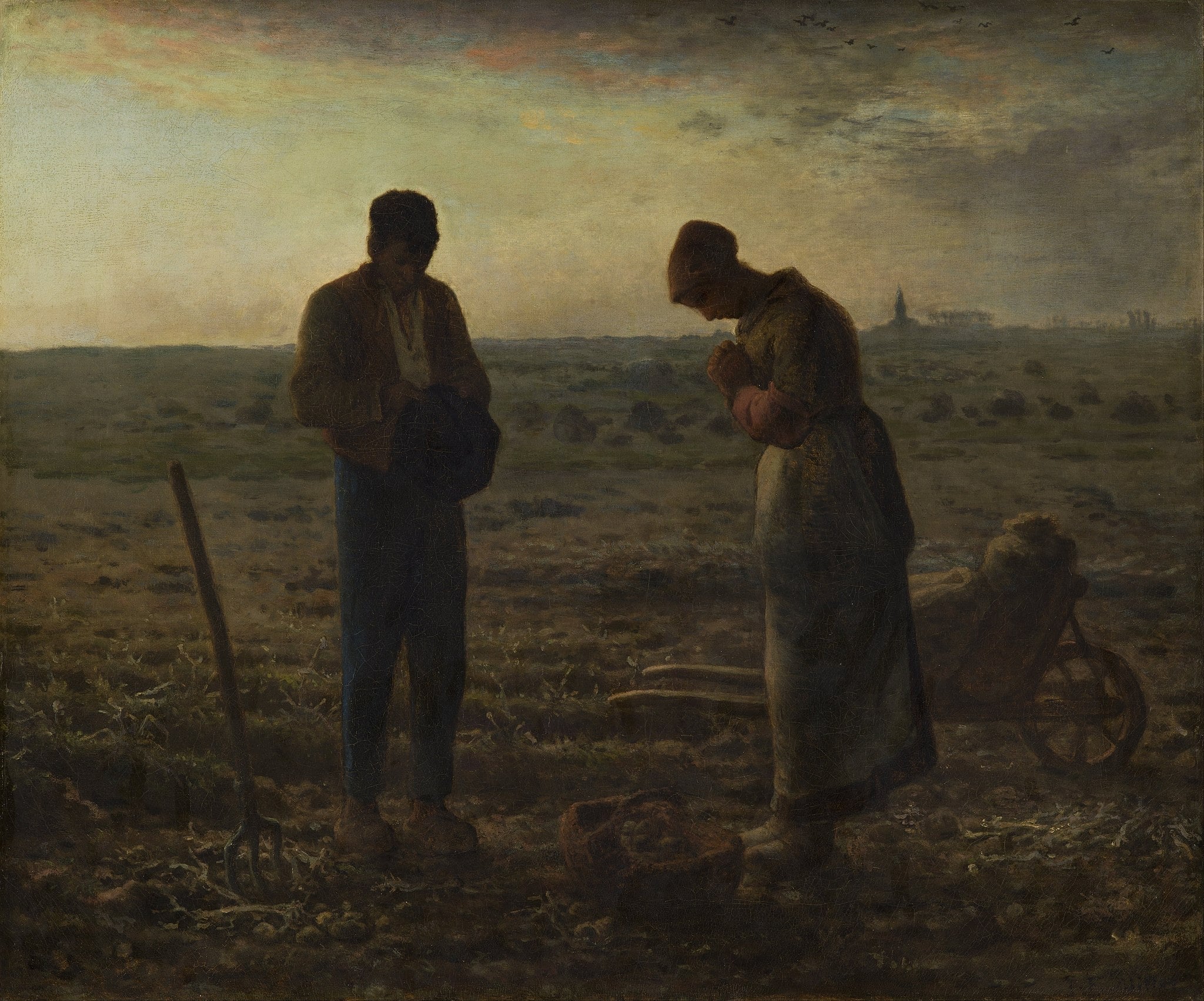
The Angelus
Jean-Francois Millet (1857–1859)
Jean-Francois Millet’s The Angelus (1857–1859) fuses <strong>devotion</strong> and <strong>labor</strong>: two peasants pause at dusk, heads bowed, as the Angelus bell sounds from a distant steeple. With a <strong>low horizon</strong>, earthen palette, and monumental silhouettes, the painting makes a brief pause in fieldwork feel timeless and sacred <sup>[1]</sup><sup>[2]</sup>.
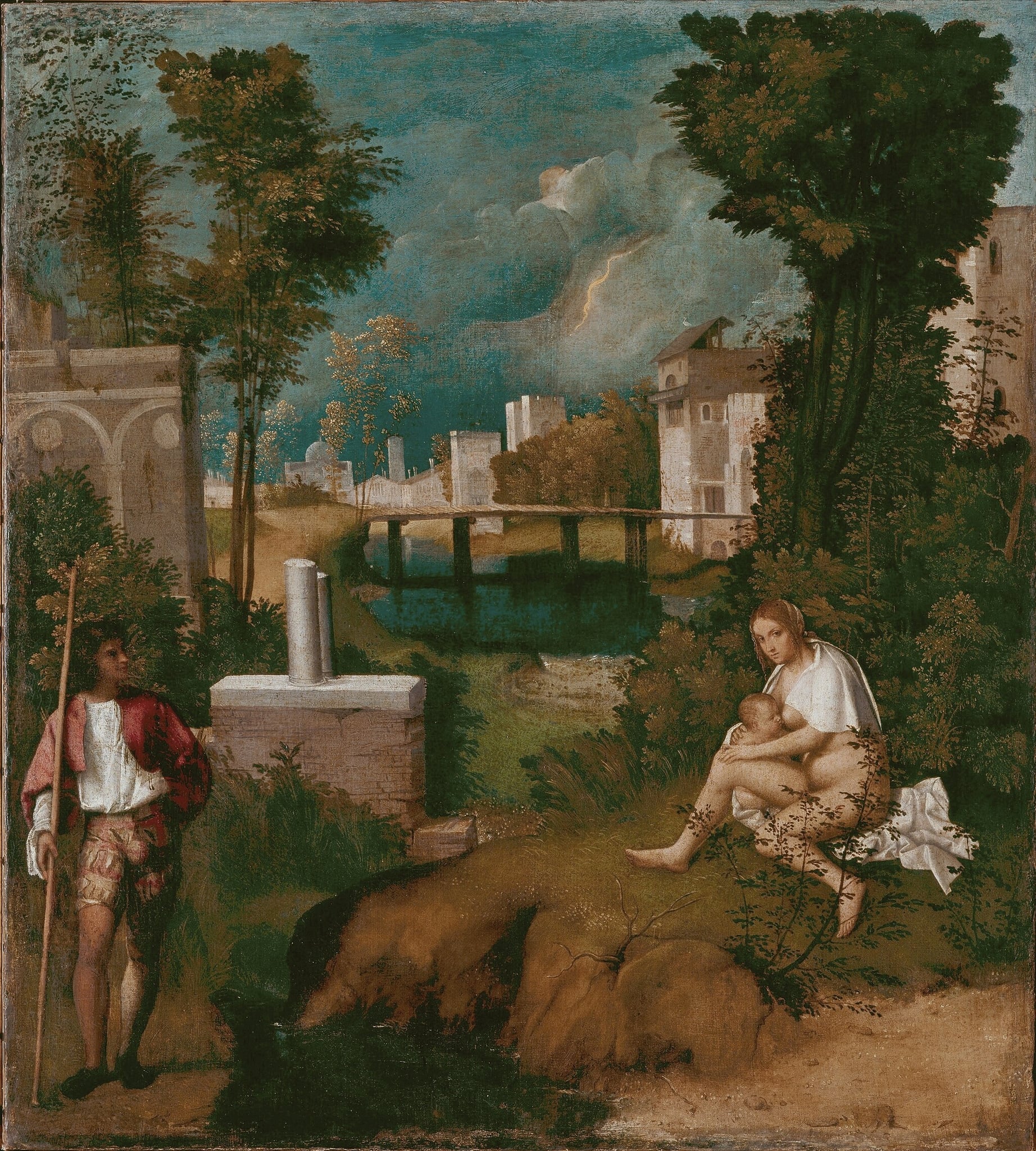
The Storm
Giorgione (c. 1505–1508)
Giorgione’s The Storm stages human life on the brink of change, fusing <strong>pastoral calm</strong> with <strong>sudden rupture</strong>. A watchful youth and a nursing mother face each other across a stream as lightning splits the blue‑green sky, while ruins and a narrow bridge signal fragile passage. The landscape itself becomes the protagonist, turning everyday figures into a <strong>poetic allegory</strong> of vulnerability and fate <sup>[1]</sup><sup>[2]</sup>.
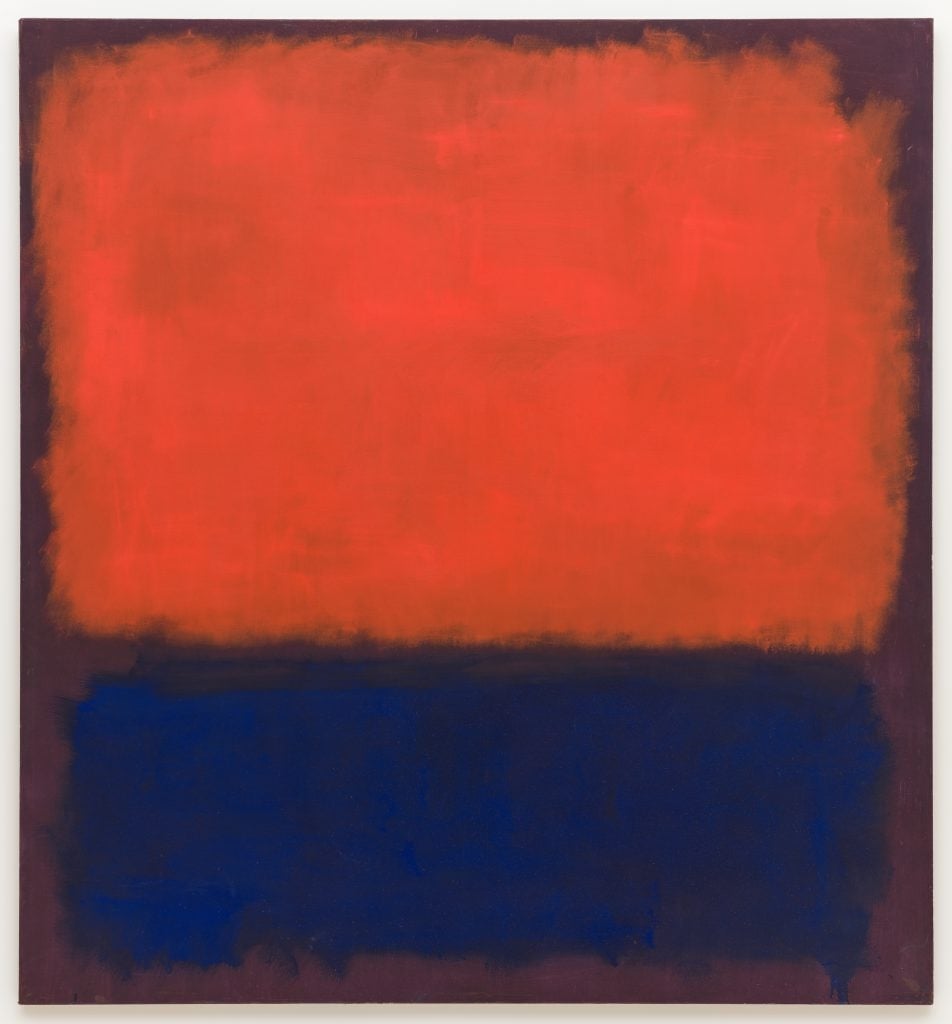
No. 14
Mark Rothko (1960)
In No. 14, 1960, Mark Rothko stages a charged encounter between a vast, <strong>ember-like red-orange</strong> plane and a weighty, <strong>indigo-blue</strong> band that nearly tips into black. The softly frayed borders and faint <strong>plum-violet</strong> surround cause the colors to hover and breathe, converting sheer scale and chroma into felt experience rather than depiction <sup>[1]</sup>.
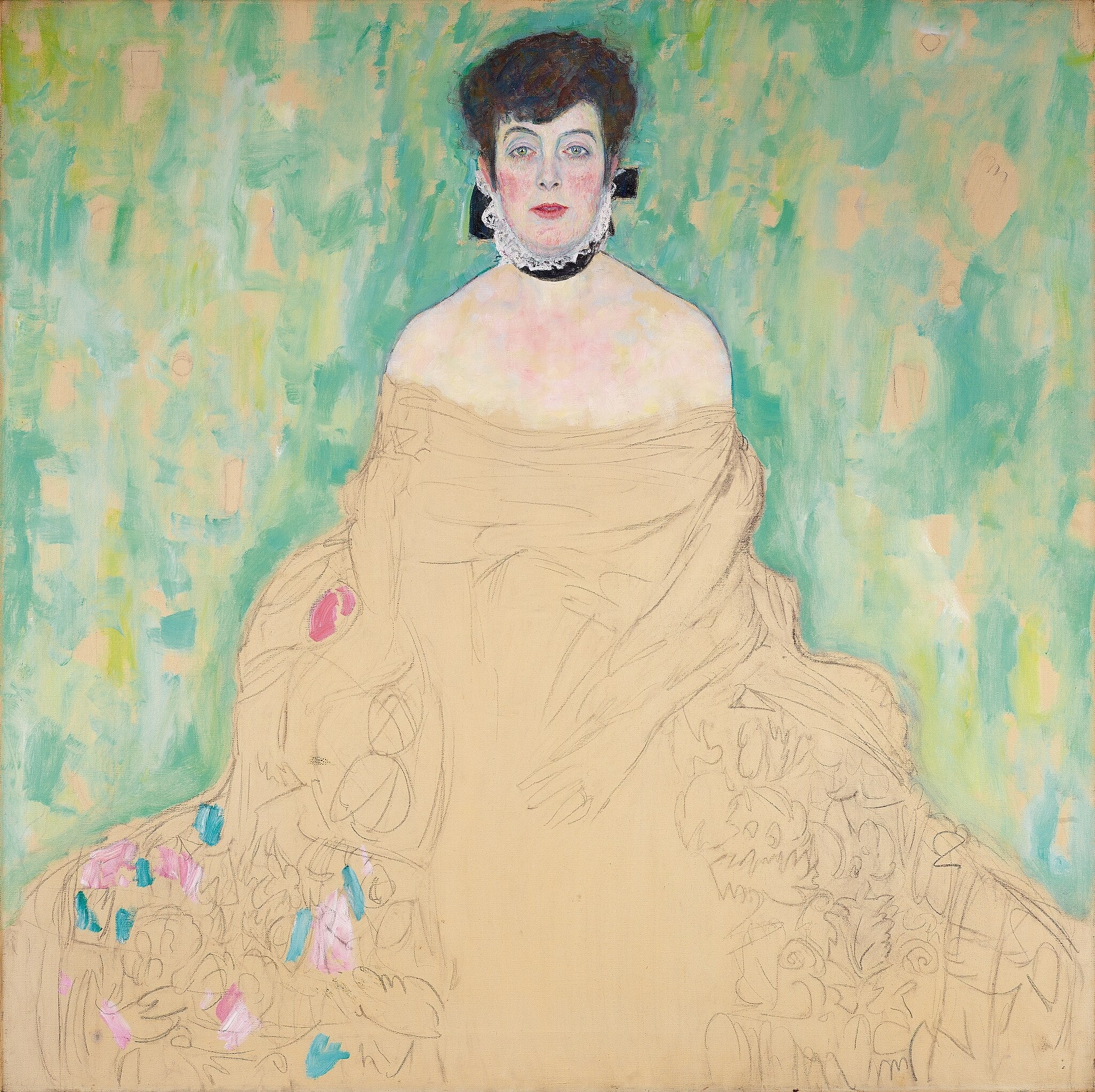
Amalie Zuckerkandl
Gustav Klimt (1917–1918)
Gustav Klimt’s Amalie Zuckerkandl is an <strong>unfinished</strong> late portrait in which a fully realized head and shoulders float above a gown left as <strong>skeletal graphite and washes</strong>. Set against a mottled, cool <strong>green ground</strong>, her flushed face, direct gaze, black <strong>choker</strong> and crisp lace collar stage a drama of poise, sensuality, and restraint <sup>[1]</sup><sup>[6]</sup>. The painting’s incompletion becomes the work’s meaning: a vivid selfhood <strong>emerging</strong> while ornament remains <strong>in potential</strong>.
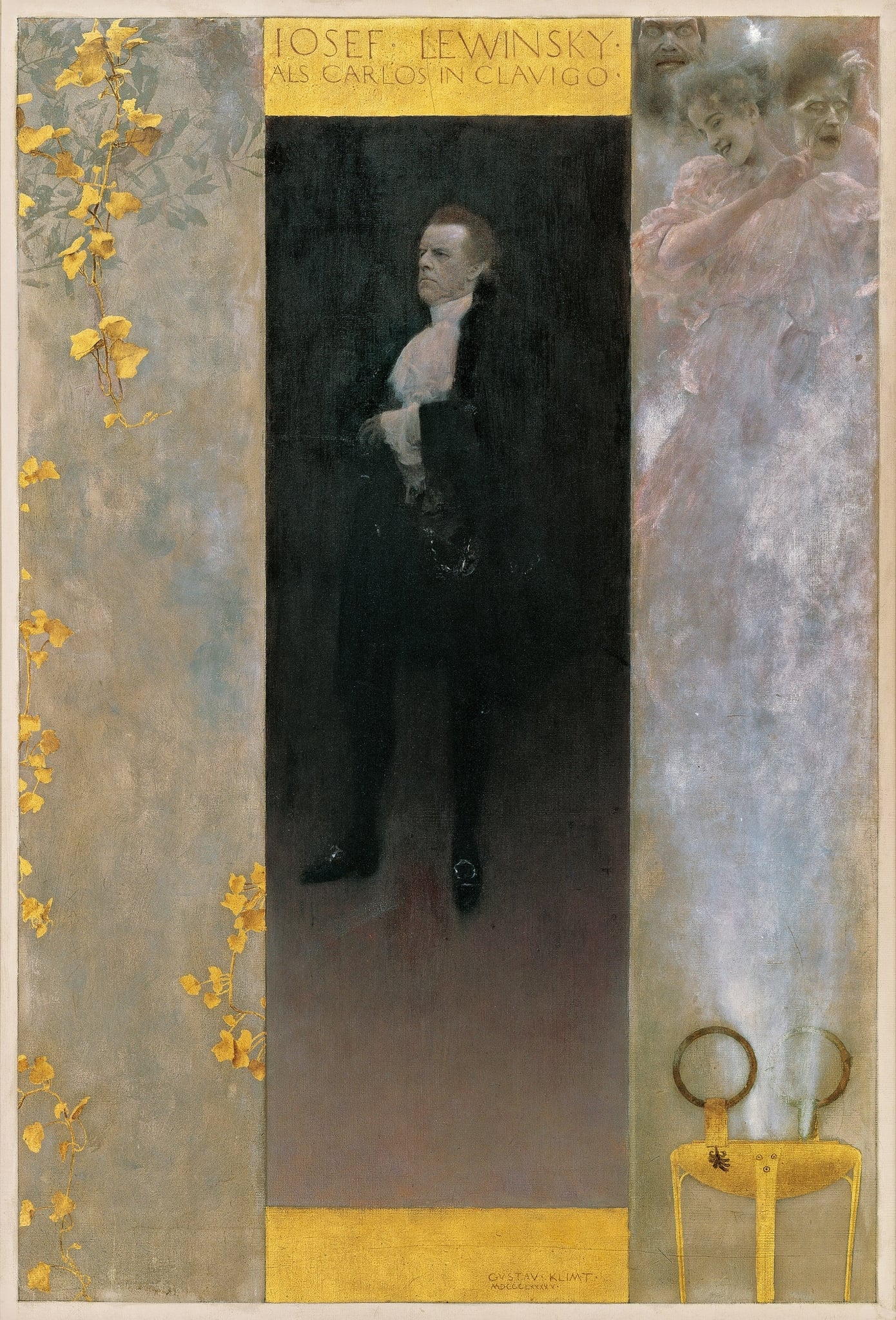
Josef Lewinsky as Carlos in Clavigo
Gustav Klimt (1895)
A stark, triptych-like design turns the actor’s upright silhouette into a test of <strong>will</strong> against a surrounding chorus of <strong>masks</strong>, <strong>laurel/ivy</strong>, and a smoking <strong>antique tripod</strong>. Klimt fuses <strong>portrait</strong> and <strong>allegory</strong> to stage the psychic weather of Goethe’s drama while previewing his turn toward <strong>Symbolism</strong> and ornamental modernity <sup>[1]</sup><sup>[2]</sup>.
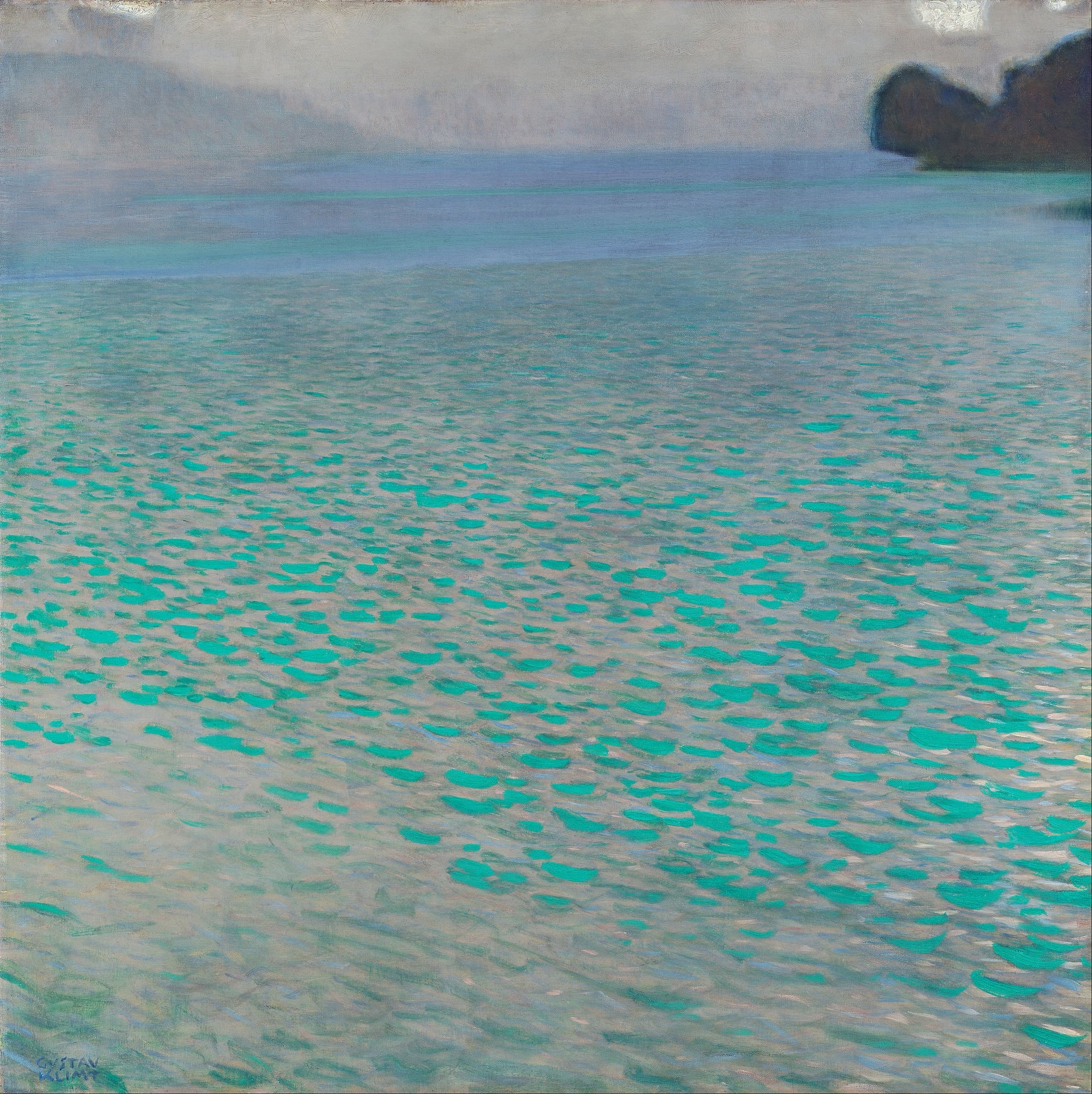
On Lake Attersee
Gustav Klimt (1900)
Gustav Klimt’s On Lake Attersee (1900) turns a summer lake into a <strong>woven field of light</strong>. A square canvas nearly filled with water, it stages a quiet duel between <strong>surface pattern</strong> and <strong>atmospheric depth</strong>, letting a tiny dark headland at the upper right anchor an otherwise hypnotic expanse <sup>[1]</sup><sup>[2]</sup>.
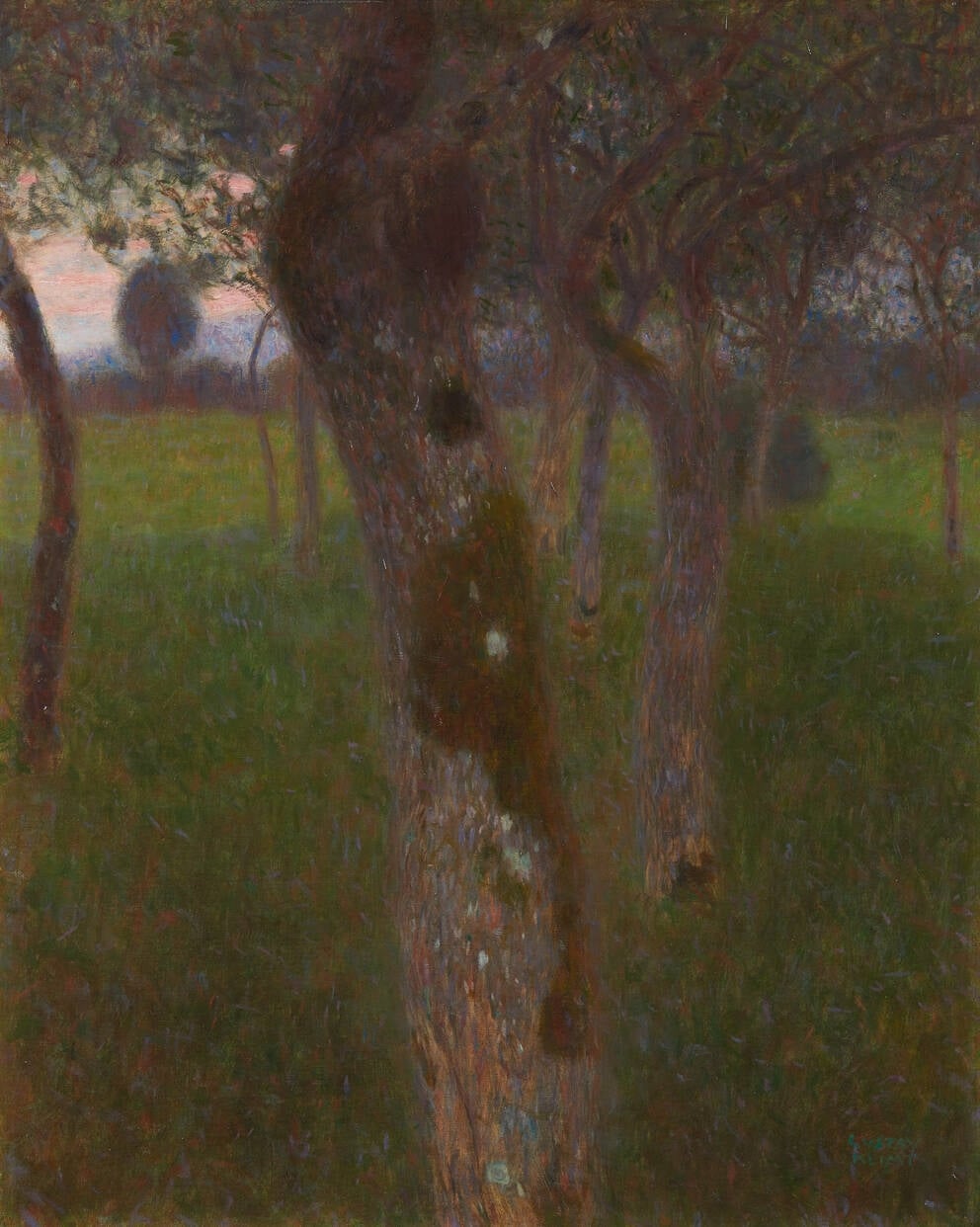
Orchard in the Evening
Gustav Klimt (1898)
Gustav Klimt’s Orchard in the Evening compresses a grove of fruit trees into a shallow, <strong>planar</strong> field where trunks press forward and dusk thins the color. A pale <strong>twilight</strong> band at the high horizon seals the space, turning observed nature into a contemplative, <strong>ornamental</strong> enclosure <sup>[1]</sup><sup>[2]</sup>.
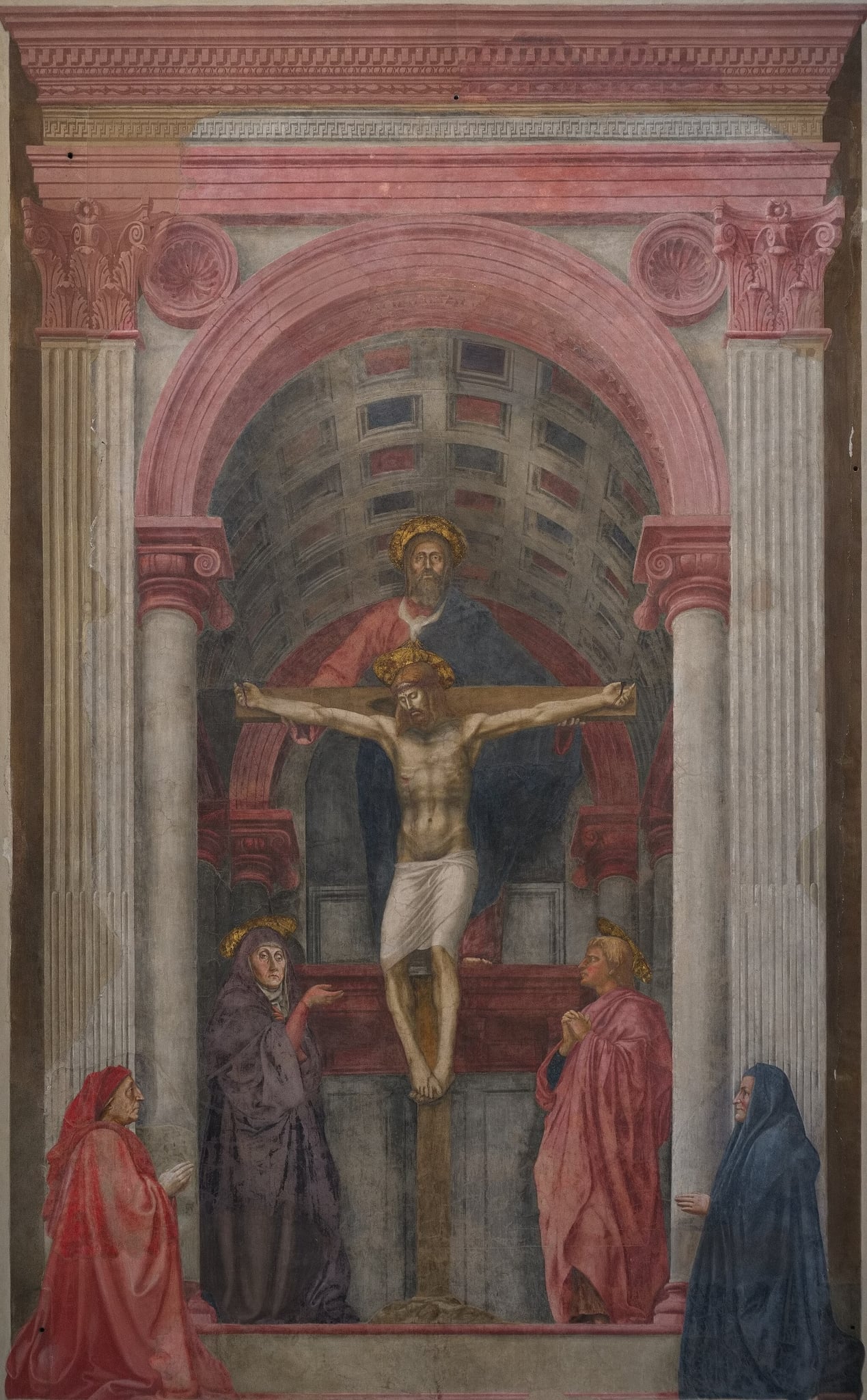
The Holy Trinity
Masaccio (c. 1425–1427)
Masaccio’s The Holy Trinity stages salvation as a rigorously ordered reality: a "Throne of Mercy" Trinity set inside a mathematically precise, coffered barrel vault. With <strong>one‑point perspective</strong>, the fictive chapel opens to the nave, placing kneeling donors at our eye level while Mary presents Christ and John prays in grief <sup>[1]</sup><sup>[2]</sup>.
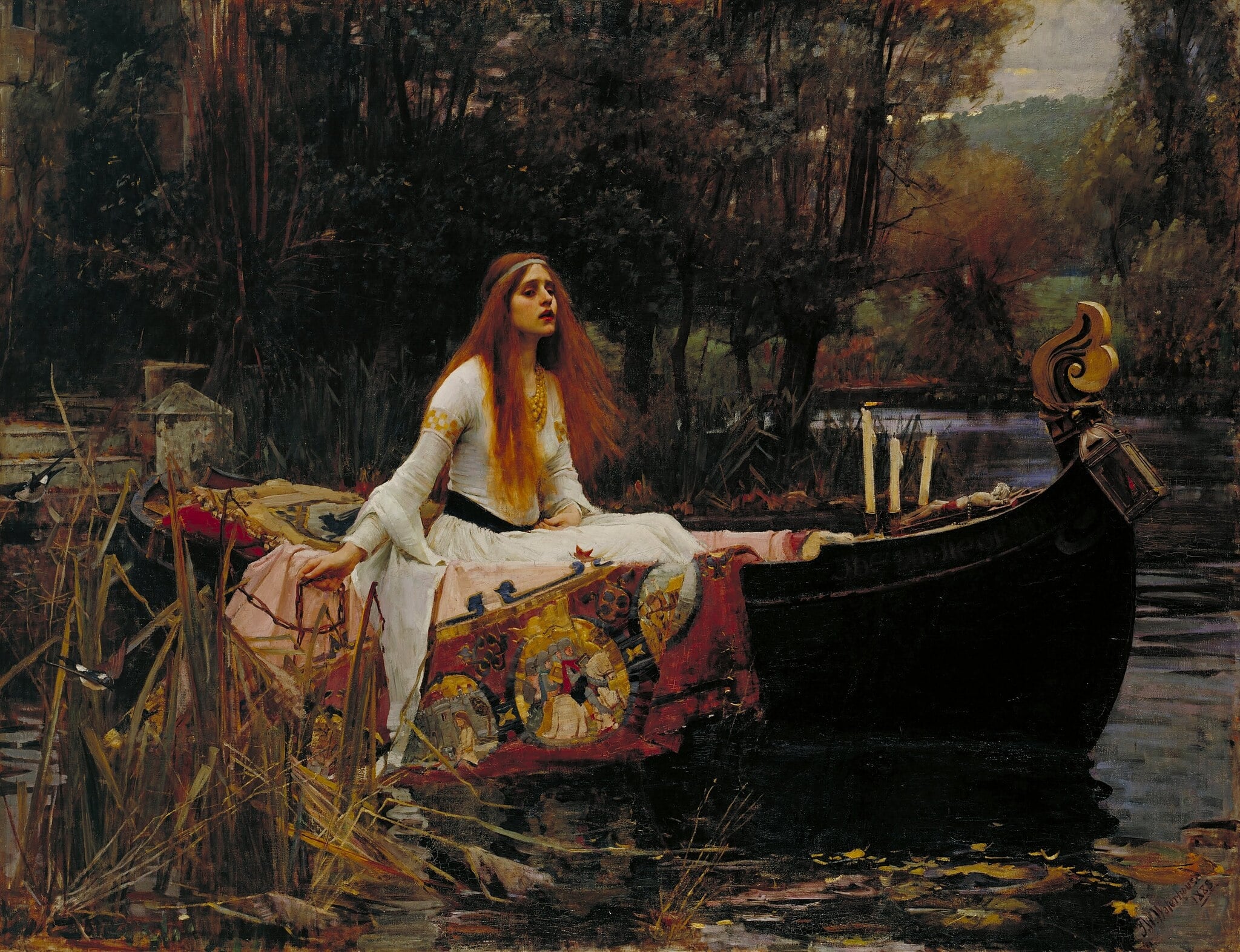
The Lady of Shallot
John William Waterhouse (1888)
John William Waterhouse’s The Lady of Shallot (1888) fixes on the instant the cursed heroine releases her chain and sets her black, coffinlike boat adrift. The extinguished candles, the small crucifix, and the tapestry trailing into the water stage a <strong>funerary voyage</strong> toward Camelot and a choice of <strong>experience over enclosure</strong> <sup>[1]</sup><sup>[2]</sup>.
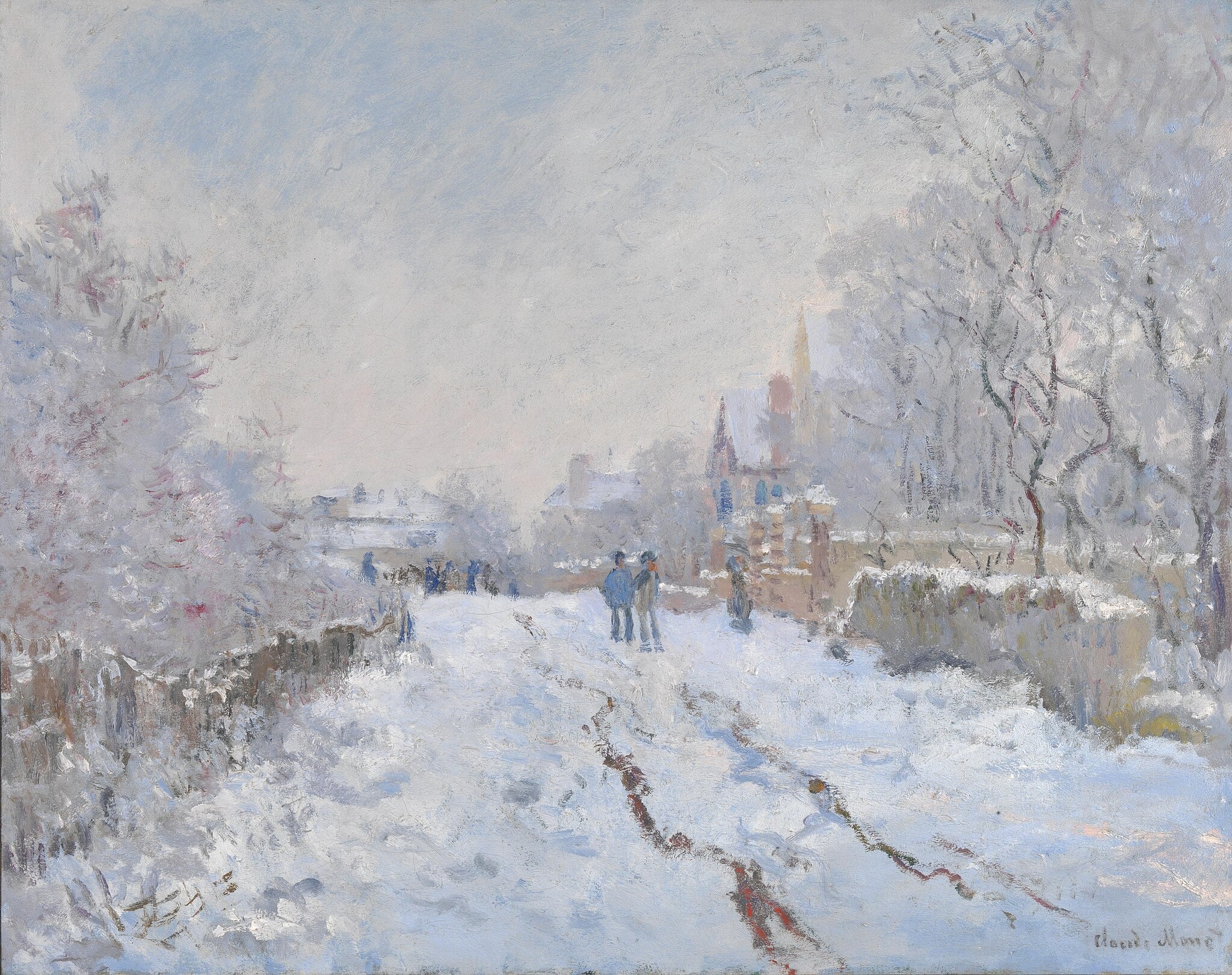
Snow Scene at Argenteuil
Claude Monet (1875)
Claude Monet’s Snow Scene at Argenteuil distills a winter afternoon into a field of shimmering perception, where <strong>air, light, and snow</strong> merge. Russet cart tracks vein the road while <strong>blue‑grey figures</strong> drift toward a misted <strong>church spire</strong>, binding ordinary movement to a larger atmospheric whole.
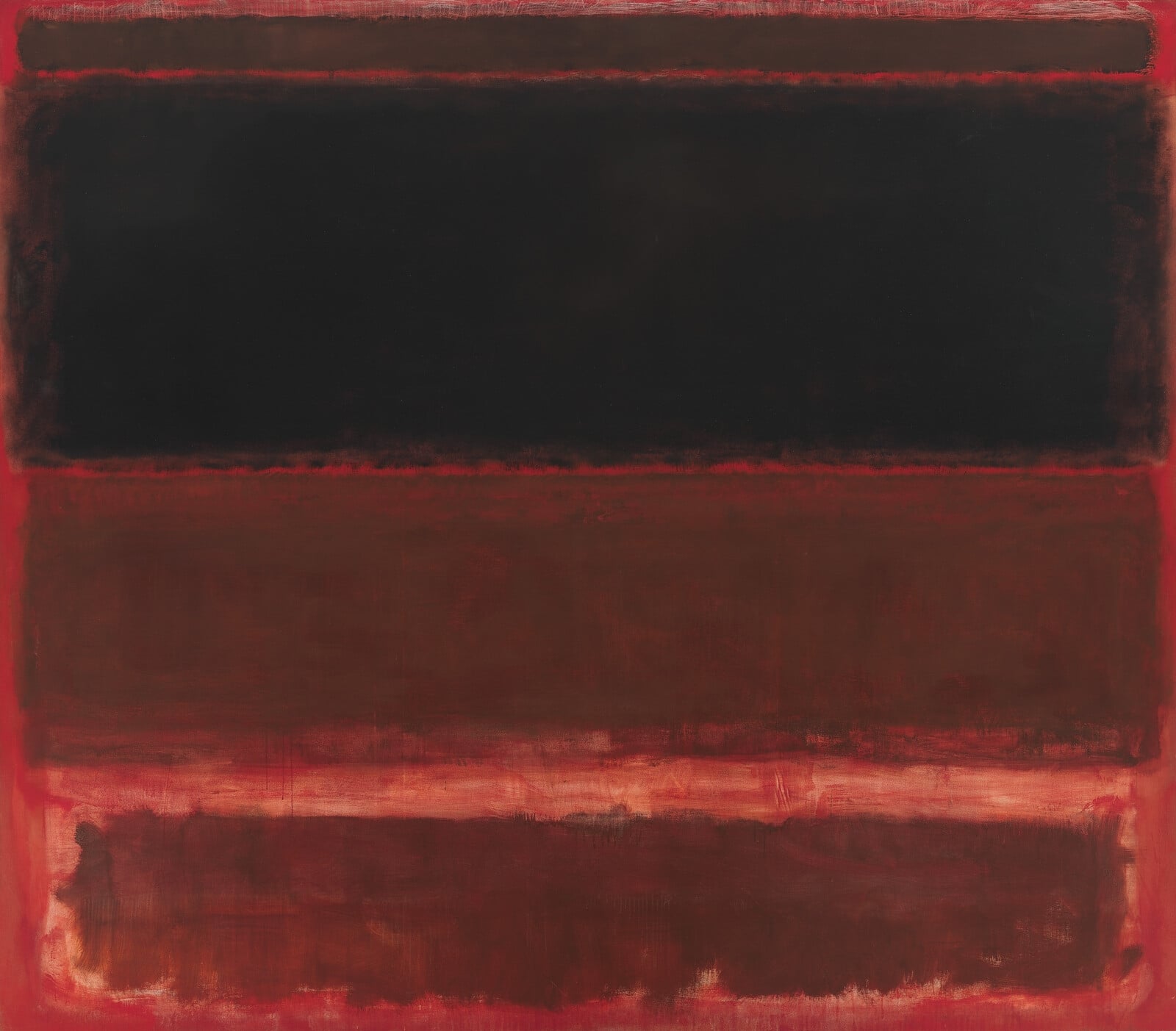
Four Darks in Red
Mark Rothko (1958)
Four Darks in Red stages four hovering bands within a smoldering red field to generate an <strong>immersive, solemn atmosphere</strong>. Thinly layered washes and feathered edges make the dark zones <strong>throb like thresholds</strong>, suspending viewers between weight and glow <sup>[1]</sup><sup>[4]</sup>. Painted in 1958 at monumental scale, it aligns with Rothko’s late‑’50s turn to wine‑dark, enclosing spaces <sup>[1]</sup><sup>[2]</sup>.
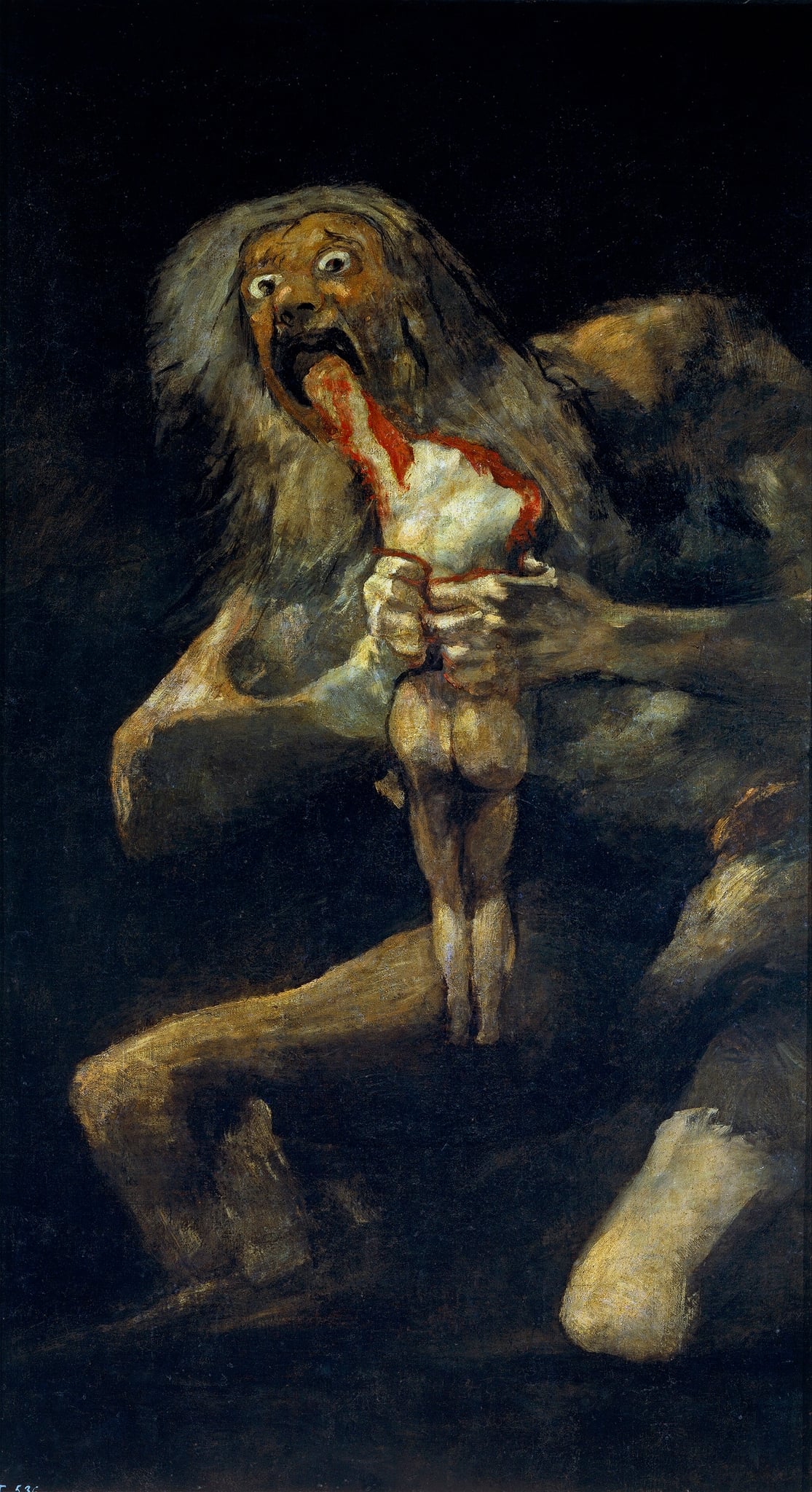
Saturn Devouring His Son
Francisco Goya (1820–1823)
Goya’s Saturn Devouring His Son distills myth into a raw vision of <strong>paranoia, power, and time</strong>: a giant crouches in darkness, eyes blown wide, tearing into a headless body whose blood streaks his hands. Stripped of classical emblems and staged in a near-black void, the scene asserts that fear of dispossession turns paternal authority into <strong>self-consuming violence</strong> <sup>[1]</sup><sup>[4]</sup>.
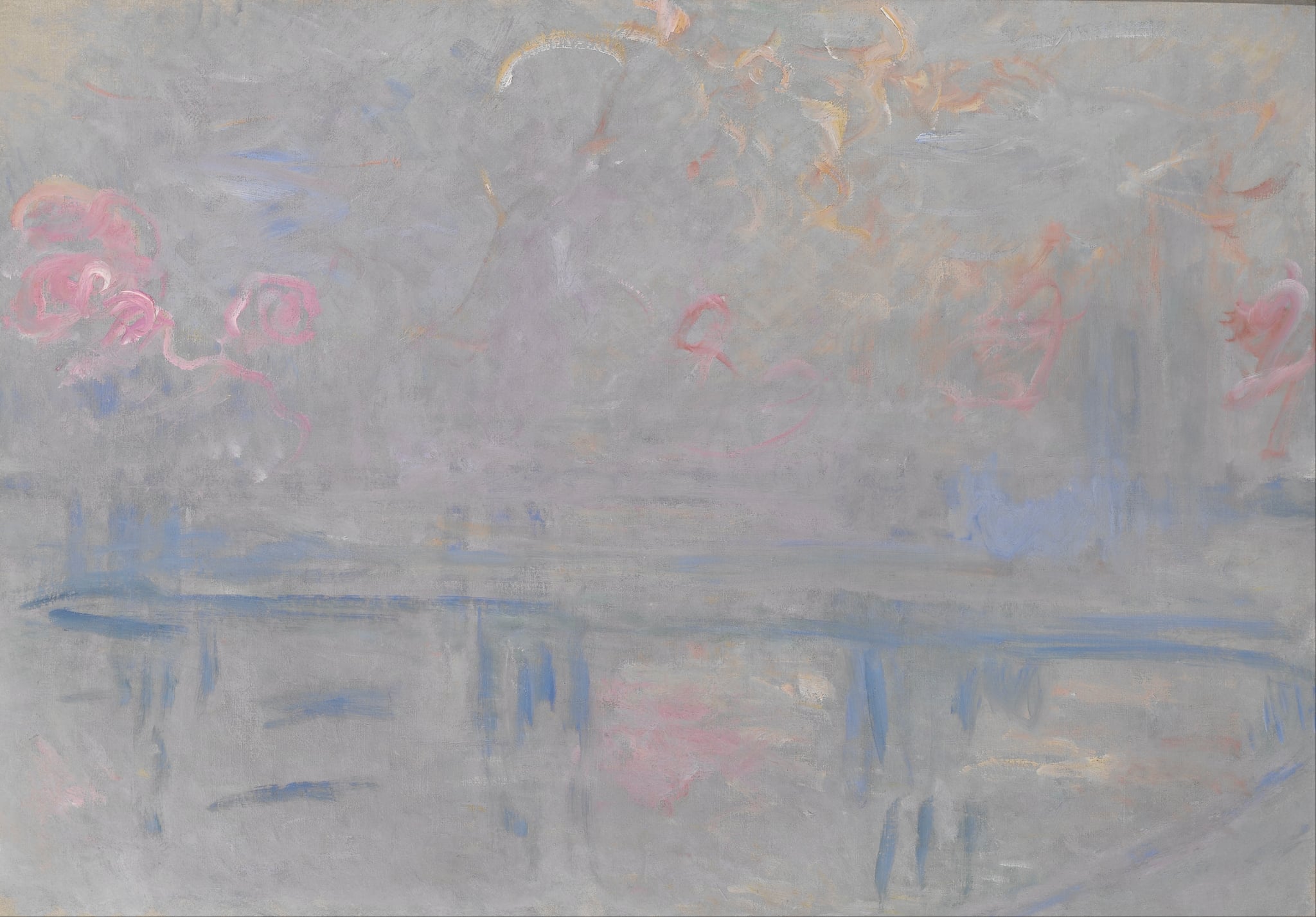
Charing Cross Bridge
Claude Monet (1901)
In Charing Cross Bridge, Claude Monet turns London into <strong>atmosphere</strong> itself: the bridge flattens into a cool, horizontal band while mauves, lavenders, and pearly grays veil the city. Spirals of <strong>pink steam</strong> and pockets of pale <strong>blue</strong> read as trains, lamps, or smoke transfigured by weather, so place becomes <strong>sensation</strong> rather than structure.
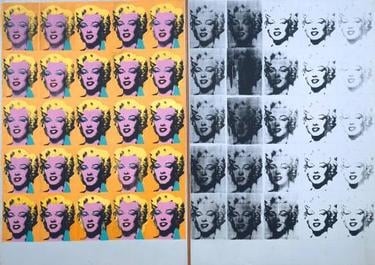
Marilyn Diptych
Andy Warhol (1962)
Marilyn Diptych crystallizes the paradox of fame: <strong>dazzling allure</strong> and <strong>inevitable decay</strong>. Warhol’s 50 repeated silkscreens—color at left, fading grayscale at right—turn a movie-star headshot into a mass-produced <strong>icon</strong> and a memento of mortality <sup>[1]</sup><sup>[2]</sup>.
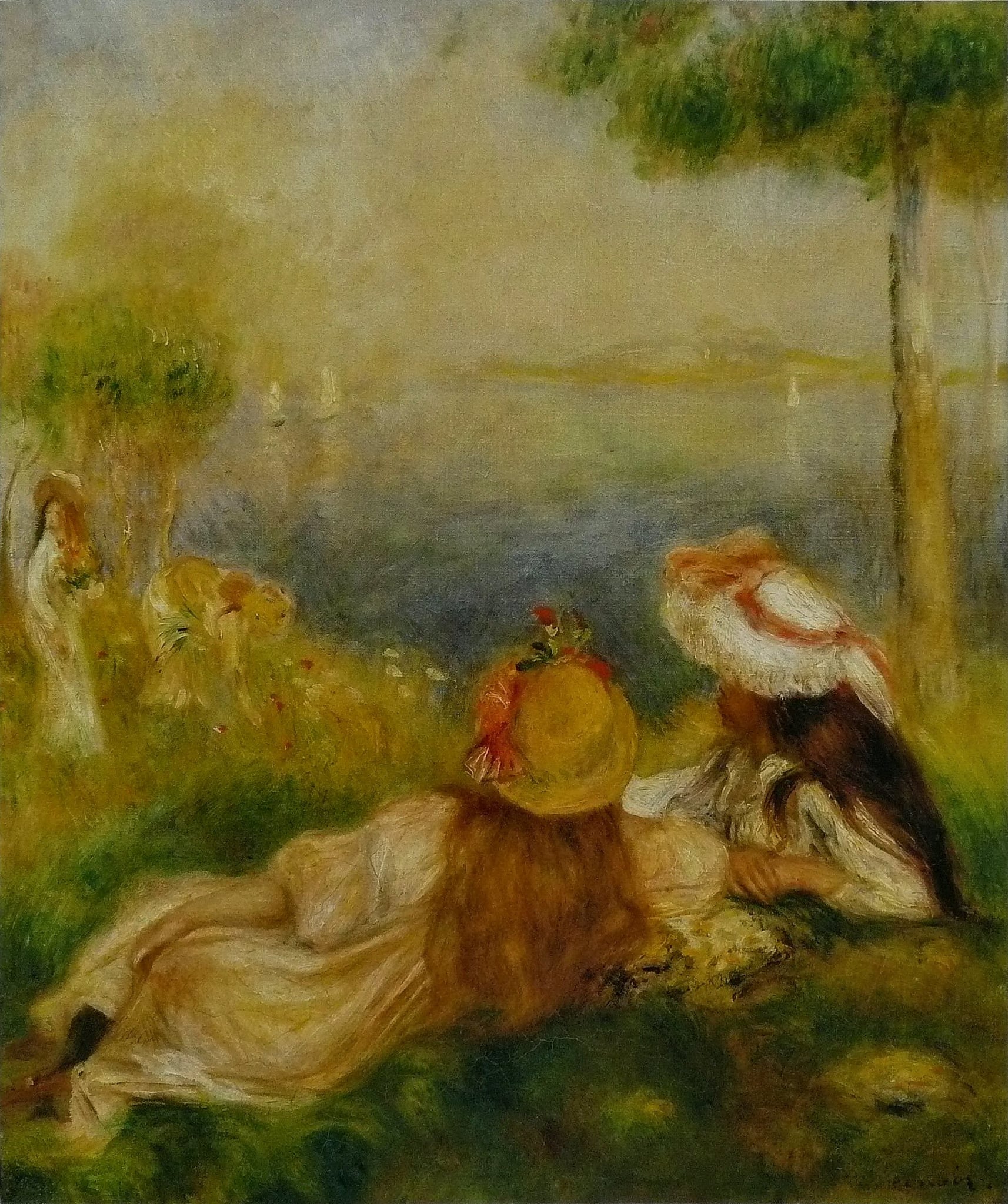
Girls at the Seashore
Pierre-Auguste Renoir (c.1890–1894)
Girls at the Seashore presents two young figures reclining on a grassy bank, their straw hats trimmed with flowers as they look toward a hazy waterway flecked with small sails. Renoir fuses figure and setting through soft, vaporous brushwork so that skin, fabric, foliage, and sea share the same light. The image is an ode to <strong>reverie</strong>, <strong>companionship</strong>, and the <strong>fleeting</strong> warmth of summer.
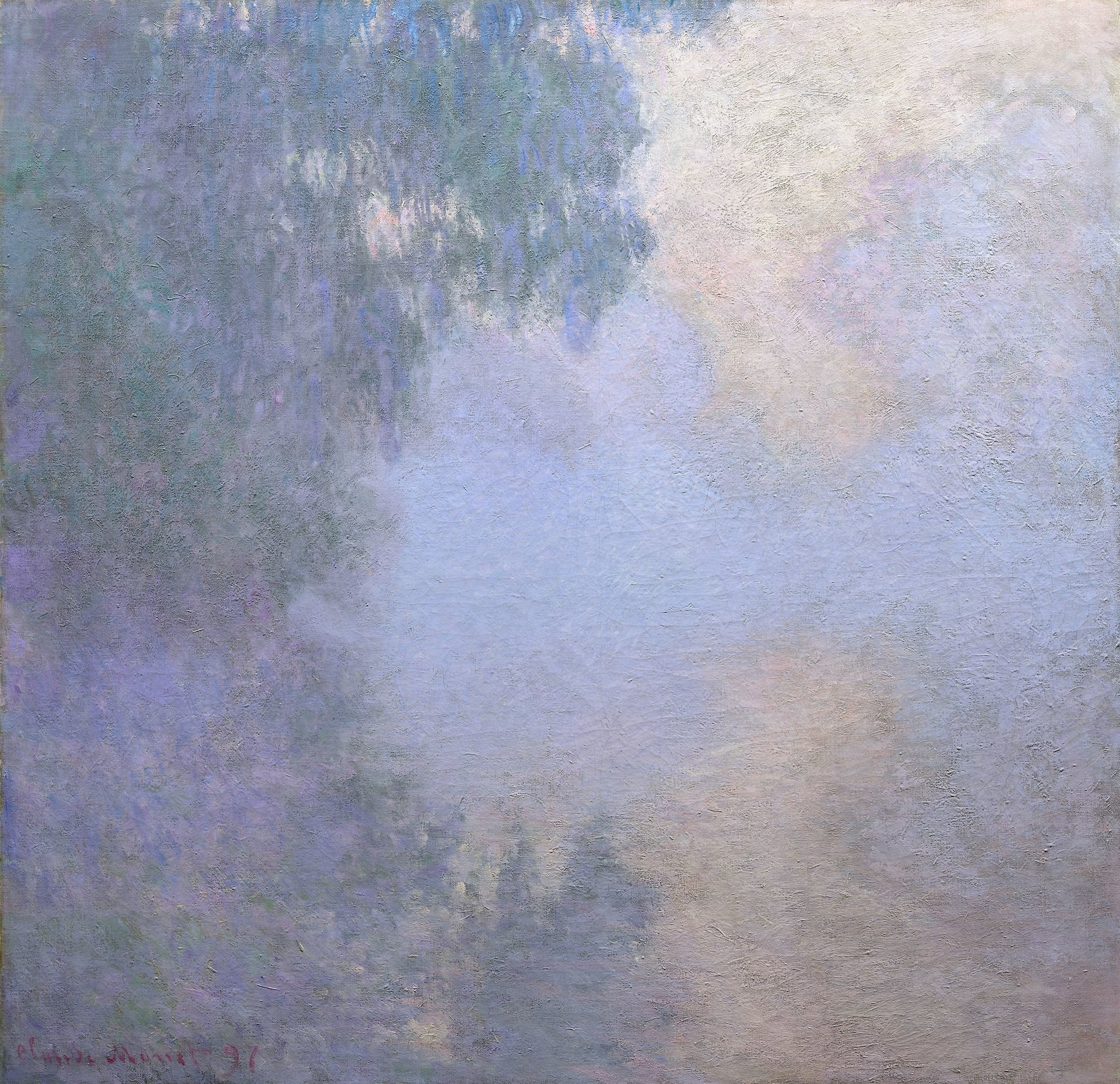
Morning on the Seine (series)
Claude Monet (1897)
Claude Monet’s Morning on the Seine (series) turns dawn into an inquiry about <strong>perception</strong> and <strong>time</strong>. In this canvas, the left bank’s shadowed foliage dissolves into lavender mist while a pale radiance opens at right, fusing sky and water into a single, reflective field <sup>[1]</sup><sup>[2]</sup>.
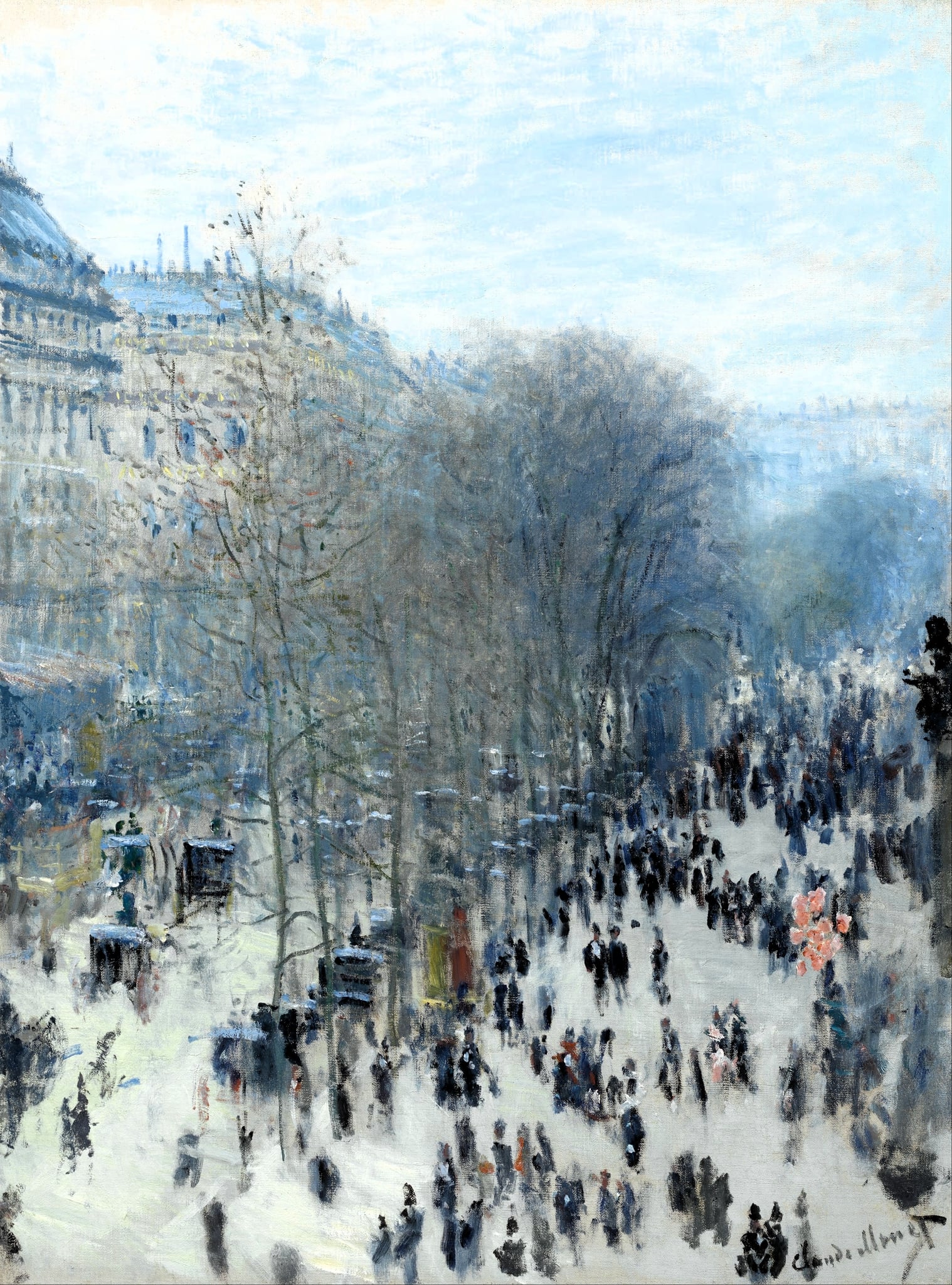
Boulevard des Capucines
Claude Monet (1873–1874)
From a high perch above Paris, Claude Monet turns the Haussmann boulevard into a living current of <strong>light, weather, and motion</strong>. Leafless trees web the view, crowds dissolve into <strong>flickering strokes</strong>, and a sudden <strong>pink cluster of balloons</strong> pierces the cool winter scale <sup>[1]</sup><sup>[2]</sup>.
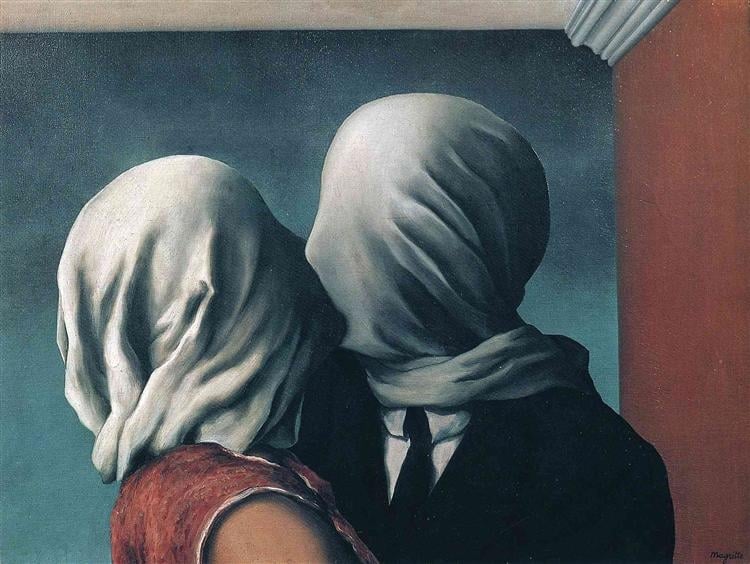
The Lovers
Rene Magritte (1928)
René Magritte’s The Lovers turns a kiss into an emblem of <strong>desire obstructed</strong>: two figures—she in red, he in a dark suit—press together while their heads are swathed in <strong>white cloth</strong>. Within a cool blue‑grey interior bounded by crown molding and a rust-red wall, intimacy becomes an image of <strong>opacity</strong> rather than revelation <sup>[1]</sup>.
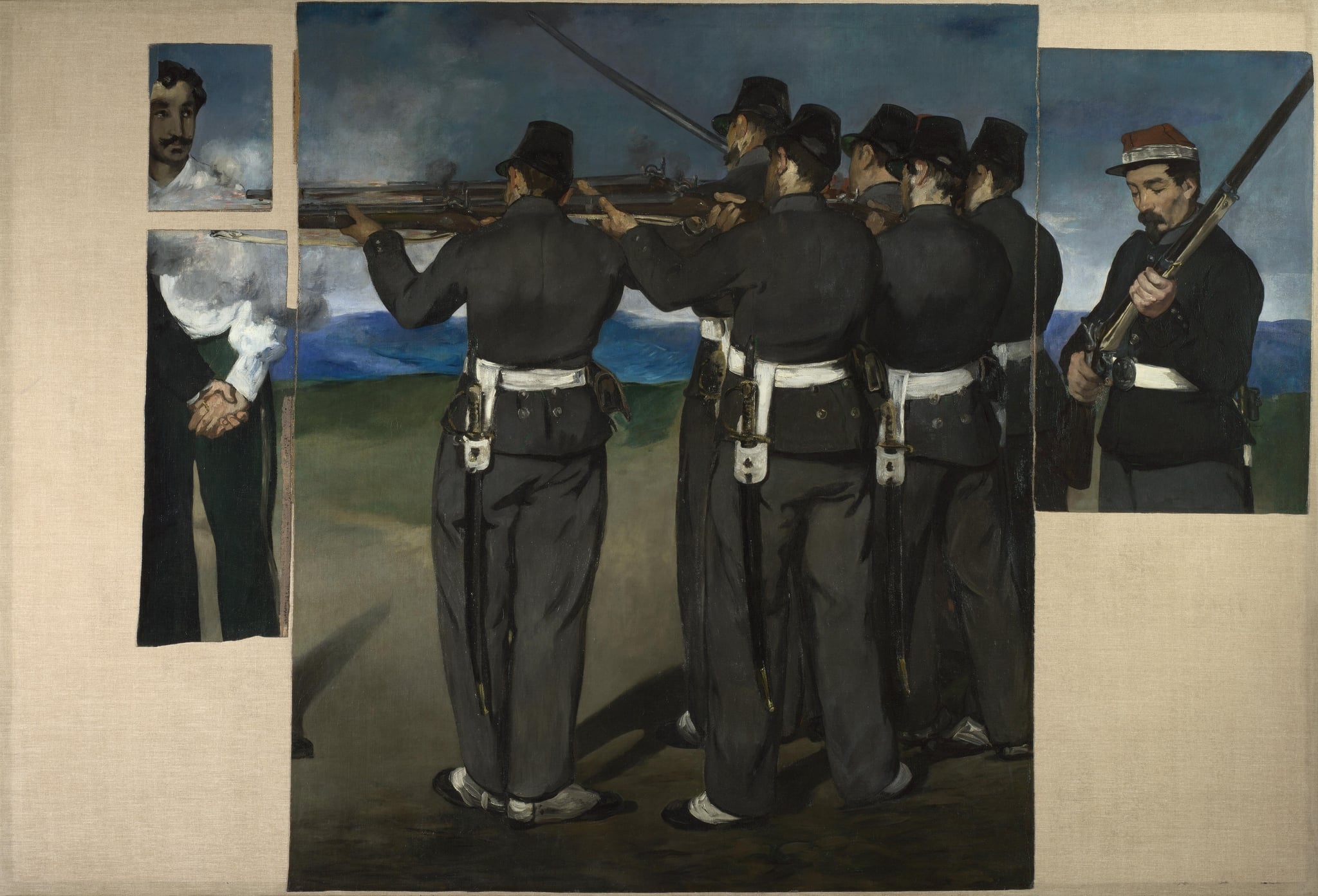
The Execution of Emperor Maximilian
Édouard Manet (1867–1868)
Manet’s The Execution of Emperor Maximilian confronts state violence with a <strong>cool, reportorial</strong> style. The wall of gray-uniformed riflemen, the <strong>fragmented canvas</strong>, and the dispassionate loader at right turn the killing into <strong>impersonal machinery</strong> that implicates the viewer <sup>[1]</sup><sup>[2]</sup>.
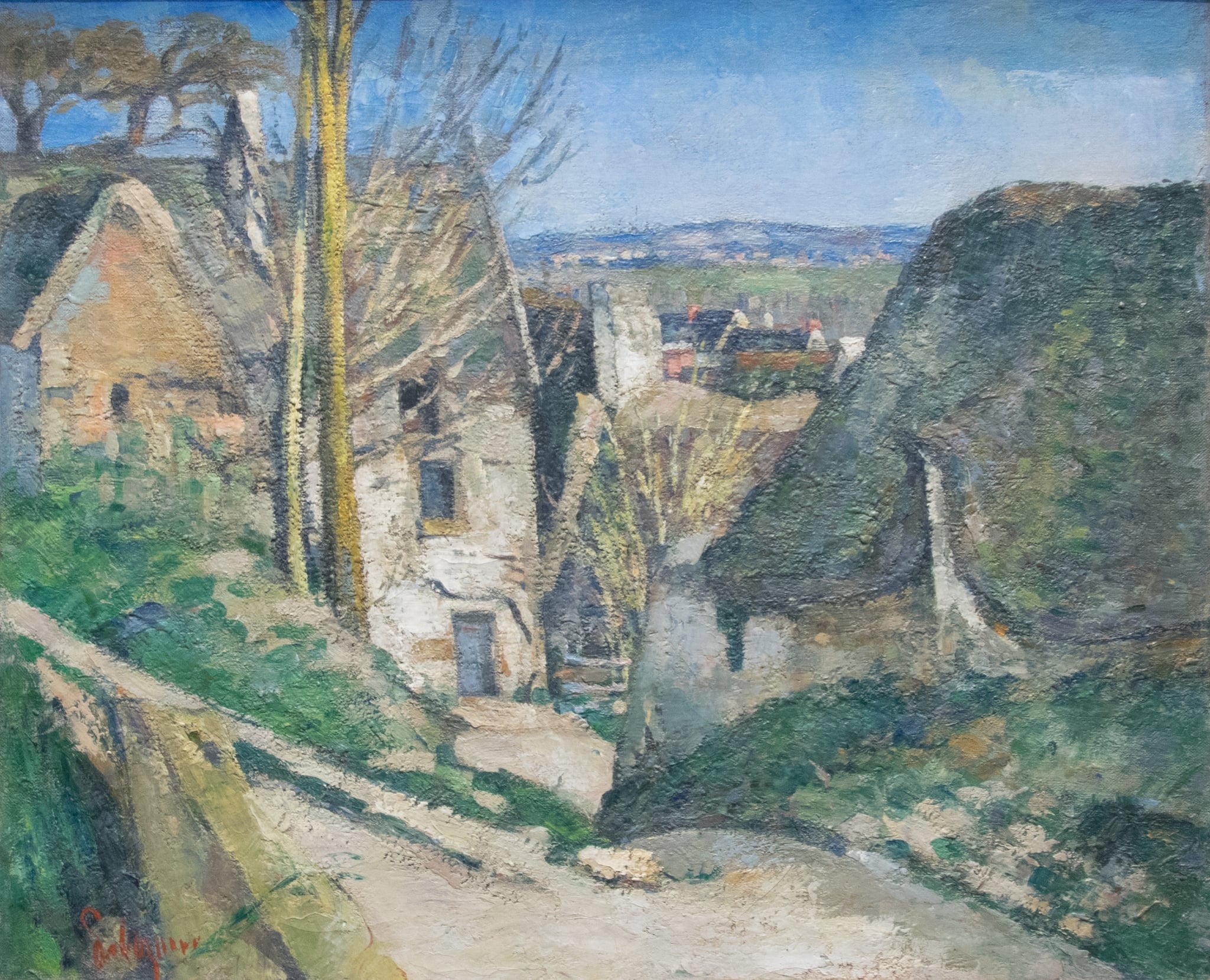
The House of the Hanged Man
Paul Cézanne (1873)
Paul Cézanne’s The House of the Hanged Man turns a modest Auvers-sur-Oise lane into a scene of <strong>engineered unease</strong> and <strong>structural reflection</strong>. Jagged roofs, laddered trees, and a steep path funnel into a narrow, shadowed V that withholds a center, making absence the work’s gravitational force. Cool greens and slate blues, set in blocky, masoned strokes, build a world that feels both solid and precarious.
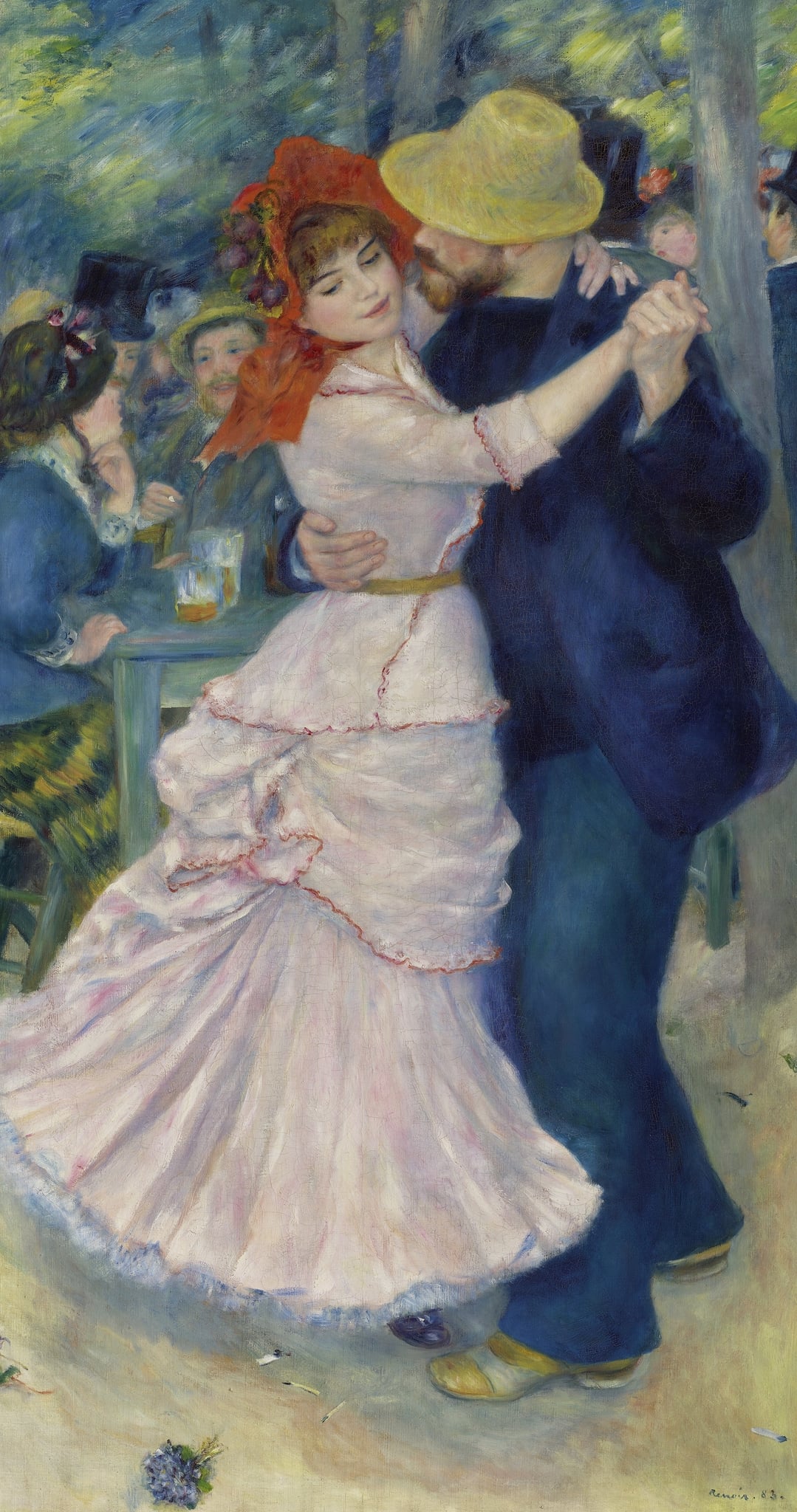
Dance at Bougival
Pierre-Auguste Renoir (1883)
In Dance at Bougival, Pierre-Auguste Renoir turns a crowded suburban dance into a <strong>private vortex of intimacy</strong>. Rose against ultramarine, skin against shade, and a flare of the woman’s <strong>scarlet bonnet</strong> concentrate the scene’s energy into a single turning moment—modern leisure made palpable as <strong>touch, motion, and light</strong> <sup>[1]</sup><sup>[2]</sup>.
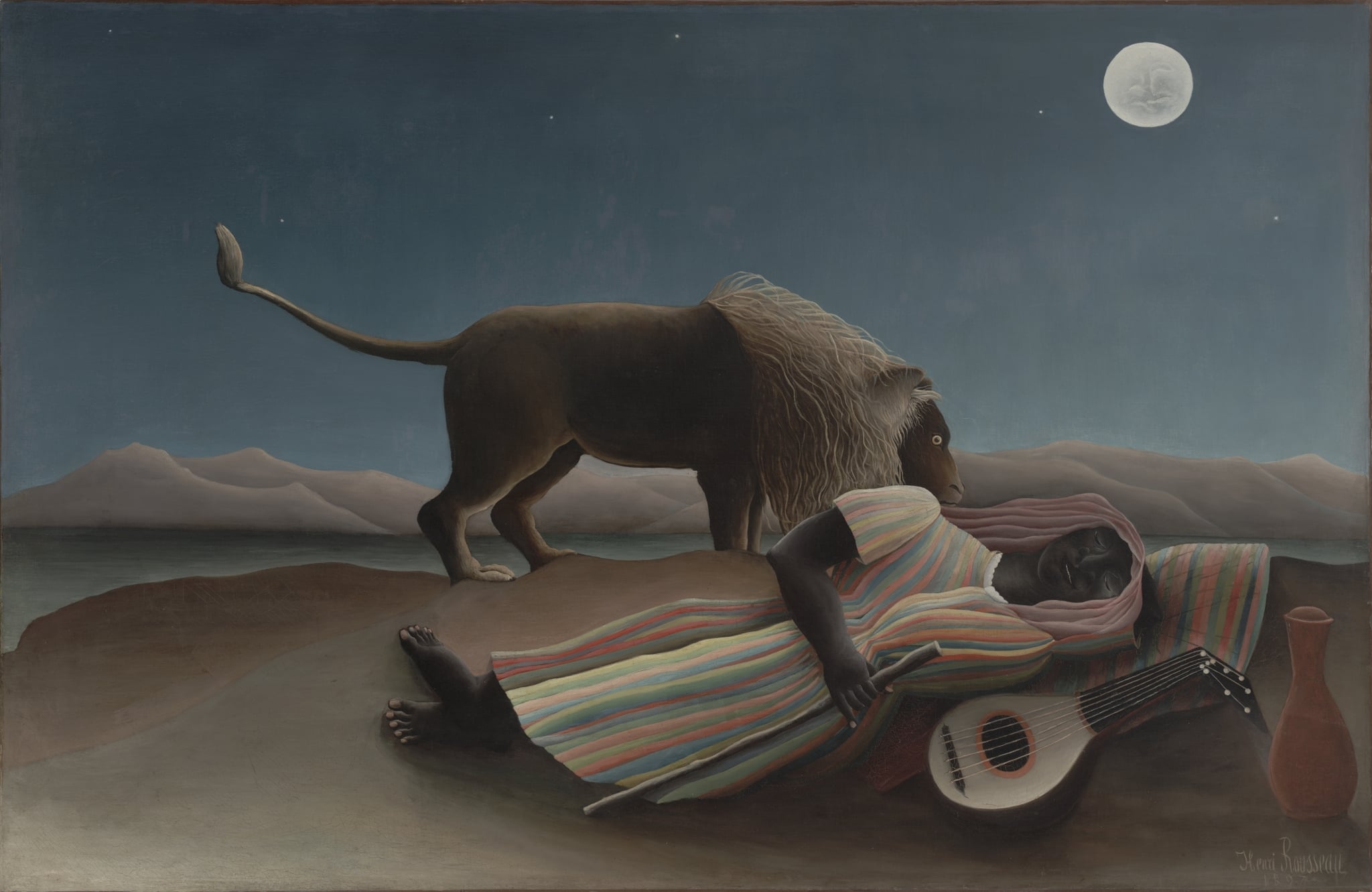
The Sleeping Gypsy
Henri Rousseau (1897)
Under a cold moon, a traveler sleeps in a striped robe as a lion pauses to sniff, not strike—an image of <strong>danger held in suspension</strong> and <strong>imagination as protection</strong>. Rousseau’s polished surfaces, flattened distance, and toy-like clarity turn the desert into a <strong>dream stage</strong> where art (the mandolin) and life (the water jar) keep silent vigil <sup>[1]</sup><sup>[2]</sup>.
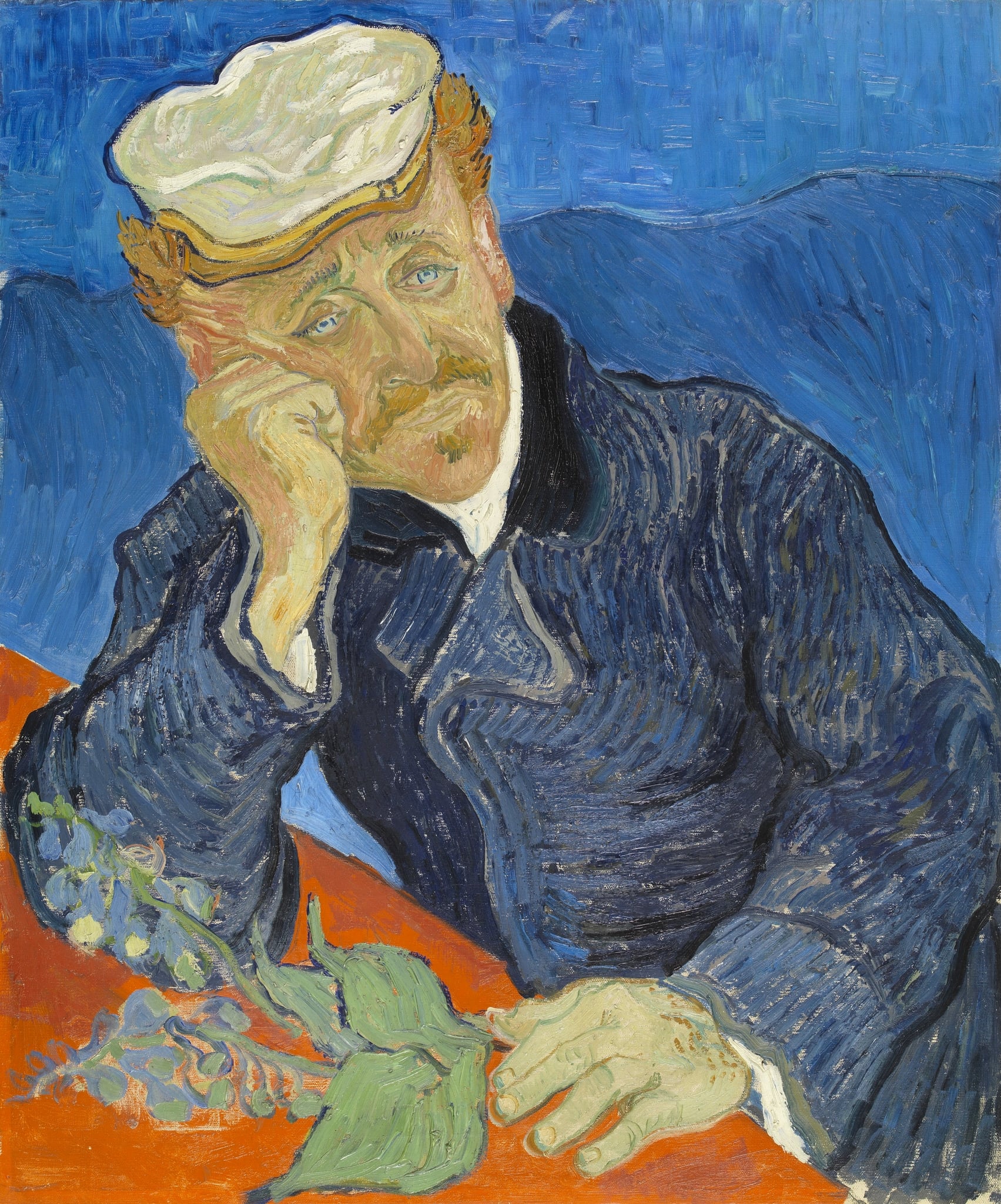
Portrait of Dr. Gachet
Vincent van Gogh (1890)
Portrait of Dr. Gachet distills Van Gogh’s late ambition for a <strong>modern, psychological portrait</strong> into vibrating color and touch. The sitter’s head sinks into a greenish hand above a <strong>blazing orange-red table</strong>, foxglove sprig nearby, while waves of <strong>cobalt and ultramarine</strong> churn through coat and background. The chromatic clash turns a quiet pose into an <strong>empathic image of fragility and care</strong> <sup>[1]</sup><sup>[2]</sup>.
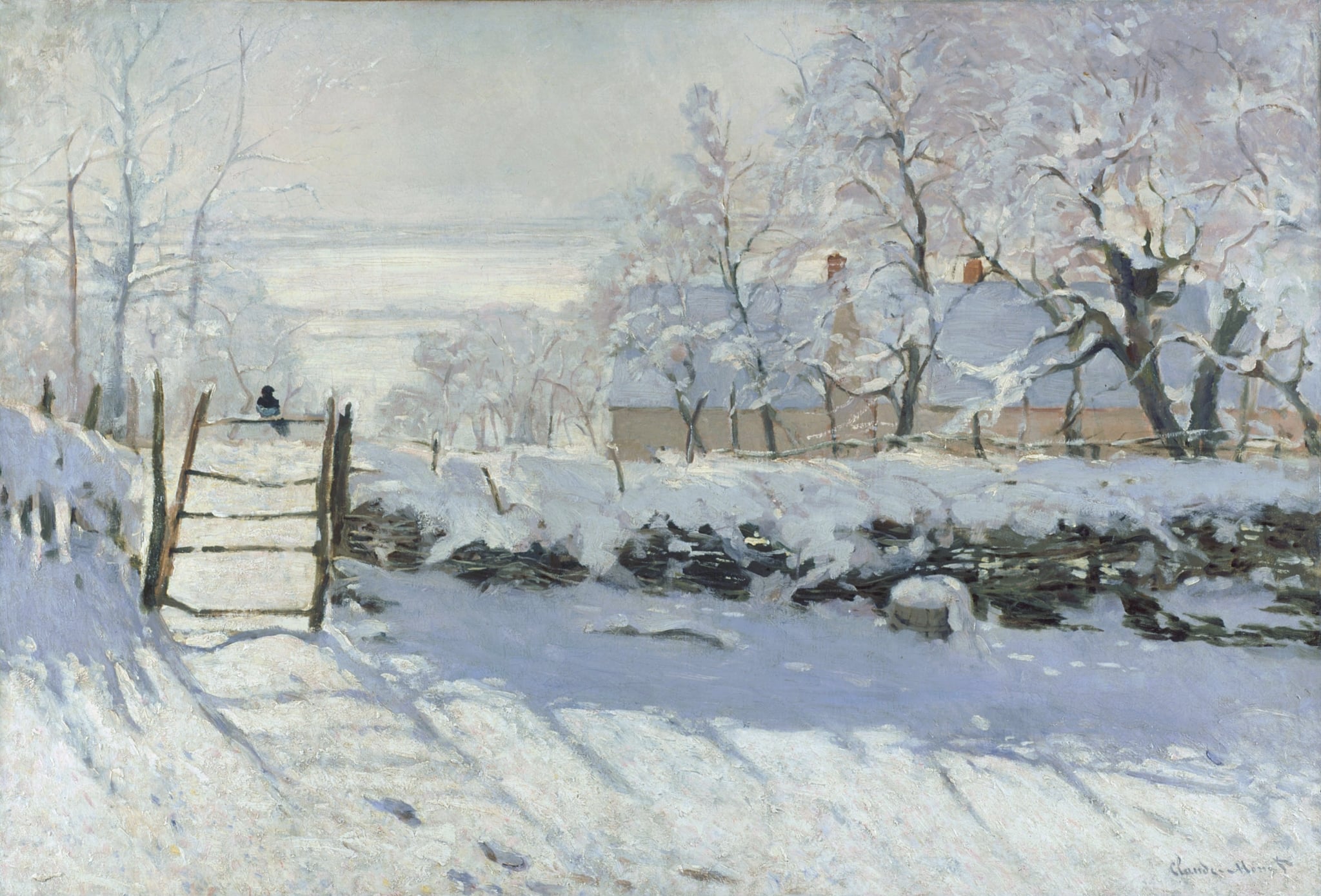
The Magpie
Claude Monet (1868–1869)
Claude Monet’s The Magpie turns a winter field into a study of <strong>luminous perception</strong>, where blue-violet shadows articulate snow’s light. A lone <strong>magpie</strong> perched on a wooden gate punctuates the silence, anchoring a scene that balances homestead and open countryside <sup>[1]</sup>.
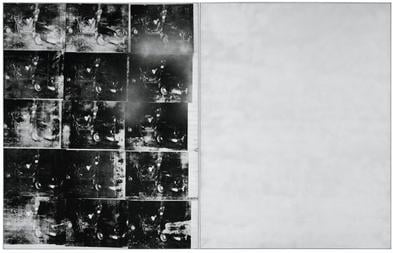
Silver Car Crash (Double Disaster)
Andy Warhol (1963)
Silver Car Crash (Double Disaster) pairs a grid of uneven, black‑and‑white silkscreened crash images with a vast, nearly blank field of metallic silver, staging a battle between <strong>relentless spectacle</strong> and <strong>mute void</strong>. Warhol’s industrial repetition converts tragedy into a consumable pattern while the reflective panel withholds detail, forcing viewers to face the limits of representation and the cold afterglow of modern media <sup>[1]</sup><sup>[2]</sup>.
![Triple Elvis [Ferus Type] by Andy Warhol](/_next/image?url=https%3A%2F%2Fstorage.googleapis.com%2Fsite-images-programmatic%2Fpaintings%2F1771915343451-6gzg8m.jpg&w=3840&q=85&dpl=dpl_ASiQPiqukSad84i91Tcm2dUShHhL)
Triple Elvis [Ferus Type]
Andy Warhol (1963)
In Triple Elvis [Ferus Type] (1963), Andy Warhol multiplies a gunslinging movie idol across a cool, metallic field, turning a singular persona into a <strong>serial commodity</strong>. The sharply printed figure at center flanked by fading, <strong>ghosted</strong> doubles collapses still image, filmic motion, and mass reproduction into one charged surface <sup>[1]</sup><sup>[2]</sup>.
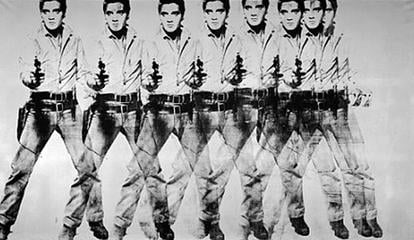
Eight Elvises
Andy Warhol (1963)
A sweeping frieze of eight overlapping, gun‑drawn cowboys marches across a silver field, their forms slipping and ghosting as if frames of a film. Warhol converts a singular star into a <strong>serial commodity</strong>, where <strong>mechanical misregistration</strong> and life‑size scale turn bravado into spectacle <sup>[1]</sup><sup>[2]</sup>.
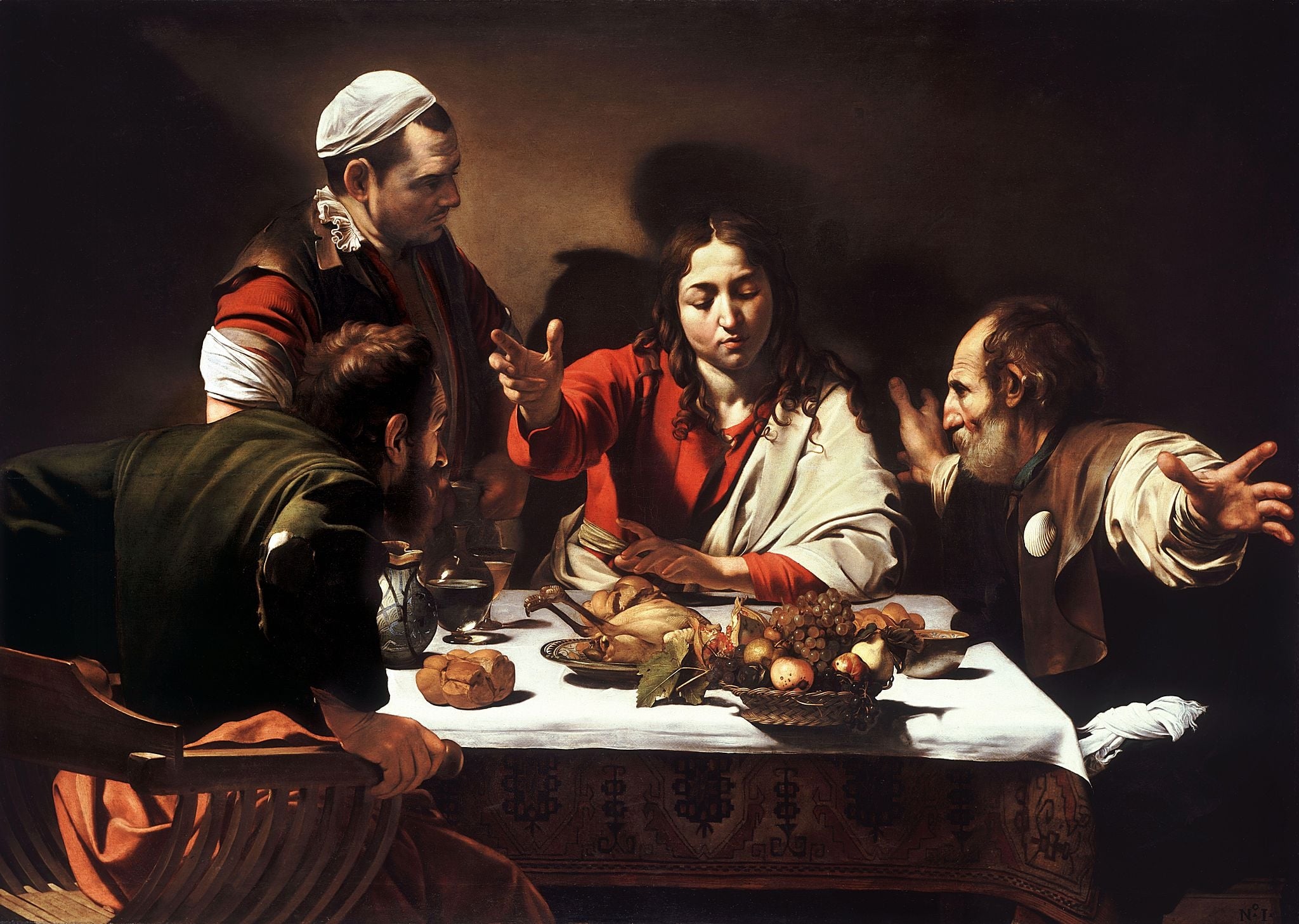
The Supper at Emmaus
Caravaggio (1601)
Caravaggio’s The Supper at Emmaus captures the split-second when two disciples recognize Christ in the <strong>breaking of bread</strong>. A raking light isolates Christ’s calm blessing while the disciples erupt—one surging forward with a torn sleeve, the other flinging his arms wide—so the shock of revelation reads as bodily fact. The teetering <strong>basket of fruit</strong> and Eucharistic table amplify themes of abundance and fragility <sup>[1]</sup><sup>[4]</sup>.
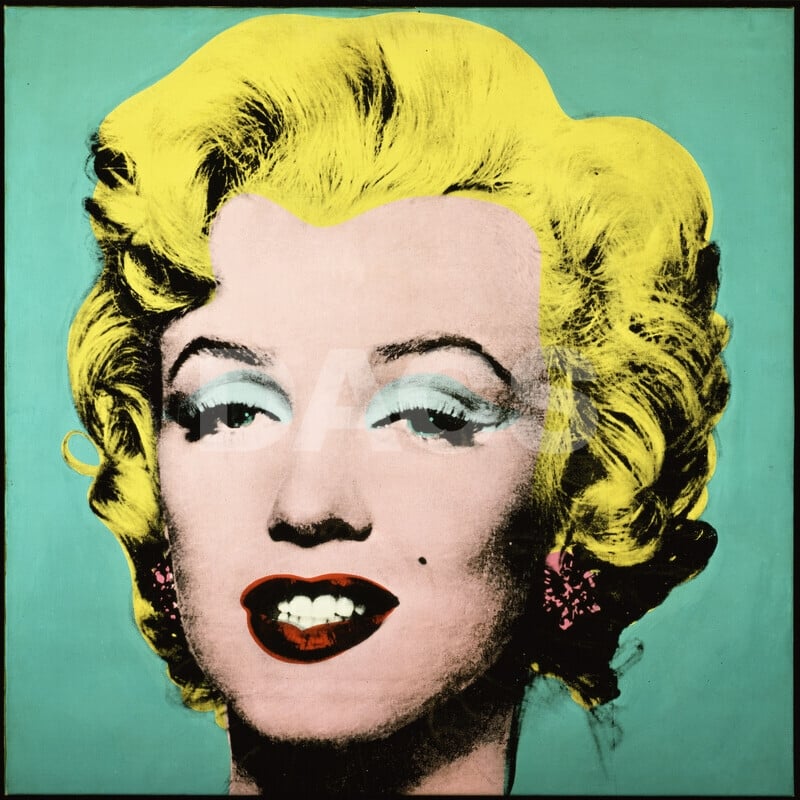
Turquoise Marilyn
Andy Warhol (1964)
In Turquoise Marilyn, Andy Warhol converts a movie star’s face into a <strong>modern icon</strong>: a tightly cropped head floating in a flat <strong>turquoise</strong> field, its <strong>acidic yellow hair</strong>, turquoise eye shadow, and <strong>lipstick-red</strong> mouth stamped by silkscreen’s mechanical bite. The slight <strong>misregistration</strong> around eyes and hair produces a halo-like tremor, fusing <strong>glamour and ghostliness</strong> to expose celebrity as a manufactured surface <sup>[1]</sup><sup>[2]</sup>.

Sixty Last Suppers
Andy Warhol (1986)
Andy Warhol’s Sixty Last Suppers multiplies Leonardo’s scene into a vast grid, turning a singular sacred image into <strong>serial</strong> signage. From afar it reads as an architectural surface; up close, silkscreen <strong>variations</strong>—blurs, darker panels, dropped ink—reassert the human trace <sup>[1]</sup><sup>[2]</sup>.
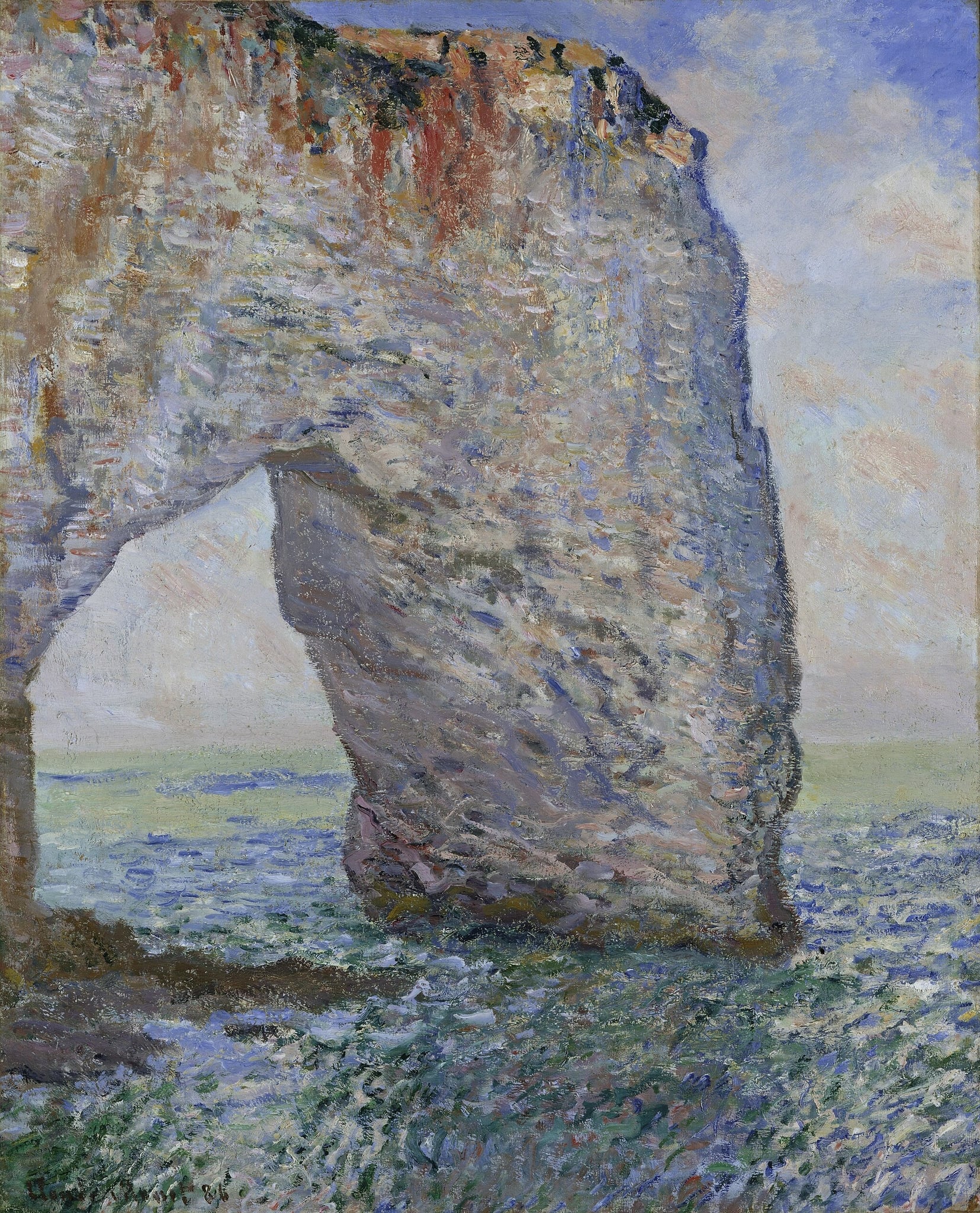
The Manneporte near Étretat
Claude Monet (1886)
Monet’s The Manneporte near Étretat turns the colossal sea arch into a <strong>threshold of light</strong>: rock, sea, and air interlock as shifting color rather than fixed form. Dense lilac–ochre strokes make the cliff feel massive yet <strong>dematerialized</strong> by illumination, while the arch’s opening stages a quiet, glimmering horizon <sup>[1]</sup><sup>[2]</sup>.
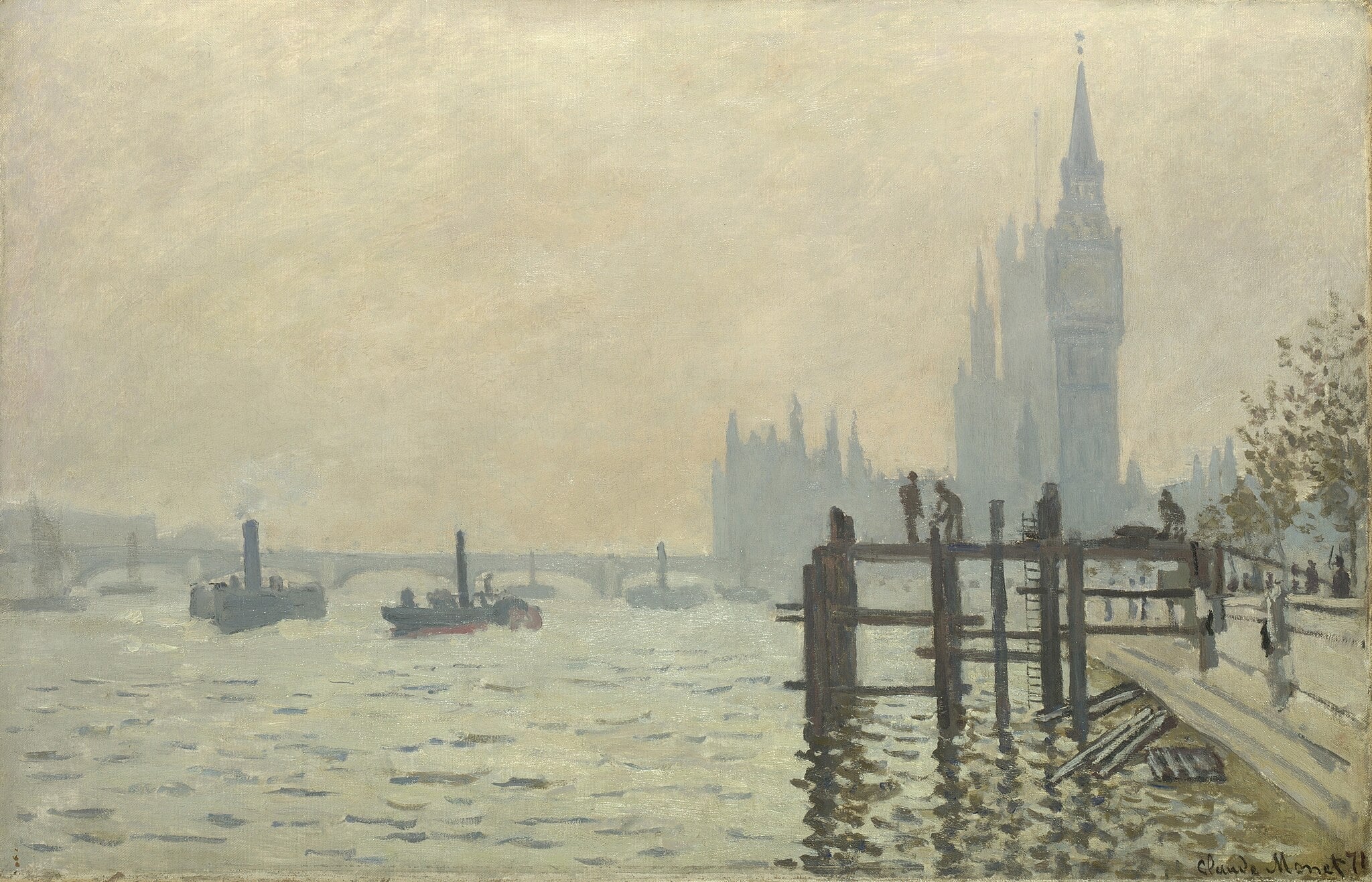
The Thames below Westminster
Claude Monet (about 1871)
Claude Monet’s The Thames below Westminster turns London into <strong>light-made architecture</strong>, where Parliament’s mass dissolves into mist and the river shivers with <strong>industrial motion</strong>. Tugboats, a timber jetty with workers, and the rebuilt Westminster Bridge assert a modern city whose power is felt through atmosphere more than outline <sup>[1]</sup>.
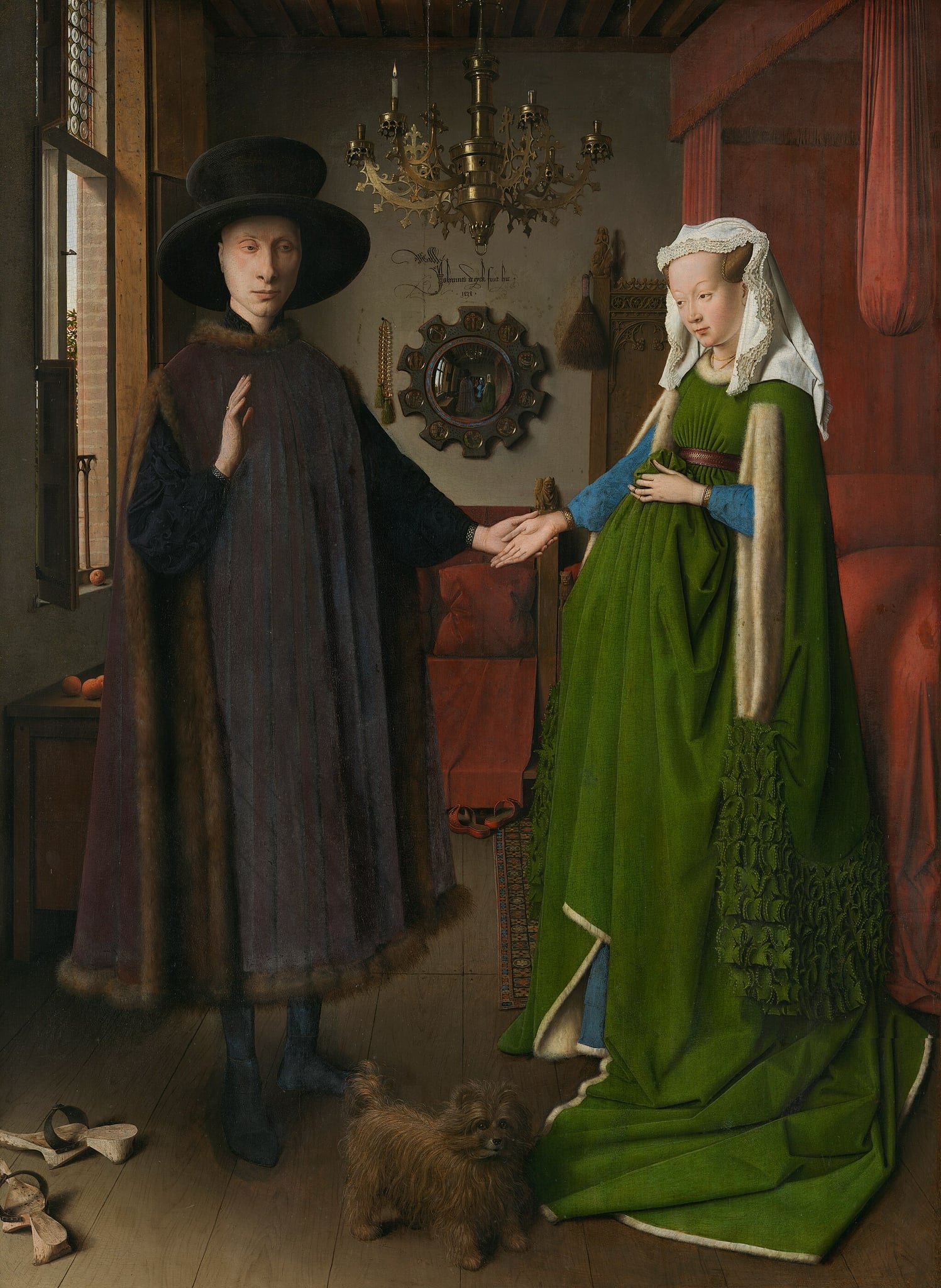
The Arnolfini Portrait
Jan van Eyck (1434)
In The Arnolfini Portrait, Jan van Eyck stages a poised encounter between a richly dressed couple whose joined hands, a single burning candle, and a convex mirror transform a domestic interior into a scene of <strong>status and sanctity</strong>. The painting asserts the artist’s own <strong>presence</strong>—"Johannes de eyck fuit hic 1434"—as if to validate the moment while showcasing oil painting’s power to make belief tangible through light, texture, and reflection <sup>[1]</sup><sup>[2]</sup>.
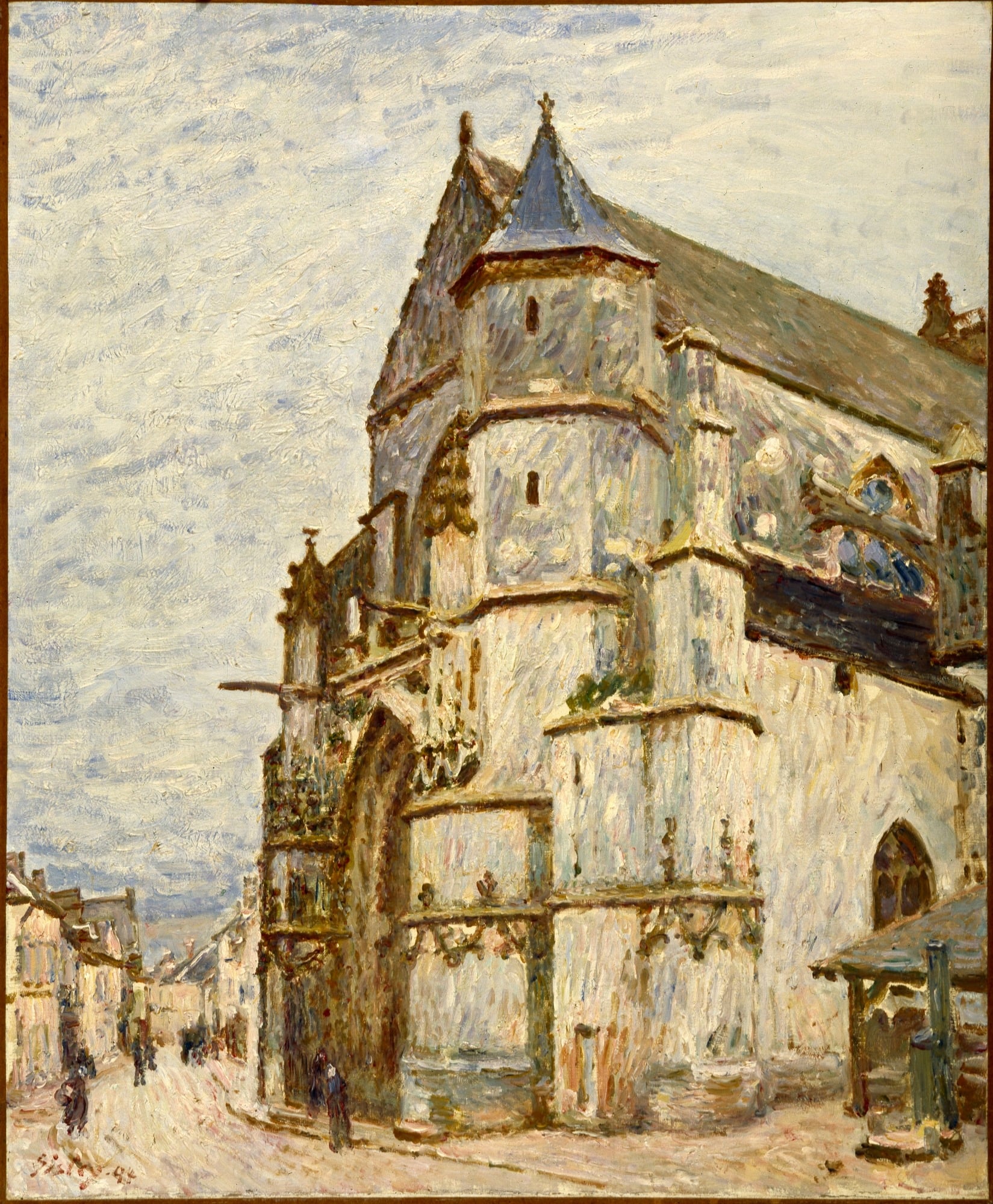
The Church at Moret
Alfred Sisley (1894)
Alfred Sisley’s The Church at Moret turns a Flamboyant Gothic façade into a living barometer of light, weather, and time. With <strong>cool blues, lilacs, and warm ochres</strong> laid in broken strokes, the stone seems to breathe as tiny townspeople drift along the street. The work asserts <strong>permanence meeting transience</strong>: a communal monument held steady while the day’s atmosphere endlessly remakes it <sup>[1]</sup><sup>[2]</sup><sup>[3]</sup>.
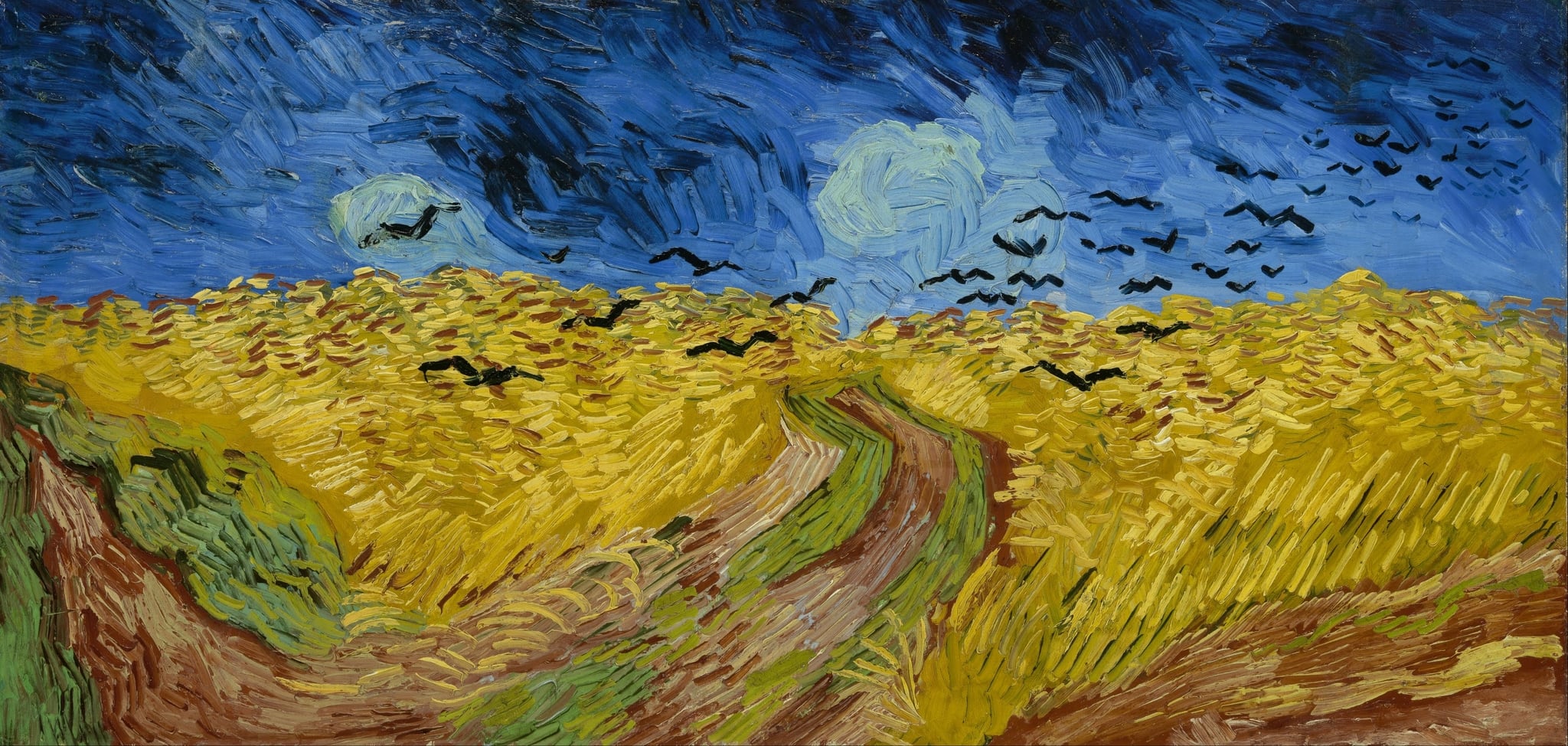
Wheatfield with Crows
Vincent van Gogh (1890)
A panoramic wheatfield splits around a rutted track under a storm-charged sky while black crows rush toward us. Van Gogh drives complementary blues and yellows into collision, fusing <strong>nature’s vitality</strong> with <strong>inner turbulence</strong>.
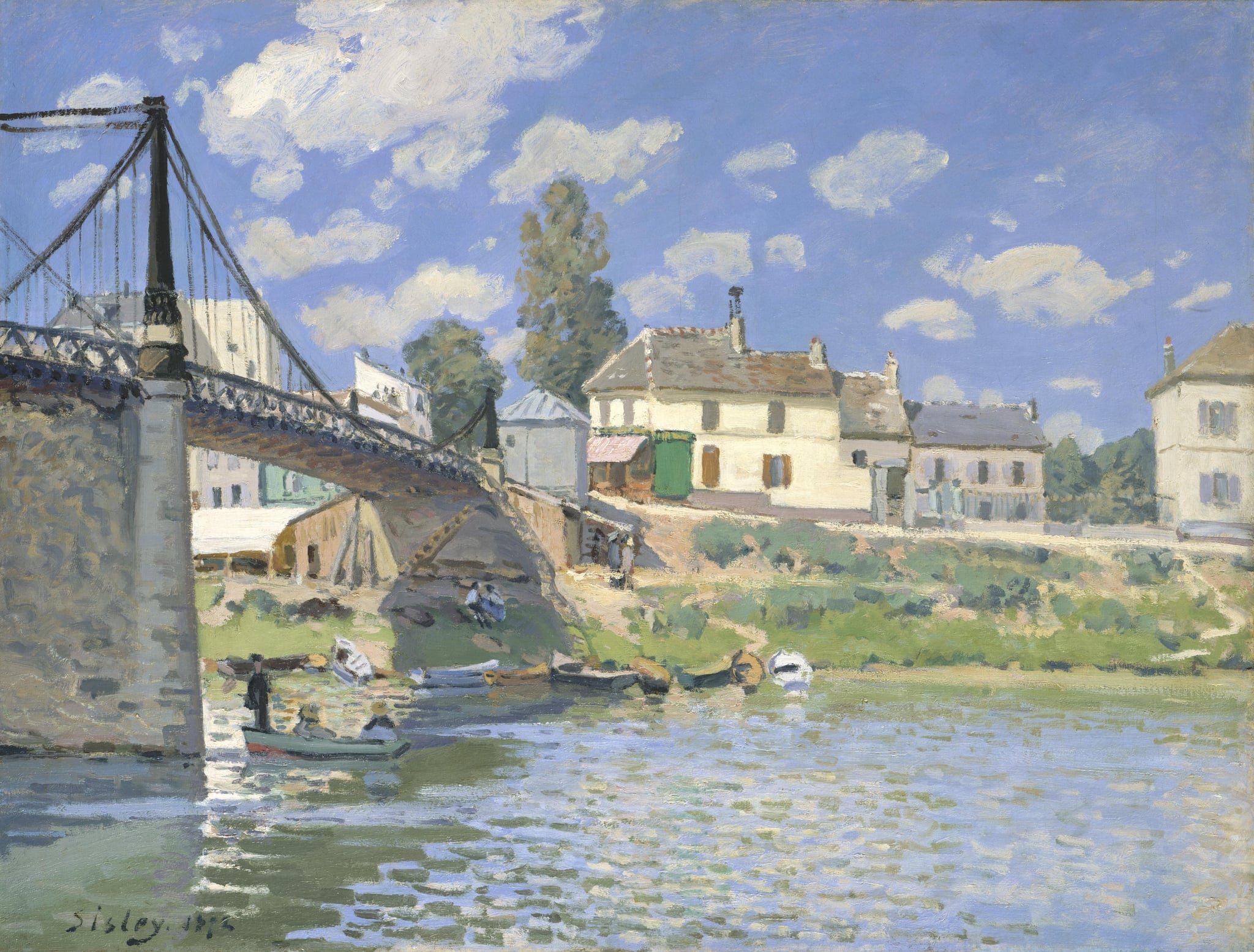
The Bridge at Villeneuve-la-Garenne
Alfred Sisley (1872)
Alfred Sisley's The Bridge at Villeneuve-la-Garenne crystallizes the encounter between <strong>modern engineering</strong> and <strong>riverside leisure</strong> under <strong>Impressionist light</strong>. The diagonal suspension bridge, dark pylons, and filigreed truss command the left foreground while small boats skim the Seine, their wakes breaking into shimmering strokes that echo the sky.
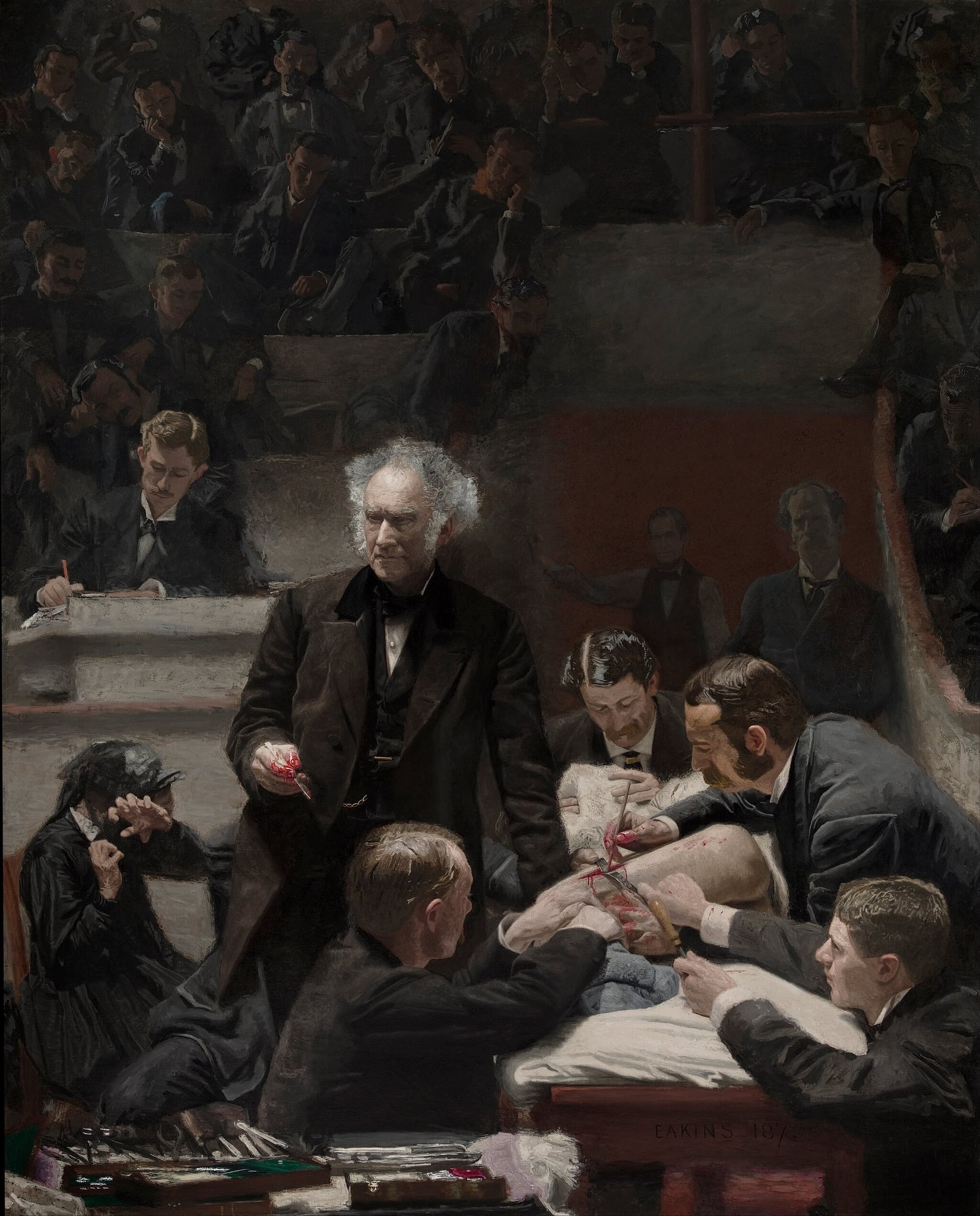
The Gross Clinic
Thomas Eakins (1875)
Thomas Eakins’s The Gross Clinic turns a surgical lesson into civic drama, casting a blaze of light on the surgeon’s white hair and bloodied fingers while students fade into shadow. With the veiled woman recoiling at left and a clerk calmly recording at right, the painting frames <strong>science as spectacle</strong> and <strong>witness as ethics</strong> <sup>[1]</sup><sup>[2]</sup>.
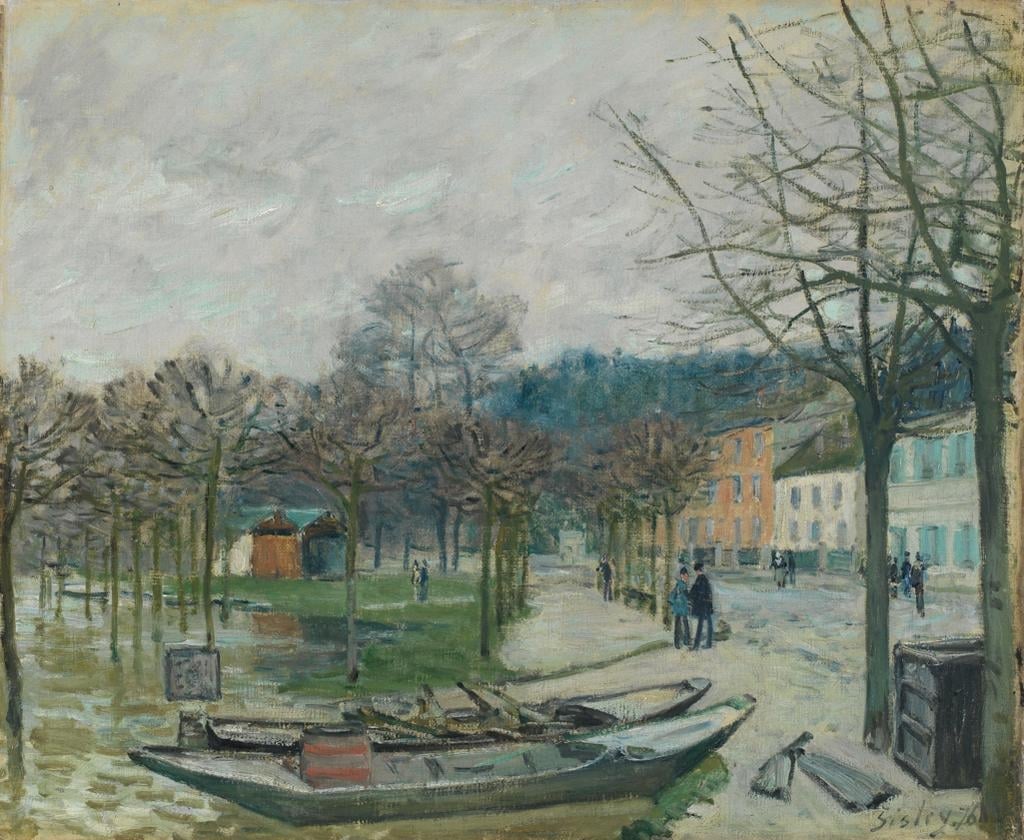
Flood at Port-Marly
Alfred Sisley (1876)
In Flood at Port-Marly, Alfred Sisley turns a flooded street into a reflective stage where <strong>human order</strong> and <strong>natural flux</strong> converge. The aligned, leafless trees function like measuring rods against the water, while flat-bottomed boats replace carriages at the curb. With cool, silvery strokes and a cloud-laden sky, Sisley asserts that the scene’s true drama is <strong>atmosphere</strong> and <strong>adaptation</strong>, not catastrophe <sup>[1]</sup><sup>[2]</sup><sup>[4]</sup>.
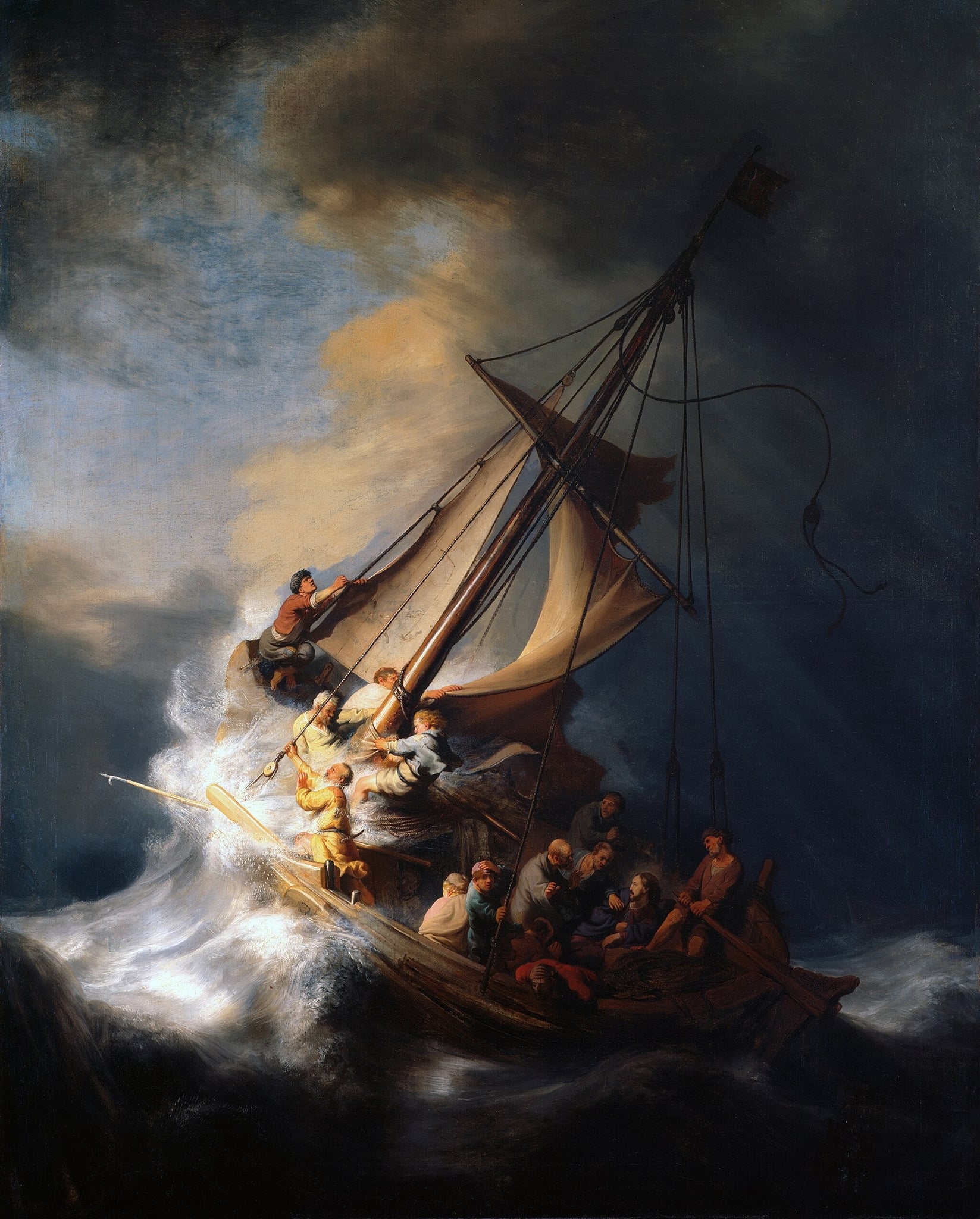
The Storm on the Sea of Galilee
Rembrandt van Rijn (1633)
Rembrandt van Rijn’s The Storm on the Sea of Galilee stages a clash of <strong>human panic</strong> and <strong>divine composure</strong> at the instant before the miracle. A torn mainsail whips across a steeply tilted boat as terrified disciples scramble, while a <strong>serenely lit Christ</strong> anchors a pocket of calm—an image of faith holding within chaos <sup>[1]</sup><sup>[3]</sup>. It is Rembrandt’s only painted seascape, intensifying its dramatic singularity in his oeuvre <sup>[2]</sup>.
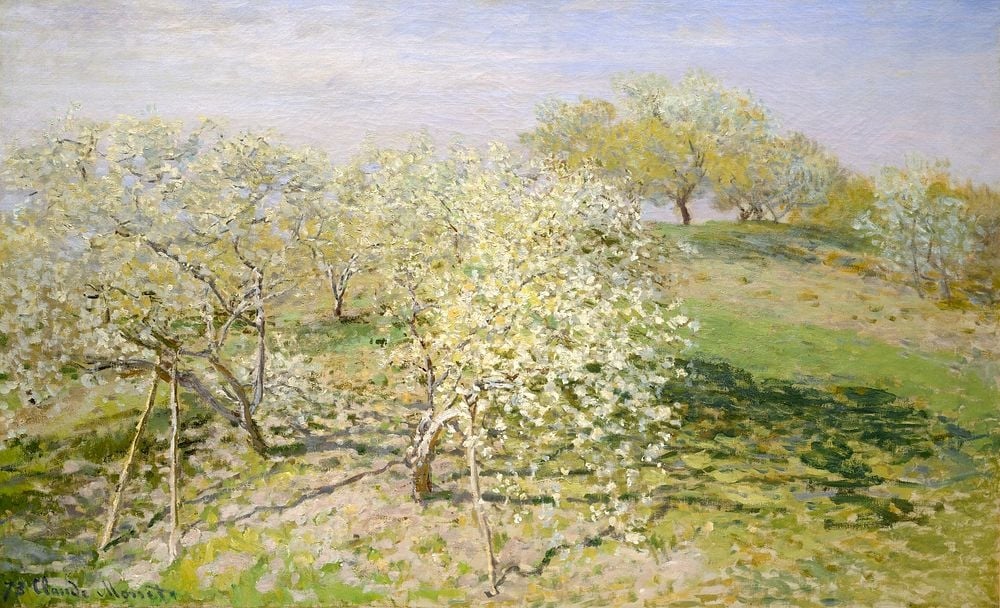
Spring (Fruit Trees in Bloom)
Claude Monet (1873)
Claude Monet’s Spring (Fruit Trees in Bloom) captures a hillside orchard at Argenteuil where pale blossoms flicker across a diagonal slope under a <strong>pearly, breathable sky</strong>. The canvas privileges <strong>light over contour</strong>, letting trunks, stakes, and petal-clusters resolve through vibrating touches of color that register passing air and sun <sup>[1]</sup><sup>[2]</sup>. The scene fixes a <strong>radiant instant</strong> while acknowledging its fragility.
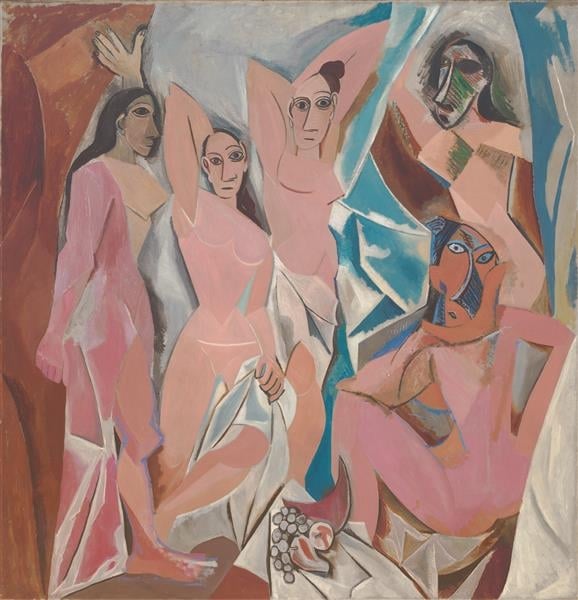
Les Demoiselles d'Avignon
Pablo Picasso (1907)
Les Demoiselles d'Avignon hurls five nudes toward the viewer in a shallow, splintered chamber, turning classical beauty into <strong>sharp planes</strong>, <strong>masklike faces</strong>, and <strong>fractured space</strong>. The fruit at the bottom reads as a sensual lure edged with threat, while the women’s direct gazes indict the beholder as participant. This is the shock point of <strong>proto‑Cubism</strong>, where Picasso reengineers how modern painting means and how looking works <sup>[1]</sup><sup>[2]</sup>.
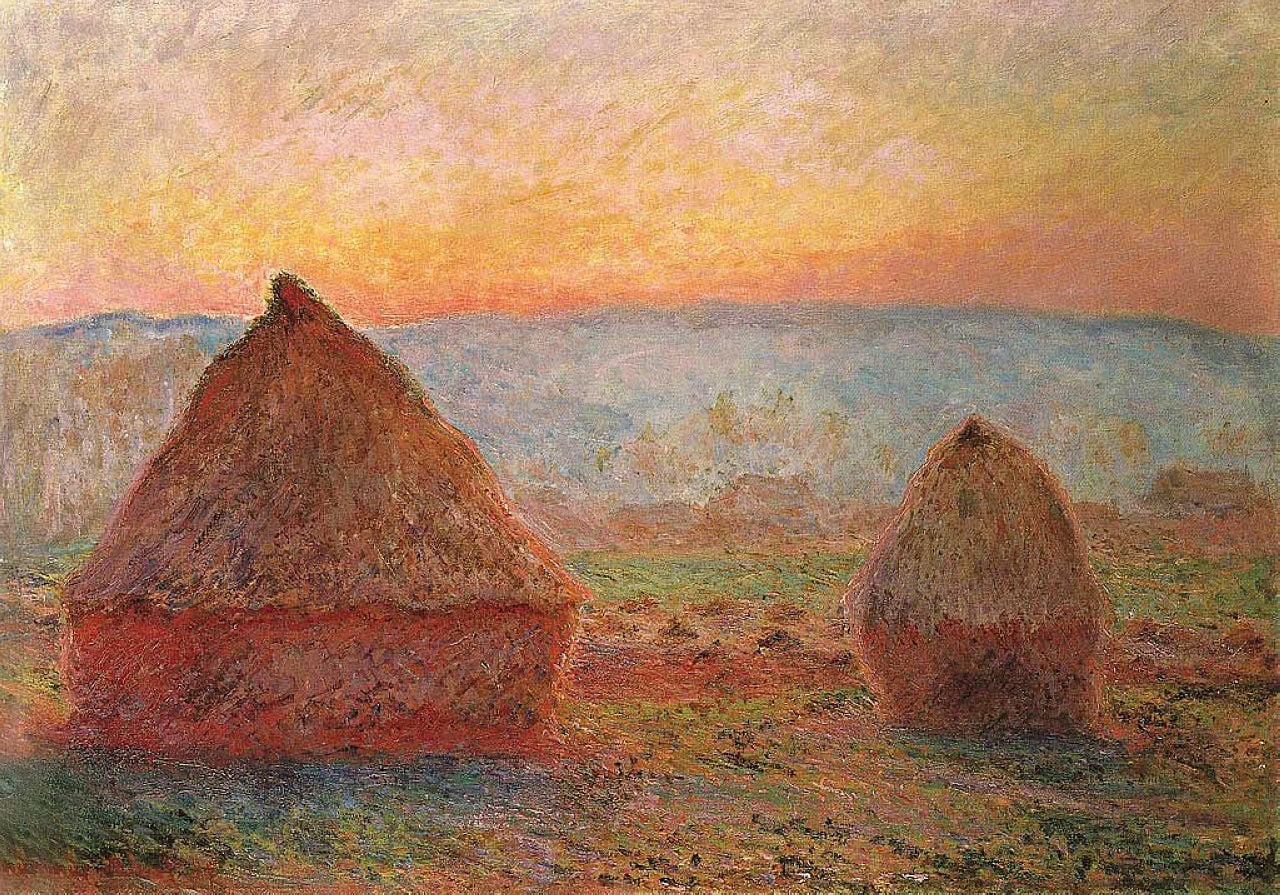
Haystack, Sunset
Claude Monet (1891)
Two conical stacks blaze against a cooling horizon, turning stored grain into a drama of <strong>light, time, and rural wealth</strong>. Monet’s broken strokes fuse warm oranges and cool violets so the stacks seem to glow from within, embodying the <strong>transience</strong> of a single sunset and the <strong>endurance</strong> of agrarian cycles <sup>[1]</sup><sup>[2]</sup><sup>[3]</sup>.
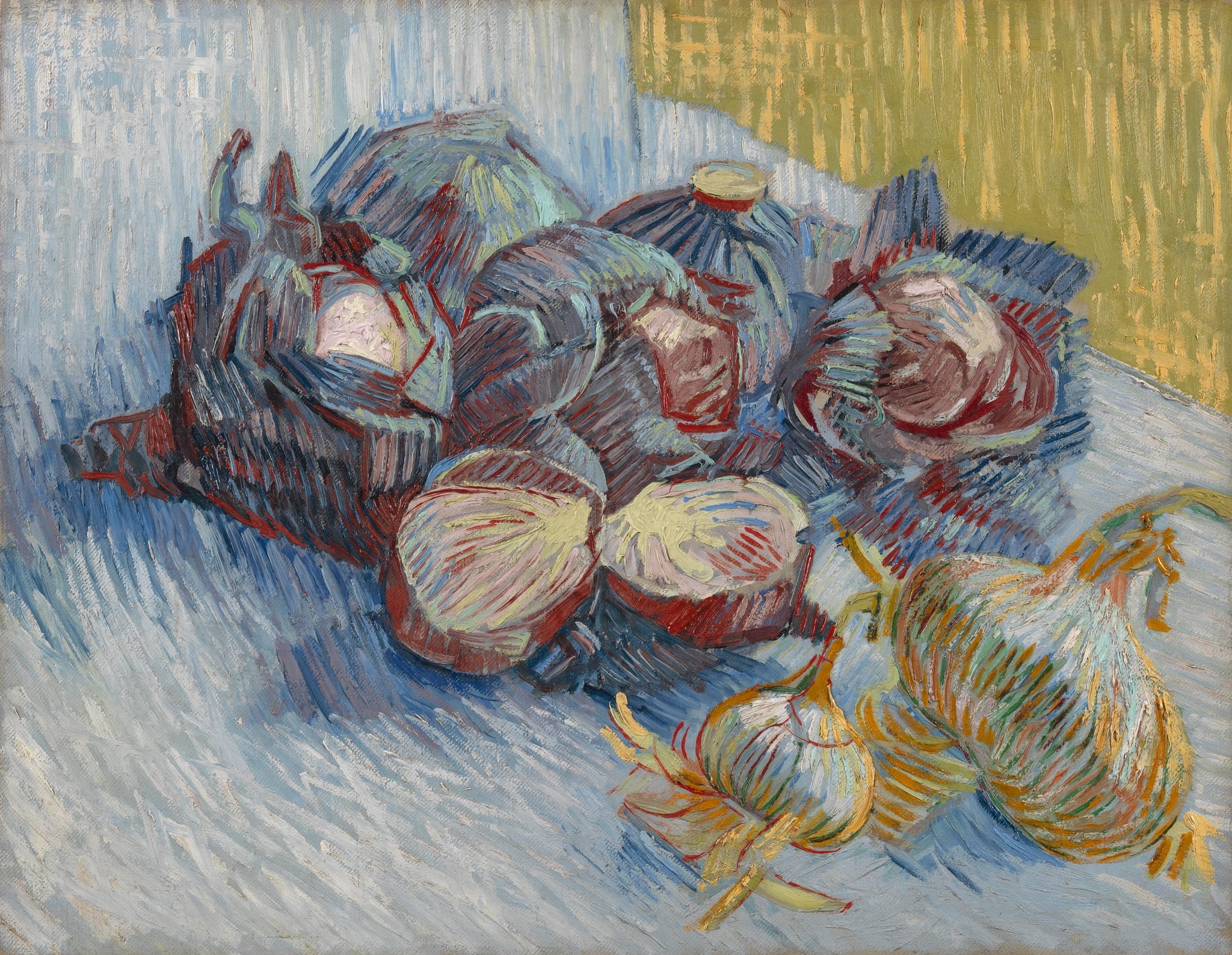
Red Cabbages and Onions
Vincent van Gogh (1887)
In Red Cabbages and Onions, Vincent van Gogh turns everyday produce into a drama of <strong>complementary color</strong> and <strong>restless brushwork</strong>. Hot red contours cinch violet cabbages and pale yellow bulbs against a cool, striated blue table, while a mustard‑yellow patch in the upper right tilts the space and sharpens the chromatic clash. The result asserts ordinary food as a locus of <strong>resilience</strong> and <strong>experimentation</strong> <sup>[1]</sup><sup>[2]</sup>.
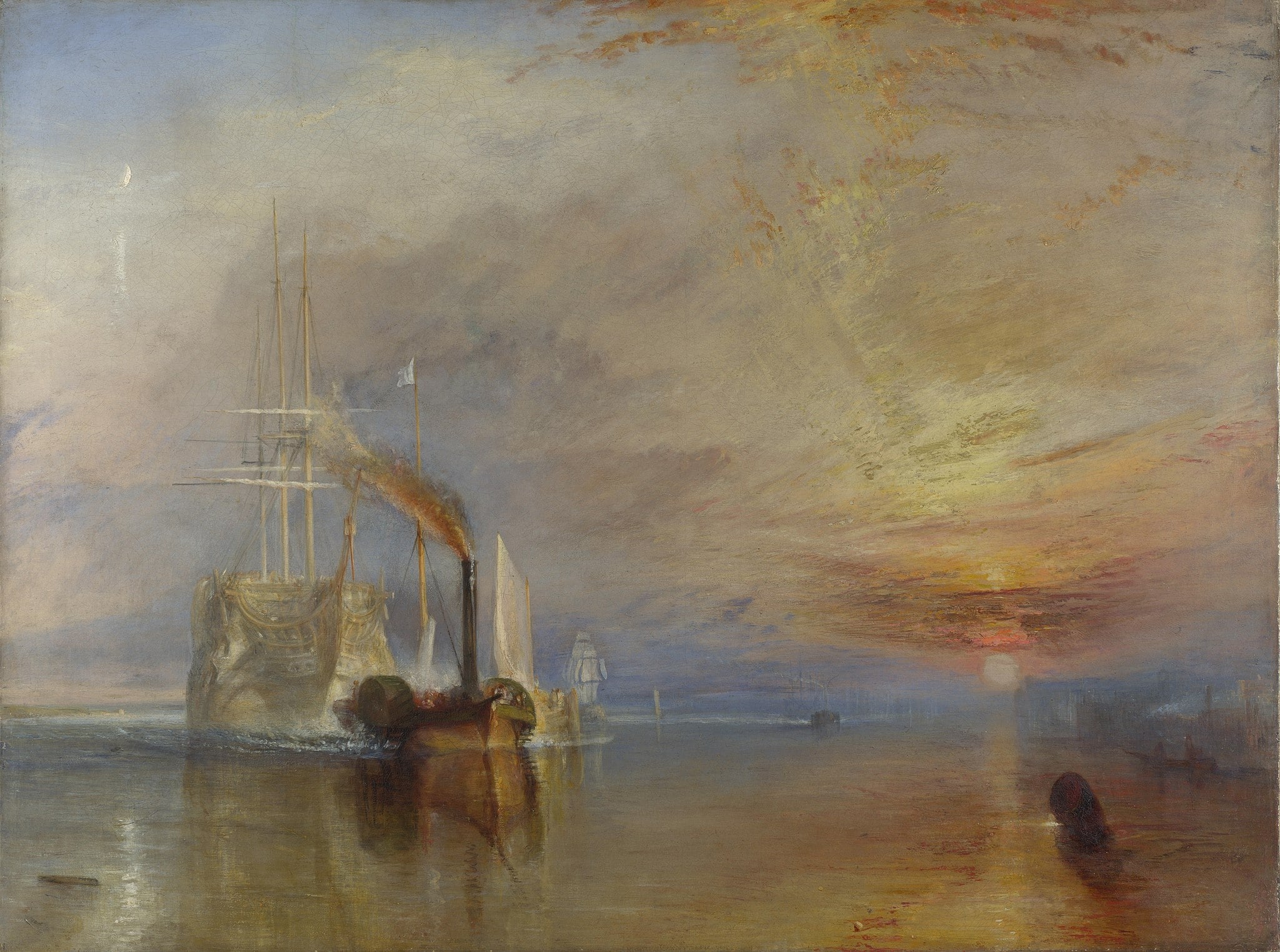
The Fighting Temeraire
J. M. W. Turner (1839)
In The Fighting Temeraire, J. M. W. Turner sets a <strong>ghostly man‑of‑war</strong> against a <strong>sooty steam tug</strong> under a blazing, emblematic sunset. The pale ship’s towering masts and slack rigging read like memory, while the tug’s black smoke cuts through the rigging where a flag once flew, signaling <strong>power passing from sail to steam</strong> <sup>[1]</sup><sup>[2]</sup>. A crescent moon and a humble buoy punctuate a river turned to molten gold, marking both ending and beginning <sup>[3]</sup><sup>[4]</sup>.
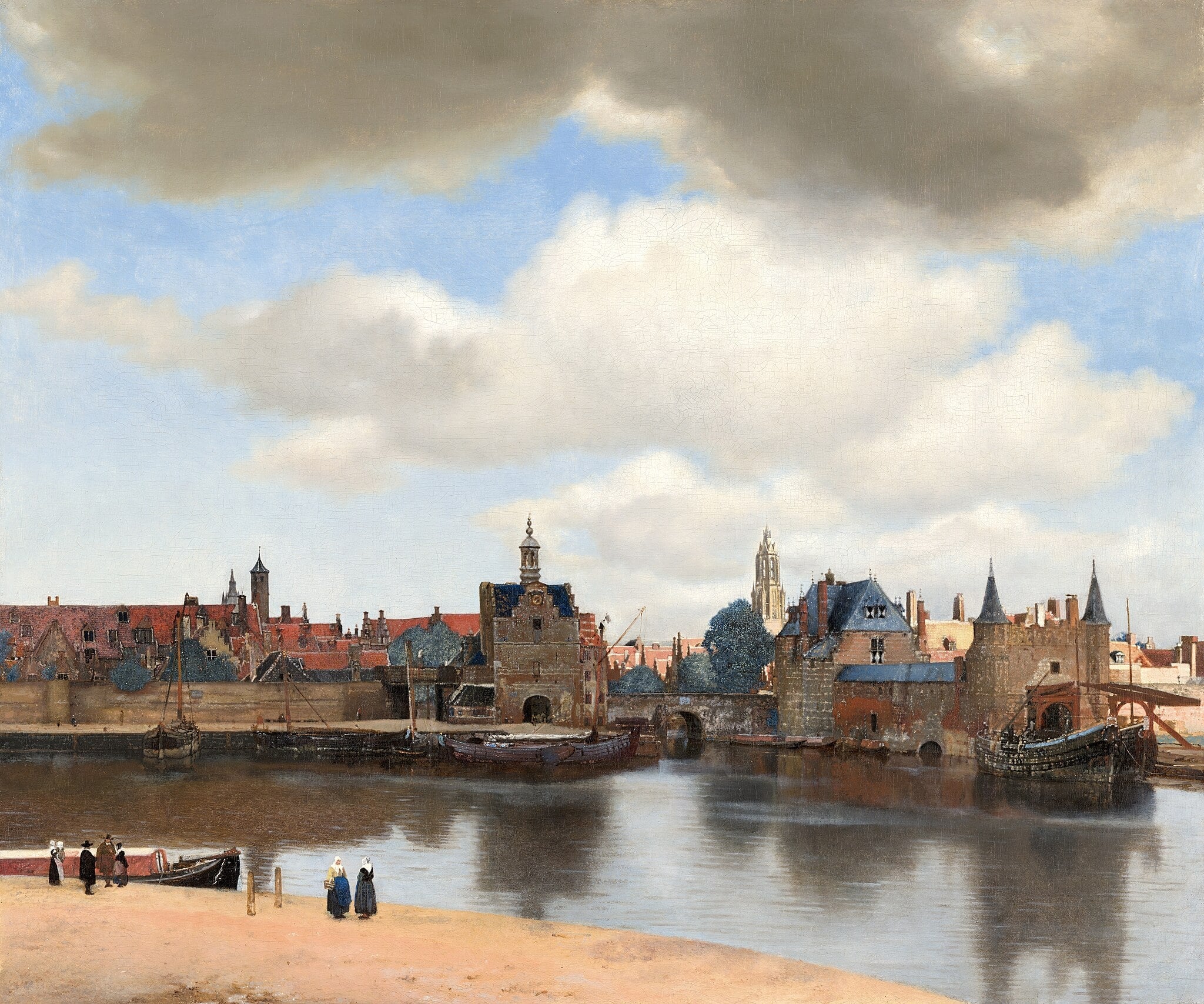
View of Delft
Johannes Vermeer (c. 1660–1661)
View of Delft turns a faithful city prospect into a meditation on <strong>civic order, resilience, and time</strong>. Beneath a low horizon, drifting clouds cast mobile shadows while shafts of sun ignite blue roofs and the bright spire of the <strong>Nieuwe Kerk</strong>, holding the scene’s moral center <sup>[1]</sup>. Small figures and moored boats ground prosperity in <strong>everyday community</strong> without breaking the hush.
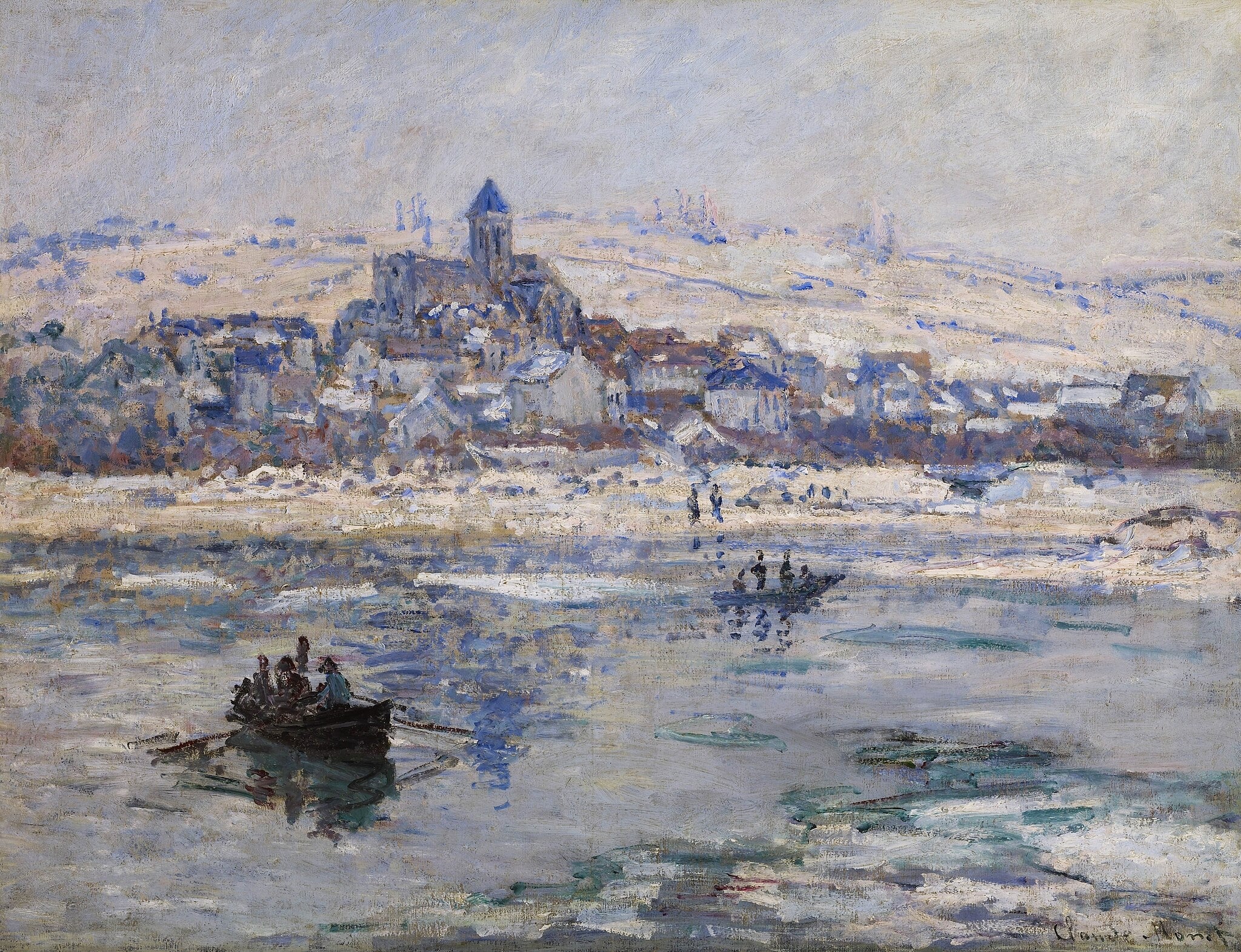
Vétheuil in Winter
Claude Monet (1878–79)
Claude Monet’s Vétheuil in Winter renders a riverside village in a <strong>silvery, frost-laden light</strong>, where the Seine carries <strong>broken ice</strong> past clustered houses and the tall church tower. The scene’s <strong>granular blue-green palette</strong> and softened edges make the town appear to crystallize out of air and water, while small boats and figures signal quiet persistence.
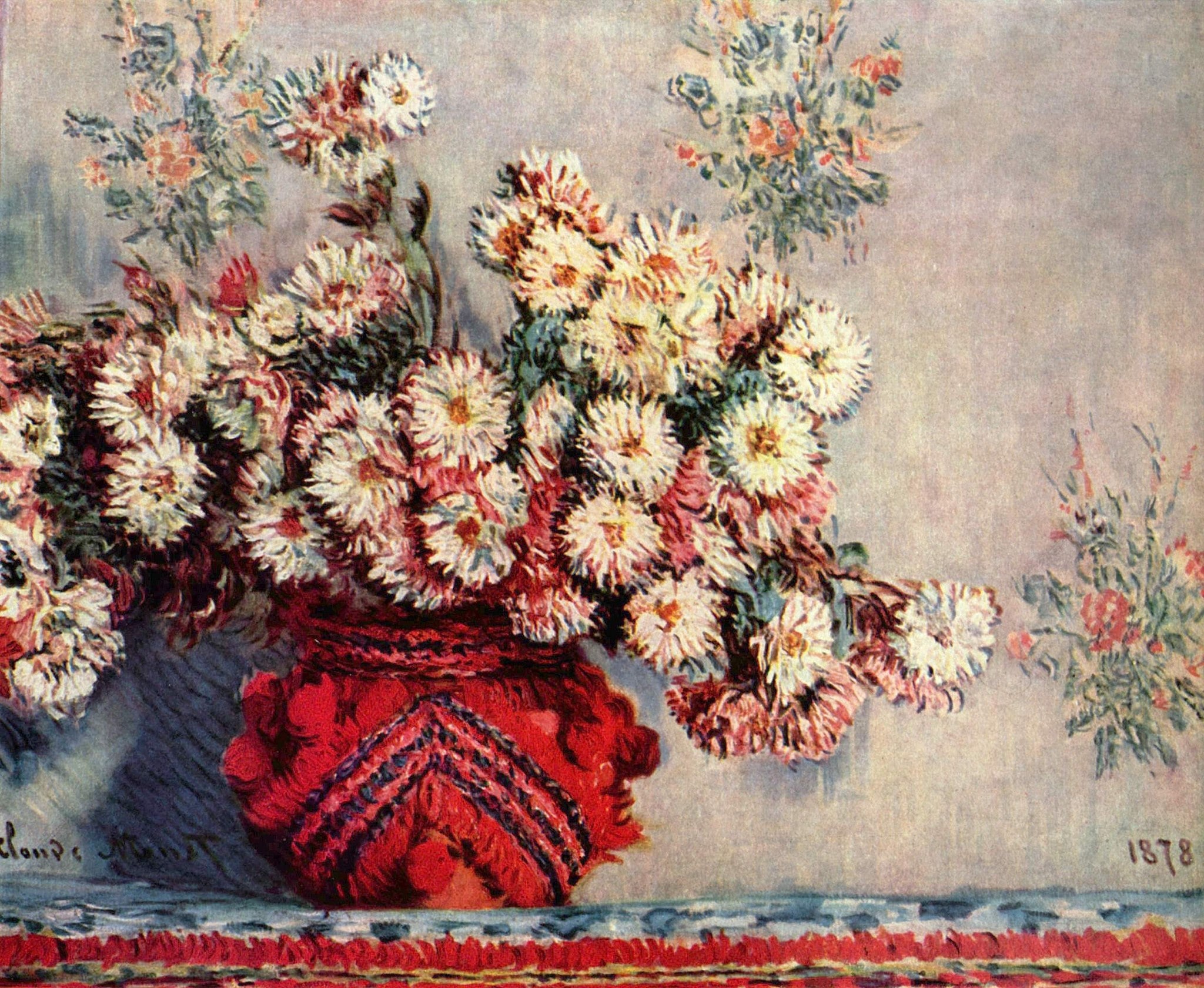
Chrysanthemums
Claude Monet (1878)
Claude Monet’s Chrysanthemums fixes a burst of late‑season bloom in a <strong>scarlet, plush‑textured vase</strong> against a cool <strong>blue‑gray wall</strong> where faint floral <strong>sprigs</strong> echo the bouquet. The painting privileges <strong>vibration of color</strong> over contour, turning still life into a decorative field. It condenses autumnal abundance and the fleetingness of light into a single, shimmering sensation <sup>[1]</sup><sup>[2]</sup>.
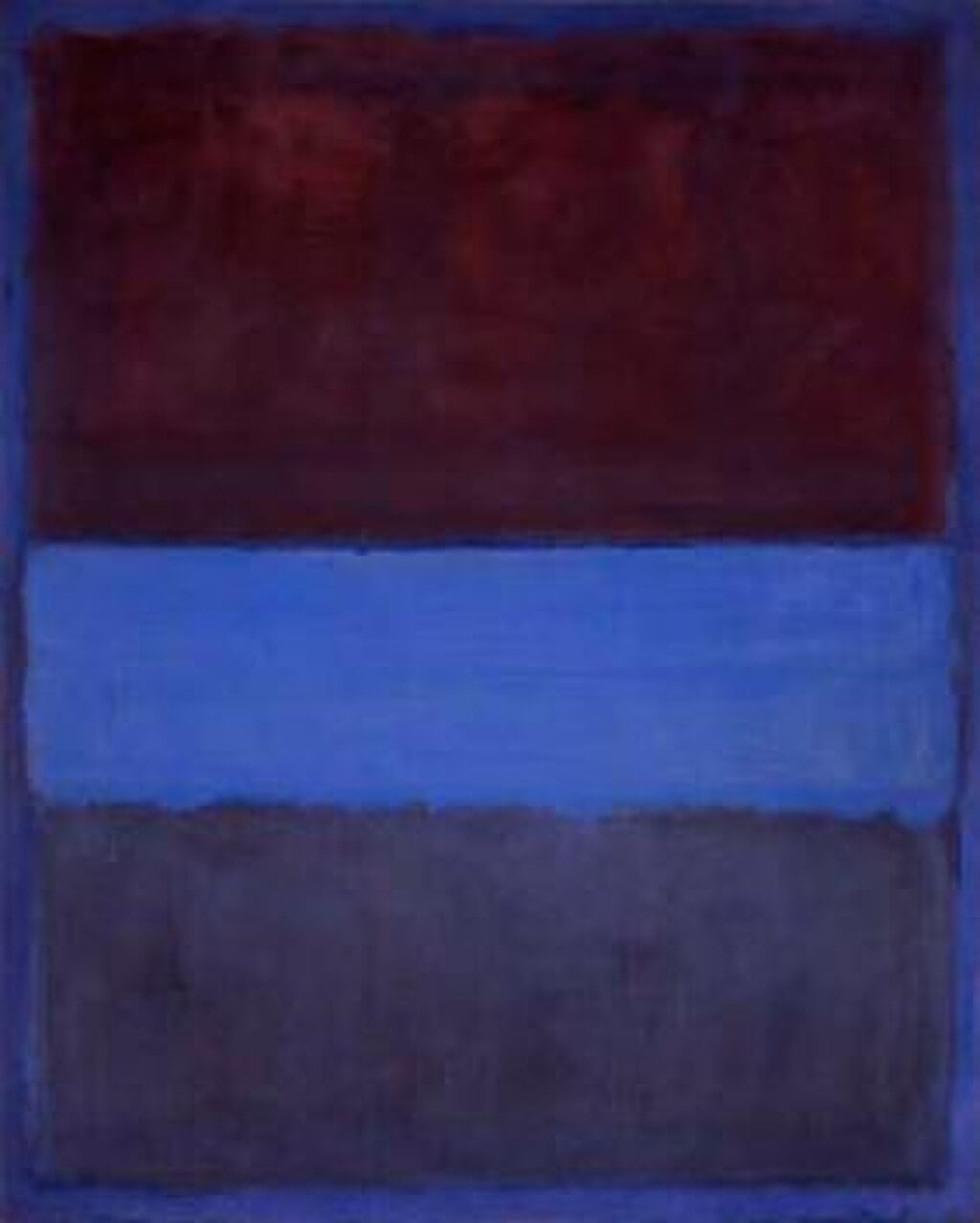
No. 61 (Rust and Blue)
Mark Rothko (1953)
<strong>No. 61 (Rust and Blue)</strong> (1953) stages three hovering color fields—rust, saturated blue, and indigo—within a deep blue perimeter. Through thin, layered oil and feathered borders, Mark Rothko turns color into a felt space where warmth and dusk meet, inviting a contemplative, immersive encounter <sup>[1]</sup><sup>[5]</sup>.
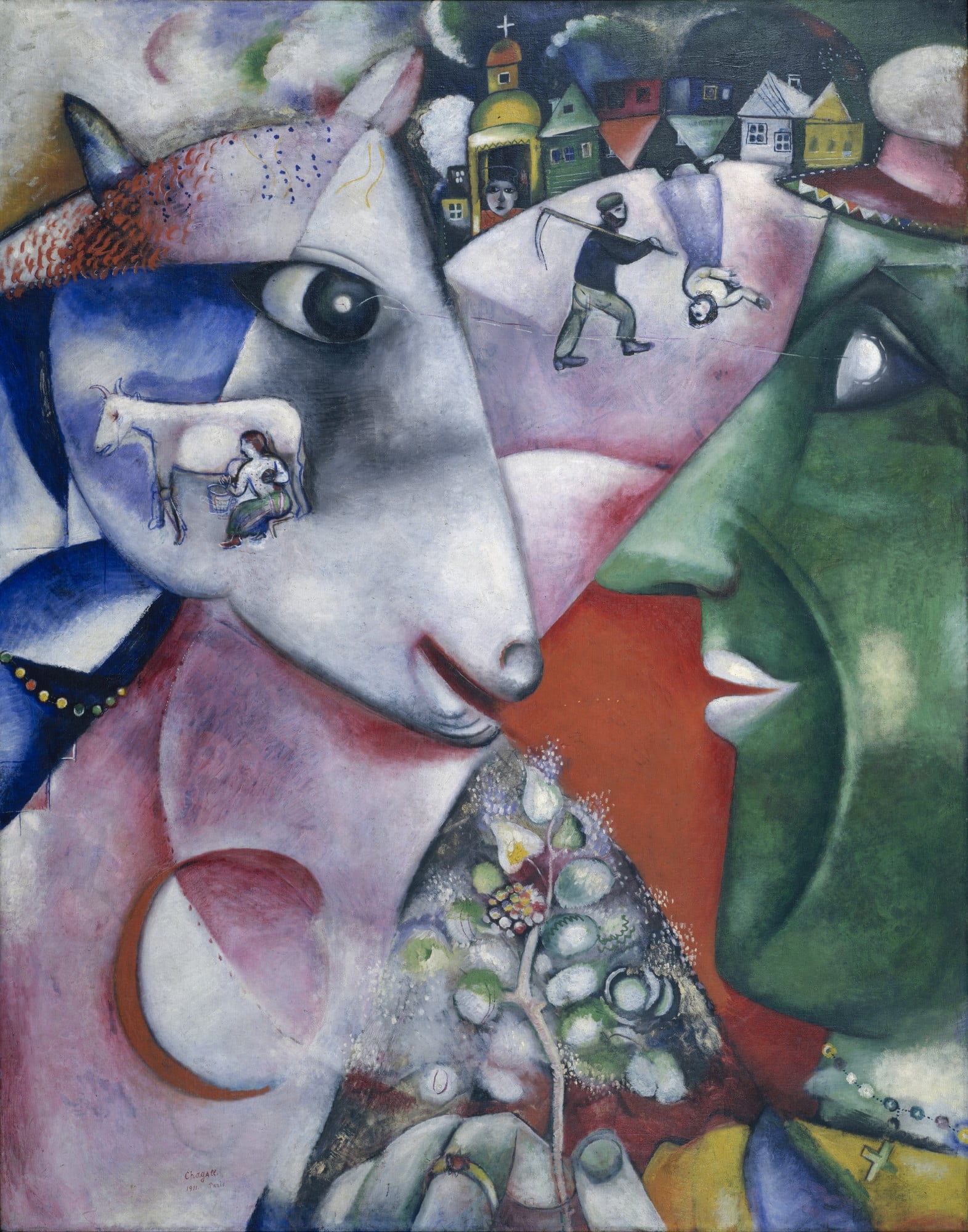
I and the Village
Marc Chagall (1911)
In I and the Village, Marc Chagall fuses <strong>memory, myth, and rural ritual</strong> into a dream‑logic tableau where a green‑faced villager and a pale bovine meet <strong>eye‑to‑eye</strong>. Concentric forms, prismatic color, and floating figures turn Vitebsk’s everyday life into a <strong>cosmic community</strong> where work, faith, and imagination coexist <sup>[1]</sup><sup>[3]</sup>.
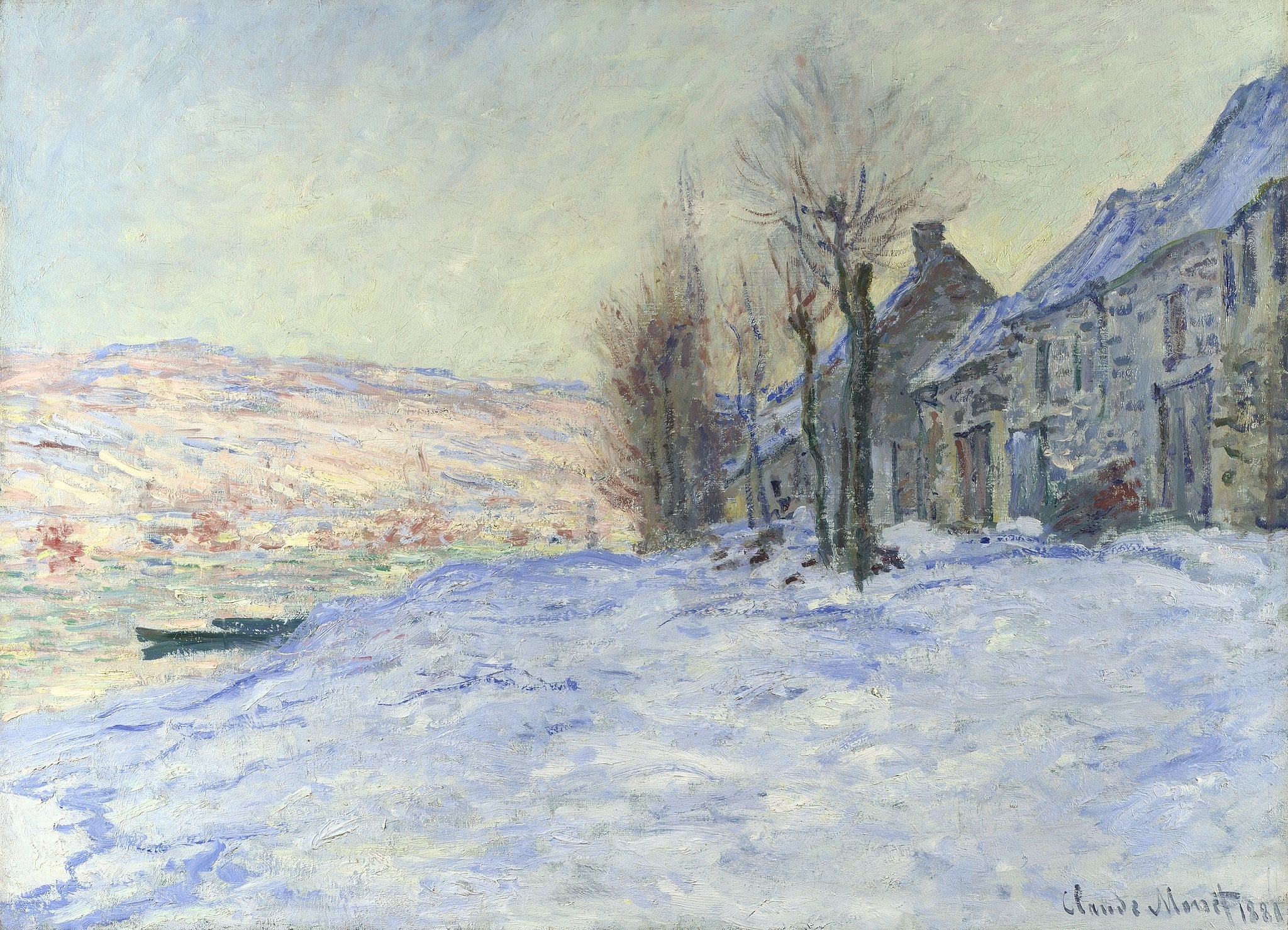
Lavacourt under Snow
Claude Monet (about 1878–81 (probably winter 1879–80; signed 1881))
Claude Monet’s Lavacourt under Snow distills a frozen morning on the Seine into a field of <strong>lilac‑blue shadows</strong> and a counterglow of <strong>rose light</strong> across the far bank. A diagonal of cottages and <strong>leafless trees</strong> holds the right margin while a <strong>moored dark boat</strong> punctuates the left, turning transience into structure <sup>[1]</sup>.
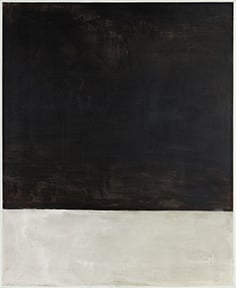
Untitled (Black on Grey)
Mark Rothko (1969–1970)
Mark Rothko’s Untitled (Black on Grey) compresses feeling into two stacked fields: a vast, softly modulated <strong>black</strong> pressing down upon a lower band of <strong>chalky grey</strong>, both ringed by a narrow white border. The blurred seam between them holds a charged <strong>threshold</strong> where descent and persistence meet <sup>[1]</sup><sup>[3]</sup><sup>[4]</sup>.
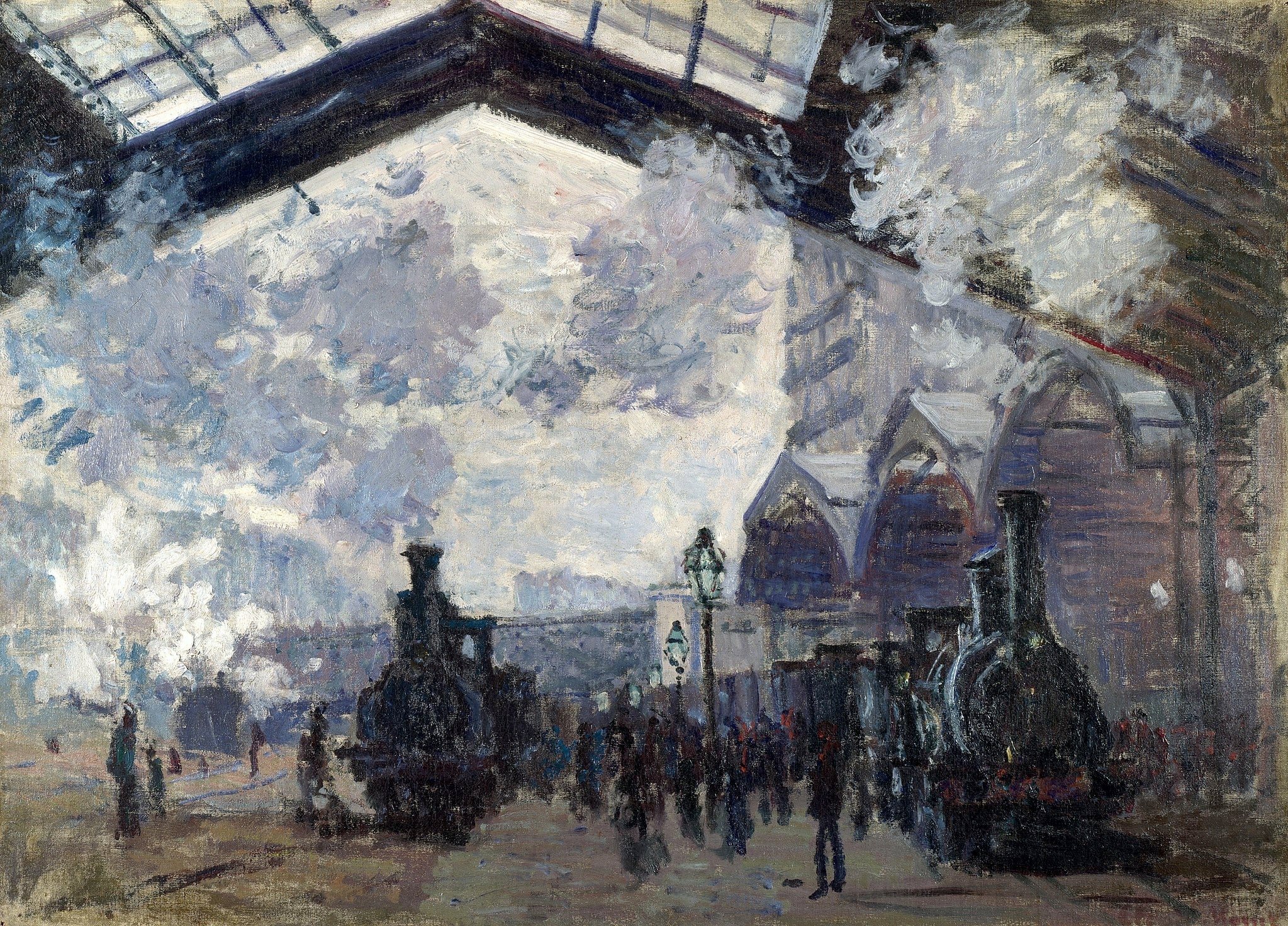
The Gare St-Lazare
Claude Monet (1877)
The Gare St-Lazare turns a bustling rail hub into a theater of <strong>light, steam, and speed</strong>. Under a nave-like iron-and-glass canopy, two dark locomotives loom as crowds and gas lamps dissolve into <strong>atmosphere</strong>, translating industry into sensation <sup>[1]</sup>.
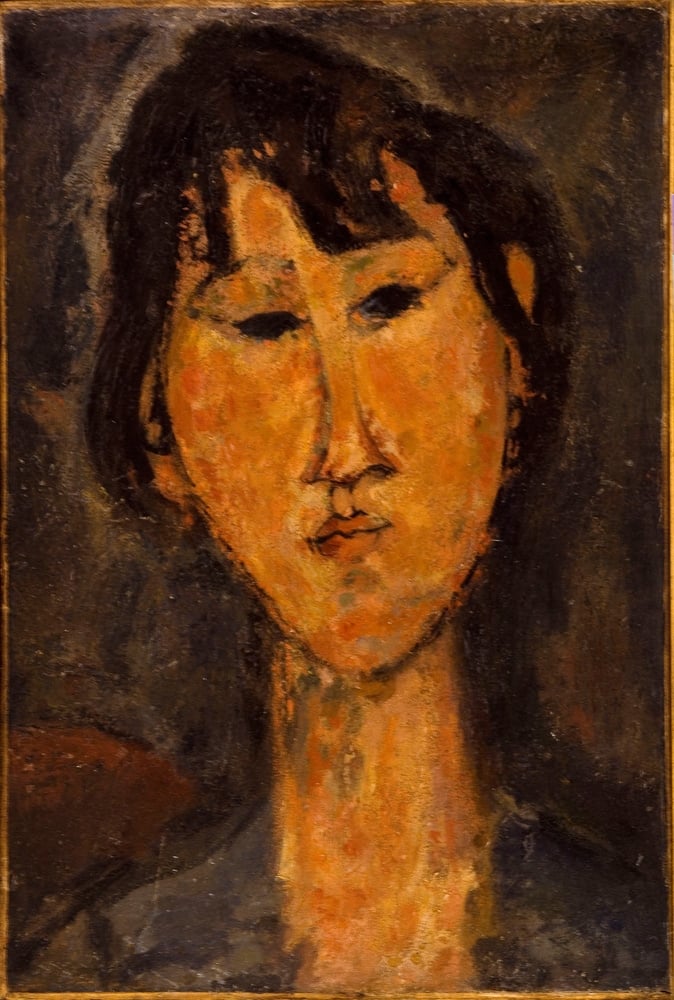
Tête
Amedeo Modigliani (1915)
<strong>Tête</strong> distills a human face into an icon: an ovoid head, blade-like nose, tight bow of lips, and slitted, pupil-less eyes emerging from a dark, smoky field. Drawing on his sculptural idiom, Amedeo Modigliani fuses <strong>elegance and estrangement</strong> so the sitter becomes a universal sign rather than a likeness <sup>[1]</sup><sup>[2]</sup>.
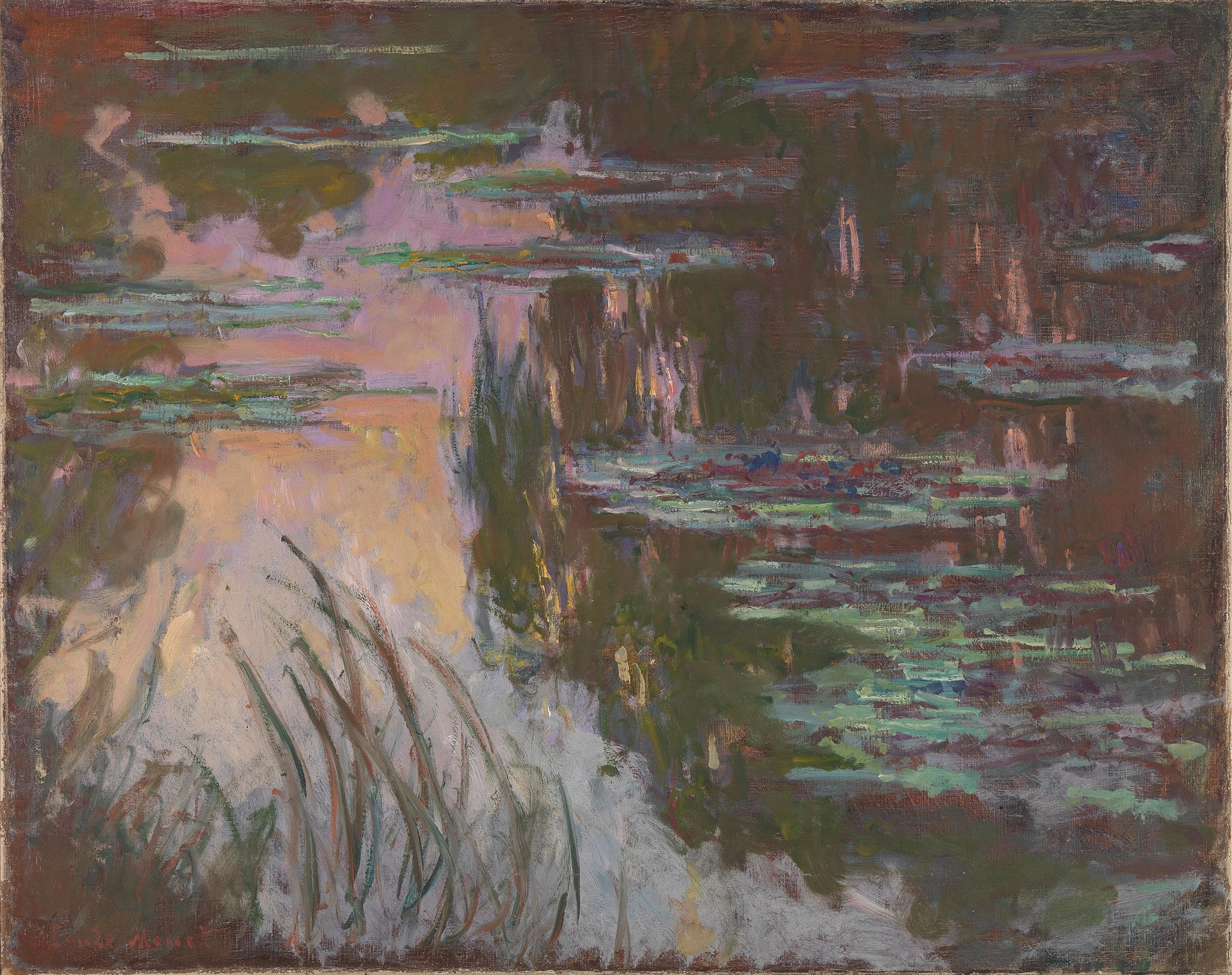
Water-Lilies, Setting Sun
Claude Monet (about 1907)
Claude Monet’s Water-Lilies, Setting Sun turns the Giverny pond into an <strong>immersive field of light</strong> where reflections overtake solid forms. Horizontal lily pads and a <strong>central column of pink-apricot glow</strong> register sunset as a reflection, while dark, vertical willow traces unsettle depth and horizon <sup>[1]</sup>. The result is a vision of <strong>time in flux</strong>, held together by the quiet persistence of the floating lilies.
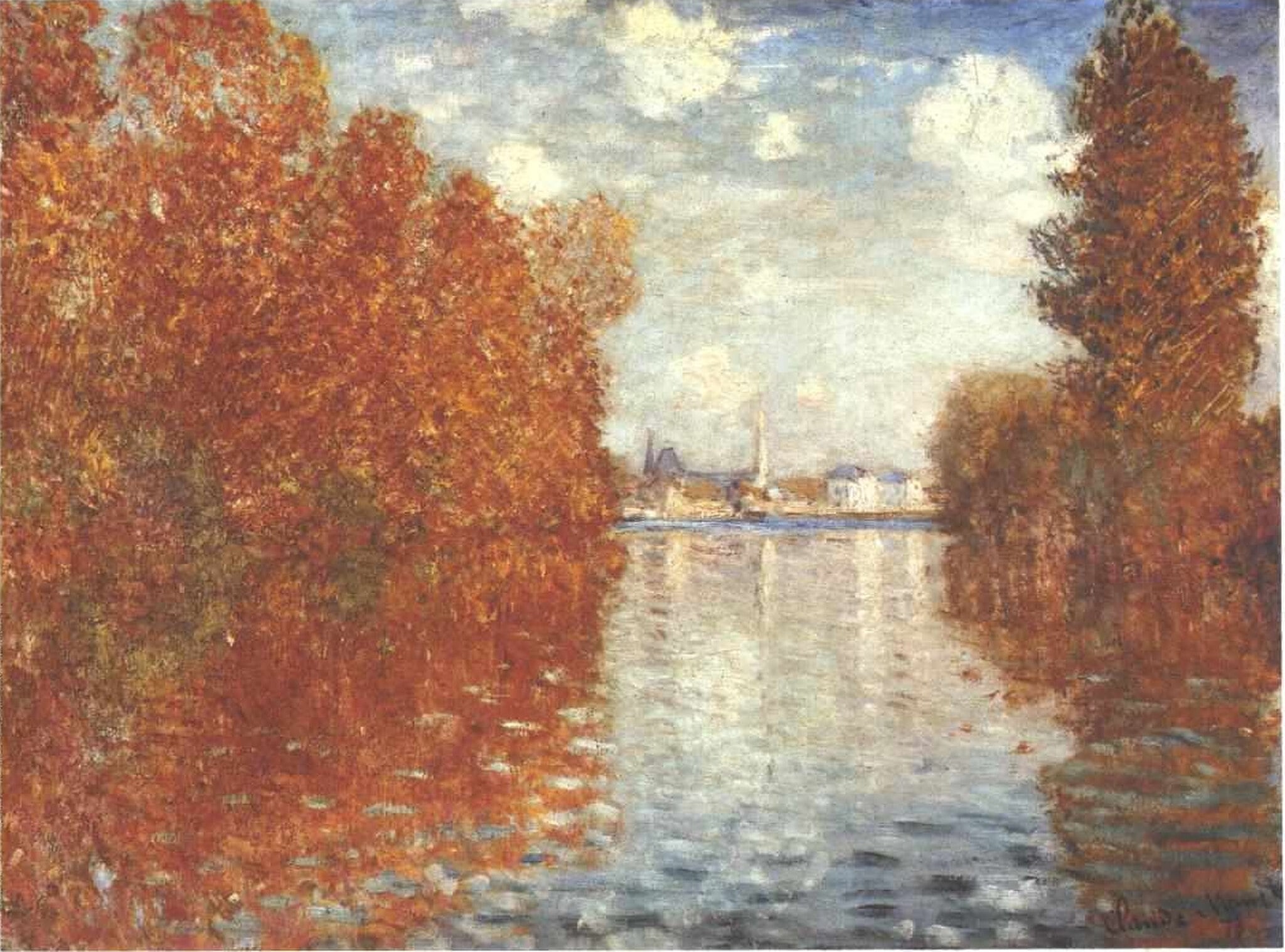
Autumn Effect at Argenteuil
Claude Monet (1873)
Autumn Effect at Argenteuil presents a luminous channel of the Seine flanked by blazing foliage, its surface vibrating with broken reflections. Monet turns the scene into an <strong>optical drama</strong> of complementary <strong>orange–blue</strong> contrasts, staging a passage from the narrowed banks to a light-struck town on the horizon. Painted from his <strong>studio boat</strong>, the work distills the Impressionist belief that truth resides in fleeting effects of light and air <sup>[1]</sup><sup>[2]</sup>.
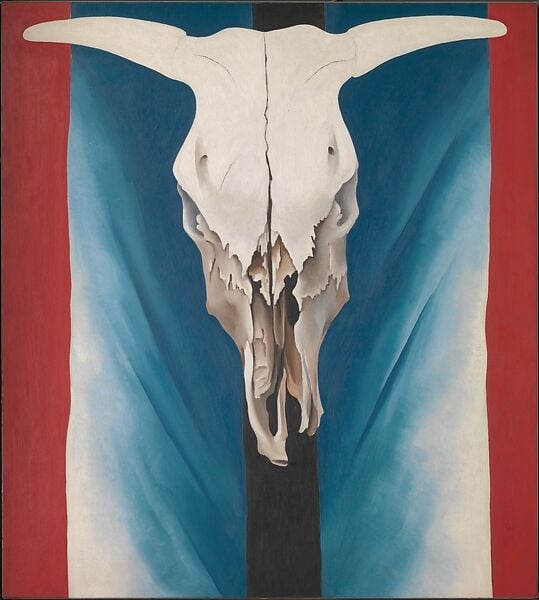
Cow’s Skull: Red, White, and Blue
Georgia O’Keeffe (1931)
Georgia O’Keeffe’s Cow’s Skull: Red, White, and Blue (1931) turns a sun‑bleached bovine skull into a <strong>modern American emblem</strong>, set against a tricolor field that quietly evokes the flag. The skull’s chalky surface becomes the composition’s <strong>white</strong>, framed by red side bands and a folded blue ground cleaved by a dark vertical bar, asserting <strong>resilience</strong> rather than morbidity <sup>[1]</sup><sup>[2]</sup>.
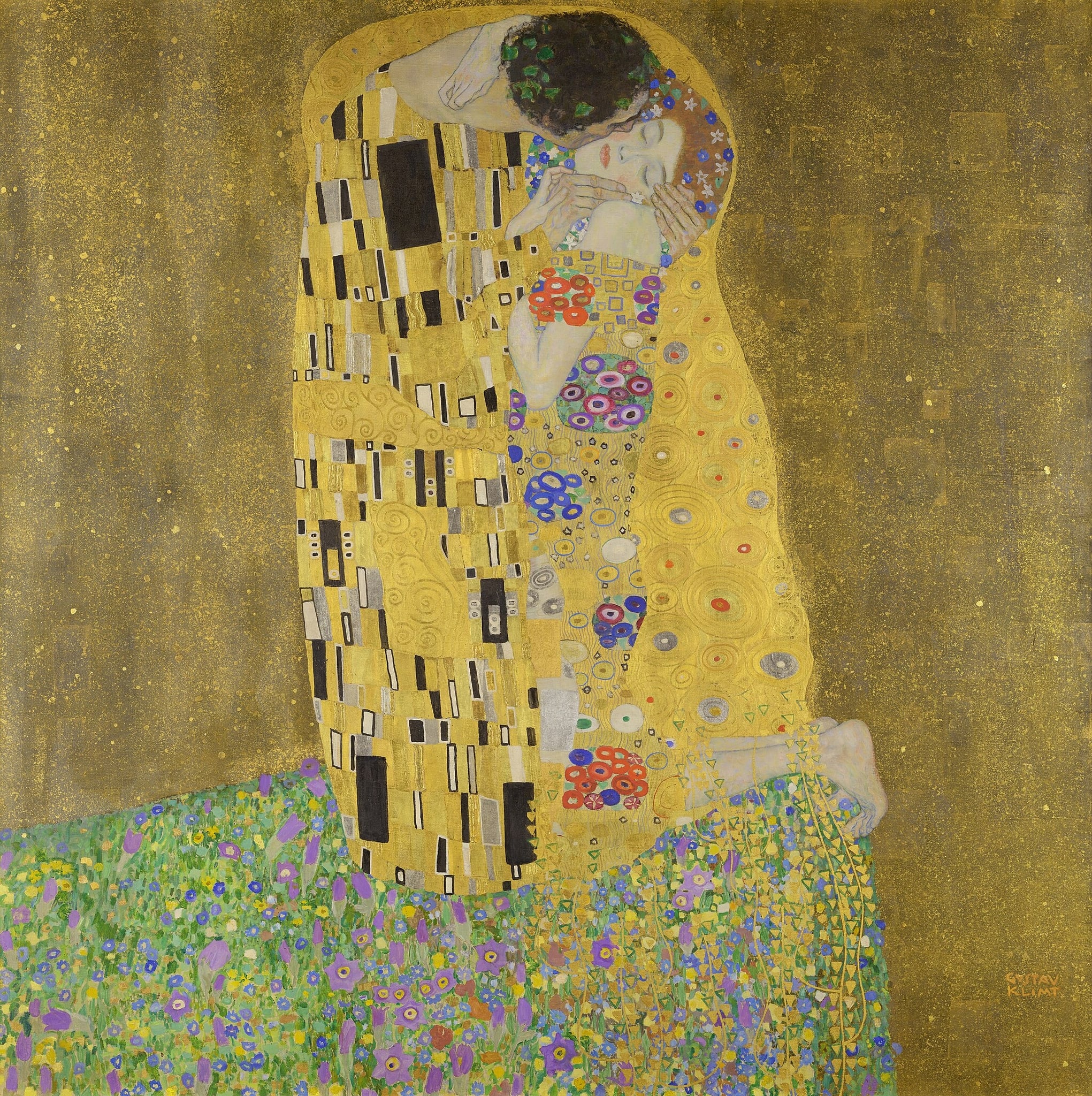
The Kiss (Lovers)
Gustav Klimt (1907–1908 (Belvedere lists 1908/09))
The Kiss (Lovers) crystallizes Klimt’s <strong>Golden Period</strong> ideal: erotic union staged as a sacred vision. Two bodies fuse beneath a single golden mantle, poised on a flowered ledge at the brink of the unknown, where <strong>pattern becomes symbol</strong> and intimacy becomes icon.
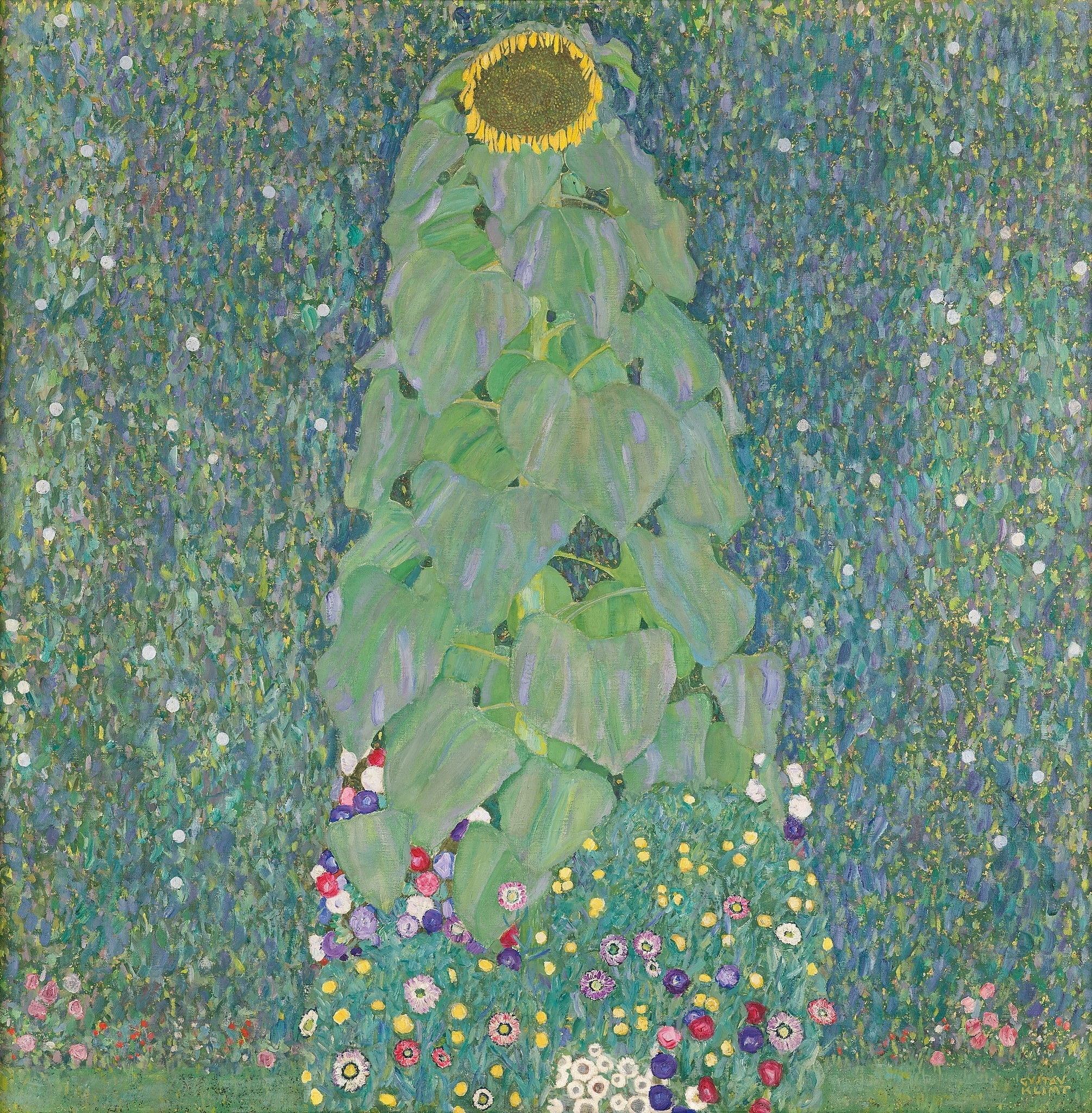
Sunflower
Gustav Klimt (1907/1908)
Gustav Klimt’s Sunflower turns a single bloom into a <strong>monumental, figure-like presence</strong>. A tapering stack of broad, drooping leaves rises from a <strong>mosaic-like carpet of round blossoms</strong>, crowned by a gold-flecked disc that glows against a cool, stippled field. The work fuses <strong>portrait, icon, and landscape</strong> into one emblem of vitality and quiet sanctity <sup>[1]</sup><sup>[2]</sup>.
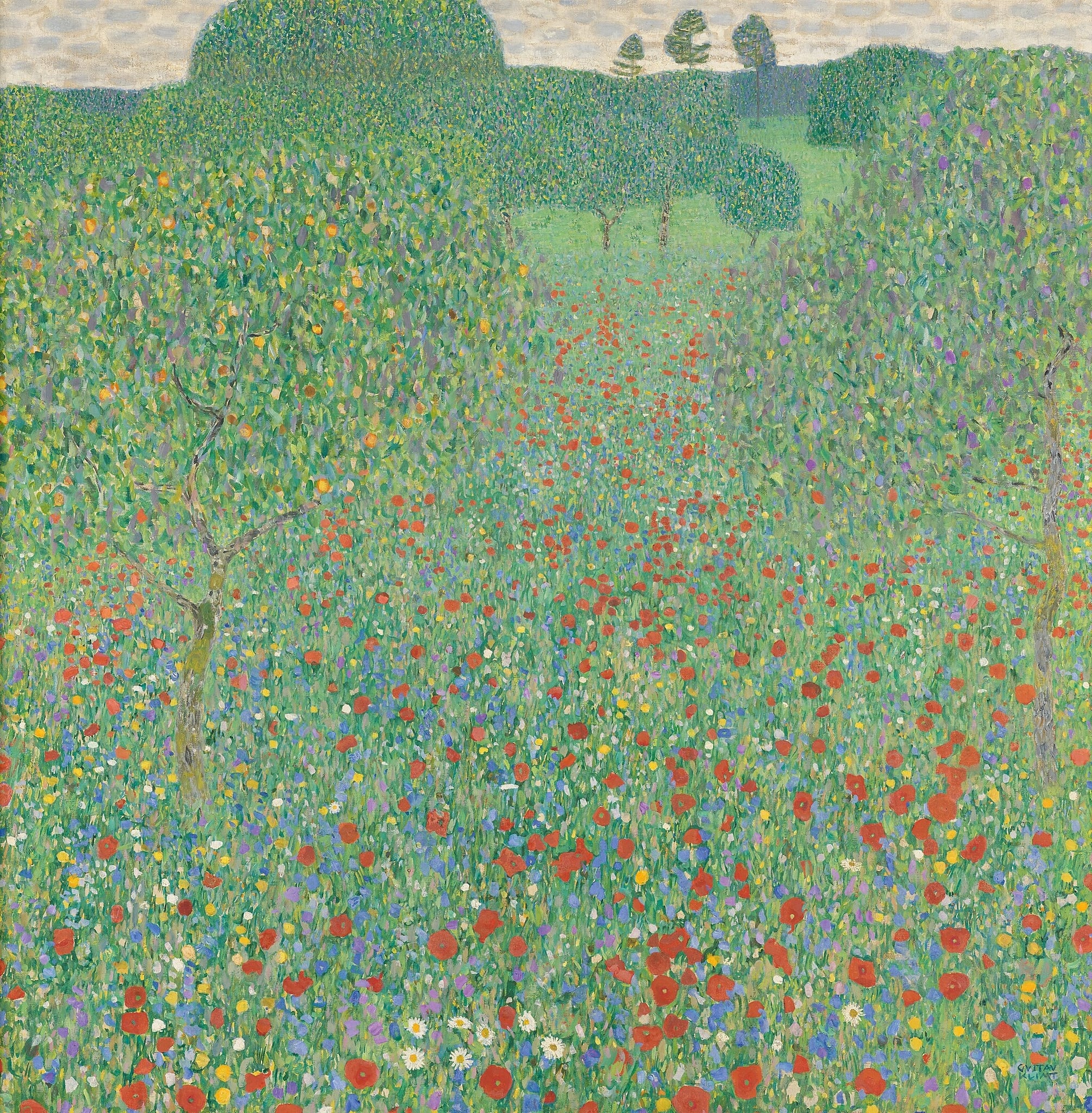
Flowering Poppies
Gustav Klimt (1907)
Gustav Klimt’s <strong>Flowering Poppies</strong> (1907) turns a meadow into a shimmering, all-over field where botany becomes <strong>ornament</strong>. A square canvas packed with red poppies, daisies, and fruiting trees compresses depth and invites a drifting gaze rather than linear recession <sup>[1]</sup><sup>[2]</sup>. The result is a sensuous, immersive vision that fuses observed nature with <strong>decorative abstraction</strong> <sup>[2]</sup>.
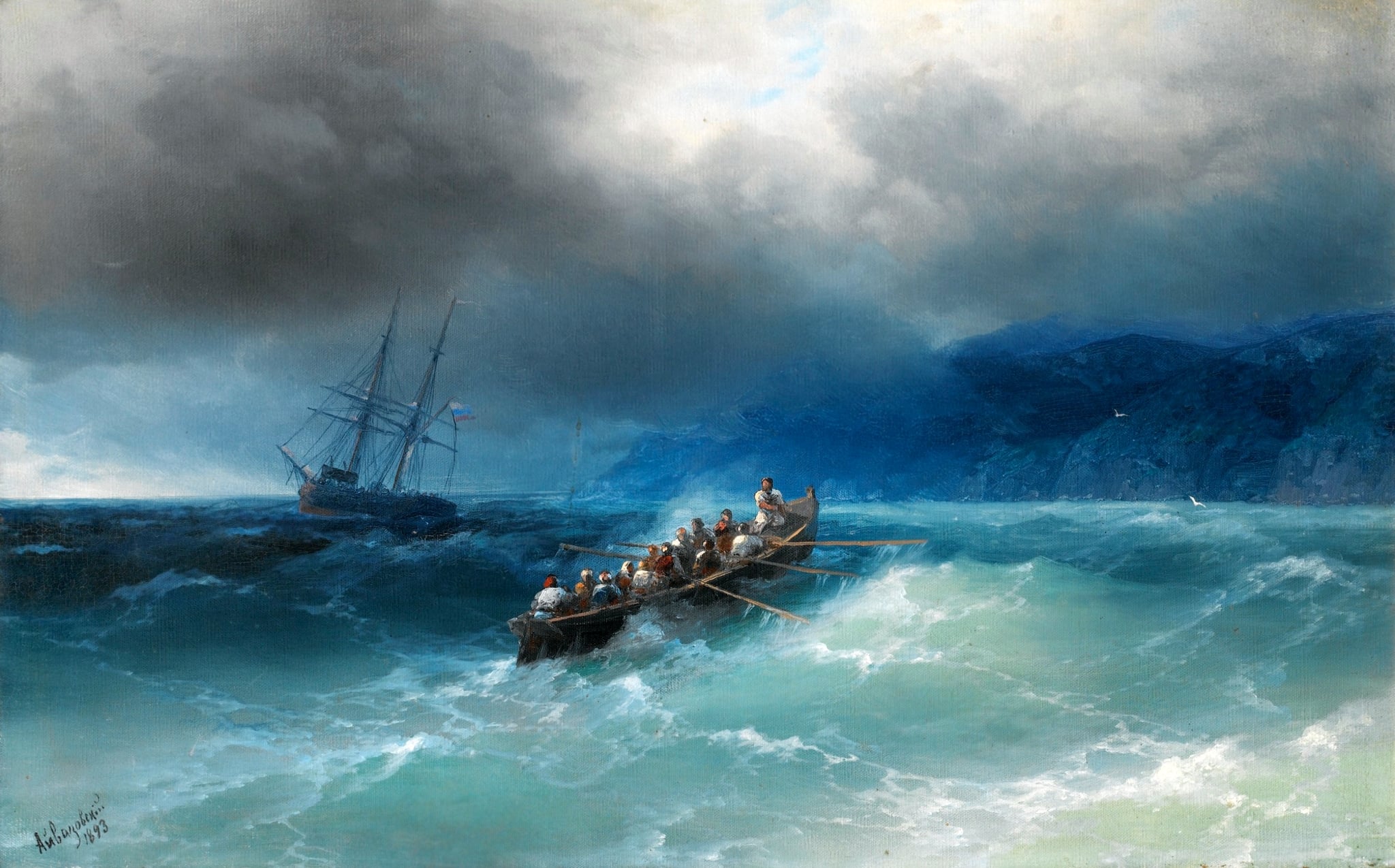
The Storm (Seascape)
Ivan Aivazovsky (1850)
In The Storm (Seascape), Ivan Aivazovsky forges a drama of <strong>human resolve</strong> against the <strong>Sublime sea</strong>. A crowded lifeboat claws up a green-blue swell toward a <strong>break of light</strong>, while a tall-masted ship lists behind and a <strong>rocky coast</strong> looms to the right. The painting crystallizes peril and hope in a single, surging moment.
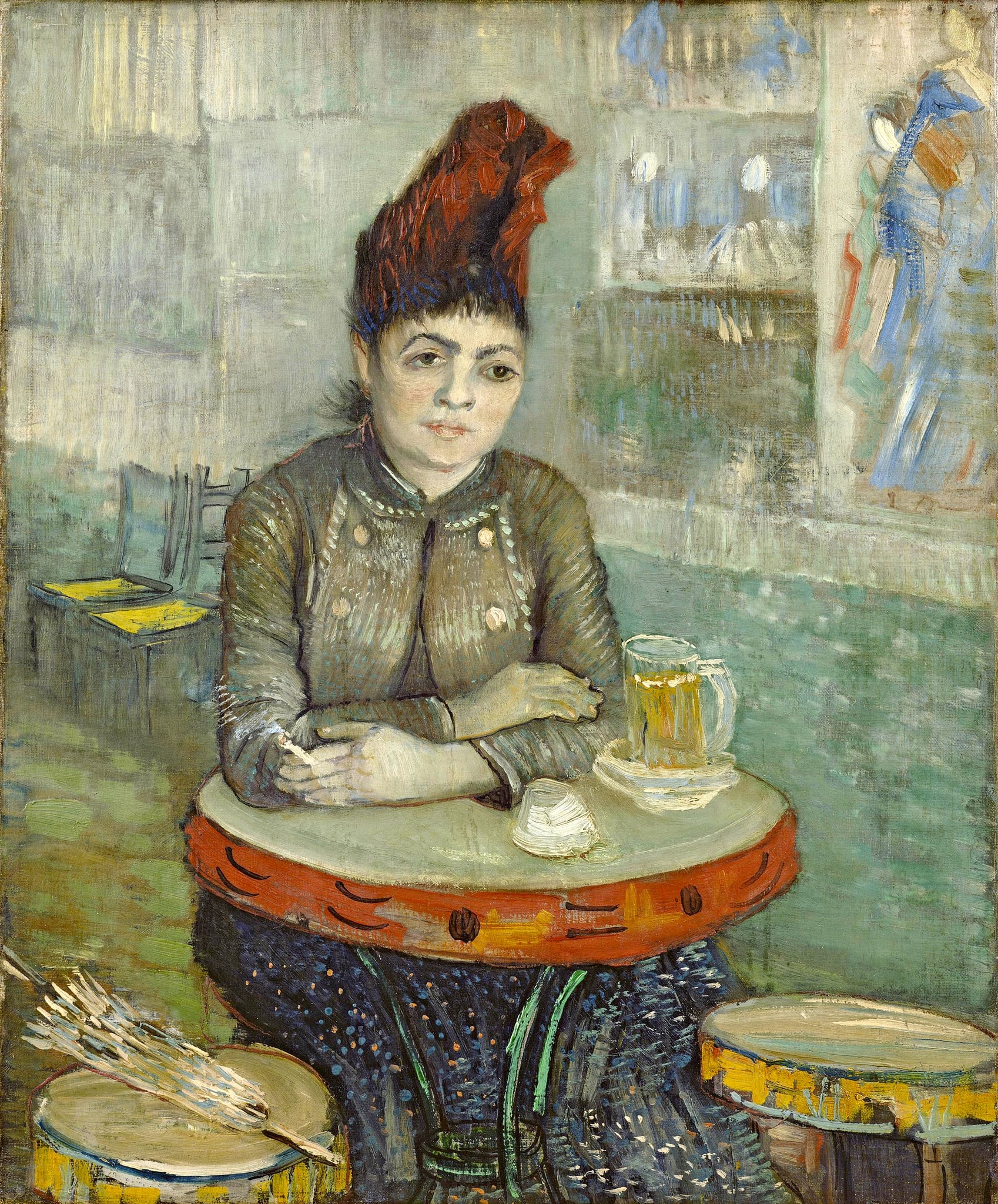
In the Café: Agostina Segatori in Le Tambourin
Vincent van Gogh (1887 (Jan–Mar))
Van Gogh casts Agostina Segatori at a tiny, tambourine‑like café table, turning Le Tambourin into a <strong>stage of modern life</strong>. Cool greens and greys make the red <strong>flame‑plume hat</strong> and the foaming <strong>beer</strong> flare, while folded arms and a set‑aside <strong>parasol</strong> register private fatigue amid public display <sup>[1]</sup><sup>[2]</sup><sup>[3]</sup>.
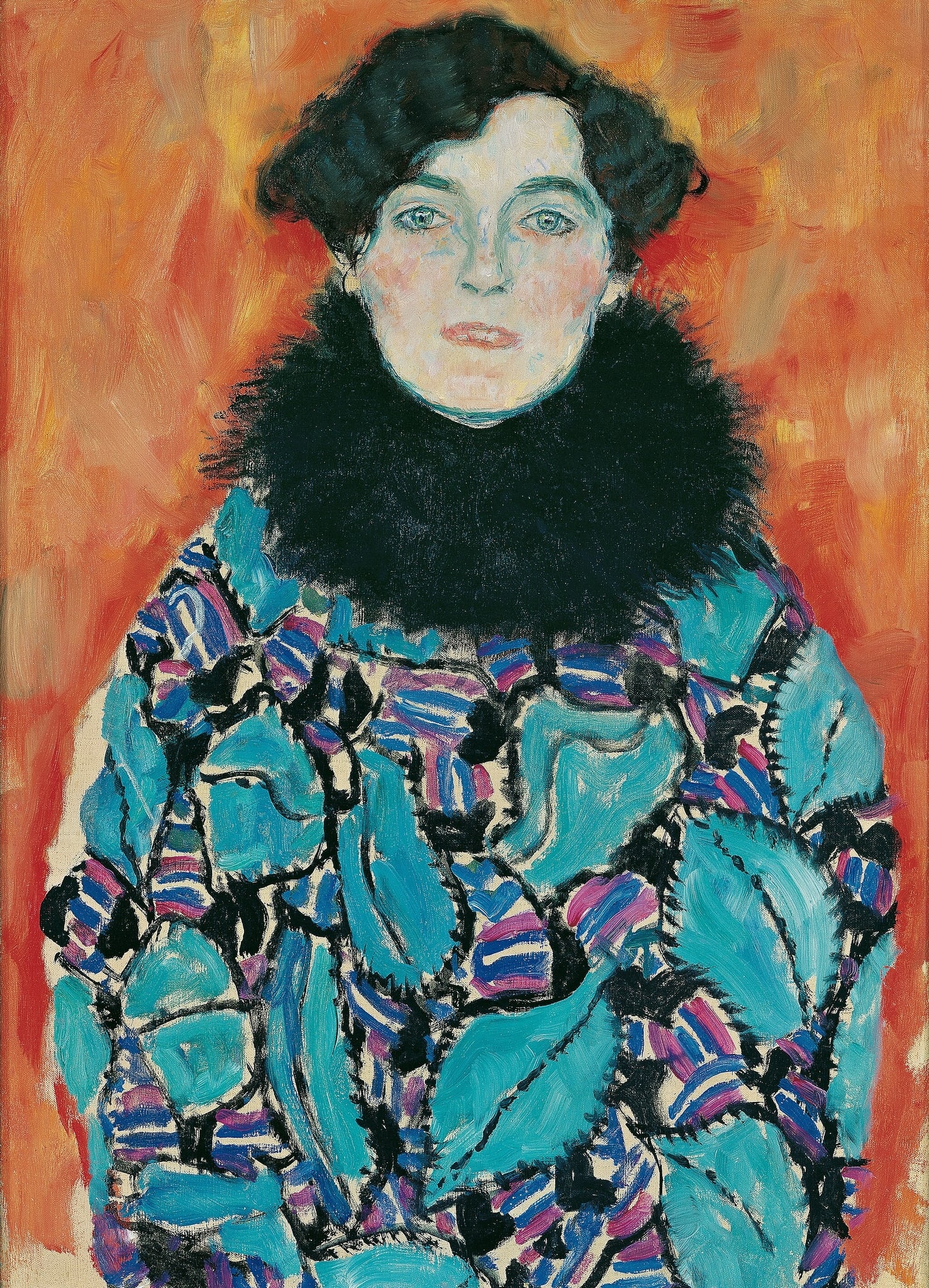
Johanna Staude
Gustav Klimt (1917/1918)
<strong>Johanna Staude</strong> distills Klimt’s late style into a charged encounter between a cool, impassive face and a blazing orange field. The sitter’s head is isolated by a <strong>black feather collar</strong>, while a <strong>Wiener Werkstätte</strong> blouse in turquoise leaves and violet stripes surges forward as a near-abstract surface <sup>[1]</sup><sup>[2]</sup>. Painted in 1917/1918 and left <strong>unfinished</strong> at the mouth, it becomes a poised emblem of modern identity in Vienna on the eve of Klimt’s death <sup>[1]</sup><sup>[2]</sup><sup>[5]</sup>.
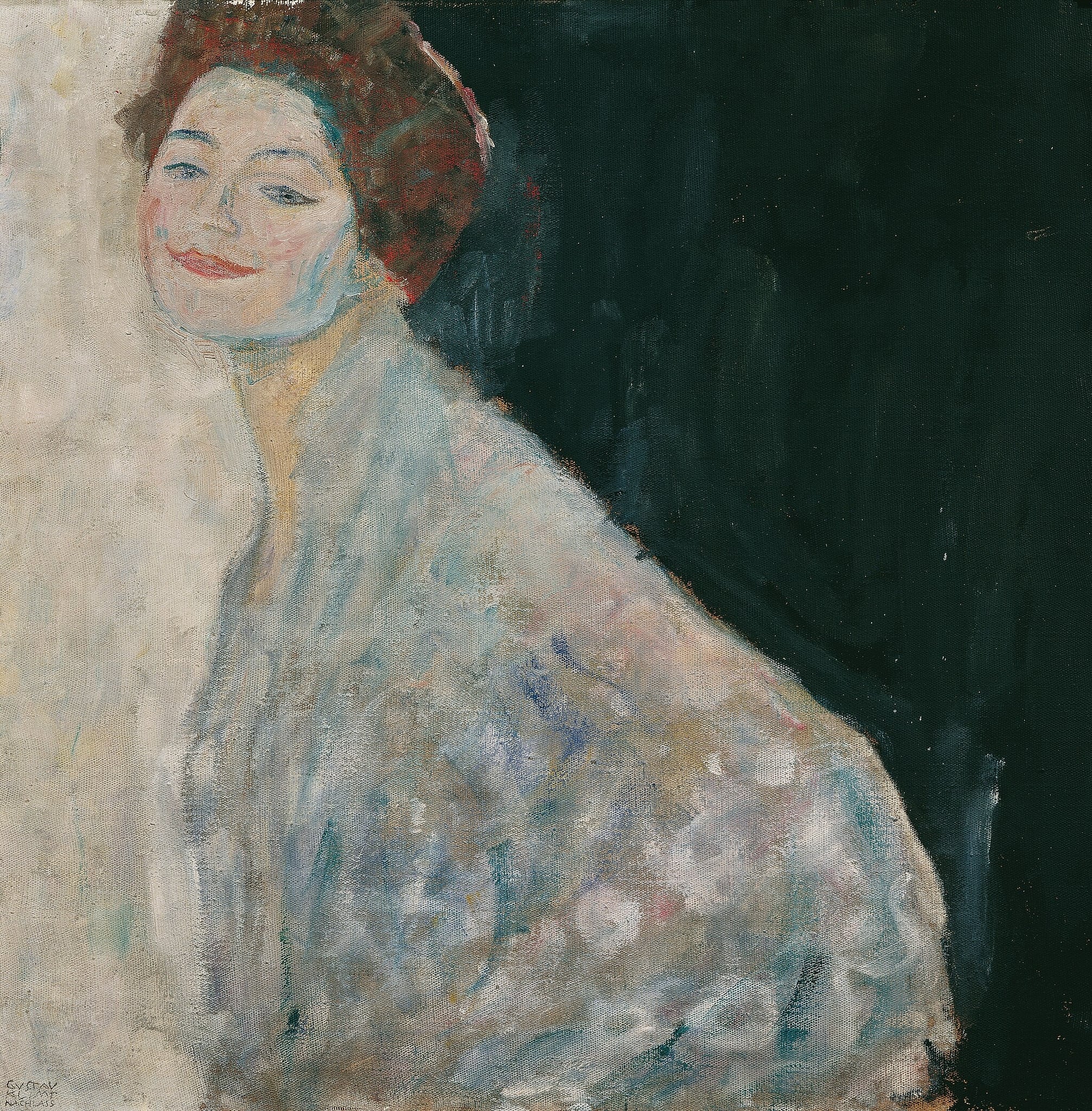
Lady in White
Gustav Klimt (1917–1918)
Lady in White crystallizes Klimt’s late style as a <strong>liminal apparition</strong>: a woman who seems to form out of paint where a pale field meets a dark one. Her kimono‑like robe dissolves into <strong>iridescent whites</strong> touched by blues and violets, while a tilted, <strong>mask‑like smile</strong> hovers between intimacy and anonymity <sup>[1]</sup><sup>[2]</sup><sup>[3]</sup>. The result is less a likeness than a <strong>luminous state of being</strong> suspended on a threshold.
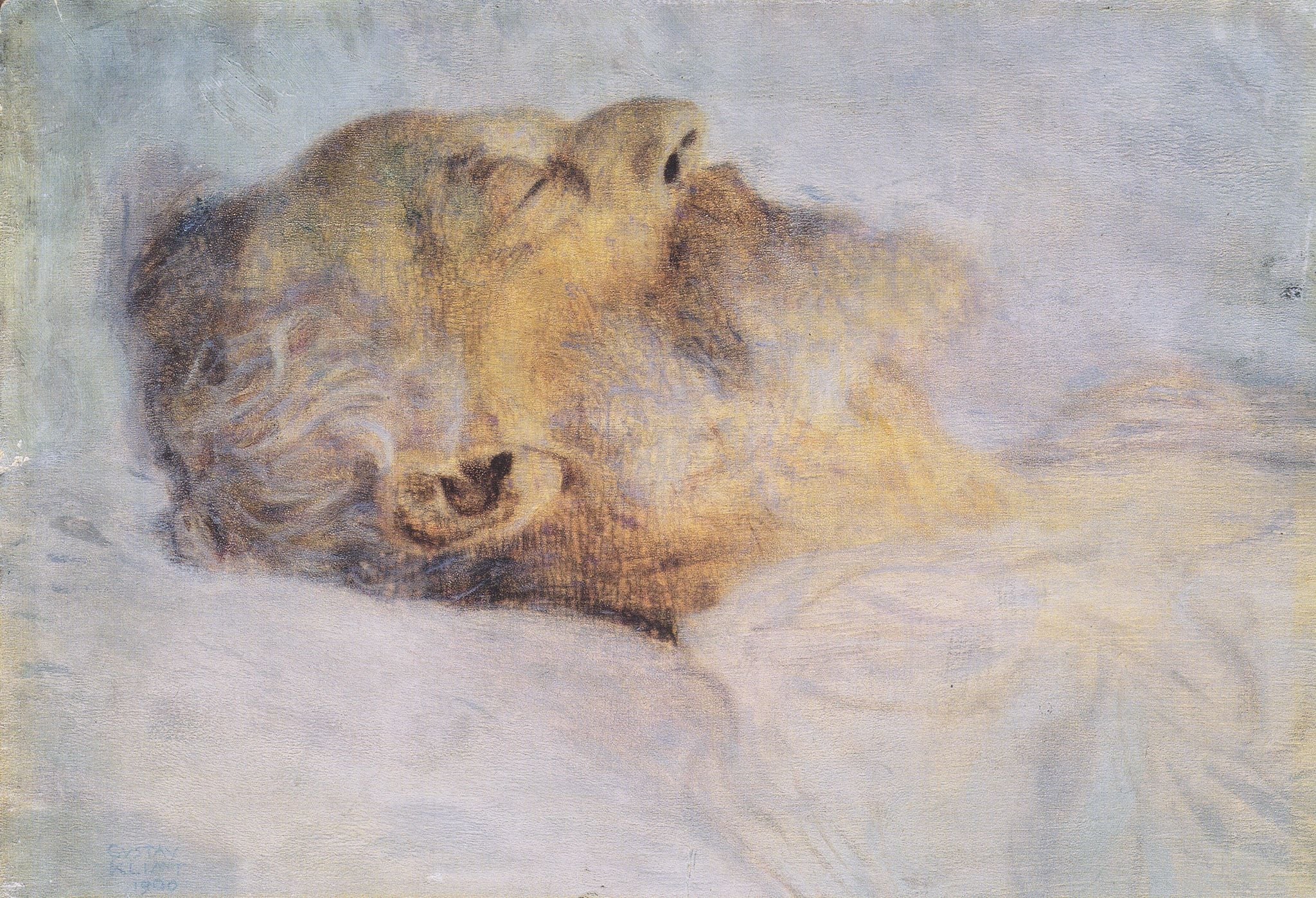
Old Man on His Deathbed
Gustav Klimt (1900 (cataloged; c. 1899–1900, inscription likely by another hand))
Gustav Klimt’s Old Man on His Deathbed is a concentrated vigil at life’s threshold, rendered in <strong>vaporous blues and ochers</strong> that let head, pillow, and air bleed into one another. The profile turned toward light, with <strong>closed eyes and a slightly parted mouth</strong>, transforms observation into a modern <strong>memento mori</strong> <sup>[1]</sup><sup>[2]</sup>.
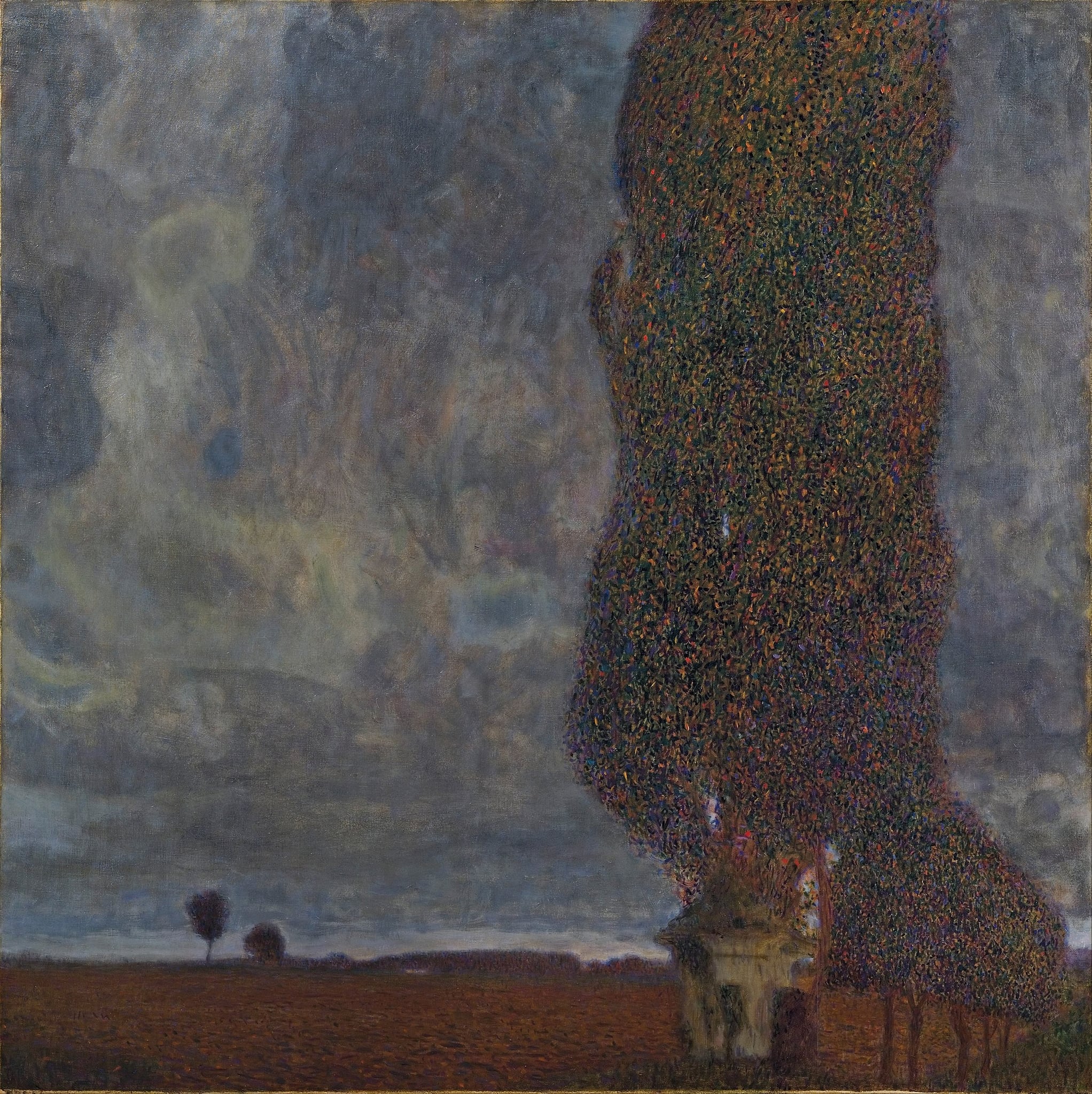
The Large Poplar II (Gathering Storm)
Gustav Klimt (1902/03)
In The Large Poplar II (Gathering Storm), a monumental poplar rises like a <strong>sentinel</strong> at the right edge while a low, rust-toned plain and tiny chapel anchor the horizon. Klimt devotes most of the square canvas to a <strong>charged, near-monochrome sky</strong>, making weather the protagonist and turning the tree’s flecked canopy into a shimmering, ominous <strong>mosaic</strong> <sup>[1]</sup><sup>[2]</sup>.
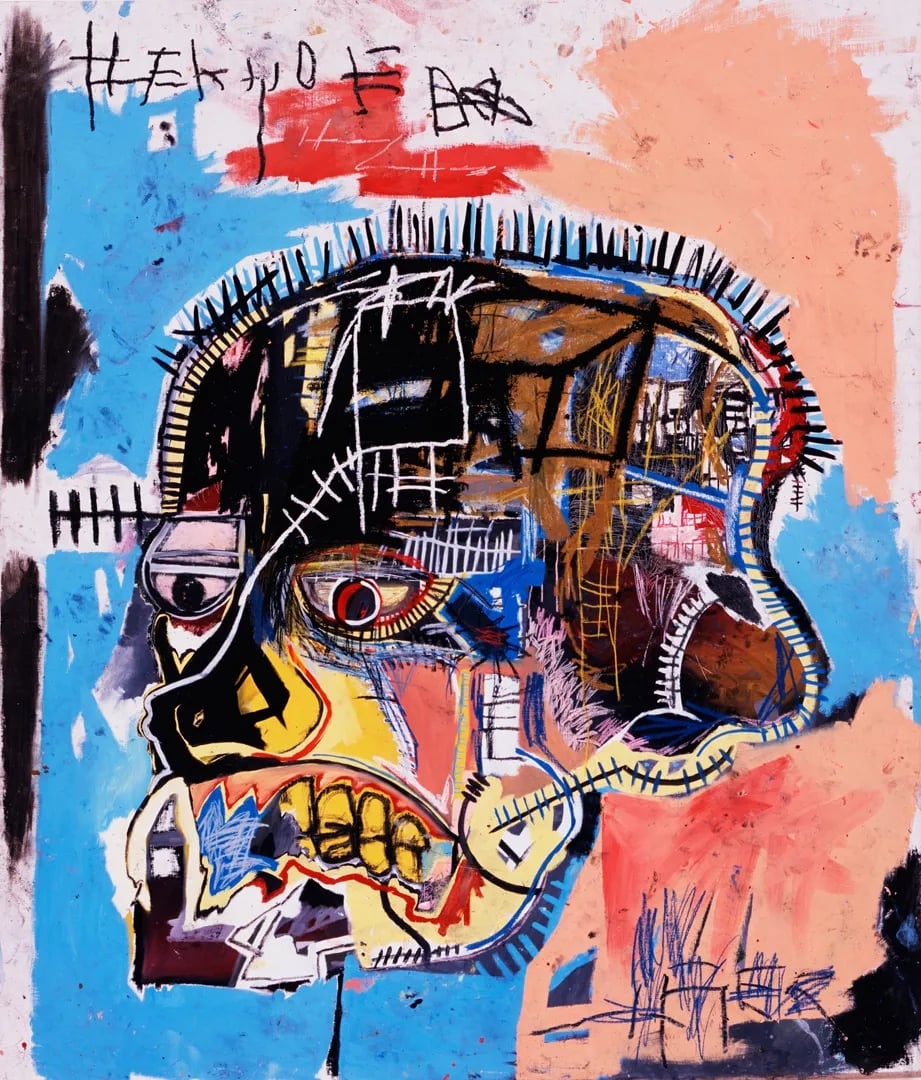
Untitled
Jean-Michel Basquiat (1981)
Untitled confronts the viewer with a cutaway <strong>head</strong> that fuses portrait and <strong>x‑ray</strong>, mapping the psyche as anatomy. Searing lines, sutures, and bared teeth stage a battle between expression and damage, turning the act of seeing into an autopsy of identity. Basquiat’s volatile color blocks of <strong>powder blue</strong> and <strong>peach</strong> intensify the sense of a self under pressure and alive with current.
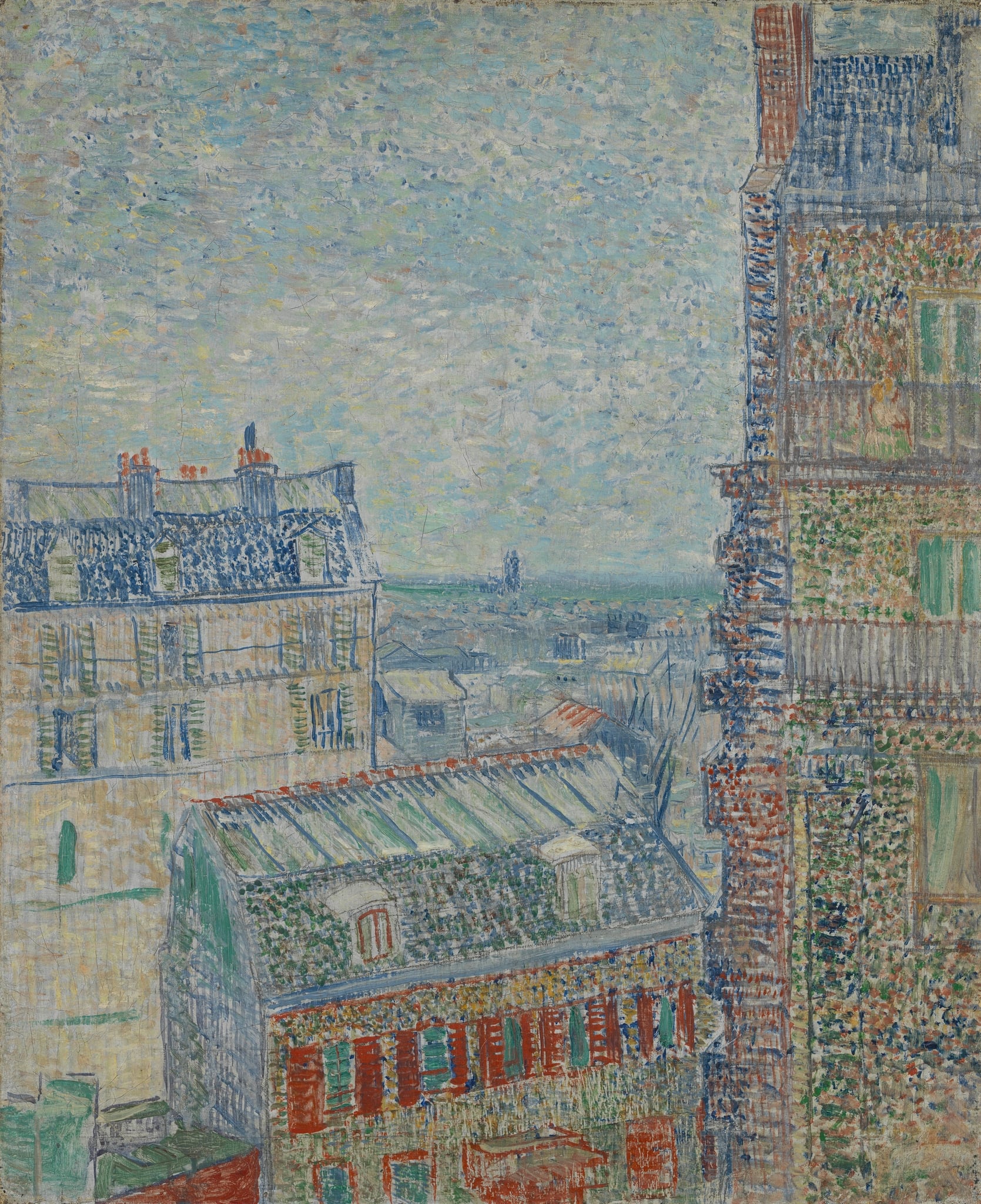
View from Theo's Apartment
Vincent van Gogh (1887)
Van Gogh’s View from Theo’s Apartment compresses Paris into a close tapestry of roofs, windows, and chimneys, then releases the gaze into a pale, stippled sky. The painting fuses loose strokes with Pointillist touches, setting cool slate blues against warm brick reds to make the city surface <strong>quiver with urban energy</strong> <sup>[1]</sup><sup>[5]</sup>. On the far horizon, the vista opens toward Meudon and the Trocadéro, anchoring the scene in a real, breathable distance <sup>[2]</sup>.
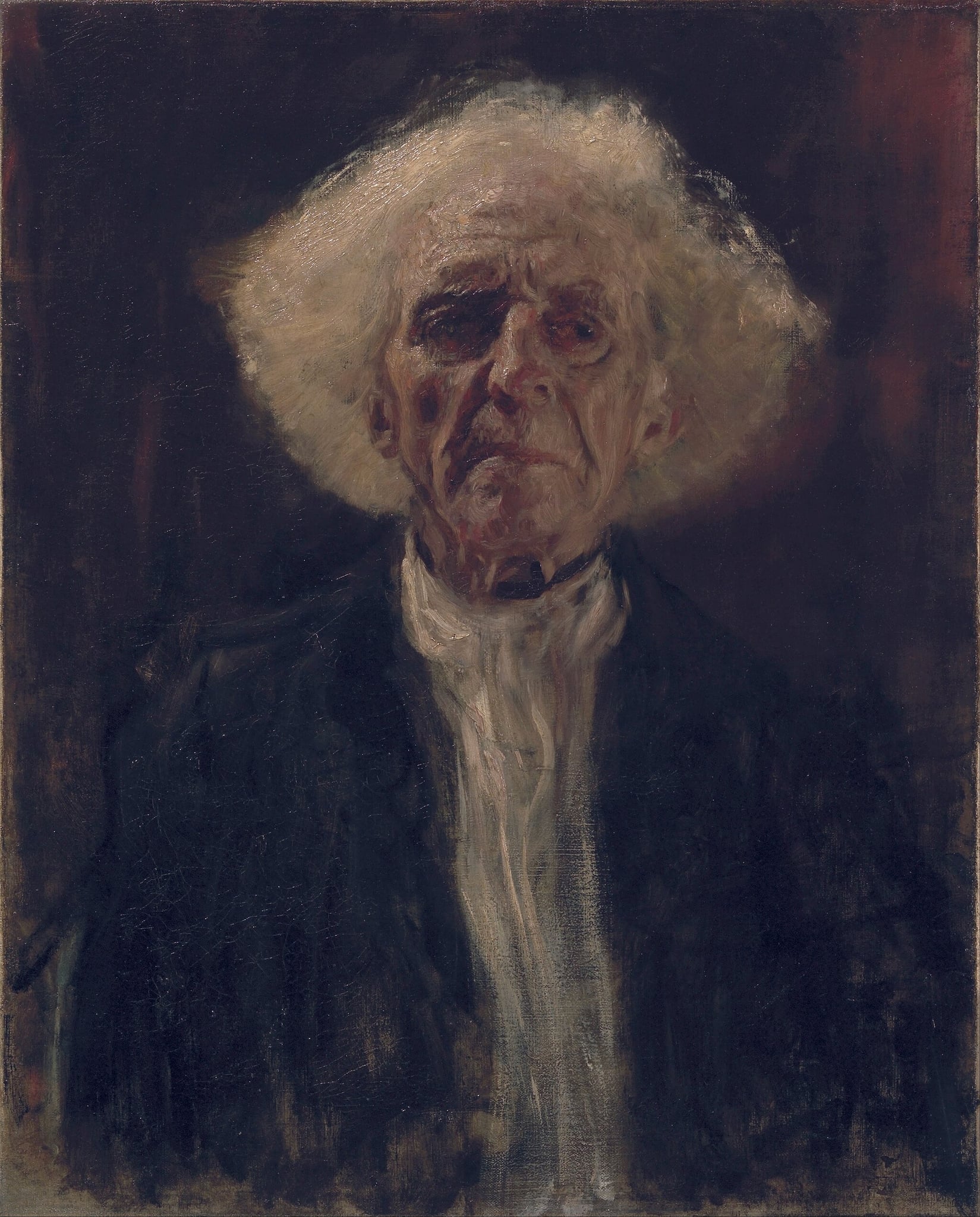
The Blind Man
Gustav Klimt (c. 1896)
Gustav Klimt’s The Blind Man confronts the viewer with a monumental head and torso emerging from a near-black field, where <strong>chiaroscuro</strong>, <strong>tactile paint</strong>, and an <strong>occluded gaze</strong> redirect attention from sight to touch and memory. The dissolving white collar and scumbled halo of hair make the figure feel carved from darkness, asserting <strong>dignity without sentiment</strong> and turning blindness into a form of inward presence <sup>[1]</sup>.
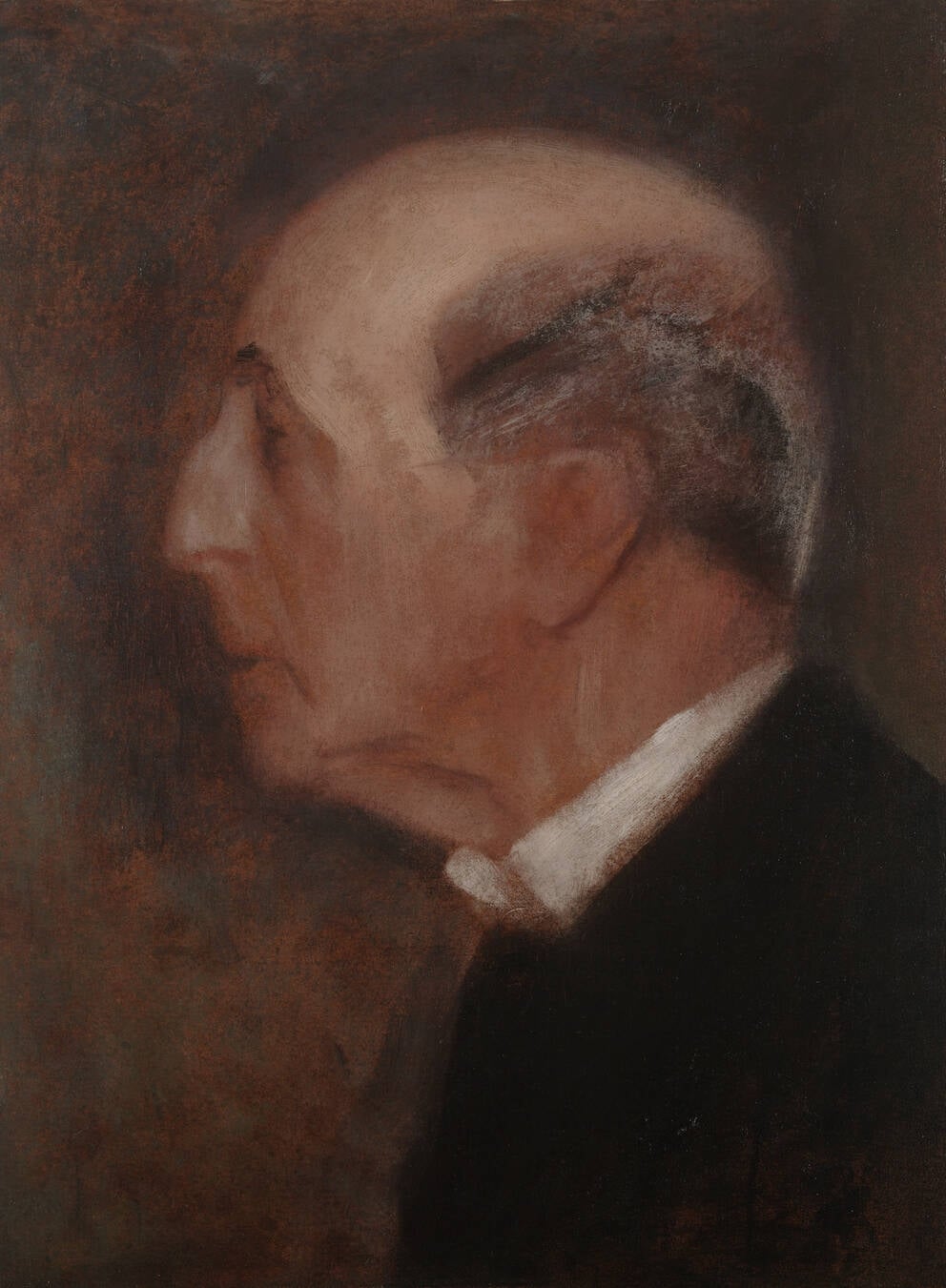
Portrait of an Old Man in Profile (Count Traun?)
Gustav Klimt (c. 1896)
Gustav Klimt’s Portrait of an Old Man in Profile (Count Traun?) distills human presence to a <strong>strict profile</strong> set against a <strong>dusky, earth‑toned</strong> field. With thin oil on cardboard, Klimt lets edges <strong>dissolve into atmosphere</strong>, turning the bald crown, graying wisps, and slack jaw into a meditation on <strong>age and transience</strong> <sup>[1]</sup>.
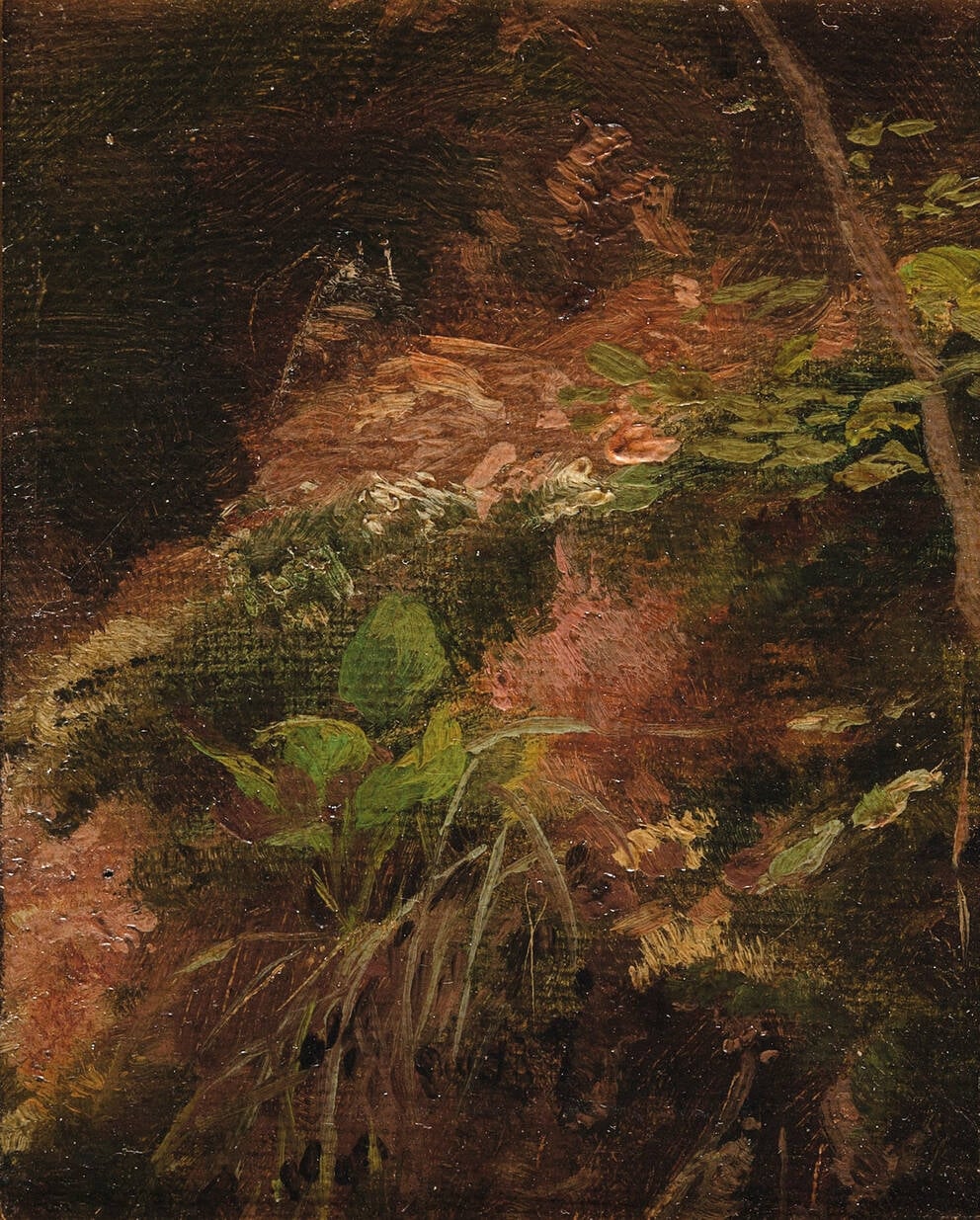
Forest Floor
Gustav Klimt (c. 1881/1882)
Forest Floor concentrates the eye on a miniature world of soil, moss, and leaf-litter rendered in tactile strokes and dark-to-amber light. Klimt frames a diagonal bank with a small sapling and sprouting leaves, turning the ground into a <strong>living tapestry</strong> of decay and renewal <sup>[1]</sup>. As an early oil sketch, it fuses <strong>academic chiaroscuro</strong> with a proto-decorative rhythm that hints at later developments <sup>[1]</sup>.
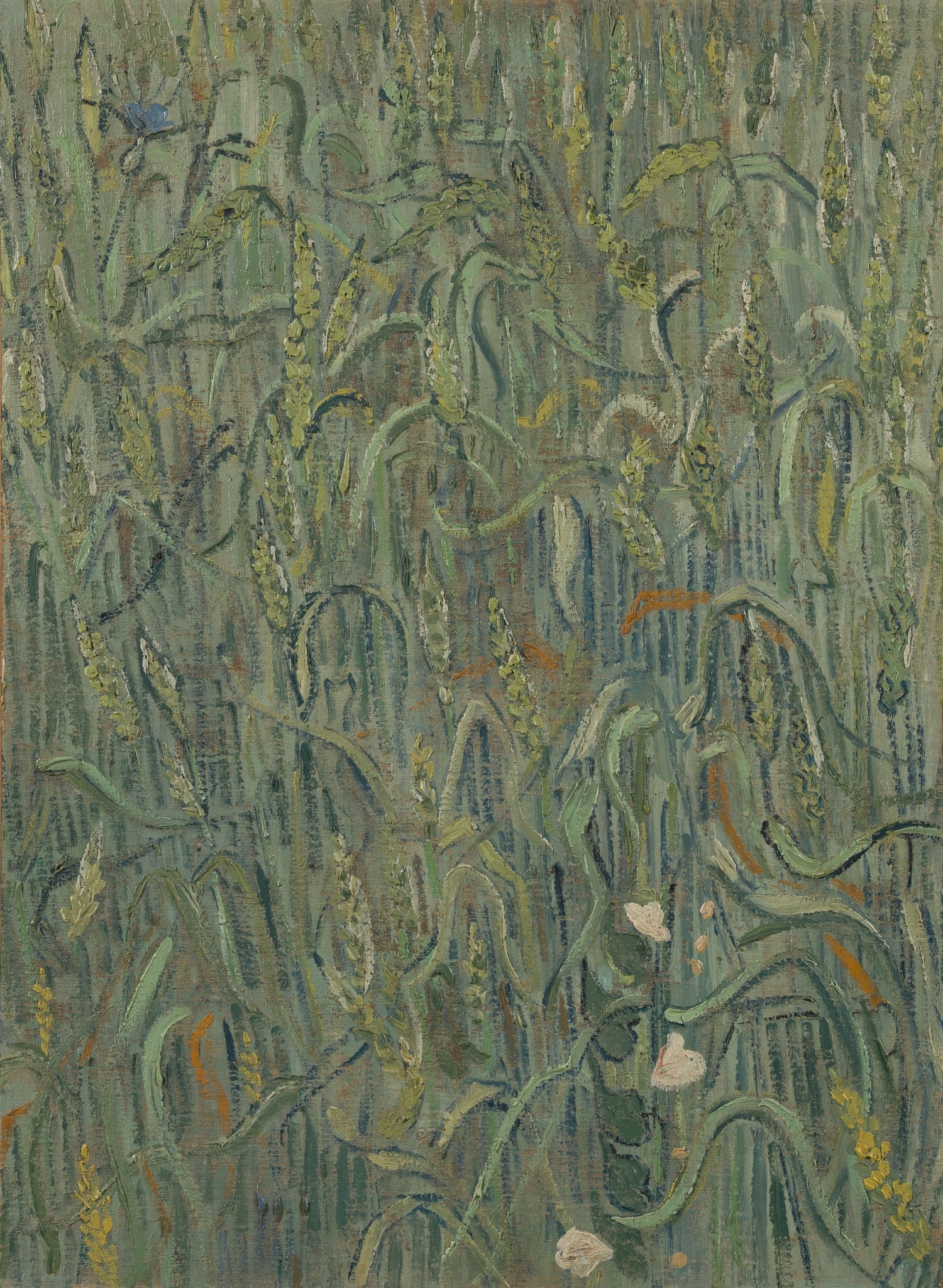
Ears of Wheat
Vincent van Gogh (1890)
Ears of Wheat plunges the viewer into a close, horizonless tangle of grain, rendering a living field as an all‑over surface of <strong>vibrating strokes</strong> and <strong>looping leaves</strong>. Cool greens and blue‑grays are pricked by ocher and rusty orange, while a blue <strong>cornflower</strong> at upper left and pale <strong>bindweed</strong> at lower right anchor the scene’s ecology <sup>[1]</sup><sup>[2]</sup>. Van Gogh turns a humble crop into a <strong>meditation on resilience and life’s cycles</strong>.
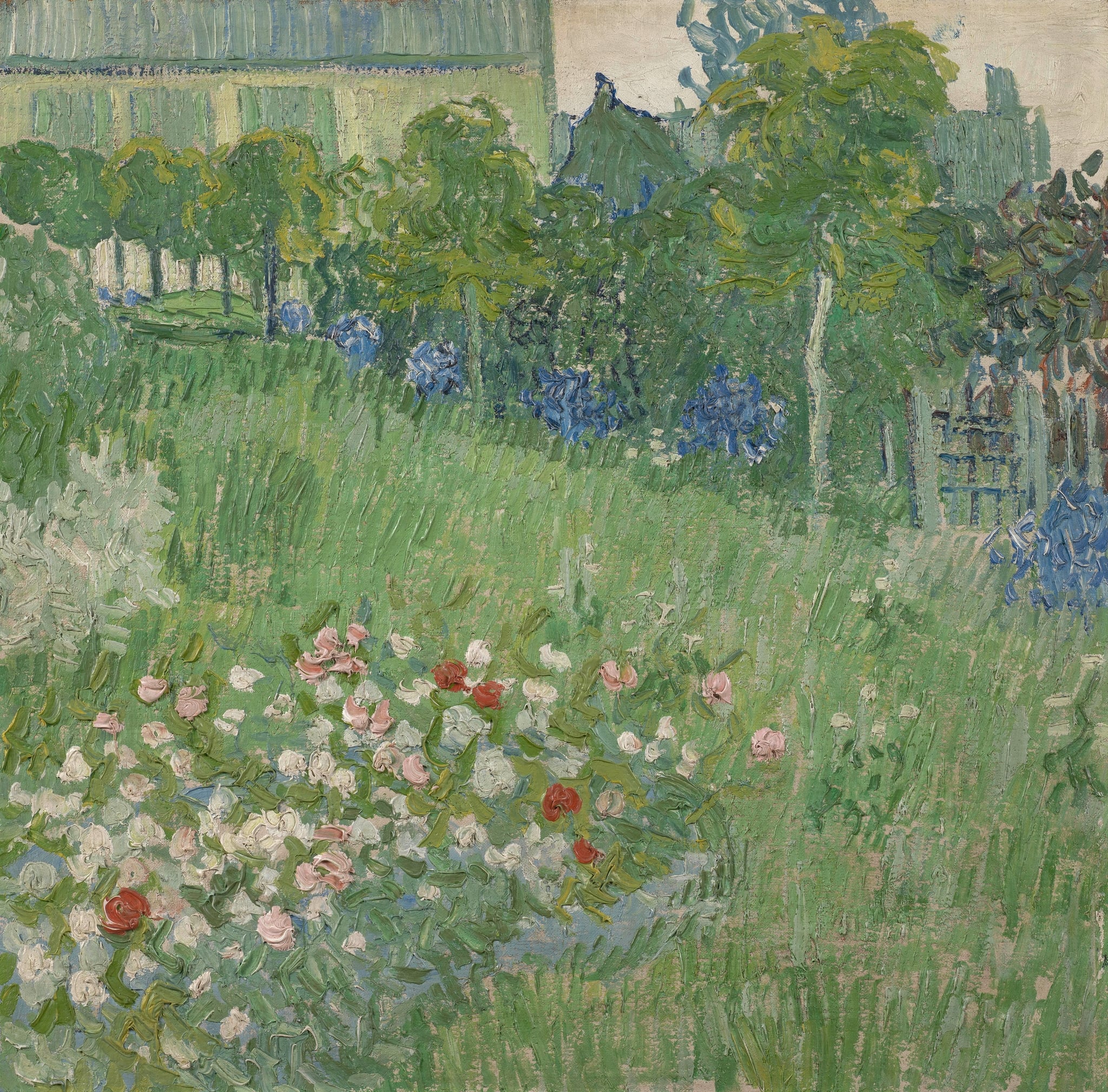
Daubigny's Garden
Vincent van Gogh (1890)
In Daubigny's Garden, Vincent van Gogh forges a <strong>living field of green</strong> where short, pulsating strokes turn grass, hedge, and trees into a single, breathing organism. A <strong>rose bed of pale pinks and reds</strong> pools in the foreground, while <strong>cobalt-blue flowers</strong> puncture the middle hedge, and the pale façade and roof beyond seal the garden into an intimate retreat <sup>[1]</sup><sup>[2]</sup>.
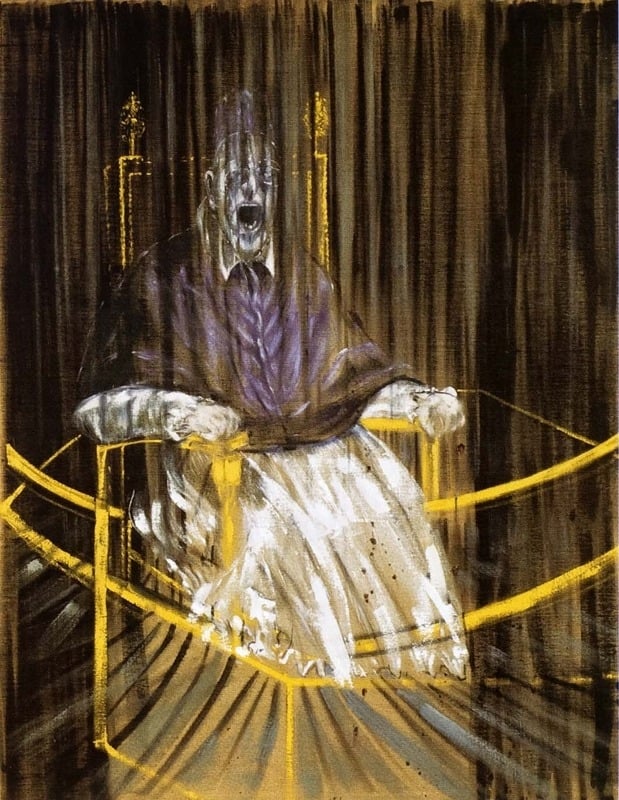
Study for Portrait of Pope Innocent X
Francis Bacon (1953)
Francis Bacon’s Study for Portrait of Pope Innocent X converts a seat of power into a <strong>cage of panic</strong>: a pontiff pinned in a golden <strong>space‑frame</strong>, mouth <strong>wrenched open</strong> beneath a torrent of vertical strokes. Violets, blacks, and acidic yellows turn vestments into a <strong>shroud</strong>, while the white robe flares like a spectral residue.
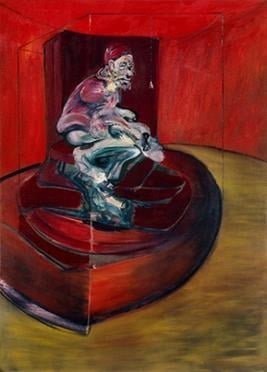
Study from Innocent X
Francis Bacon (1962)
Francis Bacon’s Study from Innocent X recasts the papal portrait as an image of <strong>enthroned vulnerability</strong>. Hemmed by thin <strong>cage-lines</strong> on a curved <strong>stage-like dais</strong>, the red-suffused figure trembles between flesh and regalia, turning authority into exposure <sup>[1]</sup><sup>[3]</sup>.
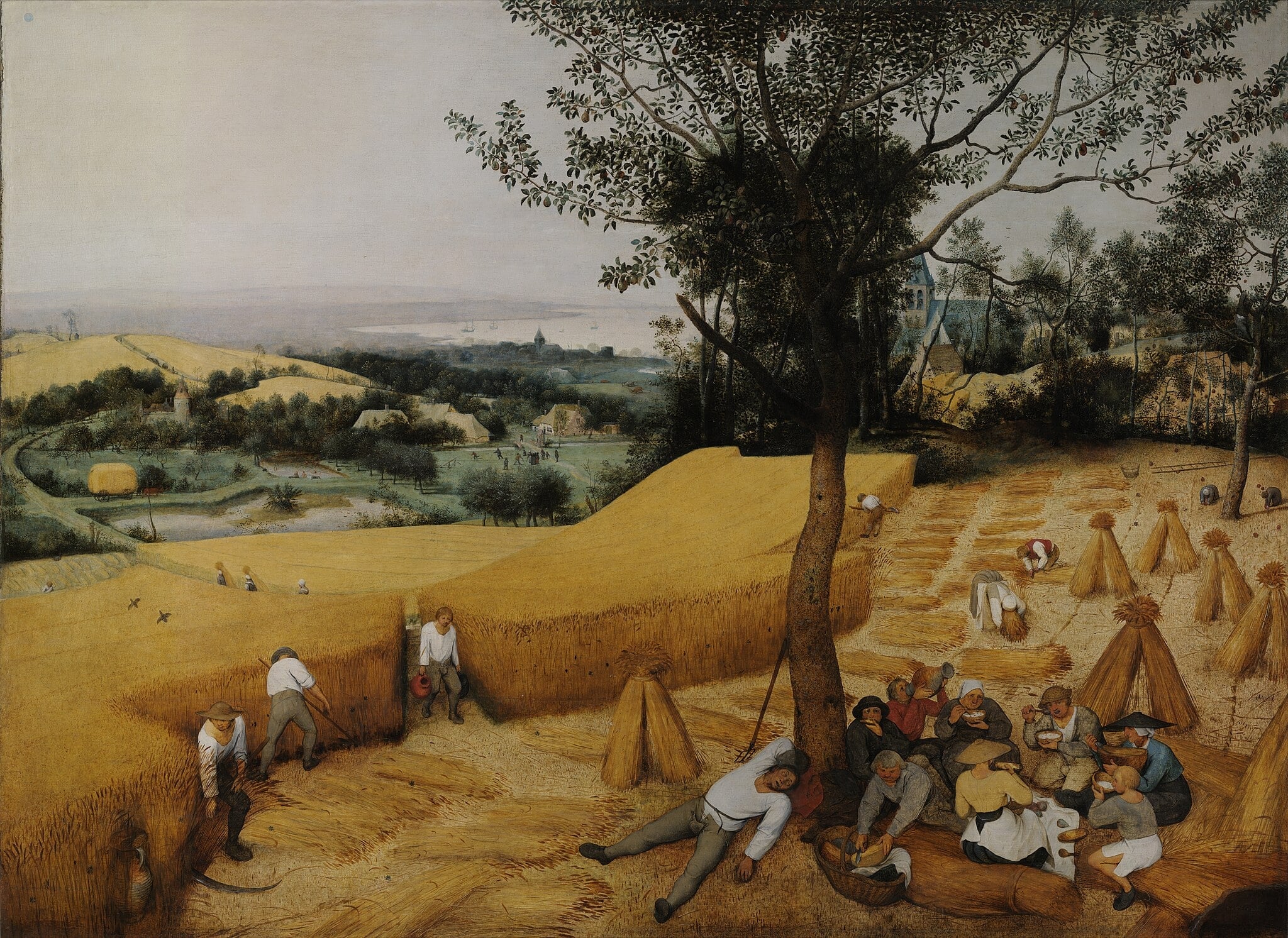
The Harvesters
Pieter Bruegel the Elder (1565)
The Harvesters distills late summer into a seamless weave of <strong>labor and reward</strong>: reapers bend to wheat while others eat and doze beneath a tree, and the world opens to roads, a village, and ships. Bruegel dignifies every action with <strong>even light</strong> and a democratic gaze, turning a specific day’s work into an image of <strong>cyclical time</strong> and shared sustenance <sup>[1]</sup><sup>[4]</sup>.
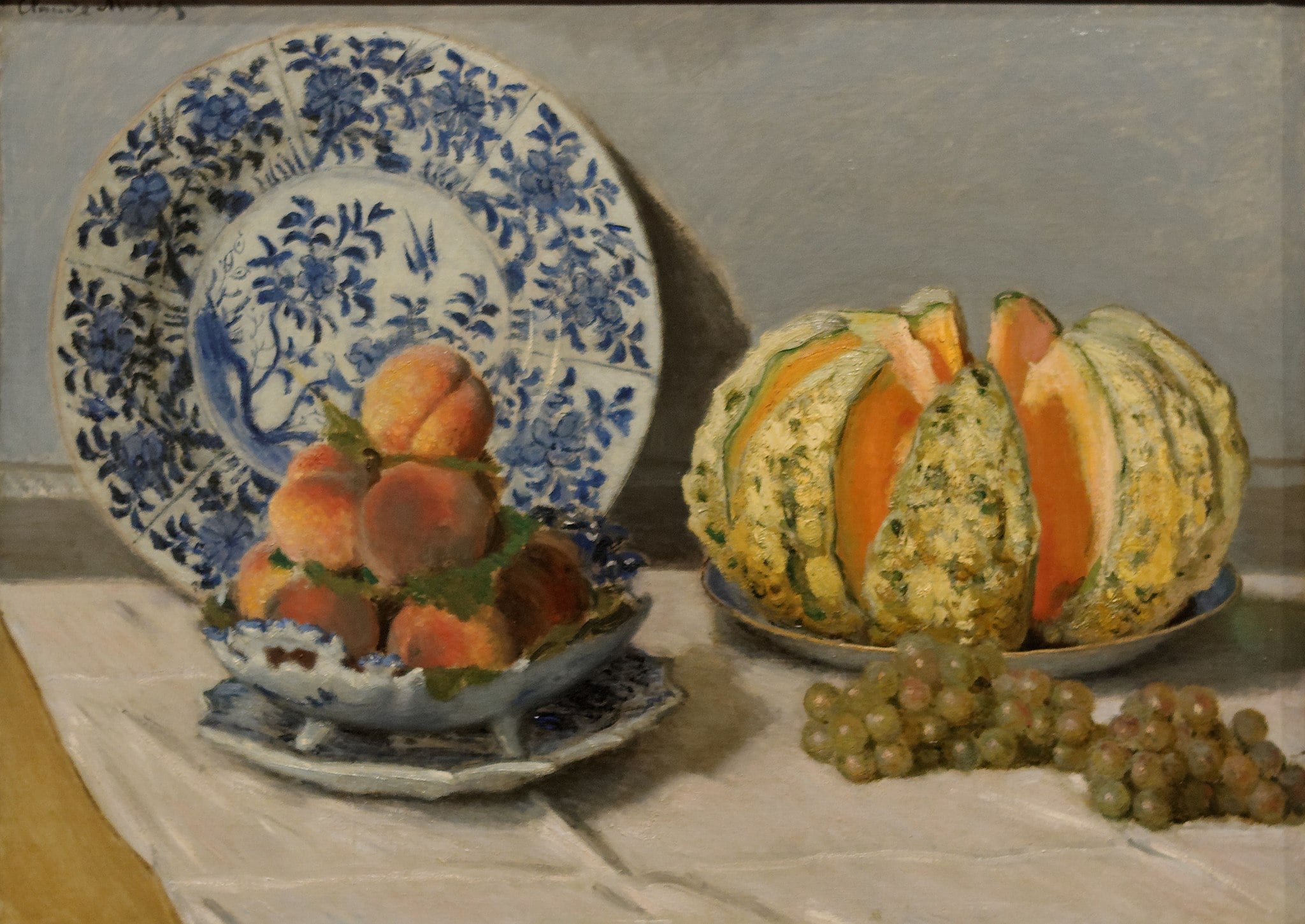
Still Life
Claude Monet (1872)
Claude Monet’s Still Life (1872) stages ripe peaches, a cut <strong>melon</strong>, and scattered grapes before luminous <strong>blue-and-white porcelain</strong>, turning a domestic spread into a drama of light and texture. Cool ceramics and a pale wall frame the warm, tactile fruit, while firm contours yield to buttery impasto on the melon’s rind. The painting renews a venerable genre through an Impressionist focus on <strong>perception</strong> and chromatic contrast <sup>[1]</sup><sup>[2]</sup>.
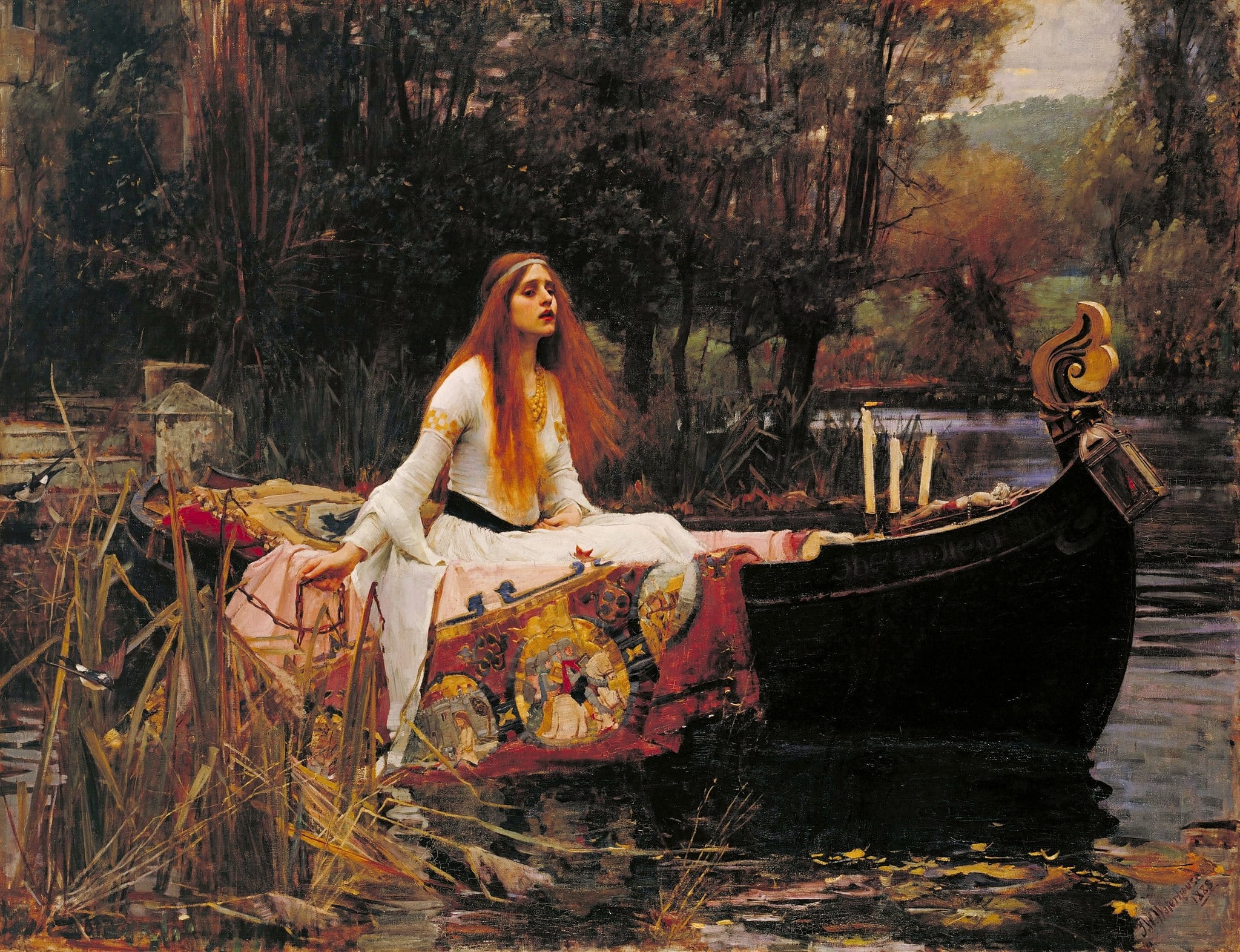
The Lady of Shalott
John William Waterhouse (1888)
John William Waterhouse’s The Lady of Shalott fixes the tragic instant when the cursed Lady chooses to loose her mooring and drift toward Camelot. The released <strong>chain</strong>, the guttering <strong>candles</strong>, and the tapestry spilling over the boat narrate a passage from sheltered artifice to fatal reality. Waterhouse fuses late <strong>Pre-Raphaelite</strong> symbolism with elegiac atmosphere to stage beauty caught between <strong>agency</strong> and <strong>doom</strong> <sup>[1]</sup><sup>[2]</sup><sup>[3]</sup>.
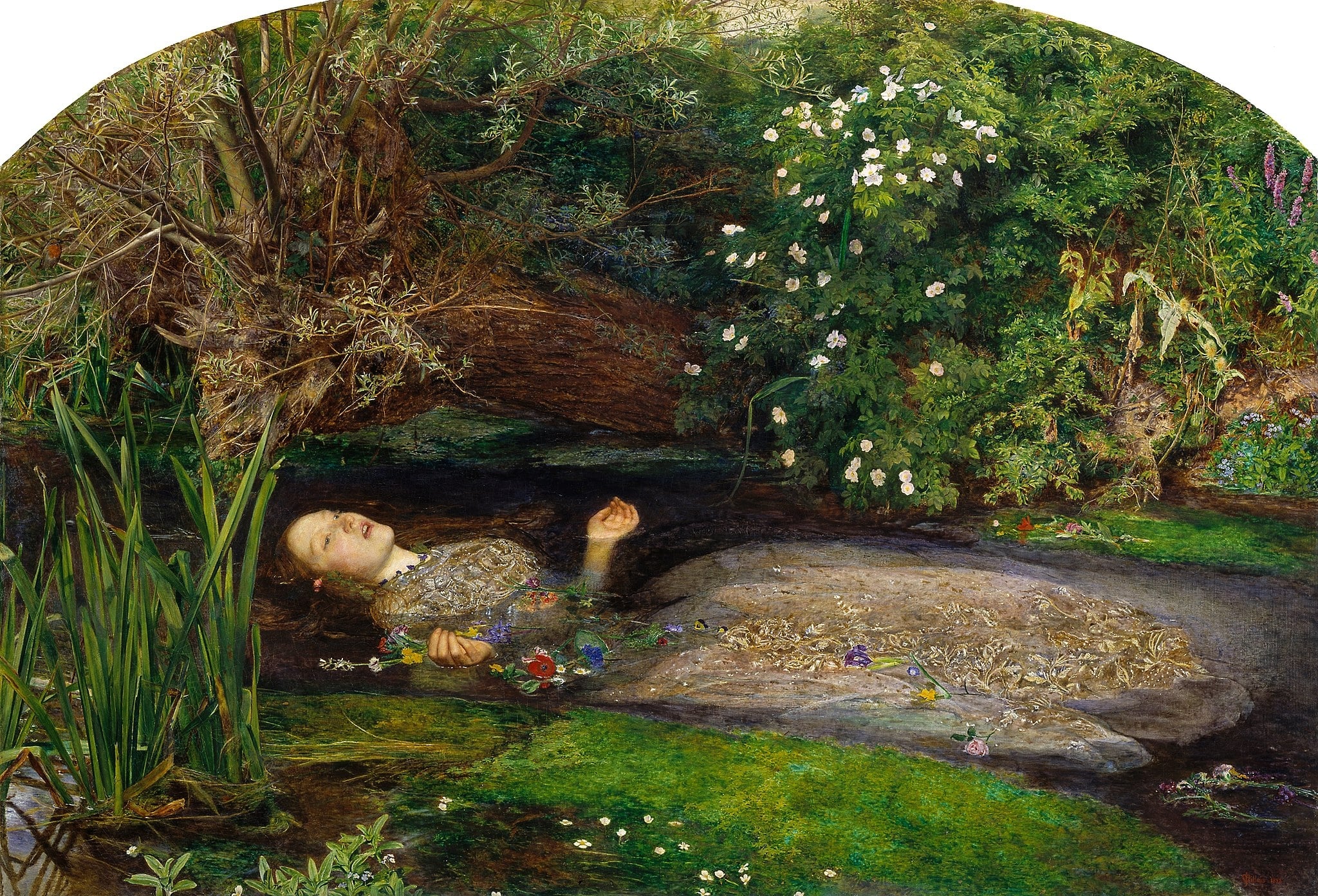
Ophelia
John Everett Millais (1851–1852)
John Everett Millais’s Ophelia shows Shakespeare’s heroine floating in a narrow stream, her jeweled dress both buoying and engulfing her. Millais renders the riverbank with <strong>forensic botanical precision</strong>, so that reeds, willow, briars, nettles, and a scatter of emblematic flowers surround a face slack in mid‑song and hands raised in <strong>open‑palmed surrender</strong> <sup>[1]</sup><sup>[3]</sup>.
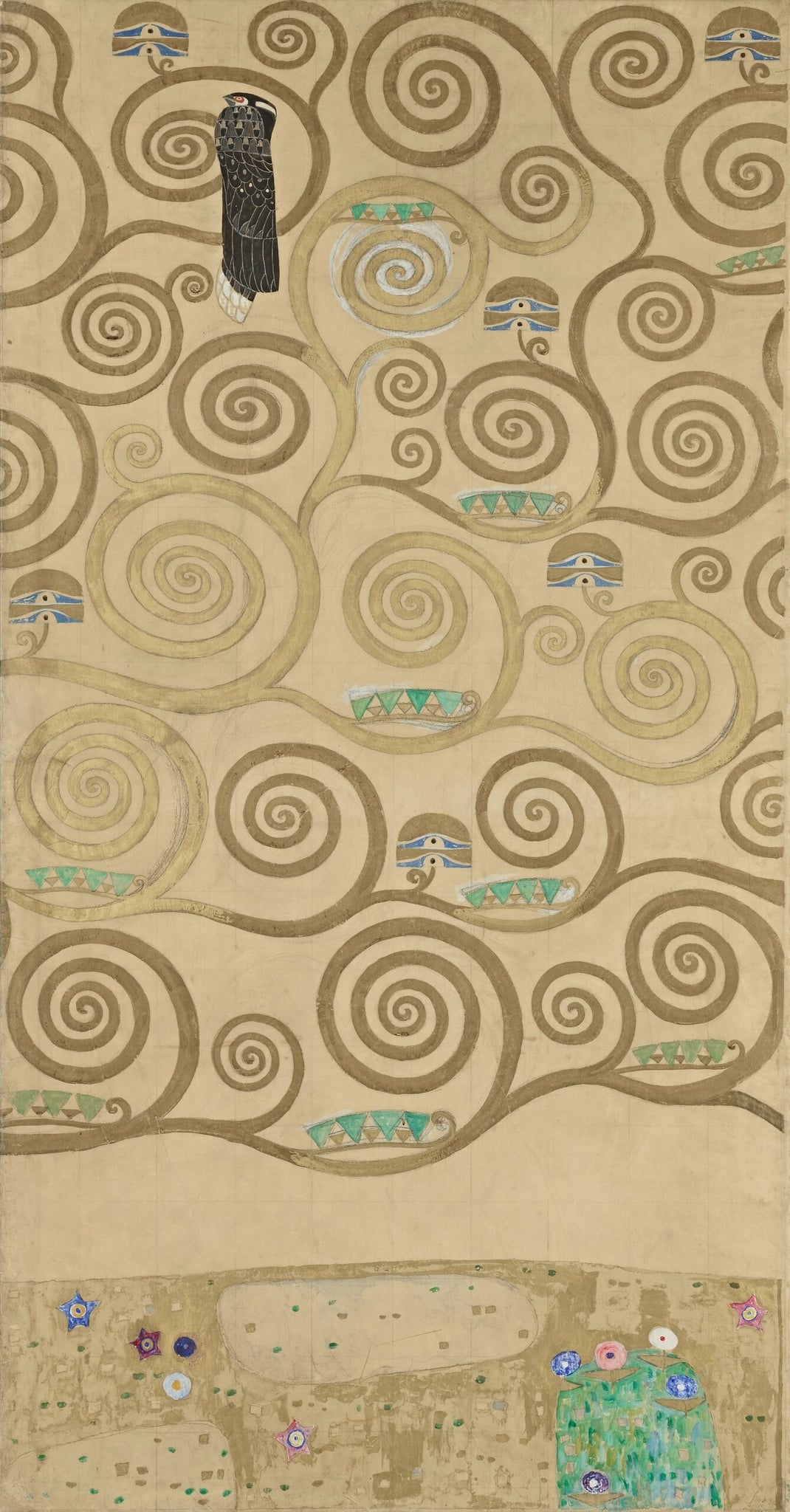
Part of the Tree of Life (Part 5)
Gustav Klimt (1910–1911)
In Part of the Tree of Life (Part 5), Gustav Klimt renders a cosmos of spiraling branches studded with <strong>Eyes of Horus</strong>, turquoise tesserae, and a solitary dark <strong>bird</strong>. The panel condenses themes of vigilance, renewal, and mortality into a decorative grammar that served as a full-scale working <strong>cartoon</strong> for the Stoclet dining-room mosaics—a key Secessionist <strong>Gesamtkunstwerk</strong> <sup>[1]</sup><sup>[2]</sup>.
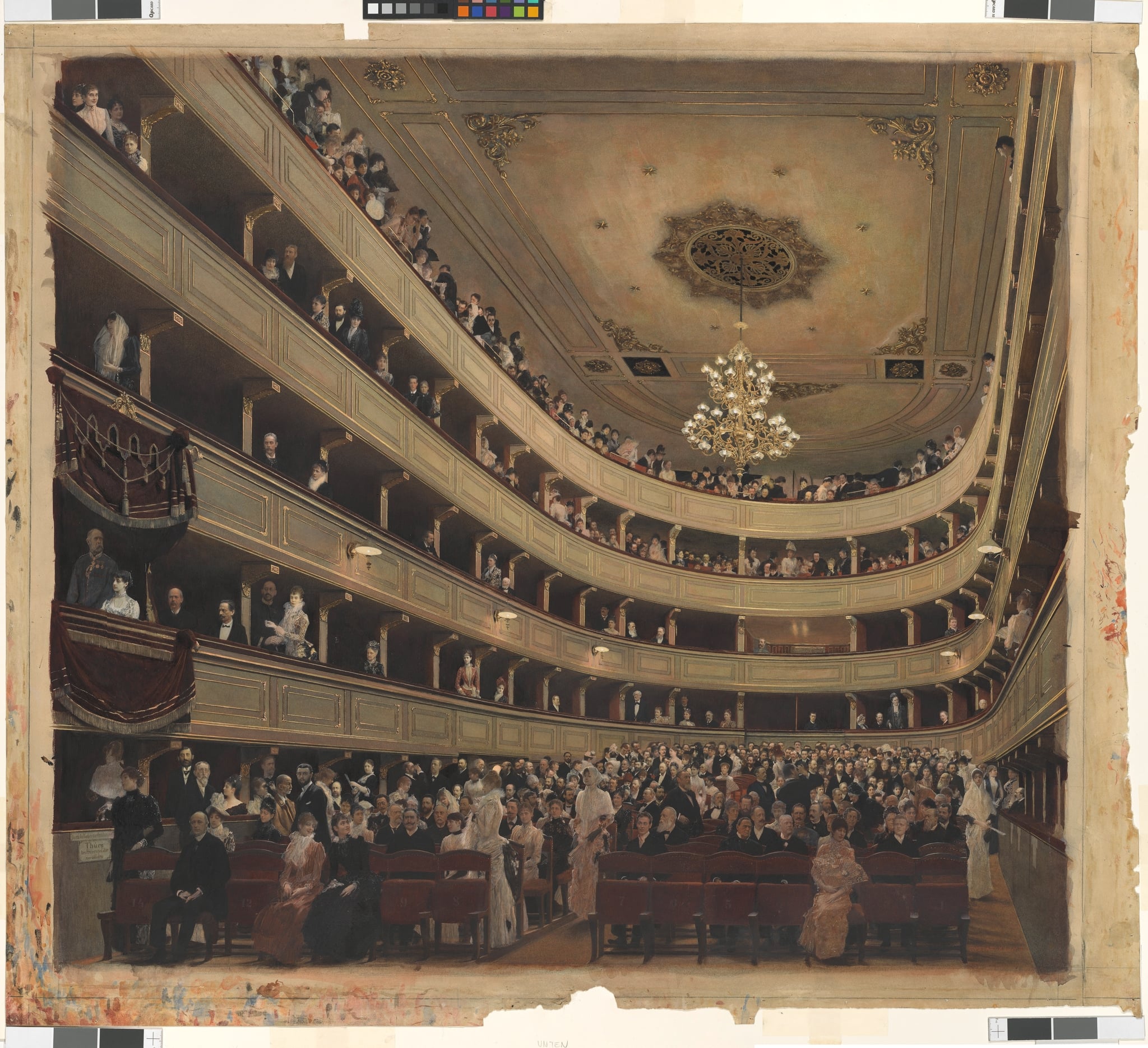
Auditorium of the Old Burgtheater
Gustav Klimt (1888–1889)
<strong>Auditorium of the Old Burgtheater</strong> turns the stage around: the audience becomes the show beneath a glowing chandelier and sweeping tiers. Klimt fuses hundreds of individualized faces into a single, wave‑like body of spectators, lit by gaslight and framed by gilded medallions. The result is a civic mirror—Vienna watching itself—at the very moment its old theater was disappearing.
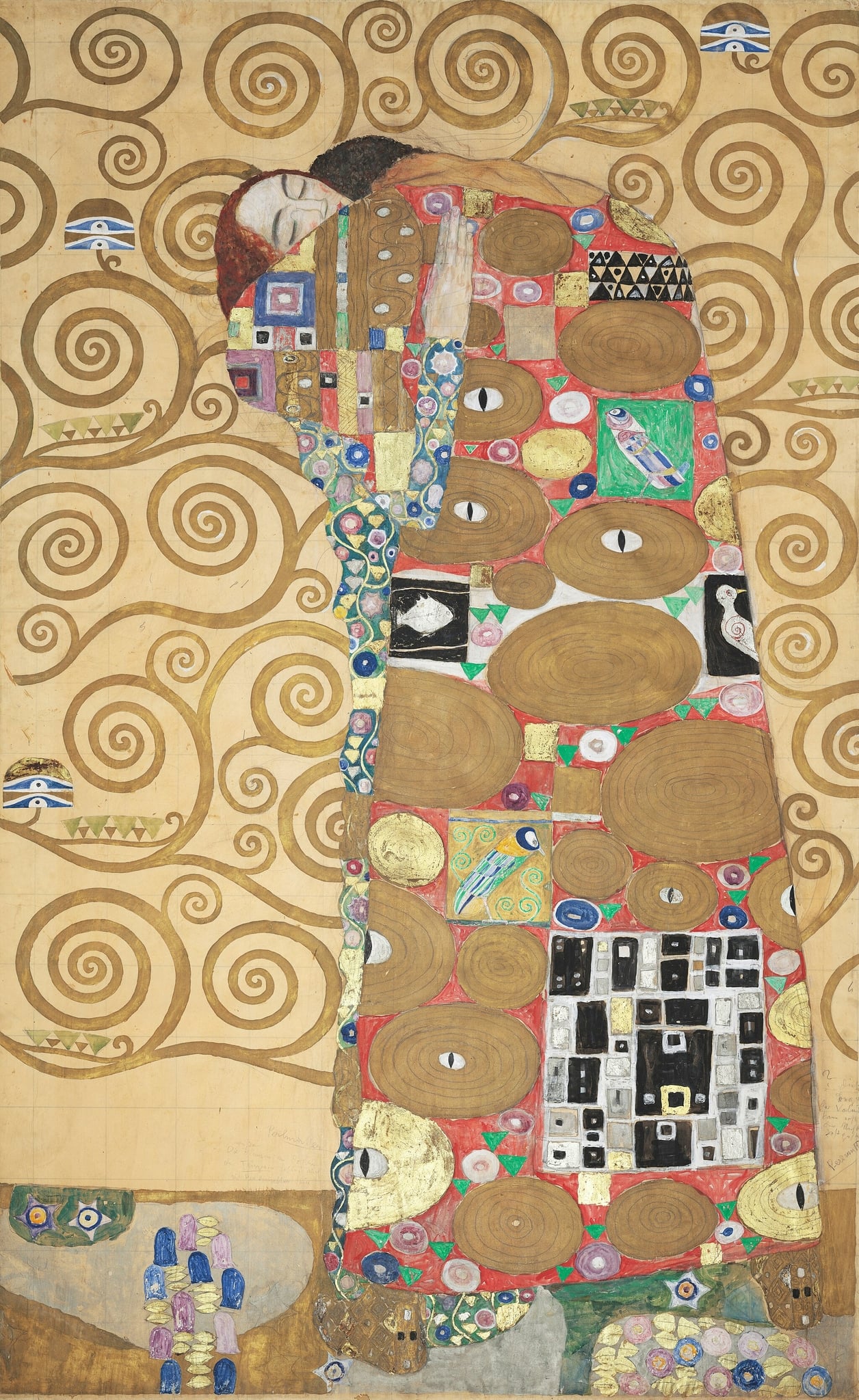
Fulfillment
Gustav Klimt (1910–1911 (cartoon); mosaic installed by 1911)
Klimt’s Fulfillment fuses two lovers into a single, radiant figure set before the spiraling <strong>Tree of Life</strong>, turning private embrace into a <strong>sacral consummation</strong>. Patterned robes—ovals, eyes, and flowers against black‑and‑white rectangles—stage a union of <strong>feminine/masculine energies</strong> within a golden, eternal field <sup>[1]</sup><sup>[3]</sup>.
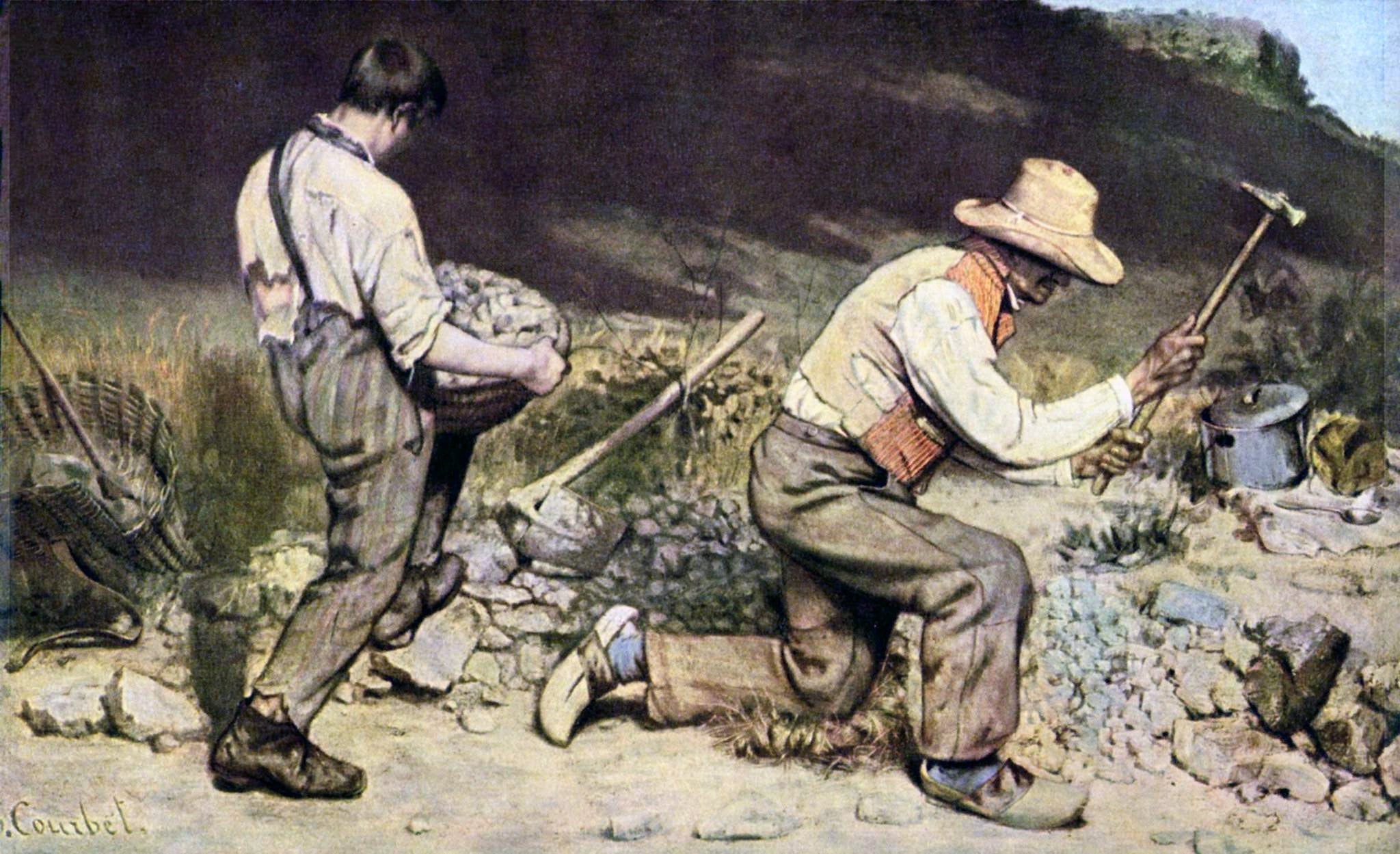
The Stone Breakers
Gustave Courbet (1849)
In The Stone Breakers, <strong>Gustave Courbet</strong> monumentalizes the backbreaking <strong>labor</strong> that underpins modern life. Two workers—youth and age—turn their faces away as patched clothes, wooden clogs, a wicker basket, and a dented kettle state a stark economy. The low horizon and compressed space forge a mood of <strong>claustrophobic realism</strong> that resists heroism <sup>[1]</sup><sup>[2]</sup><sup>[3]</sup>.
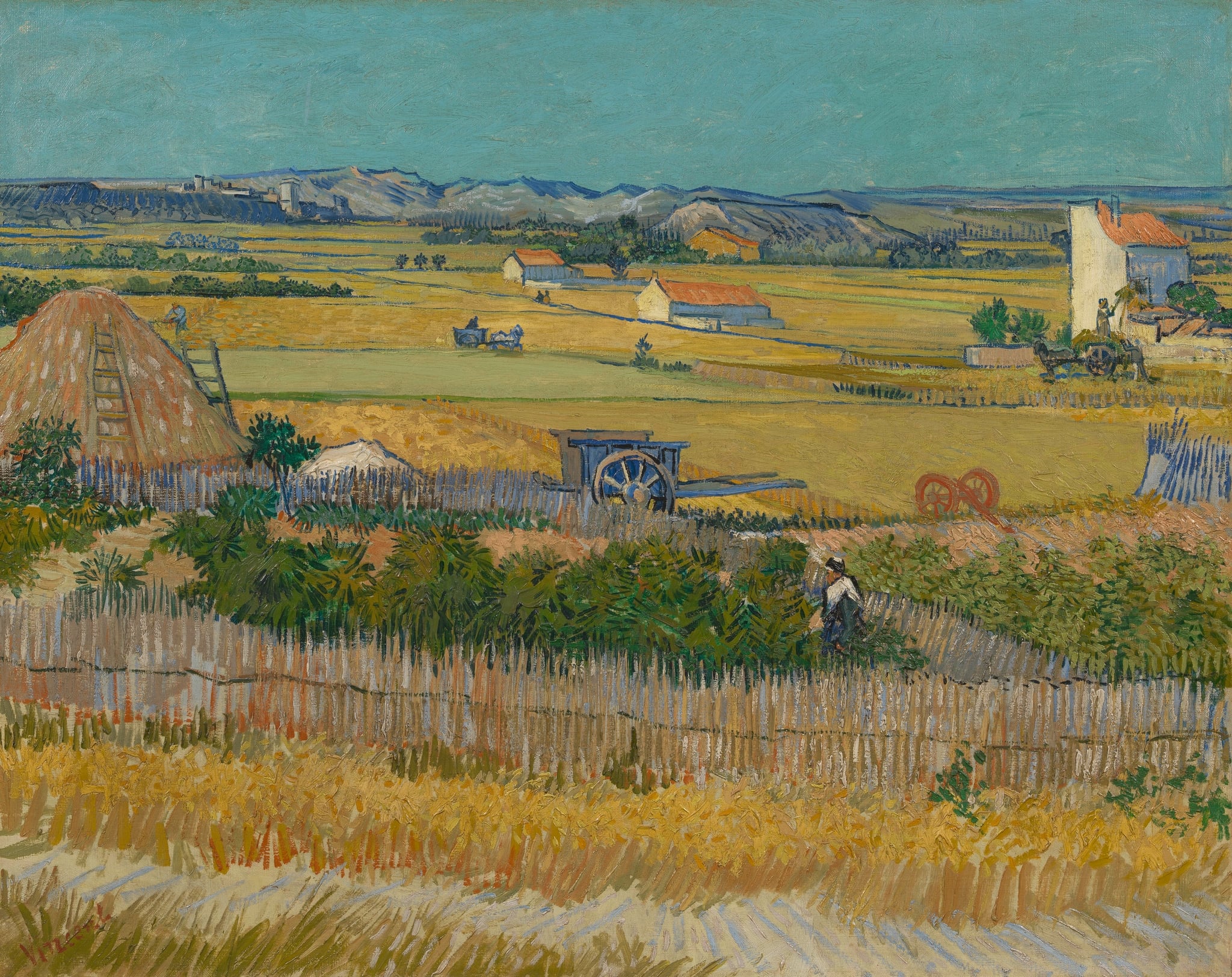
The Harvest
Vincent van Gogh (1888)
<strong>The Harvest</strong> surveys the La Crau plain as a luminous patchwork of ripe wheat, garden strips, and farm tracks under an <strong>azure</strong> sky. Van Gogh orchestrates tools and tasks—haystack with ladder, carts with <strong>red wheels</strong>, fenced plots—into a single, sunstruck order that turns labor into vision <sup>[1]</sup><sup>[2]</sup>. A lone reaper almost dissolves in the foliage, anchoring the panorama in human toil and seasonal time.
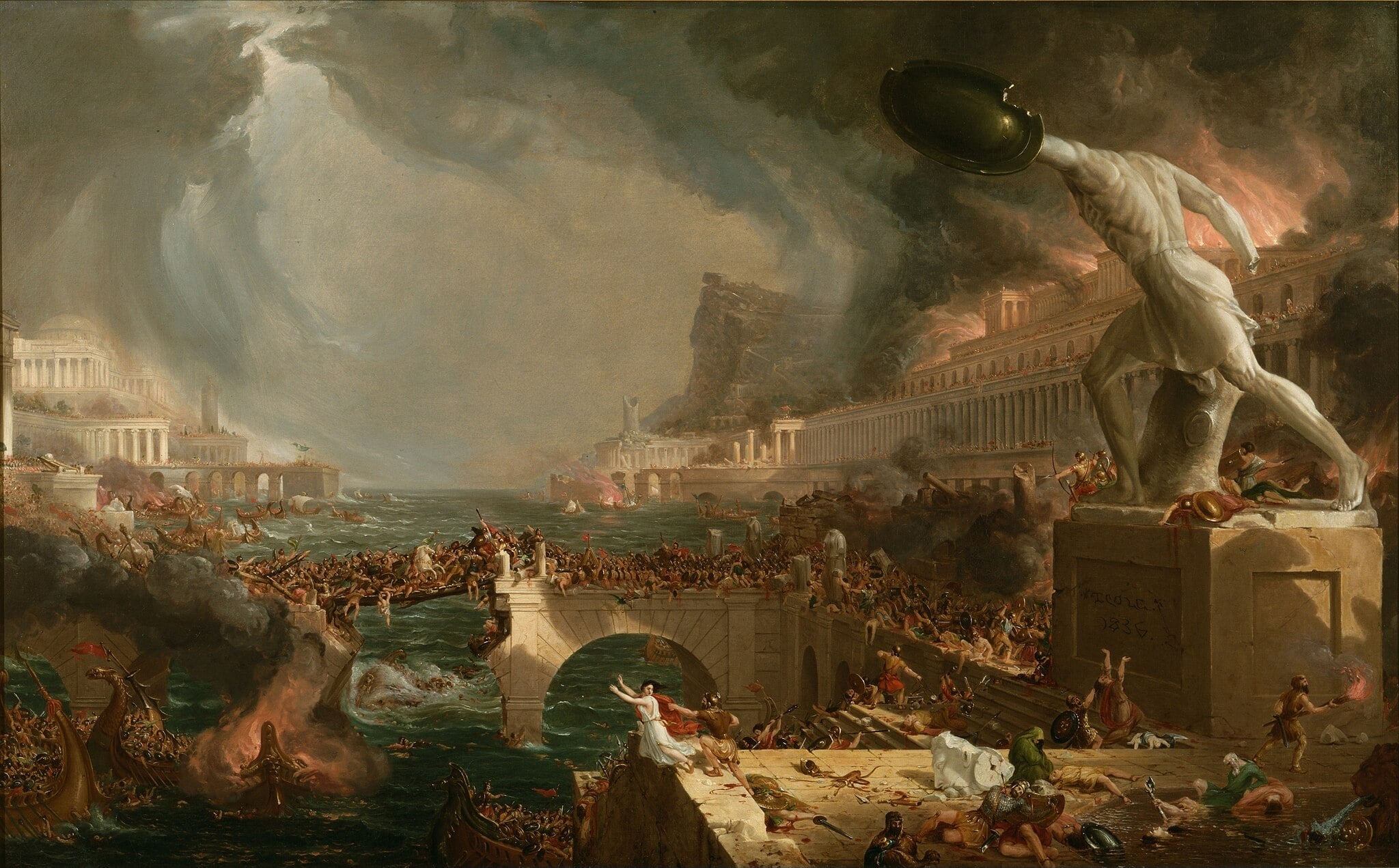
The Course of Empire: Destruction
Thomas Cole (1836)
Thomas Cole’s The Course of Empire: Destruction plunges a once‑ordered classical city into <strong>apocalyptic collapse</strong>. A <strong>collapsing bridge</strong>, <strong>burning colonnades</strong>, and a <strong>headless gladiator statue</strong> preside over panicked crowds and flaming warships, while a fixed mountain crag endures beyond the chaos. The canvas stages <strong>moral retribution</strong>: empire’s luxury curdles into vice and is swept away by combined human and elemental fury <sup>[1]</sup><sup>[2]</sup>.
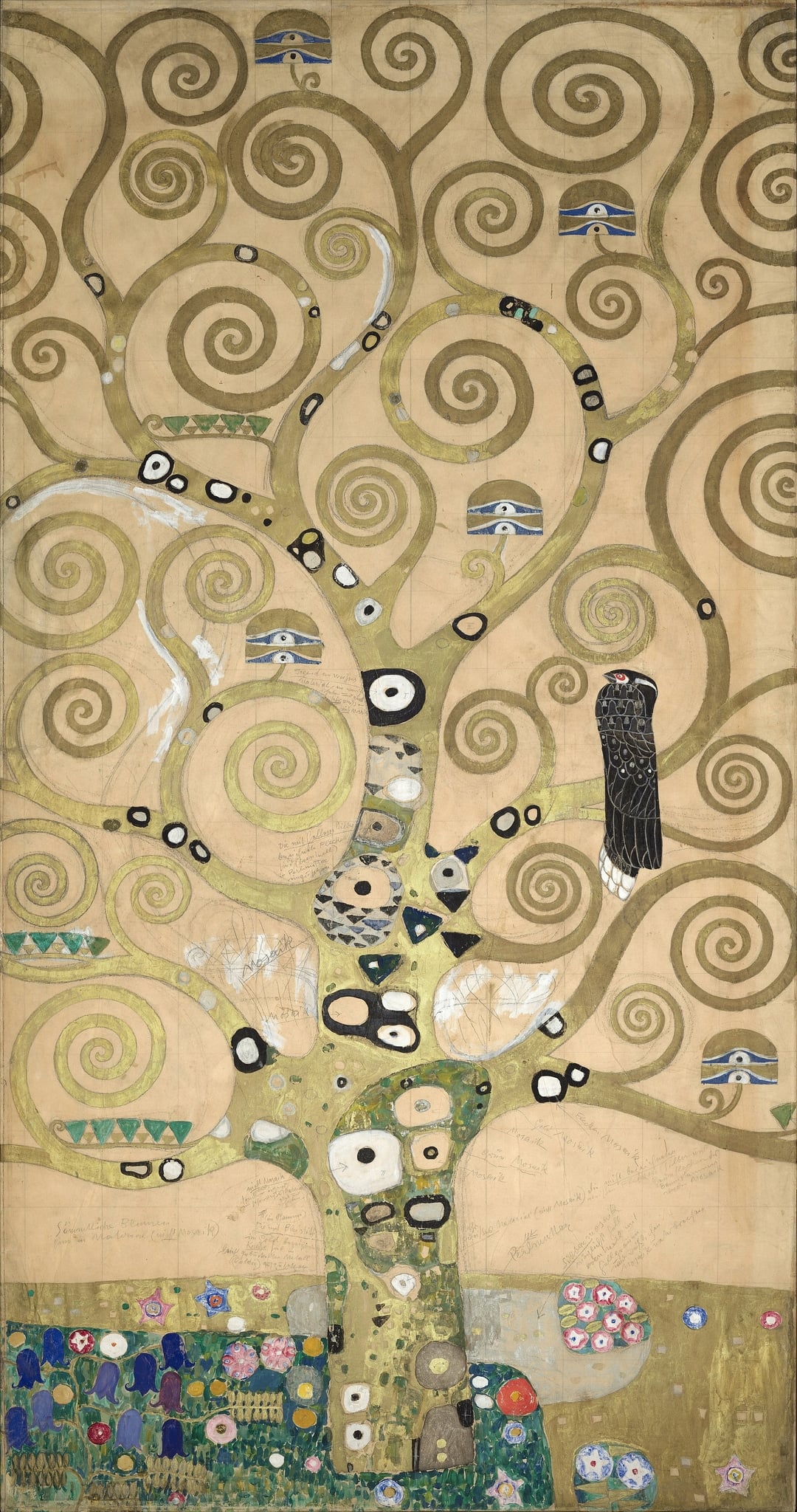
Tree of Life (Part 4)
Gustav Klimt (1910–1911)
Tree of Life (Part 4) stages a gilded axis where <strong>spiraling branches</strong>, <strong>amuletic eyes</strong>, and a <strong>black raptor</strong> compress growth, vigilance, and mortality into a single ornamental system. The mosaic-like bark and jewel-bright flower carpet root the image in fecund earth while the volutes coil upward toward the abstract and the eternal <sup>[1]</sup><sup>[6]</sup>.
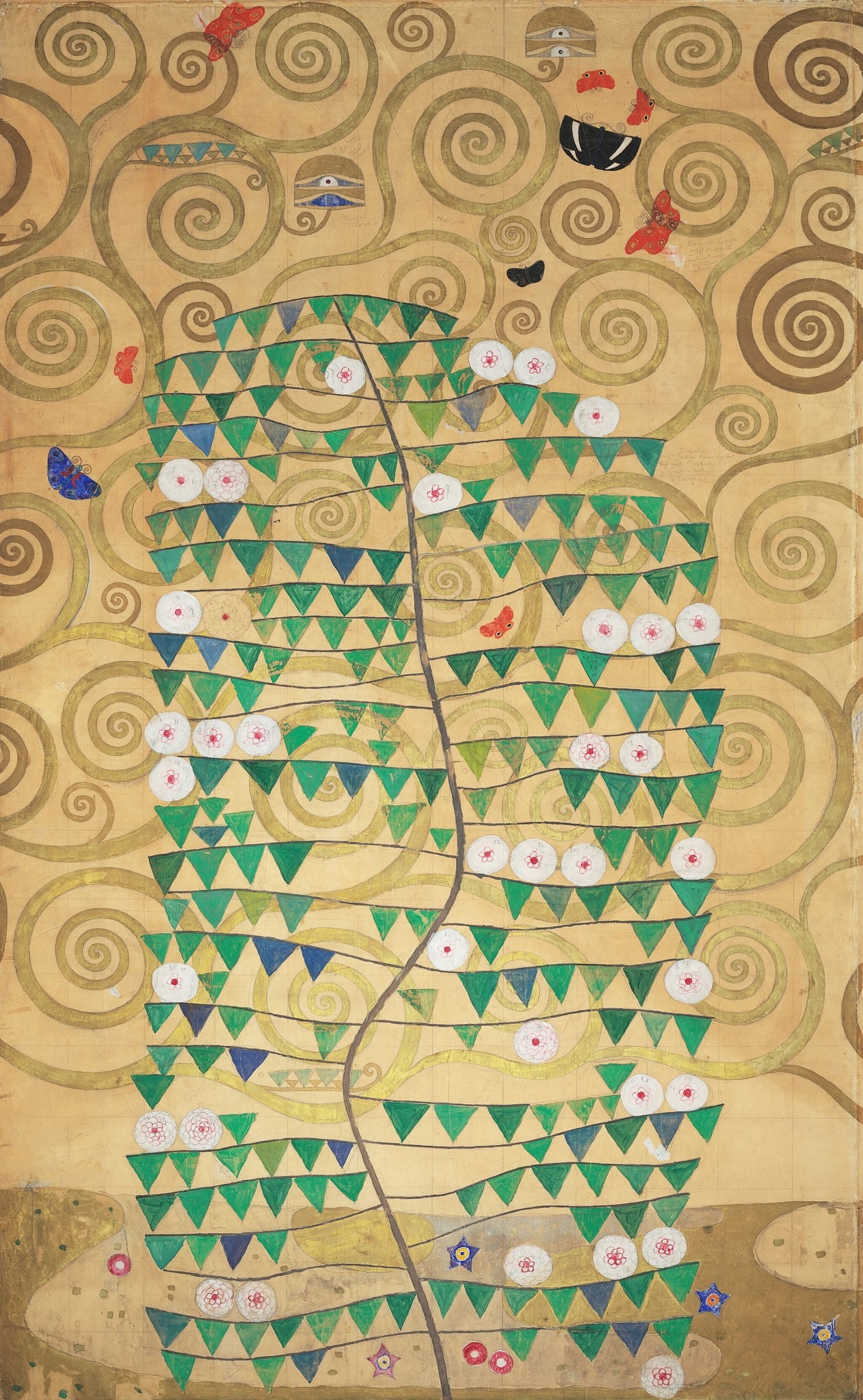
Rosebush (Part 6)
Gustav Klimt (1910/11)
In Rosebush (Part 6), a single, wavering stem climbs through a field of gold spirals while regimented green-and-blue triangular leaves and pale, jewel-like blossoms punctuate its path. Around it, vivid butterflies and star-flowers animate the surface. Klimt fuses nature and ornament into a <strong>precious</strong>, <strong>cyclical</strong> emblem of growth, metamorphosis, and renewal.
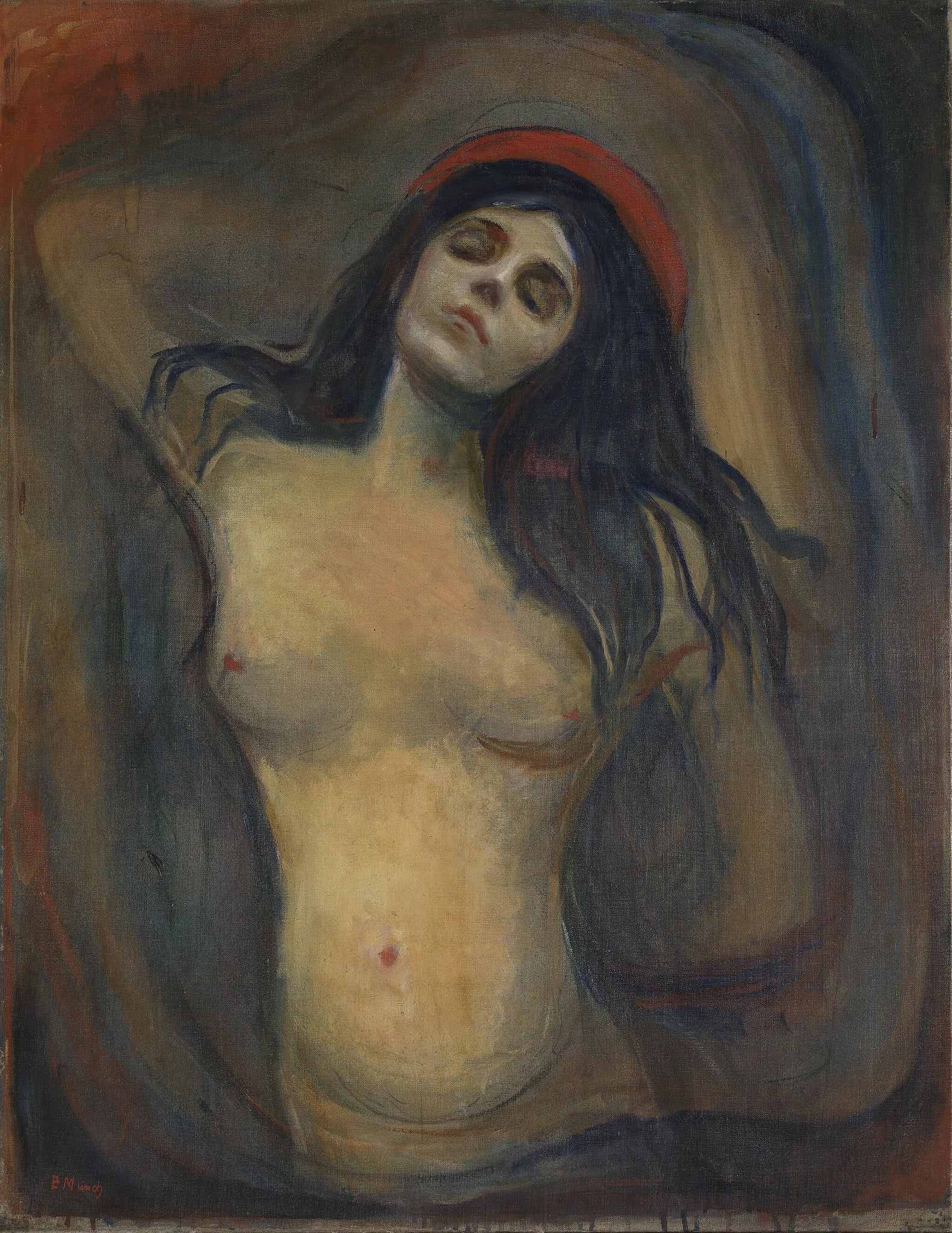
Madonna
Edvard Munch (1894)
Munch’s Madonna stages a collision of <strong>sanctity and sensuality</strong>: a half-length nude, eyes closed, tilts into a crimson nimbus while a dark, tidal field seems to carry her body. With smeared contours and a sparse palette, the figure hovers between emergence and dissolution, turning the Virgin’s icon into a modern emblem of <strong>eros, creation, and death</strong> <sup>[1]</sup><sup>[2]</sup><sup>[3]</sup>.
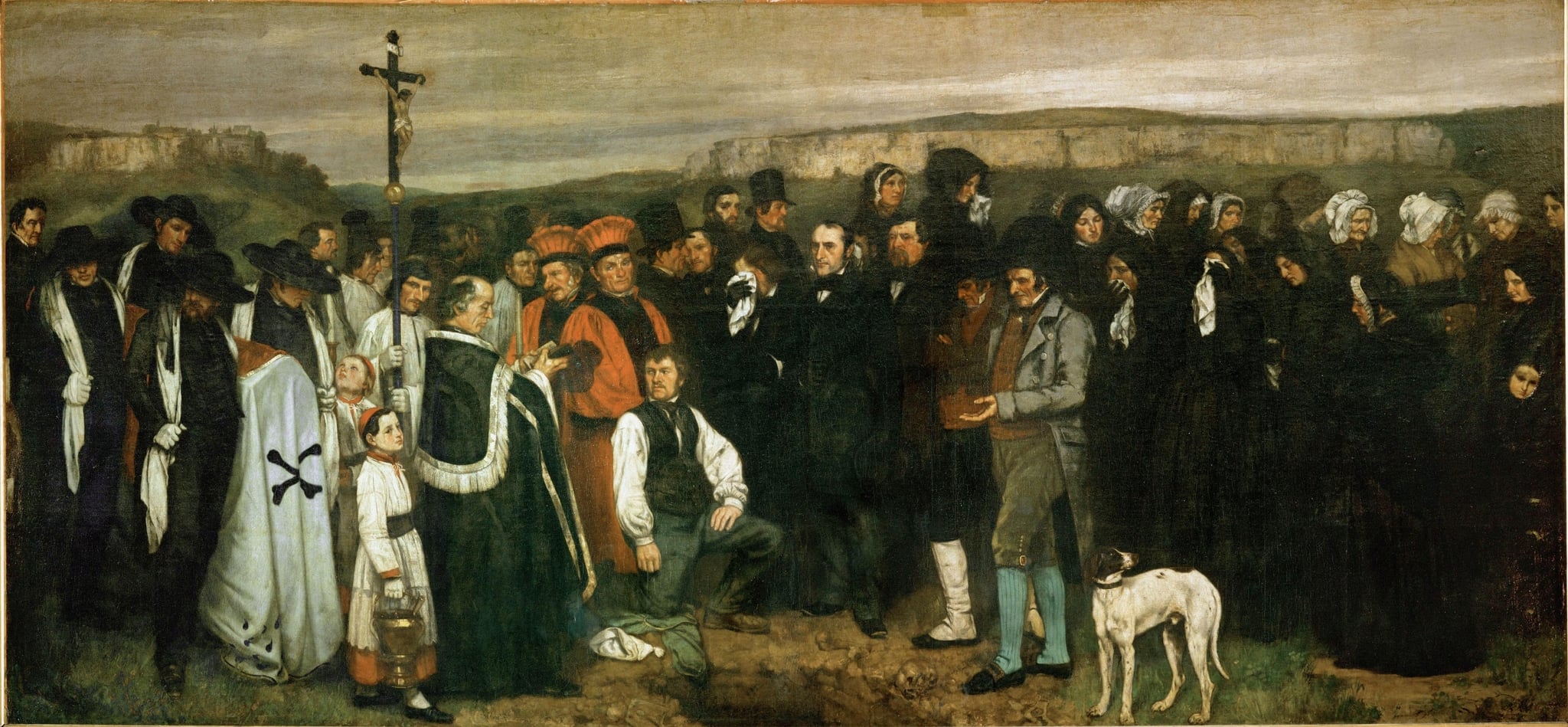
A Burial at Ornans
Gustave Courbet (1849–1850)
A Burial at Ornans turns a provincial funeral into a life‑size, horizontal <strong>frieze</strong> where clergy, officials, peasants, and mourners stand shoulder to shoulder before an <strong>open grave</strong> and skull. Courbet’s refusal of climax—despite the tall <strong>processional crucifix</strong>—and details like the <strong>kneeling gravedigger</strong> and indifferent <strong>dog</strong> make mortality the great equalizer, not piety or heroism. The limestone <strong>cliffs of Ornans</strong> close the horizon, sealing the scene’s weight and finality.
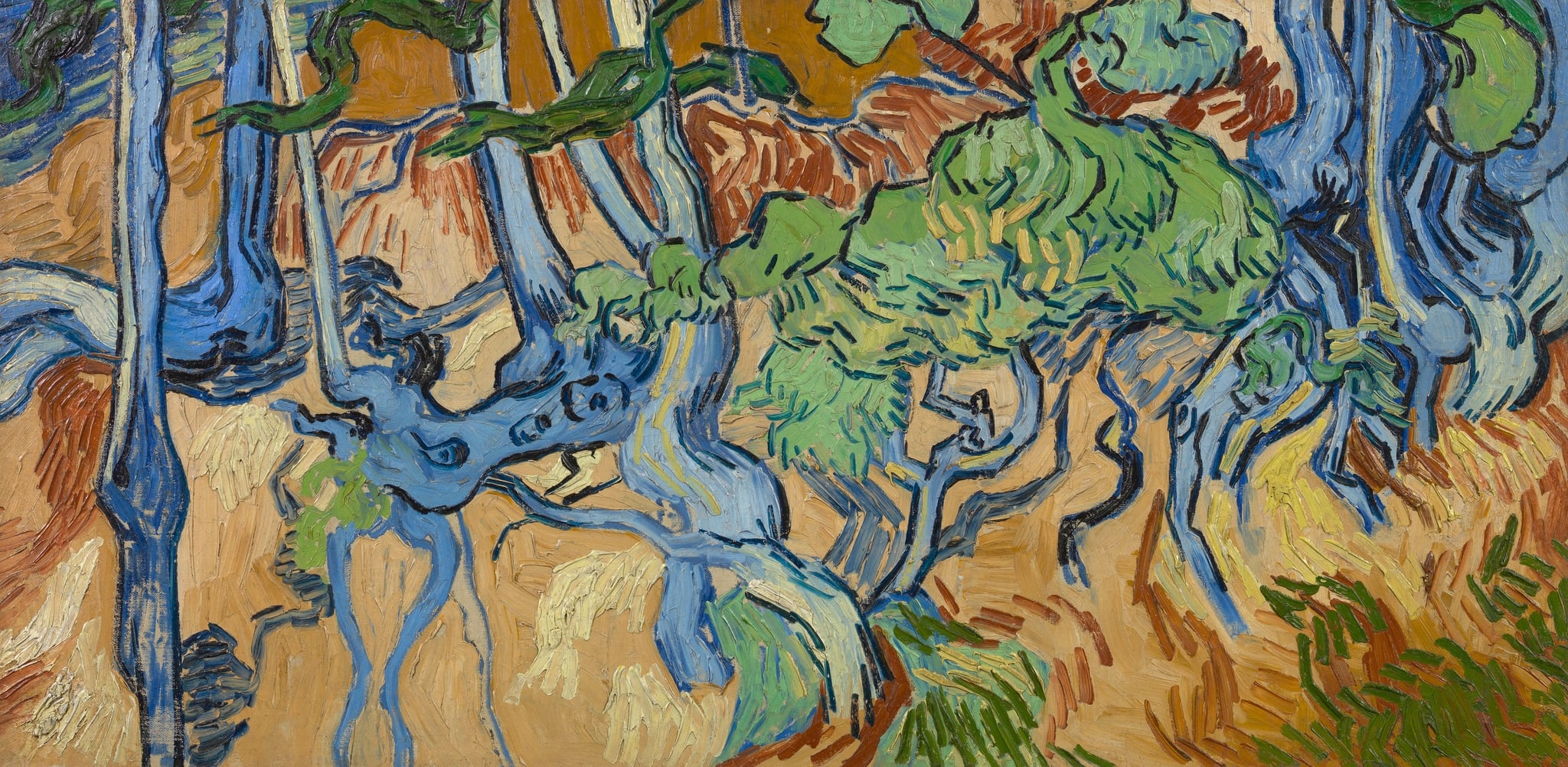
Tree Roots
Vincent van Gogh (1890)
Tree Roots is a late Auvers canvas in a rare, elongated "double‑square" format that compresses the view to nothing but interlaced trunks and roots. Thick, cobalt‑blue contours and vibrating oranges/ochres forge a field of near‑abstraction, turning a roadside bank into a <strong>charged meditation on resilience and exposure</strong> <sup>[1]</sup><sup>[6]</sup><sup>[2]</sup>.
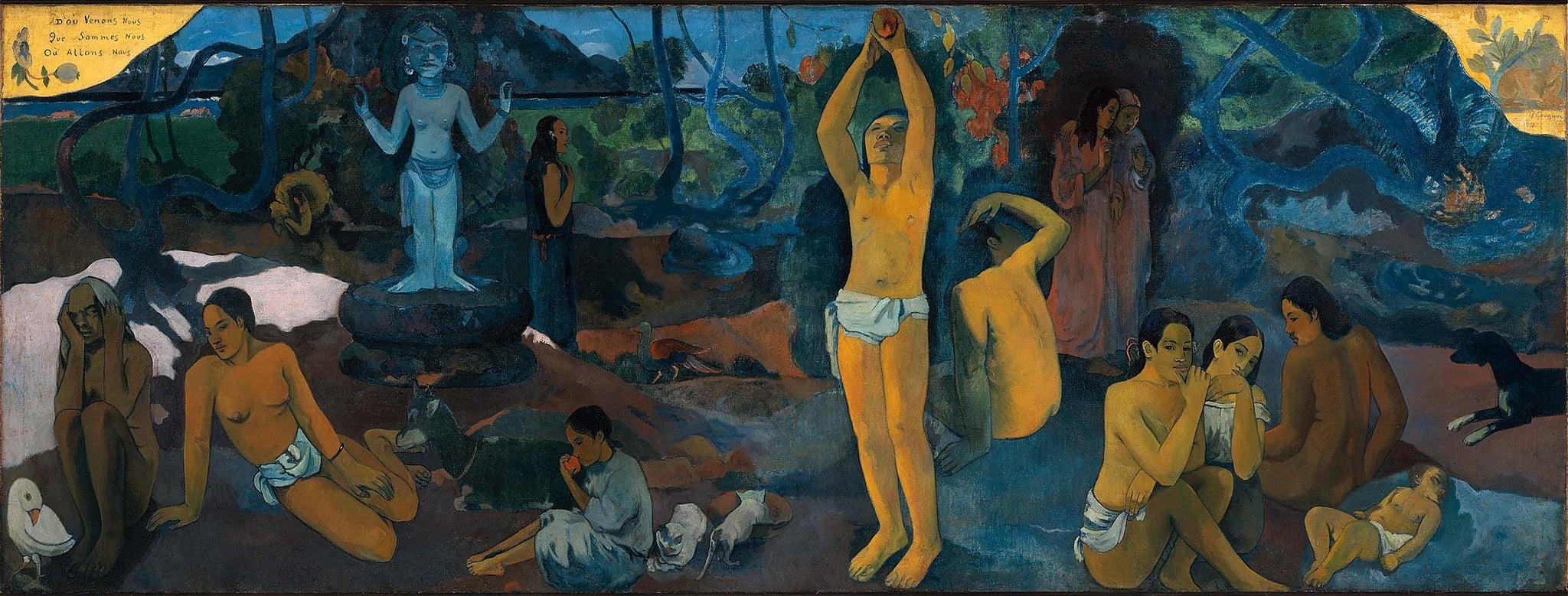
Where Do We Come From? What Are We? Where Are We Going?
Paul Gauguin (1897–1898)
A panoramic frieze staged in a Tahitian grove, Paul Gauguin’s Where Do We Come From? What Are We? Where Are We Going? unfolds right-to-left as a cycle of life, from an infant at the far right to an aged woman at the far left. Amid saturated blues and ochres, a central figure reaches for fruit and a pale-blue idol stands motionless, creating a theatre of <strong>origin, desire, and destiny</strong> that never resolves into a single answer.
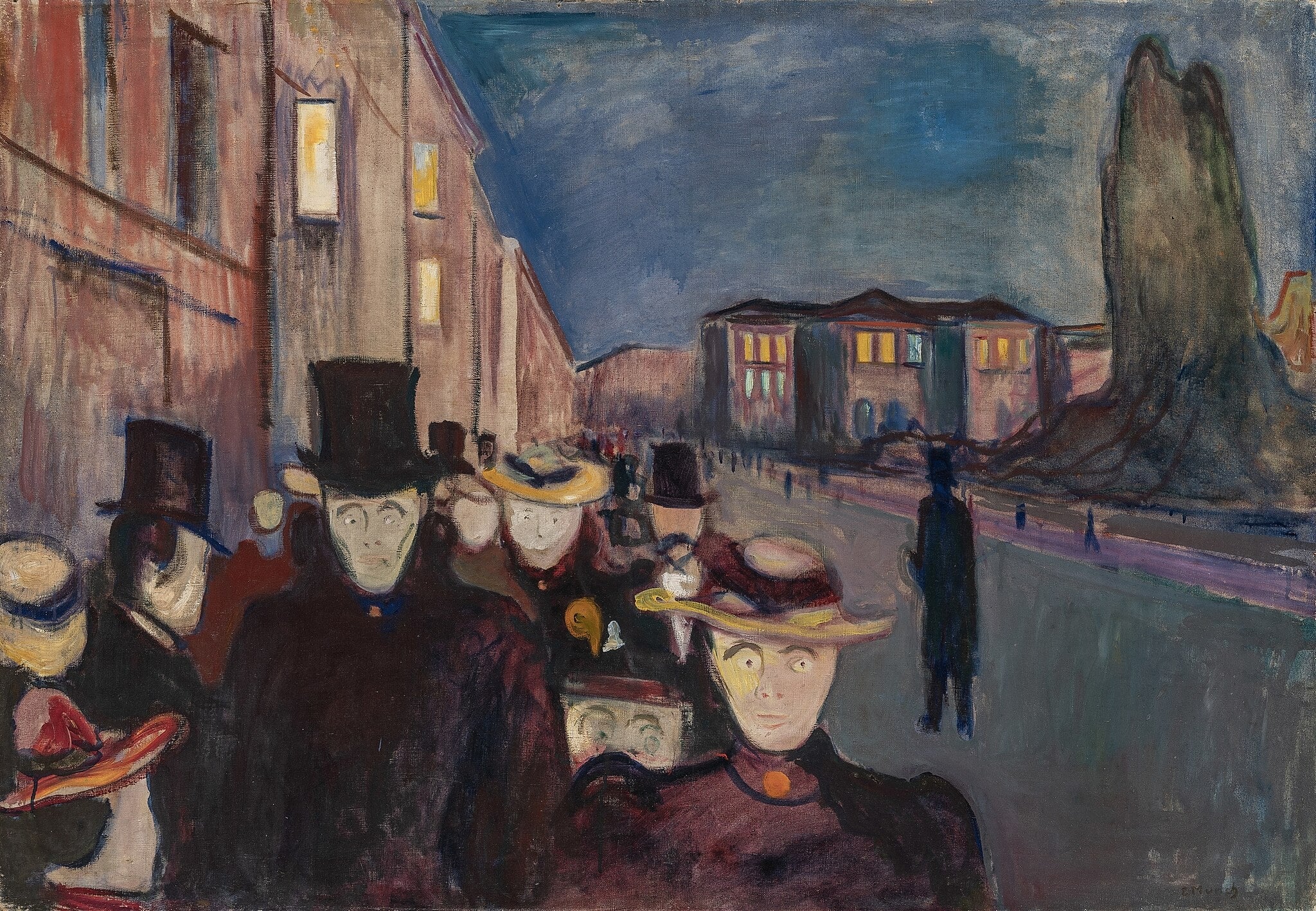
Evening on Karl Johan
Edvard Munch (1892)
Evening on Karl Johan by Edvard Munch stages a fashionable Oslo boulevard as a scene of <strong>urban dread</strong>. A mask-faced crowd in top hats surges forward while an <strong>isolated silhouette</strong> recedes at right, and tilted buildings glow with jaundiced windows under a cold blue sky. Munch converts a social promenade into a <strong>symbol of alienation</strong> through compressed space, skewed color, and nervous brushwork <sup>[1]</sup><sup>[2]</sup><sup>[3]</sup><sup>[4]</sup>.
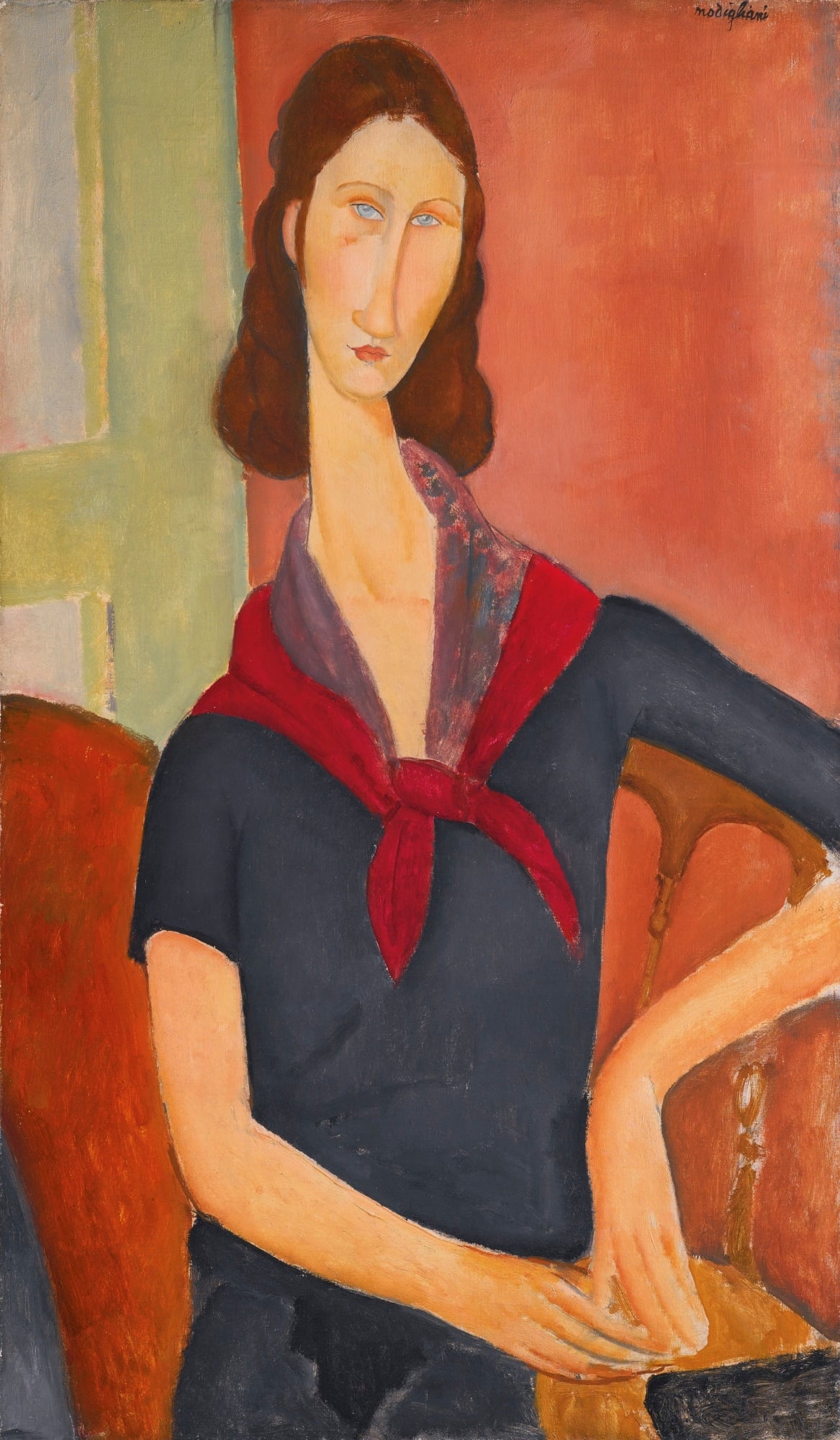
Jeanne Hébuterne (au foulard)
Amedeo Modigliani (1919)
Jeanne Hébuterne (au foulard) crystallizes Modigliani’s late style into a poised emblem of <strong>tenderness held in restraint</strong>. The elongated neck, <strong>masklike visage</strong>, and cool navy dress are pierced by the <strong>red scarf</strong> at the throat, a chromatic node that concentrates feeling and presence <sup>[1]</sup><sup>[2]</sup>. The subtly indicated pupils—rare in many Modigliani portraits—sharpen her psychological immediacy amid the flattened, terracotta field <sup>[1]</sup>.
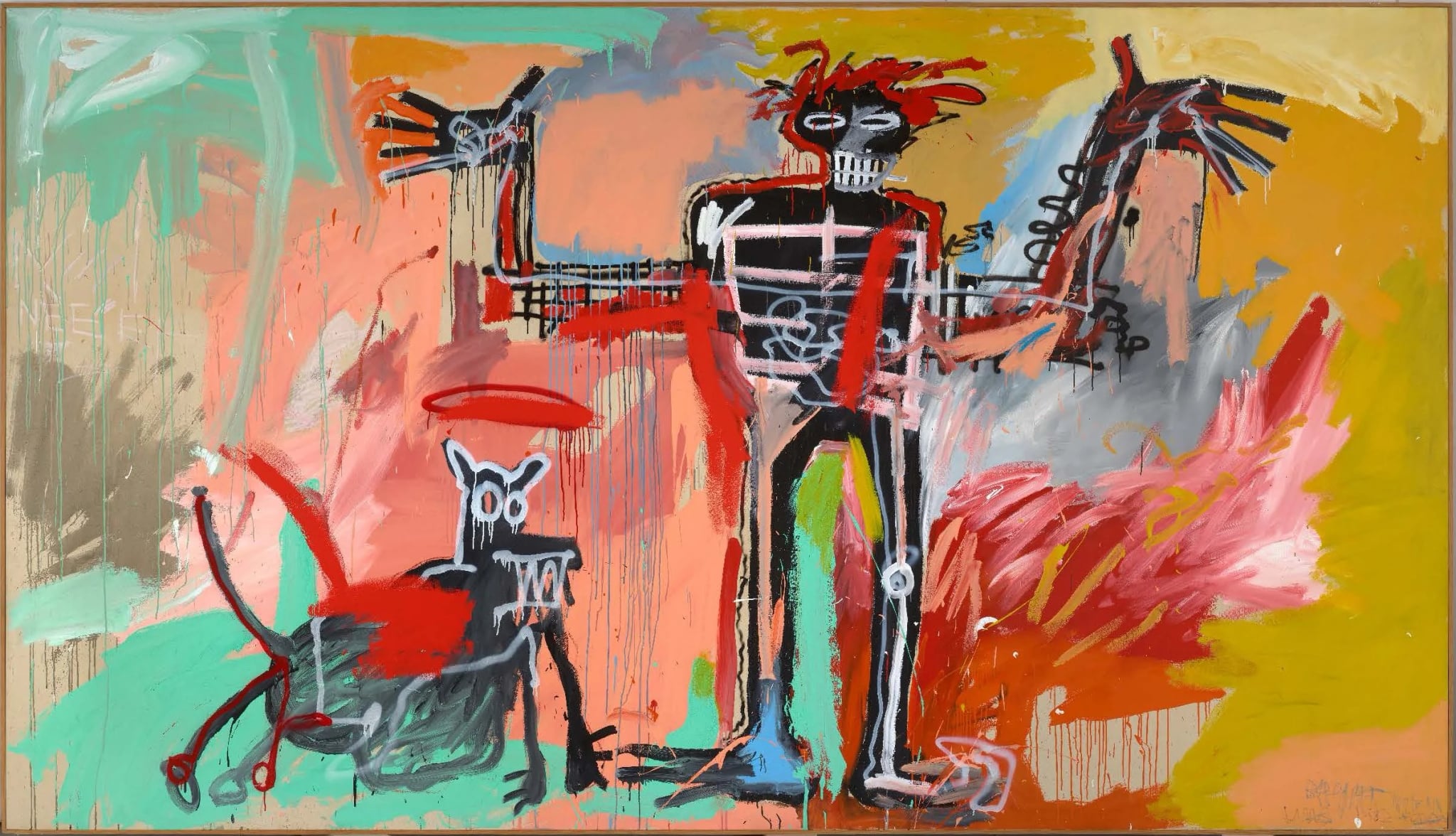
Boy and Dog in a Johnnypump
Jean-Michel Basquiat (1982)
<strong>Boy and Dog in a Johnnypump</strong> (1982) stages a wiry, x‑rayed boy with arms flung wide beside a bristling dog under a red arc that doubles as a halo and the spray of a New York <strong>johnnypump</strong>. Basquiat fuses <strong>childhood play</strong> and <strong>urban peril</strong> in a heat‑drenched field of oranges, yellows, and mints, emblematic of his breakthrough <strong>Neo‑Expressionism</strong> and the 1982 Modena cycle. The painting asserts Black presence and survival with ferocious scale and velocity <sup>[1]</sup><sup>[2]</sup>.
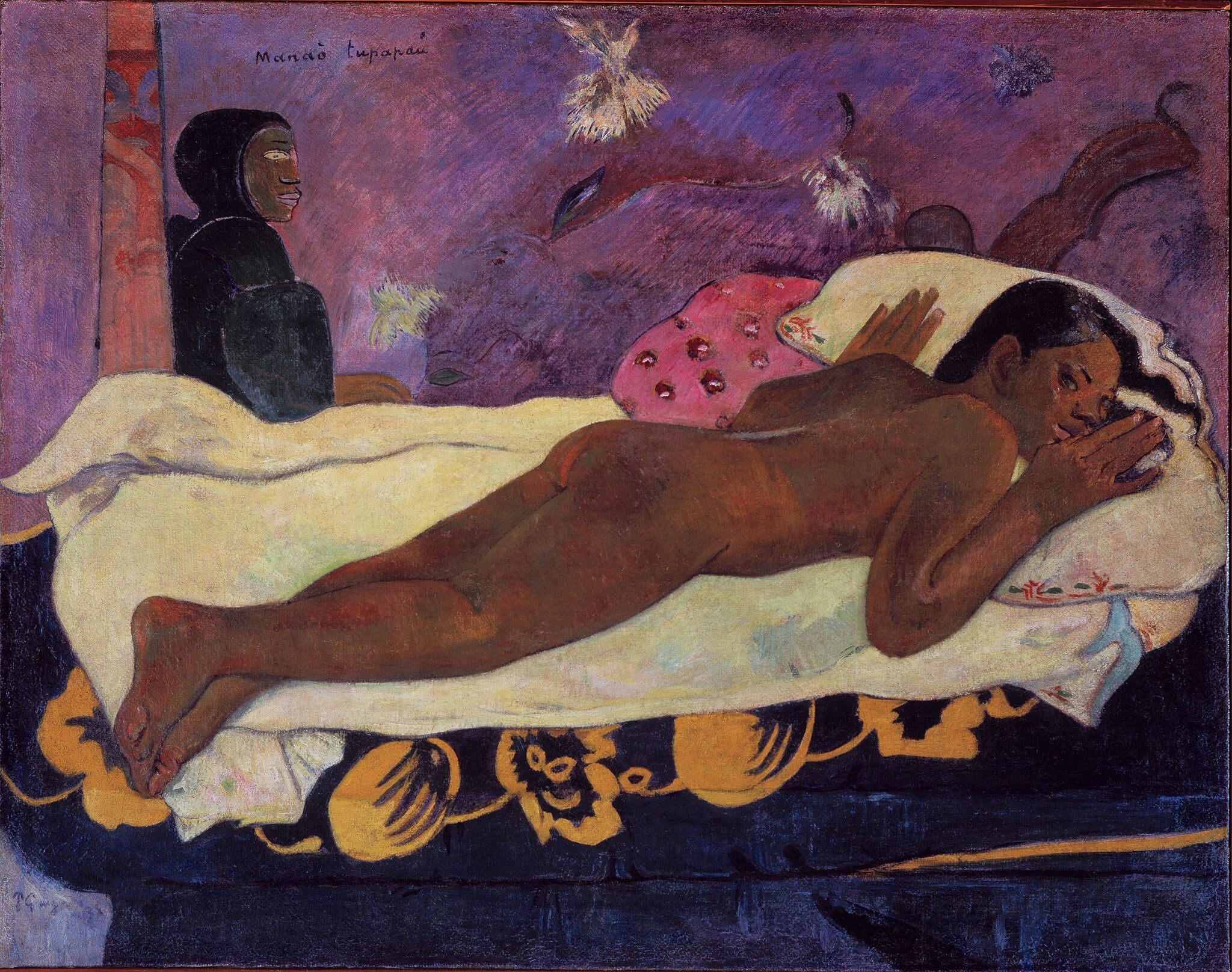
Spirit of the Dead Watching
Paul Gauguin (1892)
Spirit of the Dead Watching stages a nocturnal confrontation between a rigid, prone nude and a dark, hooded presence at the bed’s edge, fusing <strong>desire</strong> with <strong>dread</strong>. Flat patterns, cloisonné outlines, and violet-black fields convert the room into a symbolic plane where a Tahitian <strong>tupapaú</strong> may be either guardian or threat. The work crystallizes Gauguin’s Synthetist aim to make color and contour carry <strong>mythic psychology</strong> rather than mere description <sup>[1]</sup><sup>[2]</sup>.
Van Gogh's Chair
Vincent van Gogh (1888; reworked January 1889)
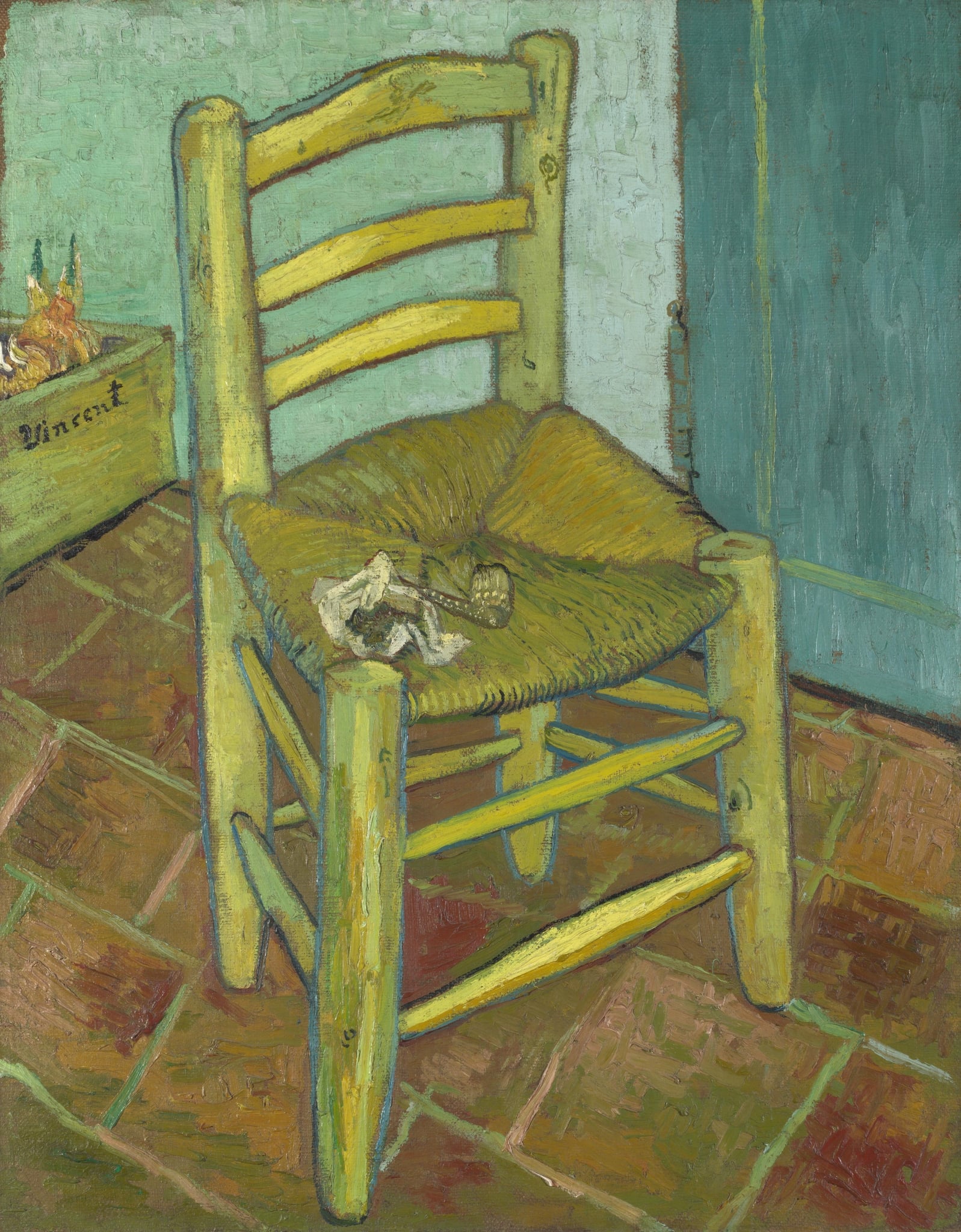
In Van Gogh's Chair, a humble rush-seated chair blazes in <strong>radiant yellow</strong> against <strong>cool teal</strong> walls and door, its bold outlines charging the scene with tension. A <strong>pipe and tobacco pouch</strong> on the seat, a crate marked <strong>“Vincent”</strong> and sprouting onions turn this empty place into a surrogate presence, a still-life self-portrait built from things rather than a face <sup>[1]</sup><sup>[2]</sup>.
Farms near Auvers
Vincent van Gogh (1890)
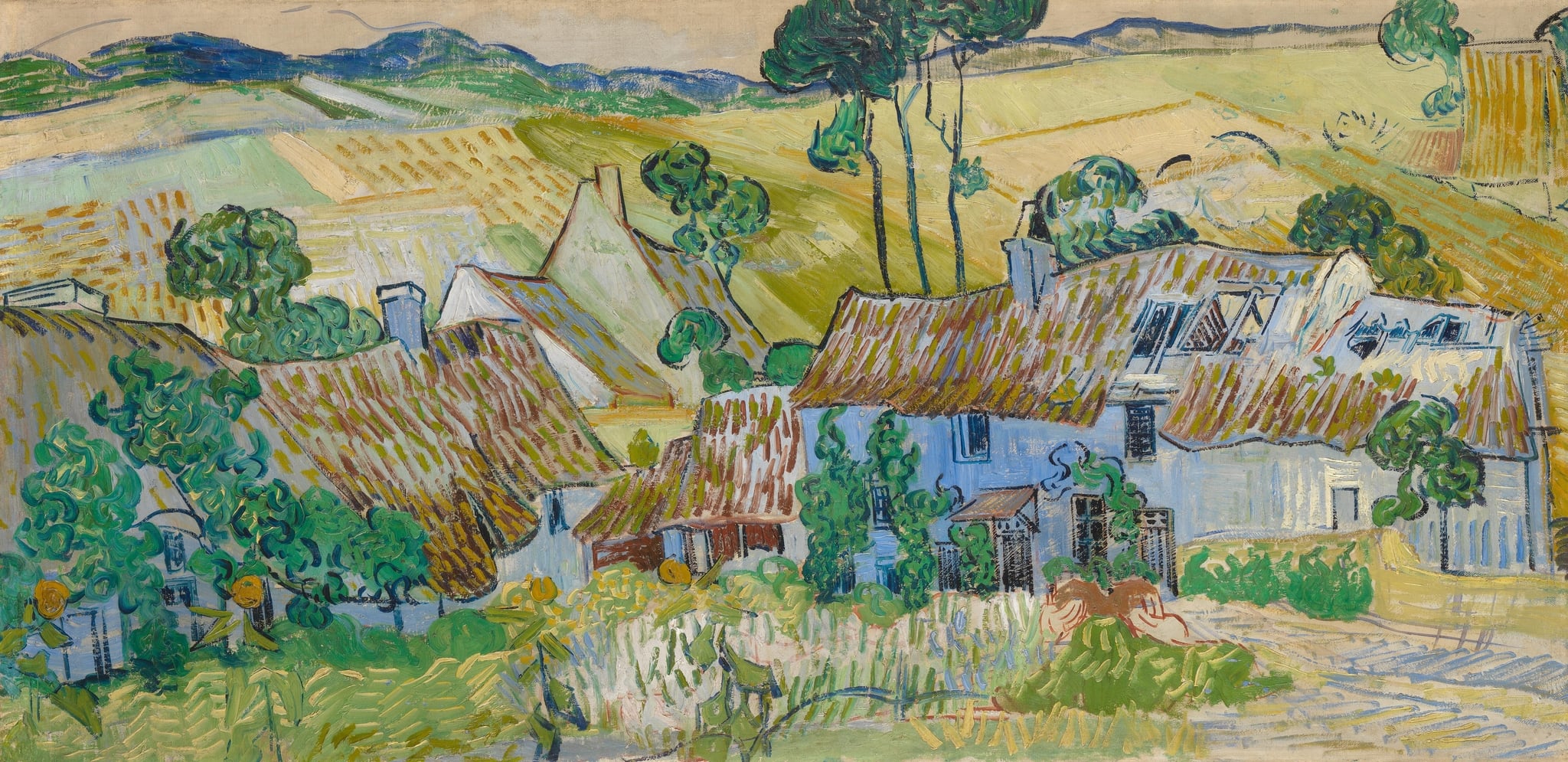
Painted in July 1890, Vincent van Gogh’s Farms near Auvers is a late, "double‑square" panorama where thatched cottages, wheat plots, and wind‑bent trees pulse with <strong>rhythmic energy</strong>. The high horizon and criss‑crossing roofs compress the village into a living weave of color and line, turning ordinary farms into a scene of <strong>charged stillness</strong> <sup>[1]</sup><sup>[3]</sup>.
Dustheads
Jean-Michel Basquiat (1982)
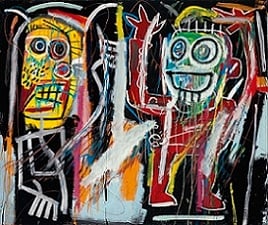
Dustheads stages two electrified, mask-like figures lunging out of a saturated black field, their concentric eyes and bared teeth pumping with <strong>manic, nocturnal energy</strong>. The title’s nod to PCP (“angel dust”) fuses <strong>ecstasy and menace</strong>, turning the scene into a charged allegory of altered perception and survival in downtown New York, 1982 <sup>[1]</sup><sup>[6]</sup>.
In This Case
Jean-Michel Basquiat (1983)
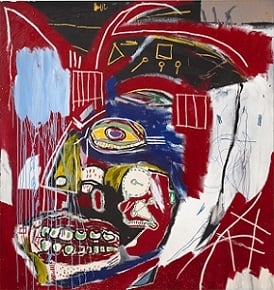
In This Case thrusts a flayed, X‑ray‑like head against a <strong>searing red field</strong>, where boxed teeth, a target‑bright <strong>single eye</strong>, and schematic glyphs above the brow turn the face into a site of <strong>classification and alarm</strong>. Jean-Michel Basquiat fuses anatomy with street mark‑making to stage a confrontation with <strong>mortality, surveillance, and Black embodiment</strong> <sup>[1]</sup><sup>[2]</sup>.
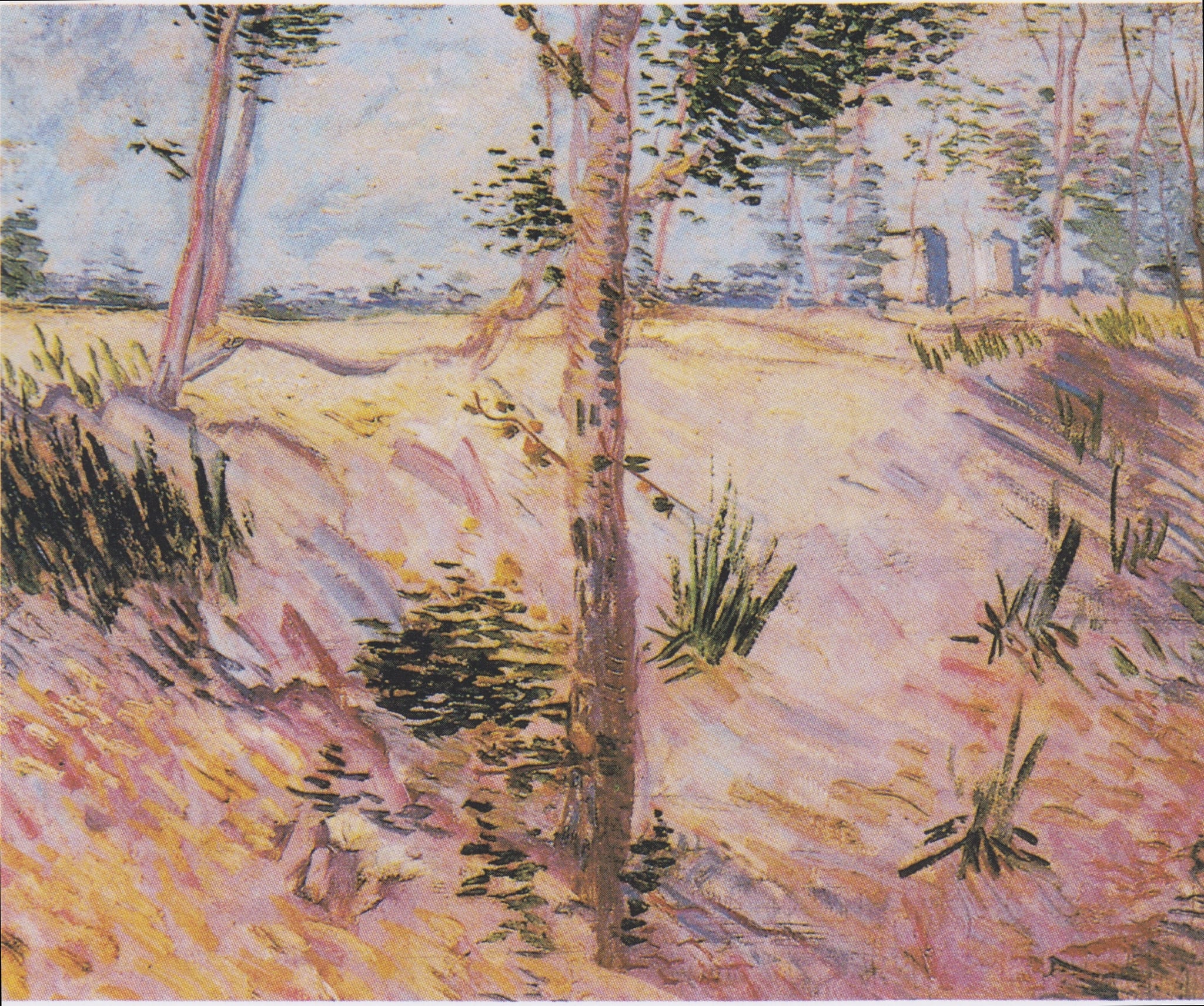
Riverbank with Trees
Vincent van Gogh (1887)
Riverbank with Trees is a compact 1887 study in which Vincent van Gogh turns a modest Seine embankment into a field of <strong>vibration and light</strong>. Diagonal sweeps of lilac and ochre sand collide with <strong>staccato foliage</strong> and a single upright trunk, fusing observation with sensation <sup>[1]</sup><sup>[2]</sup>.
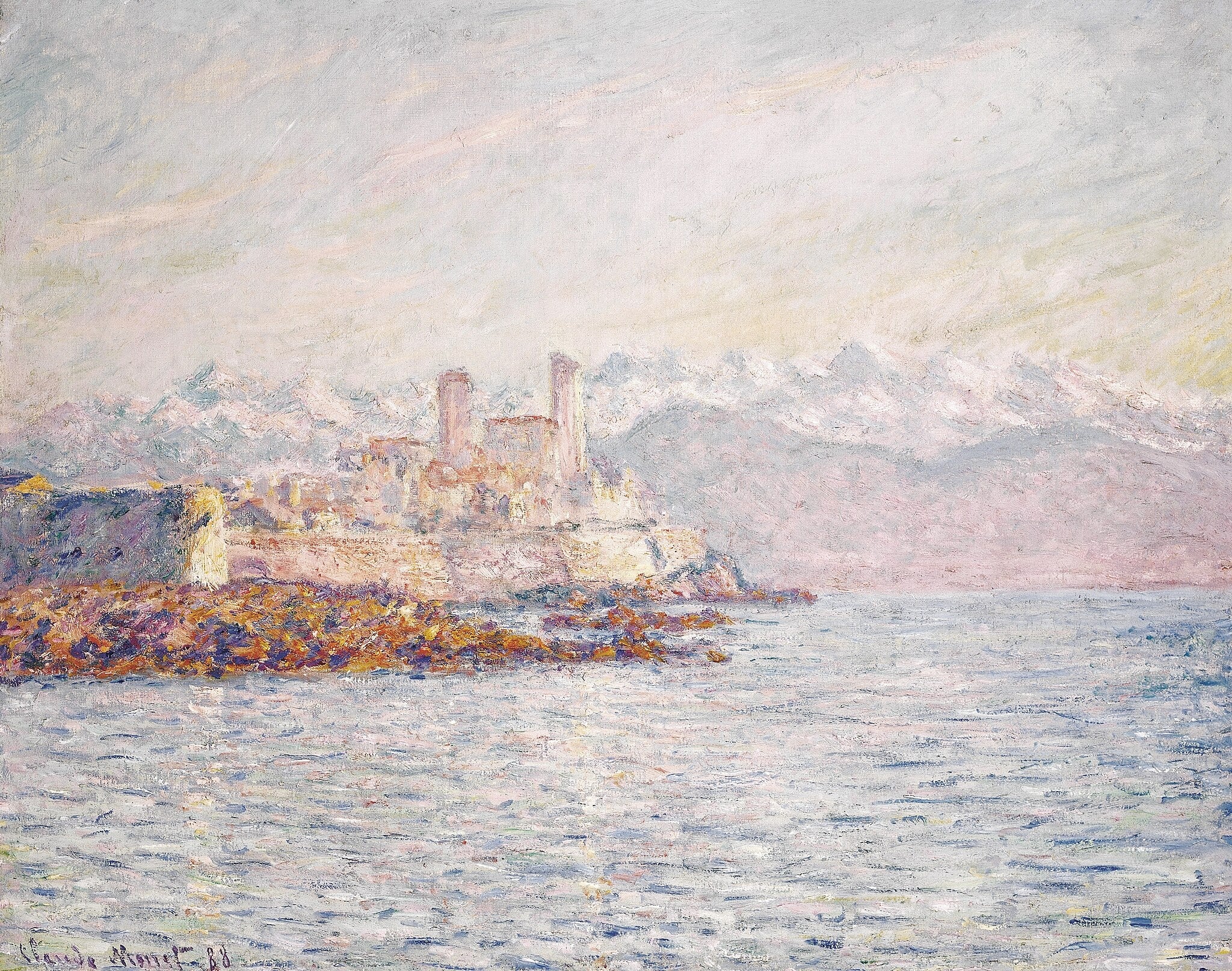
Antibes
Claude Monet (1888)
Monet’s Antibes turns a fortified headland into a <strong>luminous apparition</strong>: towers, ramparts, sea, and Alps dissolve into trembling strokes of lilac, lemon, blue‑green, and rose. By fusing stone and atmosphere, Monet makes the southern light itself the painting’s <strong>true subject</strong> <sup>[1]</sup><sup>[2]</sup>.
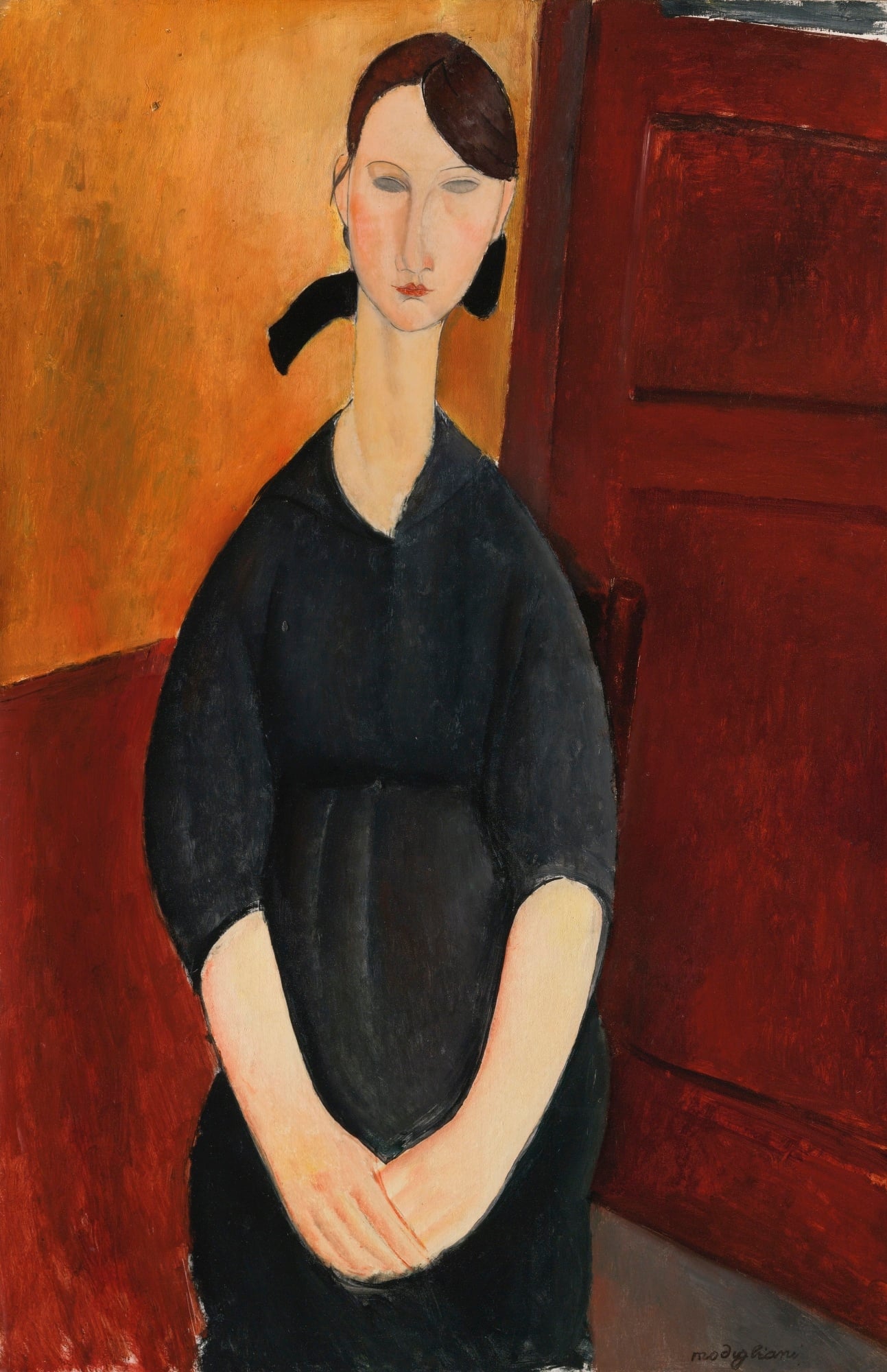
Portrait of Paulette Jourdain
Amedeo Modigliani (1919)
Portrait of Paulette Jourdain crystallizes a young sitter into a <strong>poised, timeless icon</strong>: an attenuated neck, mask-like almond eyes, and gently folded hands set before ochre walls and a <strong>slightly ajar red door</strong>. Modigliani’s sculptural contour and restrained palette turn likeness into an <strong>archetype of grace and inwardness</strong> <sup>[1]</sup><sup>[2]</sup><sup>[3]</sup>.
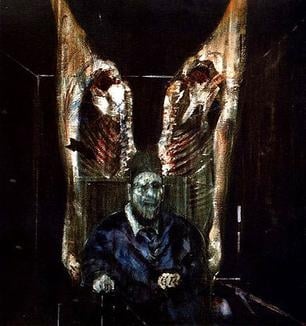
Figure with Meat
Francis Bacon (1954)
Francis Bacon’s Figure with Meat fuses a screaming pontiff with two flayed carcasses that hang like grotesque wings, locking power and flesh into the same dark box. Through <strong>cage-like lines</strong>, <strong>stage-lit isolation</strong>, and paint handled as <strong>raw meat</strong>, Bacon asserts a brutal equivalence: sanctity and sovereignty are only bodies destined to decay <sup>[1]</sup><sup>[2]</sup>.
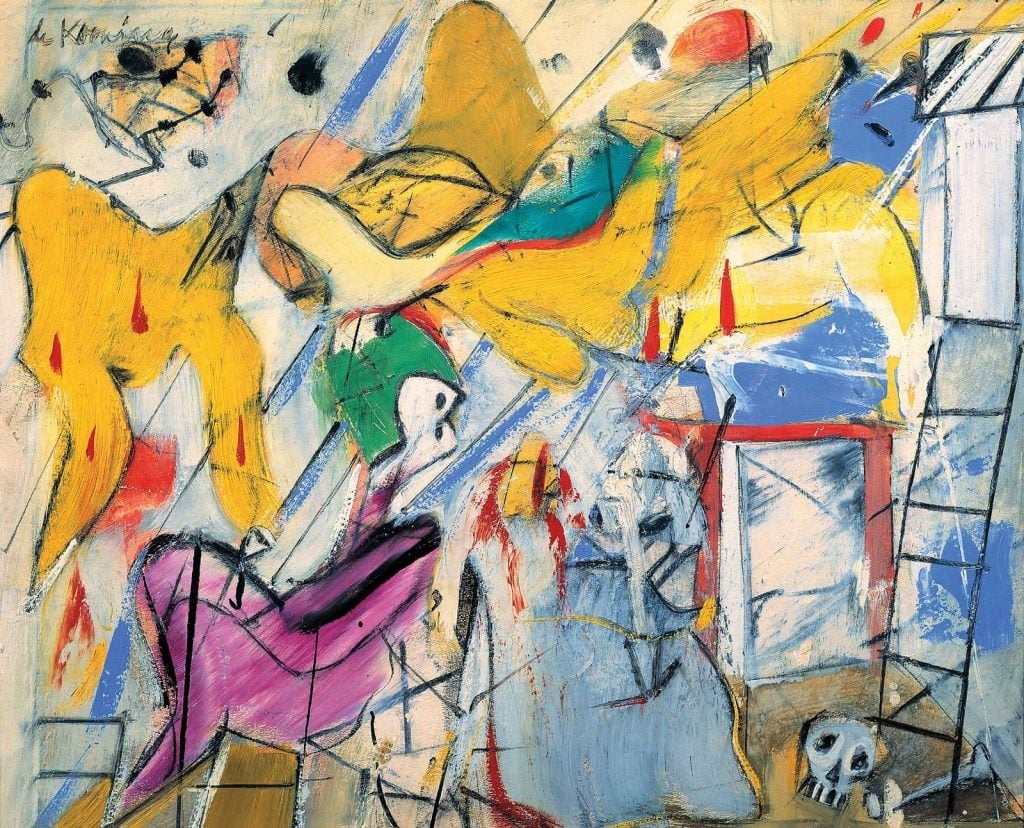
Interchange
Willem de Kooning (1955)
Interchange condenses the city’s churn into an arena of <strong>figure–ground flux</strong>, where mustard yellows, lilac, and sea‑blue collide and are corralled by black, calligraphic lines. De Kooning turns scraping, repainting, and slashing gestures into a living map of <strong>exchange</strong> between flesh and architecture, motion and arrest <sup>[2]</sup><sup>[3]</sup>.
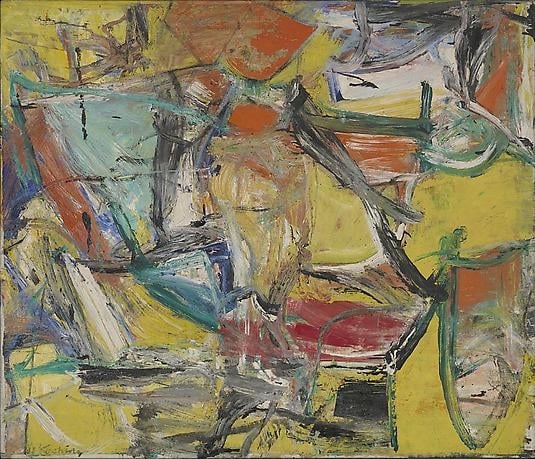
Police Gazette
Willem de Kooning (1955)
<strong>Police Gazette</strong> converts tabloid scandal into a field of charged marks: acidic yellow grounds, slashed blacks, and jolts of teal and coral collide like headlines in motion. De Kooning’s scraped, reworked surface turns the city’s noise into <strong>gesture-as-event</strong>, where half-hinted limbs and curb-like edges surface, then dissolve. As a key mid-1950s canvas, it anchors his shift to the so-called <strong>abstract urban landscapes</strong> within Abstract Expressionism <sup>[1]</sup><sup>[2]</sup>.
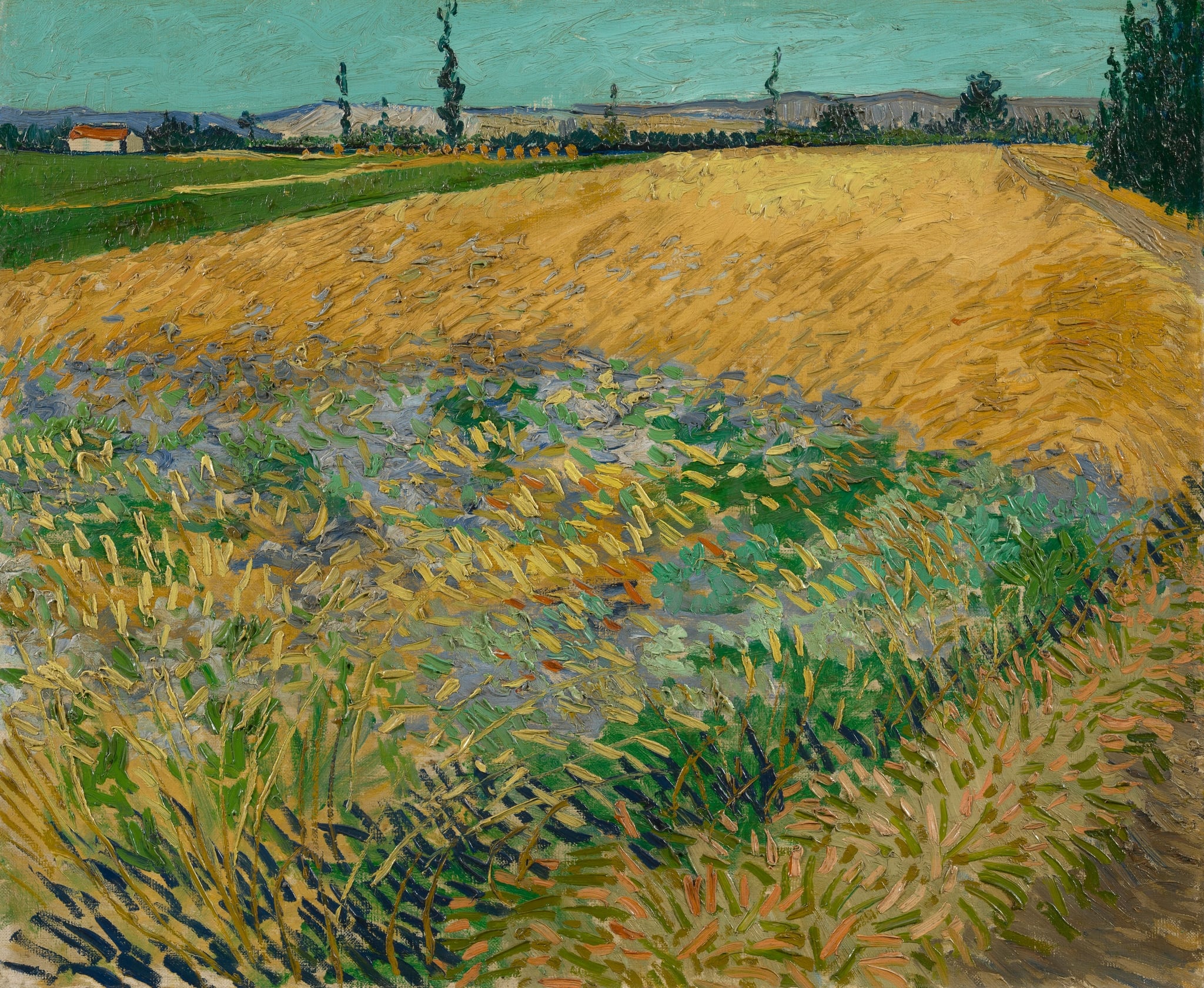
Wheatfield
Vincent van Gogh (1888)
Wheatfield converts a Provençal field into a drama of <strong>living motion</strong> and <strong>complementary color</strong>. A high horizon compresses the turquoise sky so the gold expanse dominates, while a narrow path at right and a modest farmhouse at left anchor human presence within <strong>restless nature</strong> <sup>[1]</sup><sup>[2]</sup>. Painted in Arles in June 1888, it crystallizes Van Gogh’s pursuit of expressive brushwork and yellow–blue vibration.
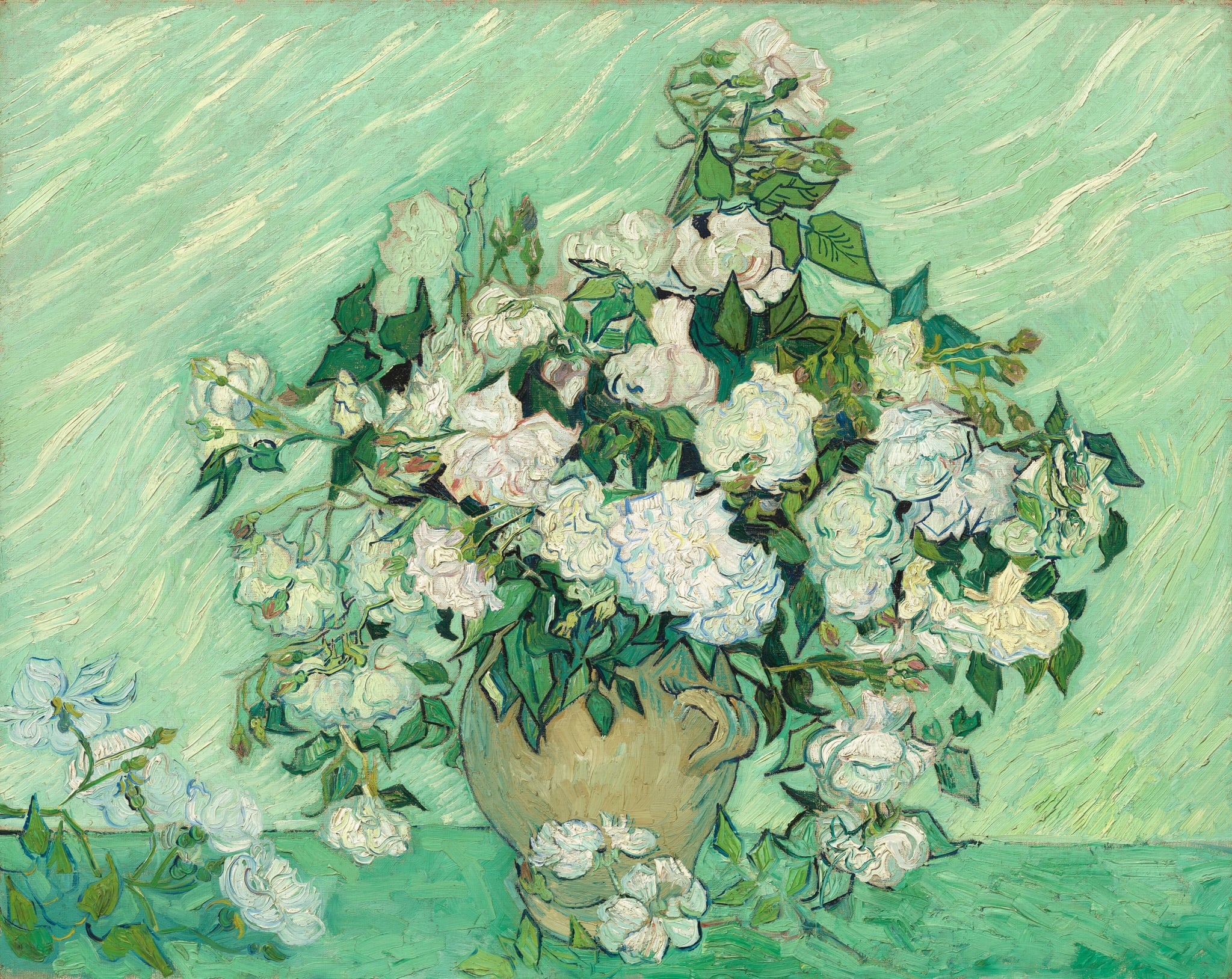
Roses
Vincent van Gogh (1890)
Roses gathers a bursting bouquet in a simple earthen pot against a sea of mint-green strokes, its blooms tipping, spilling, and glowing a cool white. Van Gogh’s thick, directional brushwork charges the still life with <strong>restless vitality</strong>, while the restrained green-and-pale palette creates a <strong>restorative</strong> calm <sup>[1]</sup>. Conservation shows the flowers were once <strong>pink</strong>, their fading altering the intended pink–green complement that anchored the ensemble of Irises and Roses from May 1890 <sup>[1]</sup><sup>[2]</sup><sup>[4]</sup>.
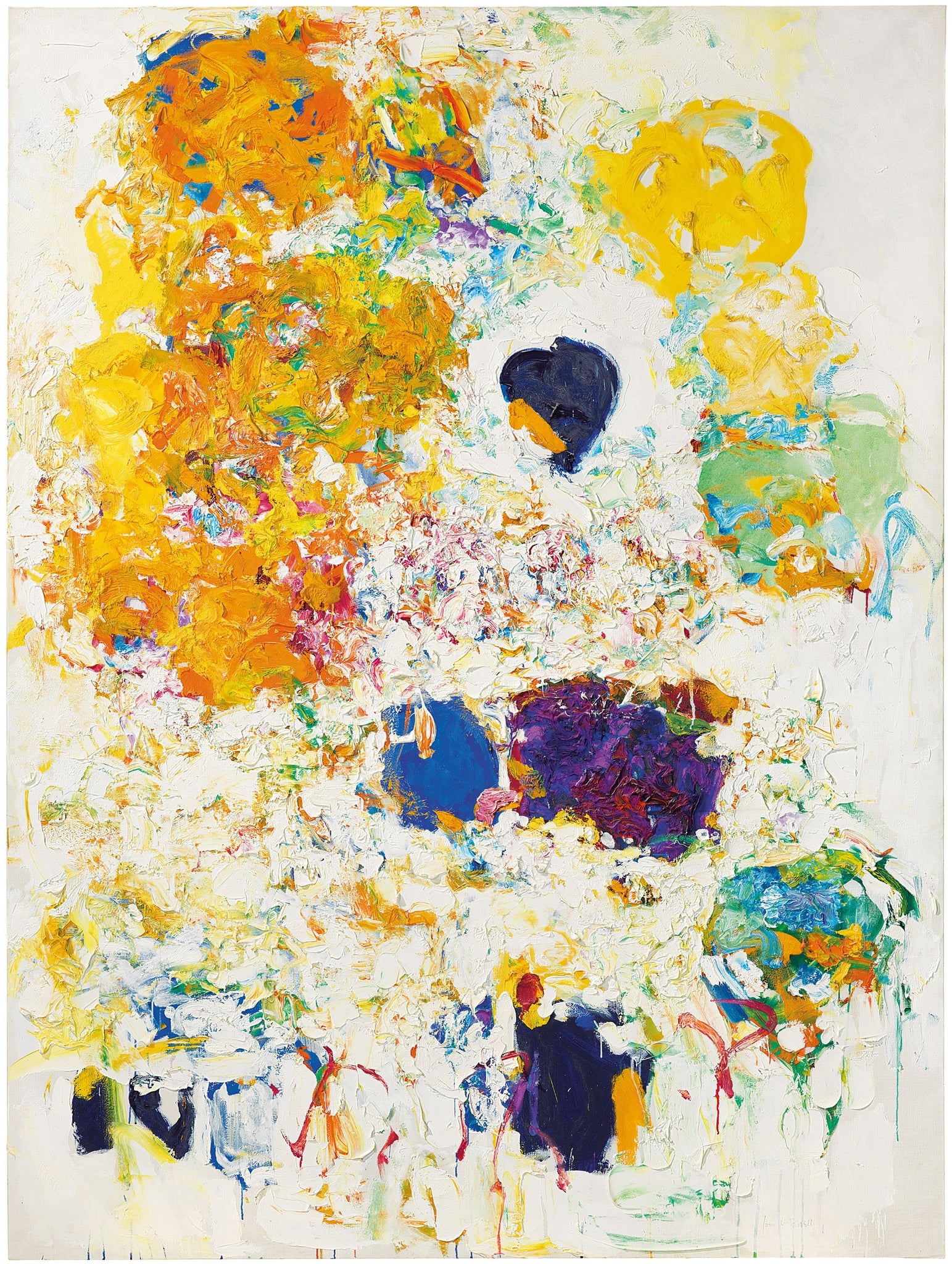
Blueberry
Joan Mitchell (1969)
Joan Mitchell’s Blueberry (1969) stages a <strong>clustering storm of color</strong> within a wide, breathing field of white. Thick blue-violet cores press against ochre and lemon swaths, while scraped light and drips open pockets of air, turning memory into <strong>weathered sensation</strong> <sup>[1]</sup><sup>[3]</sup><sup>[2]</sup>.
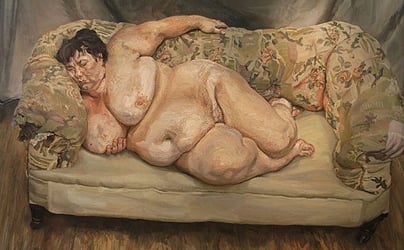
Benefits Supervisor Sleeping
Lucian Freud (1995)
Benefits Supervisor Sleeping is a 1995 oil painting in which Lucian Freud renders a sleeping, unidealized body across a sagging, floral sofa. With dense, tactile brushwork and a close, low vantage, the work asserts <strong>monumental presence</strong> while confronting viewers with the <strong>material truth of flesh</strong> and time’s imprint. It is a late‑century landmark of the School of London’s uncompromising figurative art <sup>[1]</sup><sup>[4]</sup>.
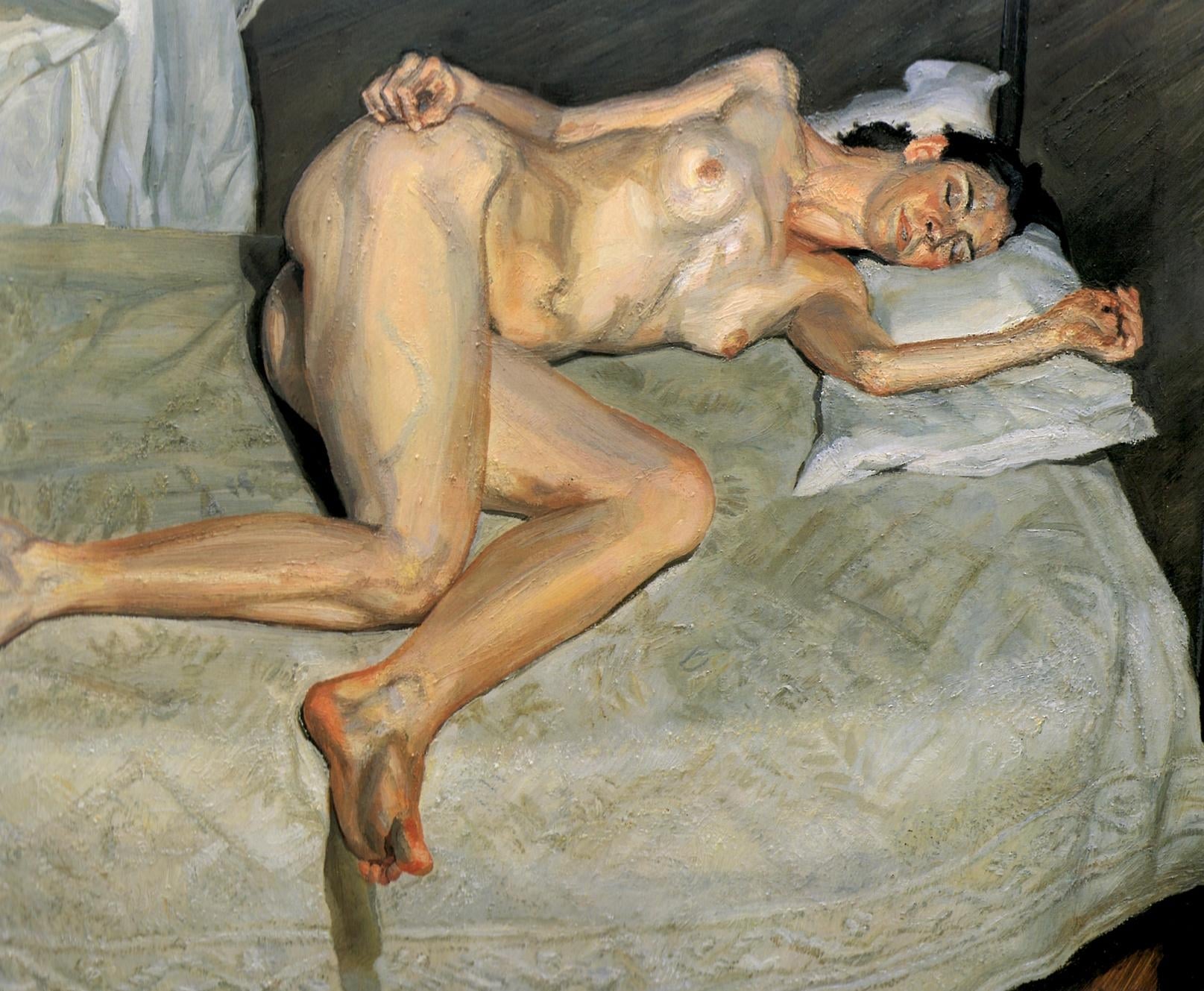
Portrait on a White Cover
Lucian Freud (2002–2003)
Lucian Freud’s Portrait on a White Cover turns the human body into a field of <strong>material truth</strong>, setting warm, bruised flesh against a <strong>cool, worked cloth</strong> that is named in the title. The diagonal sprawl, clenched left hand, and twisted feet make <strong>gravity</strong> and <strong>duration</strong> felt as subjects in their own right <sup>[1]</sup><sup>[2]</sup>.
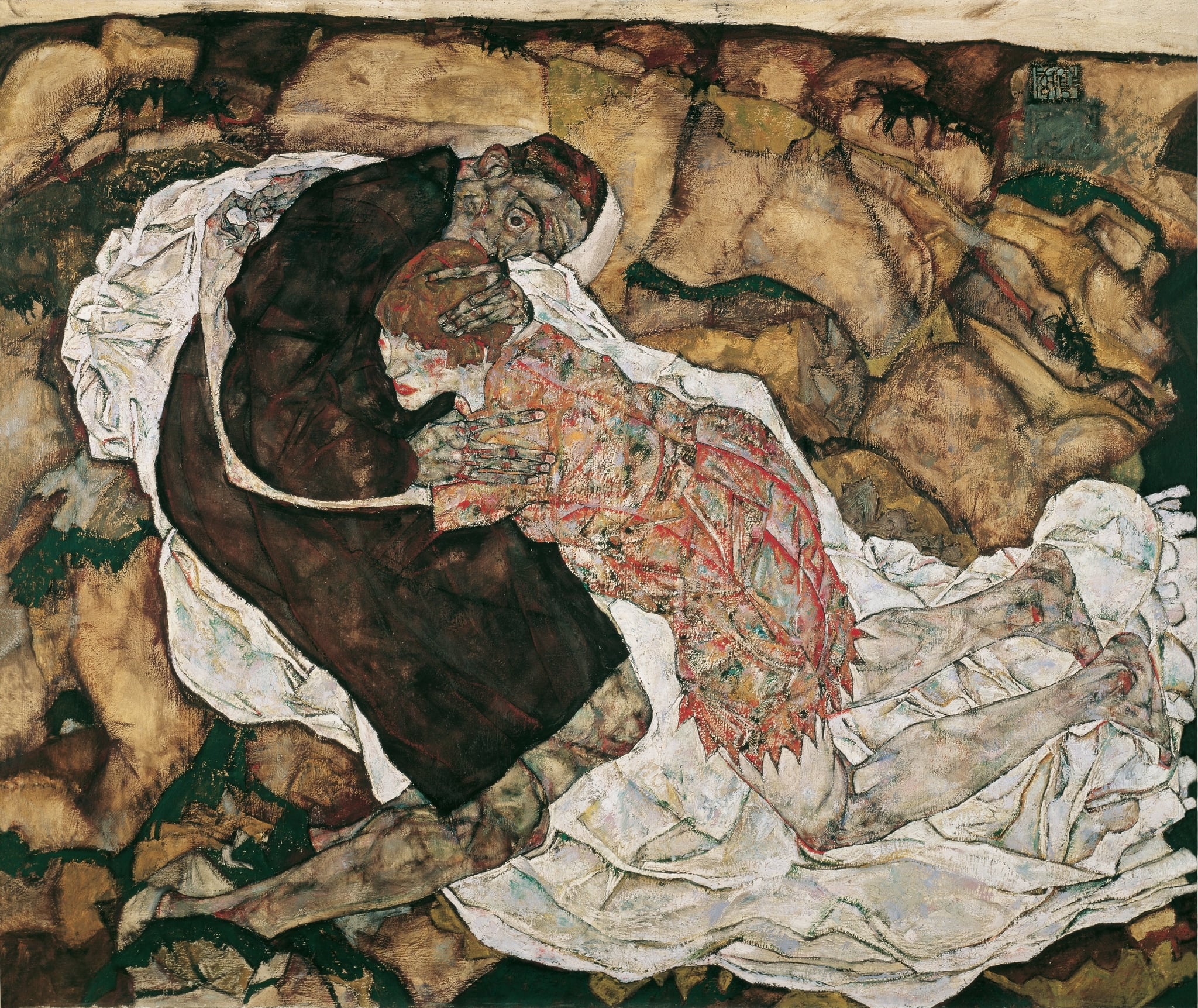
Death and the Maiden
Egon Schiele (1915)
In Death and the Maiden, Egon Schiele fuses <strong>eros and thanatos</strong> into a single, uneasy embrace: a gaunt, hooded figure in dark robes wraps himself around a young woman whose patterned dress and red mouth still signal life. On a crumpled <strong>white cloth</strong>—at once bed and shroud—their angular, ashen bodies kneel against <strong>barren ocher earth</strong>, turning intimacy into a memento of parting. The scene asserts that tenderness and terror are inseparable, especially under the shadow of war.
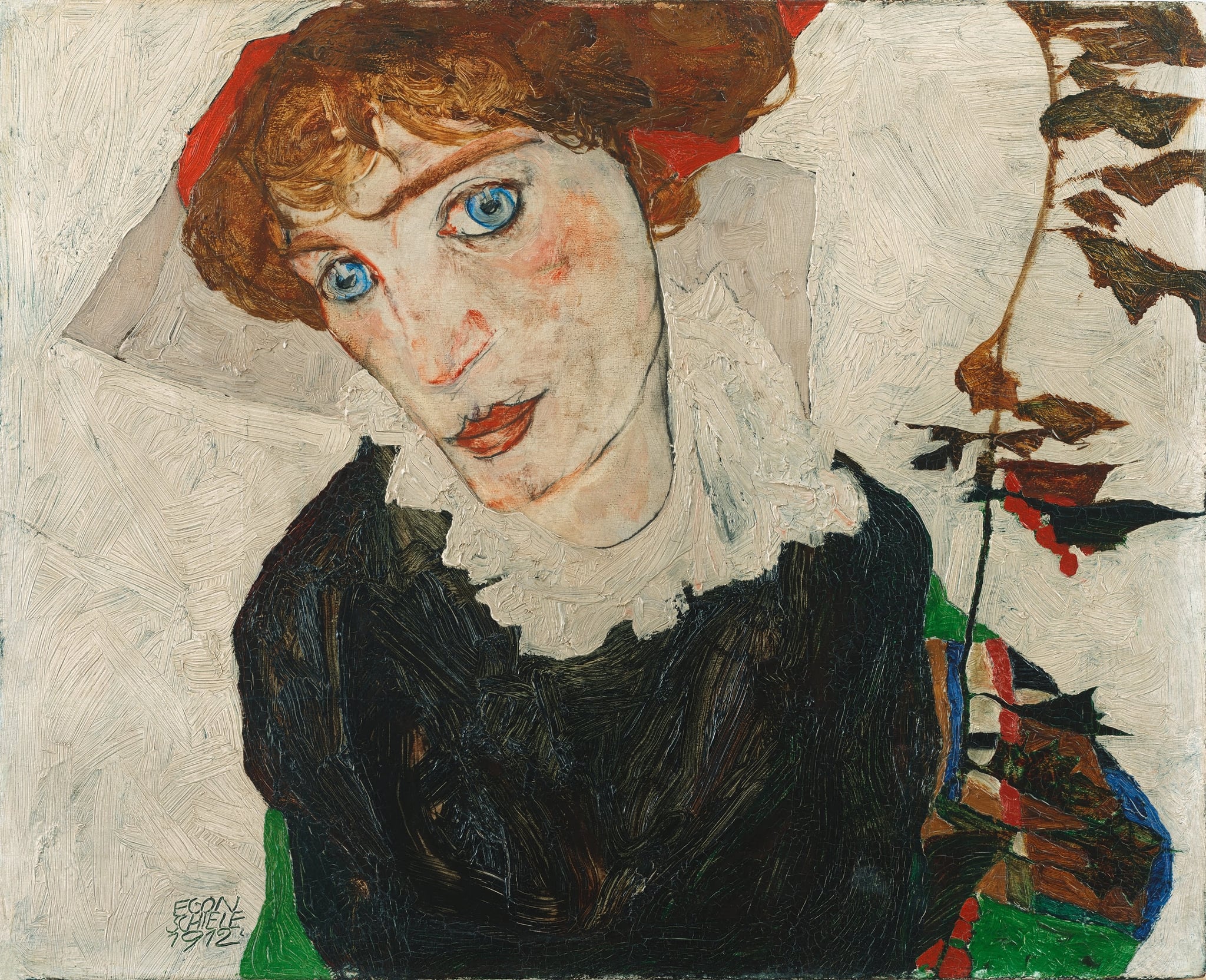
Portrait of Wally
Egon Schiele (1912)
Egon Schiele’s Portrait of Wally (1912) turns likeness into <strong>emotional topography</strong>: an oblique head, ice‑blue eyes, and a ruffled white collar flare against an <strong>impasto, airless ground</strong>. The right‑edge twig with red berries acts as a terse sign of <strong>vitality under threat</strong>, while jagged contours and a dense black dress pull the figure toward us with unsettling intimacy <sup>[1]</sup><sup>[3]</sup>.
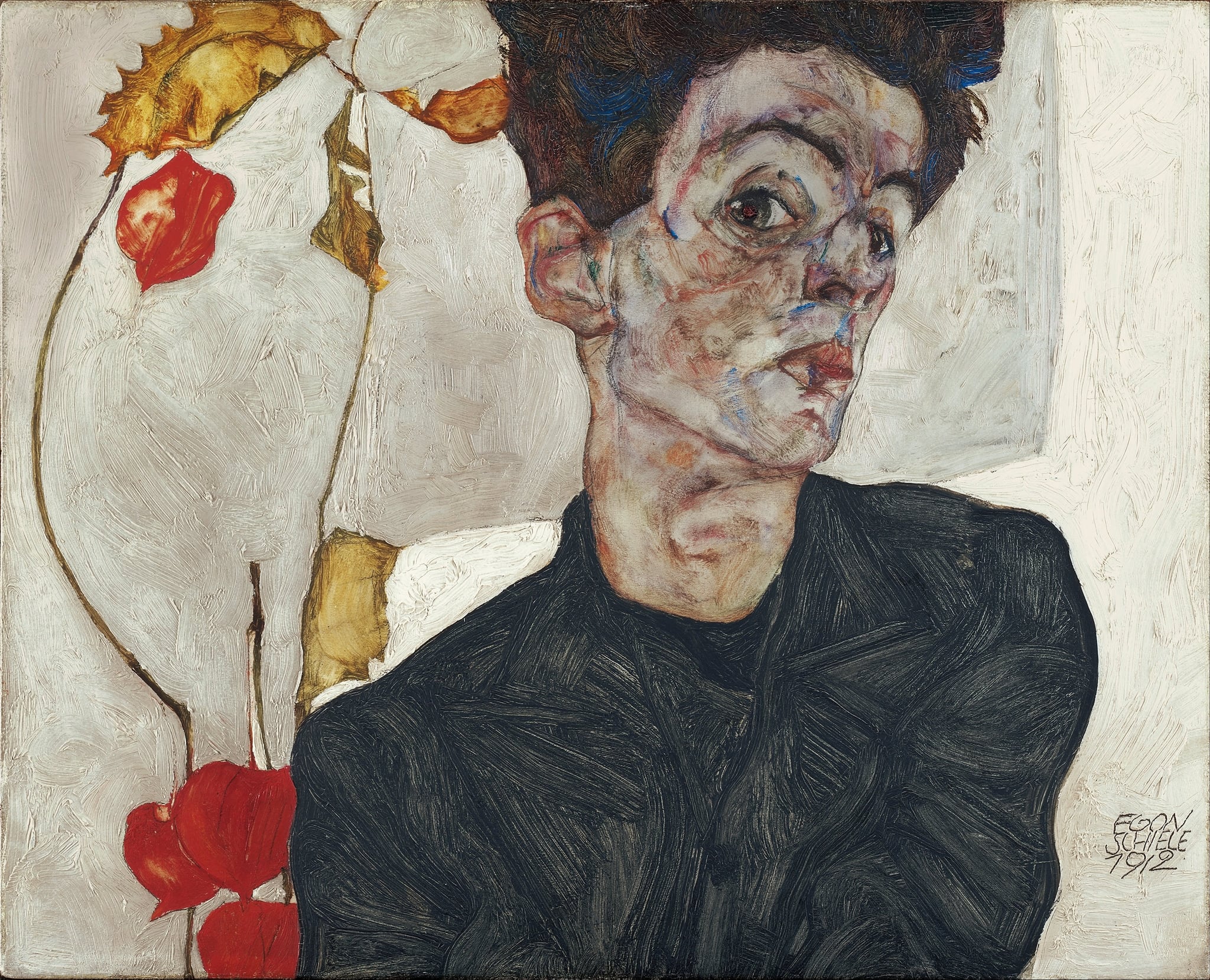
Self-Portrait with Physalis
Egon Schiele (1912)
In Self-Portrait with Physalis, Egon Schiele twists his gaunt body toward us, the face flayed by violet and blue accents and set against a scraped, chalky ground. The <strong>red-orange lantern pods</strong> flare beside his black, sharply linear jacket, a <strong>counterweight</strong> that charges the image with tension between vitality and decay <sup>[1]</sup><sup>[2]</sup>. Signed and dated <strong>1912</strong> at lower right, it crystallizes Schiele’s Expressionist self-scrutiny.
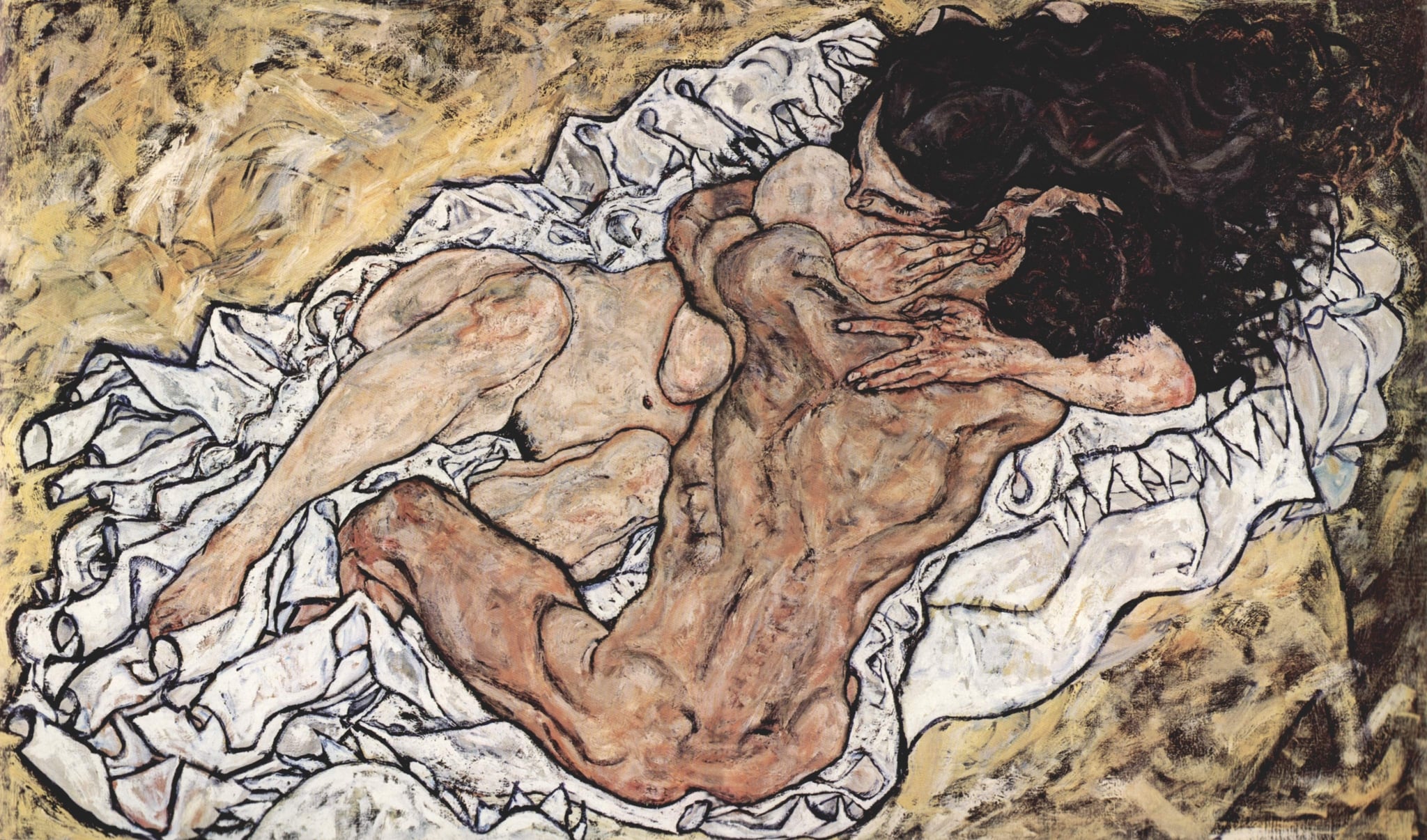
The Embrace
Egon Schiele (1917)
The Embrace fuses two nude bodies into a single, trembling organism, where <strong>tenderness</strong> and <strong>separation anxiety</strong> coexist. Schiele’s taut contours, proliferating <strong>hands</strong>, and storm‑like <strong>sheet</strong> make desire feel both sheltering and perilous <sup>[1]</sup>. From the overhead view, intimacy reads as a pact against isolation and a recognition of the body’s <strong>fragility</strong>.
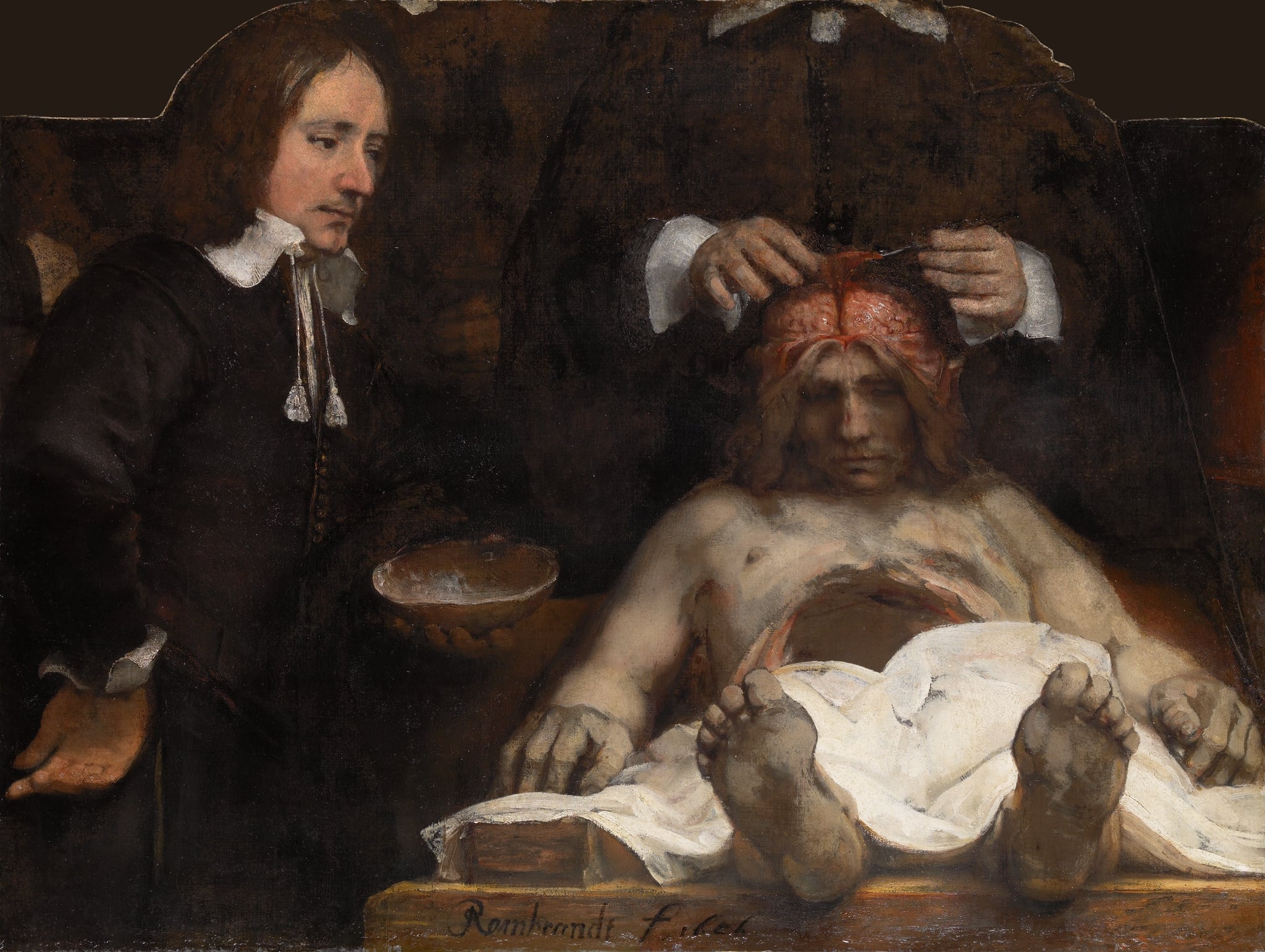
The Anatomy Lesson of Dr. Jan Deijman
Rembrandt van Rijn (1656)
Rembrandt van Rijn’s The Anatomy Lesson of Dr. Jan Deijman (1656) stages a public dissection in which the surgeon exposes the <strong>falx cerebri</strong> while a foreshortened corpse thrusts its feet toward us. The white sheet blazes under Rembrandt’s <strong>chiaroscuro</strong>, making inquiry itself the drama as instruments and cuffs emerge from shadow. What survives—now a fragment—is a riveting meditation on knowledge practiced at the edge of <strong>mortality</strong> <sup>[1]</sup><sup>[3]</sup><sup>[5]</sup>.
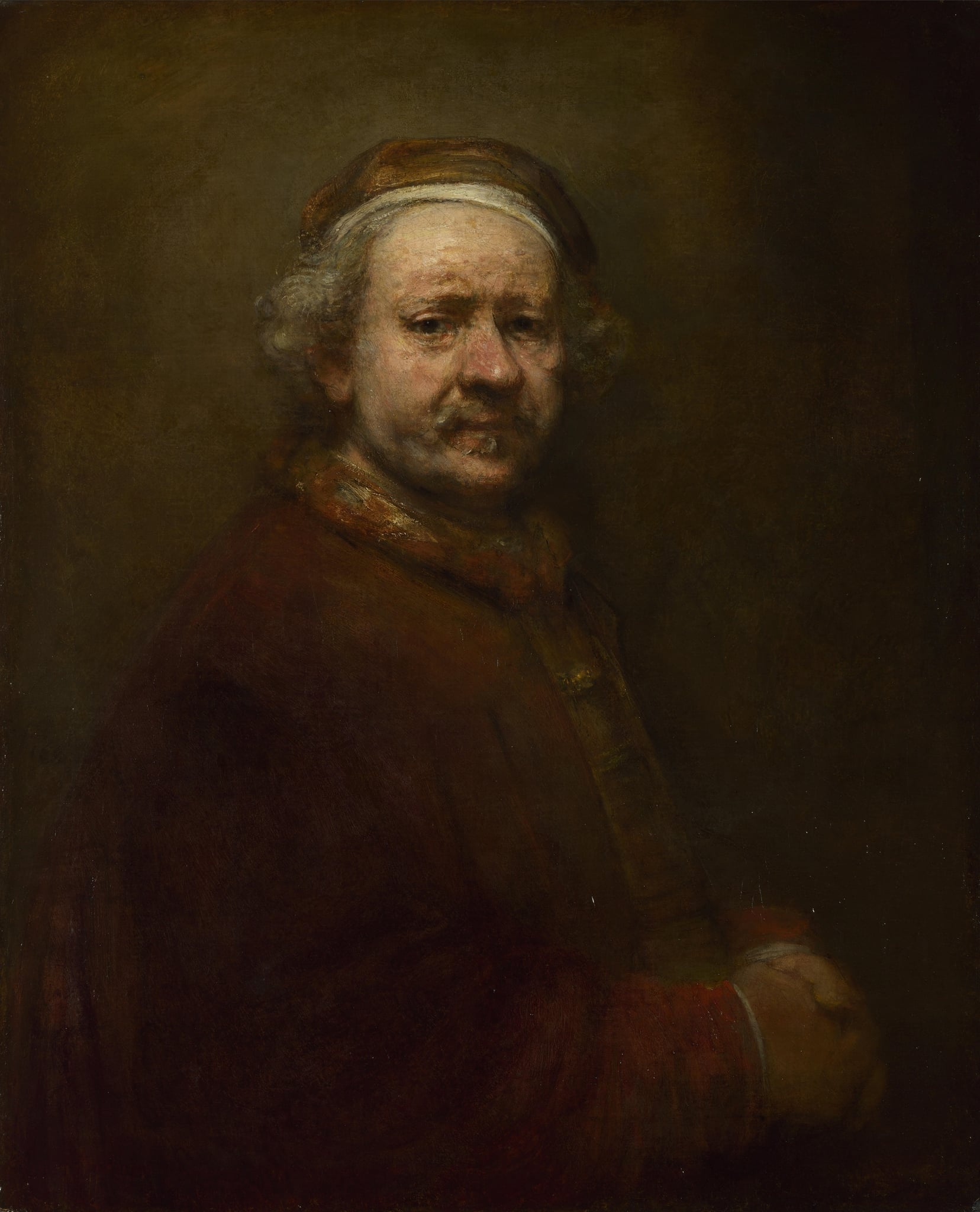
Self Portrait at the Age of 63
Rembrandt van Rijn (1669)
Rembrandt van Rijn’s Self Portrait at the Age of 63 (1669) presents an aged painter held in a warm cone of light against an engulfing dark. Thick, tactile strokes carve the face while the clasped hands retreat into shadow, turning bodily presence into a <strong>meditation on endurance</strong> and the <strong>craft of looking</strong> <sup>[1]</sup><sup>[2]</sup>.
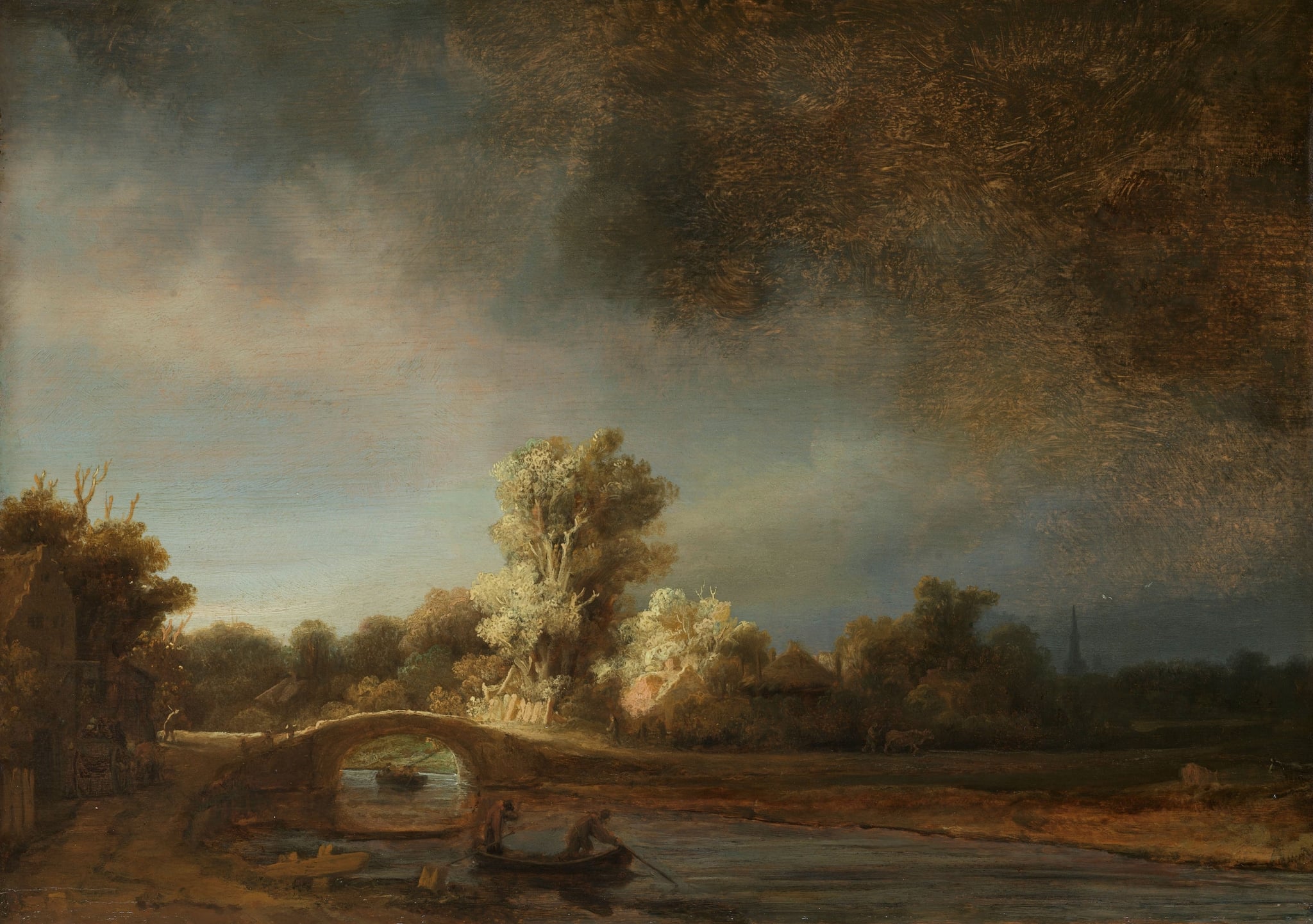
Landscape with a Stone Bridge
Rembrandt van Rijn (late 1630s (c. 1637–1638))
Under a storm-laden sky, a sudden shaft of light isolates the low <strong>stone bridge</strong> and a cluster of <strong>silvery trees</strong>, while tiny boats, a rutted track, a cottage, grazing animals, and a far <strong>church spire</strong> register human presence. Rembrandt van Rijn turns an everyday crossing into a scene of <strong>passage and providence</strong>, where transience moves beneath the endurance of stone and sky <sup>[1]</sup><sup>[2]</sup>.
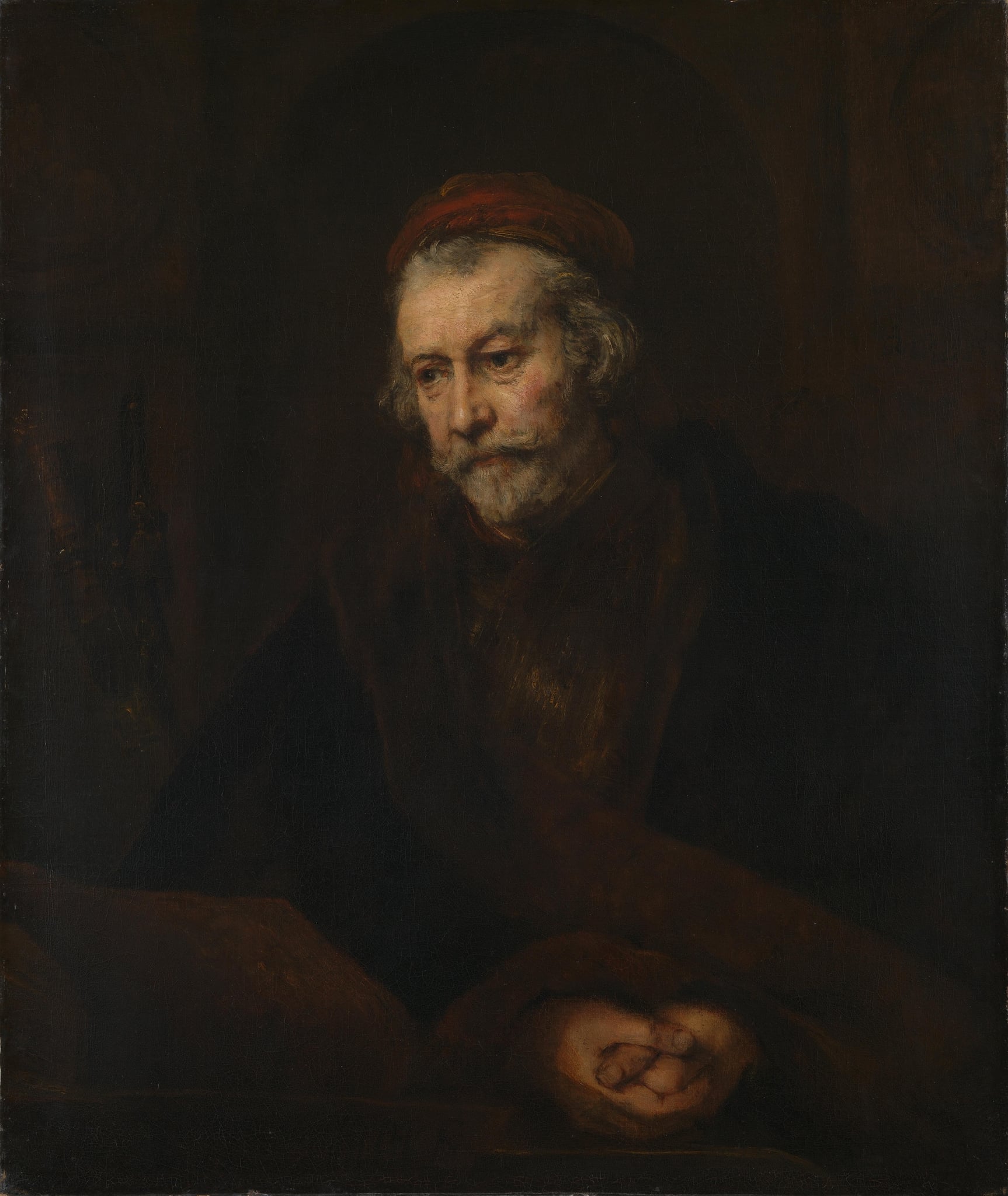
An Elderly Man as Saint Paul
Rembrandt van Rijn (1659 (probably))
Rembrandt’s An Elderly Man as Saint Paul stages a profound meditation on <strong>thought joined to faith</strong>, cupping light around a weathered face and folded hands that hover above a scholar’s book. A veiled <strong>sword</strong> and faint <strong>roundel of the Sacrifice of Isaac</strong> deepen the painting’s argument that conviction, text, and trial cohere in Pauline wisdom <sup>[1]</sup><sup>[2]</sup>.
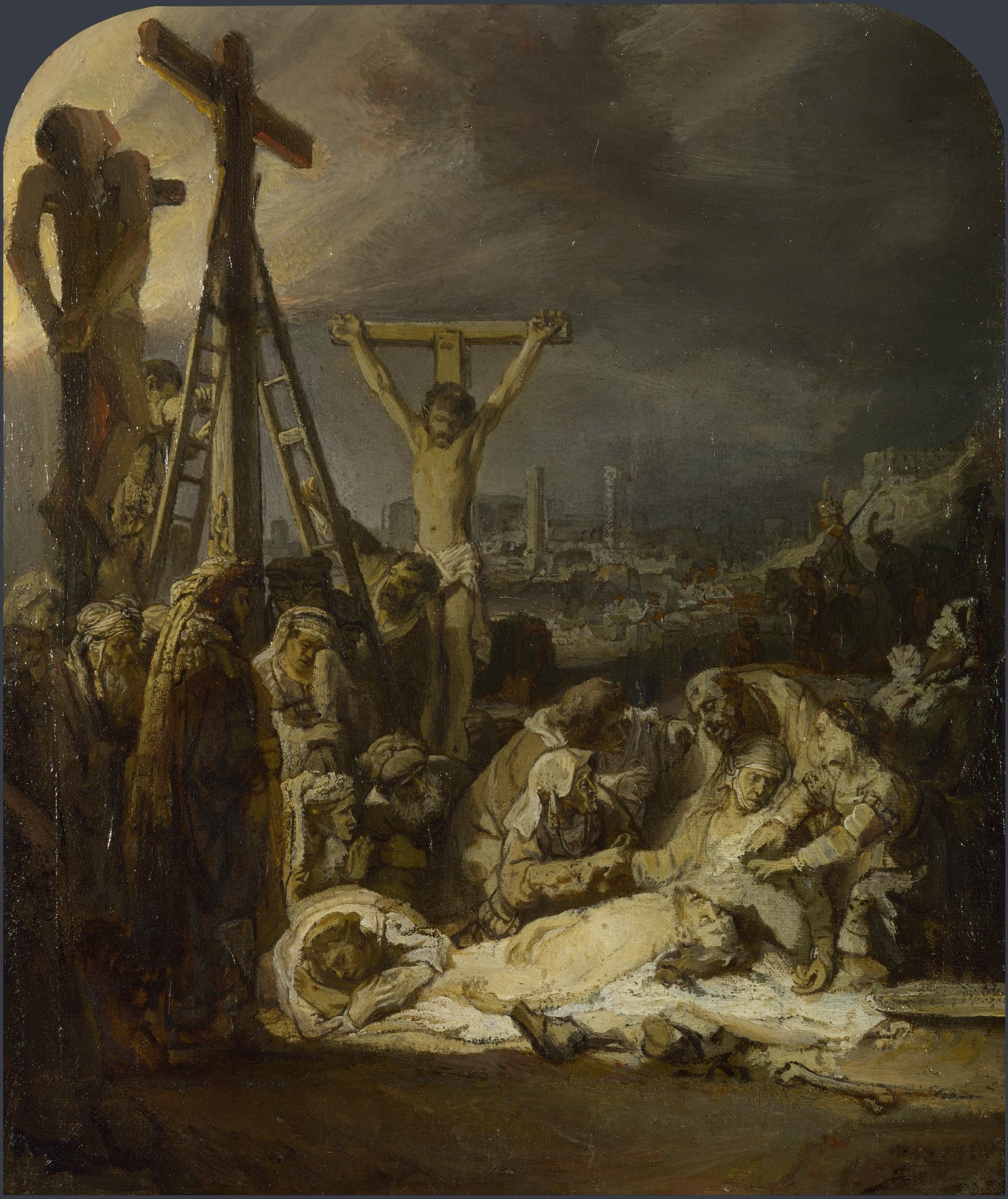
The Lamentation over the Dead Christ
Rembrandt van Rijn (about 1635)
In The Lamentation over the Dead Christ, Rembrandt van Rijn gathers grief and hope into a single <strong>grisaille</strong> blaze of light. Christ’s diagonal, pallid body on a white shroud draws mourners into a tight arc, while ladders, crosses, and the silhouetted thieves still crown the hill under a storming sky <sup>[1]</sup>.
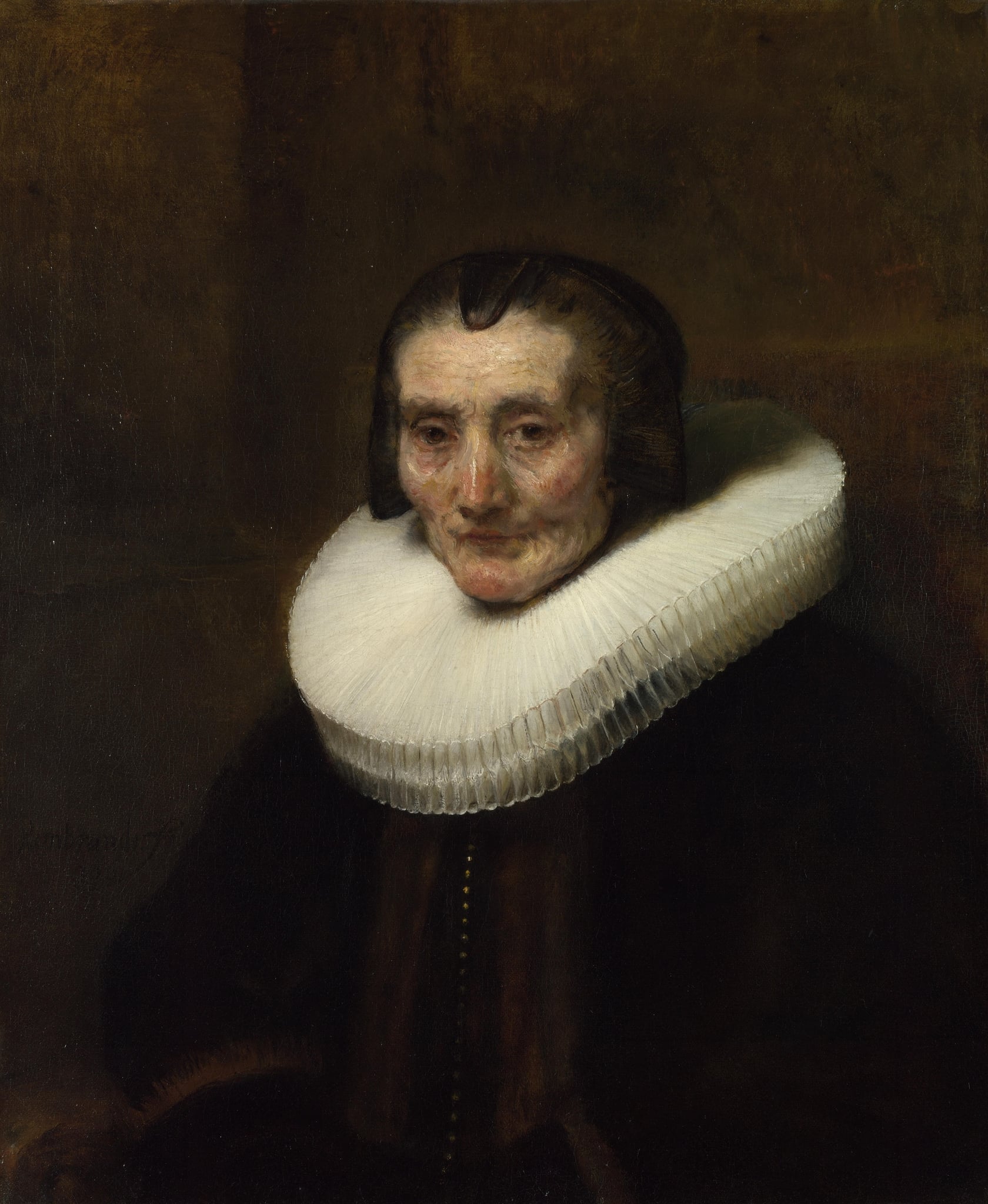
Portrait of Margaretha de Geer, Wife of Jacob Trip
Rembrandt van Rijn (about 1661)
Rembrandt van Rijn’s Portrait of Margaretha de Geer, Wife of Jacob Trip crystallizes late‑style <strong>chiaroscuro</strong> and a fearless study of <strong>age and dignity</strong>. The incandescent <strong>millstone ruff</strong> gathers and emits light against a brown void, while the dark gown and measured posture project wealth disciplined by piety <sup>[1]</sup>.
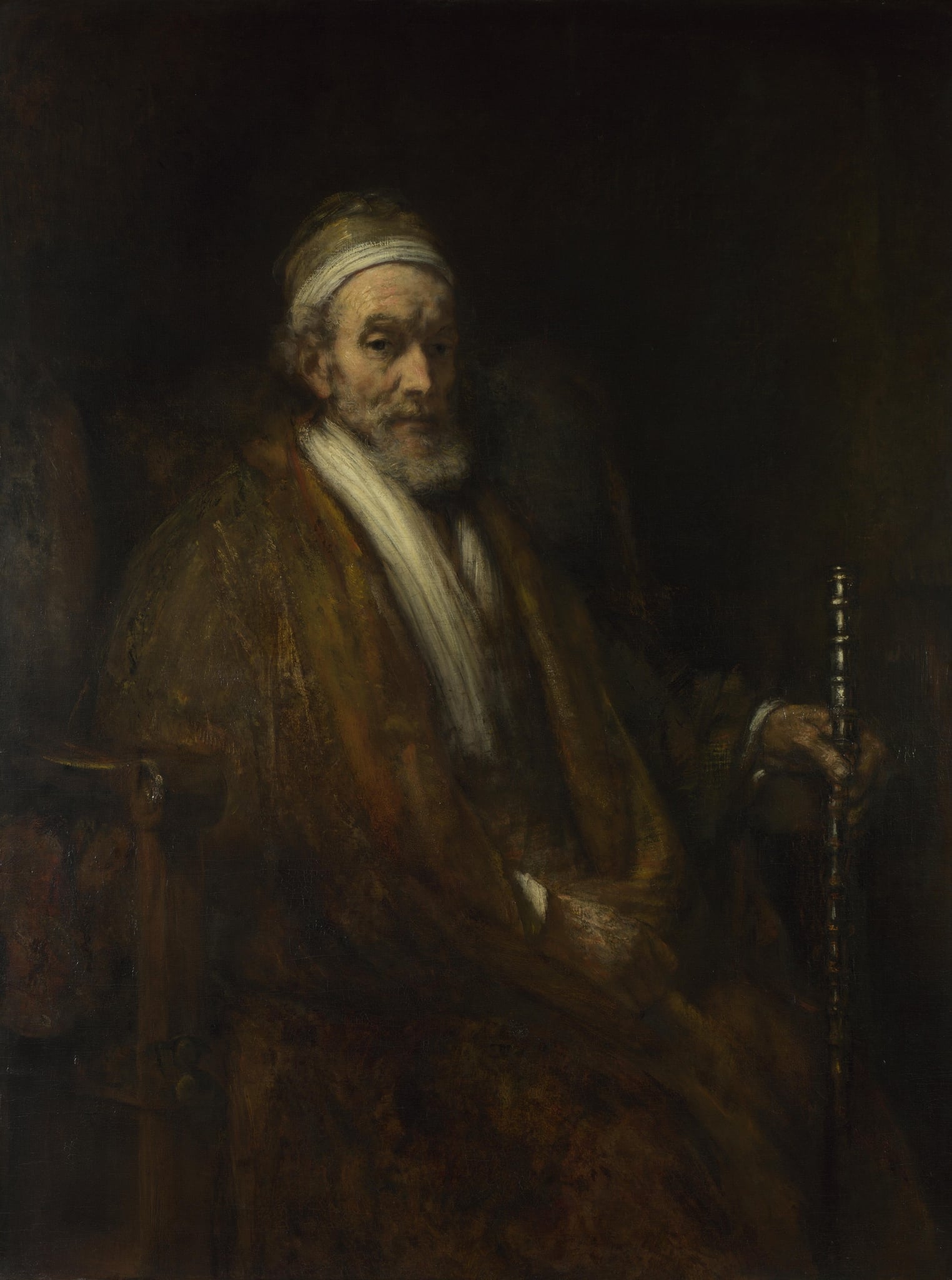
Portrait of Jacob Trip
Rembrandt van Rijn (c. 1661)
In Portrait of Jacob Trip, Rembrandt van Rijn distills worldly rank into <strong>quiet authority</strong> and <strong>moral gravity</strong>. A narrow beam lifts the sitter’s brow, nose, and beard while the rest recedes, so that character—not costume—carries the image <sup>[1]</sup><sup>[2]</sup>. The lightly held, scepter‑like <strong>staff</strong> and tabbaard‑like robe project power tempered by age and introspection <sup>[1]</sup><sup>[5]</sup>.
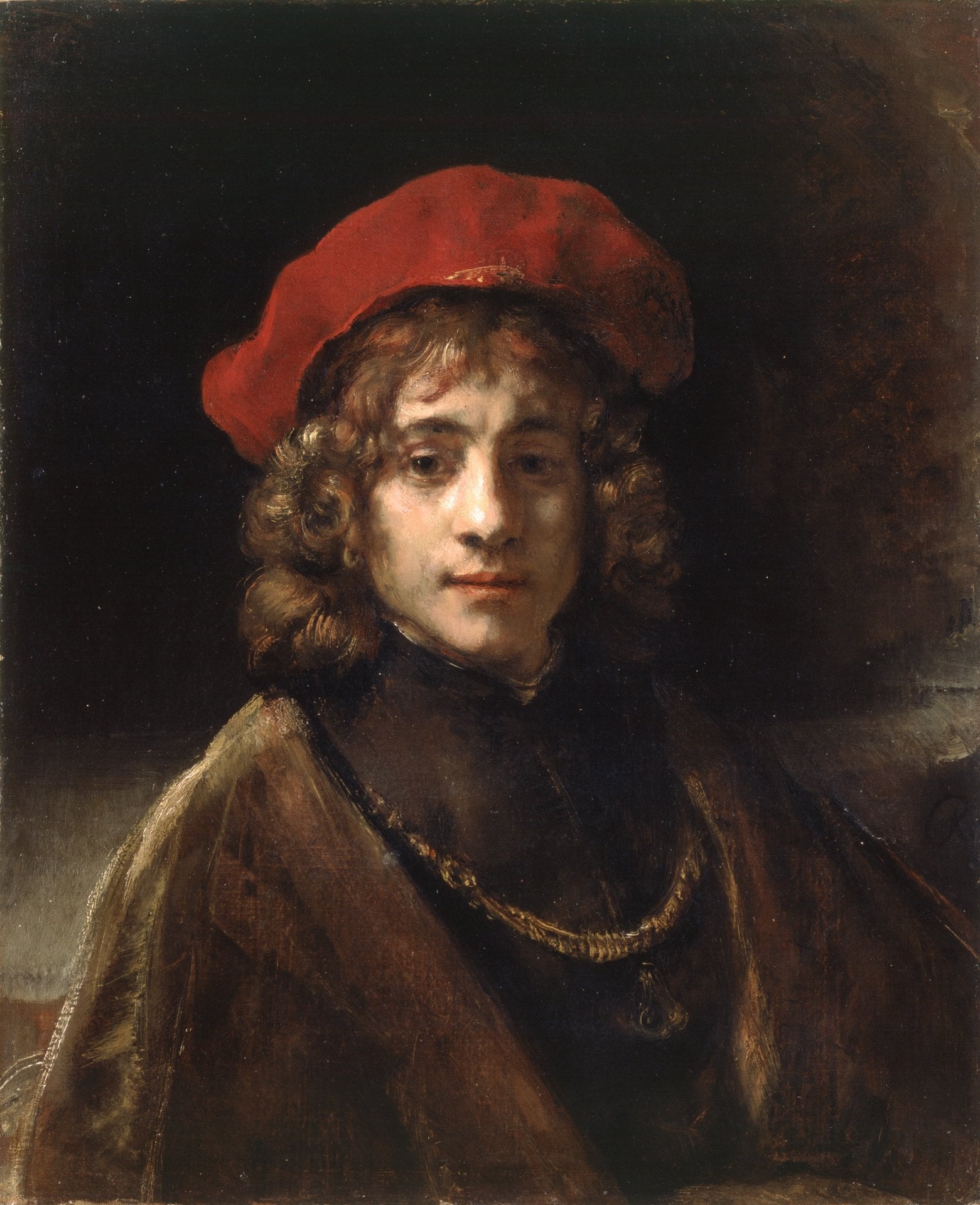
Titus, the Artist's Son
Rembrandt van Rijn (c. 1657)
Rembrandt van Rijn’s Titus, the Artist’s Son is a poised, half-lit study of youth, where <strong>tender chiaroscuro</strong> gathers on the face and crimson cap while the rest dissolves into shadow. The <strong>fancy Venetian costume</strong>, notably the red beret and simple gold chain, elevates a private likeness into a meditation on dignity and becoming <sup>[1]</sup><sup>[2]</sup>.
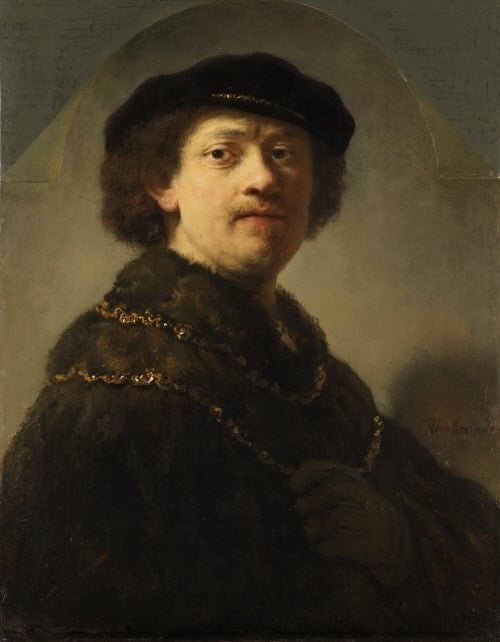
Self-Portrait in a Black Cap
Rembrandt van Rijn (1637)
In Self-Portrait in a Black Cap, Rembrandt van Rijn stages himself in <strong>sumptuous fur</strong>, a <strong>black cap</strong>, and a <strong>glinting gold chain</strong>, then cuts the figure from dusk with incisive light. The steady gaze and slightly parted lips meet the viewer while a <strong>gloved hand lifts the chain</strong>, redirecting status back to the artist’s own hand. Painted c. 1637 in oil on oak, the work now has an <strong>arched top</strong> from a later reshaping of the panel <sup>[1]</sup>.