Charing Cross Bridge

by Claude Monet

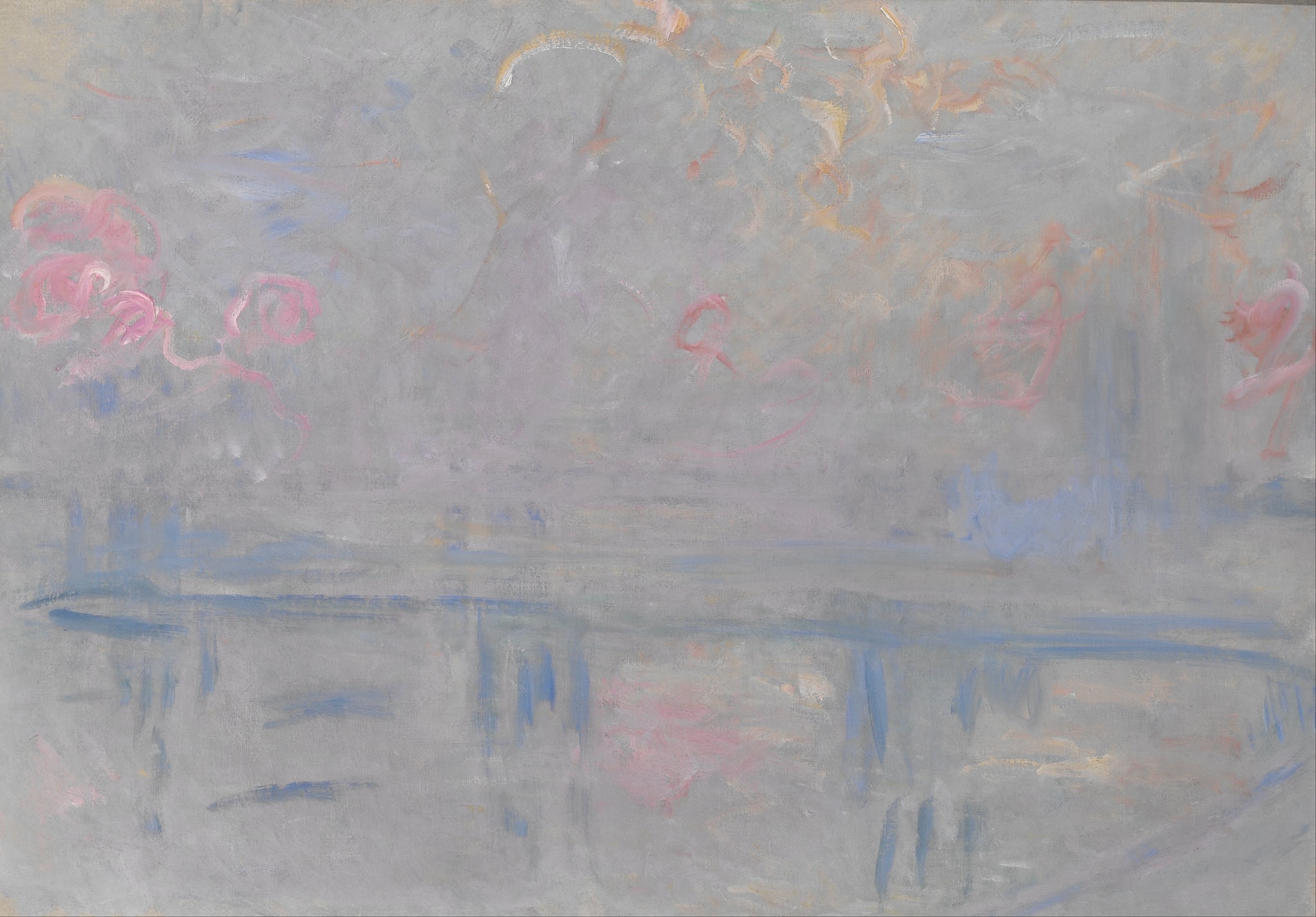
In Charing Cross Bridge, Claude Monet turns London into atmosphere itself: the bridge flattens into a cool, horizontal band while mauves, lavenders, and pearly grays veil the city. Spirals of pink steam and pockets of pale blue read as trains, lamps, or smoke transfigured by weather, so place becomes sensation rather than structure.

Fast Facts

Year
1901
Medium
Oil on canvas
Dimensions
65 x 92.2 cm
Location
Art Institute of Chicago, Chicago
Charing Cross Bridge by Claude Monet (1901)

Click on any numbered symbol to learn more about its meaning

Meaning & Symbolism

Monet’s canvas asserts that meaning resides in the air between things. The bridge is a low, cool stratum—its span and piers registered as desaturated blue bars whose reflections drip vertically into the Thames—while the rest of London recedes into a unified, silvery enveloppe of color 1. Within that veil, small shocks of hue do the narrative work: curling ribbons of pink at left and right suggest locomotive plumes or streetlamps diffused by humidity; a floating pocket of cornflower blue near the right bank flickers like sudden sunlight tearing at fog; a faint, upright blur at the far right reads as distant architecture only because the surrounding gray grants it context. Monet refuses outlines; he replaces description with temporal vibration, so the eye must assemble the city from pulses. The result is not a view but a state—London as felt instant—aligning with his serial method of staging multiple canvases as time-slices unified by atmosphere 16. By treating the bridge as a cool bar cutting across warm, aerated light, Monet stages a negotiation between industry and nature. The bridge’s rectilinear rhythm—kin to the wood-blocked skeletons in Japanese prints Monet collected—becomes a modern motif softened by vapor, a symbol of engineering subsumed by climate 1. The pink spirals and peach tints do double duty: they aestheticize smog, acknowledging coal-fired London as the very generator of beauty, while revealing how pollution authored the chromatic conditions he chased from the Savoy balconies 34. The composition’s horizontal calm and vertical drips suspend chronometric markers—clock towers or legible facades disappear—so that standardized city time dissolves into lived duration, a felt “now” that can only be held through color 46. In this way, why Charing Cross Bridge is important is clear: it shows late Impressionism pivoting toward near‑abstraction, replacing urban reportage with a grammar of atmospheric intervals that prefigures the Nymphéas 56. The image also reframes looking as an ethics of attention. The viewer’s gaze is trained to read minuscule differences—a slightly warmer gray along the horizon, a barely cooler wash under the span—as significant events. Modern traffic (a train signaled by that pink coil) passes, but the picture asks us to dwell in the interval rather than the object. Water mirrors the sky not as a depiction of buildings but as a ledger of shifts in pressure, humidity, and light; the river’s blurred blue-pink reflections repeat and loosen the bridge’s grid, turning infrastructure into memory. In Monet’s hands, London is not a place to be mapped but a phenomenon to be experienced, and the bridge is the device that makes this passage—between banks, elements, and modes of seeing—legible 126.

Explore Deeper with AI

Ask questions about Charing Cross Bridge

Popular questions:

Powered by AI • Get instant insights about this artwork

💬 Ask questions about this artwork!

Interpretations

Formal Analysis

Monet slims the bridge to a banded scaffold of cool, desaturated strokes that behave less like architecture than like a register for atmospheric modulation. Contours collapse into chromatic adjacency; violet-greys toggle against peach and pink suspensions that read as smoke or low sun, activating a plane where depth is inferred through saturation and temperature rather than linear perspective. This optical flattening, allied to the bridge’s rectilinear cadence and its kinship to Japanese print structures, nudges the canvas toward proto‑abstraction, prefiguring the late Nymphéas where motif yields to field. The “enveloppe” guarantees unity across the surface, while vertical drip-reflections counter the span’s horizontals, creating a grid loosened by fluidity. The result is a painting that choreographs contrasts—cool/warm, vertical/horizontal, opaque/diaphanous—into a single atmospheric system 126.

Source: Art Institute of Chicago; Courtauld Gallery (Monet and London: Views of the Thames)

Historical Context

From upper floors of the Savoy, Monet organized his day by effects: Waterloo in the morning, Charing Cross at midday, and Parliament in the afternoon—an industrial-age schedule bent to light rather than clocks. He initiated dozens of canvases on-site (1899–1901), then spent years in Giverny aligning them into a coherent series, culminating in the 1904 Durand‑Ruel exhibition. This workflow explains variable dates across museum labels and the serial “time-slice” logic that binds the group. Research triangulating sun angles, maps, and weather data even pins his Savoy rooms to specific floors and numbers, grounding the poetics of fog in empirical vantage 267.

Source: Art Institute of Chicago (scholarly catalogue); Christie’s contextual research; Courtauld Gallery catalogue

Environmental History

The haze is not only meteorology but infrastructure made visible: coal smoke from locomotives and chimneys fuses with river mist to fabricate the pearly veil Monet pursues. Contemporary analyses and reviews underscore how London’s industrial atmosphere—soot, sulfur, humidity—generated rapidly changing color conditions; Monet sometimes reported the river vanishing entirely. The series thus performs a paradox: it beautifies pollution while documenting the very processes that birthed it, turning environmental degradation into a chromatic resource. The locomotive plumes, often legible on the span, act as narrative triggers inside this vapor, suturing human industry to optical effect 345.

Source: Musée des Beaux‑Arts de Lyon; The Guardian (meteorology report); Financial Times (exhibition review)

Cross-Cultural Optics (Japonisme and Modernity)

Curators note the bridge’s “rectilinear skeleton” as kin to the woodblock geometries Monet admired in Japanese prints. Here, that scaffold behaves like a pictorial armature—flattened, rhythmic, and pattern-forward—upon which atmospheric washes hang. The dialogue is twofold: Japonisme informs the painting’s planar design and modular repetition, while industrial London supplies the motif. The result is a hybrid modernism where a modern bridge is translated through a print-derived sense of intervals and edges softened by fog, compressing East–West pictorial ideas into a single urban elegy 12.

Source: Art Institute of Chicago (object page and scholarly catalogue)

Phenomenology of Time

Monet suppresses chronometric markers—legible clocks, sharp facades—so that duration is carried by chroma and diffusion. The series structures time as a set of atmospheric intervals, each canvas a “now” articulated by hue and value rather than by narrative or landmark. This anti-chronometric strategy aligns with the serial display of variations that let viewers sense change as lived duration rather than as ticked time. In Charing Cross Bridge, the city coheres only as pulses of color; perception itself becomes the measure of temporality, dissolving standardized urban time into experiential breadth 26.

Source: Art Institute of Chicago (scholarly catalogue); Courtauld Gallery (Monet and London: Views of the Thames)

Related Themes

About Claude Monet

Claude Monet (1840–1926) led Impressionism’s pursuit of open-air painting and optical immediacy, especially during his Argenteuil years focused on modern leisure and light. He later developed serial studies of changing conditions, culminating in the Water Lilies cycle [2].
View all works by Claude Monet

More by Claude Monet

Haystacks Series by Claude Monet | Light, Time & Atmosphere by Claude Monet

Haystacks Series by Claude Monet | Light, Time & Atmosphere

Claude Monet

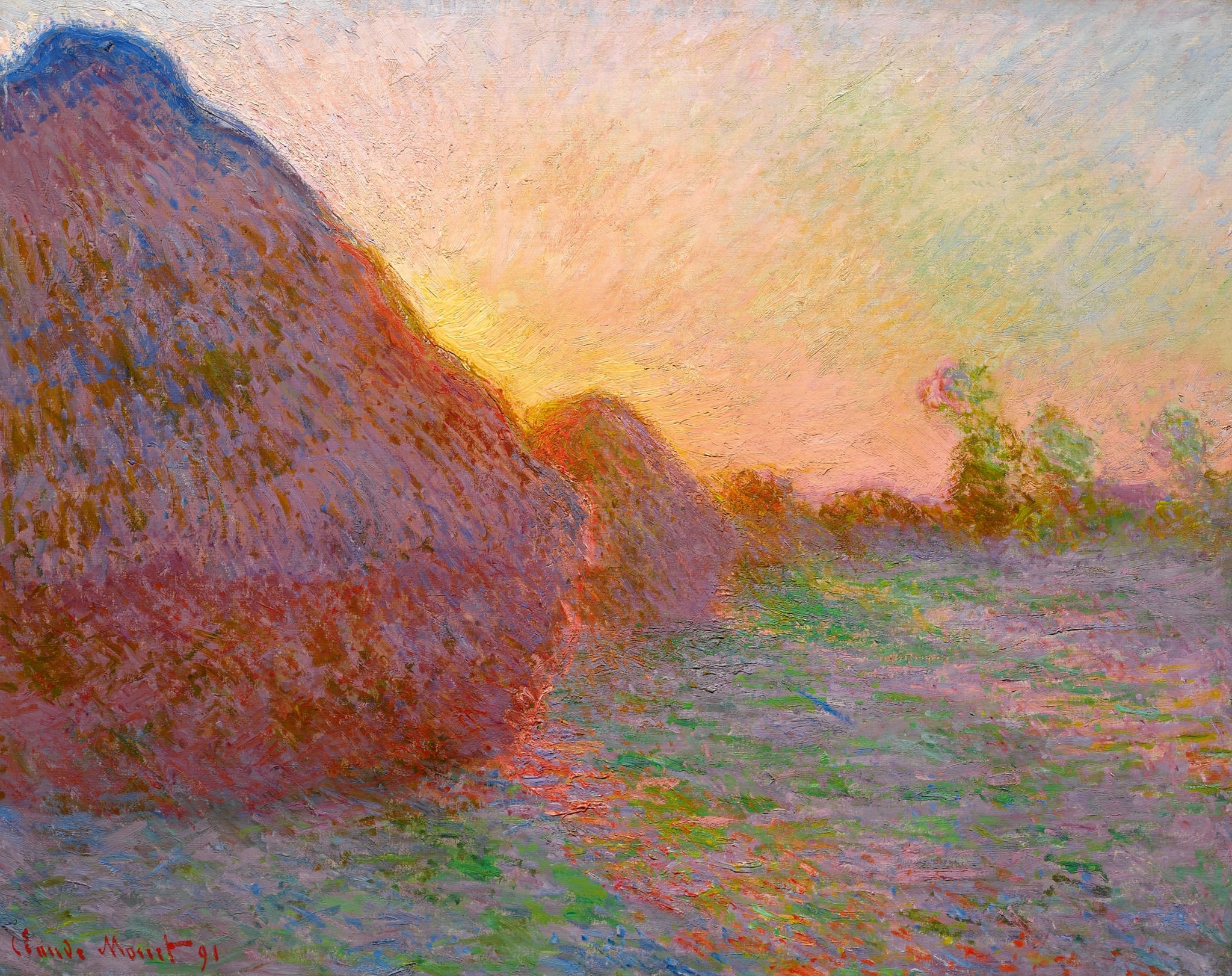
Claude Monet’s <strong>Haystacks Series</strong> transforms a routine rural subject into an inquiry into <strong>light, time, and perception</strong>. In this sunset view, the stacks swell at the left while the sun burns through the gap, making the field shimmer with <strong>apricot, lilac, and blue</strong> vibrations.
The Artist's Garden at Giverny by Claude Monet

The Artist's Garden at Giverny

Claude Monet (1900)

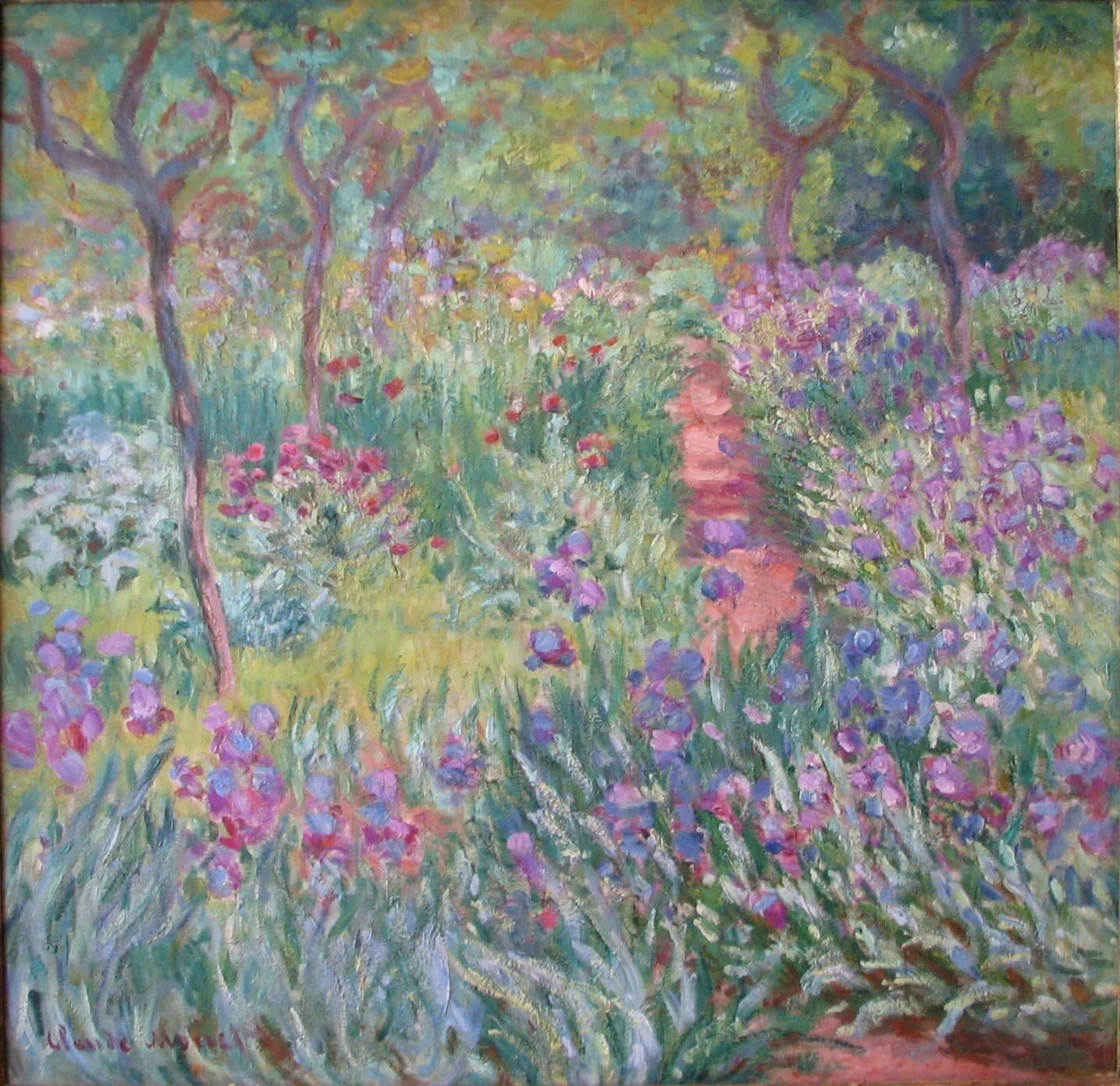
In The Artist's Garden at Giverny, Claude Monet turns his cultivated Clos Normand into a field of living color, where bands of violet <strong>irises</strong> surge toward a narrow, rose‑colored path. Broken, flickering strokes let greens, purples, and pinks mix optically so that light seems to tremble across the scene, while lilac‑toned tree trunks rhythmically guide the gaze inward <sup>[1]</sup><sup>[3]</sup>.
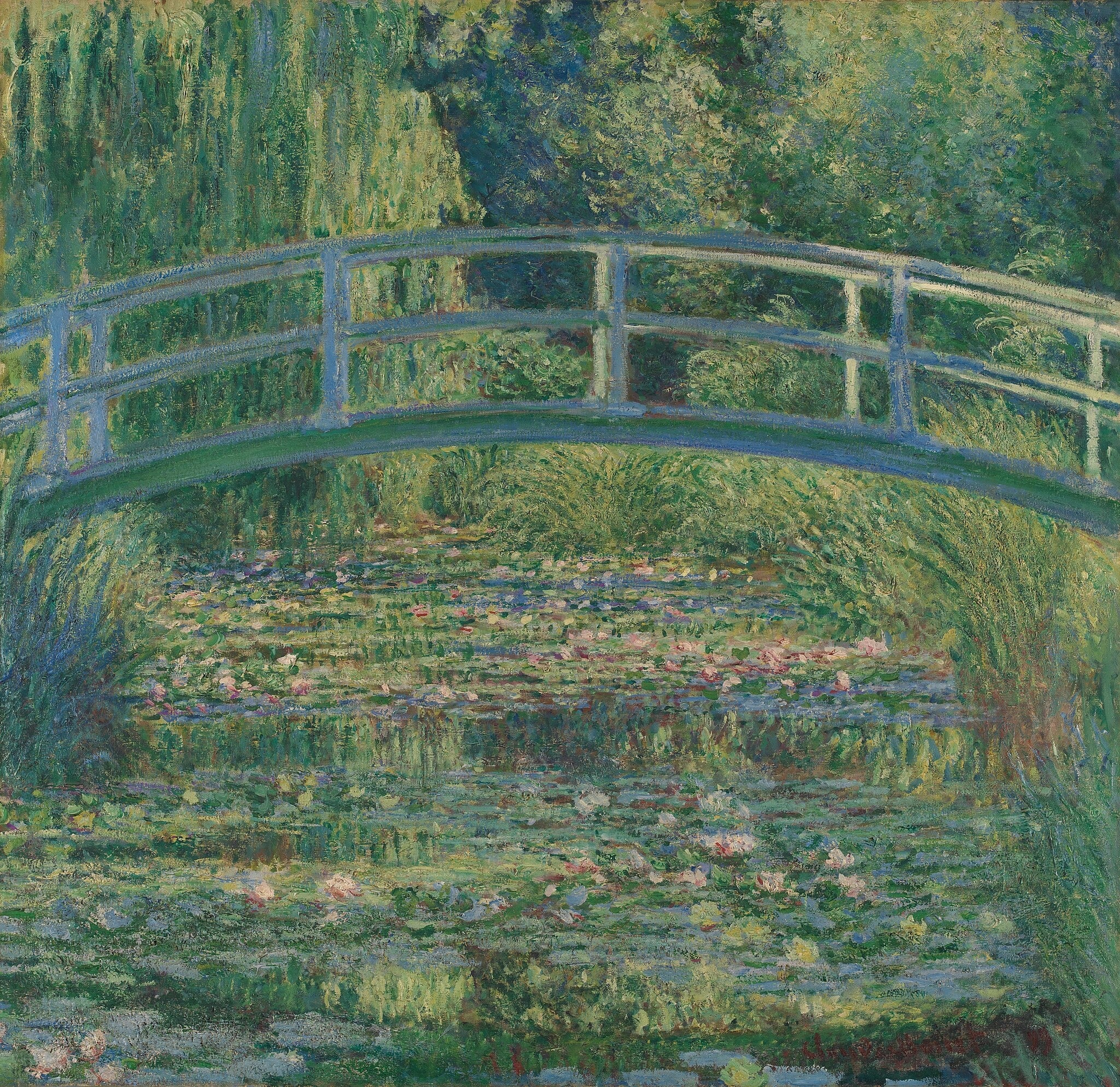
The Water Lily Pond by Claude Monet

The Water Lily Pond

Claude Monet (1899)

Claude Monet’s The Water Lily Pond transforms a designed garden into a theater of <strong>perception and reflection</strong>. The pale, arched <strong>Japanese bridge</strong> hovers over a surface where lilies, reeds, and mirrored willow fronds dissolve boundaries between water and sky, proposing <strong>seeing itself</strong> as the subject <sup>[1]</sup><sup>[3]</sup>.

Waterloo Bridge, Sunlight Effect by Claude Monet

Waterloo Bridge, Sunlight Effect

Claude Monet (1903 (begun 1900))

Claude Monet’s Waterloo Bridge, Sunlight Effect renders London as a <strong>lilac-blue atmosphere</strong> where form yields to light. The bridge’s stone arches persist as anchors, yet the span dissolves into mist while <strong>flecks of lemon and ember</strong> signal modern traffic crossing a city made weightless <sup>[1]</sup><sup>[2]</sup>. Vertical hints of chimneys haunt the distance, binding industry to beauty as the Thames shimmers with the same notes as the sky <sup>[1]</sup><sup>[3]</sup>.

Morning on the Seine (series) by Claude Monet

Morning on the Seine (series)

Claude Monet (1897)

Claude Monet’s Morning on the Seine (series) turns dawn into an inquiry about <strong>perception</strong> and <strong>time</strong>. In this canvas, the left bank’s shadowed foliage dissolves into lavender mist while a pale radiance opens at right, fusing sky and water into a single, reflective field <sup>[1]</sup><sup>[2]</sup>.

Woman with a Parasol by Claude Monet

Woman with a Parasol

Claude Monet (1875)

Claude Monet’s Woman with a Parasol fixes a breezy hillside instant in high, shifting light, setting a figure beneath a <strong>green parasol</strong> against a vast, vibrating sky. The low vantage and <strong>broken brushwork</strong> merge dress, clouds, and grasses into one atmosphere, while a child at the rise anchors depth and intimacy <sup>[1]</sup>. It is a manifesto of <strong>plein-air</strong> perception—painting the sensation of air in motion rather than the contours of things <sup>[2]</sup>.