Impression, Sunrise

by Claude Monet

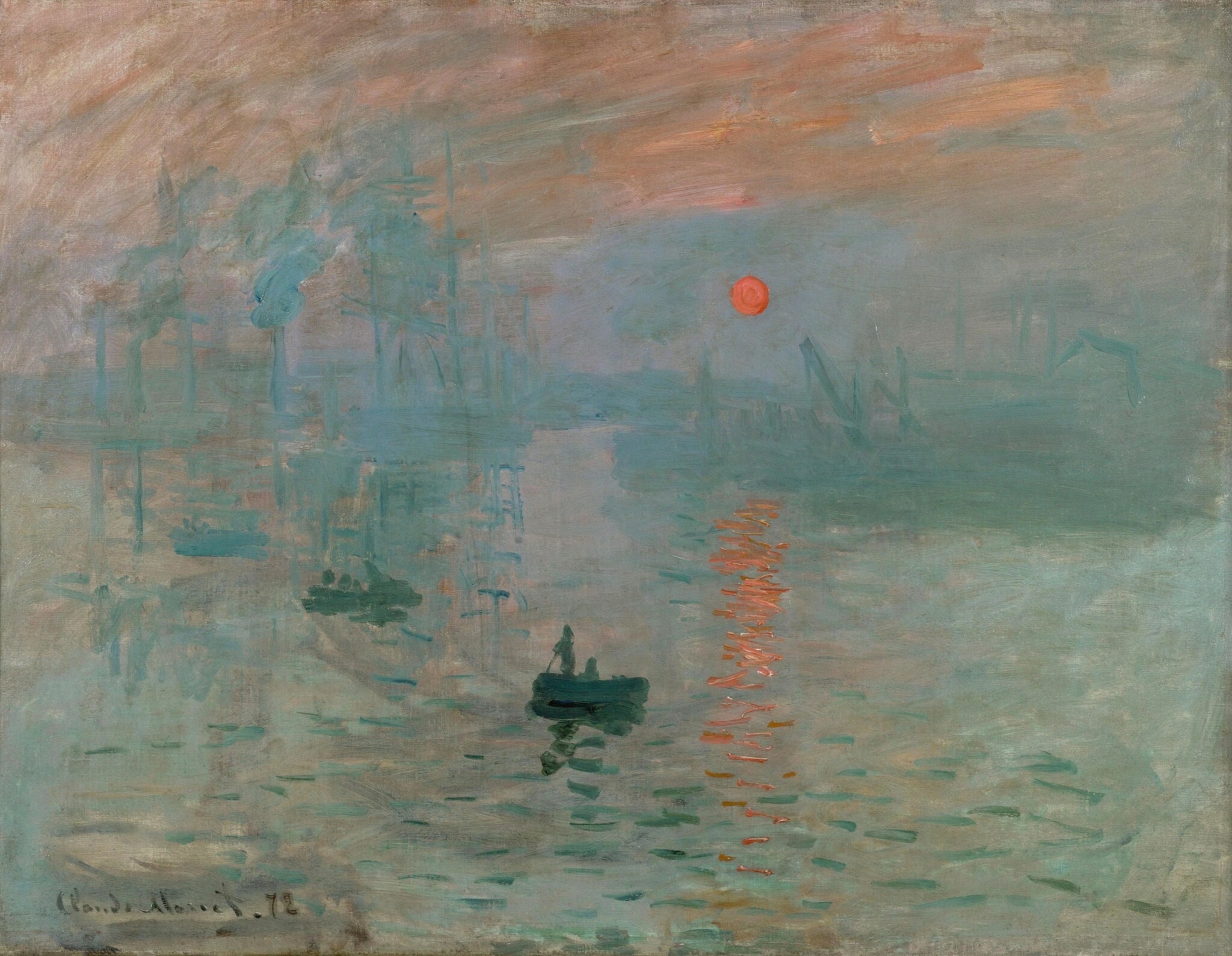
In Impression, Sunrise, Claude Monet turns Le Havre’s fog-bound harbor into an experiment in immediacy and modernity. Cool blue-greens dissolve cranes, masts, and smoke, while a small skiff cuts the water beneath a blazing, equiluminant orange sun whose vertical reflection stitches the scene together [1][3]. The effect is a poised dawn where industry meets nature, a quiet awakening rendered through light rather than line.
💰

Market Value

$250-400 million

How much is Impression, Sunrise worth?

Fast Facts

Year
1872
Medium
Oil on canvas
Dimensions
50 × 65 cm
Location
Musée Marmottan Monet, Paris
Impression, Sunrise by Claude Monet (1872)

Click on any numbered symbol to learn more about its meaning

Meaning & Symbolism

Monet positions the viewer at the Hôtel de l’Amirauté, facing Le Havre’s outer harbor, with the Quai au Bois massing to the left and the Quai Courbe to the right; between them opens the tide lock to the Bassin de l’Eure—structures that read as dark scaffolds inside a milky haze 1. A pair of low skiffs, their oarsmen reduced to notches of paint, hover at mid-foreground, while smoke plumes, masts, and cranes blur upward. In this cool field of blue-green and gray, the lone orange sun hangs slightly right of center, its vertical, broken reflection riveted into the water’s surface. Monet’s broken touch refuses contour and trades description for sensation: the harbor is recognized not by drawn edges but by relationships of color, temperature, and moisture in the air. The equiluminant sun—painted at near the same luminance as the surrounding sky—nearly vanishes in grayscale, yet in color it flickers against the fog, making the eye feel the moment’s damp brightness rather than simply see it 3. The painting thus stages perception as the subject, with the boats and cranes functioning as anchors for a drama of light. That perceptual drama bears historical meaning. Painted in November 1872, just after the Franco‑Prussian War and Commune, the canvas casts dawn over a working port emblematic of national recovery; the cranes and smokestacks are not blights but emblems of revitalization, joined to traditional small-boat labor in a single, pulsing scene 24. The orange chord of the sun and its molten reflection cut through the industrial haze like a civic promise: modern commerce can coexist with the cyclical rhythms of nature. Monet intensifies this allegory by scale—tiny boatmen navigate conditions far larger than themselves—suggesting human modesty and adaptability within transforming infrastructures. At the same time, the painting’s very look is a polemic. By labeling it an “Impression,” Monet elevates the swift notation, the ‘unfinished’ facture, into an aesthetic principle: truth resides in the felt instant, not the polished outline 57. This stance became programmatic when the canvas hung in 1874 and critics seized on its title to name a movement, fixing the work as a metonym for an art of present-tense seeing. Monet’s harbor is therefore both a place and a proposition—Le Havre at daybreak and painting at daybreak—where an empirically verified sunrise (not sunset) concentrates the symbolism of awakening into a single, vibrating disk 2. Specific visual decisions seal the argument. The boats in the foreground were added late, stabilizing the composition and asserting lived labor amid vapor 1. The sun’s color contrast, not brightness, creates a shimmer that keeps figure and ground in oscillation, aligning the work with findings in vision science and explaining its uncanny immediacy 3. Even the harbor’s engineering—the tide lock’s central gap—acts like a pictorial breath, opening the scene toward transatlantic traffic while giving the eye a path into depth 1. Impression, Sunrise thus fuses motif, method, and moment: a modern port at work, a perceptual experiment in light, and a culturally resonant dawn that helped launch Impressionism itself 57.

Explore Deeper with AI

Ask questions about Impression, Sunrise

Popular questions:

Powered by AI • Get instant insights about this artwork

💬 Ask questions about this artwork!

Interpretations

Infrastructural Poetics (Harbor Engineering as Meaning)

Monet’s harbor is not generic atmosphere but mapped infrastructure: the Quai au Bois and Quai Courbe flank “the tide lock’s central gap,” a hinge for transatlantic traffic that reads as a pictorial breath opening the composition 1. This engineered aperture does double duty—functionally channeling ships and compositionally inviting the eye into depth—so that modern logistics become a kind of maritime prosody. Rather than lament industry’s silhouettes, Monet coordinates cranes, masts, and smoke into a rhythmic scaffold for dawn, staging a poetics of flow that fuses place-making with global trade. In this reading, the lock’s gap is a modern portal—an architectural caesura through which France re-enters circulation after 1871—turning harbor engineering into allegory without sacrificing topographic exactitude 12.

Source: Musée Marmottan Monet; Paul Hayes Tucker

Equiluminance and Perceptual Instability

The orange sun is not brighter than its fog—its luminance nearly matches the sky—yet it shimmers because color and luminance are processed on partially separate neural pathways; the disk thus “flickers” for the viewer, producing a felt immediacy rather than a static sign 3. This is a calibrated destabilization of figure/ground that makes seeing itself the subject, a modern uncertainty in which objects coalesce from atmospheric data. Monet’s broken touch and the sun’s equiluminance collaborate to keep contours provisional, advancing a scientific-poetic claim: perceptual truth is time-bound, relational, and embodied. The result is a harbor that is recognized by temperature contrasts and moisture in air, not by outline—an experiment in vision masquerading as a morning view 31.

Source: Margaret Livingstone (Harvard Gazette) with Musée Marmottan Monet topography

Title as Tactic: ‘Impression’ and the Public Sphere

Labeling the canvas an “Impression” was not a shrug but a strategy: a declaration that swiftness, contingency, and visible facture constitute value, challenging academic finish and narrative hierarchy 6. The term catalyzed a media event—Louis Leroy’s satire in Le Charivari minted “Impressionists”—showing how title, press, and exhibition format (outside the Salon) forged a new public for modern art 45. Under this lens, Monet’s harbor doubles as a manifesto of medium reflexivity: painting announces itself as about painting’s temporality, its present-tense contract with the eye. The work’s reception history thus isn’t ephemera; it is part of the piece’s meaning, binding aesthetics to the 19th‑century culture of journalism, publicity, and artistic self-definition 46.

Source: Louis Leroy (Le Charivari) via historical summaries; National Gallery; Paul Smith

Maritime Modernity and Class Ecologies

Foreground ferrymen—added late—stabilize the composition while inserting artisanal labor into an arena of cranes, masts, and steam, a coastal modernity John House tracks across Impressionist seascapes 71. Scale does the ideological work: boatmen are diminutive yet central, navigating systems larger than themselves without melodrama. This is not pastoral nostalgia; it is integration—traditional skills situated inside infrastructural transformation. The harbor becomes a contact zone where classed forms of work cohabit: manual, maritime, mechanical. Monet’s choice of an outer harbor under construction sharpens that point, making work-in-progress visible and dignified through painterly attention. The painting’s equilibrium—oar strokes against smoke plumes—renders modernization as lived, rhythmic labor rather than abstract policy 71.

Source: John House (Royal Academy: Impressionists by the Sea); Musée Marmottan Monet

Empirical Dawn: Chronometry and Atmosphere

An interdisciplinary dating places the scene at a real sunrise in mid‑November 1872, fixing the sun’s altitude and azimuth relative to Le Havre’s quays and weather logs; Monet’s chromatic choices track that damp, autumnal visibility with unusual specificity 8. This evidence reframes the canvas as a kind of observational field note whose poetics rest on empirical coordinates. The orange disk is not a symbol pasted onto fog; it is a measured occurrence rendered through calibrated contrasts that encode humidity, smoke particulates, and early-morning haze. Verifying sunrise (not sunset) also consolidates the painting’s rhetoric of awakening, tethering metaphor to celestial fact. Monet’s proposition about present-tense vision thus begins with astronomy and ends in sensation 81.

Source: Donald W. Olson study (reported by the LA Times); Musée Marmottan Monet

Related Themes

About Claude Monet

Claude Monet (1840–1926) led Impressionism’s pursuit of open-air painting and optical immediacy, especially during his Argenteuil years focused on modern leisure and light. He later developed serial studies of changing conditions, culminating in the Water Lilies cycle [2].
View all works by Claude Monet

More by Claude Monet

La Japonaise (Camille Monet in Japanese Costume) by Claude Monet

La Japonaise (Camille Monet in Japanese Costume)

Claude Monet (1876)

Claude Monet’s La Japonaise (Camille Monet in Japanese Costume) (1876) stages a witty confrontation between <strong>Parisian modernity</strong> and the fashion for <strong>Japonisme</strong>. A fair-skinned model in a blazing red uchikake preens before a wall tiled with uchiwa fans, lifting a <strong>tricolor</strong> hand fan that asserts Frenchness amid the imported decor. The painting turns costume, props, and gaze into a performance about <strong>desire, display, and identity</strong> <sup>[1]</sup><sup>[2]</sup>.

Boating by Claude Monet

Boating

Claude Monet (1887)

Monet’s Boating crystallizes modern leisure as a drama of perception, setting a slim skiff and two pale dresses against a field of dark, mobile water. Bold cropping, a thrusting oar, and the complementary flash of hull and foliage convert a quiet outing into an experiment in <strong>modern vision</strong> and the <strong>materiality of water</strong> <sup>[1]</sup><sup>[2]</sup>.

The Thames below Westminster by Claude Monet

The Thames below Westminster

Claude Monet (about 1871)

Claude Monet’s The Thames below Westminster turns London into <strong>light-made architecture</strong>, where Parliament’s mass dissolves into mist and the river shivers with <strong>industrial motion</strong>. Tugboats, a timber jetty with workers, and the rebuilt Westminster Bridge assert a modern city whose power is felt through atmosphere more than outline <sup>[1]</sup>.

Haystacks Series by Claude Monet | Light, Time & Atmosphere by Claude Monet

Haystacks Series by Claude Monet | Light, Time & Atmosphere

Claude Monet

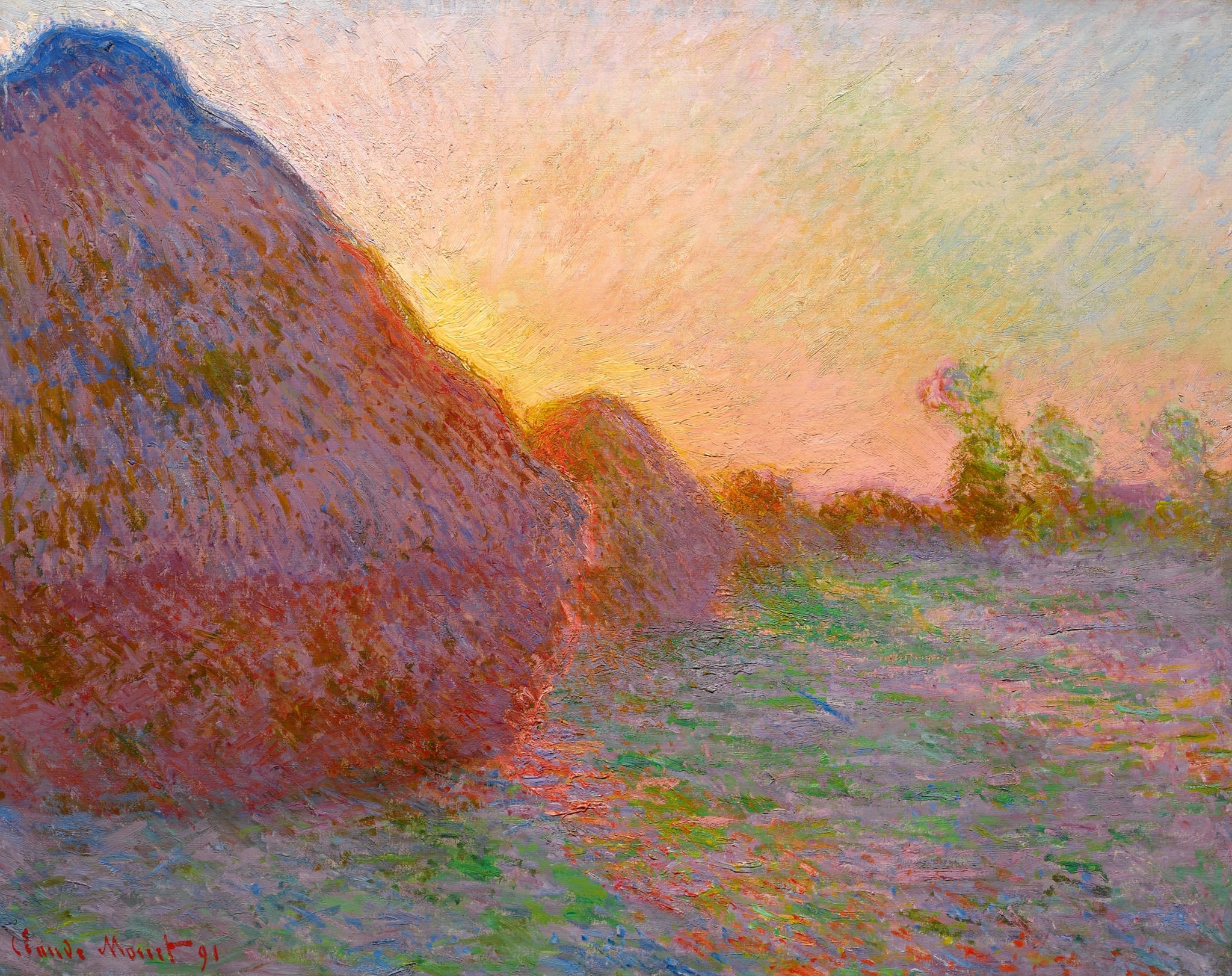
Claude Monet’s <strong>Haystacks Series</strong> transforms a routine rural subject into an inquiry into <strong>light, time, and perception</strong>. In this sunset view, the stacks swell at the left while the sun burns through the gap, making the field shimmer with <strong>apricot, lilac, and blue</strong> vibrations.
Women in the Garden by Claude Monet

Women in the Garden

Claude Monet (1866–1867)

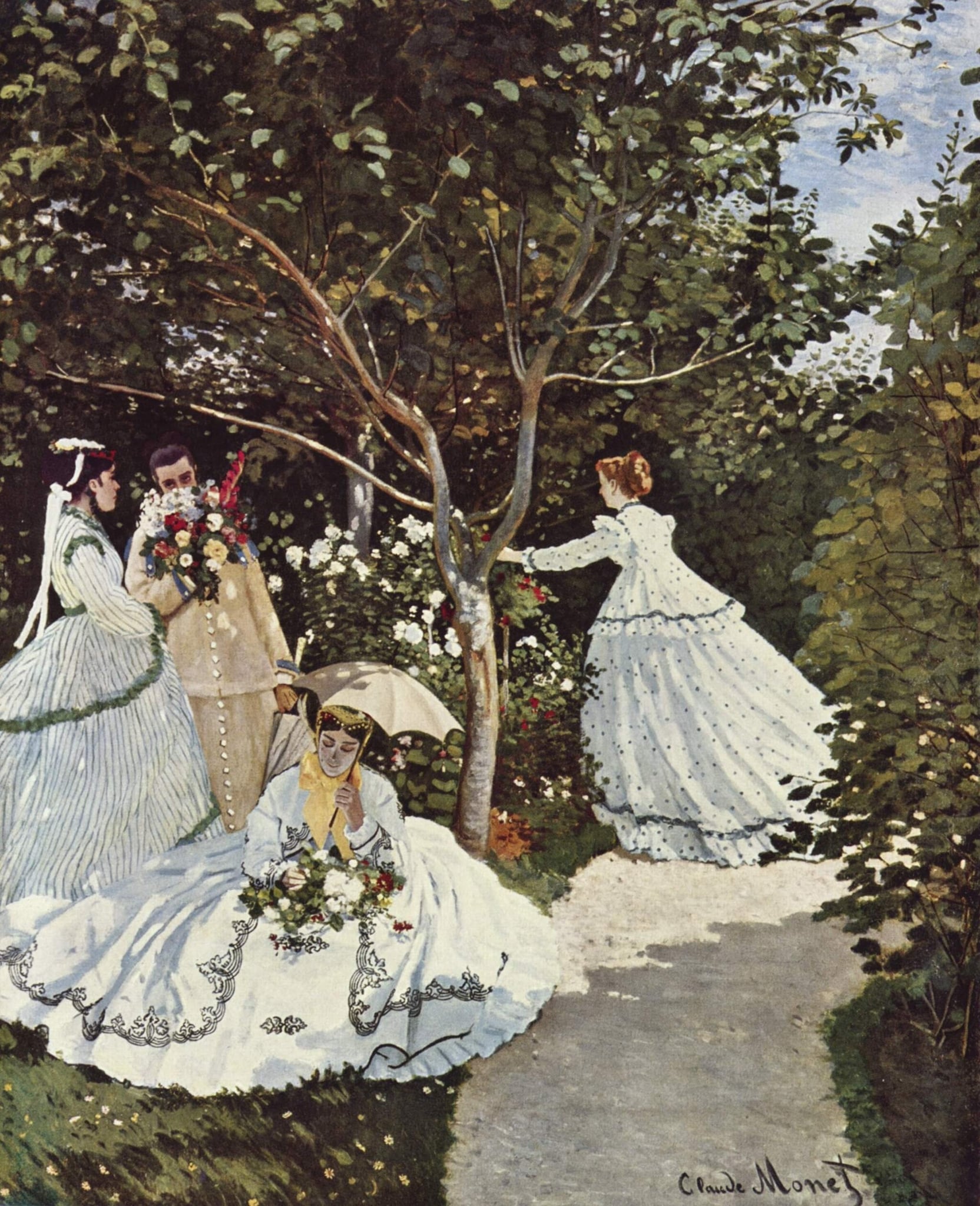
Claude Monet’s Women in the Garden choreographs four figures in a sunlit bower to test how <strong>white dresses</strong> register <strong>dappled light</strong> and shadow. The path, parasol, and clipped flowers frame a modern ritual of leisure while turning fashion into an instrument of <strong>perception</strong>. The scene reads less as portraiture than as a manifesto for painting the <strong>momentary</strong> outdoors <sup>[1]</sup><sup>[3]</sup>.
The Train in the Snow (The Locomotive) by Claude Monet

The Train in the Snow (The Locomotive)

Claude Monet (1875)

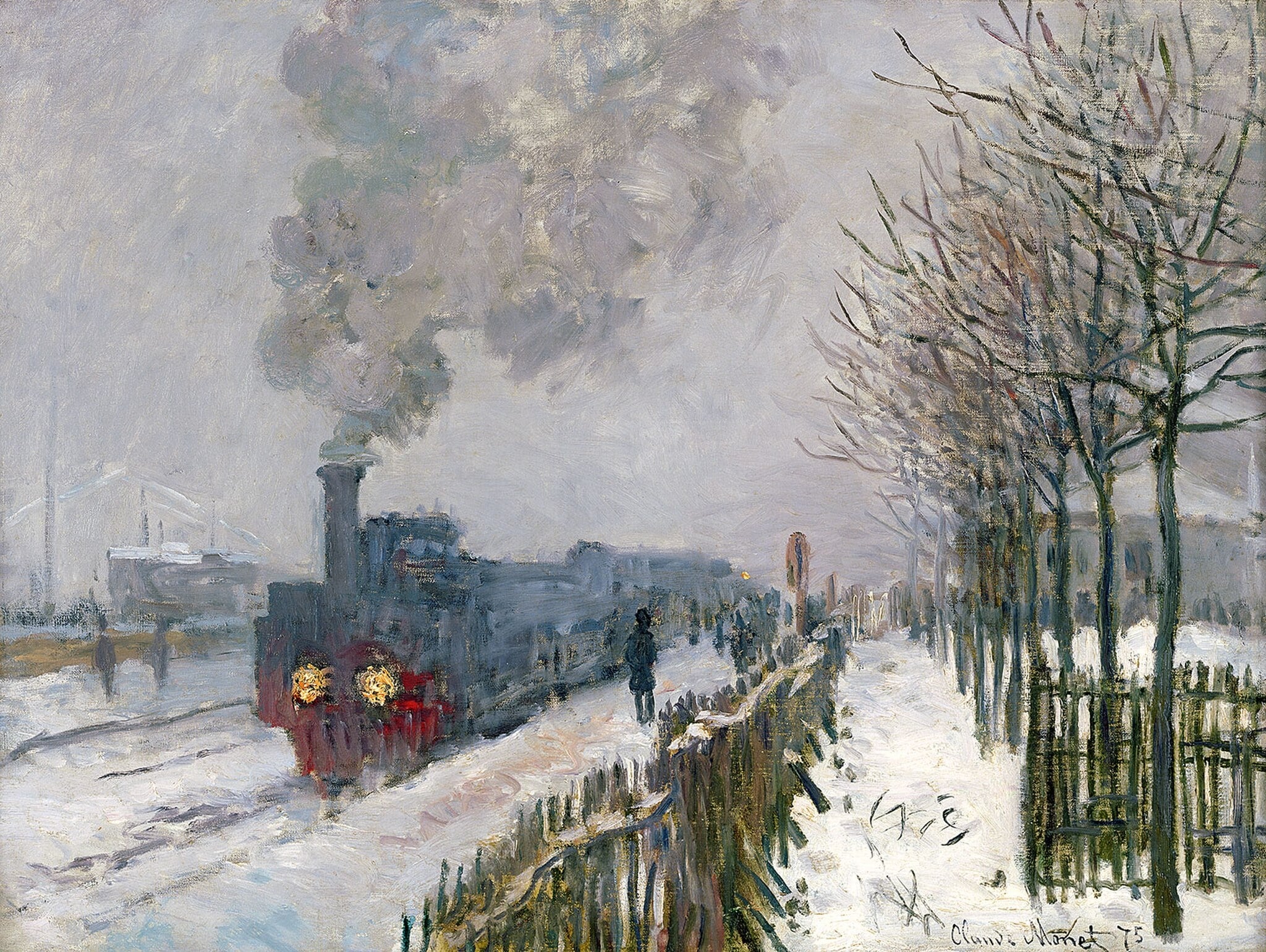
Claude Monet’s The Train in the Snow (The Locomotive) (1875) turns a suburban winter platform into a study of <strong>modernity absorbed by atmosphere</strong>. The engine’s twin yellow headlights and a smear of red push through a world of greys and violets as steam fuses with the low sky, while the right-hand fence and bare trees drill depth and cadence into the scene <sup>[1]</sup><sup>[4]</sup>. Monet fixes not an object but a <strong>moment of perception</strong>, where industry seems to dematerialize into weather <sup>[1]</sup><sup>[2]</sup>.