Boating

by Claude Monet

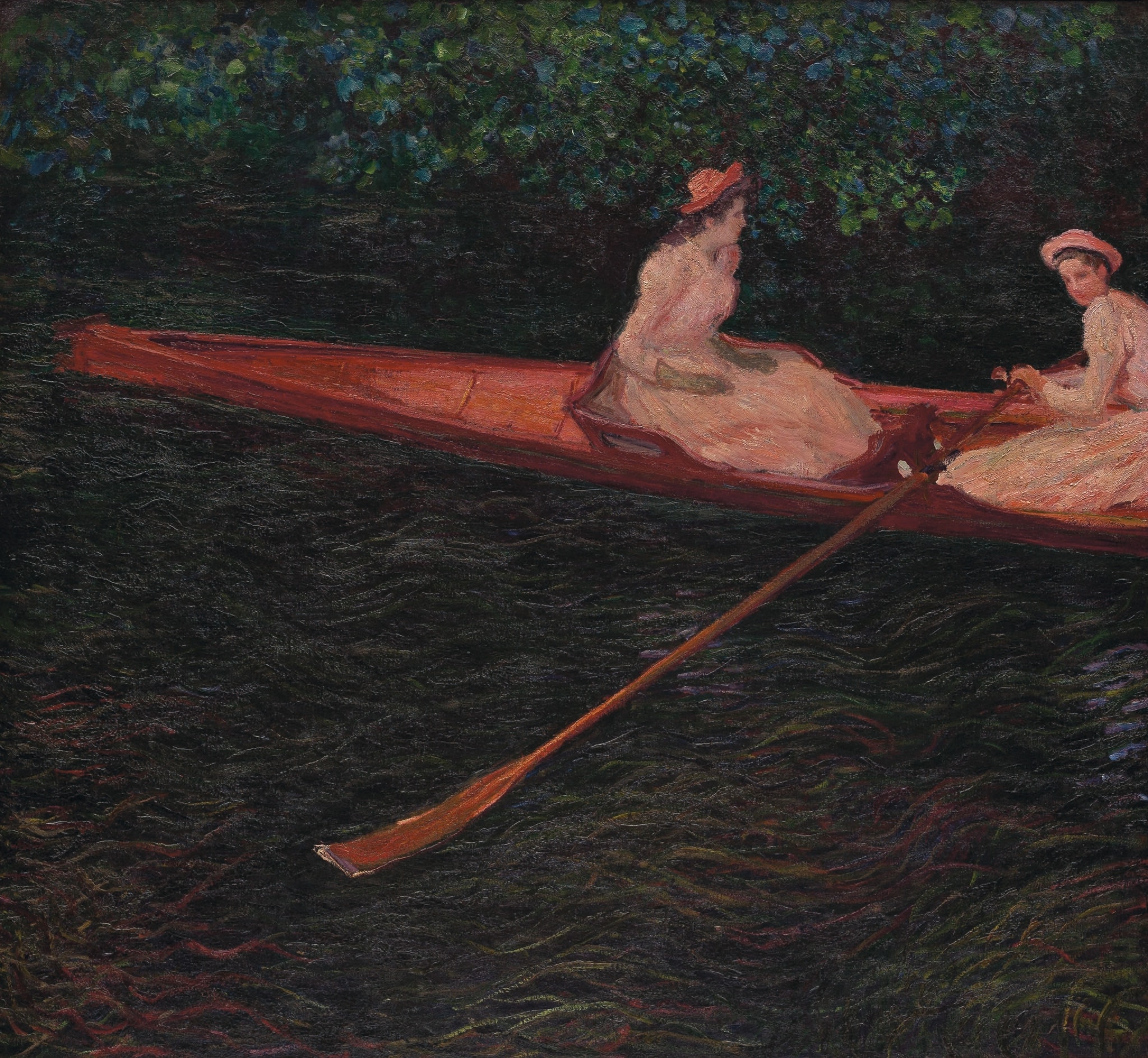
Monet’s Boating crystallizes modern leisure as a drama of perception, setting a slim skiff and two pale dresses against a field of dark, mobile water. Bold cropping, a thrusting oar, and the complementary flash of hull and foliage convert a quiet outing into an experiment in modern vision and the materiality of water [1][2].
💰

Market Value

$30-50 million

How much is Boating worth?

Fast Facts

Year
1887
Medium
Oil on canvas
Dimensions
145.5 × 133.5 cm
Location
National Museum of Western Art, Tokyo
Boating by Claude Monet (1887)

Click on any numbered symbol to learn more about its meaning

Meaning & Symbolism

Monet organizes Boating around a few decisive visual acts. First, he refuses a stabilizing horizon, cropping the orange-toned skiff laterally so that it slices the picture like a sash; a single oar lunges forward on the diagonal, striking the river’s surface and pulsing the whole field with rhythm. The two women—hats catching light, dresses flaring into brief zones of luminosity—are set against a water surface rendered as dark, swirling strokes, with hints of submerged vegetation flickering upward. This is not mere scene-setting. It is Monet’s claim that modern life is experienced in fragments and glances, where the frame itself makes meaning. Curators link such cuts and off-center balances to both photography and Japonisme, influences Monet explored intensively in the late 1880s at Giverny 12. By emphasizing the skiff’s forward thrust and the leafy bank pressing from above, he composes tension between human ease and nature’s ceaseless flux—an urbane calm edged by instability. Second, Monet redefines water as protagonist. In his 1890 letter he describes the "impossible" task of catching water with vegetation undulating below the surface; this difficulty becomes the painting’s subject 2. The river here is not a passive reflector of sky; it is a dense medium whose eddies shear forms and shear time. The dark-violet and green-black field is worked with short, tiered strokes that suggest depth rather than sheen, so the craft floats as if on a moving palimpsest. The result is a double exposure of experience: the boat reads as a momentary consolidation of light and color, even as the current, with its ribbed, vegetal undertow, threatens to dissolve it. This is leisure rendered as an optical problem. As the skiff glides, the figures remain poised yet slightly de-focused, more participants in a flow of perception than narrative characters—precisely the shift scholars see across Monet’s Epte series 12. Finally, color carries the argument. Monet opposes the warm hull and straw hats to the cool, encroaching greens, a complementary clash that makes the figures glow briefly—then recede as the eye returns to the water’s darker pressure. This push-pull is not decorative; it stages the fragility of modern calm within a world of permanent movement. In the context of Impressionism’s embrace of suburban boating as a sign of bourgeois freedom, Monet’s choice is pointed: he keeps the social markers—the dresses, the hats, the sleek recreational craft—but strips away anecdote to expose how vision itself organizes the experience of modernity 3. Read alongside the Tokyo canvas, which identifies the Hoschedé daughters and highlights the series’ Japoniste framings, and the São Paulo canvas, whose curators emphasize subsurface depth and photographic blur, Boating marks a hinge in Monet’s project. The optical density he seeks here prefigures the later Water Lilies, where water becomes the total environment rather than a setting. In short, Boating is less a pastime than a proposition: that painting can grasp the instant by letting the world’s movement do the talking—through cuts, diagonals, and a river thick with time 12.

Explore Deeper with AI

Ask questions about Boating

Popular questions:

Powered by AI • Get instant insights about this artwork

💬 Ask questions about this artwork!

Interpretations

Social History of Leisure

Monet’s boating scenes at Giverny belong to a late‑19th‑century culture of suburban leisure on the Seine and Epte, where rowing and canoeing signaled mobility, comfort, and weekend escape. Yet he pointedly withholds anecdote: Suzanne and Blanche Hoschedé—identified by Tokyo’s entry—become less portrait sitters than calibrators of atmosphere, their fashion and posture indexing class while yielding primacy to water and light 1. Read against Impressionism’s broader engagement with bathing and boating establishments, Monet’s strategy reframes leisure as a modern optics rather than a story of pastime 3. Robert Herbert’s social reading of Impressionism clarifies this pivot: bourgeois recreation is both subject and alibi, enabling experiments in perception while quietly naturalizing privilege within a seemingly neutral field of looking 5.

Source: National Museum of Western Art, Tokyo; The Met (Impressionism and modernity); Robert L. Herbert (Art Institute of Chicago)

Japonisme and the Camera’s Cut

Curators in Tokyo and São Paulo link the radical croppings, diagonal oar, and high vantage to Japonisme and to photographic seeing 12. These devices convert descriptive boating into a grammar of edges: the boat is sheared by the frame, the oar thrusts like a ukiyo‑e diagonal, and focus slips across the surface. Such moves are not stylistic garnish but methodological—importing print culture’s asymmetries and the camera’s partial frame to stage modern perception. The result is a composition that feels "developed" rather than posed, as if printed from exposure: figures momentarily cohere, then the eye sluices back into the water’s dark lattice. In Monet’s hands, Japonisme becomes a tool for temporal montage, while photographic blur sanctions a new hierarchy where framing itself becomes content 12.

Source: National Museum of Western Art, Tokyo; MASP, São Paulo

Gendered Optics without Portraiture

The Hoschedé daughters serve as modern feminine presences yet resist portrait conventions. MASP notes their slight defocus and drift, casting them as agents within a perceptual flow rather than narrative protagonists 2. This is a gendered recalibration: women anchor the scene’s social legibility (fashion, leisure) while monetizing their visibility into luminous cues—hats as light catchers, sleeves as color nodes—dispersed by rippled water 1. Rather than domestic sentiment or character study, the canvas proposes a phenomenology of looking in which femininity is legible but de‑centered, its signs subordinated to optical process. The effect complicates the period’s typical gender scripts, granting the figures a modernity of motion and mediation, even as their roles index the bourgeois milieu that makes such scenes possible 12.

Source: MASP, São Paulo; National Museum of Western Art, Tokyo

Water as Material Time (Proto‑Ecological Reading)

Monet names water as protagonist not by mirror shine but by density: the current carries submerged vegetation whose wavering is the painting’s problem, per his 1890 letter quoted by MASP 2. The river acts as a time‑bearing medium that refracts, blurs, and literally drags forms; the boat’s stability is conditional, negotiated against vegetal undertow. This is more than motif—an early phenomenology of an environment in motion. Human leisure proceeds, but at nature’s tempo, with perception laboring to keep up. The vegetal streaks confer depth and resistance, nudging the surface away from reflection toward material thickness. In this sense, Monet’s "boating" becomes a rehearsal for later immersive waterscapes, shifting attention from what water shows to what water is—and how it changes how we see 2.

Source: MASP, São Paulo

From Serial Leisure to Field Painting

Situated between Giverny figure‑boats and the Grandes Décorations, the series charts Monet’s move from situational mimesis to near all‑over fields. The Tokyo canvas is among the most "highly finished" of the Boating set, consolidating figures and craft with strong design 1, while the São Paulo work pushes subsurface complexity and shallow focus that foreshadow the Water Lilies’ enveloping surface 2. Biography underscores continuity: after 1883 at Giverny, Monet embraces serial method (Haystacks, Rouen), culminating in a water‑garden where motif dissolves into environment 4. In this arc, leisure is catalyst, not endpoint—the boat furnishes a scaffold for testing optical density until, eventually, the skiff vanishes and water becomes both subject and space, tipping Impressionism toward abstraction 124.

Source: National Museum of Western Art, Tokyo; MASP, São Paulo; Britannica

Related Themes

About Claude Monet

Claude Monet (1840–1926) led Impressionism’s pursuit of open-air painting and optical immediacy, especially during his Argenteuil years focused on modern leisure and light. He later developed serial studies of changing conditions, culminating in the Water Lilies cycle [2].
View all works by Claude Monet

More by Claude Monet

La Japonaise (Camille Monet in Japanese Costume) by Claude Monet

La Japonaise (Camille Monet in Japanese Costume)

Claude Monet (1876)

Claude Monet’s La Japonaise (Camille Monet in Japanese Costume) (1876) stages a witty confrontation between <strong>Parisian modernity</strong> and the fashion for <strong>Japonisme</strong>. A fair-skinned model in a blazing red uchikake preens before a wall tiled with uchiwa fans, lifting a <strong>tricolor</strong> hand fan that asserts Frenchness amid the imported decor. The painting turns costume, props, and gaze into a performance about <strong>desire, display, and identity</strong> <sup>[1]</sup><sup>[2]</sup>.

The Thames below Westminster by Claude Monet

The Thames below Westminster

Claude Monet (about 1871)

Claude Monet’s The Thames below Westminster turns London into <strong>light-made architecture</strong>, where Parliament’s mass dissolves into mist and the river shivers with <strong>industrial motion</strong>. Tugboats, a timber jetty with workers, and the rebuilt Westminster Bridge assert a modern city whose power is felt through atmosphere more than outline <sup>[1]</sup>.

Haystacks Series by Claude Monet | Light, Time & Atmosphere by Claude Monet

Haystacks Series by Claude Monet | Light, Time & Atmosphere

Claude Monet

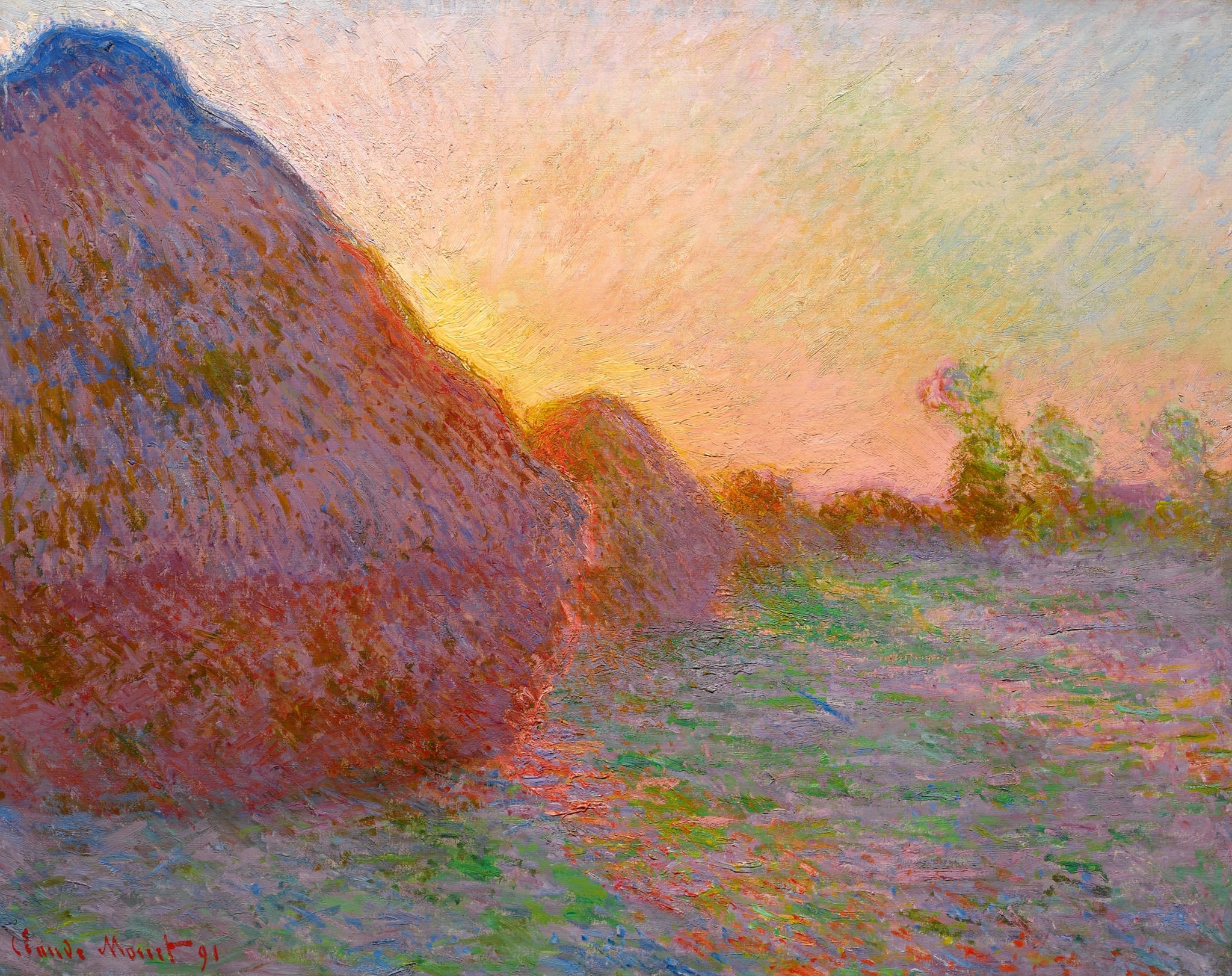
Claude Monet’s <strong>Haystacks Series</strong> transforms a routine rural subject into an inquiry into <strong>light, time, and perception</strong>. In this sunset view, the stacks swell at the left while the sun burns through the gap, making the field shimmer with <strong>apricot, lilac, and blue</strong> vibrations.
Women in the Garden by Claude Monet

Women in the Garden

Claude Monet (1866–1867)

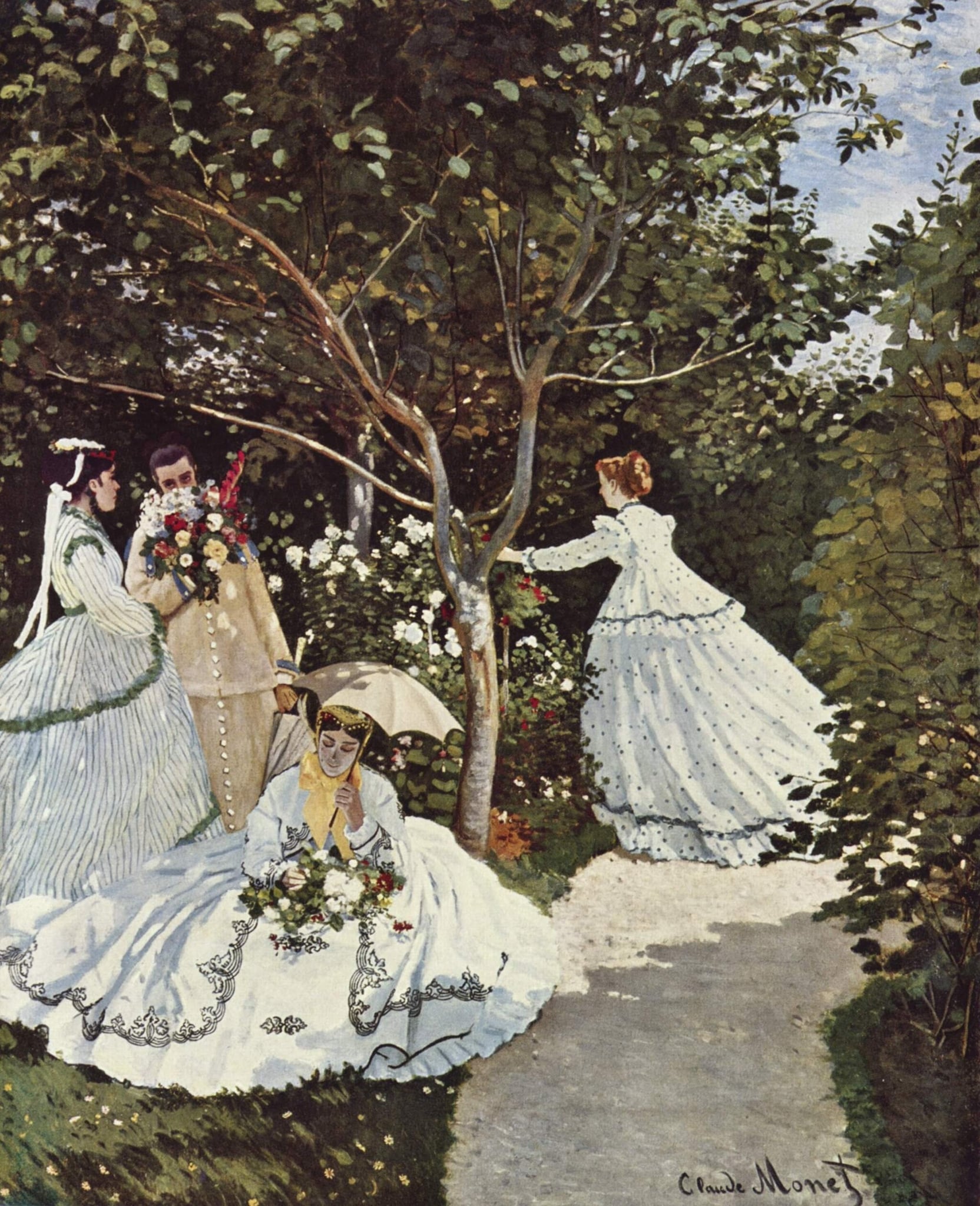
Claude Monet’s Women in the Garden choreographs four figures in a sunlit bower to test how <strong>white dresses</strong> register <strong>dappled light</strong> and shadow. The path, parasol, and clipped flowers frame a modern ritual of leisure while turning fashion into an instrument of <strong>perception</strong>. The scene reads less as portraiture than as a manifesto for painting the <strong>momentary</strong> outdoors <sup>[1]</sup><sup>[3]</sup>.
Impression, Sunrise by Claude Monet

Impression, Sunrise

Claude Monet (1872)

In Impression, Sunrise, Claude Monet turns Le Havre’s fog-bound harbor into an experiment in <strong>immediacy</strong> and <strong>modernity</strong>. Cool blue-greens dissolve cranes, masts, and smoke, while a small skiff cuts the water beneath a blazing, <strong>equiluminant</strong> orange sun whose vertical reflection stitches the scene together <sup>[1]</sup><sup>[3]</sup>. The effect is a poised dawn where industry meets nature, a quiet <strong>awakening</strong> rendered through light rather than line.

The Train in the Snow (The Locomotive) by Claude Monet

The Train in the Snow (The Locomotive)

Claude Monet (1875)

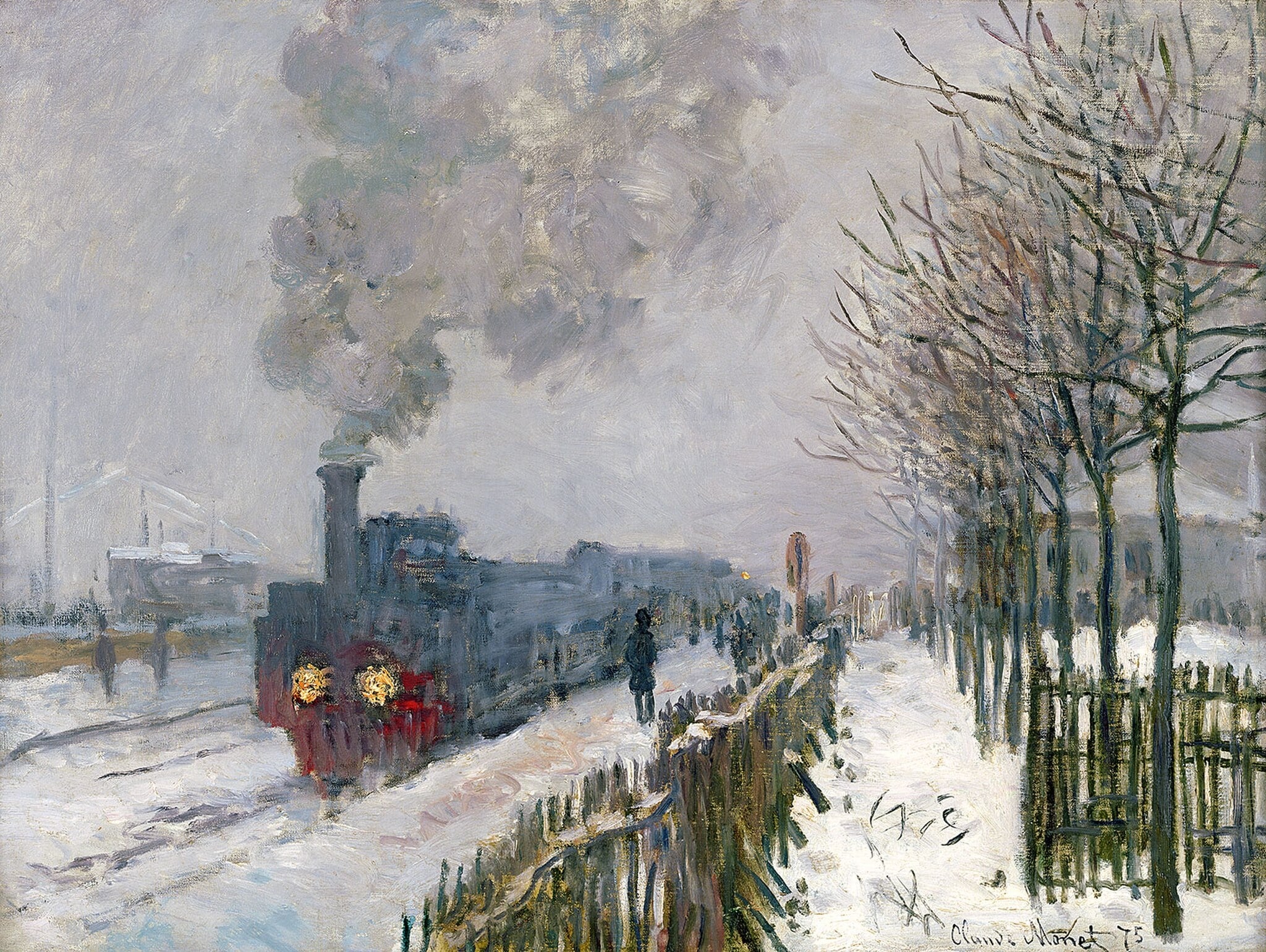
Claude Monet’s The Train in the Snow (The Locomotive) (1875) turns a suburban winter platform into a study of <strong>modernity absorbed by atmosphere</strong>. The engine’s twin yellow headlights and a smear of red push through a world of greys and violets as steam fuses with the low sky, while the right-hand fence and bare trees drill depth and cadence into the scene <sup>[1]</sup><sup>[4]</sup>. Monet fixes not an object but a <strong>moment of perception</strong>, where industry seems to dematerialize into weather <sup>[1]</sup><sup>[2]</sup>.