Leisure & recreation
Featured Artworks
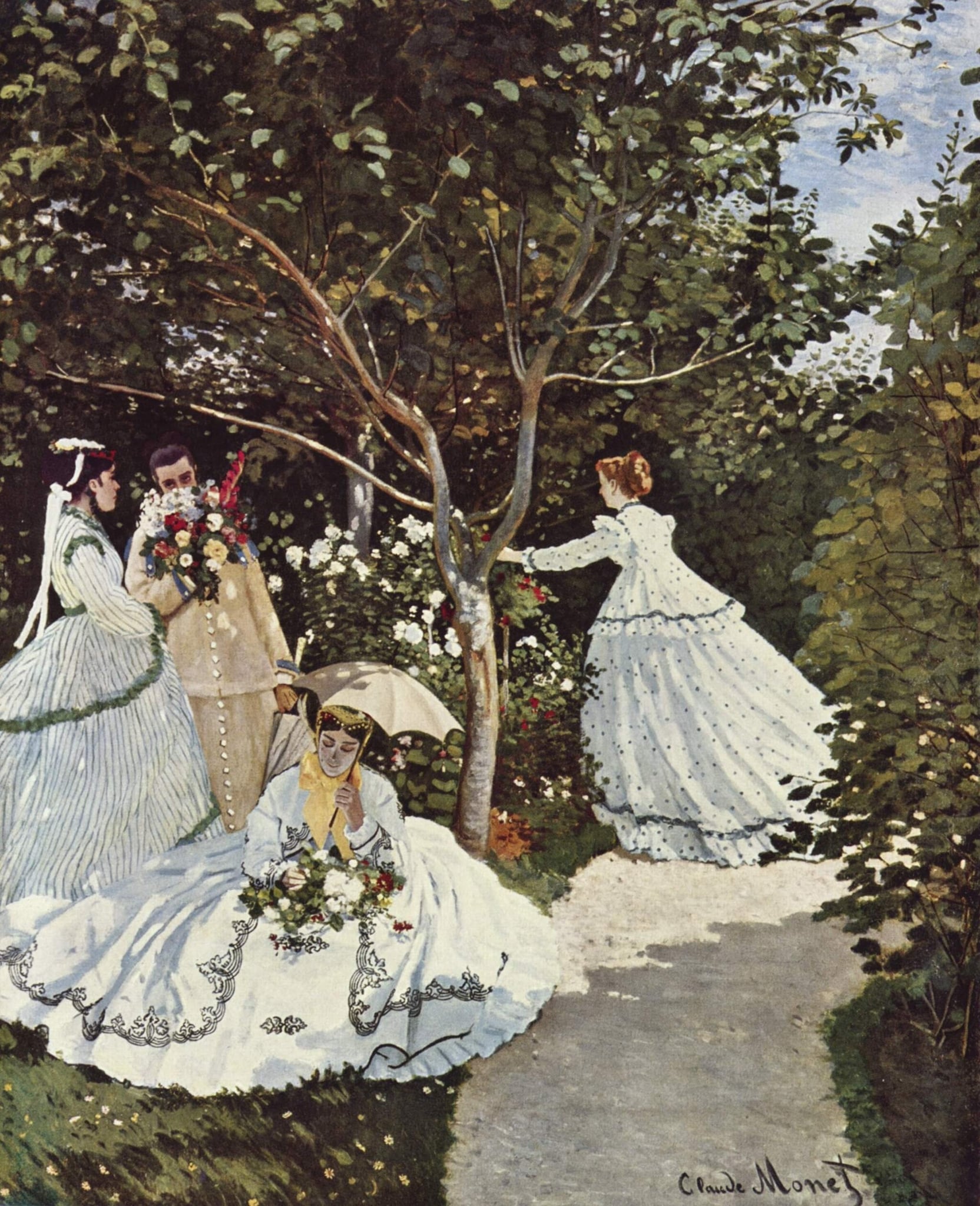
Women in the Garden
Claude Monet (1866–1867)
Claude Monet’s Women in the Garden choreographs four figures in a sunlit bower to test how <strong>white dresses</strong> register <strong>dappled light</strong> and shadow. The path, parasol, and clipped flowers frame a modern ritual of leisure while turning fashion into an instrument of <strong>perception</strong>. The scene reads less as portraiture than as a manifesto for painting the <strong>momentary</strong> outdoors <sup>[1]</sup><sup>[3]</sup>.
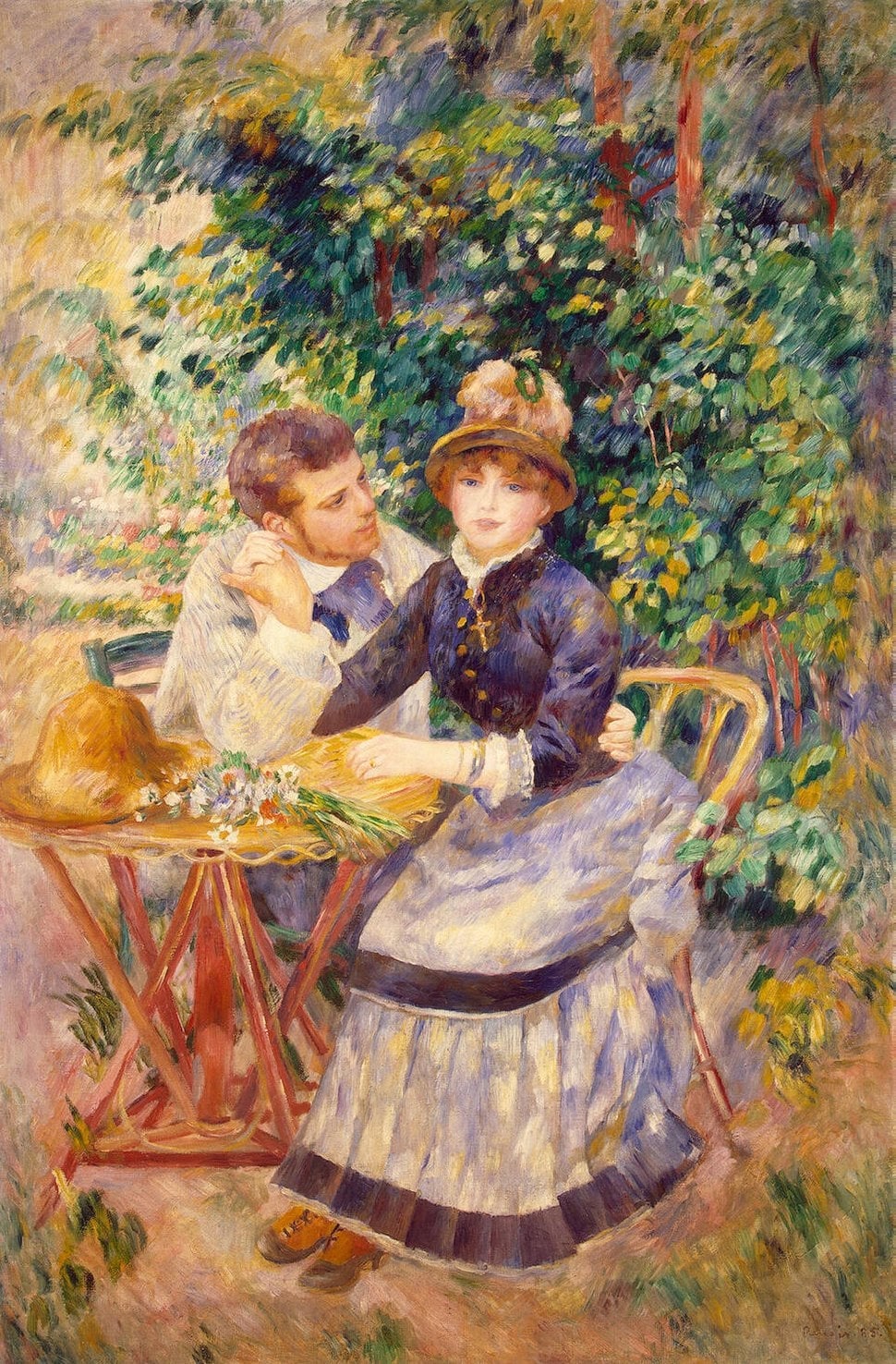
In the Garden
Pierre-Auguste Renoir (1885)
In the Garden presents a charged pause in modern leisure: a young couple at a café table under a living arbor of leaves. Their lightly clasped hands and the bouquet on the tabletop signal courtship, while her calm, front-facing gaze checks his lean. Renoir’s flickering brushwork fuses figures and foliage, rendering love as a <strong>transitory, luminous sensation</strong> <sup>[1]</sup><sup>[3]</sup>.
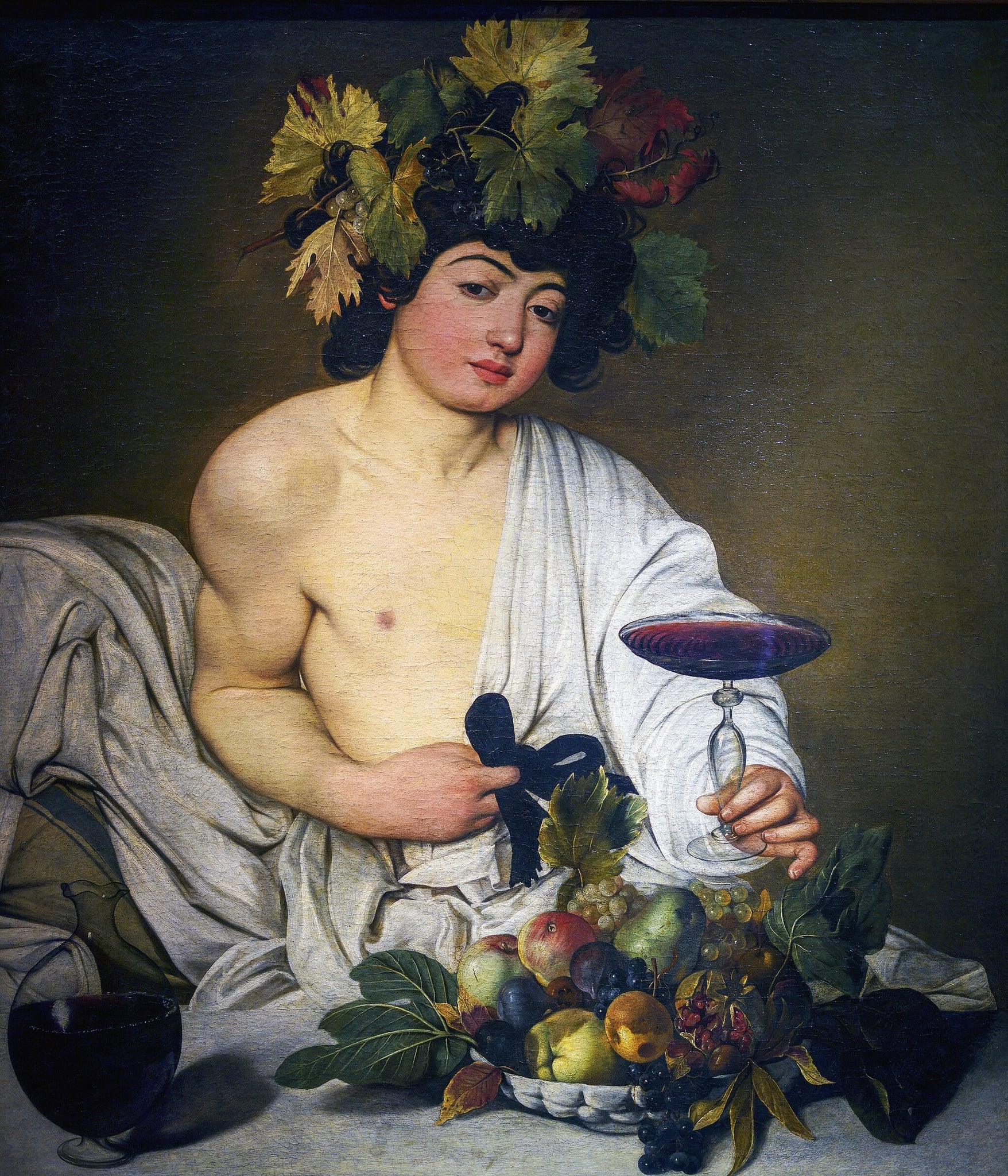
Bacchus
Caravaggio (c. 1598)
Caravaggio’s Bacchus stages a human-scaled god who offers wine with disarming immediacy, yoking <strong>sensual invitation</strong> to <strong>vanitas</strong> warning. The tilted goblet, blemished fruit, and wilting leaves insist that abundance and youth are <strong>precarious</strong>. A private Roman milieu under Cardinal del Monte shaped this refined, provocative image <sup>[1]</sup><sup>[2]</sup>.
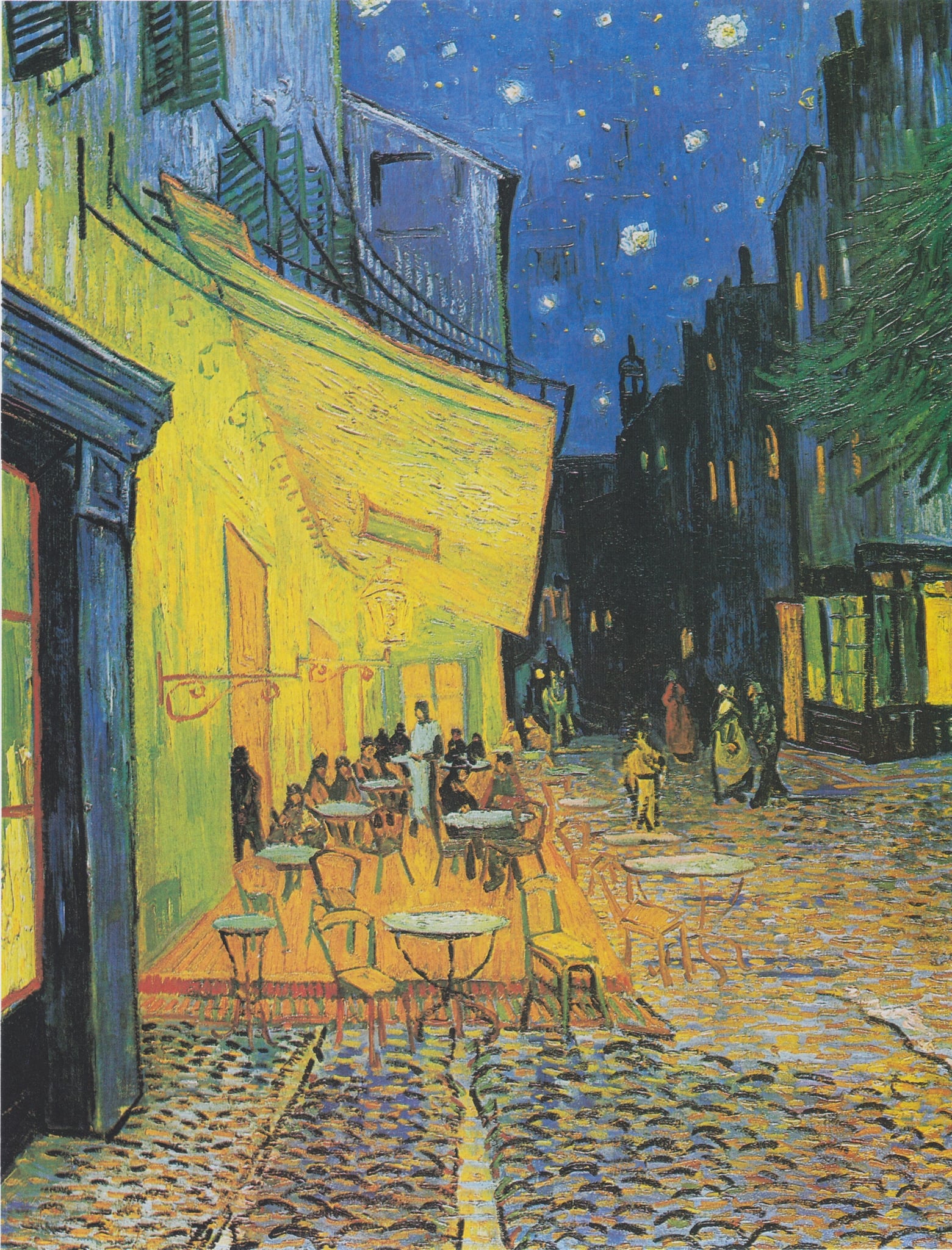
Café Terrace at Night
Vincent van Gogh (1888)
In Café Terrace at Night, Vincent van Gogh turns nocturne into <strong>luminous color</strong>: a gas‑lit terrace glows in yellows and oranges against a deep <strong>ultramarine sky</strong> pricked with stars. By building night “<strong>without black</strong>,” he stages a vivid encounter between human sociability and the vastness overhead <sup>[1]</sup><sup>[2]</sup>.
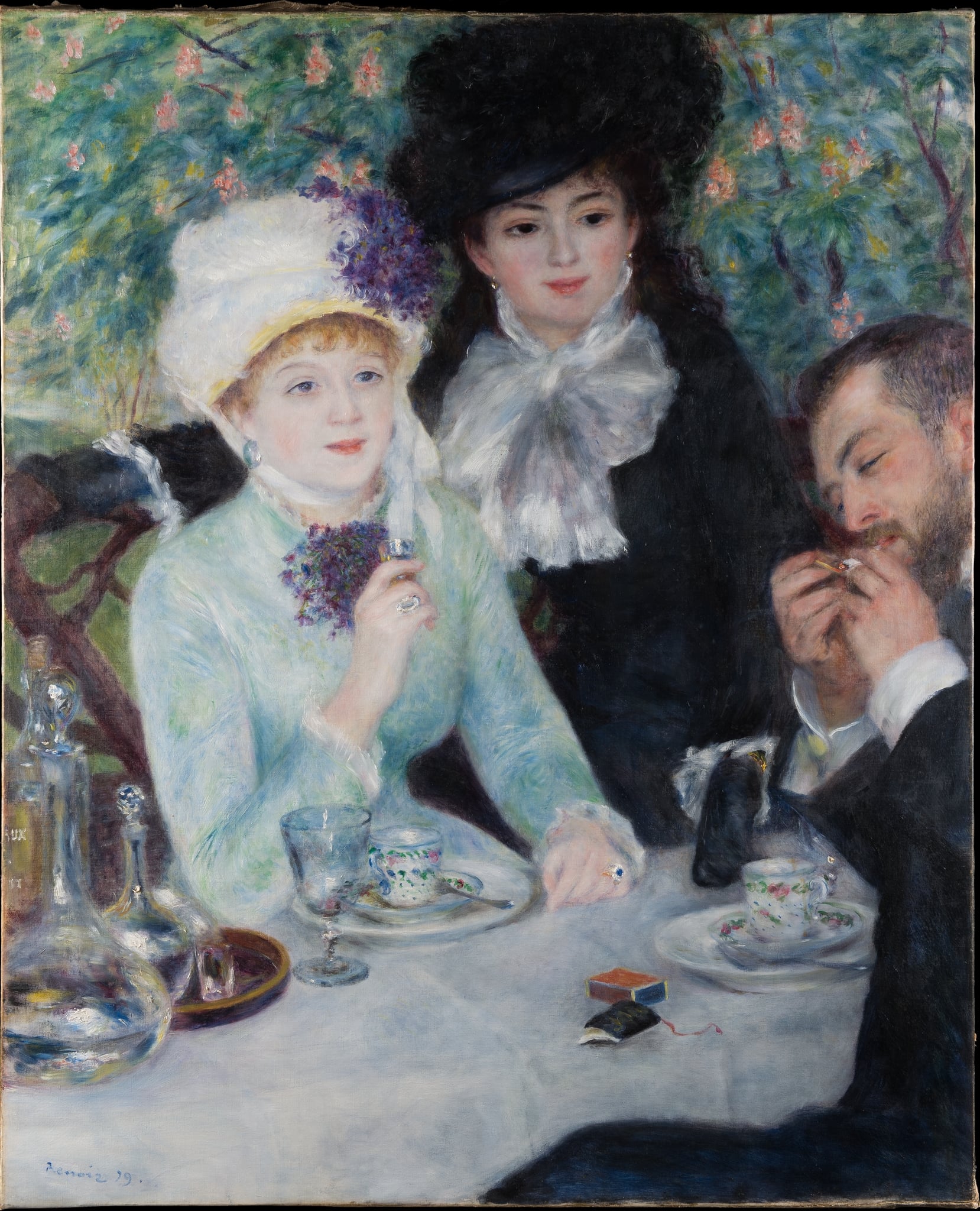
After the Luncheon
Pierre-Auguste Renoir (1879)
After the Luncheon crystallizes a <strong>suspended instant</strong> of Parisian leisure: coffee finished, glasses dappled with light, and a cigarette just being lit. Renoir’s <strong>shimmering brushwork</strong> and the trellised spring foliage turn the scene into a tapestry of conviviality where time briefly pauses.
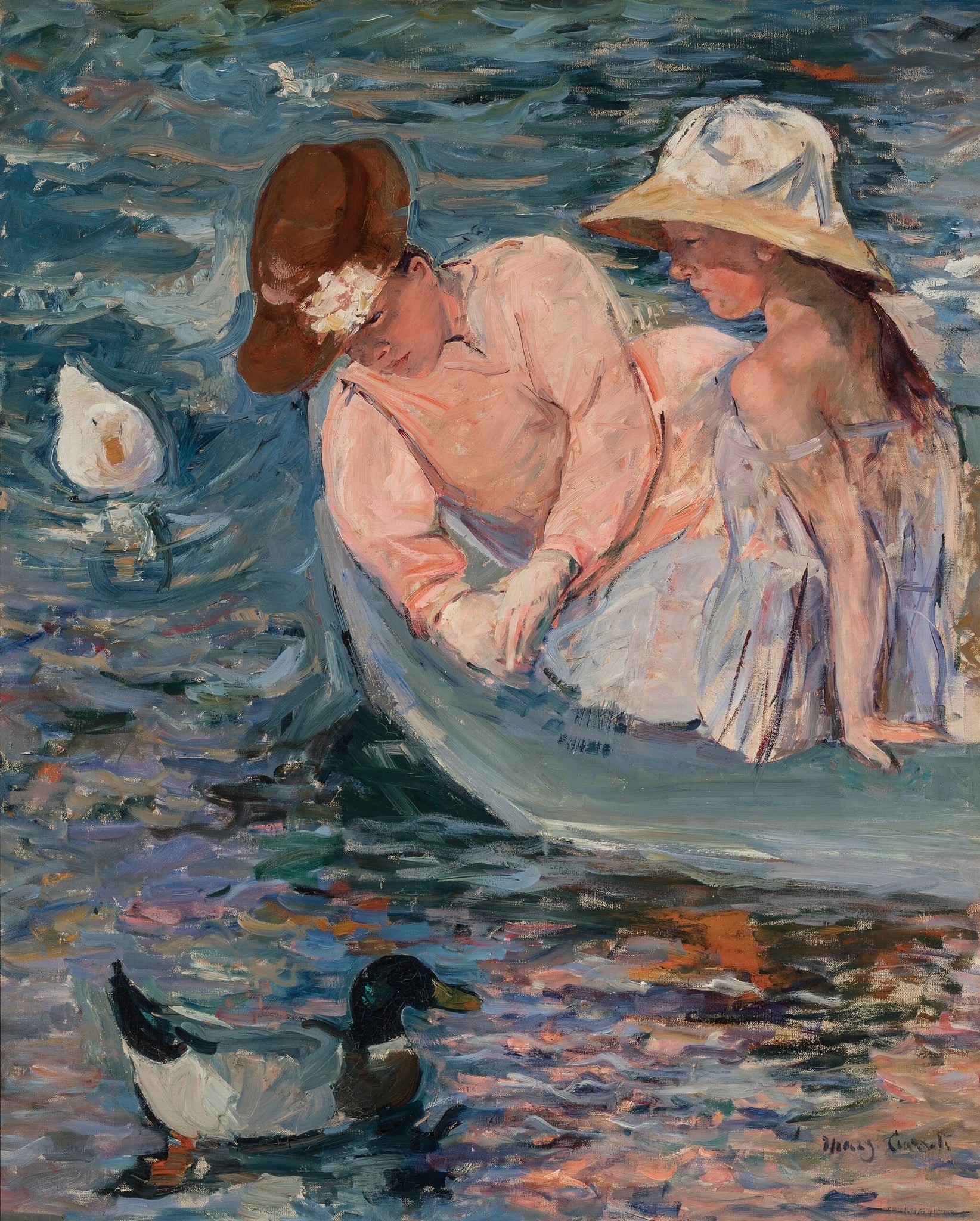
Summertime
Mary Cassatt (1894)
Mary Cassatt’s Summertime (1894) stages a quiet drama of <strong>attentive looking</strong>: a woman and a girl lean from a cropped boat toward two ducks as the lake flickers with broken color. Cassatt fuses <strong>Impressionism</strong> and <strong>Japonisme</strong>—no horizon, tipped perspective, and abrupt cropping—to press our gaze downward into light-spattered water. The result is an image of <strong>modern leisure</strong> that is also a study of perception itself <sup>[1]</sup>.
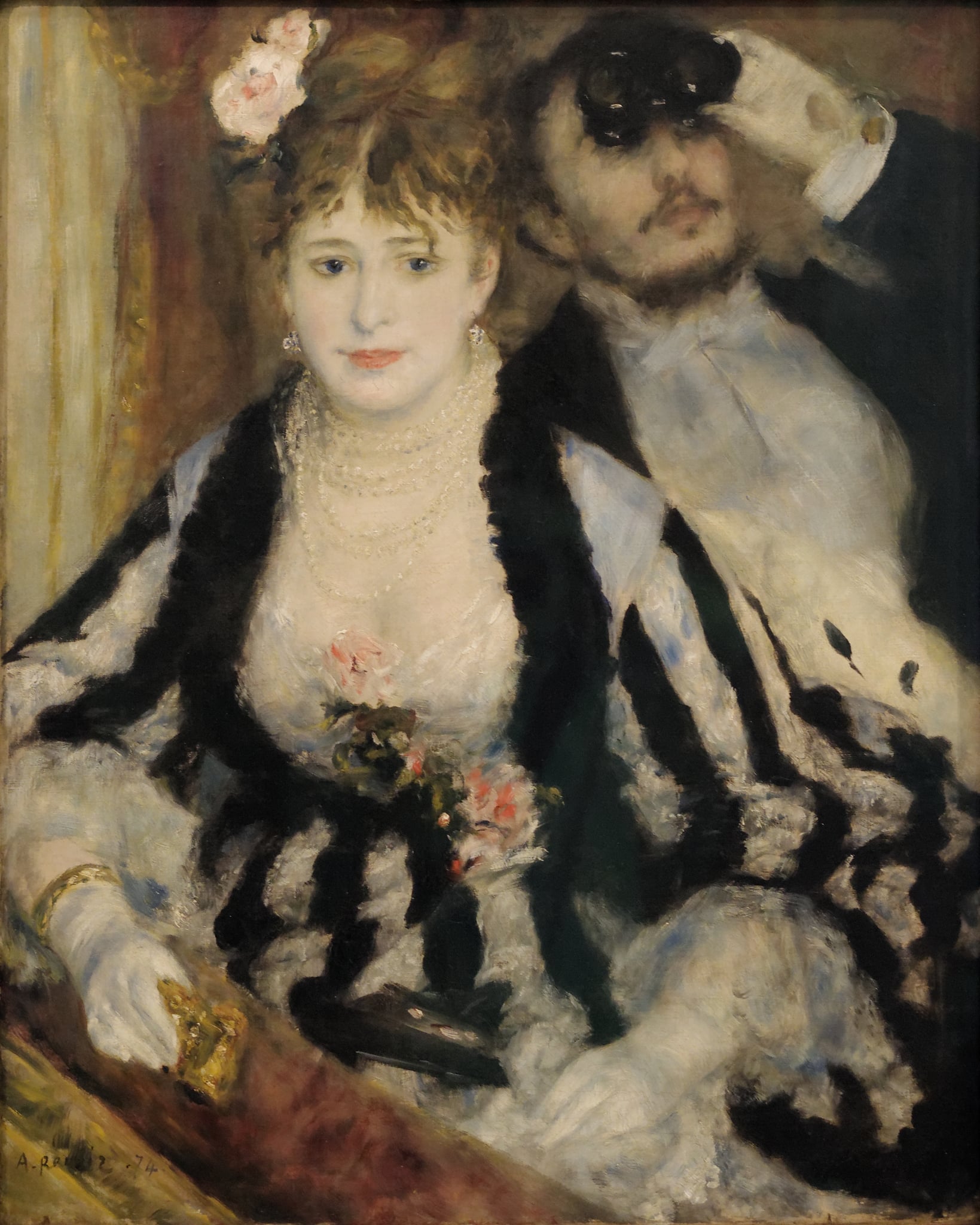
The Loge
Pierre-Auguste Renoir (1874)
Renoir’s The Loge (1874) turns an opera box into a <strong>stage of looking</strong>, where a woman meets our gaze while her companion scans the crowd through binoculars. The painting’s <strong>frame-within-a-frame</strong> and glittering fashion make modern Parisian leisure both alluring and self-conscious, turning spectators into spectacles <sup>[1]</sup><sup>[2]</sup>.
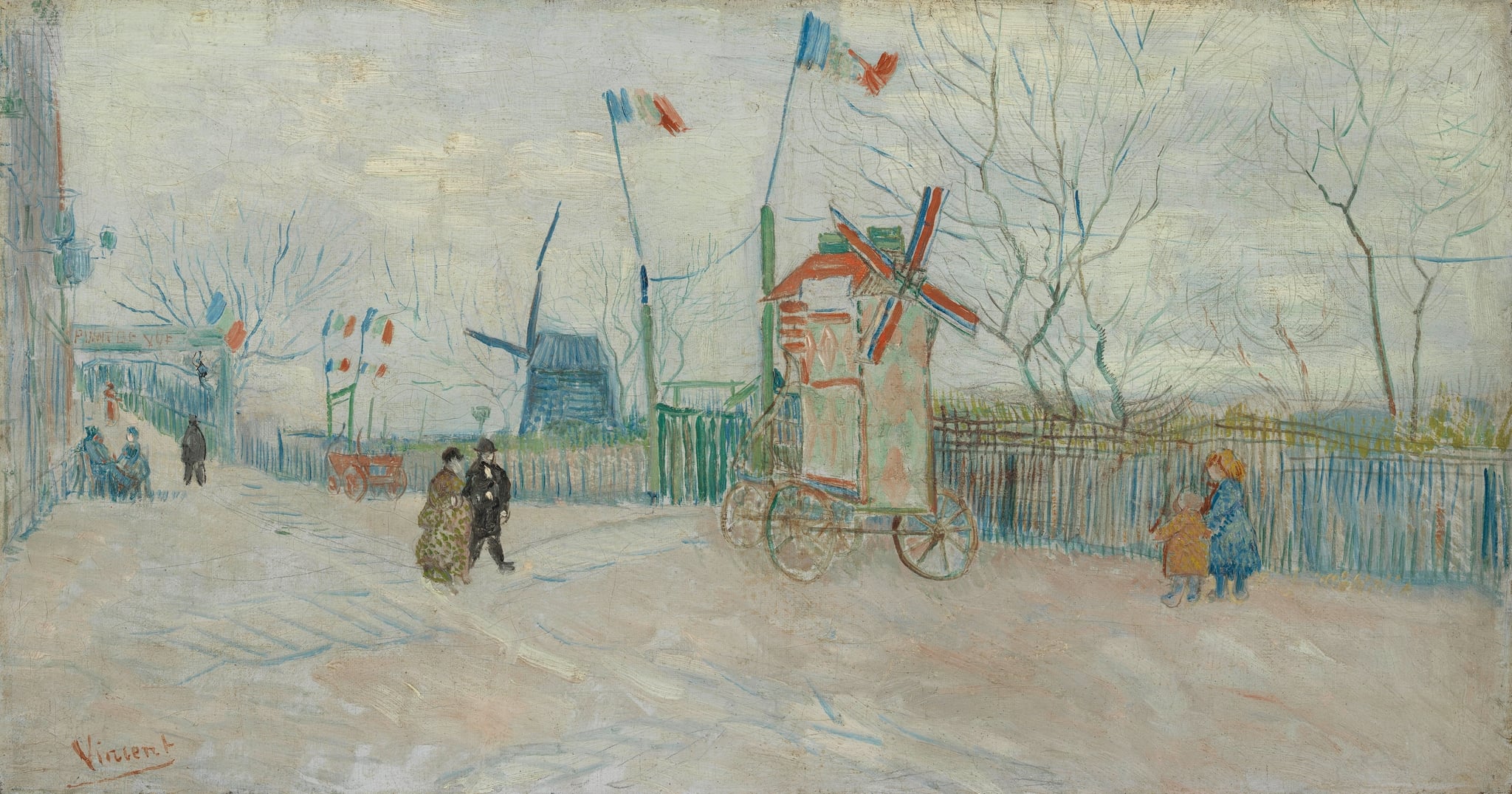
Impasse des Deux Frères in Montmartre
Vincent van Gogh (1887)
Van Gogh’s Impasse des Deux Frères in Montmartre crystallizes a <strong>threshold</strong> between rustic mills and a city turning to <strong>modern leisure</strong>. Tricolor flags, a wheeled “windmill” kiosk, and sketchlike figures animate a broad, chalky lane under pale winter light, declaring a neighborhood—and an artist—mid‑transition <sup>[1]</sup><sup>[3]</sup>.
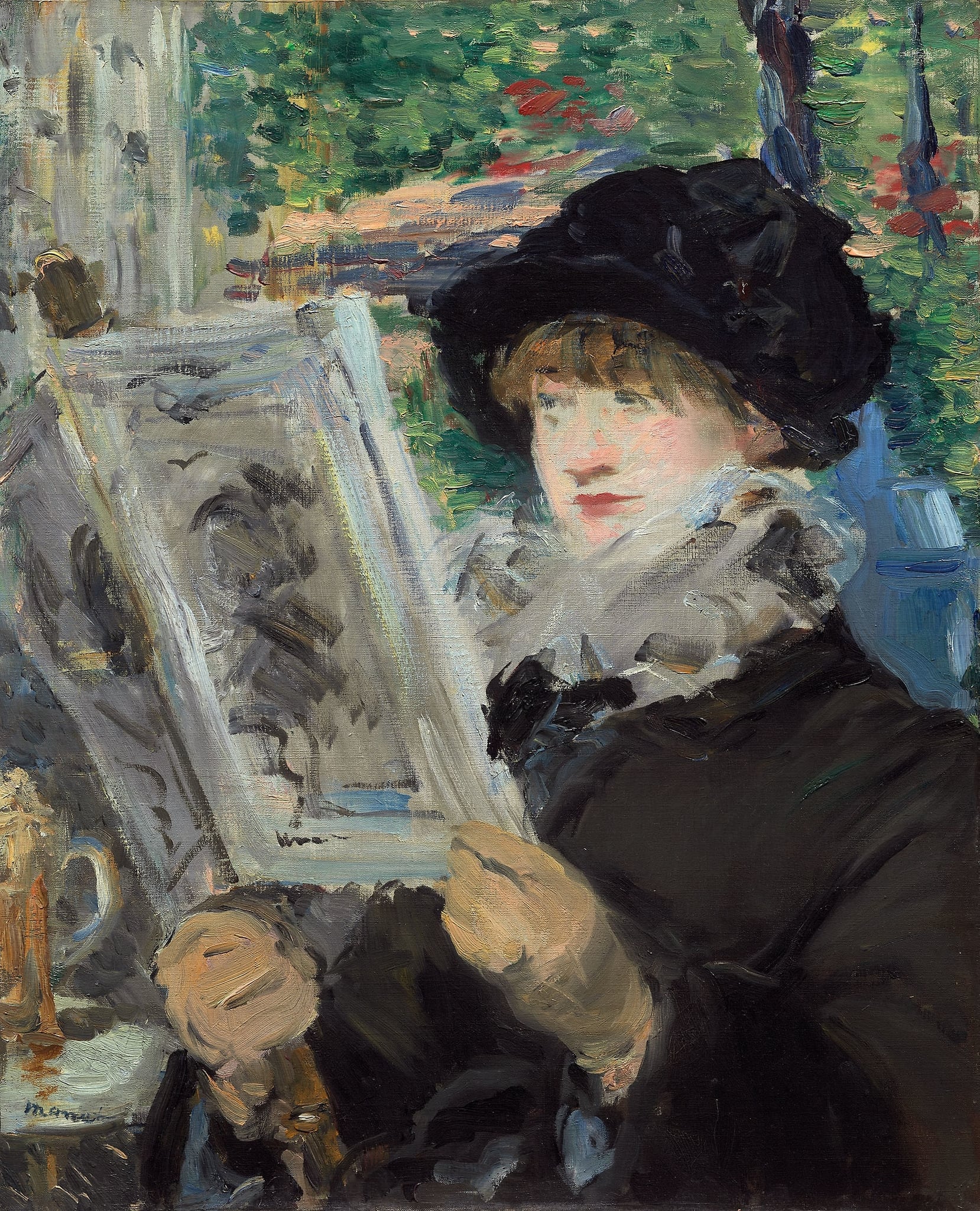
Woman Reading
Édouard Manet (1880–82)
Manet’s Woman Reading distills a fleeting act into an emblem of <strong>modern self-possession</strong>: a bundled figure raises a journal-on-a-stick, her luminous profile set against a brisk mosaic of greens and reds. With quick, loaded strokes and a deliberately cropped <strong>beer glass</strong> and paper, Manet turns perception itself into subject—asserting the drama of a private mind within a public café world <sup>[1]</sup><sup>[2]</sup>.
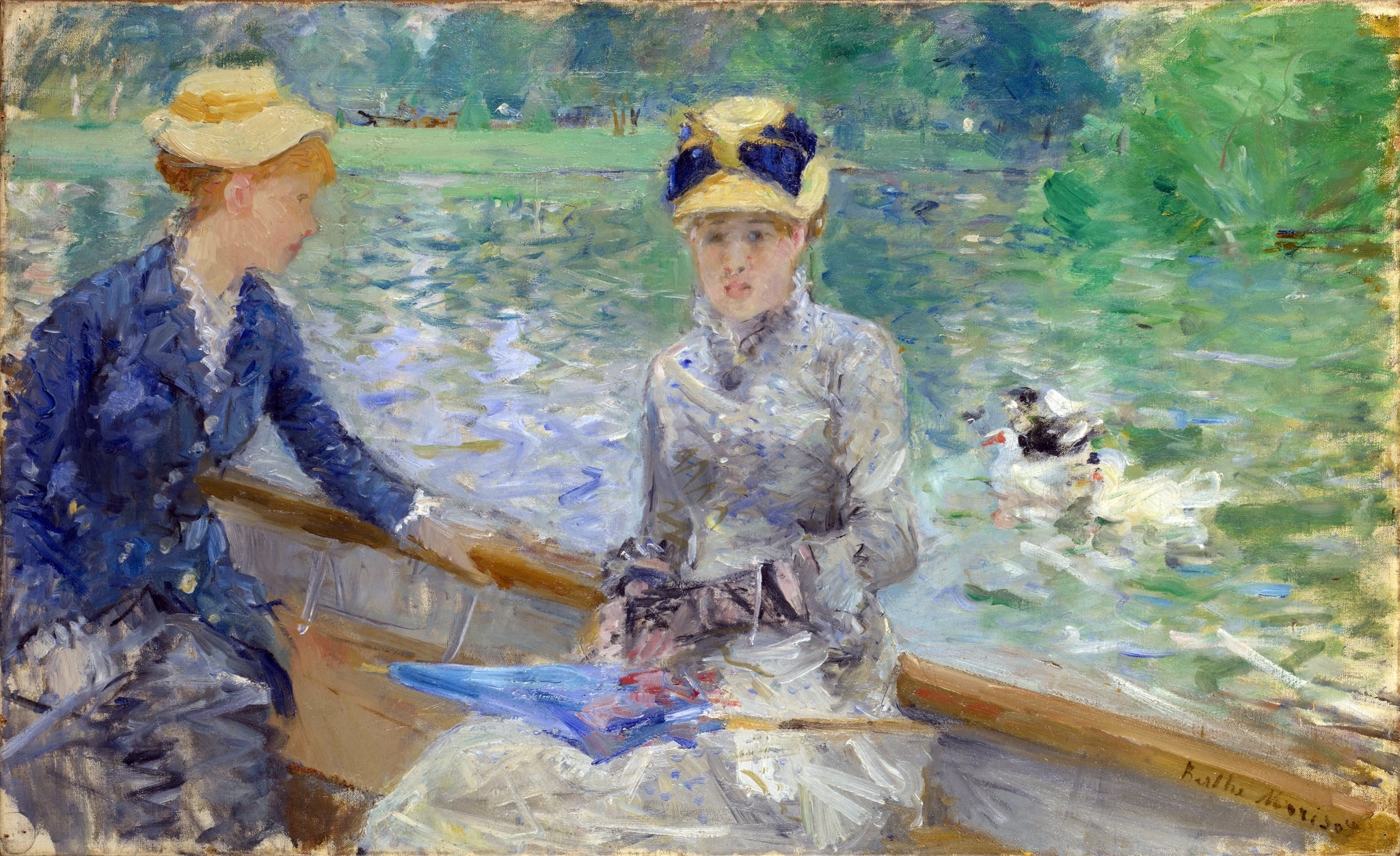
Summer's Day
Berthe Morisot (about 1879)
Two women drift on a boat in the Bois de Boulogne, their dresses, hats, and a bright blue parasol fused with the lake’s flicker by Morisot’s swift, <strong>zig‑zag brushwork</strong>. The scene turns a brief outing into a poised study of <strong>modern leisure</strong> and <strong>female companionship</strong> in public space <sup>[1]</sup>.
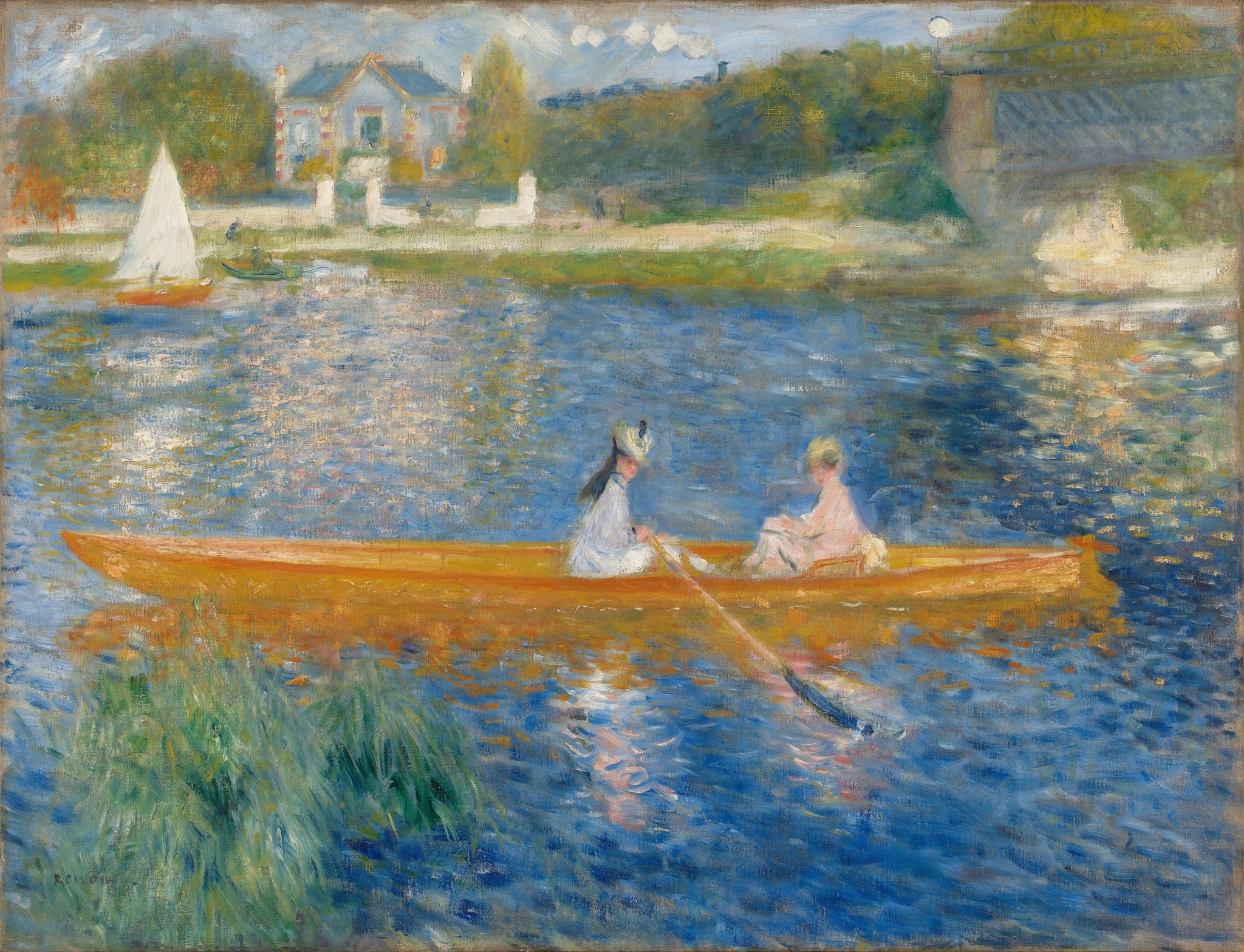
The Skiff (La Yole)
Pierre-Auguste Renoir (1875)
In The Skiff (La Yole), Pierre-Auguste Renoir stages a moment of modern leisure on a broad, vibrating river, where a slender, <strong>orange skiff</strong> cuts across a field of <strong>cool blues</strong>. Two women ride diagonally through the shimmer; an <strong>oar’s sweep</strong> spins a vortex of color as a sailboat, villa, and distant bridge settle the scene on the Seine’s suburban edge <sup>[1]</sup>. Renoir turns motion and light into a single sensation, using a high‑chroma, complementary palette to fuse human pastime with nature’s flux <sup>[1]</sup><sup>[2]</sup>.
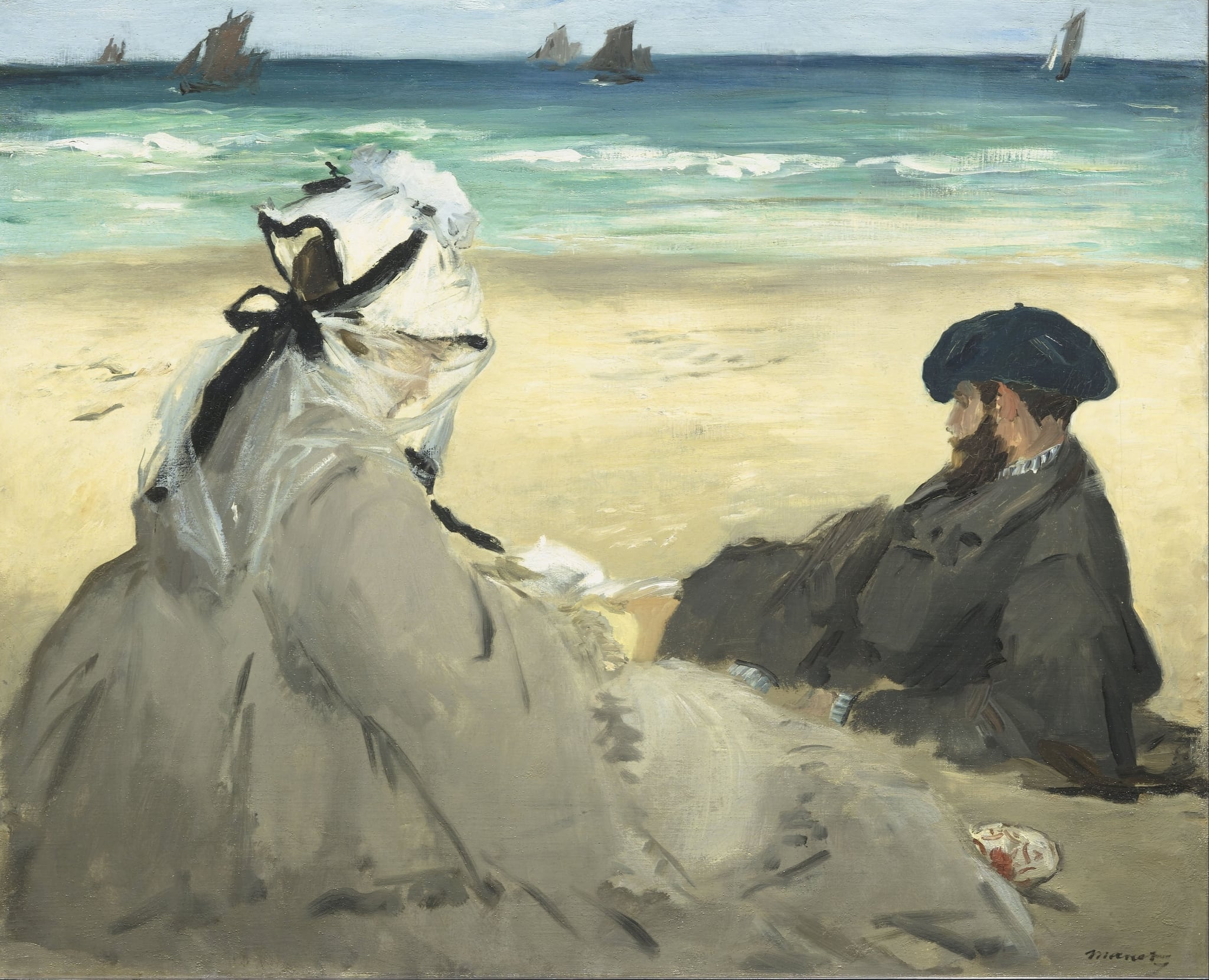
On the Beach
Édouard Manet (1873)
On the Beach captures a paused interval of modern leisure: two fashionably dressed figures sit on pale sand before a <strong>banded, high-horizon sea</strong>. Manet’s <strong>economical brushwork</strong>, restricted greys and blacks, and radical cropping stage a scene of absorption and wind‑tossed motion that feels both intimate and detached <sup>[1]</sup>.
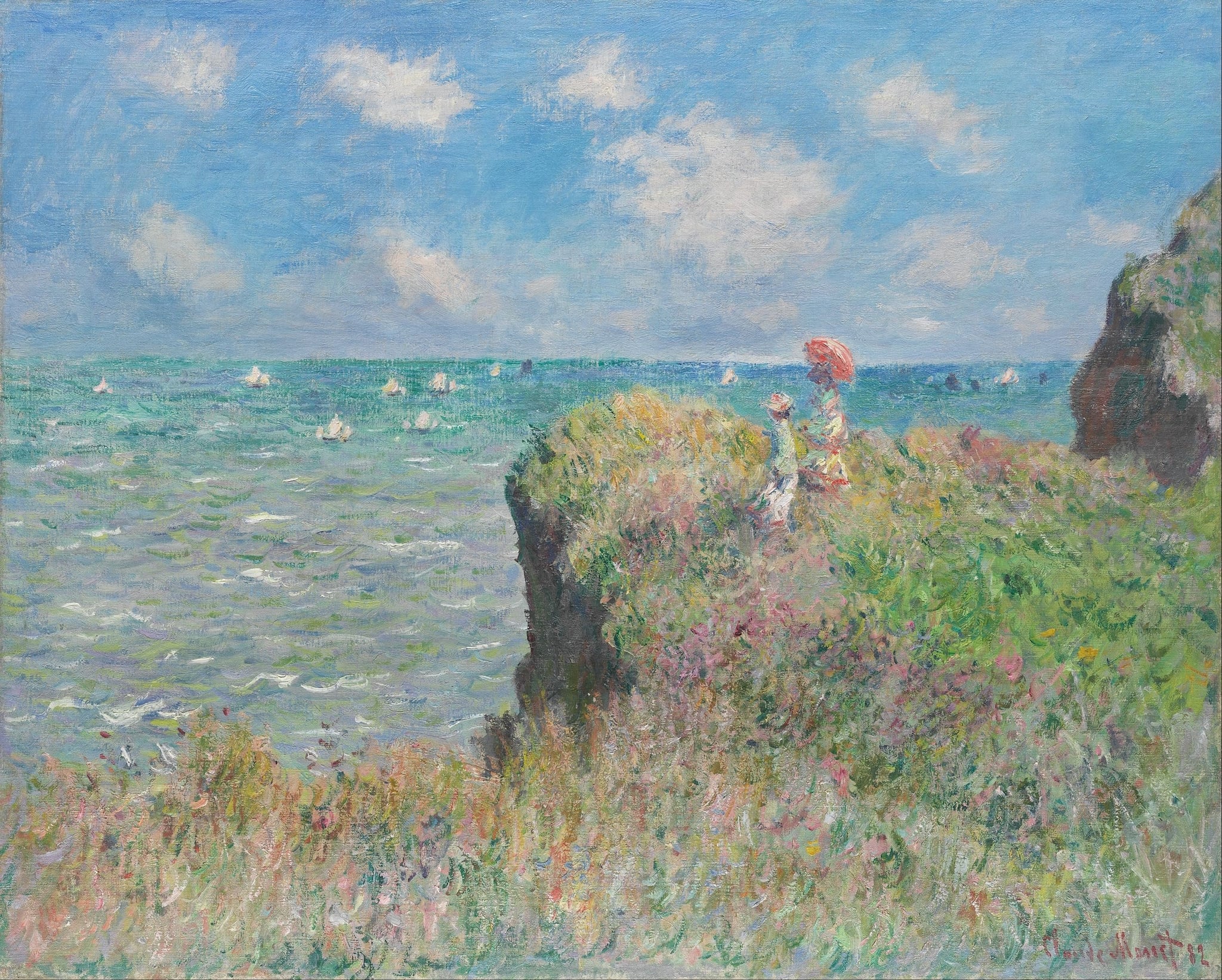
The Cliff Walk at Pourville
Claude Monet (1882)
Claude Monet’s The Cliff Walk at Pourville renders wind, light, and sea as interlocking forces through <strong>shimmering, broken brushwork</strong>. Two small walkers—one beneath a pink parasol—stand near the <strong>precipitous cliff edge</strong>, their presence measuring the vastness of turquoise water and bright sky dotted with white sails. The scene fuses leisure and the <strong>modern sublime</strong>, making perception itself the subject <sup>[1]</sup><sup>[2]</sup>.
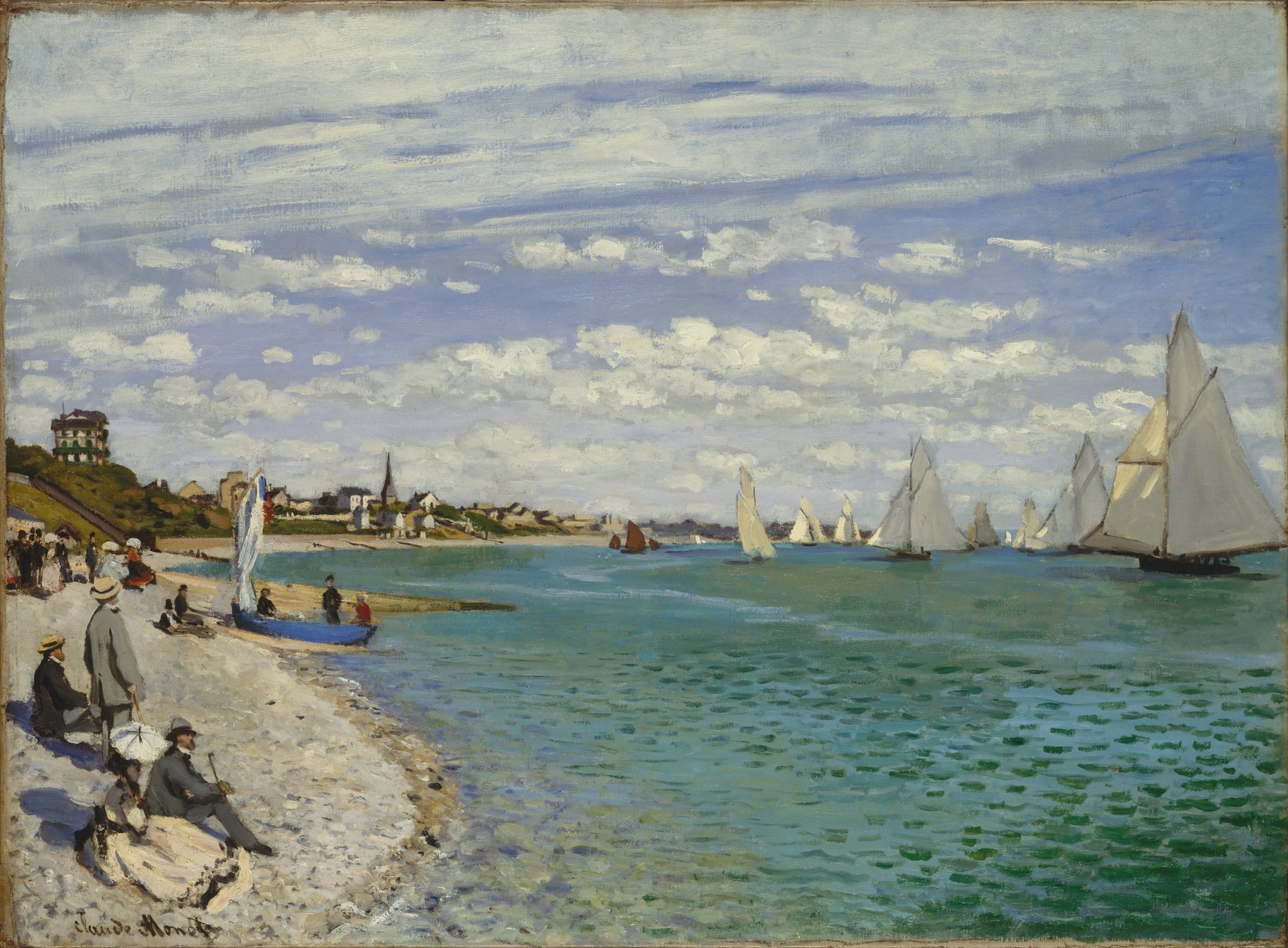
Regatta at Sainte-Adresse
Claude Monet (1867)
On a brilliant afternoon at the Normandy coast, a diagonal <strong>pebble beach</strong> funnels spectators with parasols toward a bay scattered with <strong>white-sailed yachts</strong>. Monet’s quick, broken strokes set <strong>wind, water, and light</strong> in synchrony, turning a local regatta into a modern scene of leisure held against the vastness of sea and sky <sup>[1]</sup><sup>[2]</sup>.
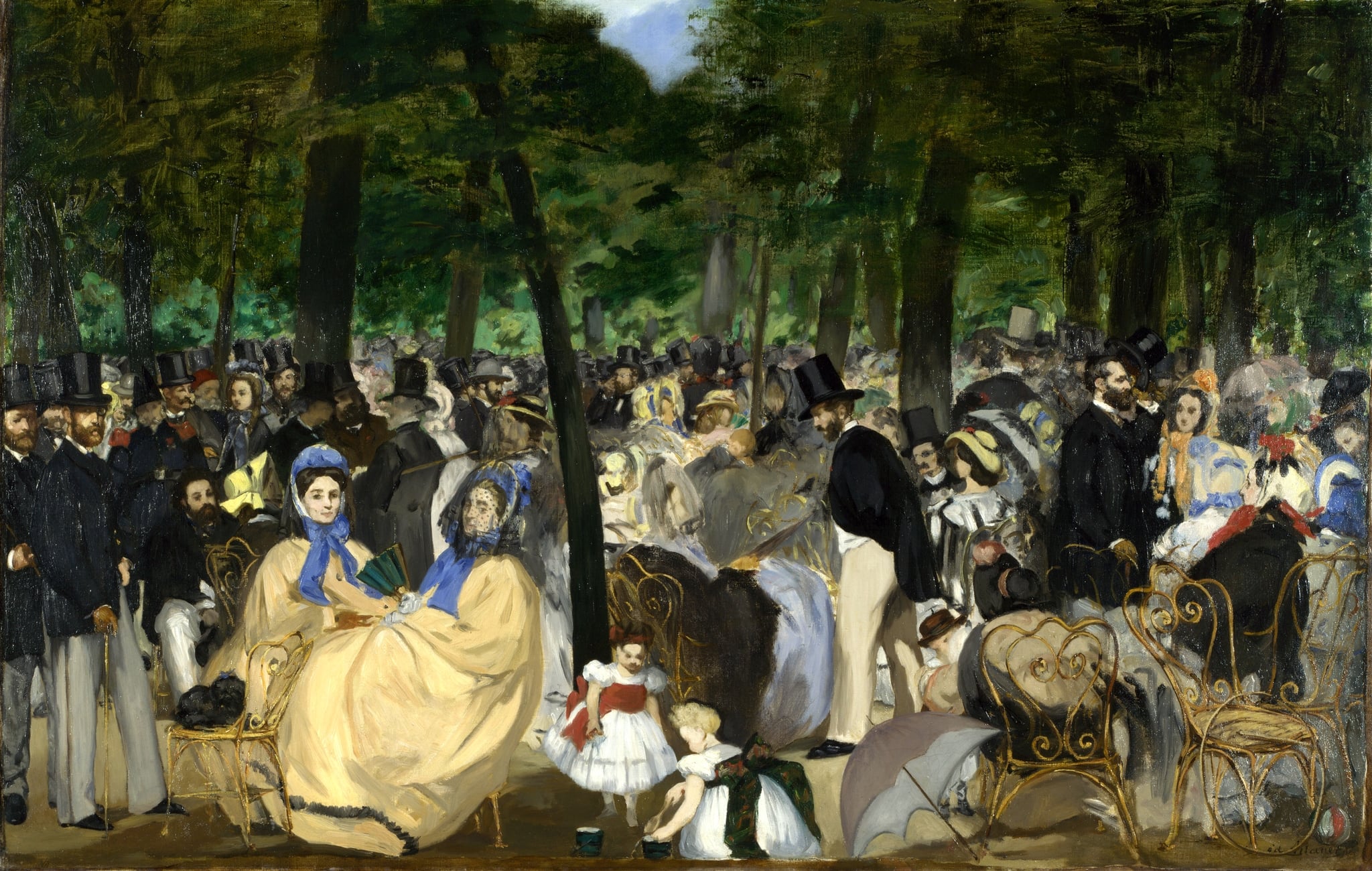
Music in the Tuileries
Édouard Manet (1862)
Édouard Manet’s Music in the Tuileries turns a Sunday concert into a manifesto of <strong>modern life</strong>: a frieze of top hats, crinolines, and iron chairs flickering beneath <strong>toxic green</strong> foliage. Instead of a hero or center, the painting disperses attention across a restless crowd, making <strong>looking itself</strong> the drama of the scene <sup>[1]</sup><sup>[2]</sup>.
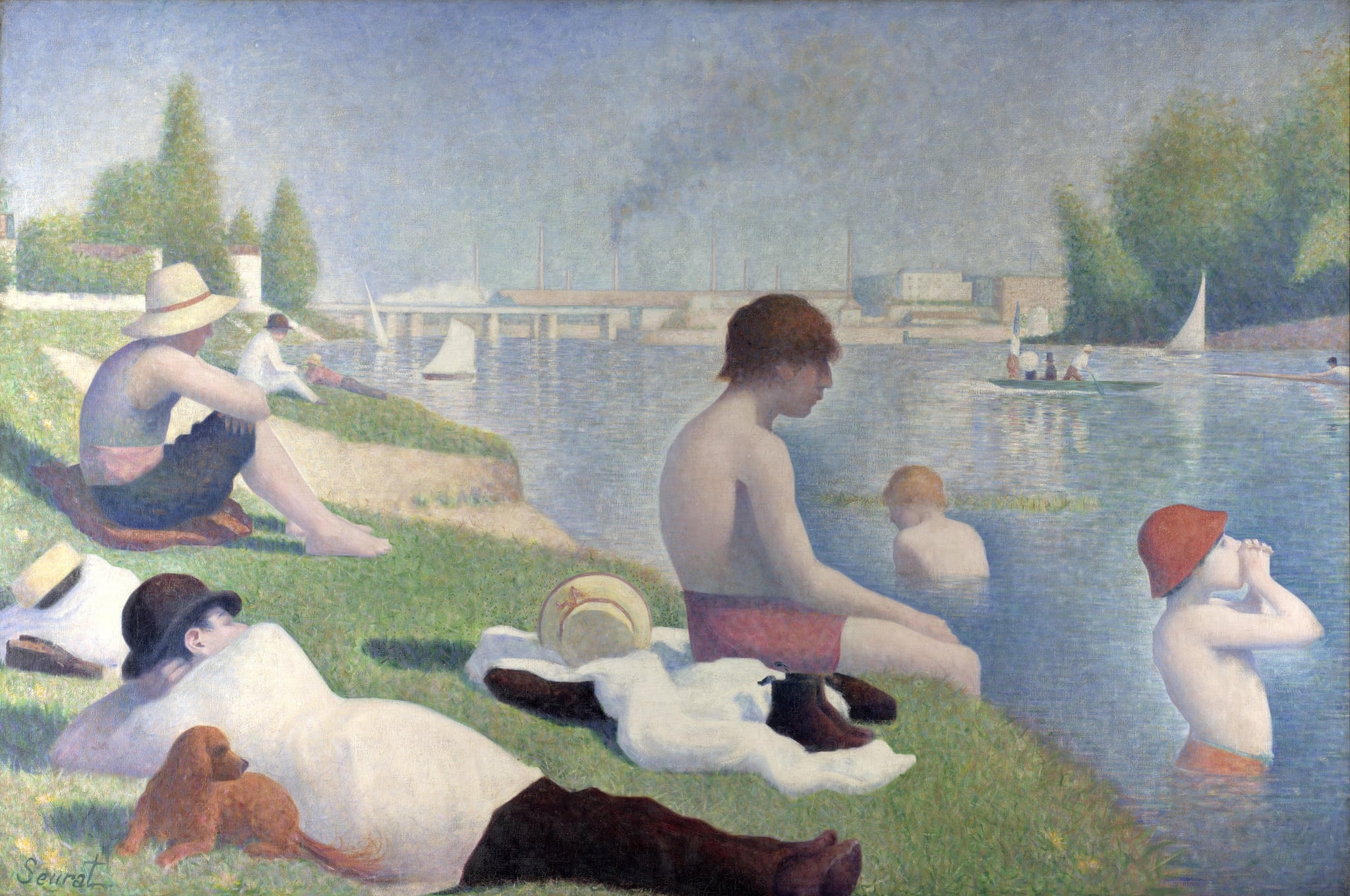
Bathers at Asnières
Georges Seurat (1884)
Bathers at Asnières stages a scene of <strong>modern leisure</strong> on the Seine, where workers recline and wade beneath a hazy, unified light. Seurat fuses <strong>classicizing stillness</strong> with an <strong>industrial backdrop</strong> of chimneys, bridges, and boats, turning ordinary rest into a monumental, ordered image of urban life <sup>[1]</sup><sup>[3]</sup>. The canvas balances soft greens and blues with geometric structures, producing a calm yet charged harmony.
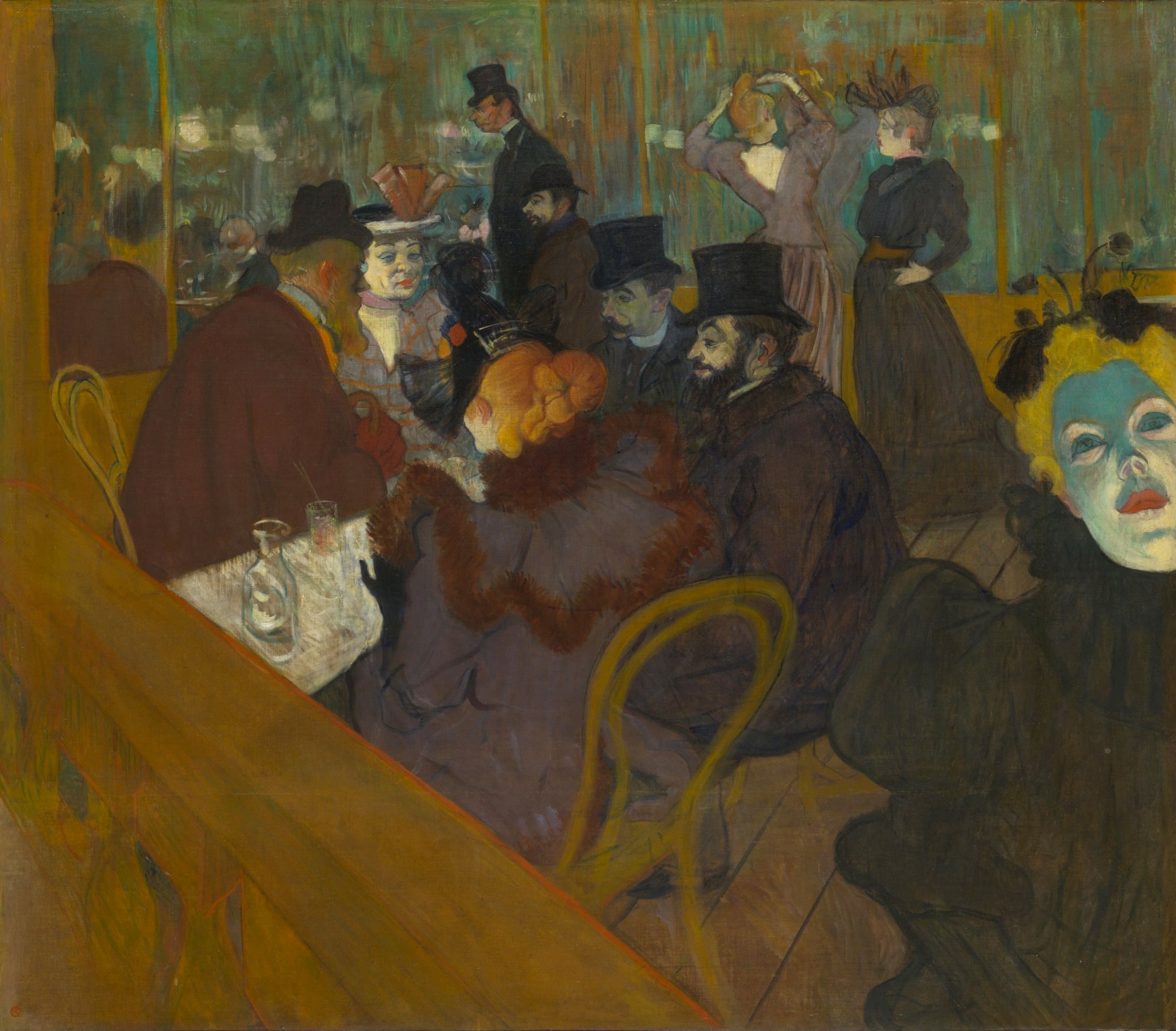
At the Moulin Rouge
Henri de Toulouse-Lautrec (1892–1895)
At the Moulin Rouge plunges us into the churn of Paris nightlife, staging a crowded room where spectacle and fatigue coexist. A diagonal banister and abrupt croppings create <strong>off‑kilter immediacy</strong>, while harsh artificial light turns faces <strong>masklike</strong> and cool. Mirrors multiply the crowd, amplifying a mood of allure tinged with <strong>urban alienation</strong> <sup>[1]</sup><sup>[3]</sup><sup>[4]</sup>.
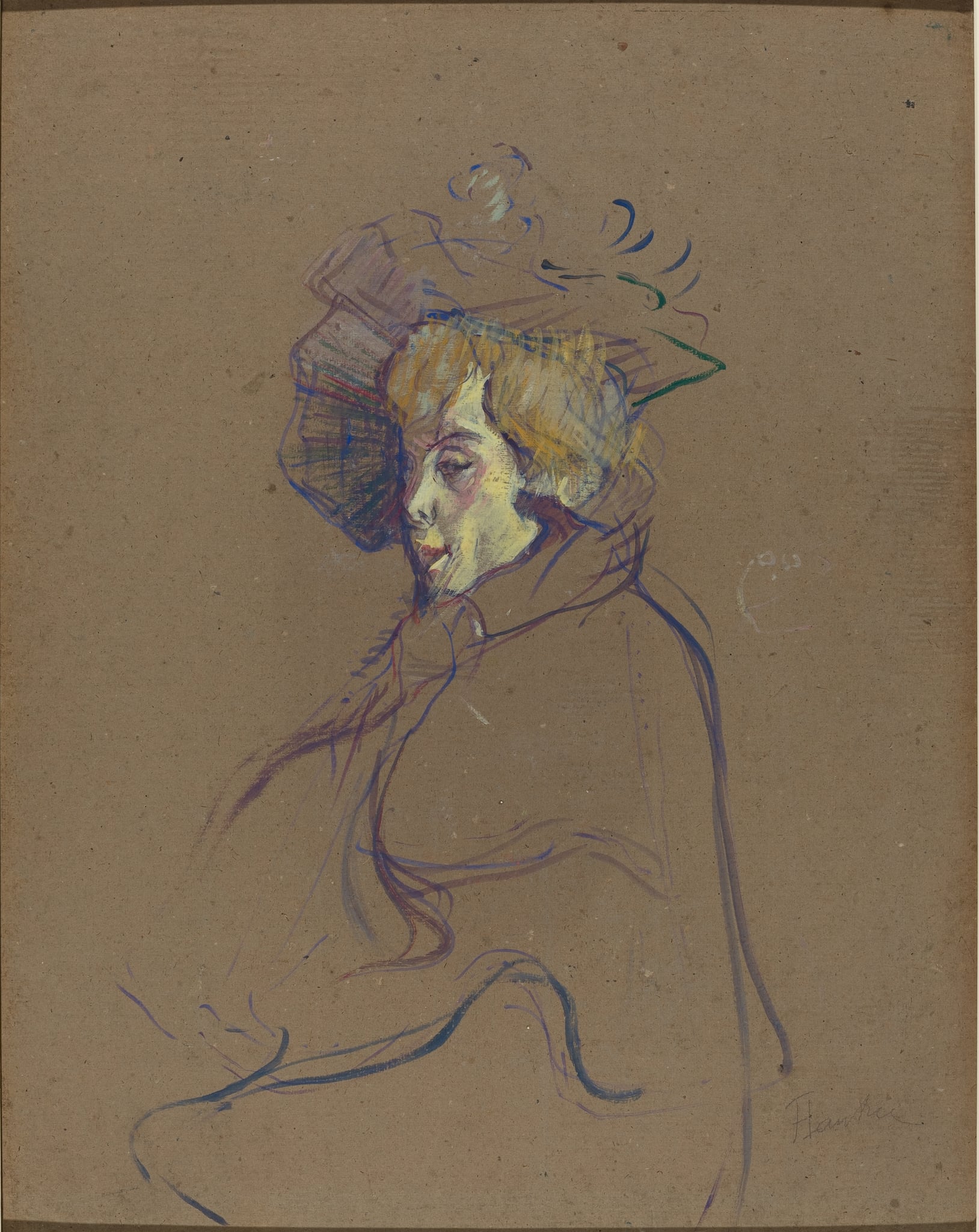
Jane Avril
Henri de Toulouse-Lautrec (c. 1891–1892)
In Jane Avril, Henri de Toulouse-Lautrec crystallizes a public persona from a few <strong>urgent, chromatic strokes</strong>: violet and blue lines whirl into a cloak, while green and indigo dashes crown a buoyant hat. Her face—sharply keyed in <strong>lemon yellow, lilac, and carmine</strong>—hovers between mask and likeness, projecting poise edged with fatigue. The raw brown ground lets her <strong>whiplash silhouette</strong> materialize like smoke from Montmartre’s nightlife.
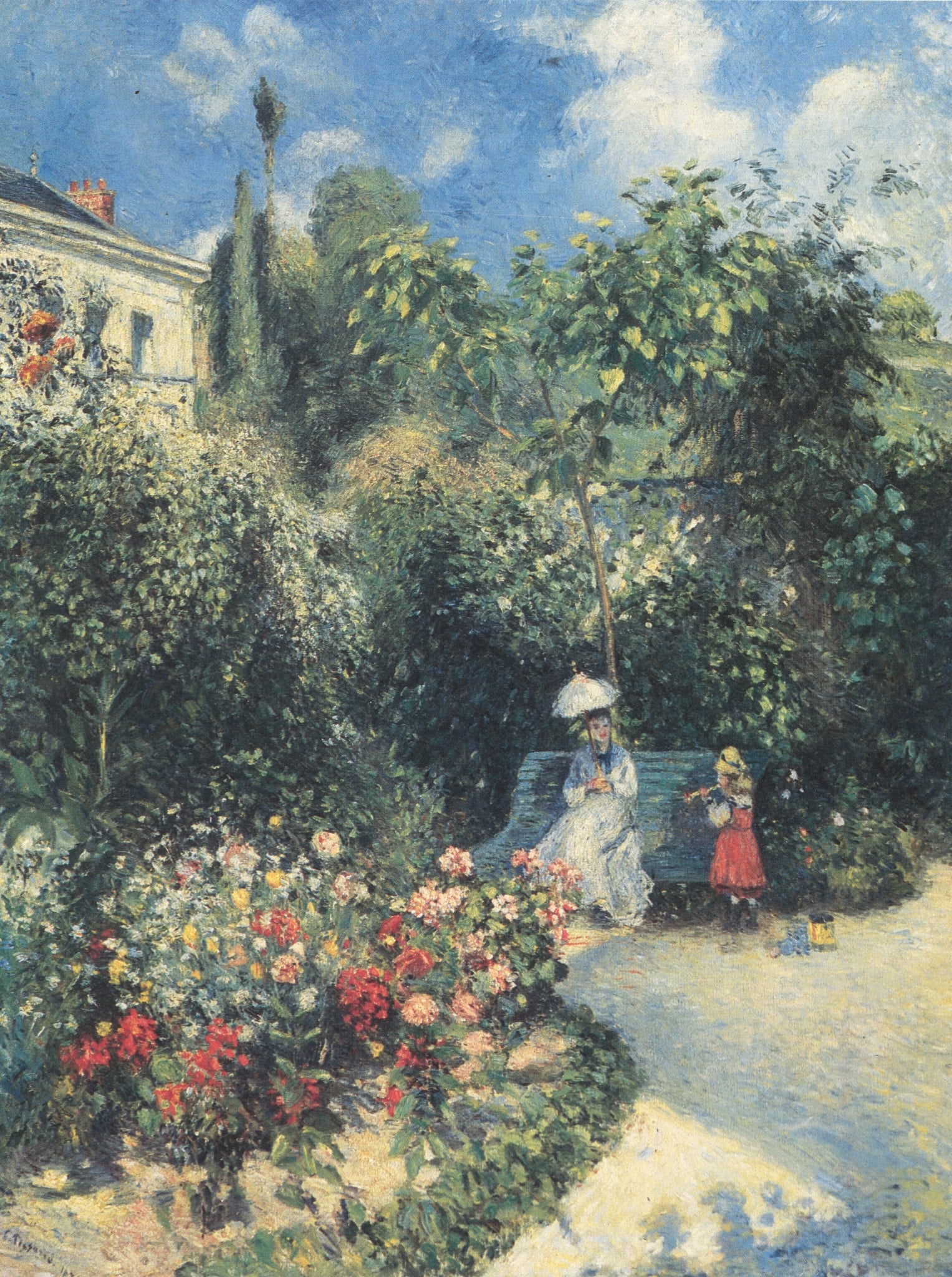
The Garden of Pontoise
Camille Pissarro (1874)
In The Garden of Pontoise, Camille Pissarro turns a modest suburban plot into a stage for <strong>modern leisure</strong> and <strong>fugitive light</strong>. A woman shaded by a parasol and a child in a bright red skirt punctuate the deep greens, while a curving sand path and beds of red–pink blossoms draw the eye toward a pale house and cloud‑flecked sky. The painting asserts that everyday, cultivated nature can be a <strong>modern Eden</strong> where time, season, and social ritual quietly unfold <sup>[1]</sup><sup>[3]</sup>.
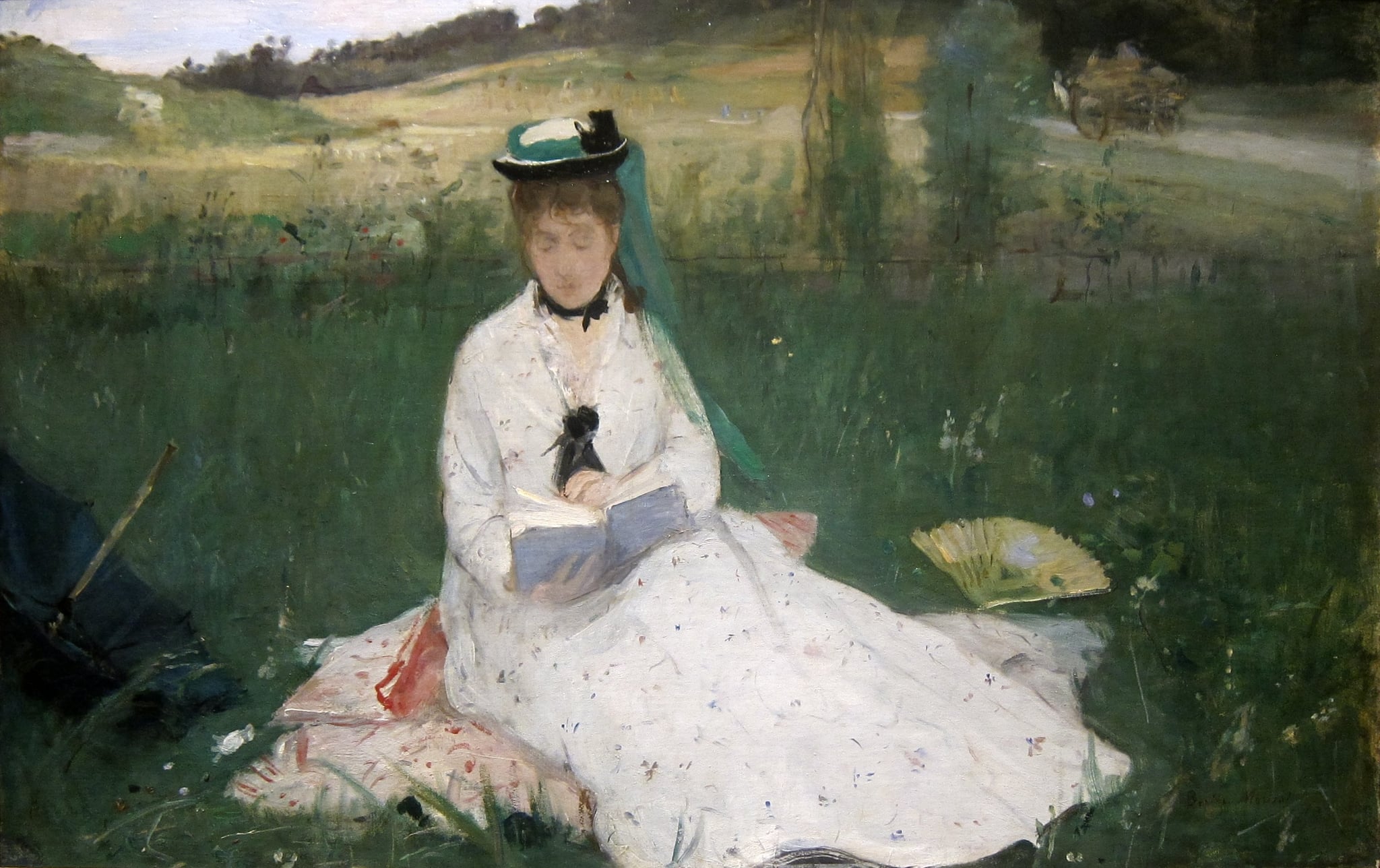
Reading
Berthe Morisot (1873)
In Berthe Morisot’s <strong>Reading</strong> (1873), a woman in a pale, patterned dress sits on the grass, absorbed in a book while a <strong>green parasol</strong> and <strong>folded fan</strong> lie nearby. Morisot’s quick, luminous brushwork dissolves the landscape into <strong>atmospheric greens</strong> as a distant carriage passes, turning an outdoor scene into a study of interior life. The work makes <strong>female intellectual absorption</strong> its true subject, aligning modern leisure with private thought.
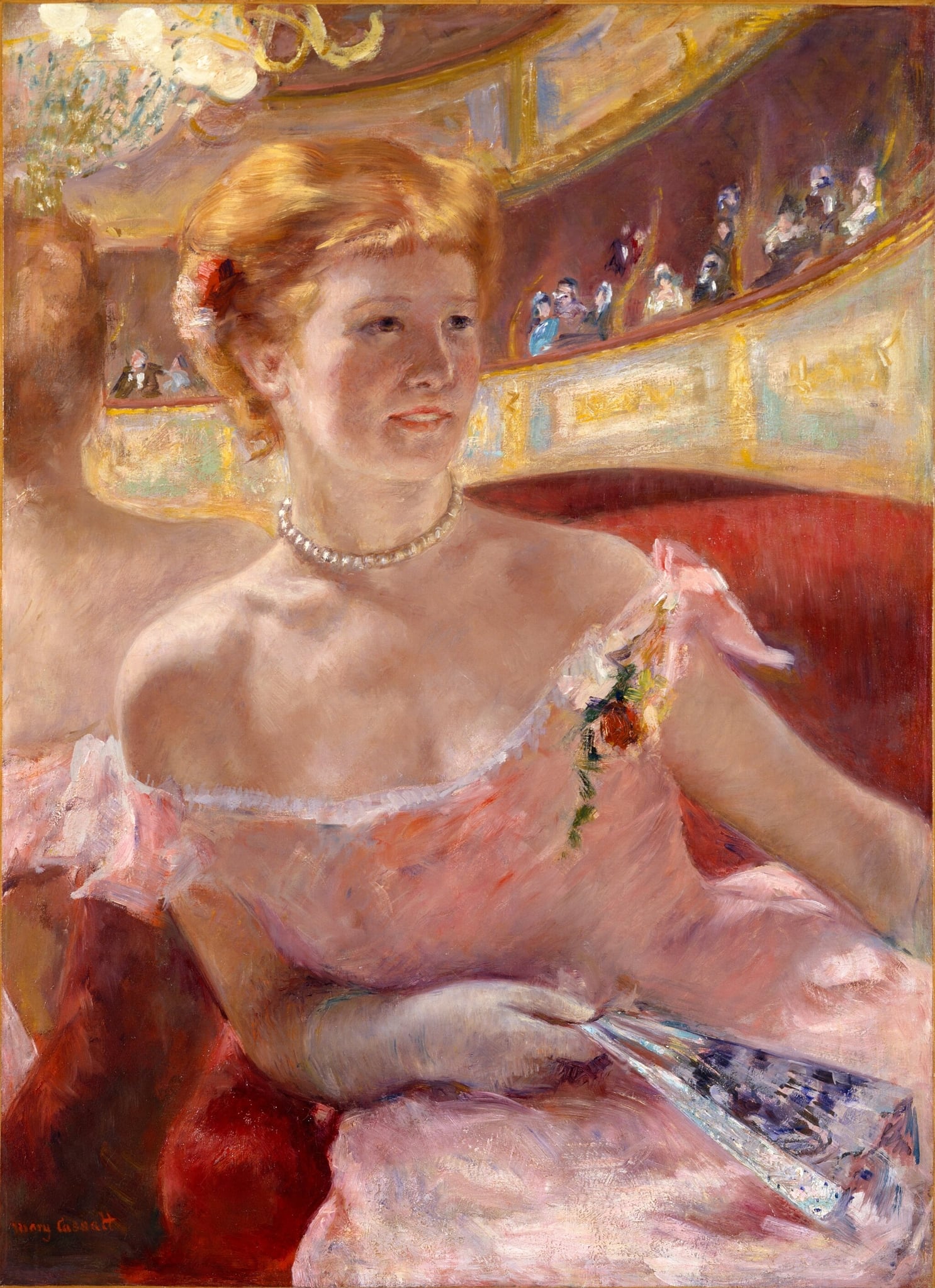
Woman with a Pearl Necklace in a Loge
Mary Cassatt (1879)
Mary Cassatt’s Woman with a Pearl Necklace in a Loge (1879) stages modern <strong>spectatorship</strong> inside a plush opera box, where a young woman in pink satin, pearls, and gloves occupies the red velvet seat while a mirror multiplies the chandeliers and balconies. Cassatt fuses <strong>intimacy</strong> and <strong>public display</strong>, using luminous brushwork to place her sitter within the social theater of Parisian leisure <sup>[1]</sup><sup>[2]</sup>.
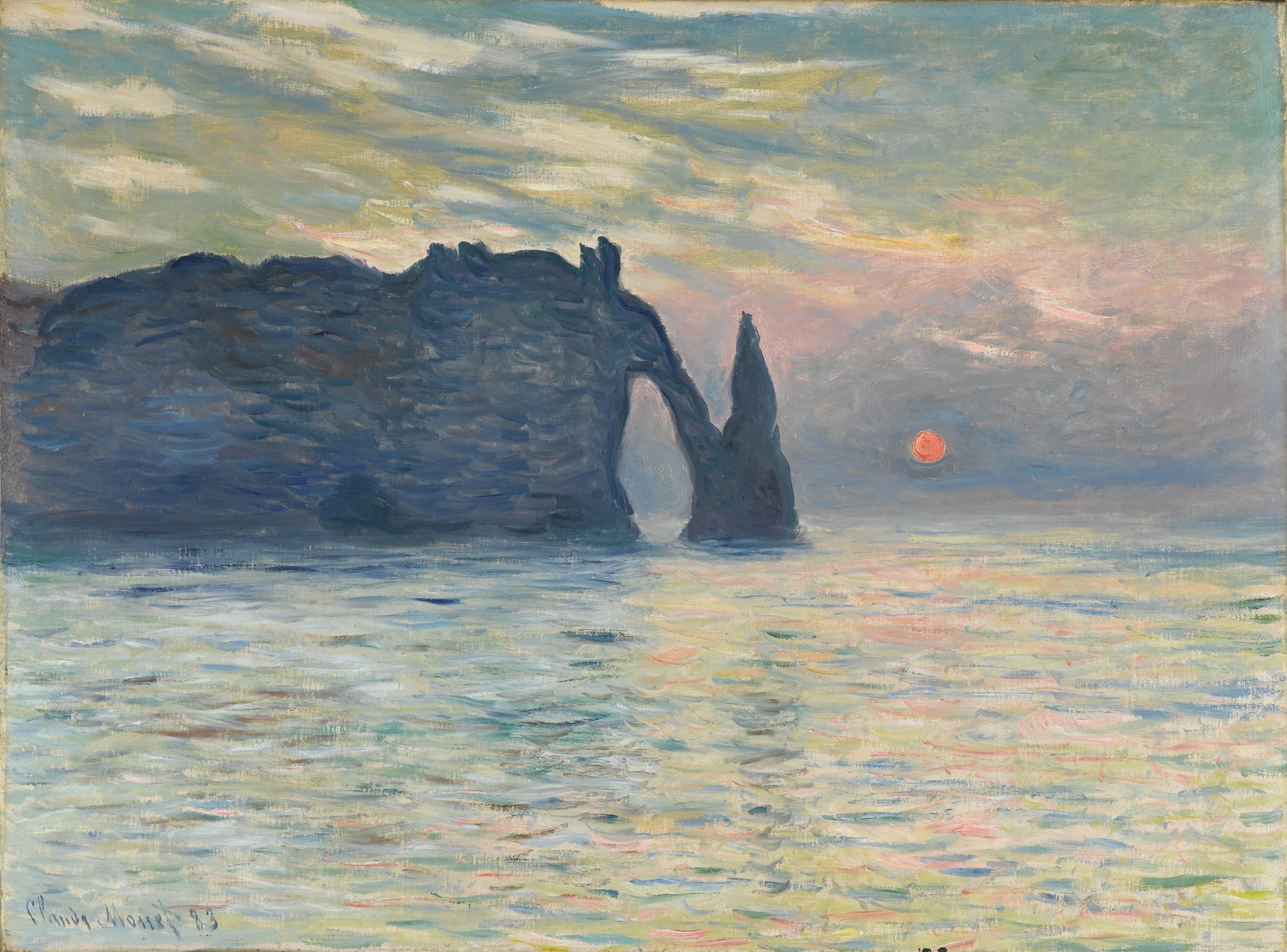
The Cliff, Etretat
Claude Monet (1882–1883)
<strong>The Cliff, Etretat</strong> stages a confrontation between <strong>permanence and flux</strong>: the dark mass of the arch and needle holds like a monument while ripples of coral, green, and blue light skate across the water. The low <strong>solar disk</strong> fixes the instant, and Monet’s fractured strokes make the sea and sky feel like time itself turning toward dusk. The arch reads as a <strong>threshold</strong>—an opening to the unknown that organizes vision and meaning <sup>[1]</sup><sup>[2]</sup>.
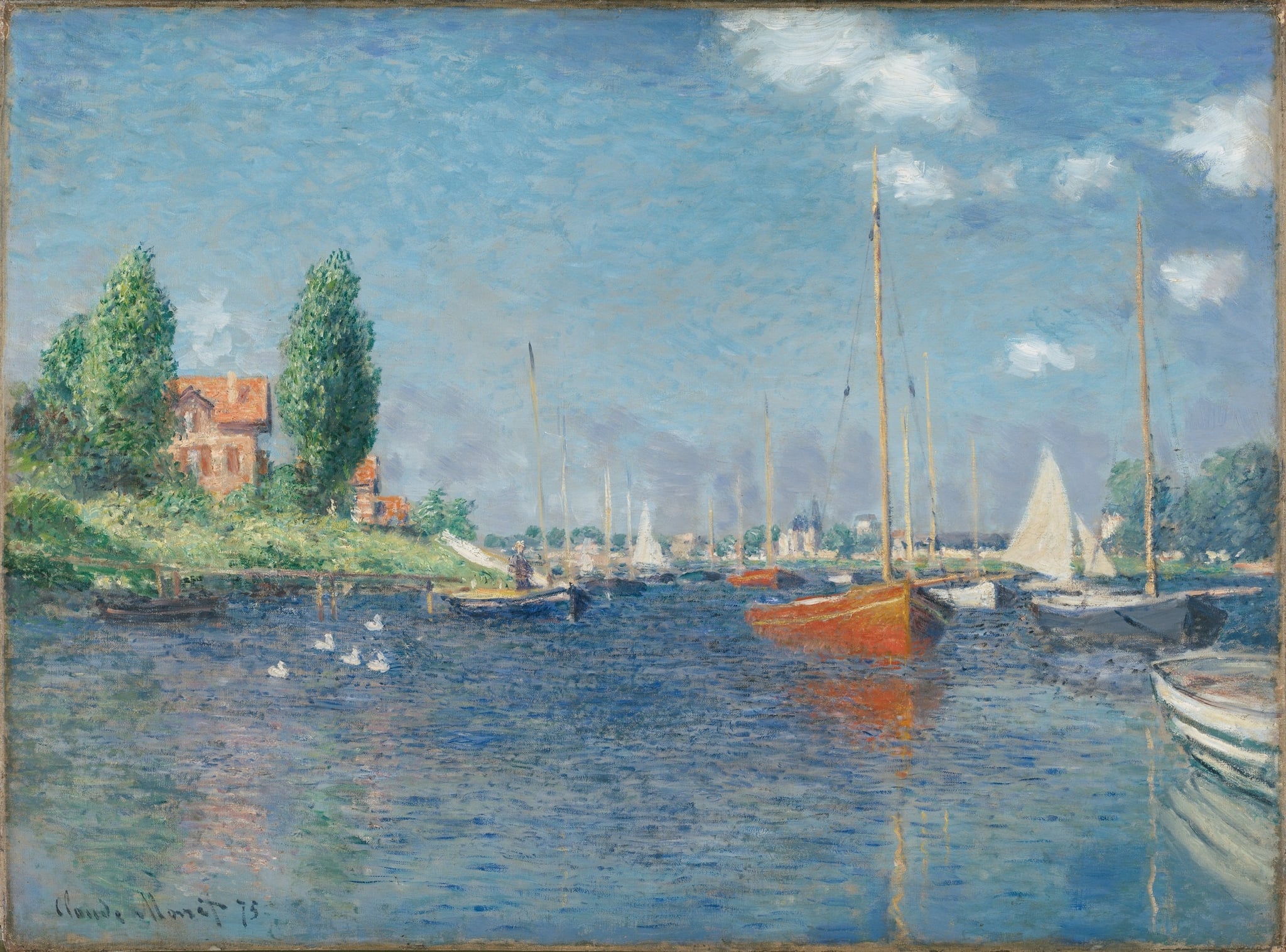
The Red Boats, Argenteuil
Claude Monet (1875)
Claude Monet’s The Red Boats, Argenteuil crystallizes a luminous afternoon on the Seine, where two <strong>vermilion hulls</strong> anchor a scene of leisure and light. The tremoring <strong>reflections</strong> and vertical <strong>masts/poplars</strong> weave nature and modern recreation into a single atmospheric field <sup>[1]</sup>.
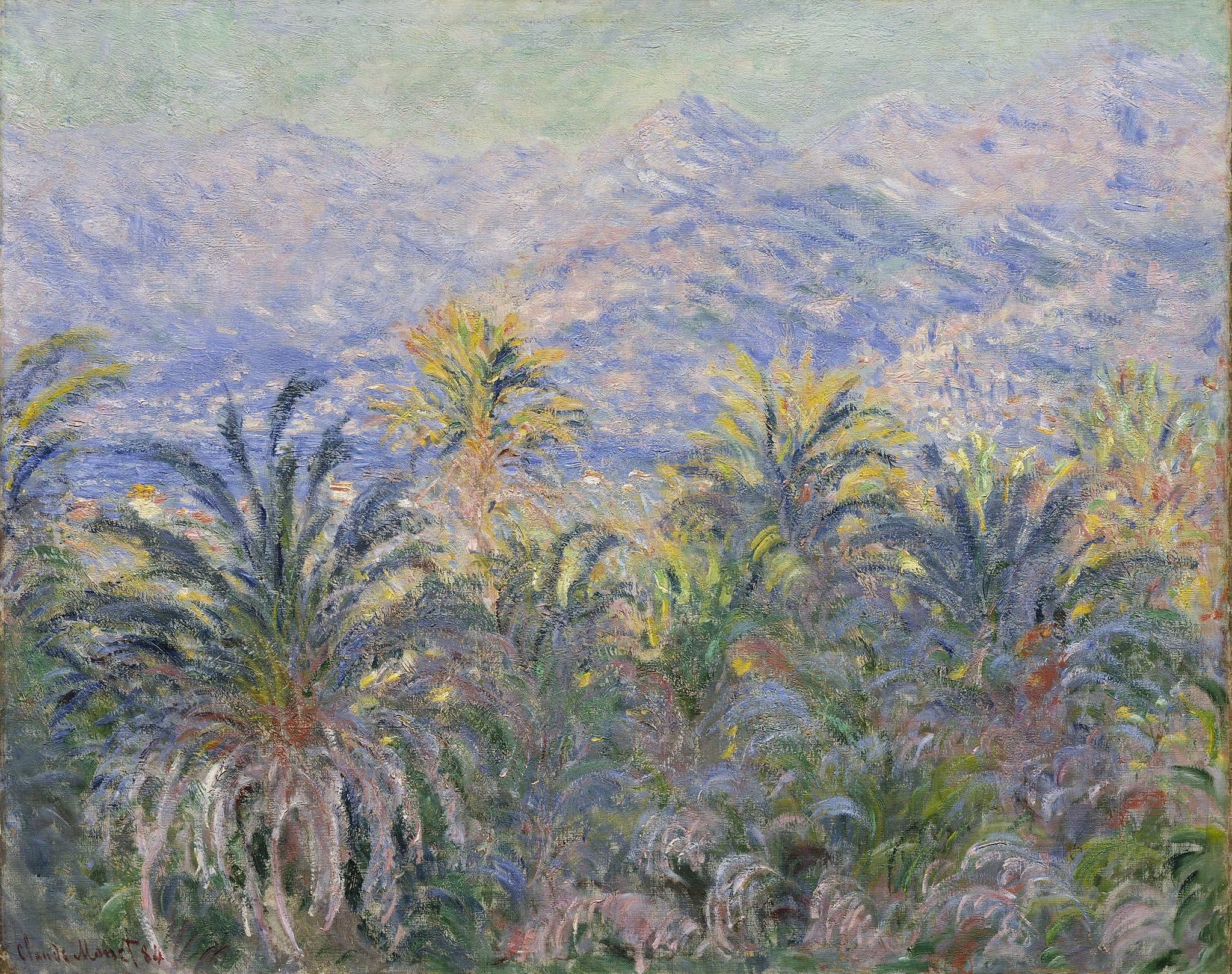
Palm Trees at Bordighera
Claude Monet (1884)
Claude Monet’s Palm Trees at Bordighera (1884) turns a Riviera grove into <strong>vibrating atmosphere</strong>: palm fronds surge across the foreground while a <strong>cobalt sea</strong> and <strong>violet-blue Alps</strong> dissolve into a misted sky. Monet pushes cool mauves, blues, and lemon tints into broken strokes so the scene reads as <strong>light-in-motion</strong> rather than botany <sup>[1]</sup><sup>[2]</sup>.
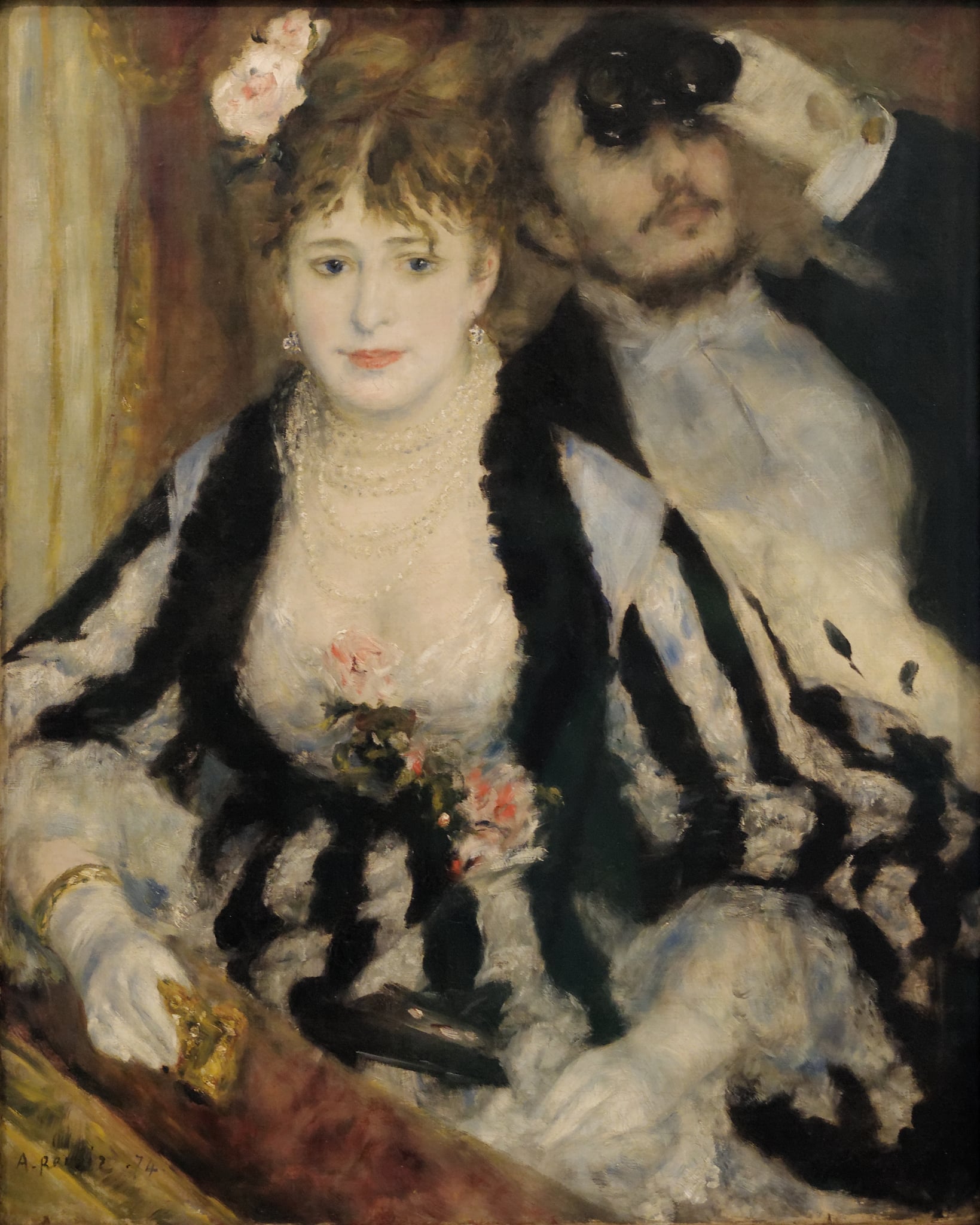
The Theater Box
Pierre-Auguste Renoir (1874)
Renoir’s The Theater Box turns a plush loge into a stage where seeing becomes the performance. A luminous woman—pearls, pale gloves, black‑and‑white stripes—faces us, while her companion scans the auditorium through opera glasses. The painting crystallizes Parisian <strong>modernity</strong> and the choreography of the <strong>gaze</strong> <sup>[1]</sup><sup>[5]</sup>.
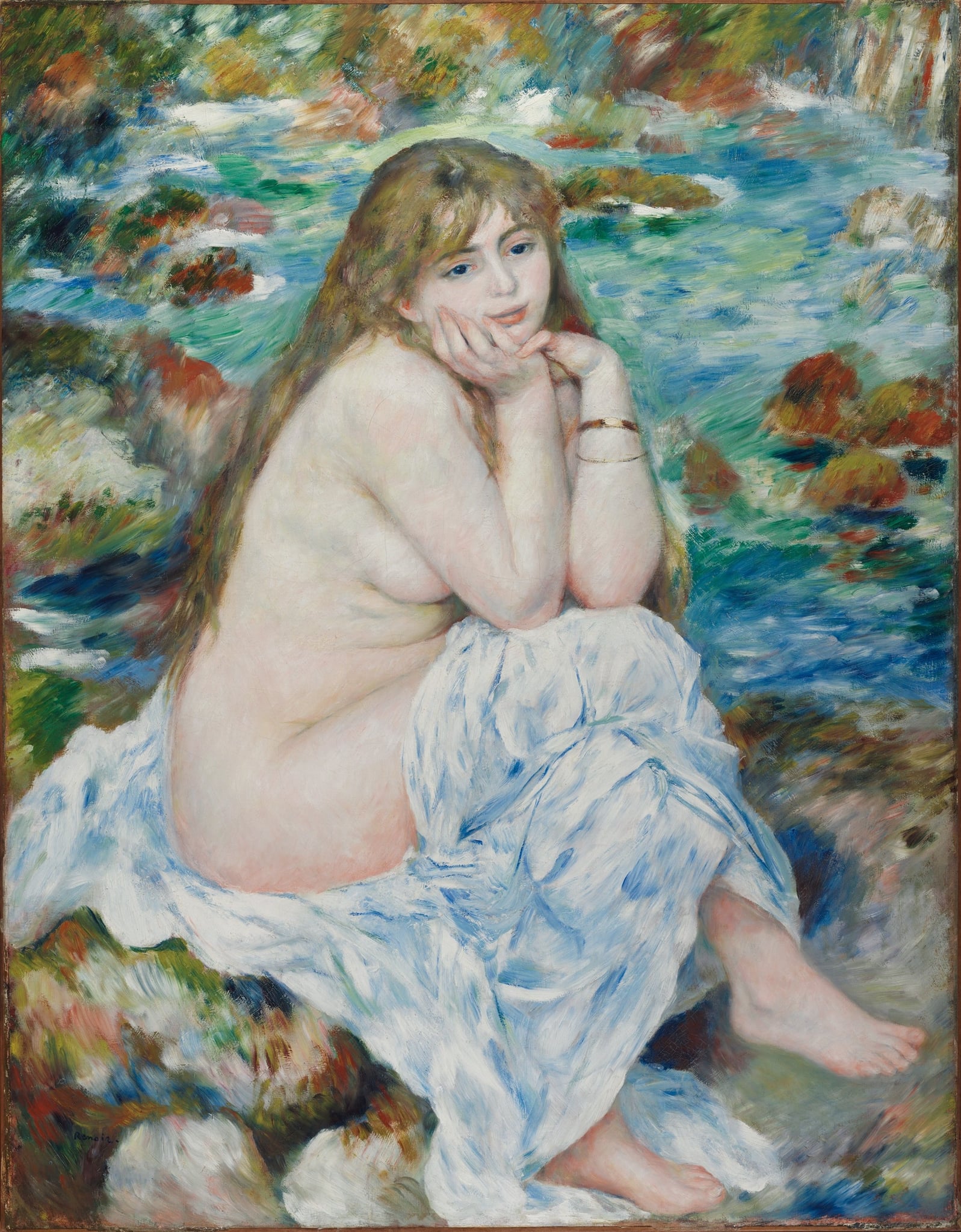
Seated Bather
Pierre-Auguste Renoir
Renoir’s Seated Bather stages a quiet pause between bathing and reverie, fusing the model’s pearly flesh with the flicker of stream and stone. The white drapery pooled around her hips and the soft, frontal gaze convert a simple toilette into a <strong>modern Arcadia</strong> where body and landscape dissolve into light. In this late-Impressionist idiom, Renoir refines the nude as a <strong>timeless ideal</strong> felt through color and touch <sup>[1]</sup><sup>[2]</sup>.
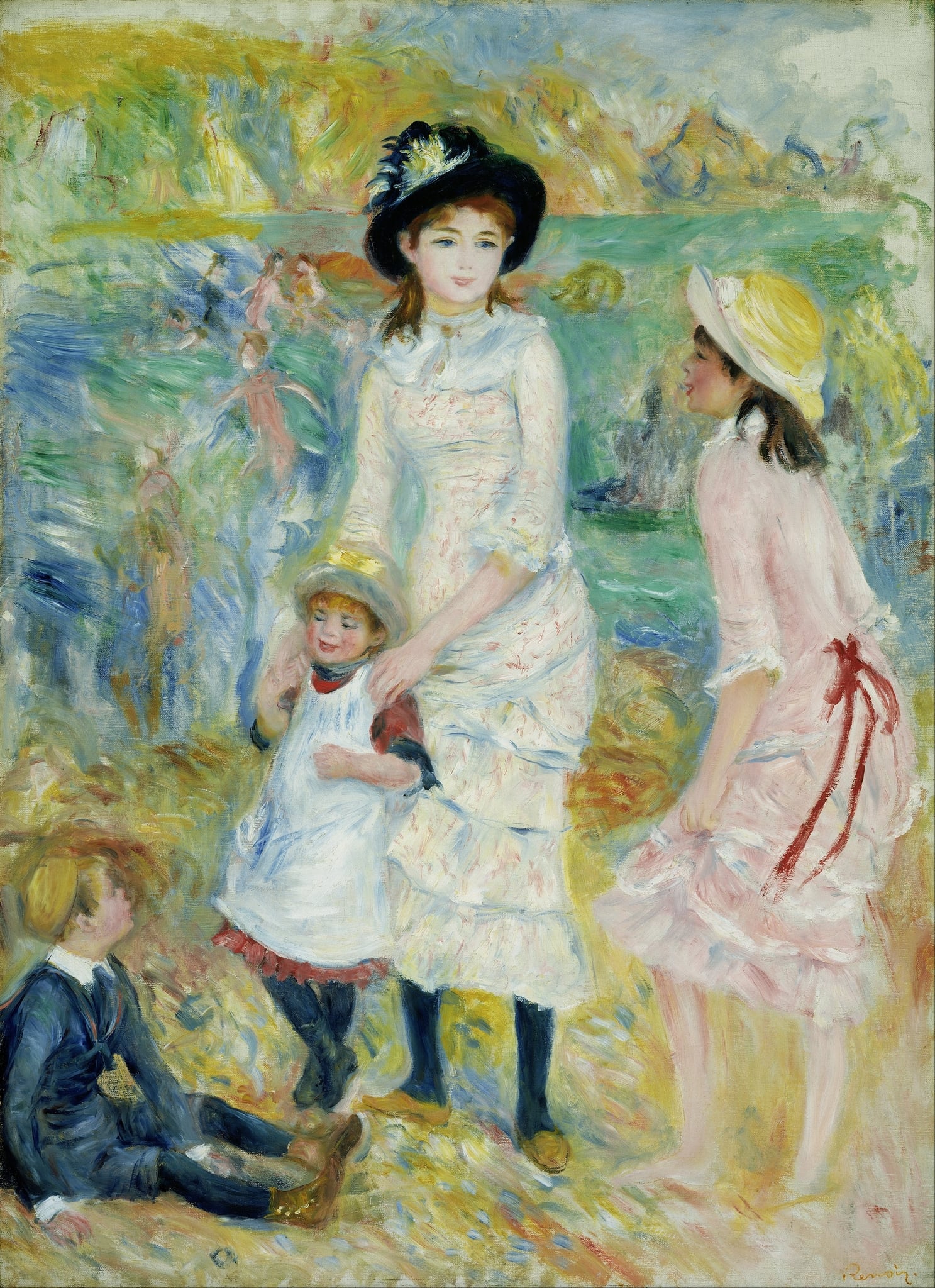
Children on the Seashore, Guernsey
Pierre-Auguste Renoir (about 1883)
Renoir’s Children on the Seashore, Guernsey crystallizes a wind‑bright moment of modern leisure with <strong>flickering brushwork</strong> and a gently choreographed group of children. The central girl in a white dress and black feathered hat steadies a toddler while a pink‑clad companion leans in and a sailor‑suited boy rests on the pebbles—an intimate triangle set against a <strong>shimmering, populated sea</strong>. The canvas makes light and movement the protagonists, dissolving edges into <strong>pearly surf and sun‑washed cliffs</strong>.
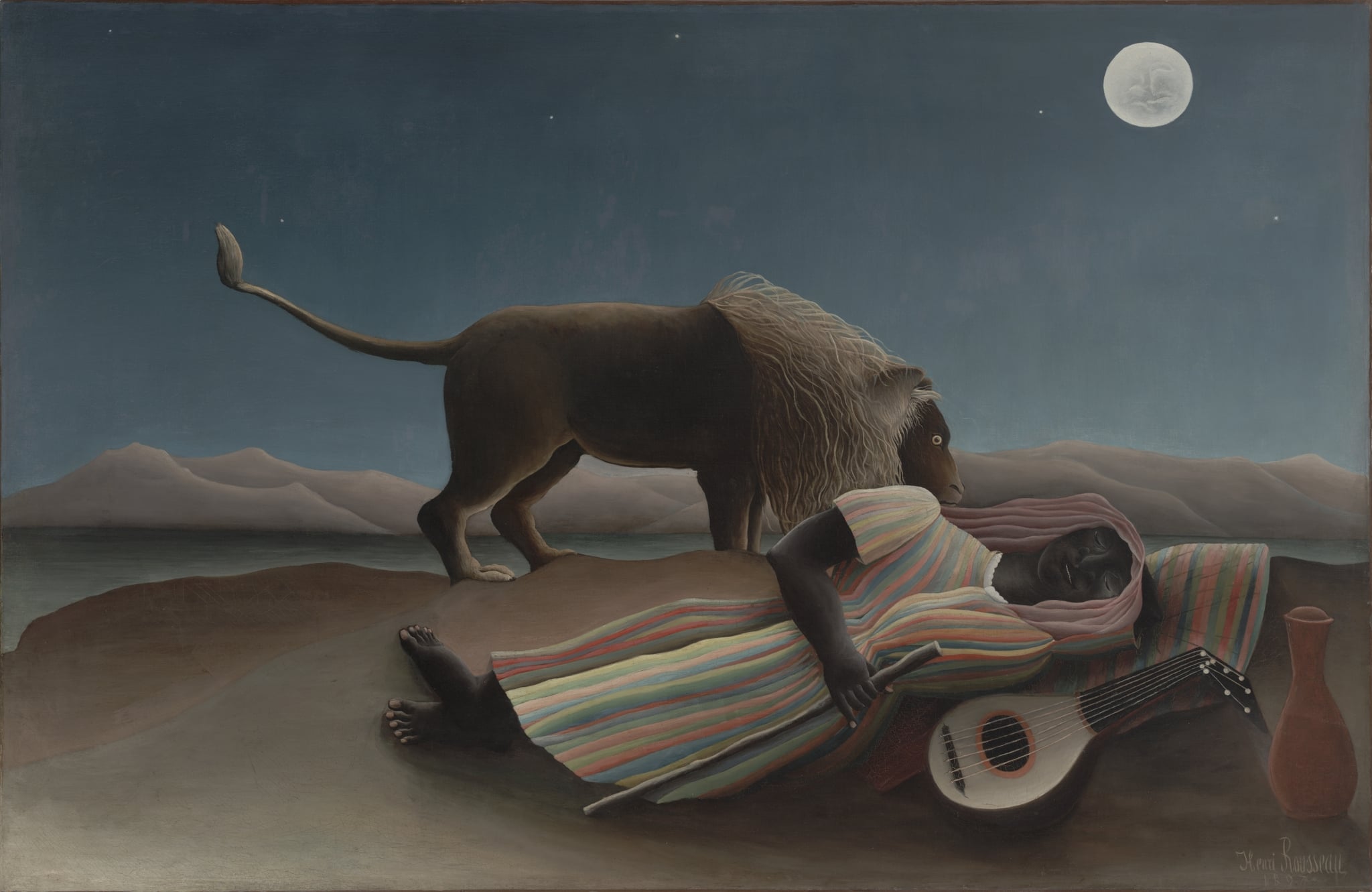
The Sleeping Shepherdess
Henri Rousseau (1897)
In The Sleeping Shepherdess, a moonlit desert holds a poised balance between <strong>vulnerability</strong> and <strong>watchful restraint</strong>. A striped‑clad traveler sleeps on a matching cushion, a <strong>mandolin</strong> and <strong>water jar</strong> at her side, while a lion, paw raised and eye wide, draws close yet does not strike. Rousseau’s flattened forms and echoing stripes create a hypnotic <strong>dream logic</strong> that turns danger into a guarded calm <sup>[1]</sup><sup>[2]</sup>.
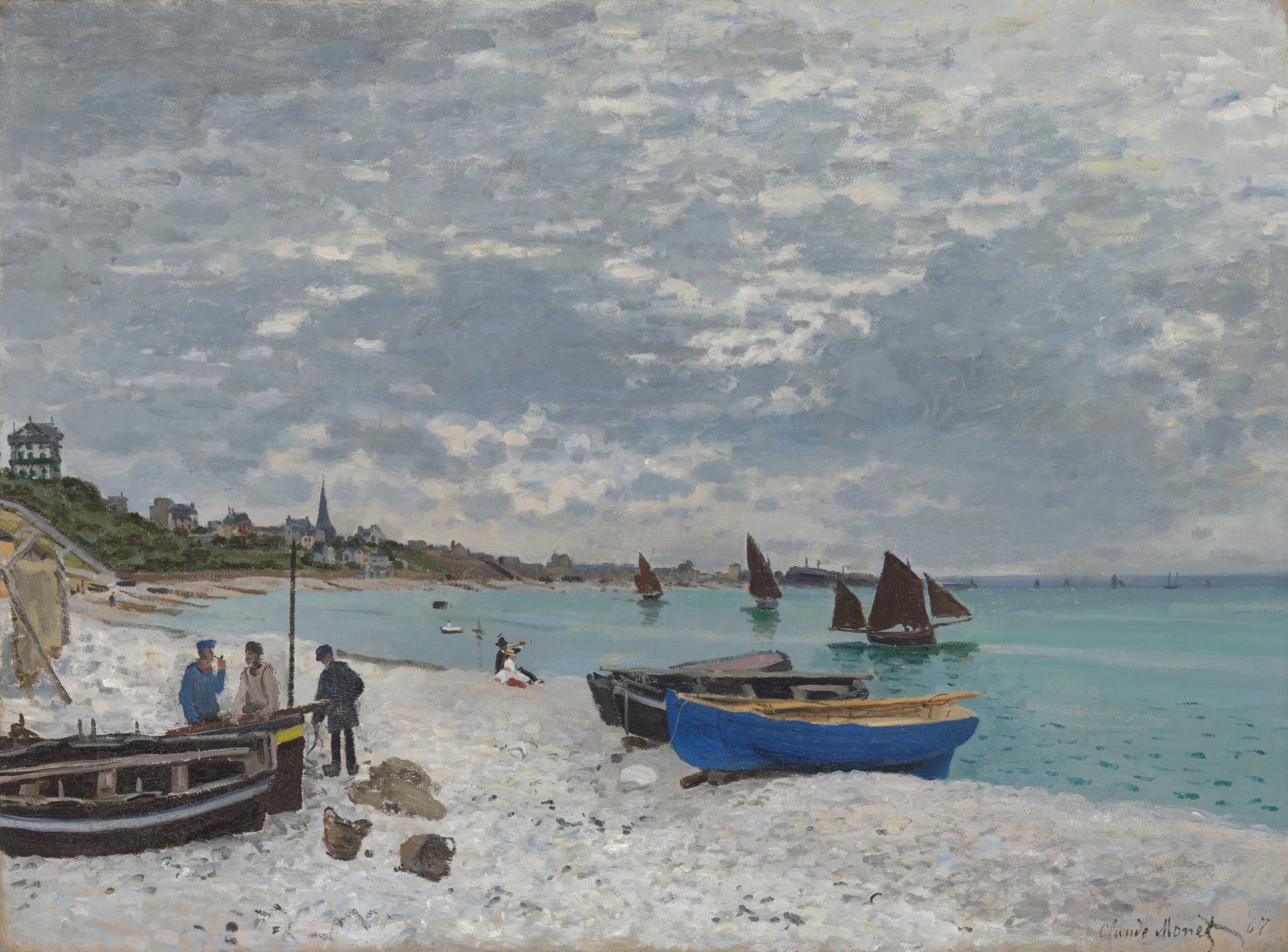
The Beach at Sainte-Adresse
Claude Monet (1867)
In The Beach at Sainte-Adresse, Claude Monet stages a modern shore where <strong>labor and leisure intersect</strong> under a broad, changeable sky. The bright <strong>blue beached boat</strong> and the flotilla of <strong>rust-brown working sails</strong> punctuate a turquoise channel, while a fashionably dressed pair sits mid-beach, spectators to the traffic of the port. Monet’s brisk, broken strokes make the scene feel <strong>caught between tides and weather</strong>, a momentary balance of work, tourism, and atmosphere <sup>[1]</sup><sup>[2]</sup>.
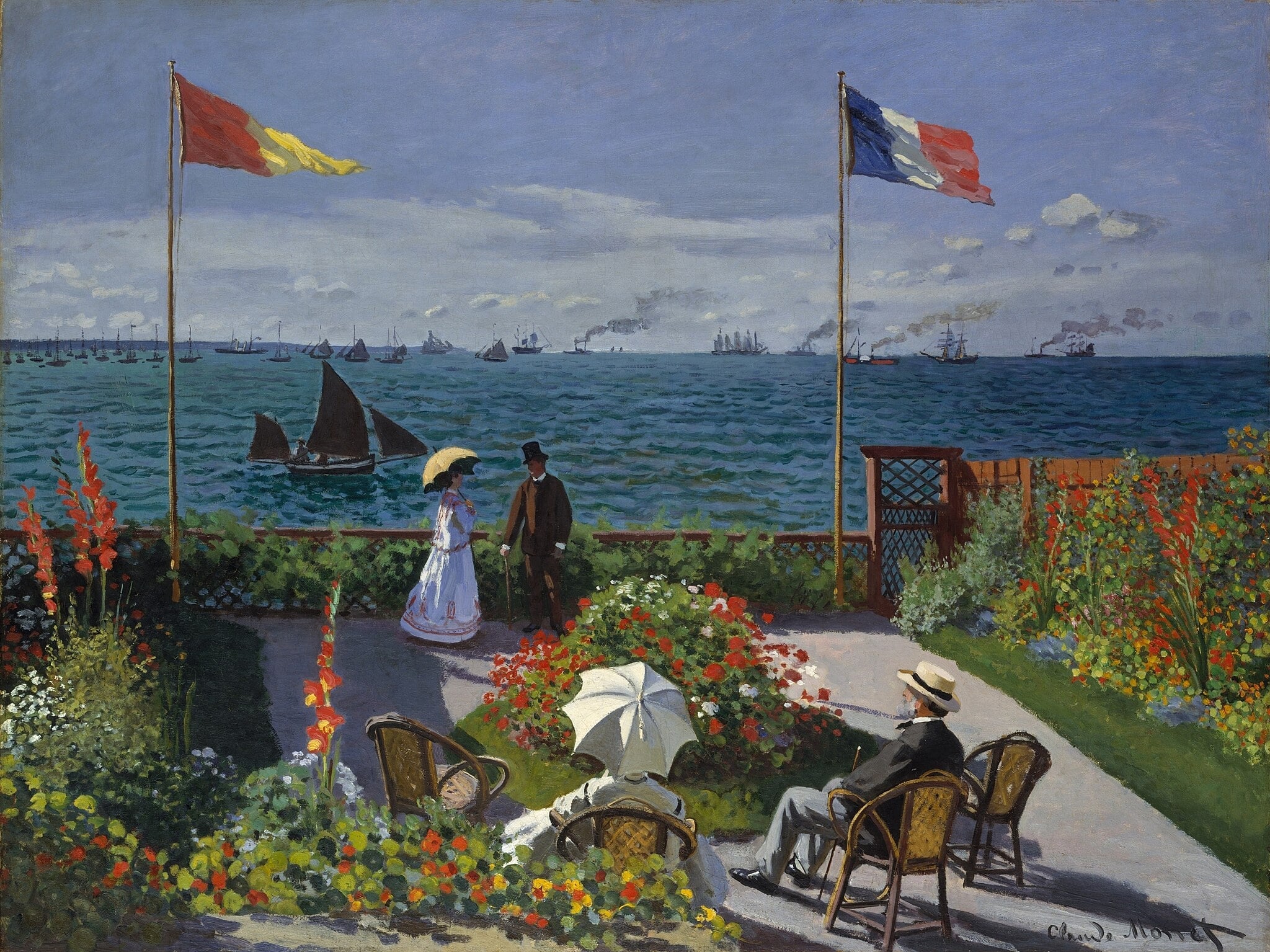
Garden at Sainte-Adresse
Claude Monet (1867)
<strong>Garden at Sainte-Adresse</strong> distills a breezy seaside terrace into a lucid design of color bands and flagpoles, where private leisure meets a busy, modern harbor. Claude Monet binds <strong>bourgeois ease</strong> (wicker chairs, parasol, promenade) to <strong>national and nautical identity</strong> (the French tricolor and a regatta/signal pennant) while sail and steam share the channel. Light and wind animate every element, turning a family terrace into a statement about modern life and its swift transitions <sup>[1]</sup><sup>[3]</sup><sup>[5]</sup>.
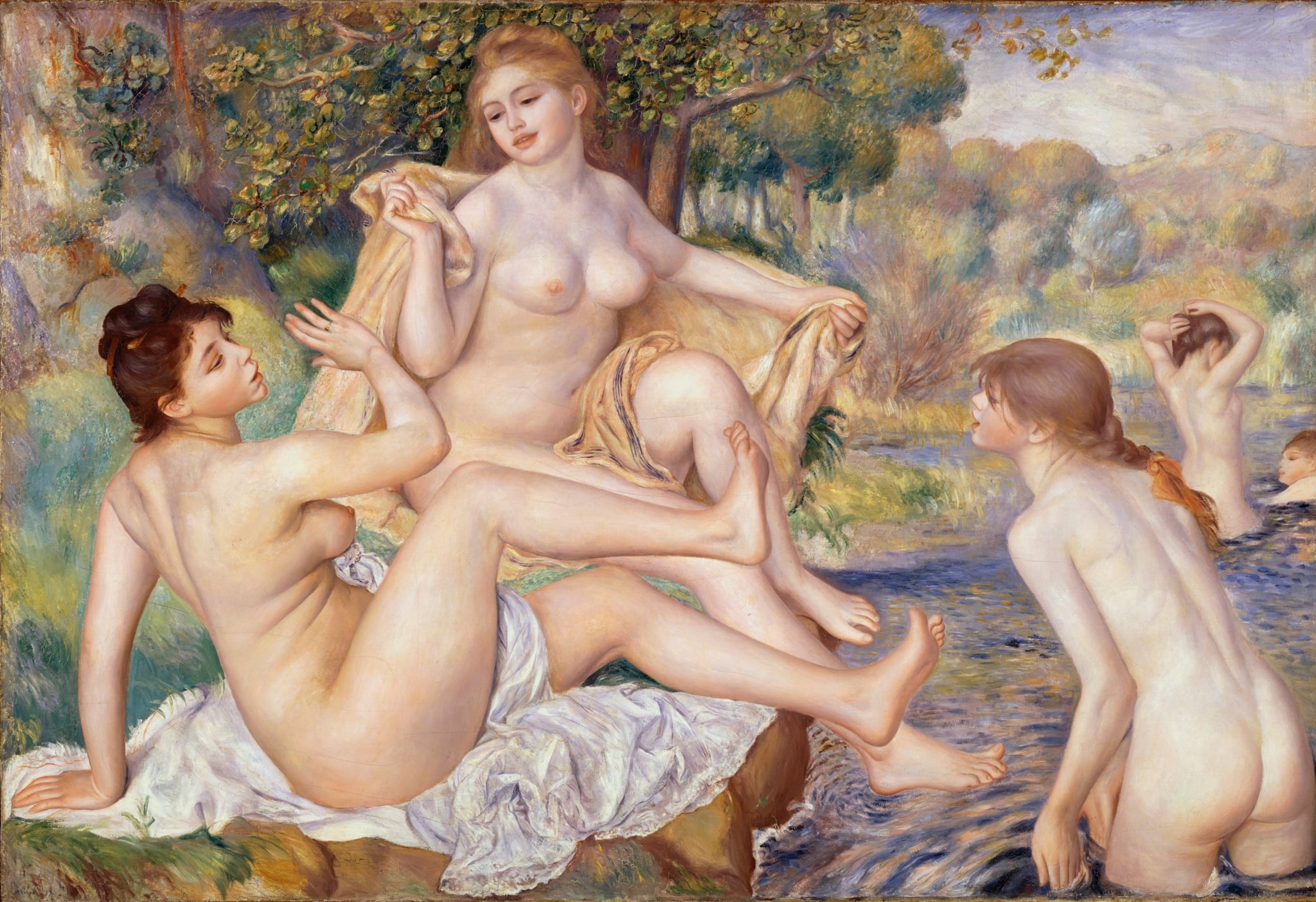
The Large Bathers
Pierre-Auguste Renoir (1884–1887)
Pierre-Auguste Renoir’s The Large Bathers unites modern bodies with a pastoral grove to stage an <strong>Arcadian ideal</strong>. Three monumental nudes form interlocking curves and triangles while two background figures splash and groom, fusing <strong>sensual warmth</strong> with <strong>classical order</strong> <sup>[1]</sup><sup>[2]</sup>.
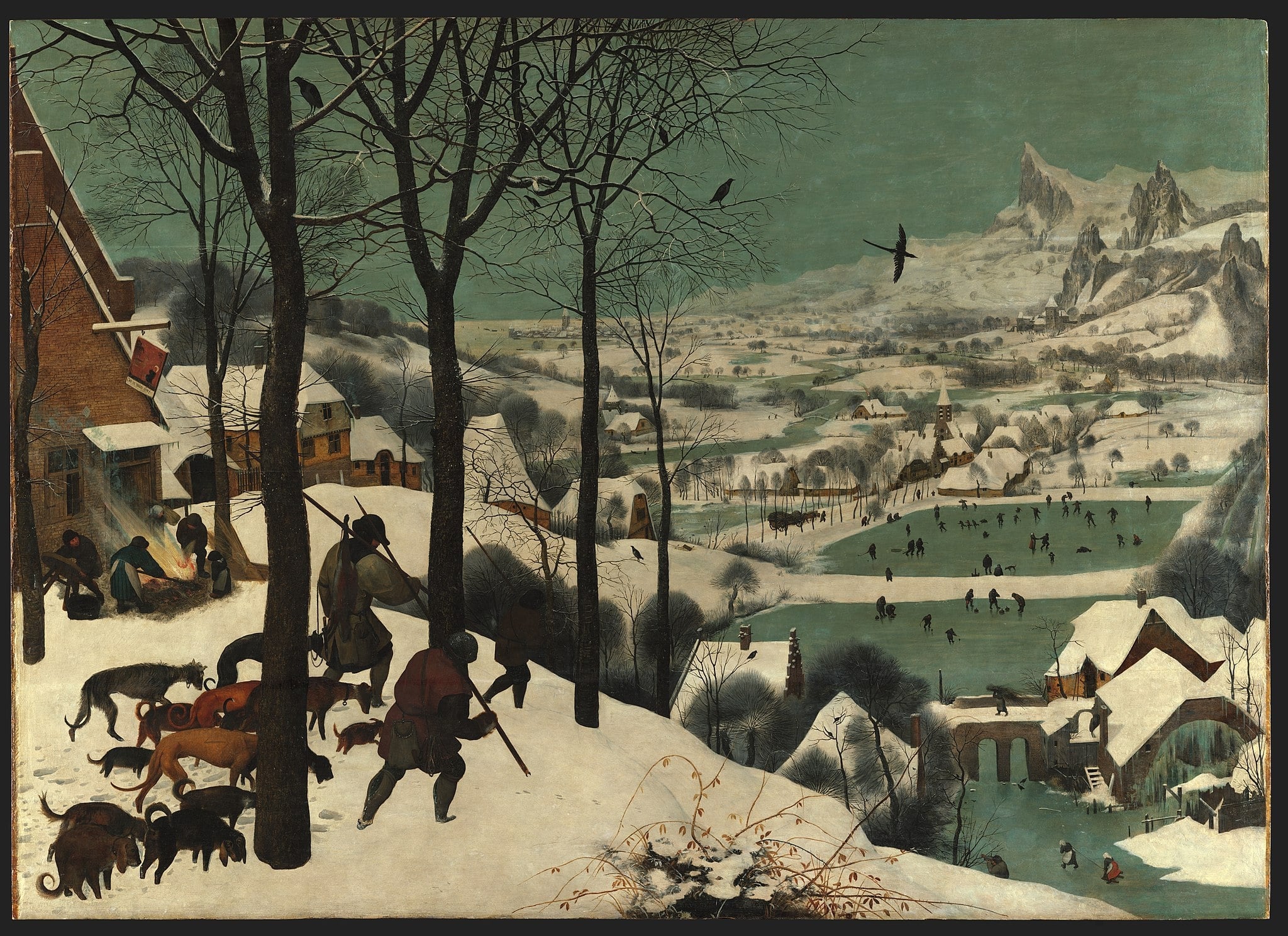
The Return of the Hunters
Pieter Bruegel the Elder (1565)
In The Return of the Hunters, Pieter Bruegel the Elder stages a wintry descent where three exhausted hunters and their dogs enter a valley alive with skaters and village chores. The painting forges a panoramic drama of <strong>hardship and resilience</strong>, contrasting scant game with communal play beneath a cold, teal sky <sup>[1]</sup><sup>[2]</sup>.
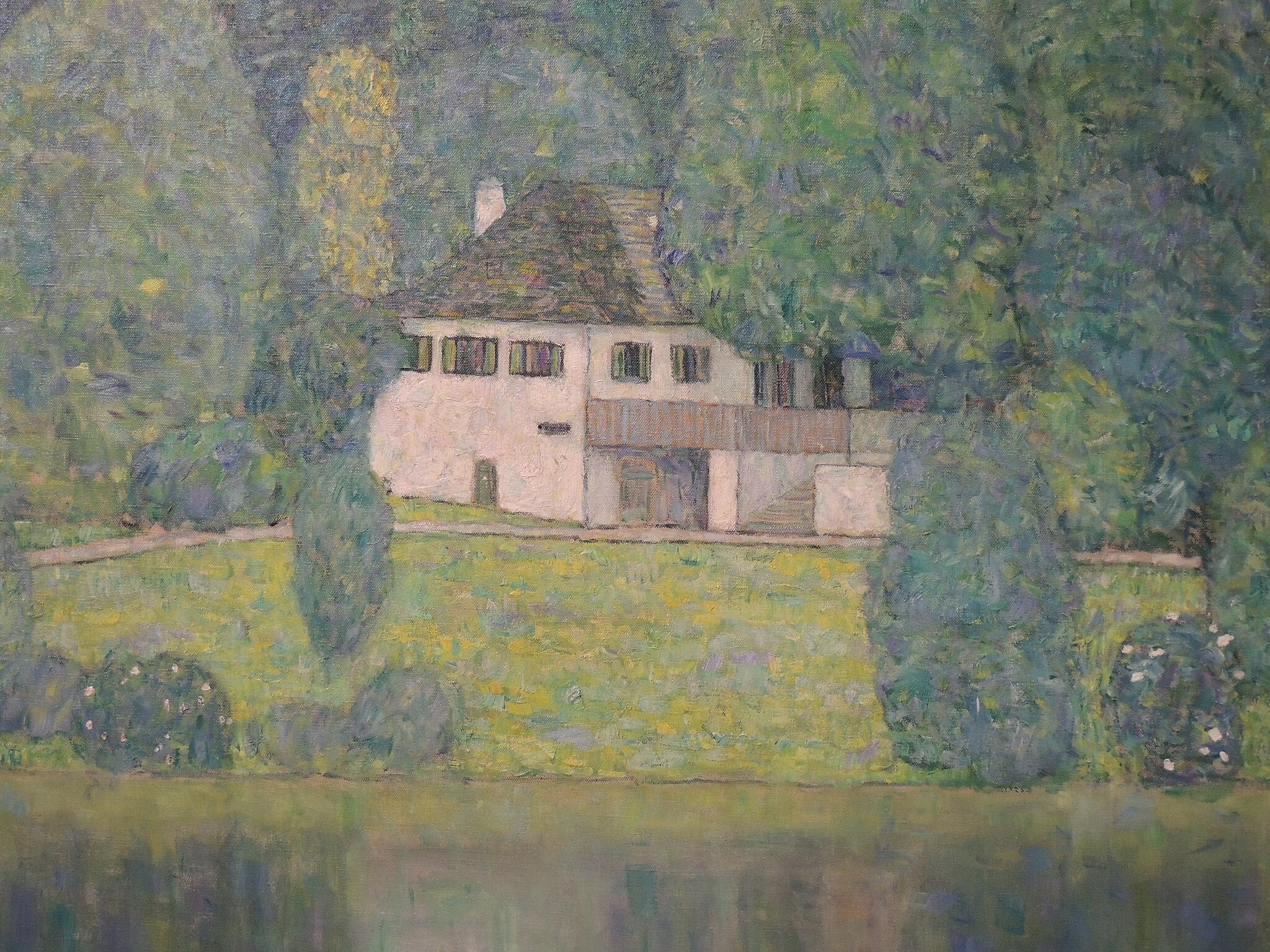
Litzlbergkeller
Gustav Klimt (1915–1916)
Litzlbergkeller distills a lakeside inn into a square, shimmering field where the house’s pale rectangle and window rhythm quietly answer the vertical screen of trees and the calm band of water below. Klimt fuses geometry and foliage into a <strong>decorative, contemplative refuge</strong>, converting observation into patterned memory <sup>[1]</sup><sup>[2]</sup>.
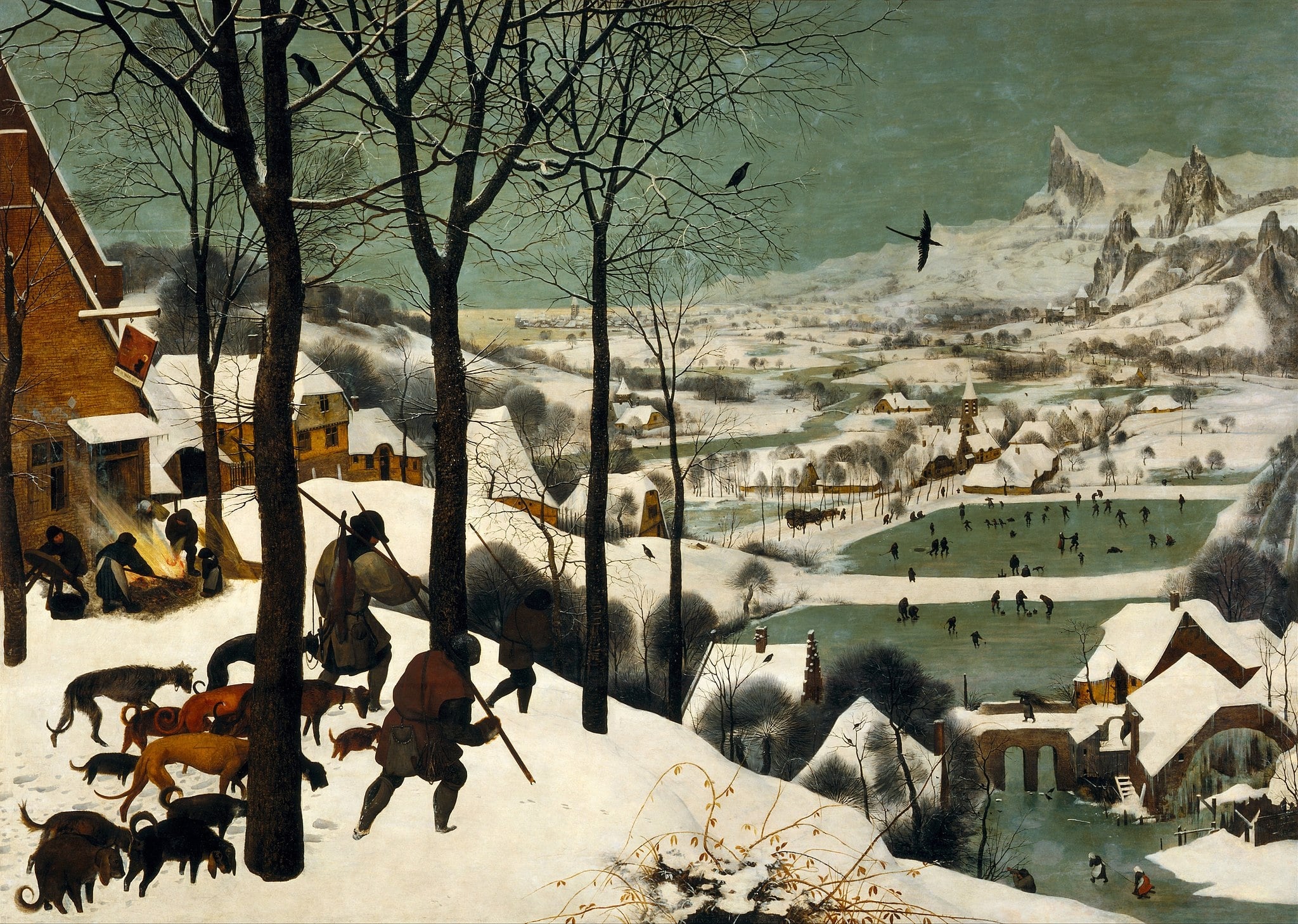
Hunters in the Snow
Pieter Bruegel the Elder (1565)
In Pieter Bruegel the Elder’s <strong>Hunters in the Snow</strong> (1565), a trio of tired hunters and <strong>gaunt dogs</strong> descend past an inn toward a vast frozen valley where villagers <strong>work, play, and endure</strong>. Bruegel fuses <strong>winter scarcity</strong> (a single fox, bare trees, crows) with <strong>communal resilience</strong> (pig-singeing fire, skaters, mill smoke) to stage a world ordered by the season’s cycle.
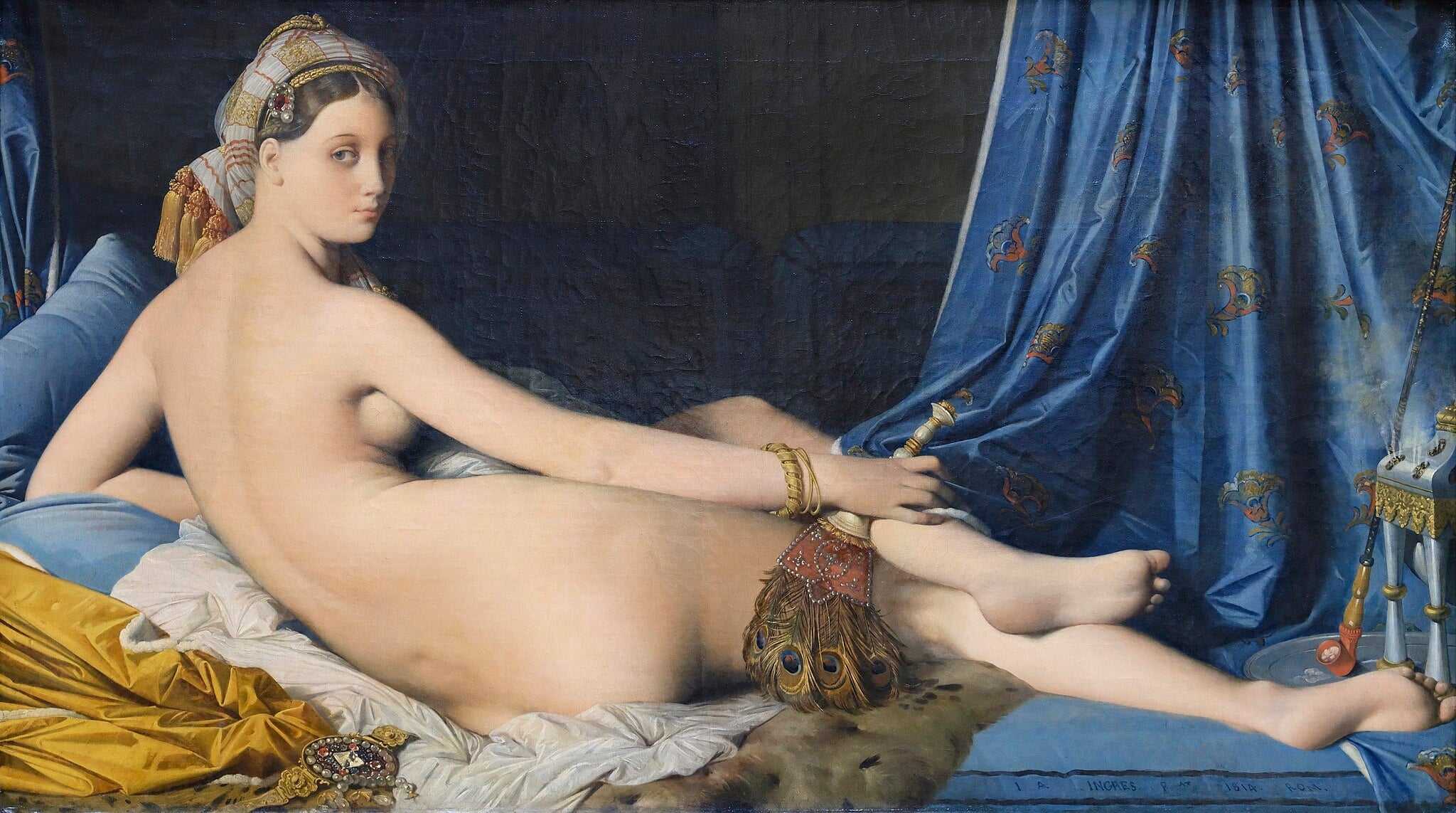
Grande Odalisque
Jean-Auguste-Dominique Ingres (1814)
In Jean-Auguste-Dominique Ingres’s Grande Odalisque (1814), a nude woman reclines against cool satin and a deep blue, patterned curtain, her spine drawn into an elegant, impossible arc. With a jeweled turban, bracelets, and a peacock-feather fan, she turns to meet the viewer’s look, poised yet distant. The image fuses <strong>Neoclassical idealization</strong> with <strong>Orientalist fantasy</strong>, privileging line and artifice over realism <sup>[1]</sup><sup>[2]</sup>.
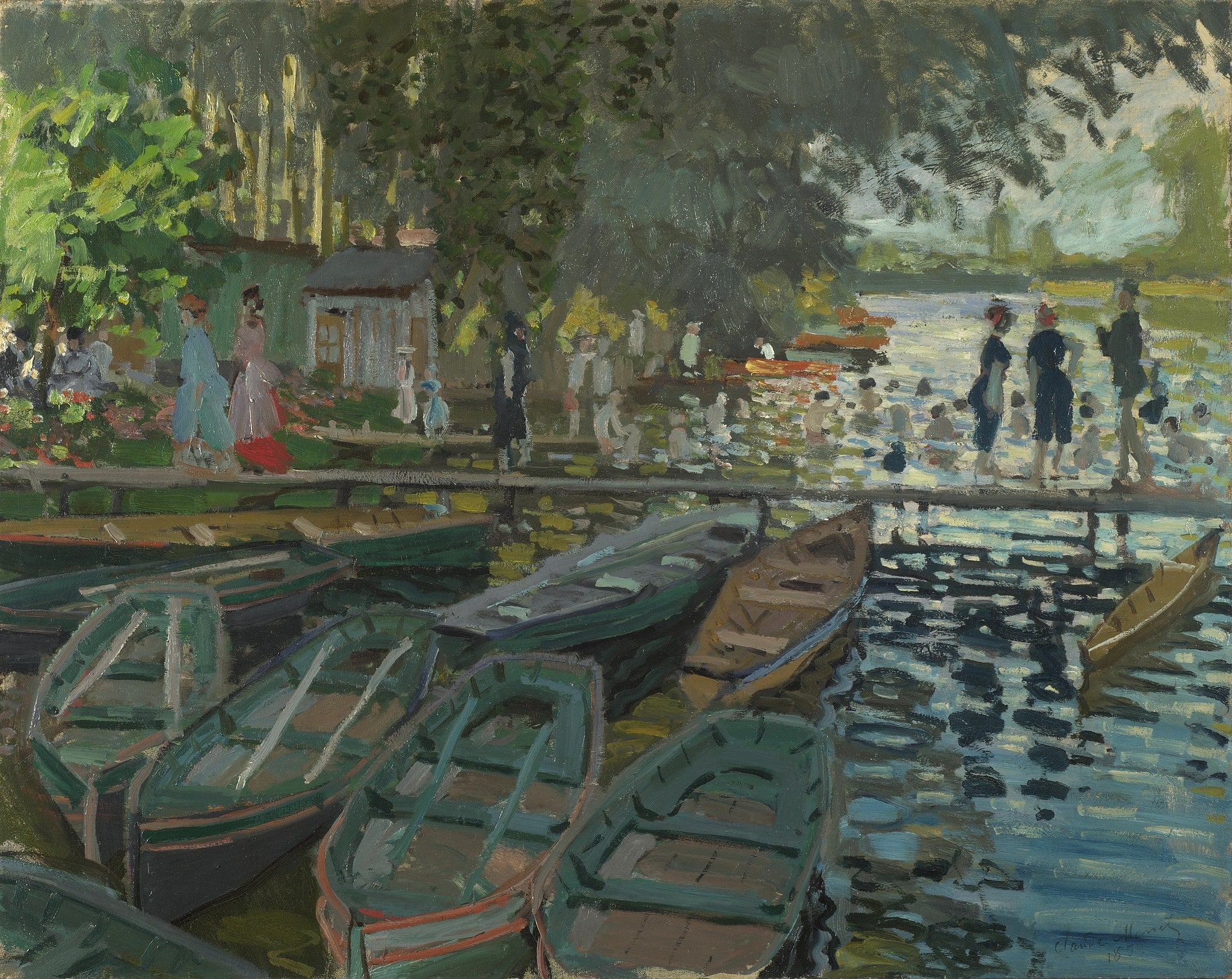
Bathers at La Grenouillère
Claude Monet (1869)
Claude Monet’s Bathers at La Grenouillère stages modern leisure on the Seine as a theater of <strong>light, motion, and sociability</strong>. Foregrounded green rowboats, a narrow footbridge, and clustered bathers turn the resort’s engineered setting into a manifesto for <strong>on‑the‑spot vision</strong> and the fleeting present <sup>[1]</sup>. Painted outdoors in 1869 with rapid strokes, it crystallizes the emergence of <strong>Impressionism</strong> <sup>[1]</sup>.
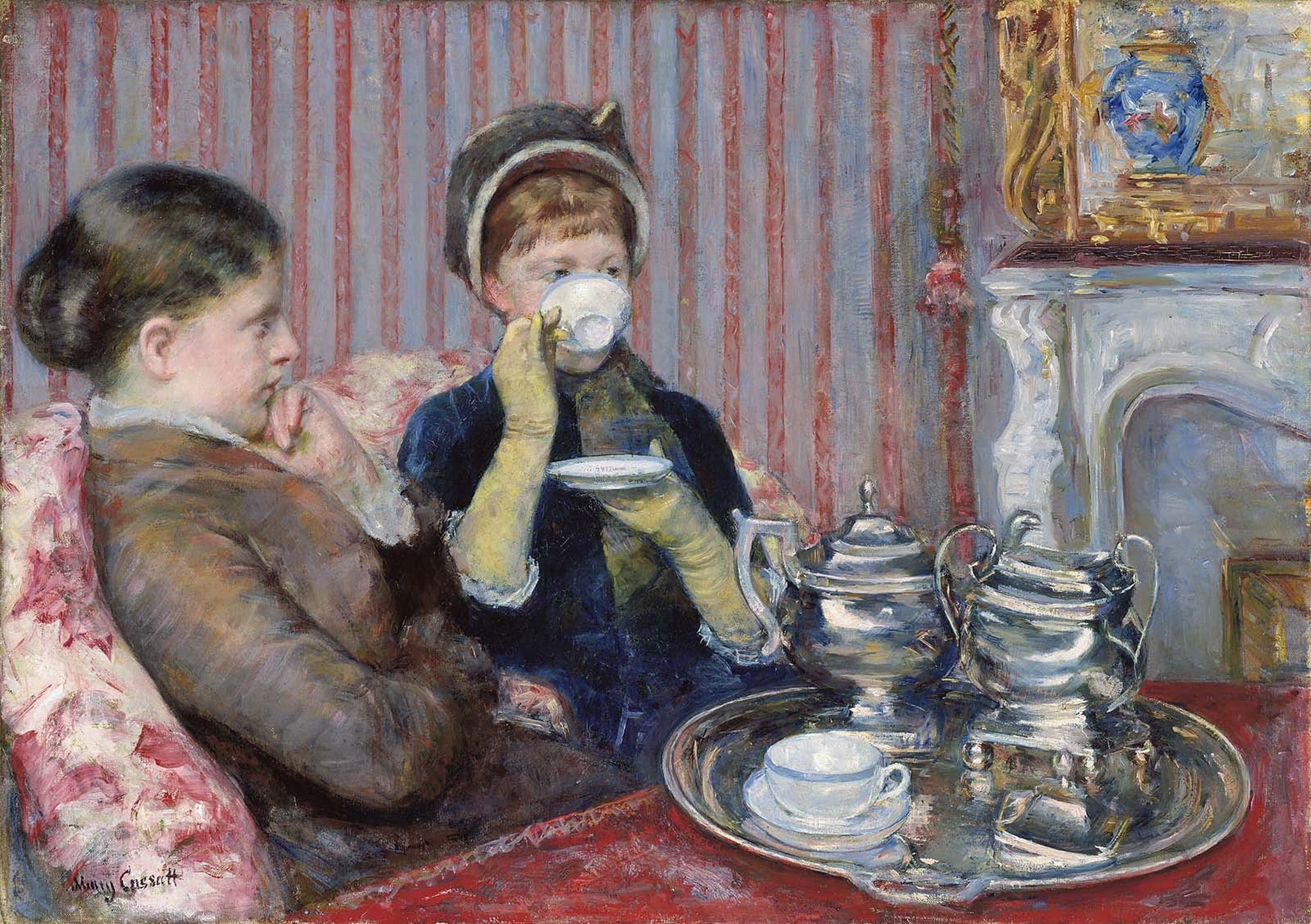
The Tea
Mary Cassatt (about 1880)
Mary Cassatt’s The Tea stages a poised, interior <strong>drama of manners</strong>: two women sit close yet feel apart, one thoughtful, the other raising a cup that <strong>veils her face</strong>. A gleaming, oversized <strong>silver tea service</strong> commands the foreground, its reflections turning ritual objects into actors in the scene <sup>[1]</sup>. The shallow, cropped room—striped wall, gilt mirror, marble mantel—compresses the atmosphere into <strong>intimacy edged by restraint</strong>.
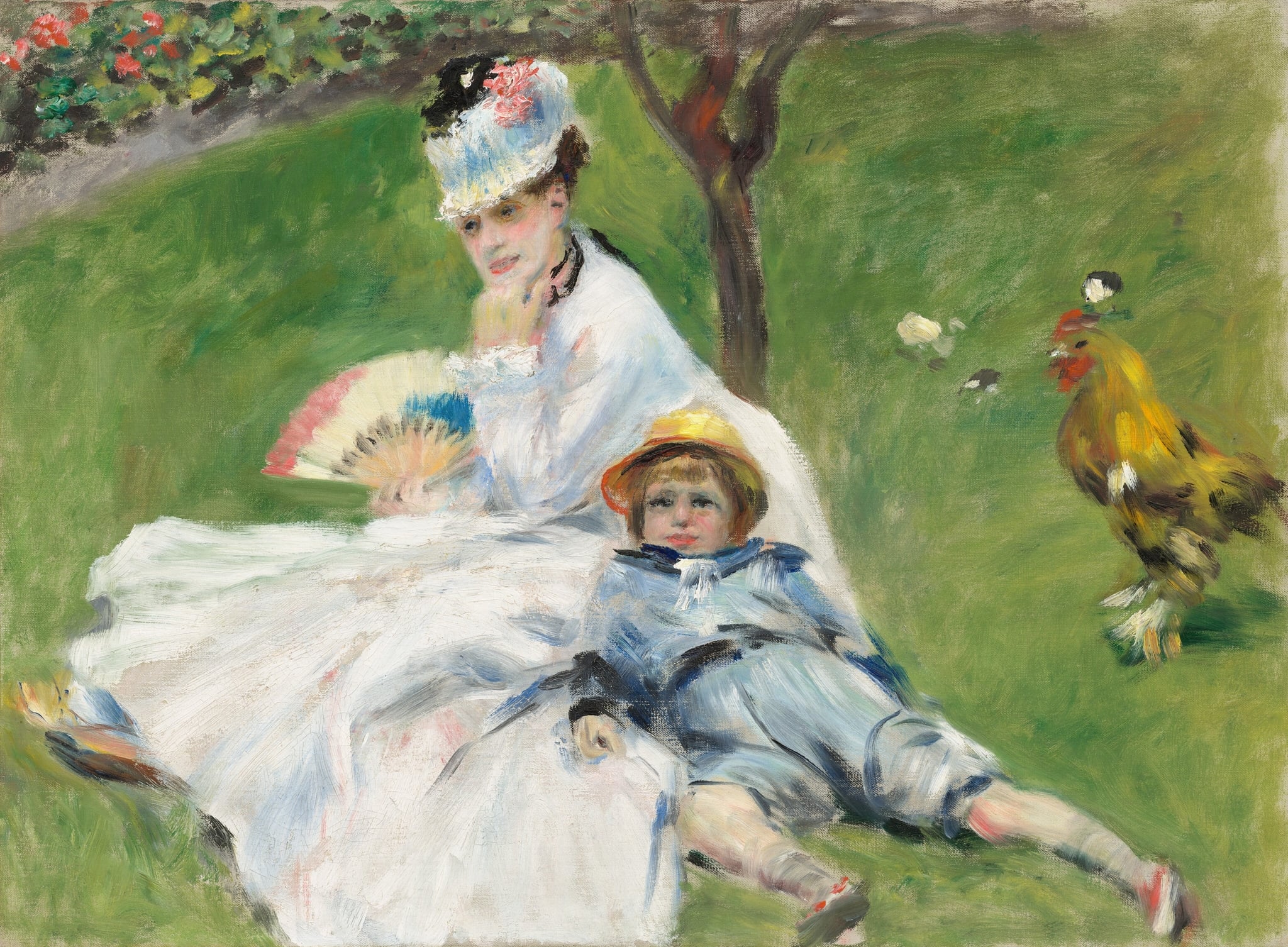
Madame Monet and Her Son
Pierre-Auguste Renoir (1874)
Renoir’s 1874 canvas Madame Monet and Her Son crystallizes <strong>modern domestic leisure</strong> and <strong>plein‑air immediacy</strong> in Argenteuil. A luminous white dress pools into light while a child in a pale‑blue sailor suit reclines diagonally; a strutting rooster punctuates the greens with warm color. The brushwork fuses figure and garden so the moment reads as <strong>lived, not staged</strong> <sup>[1]</sup><sup>[2]</sup><sup>[5]</sup>.
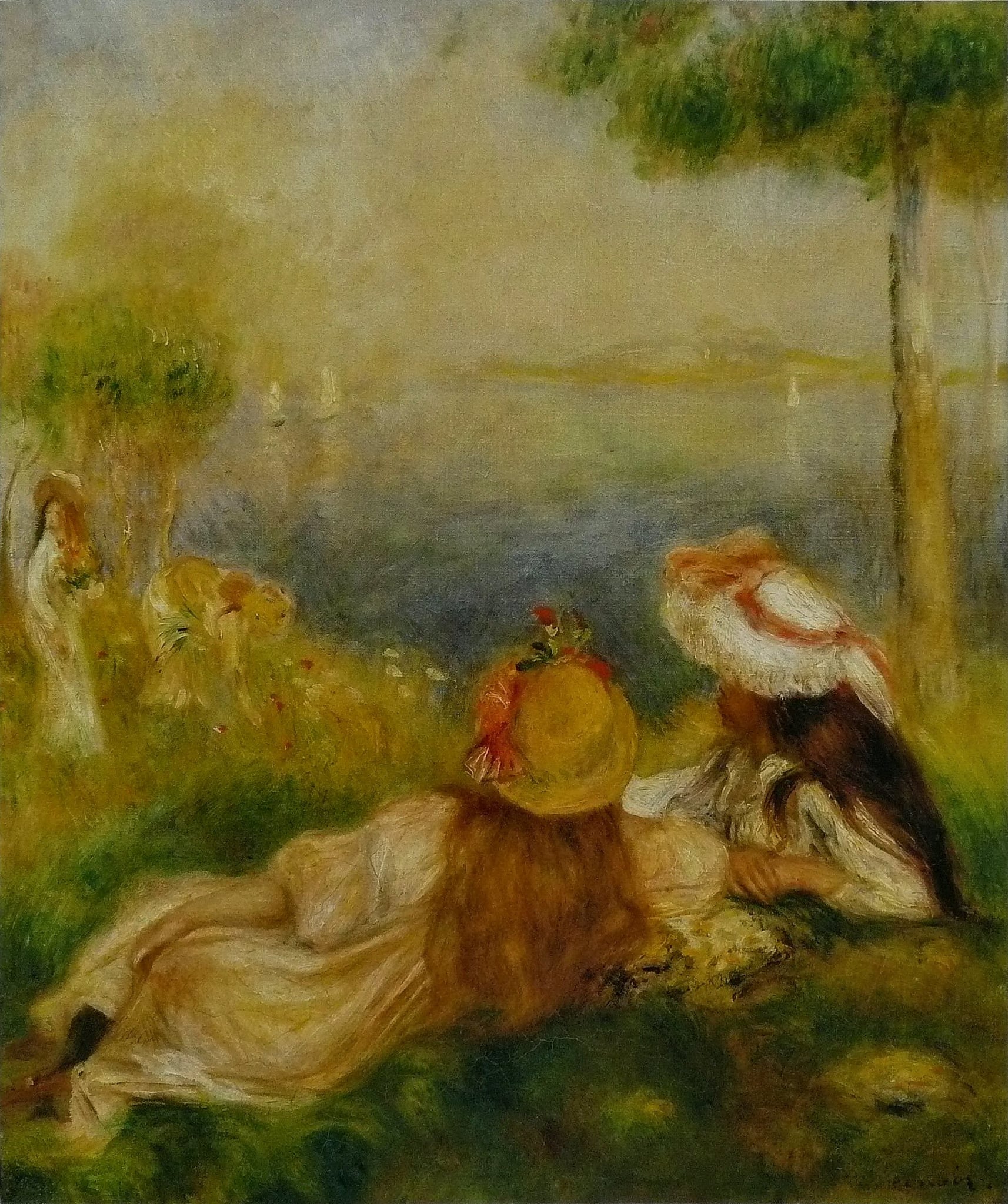
Girls at the Seashore
Pierre-Auguste Renoir (c.1890–1894)
Girls at the Seashore presents two young figures reclining on a grassy bank, their straw hats trimmed with flowers as they look toward a hazy waterway flecked with small sails. Renoir fuses figure and setting through soft, vaporous brushwork so that skin, fabric, foliage, and sea share the same light. The image is an ode to <strong>reverie</strong>, <strong>companionship</strong>, and the <strong>fleeting</strong> warmth of summer.
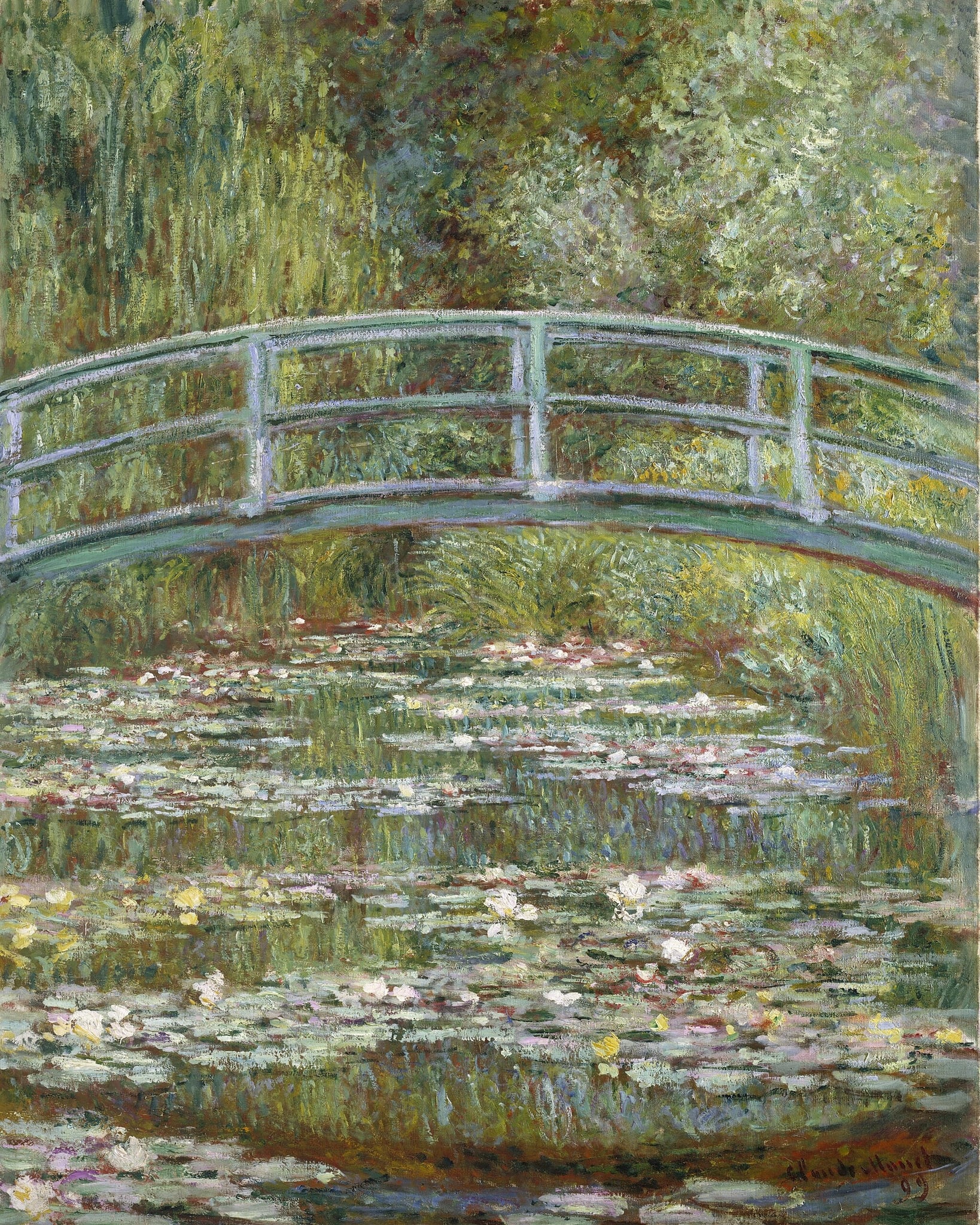
Bridge over a Pond of Water Lilies
Claude Monet (1899)
Claude Monet’s Bridge over a Pond of Water Lilies stages a <strong>threshold</strong> where garden and reflection merge. The cool arc of the <strong>Japanese-style bridge</strong> steadies a field of trembling light, while lilies hover between surface and depth, turning perception itself into the subject <sup>[1]</sup><sup>[2]</sup>.
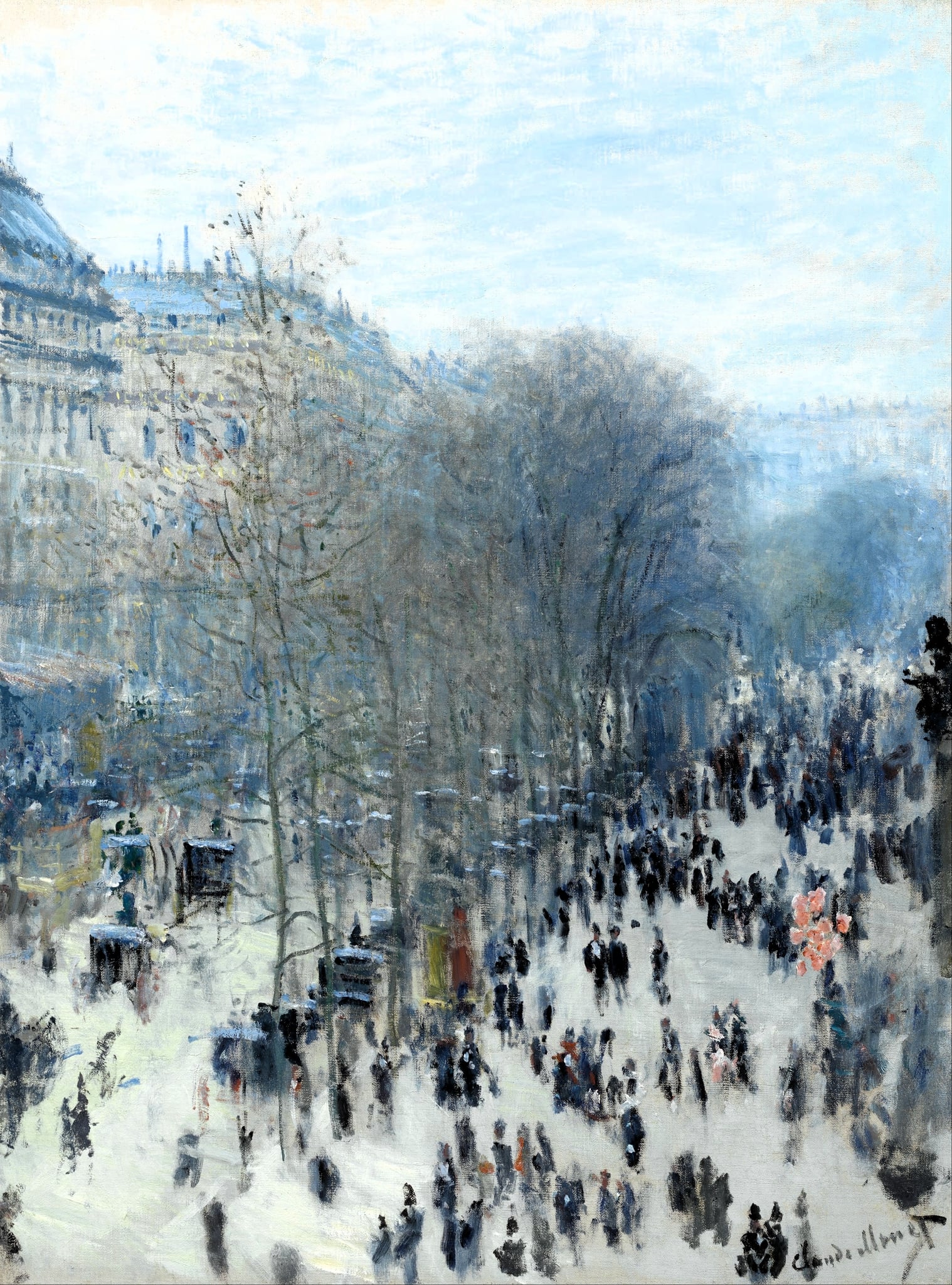
Boulevard des Capucines
Claude Monet (1873–1874)
From a high perch above Paris, Claude Monet turns the Haussmann boulevard into a living current of <strong>light, weather, and motion</strong>. Leafless trees web the view, crowds dissolve into <strong>flickering strokes</strong>, and a sudden <strong>pink cluster of balloons</strong> pierces the cool winter scale <sup>[1]</sup><sup>[2]</sup>.
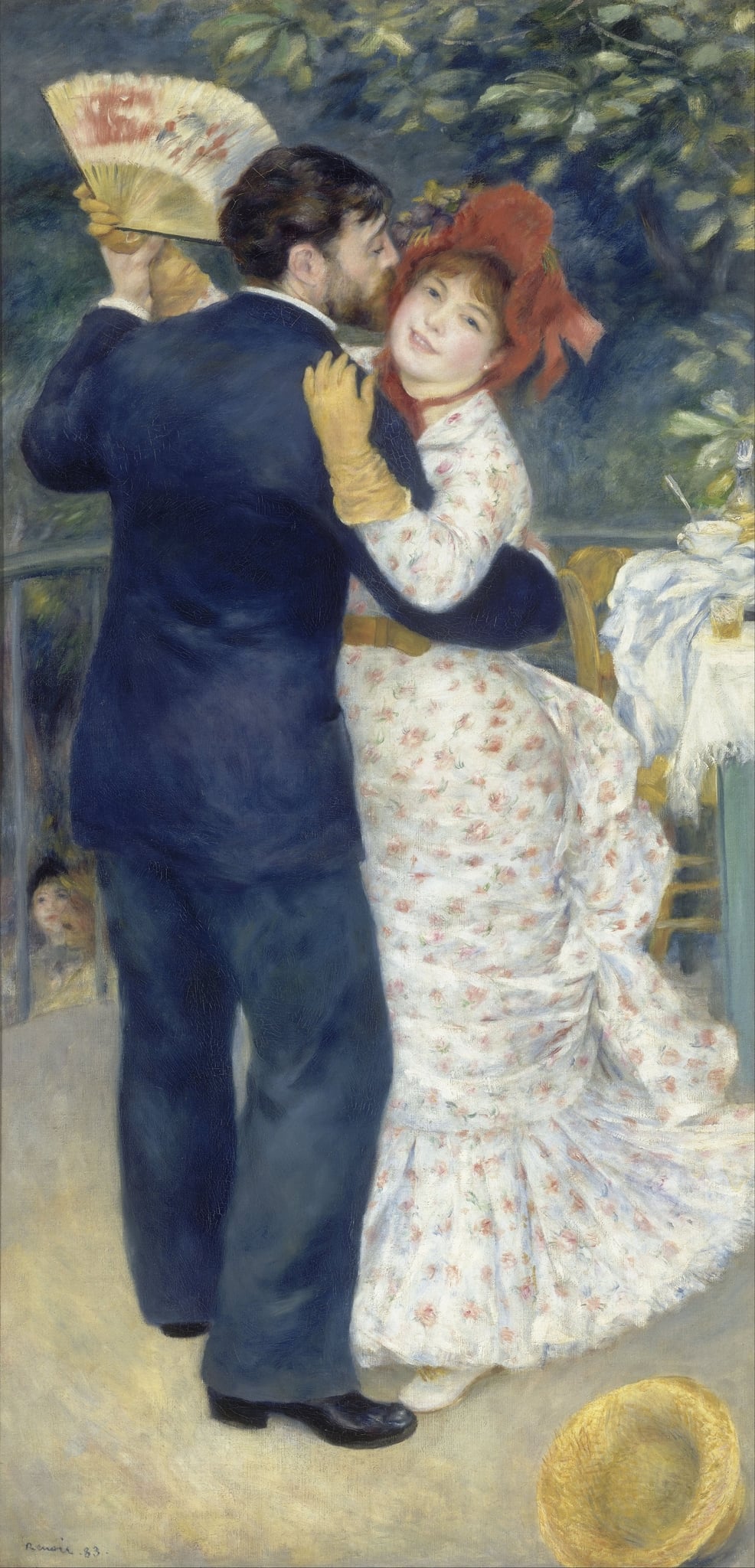
Dance in the Country
Pierre-Auguste Renoir (1883)
Dance in the Country shows a couple swept into a close embrace on a café terrace, their bodies turning in a soft spiral as foliage and sunlight dissolve into <strong>dappled color</strong>. Renoir orchestrates <strong>bourgeois leisure</strong>—the tossed straw boater, a small table with glass and napkin, the woman’s floral dress and red bonnet—to stage a moment where decorum and desire meet. The result is a modern emblem of shared pleasure, poised between Impressionist shimmer and a newly <strong>firm, linear touch</strong>.
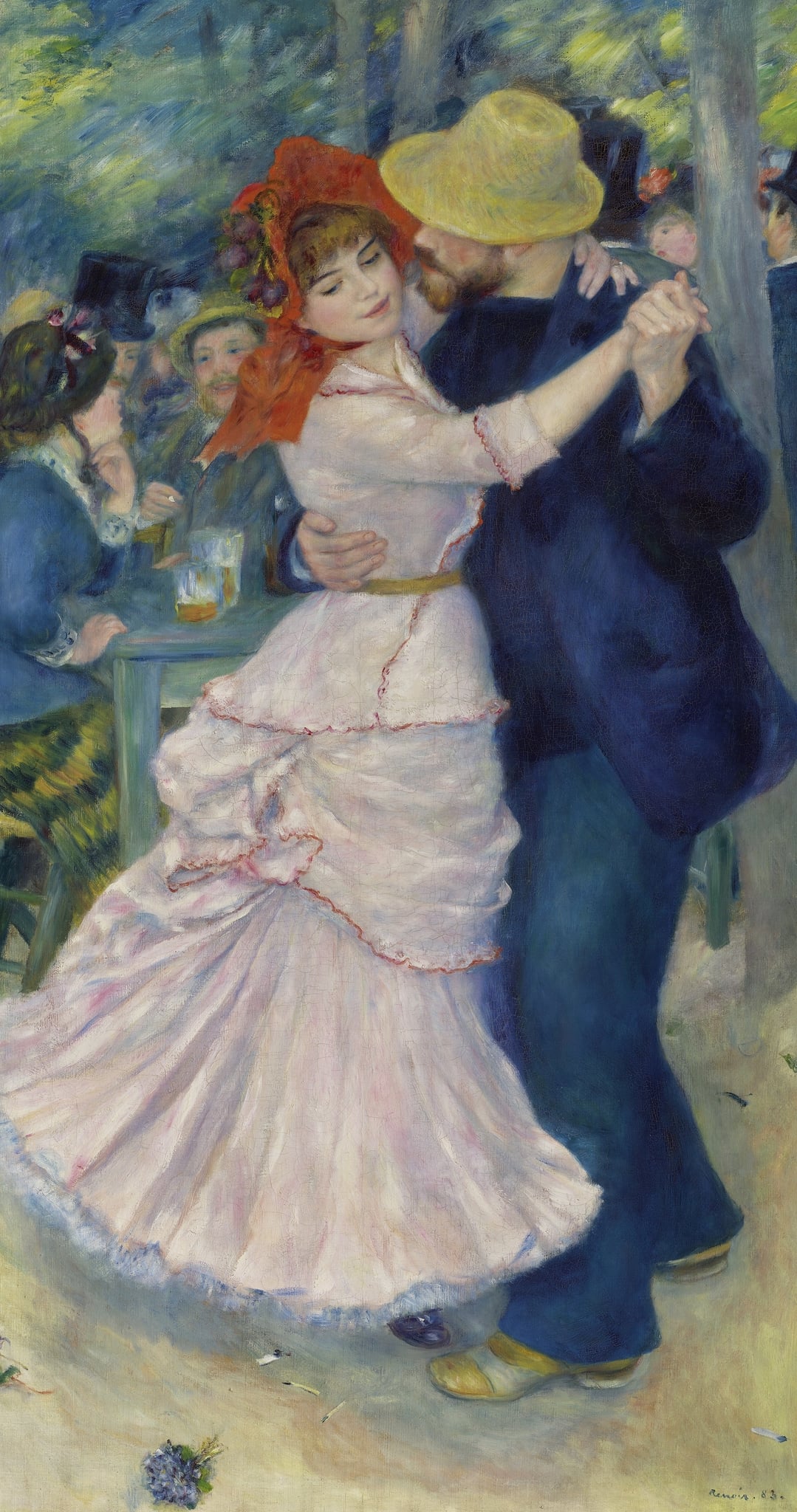
Dance at Bougival
Pierre-Auguste Renoir (1883)
In Dance at Bougival, Pierre-Auguste Renoir turns a crowded suburban dance into a <strong>private vortex of intimacy</strong>. Rose against ultramarine, skin against shade, and a flare of the woman’s <strong>scarlet bonnet</strong> concentrate the scene’s energy into a single turning moment—modern leisure made palpable as <strong>touch, motion, and light</strong> <sup>[1]</sup><sup>[2]</sup>.
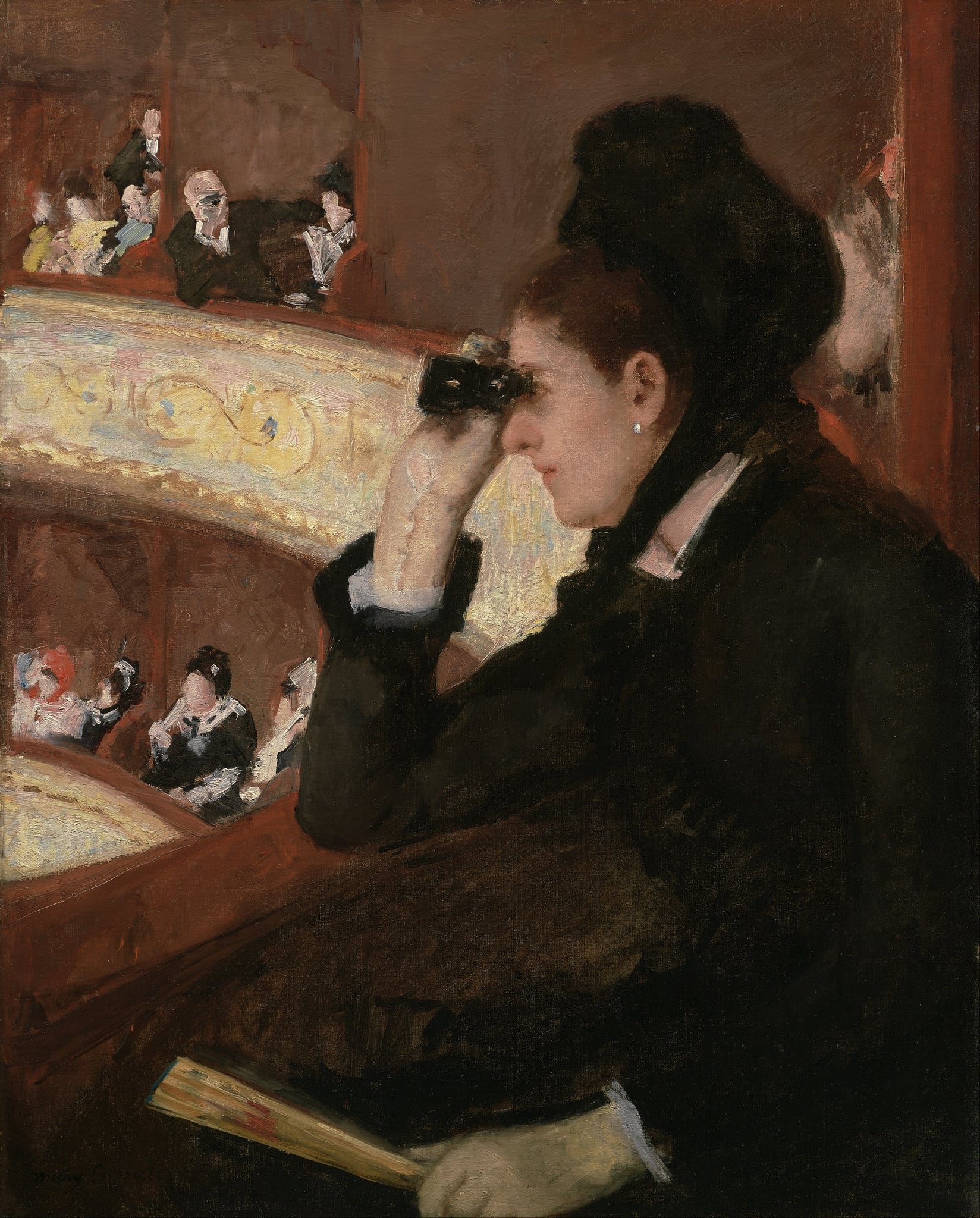
In the Loge
Mary Cassatt (1878)
Mary Cassatt’s In the Loge (1878) stages modern spectatorship as a drama of <strong>mutual looking</strong>. A woman in dark dress leans forward with <strong>opera glasses</strong>, her <strong>fan closed</strong> on her lap, as a man in the distance raises his own glasses toward her—turning the theater into a circuit of gazes <sup>[1]</sup><sup>[2]</sup>.
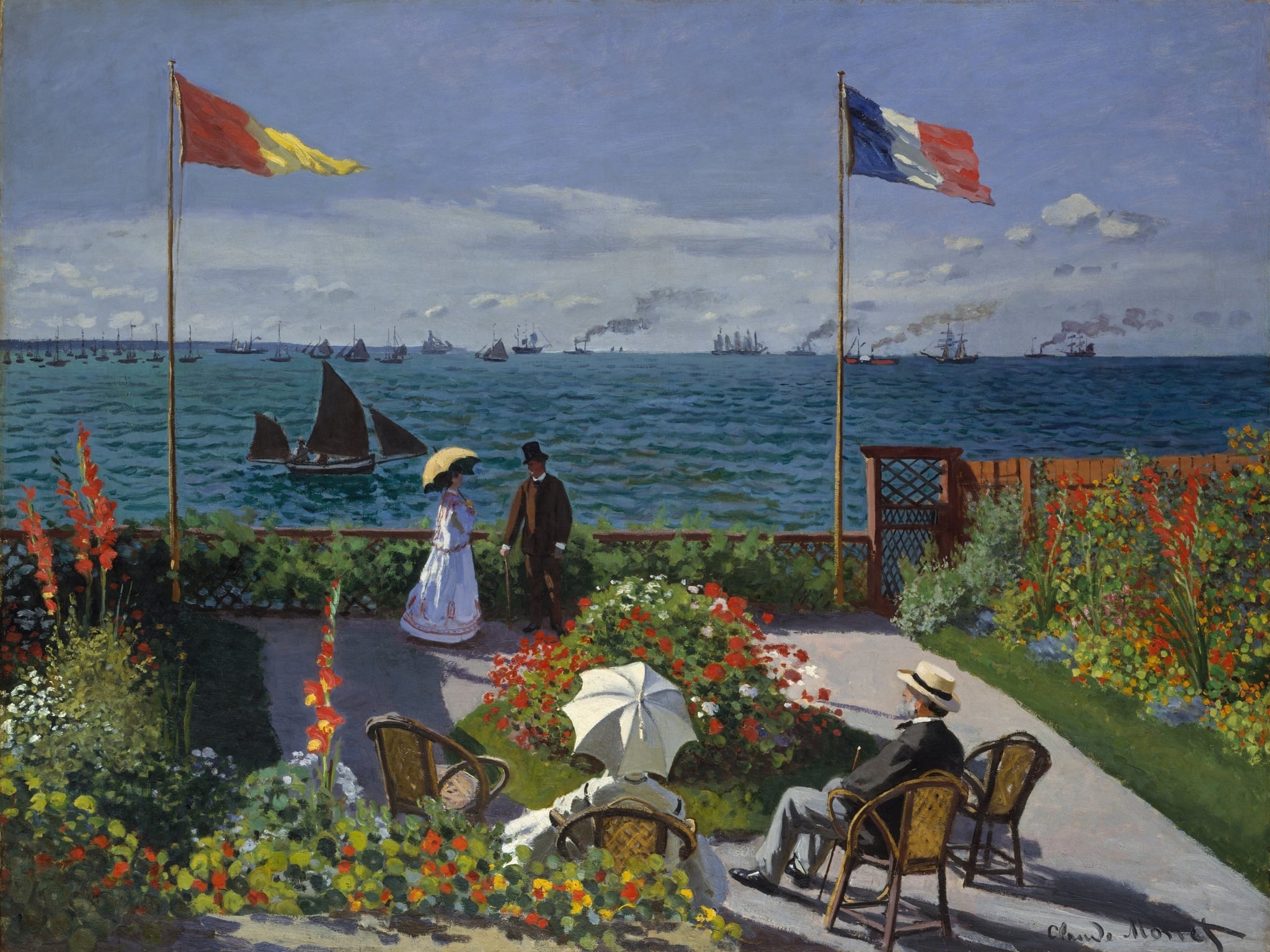
The Terrace at Sainte-Adresse
Claude Monet (1867)
Claude Monet’s The Terrace at Sainte-Adresse stages a sunlit garden against the Channel, where <strong>bourgeois leisure</strong> unfolds between two wind-whipped flags and a horizon shared by <strong>sail and steam</strong>. Bright flowers, wicker chairs, and a white parasol form an ordered foreground, while the busy harbor and snapping tricolor project a confident, modern nation. The banded design—garden, sea, sky—reveals Monet’s early <strong>Japonisme</strong> and his drive to fuse fleeting light with a consciously structured composition <sup>[1]</sup>.
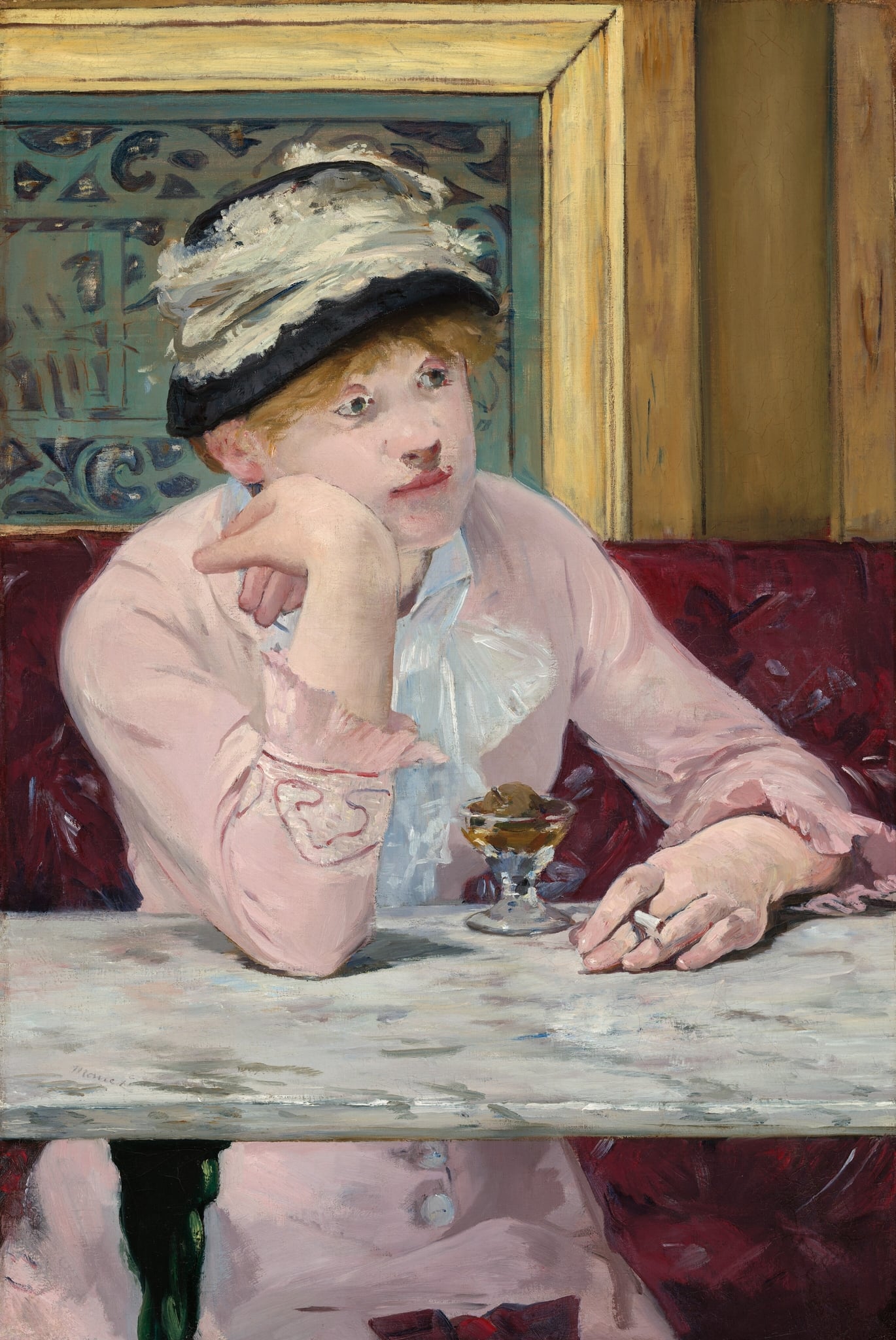
Plum Brandy
Édouard Manet (ca. 1877)
Manet’s Plum Brandy crystallizes a modern pause—an urban <strong>interval of suspended action</strong>—through the idle tilt of a woman’s head, an <strong>unlit cigarette</strong>, and a glass cradling a <strong>plum in amber liquor</strong>. The boxed-in space—marble table, red banquette, and decorative grille—turns a café moment into a stage for <strong>solitude within public life</strong> <sup>[1]</sup><sup>[2]</sup>.
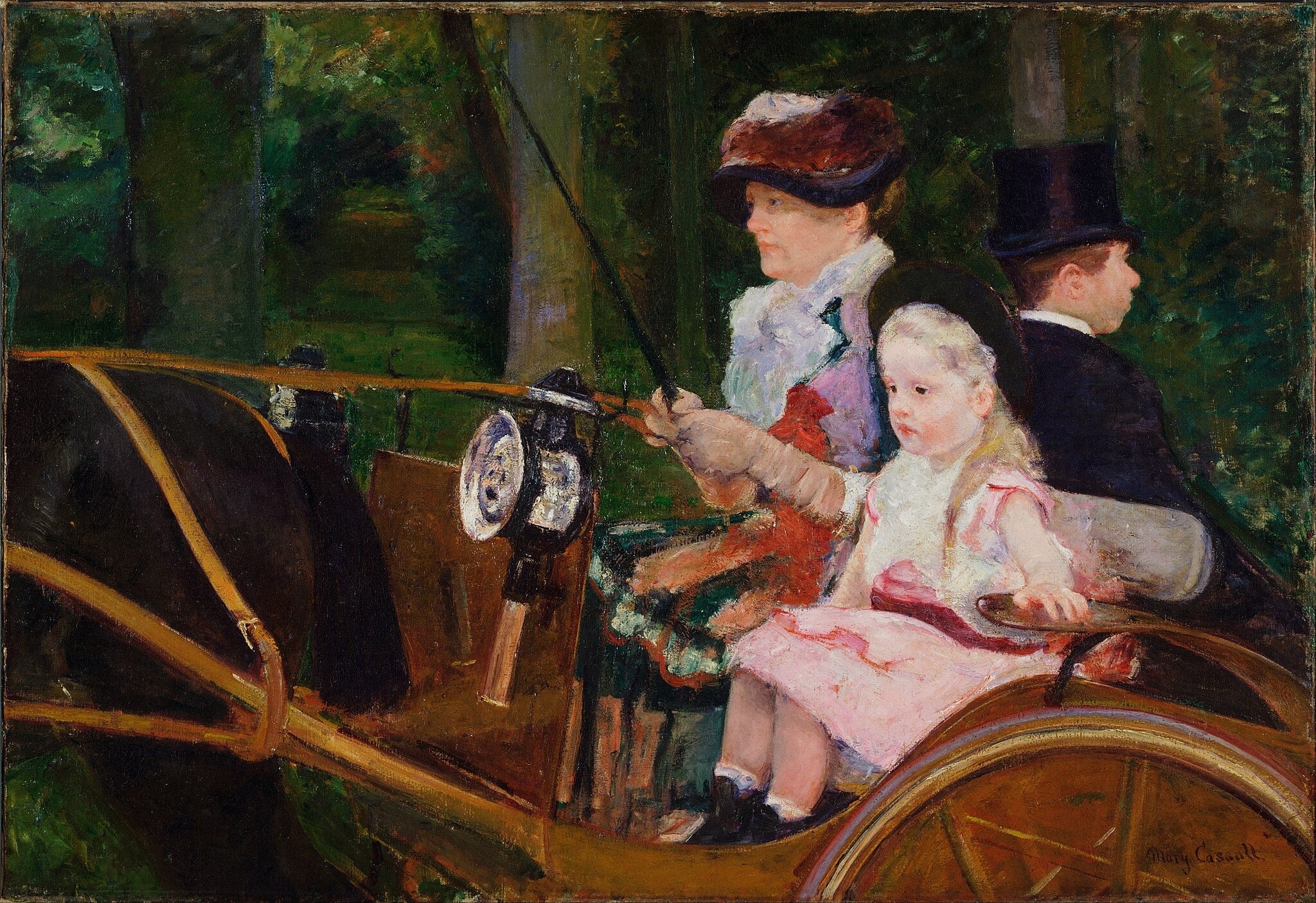
A Woman and a Girl Driving
Mary Cassatt (1881)
Cassatt stages a modern scene of <strong>female control</strong> in motion: a woman grips the reins and whip while a girl beside her mirrors the pose, and a groom seated behind looks away. The cropped horse and diagonal harness thrust the carriage forward, placing viewers inside a public outing in the Bois de Boulogne—an arena where visibility signaled status and autonomy <sup>[1]</sup><sup>[2]</sup>.
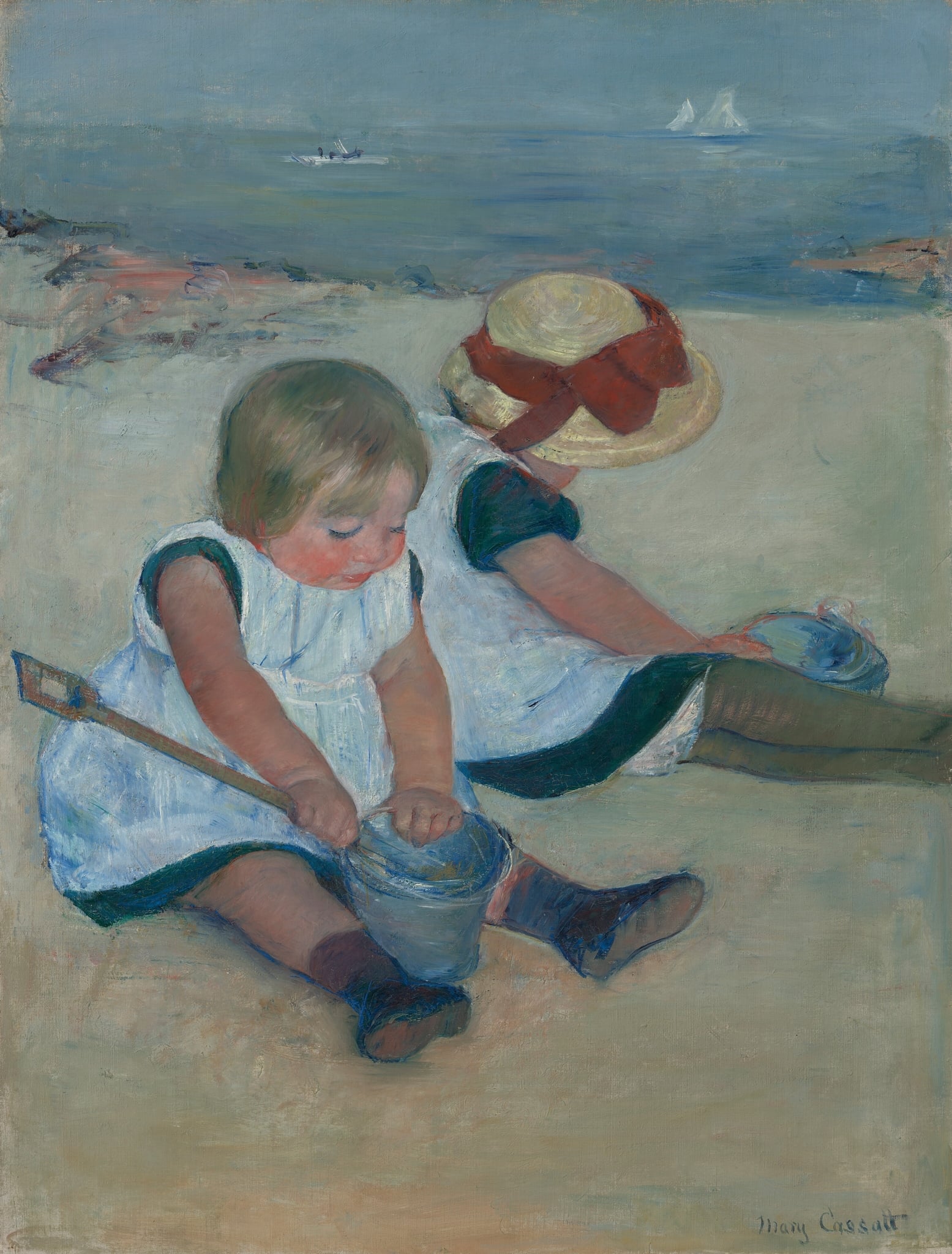
Children Playing on the Beach
Mary Cassatt (1884)
In Children Playing on the Beach, Mary Cassatt brings the viewer down to a child’s eye level, granting everyday play the weight of <strong>serious, self-contained work</strong>. The cool horizon and tiny boats open onto <strong>modern space and possibility</strong>, while the cropped, tilted foreground seals us inside the children’s focused world <sup>[1]</sup>.
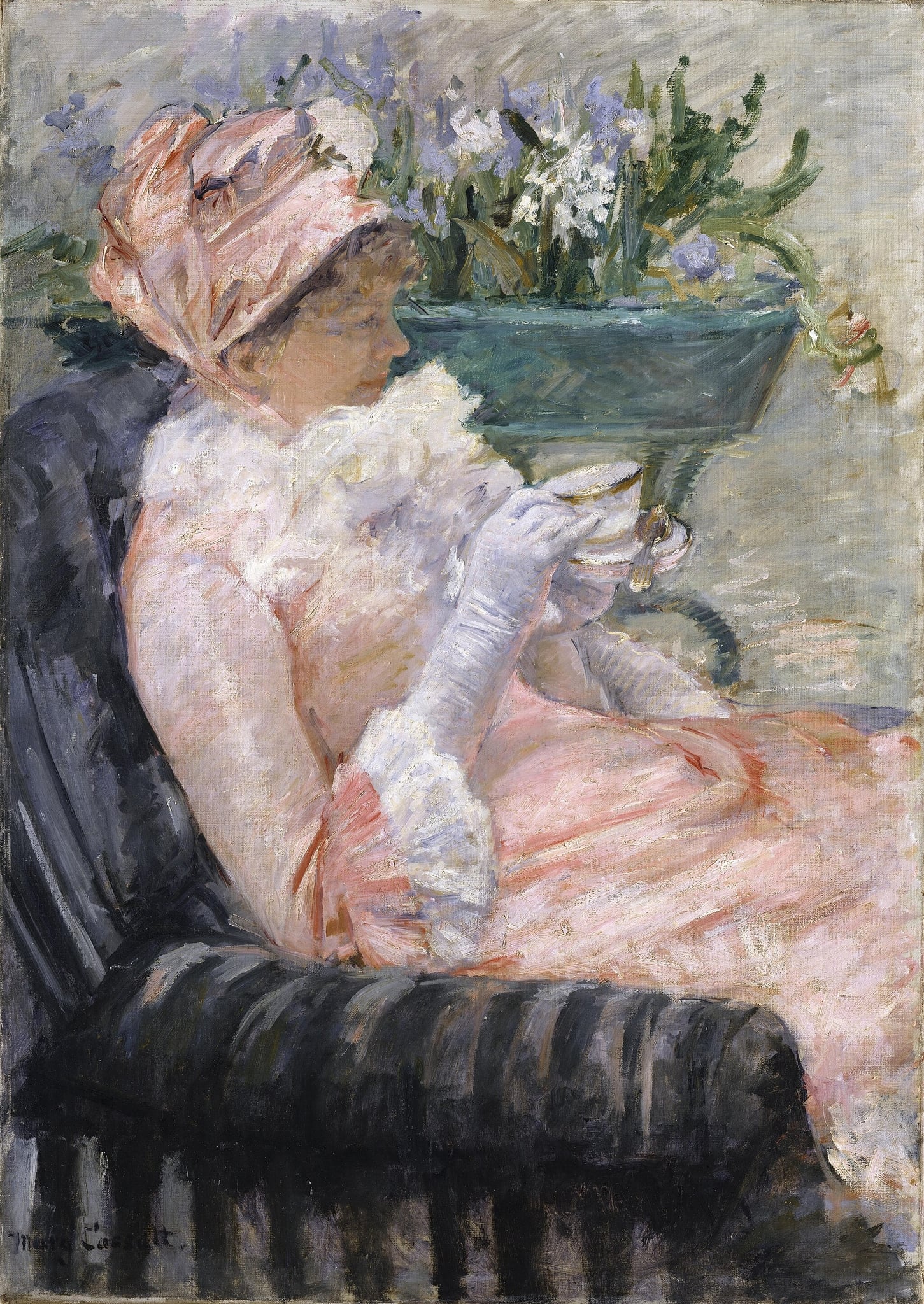
The Cup of Tea
Mary Cassatt (ca. 1880–81)
Mary Cassatt’s The Cup of Tea distills a moment of bourgeois leisure into a study of <strong>poise</strong>, <strong>etiquette</strong>, and <strong>private reflection</strong>. A woman in a rose‑pink dress and bonnet, white‑gloved, balances a gold‑rimmed cup against the shimmer of <strong>Impressionist</strong> brushwork, while a green planter of pale blossoms echoes her pastel palette <sup>[1]</sup>. The work turns an ordinary ritual into a modern emblem of women’s experience.
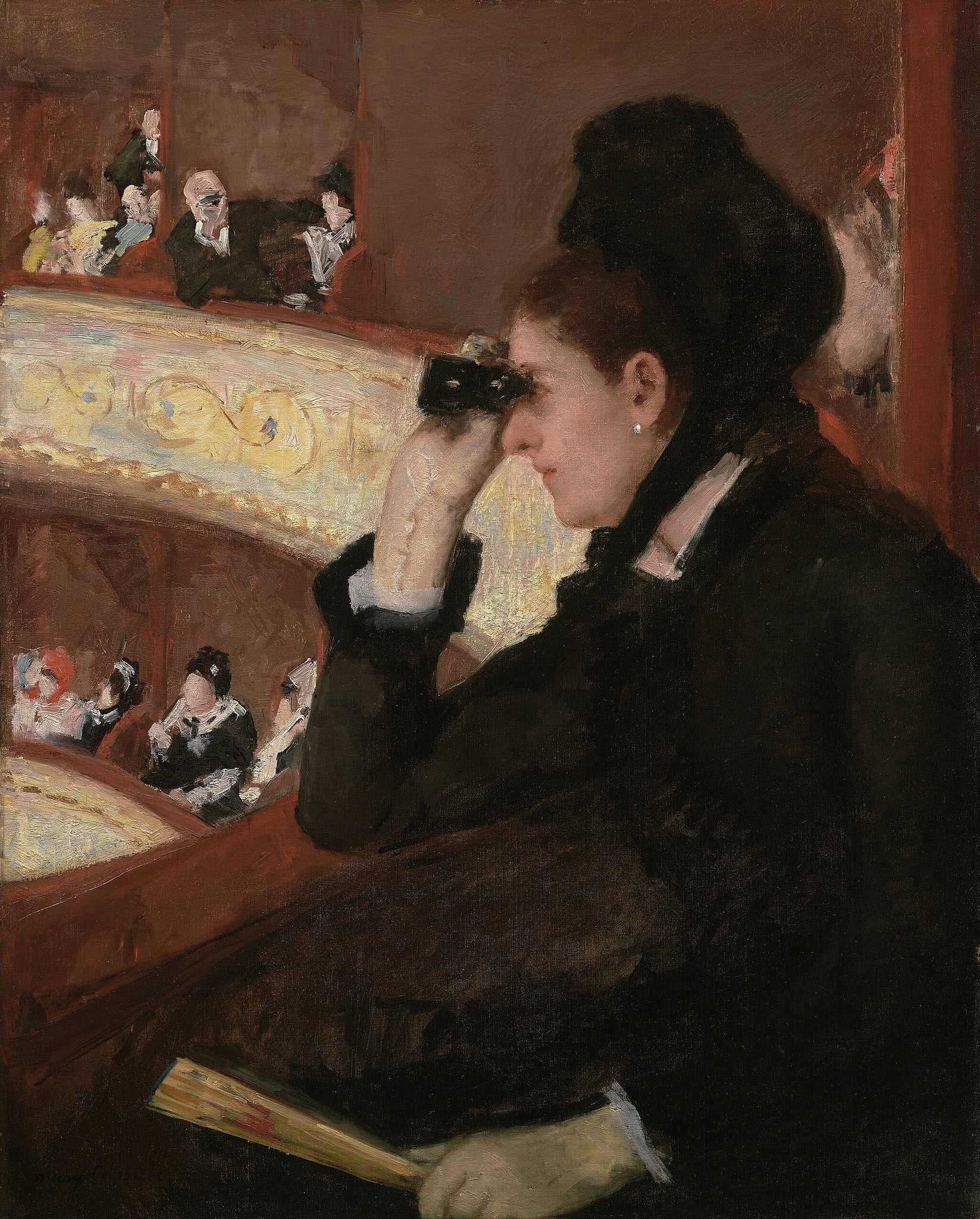
Woman in Black at the Opera
Mary Cassatt (1878)
Mary Cassatt’s Woman in Black at the Opera stages a taut drama of vision and visibility. A woman in <strong>black attire</strong> raises <strong>opera glasses</strong> while a distant man aims his own at her, setting off a chain of looks that makes public leisure a site of <strong>power, agency, and surveillance</strong> <sup>[1]</sup><sup>[2]</sup>.
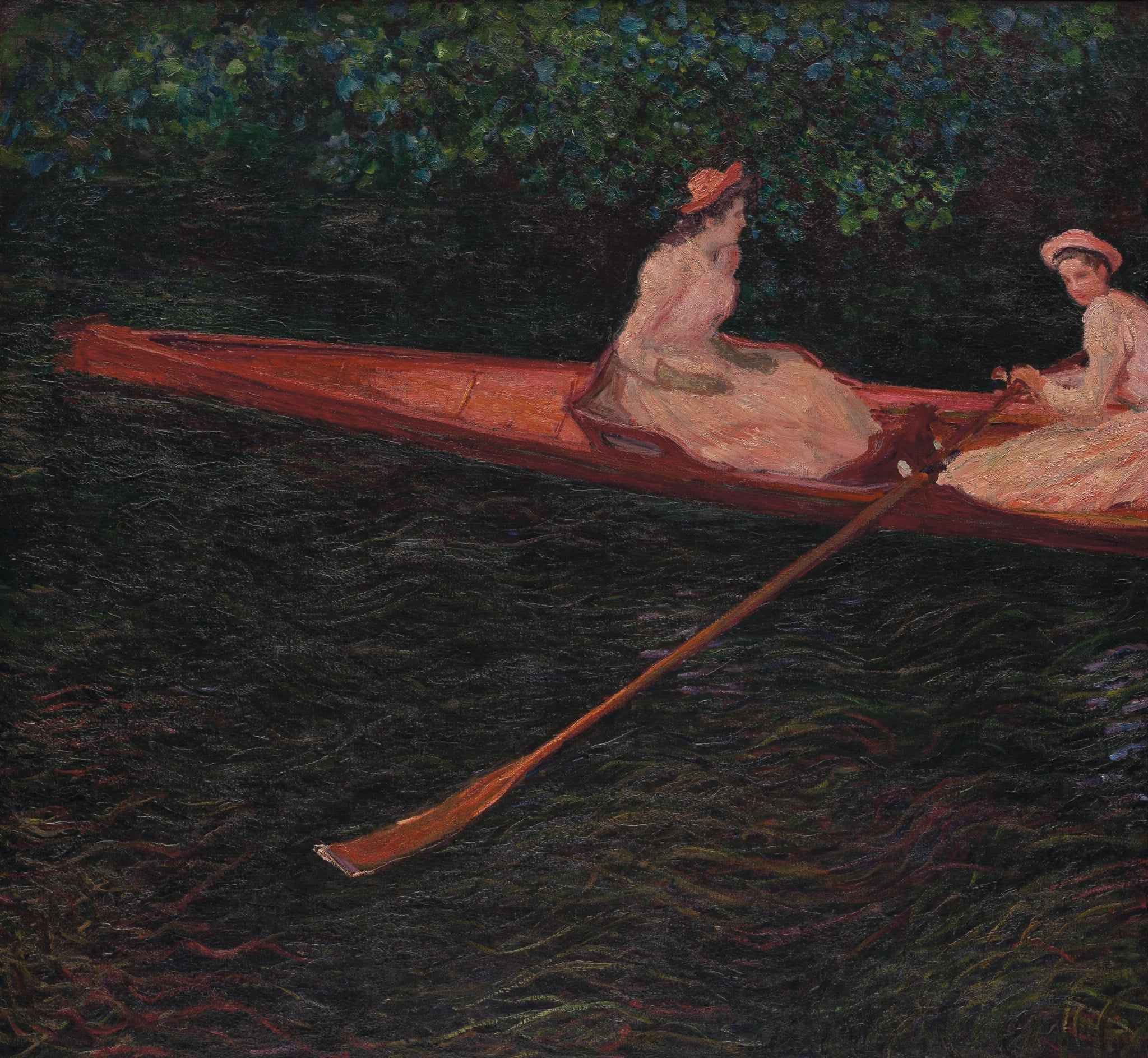
Boating
Claude Monet (1887)
Monet’s Boating crystallizes modern leisure as a drama of perception, setting a slim skiff and two pale dresses against a field of dark, mobile water. Bold cropping, a thrusting oar, and the complementary flash of hull and foliage convert a quiet outing into an experiment in <strong>modern vision</strong> and the <strong>materiality of water</strong> <sup>[1]</sup><sup>[2]</sup>.
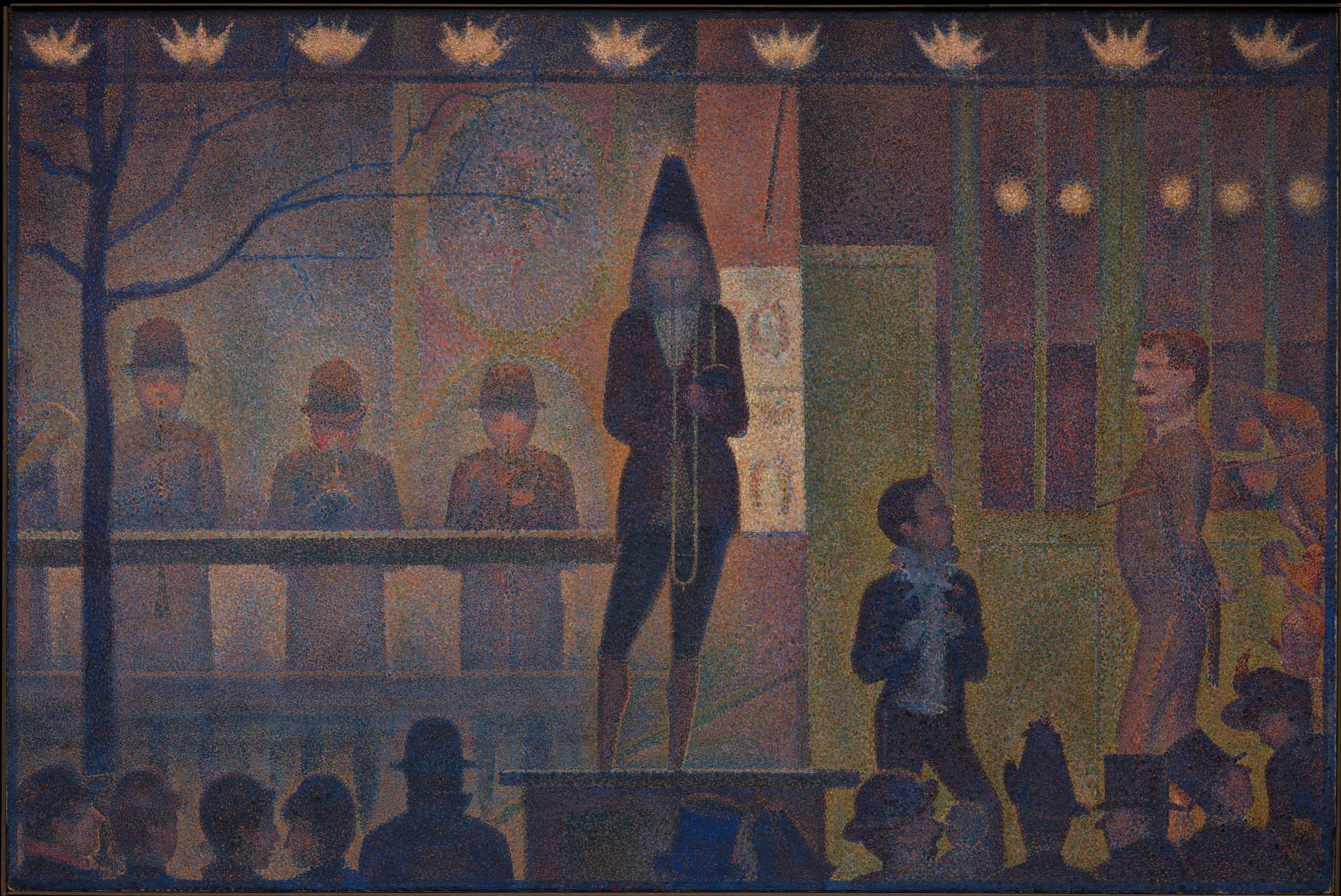
Circus Sideshow (Parade de cirque)
Georges Seurat (1887–88)
Circus Sideshow (Parade de cirque) distills a bustling Paris fairground into a cool, ritualized <strong>threshold</strong> between street and spectacle. Under nine crownlike <strong>gaslights</strong>, a barker, musicians, and attendants align with geometric restraint while the crowd remains a band of silhouettes, held at the edge. Seurat’s <strong>Neo‑Impressionist</strong> dots make the night hum yet stay eerily still, turning publicity into a modern icon of order and mood <sup>[1]</sup><sup>[2]</sup>.
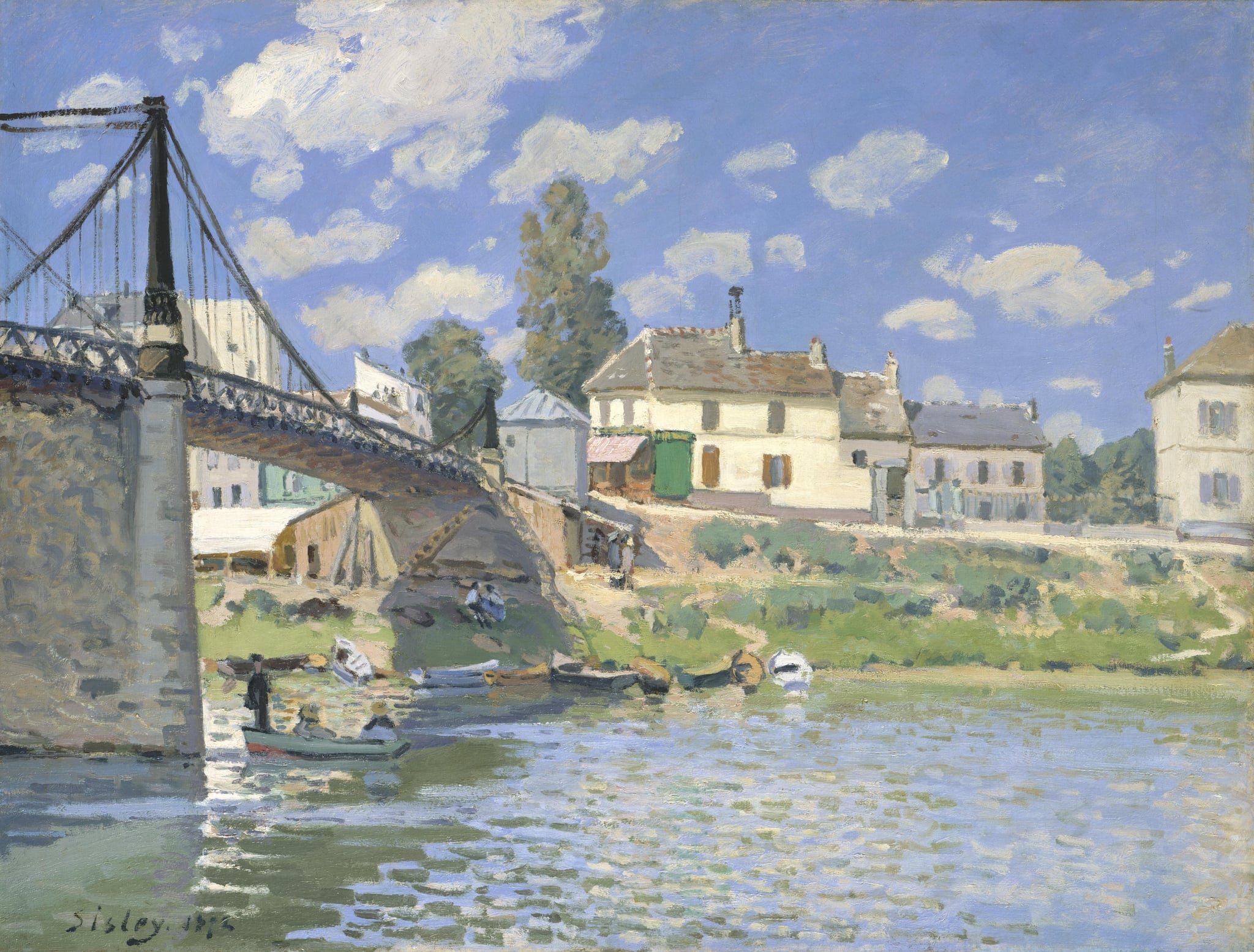
The Bridge at Villeneuve-la-Garenne
Alfred Sisley (1872)
Alfred Sisley's The Bridge at Villeneuve-la-Garenne crystallizes the encounter between <strong>modern engineering</strong> and <strong>riverside leisure</strong> under <strong>Impressionist light</strong>. The diagonal suspension bridge, dark pylons, and filigreed truss command the left foreground while small boats skim the Seine, their wakes breaking into shimmering strokes that echo the sky.
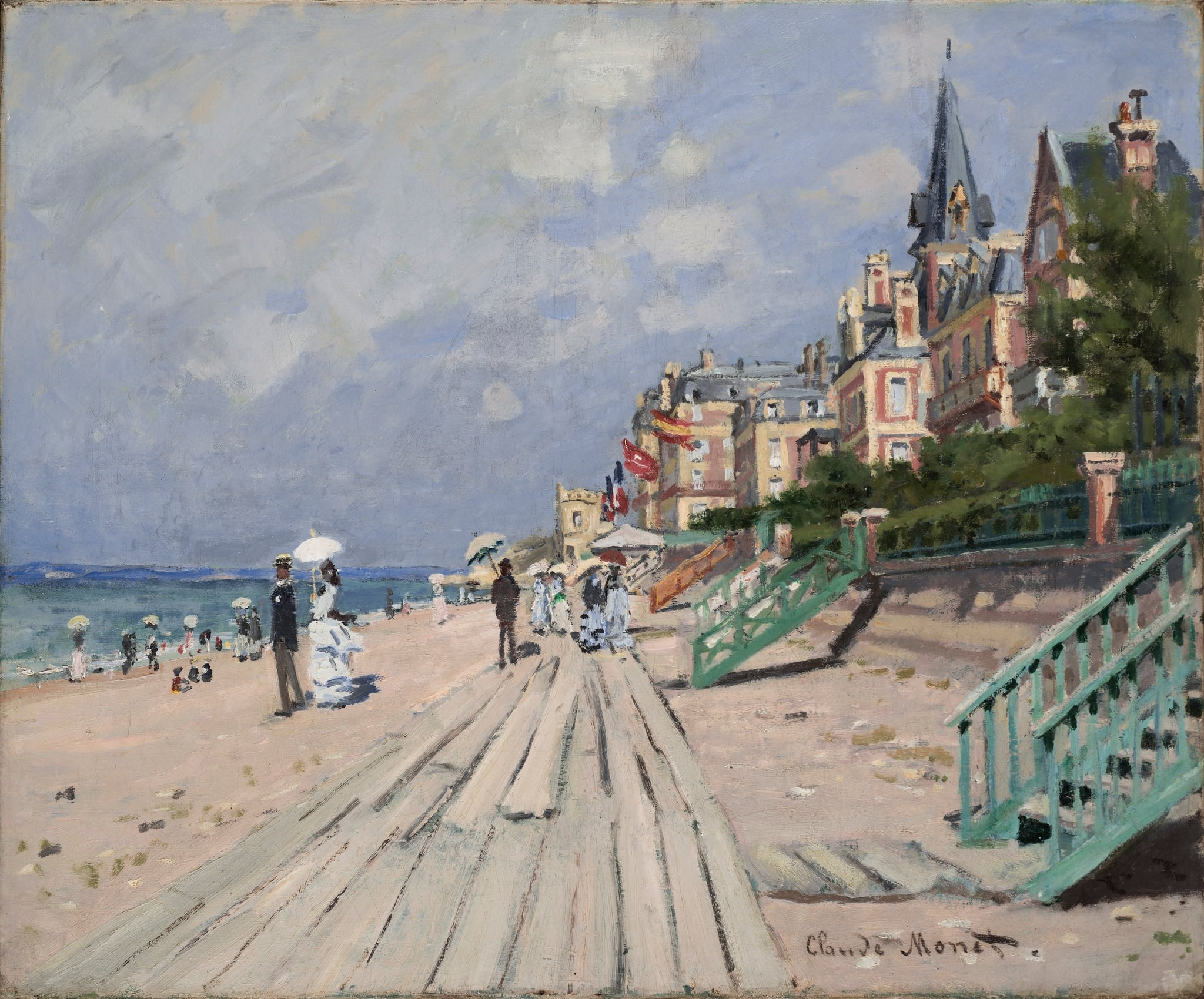
Beach at Trouville
Claude Monet (1870)
Beach at Trouville turns the Normandy resort into a stage where <strong>modern leisure</strong> meets <strong>restless weather</strong>. Monet’s diagonal boardwalk, wind-whipped <strong>red flags</strong>, and white <strong>parasols</strong> marshal the eye through a day animated by light and air rather than by individual stories <sup>[1]</sup><sup>[2]</sup>. The work asserts Impressionism’s claim to immediacy—there is even <strong>sand embedded in the paint</strong> from working on site <sup>[1]</sup>.
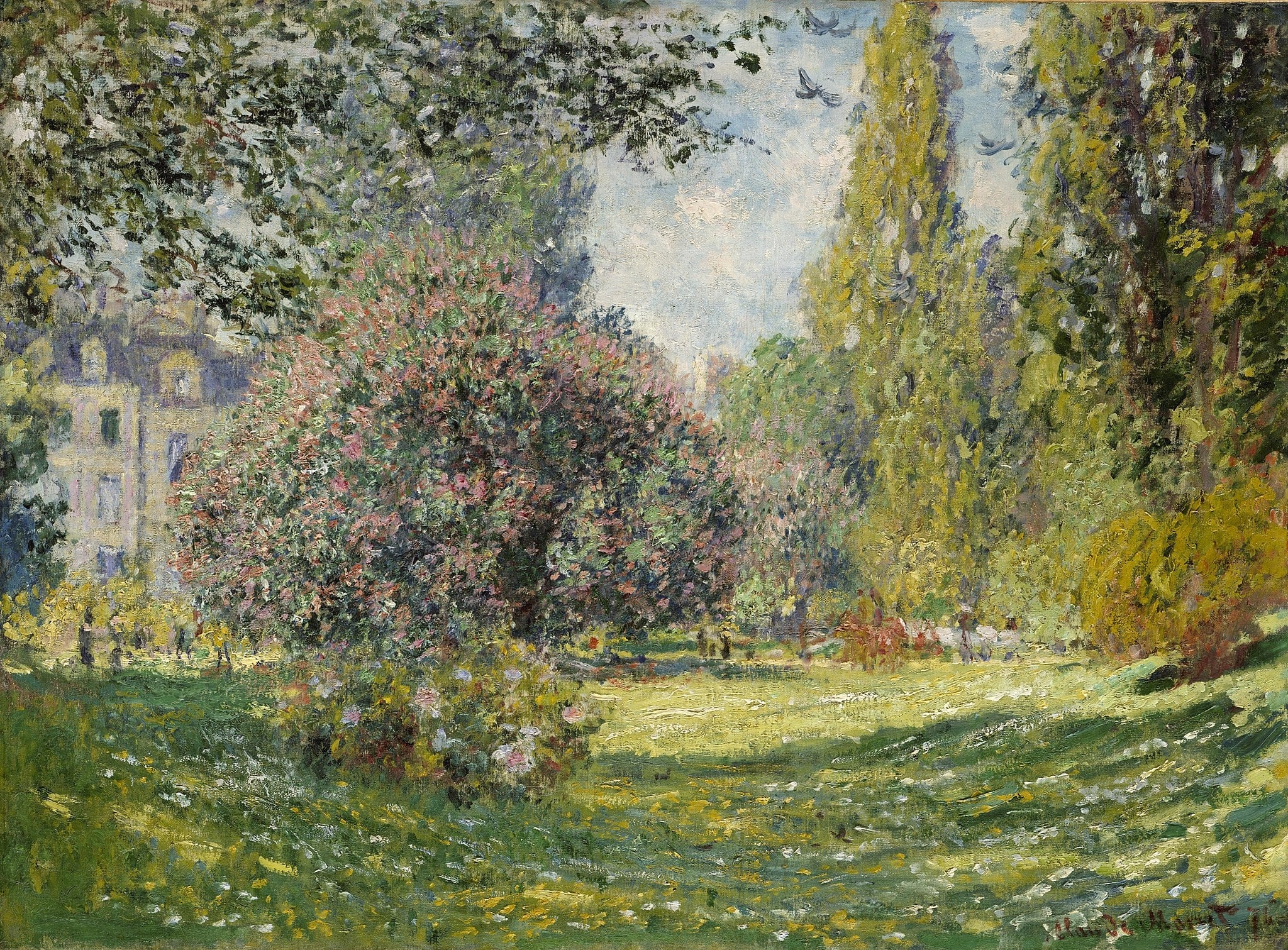
Landscape: The Parc Monceau
Claude Monet (1876)
Claude Monet’s Landscape: The Parc Monceau distills a spring afternoon into a choreography of <strong>flickering light</strong> and <strong>urban leisure</strong>. A diagonal of brightness pulls the eye from the shaded foreground toward a radiant lawn, where a voluminous, flowering shrub anchors the scene and a softened townhouse tethers nature to the city <sup>[1]</sup>. Monet turns perception itself into subject, making <strong>time and weather</strong> the picture’s active protagonists <sup>[5]</sup>.
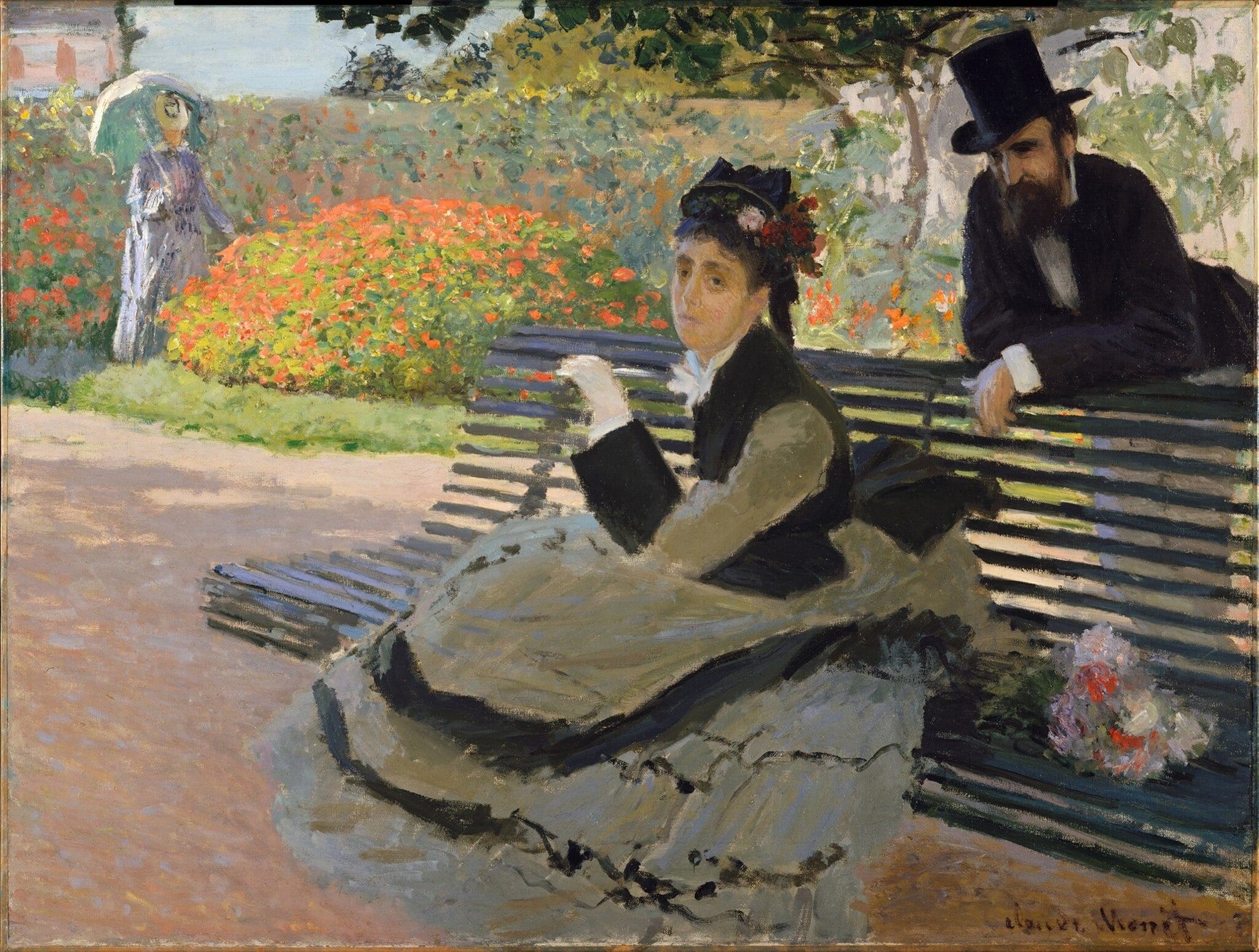
Camille Monet (1847–1879) on a Garden Bench
Claude Monet (1873)
Monet stages a modern garden drama along the <strong>diagonal bench</strong> that slices the foreground, setting Camille’s poised figure against a blaze of <strong>geraniums</strong> and dappled light. A <strong>top‑hatted neighbor</strong> leans over the slats as a second woman with a <strong>parasol</strong> wanders among blooms, while a <strong>note</strong> and a slightly tumbled <strong>bouquet</strong> cue a moment interrupted. Light, not contour, builds the scene, suspending private feeling within public leisure <sup>[1]</sup><sup>[2]</sup>.
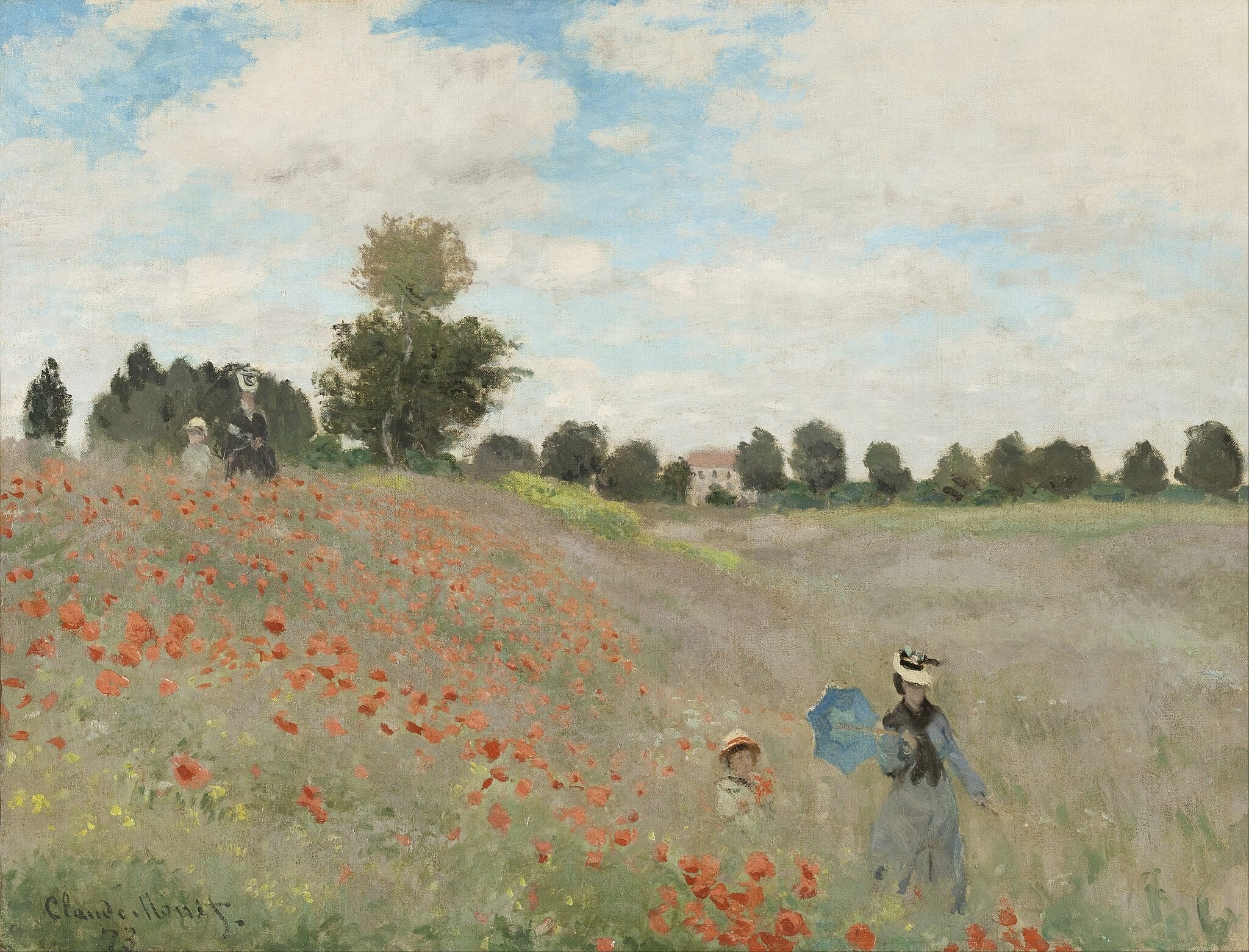
Poppy Fields near Argenteuil
Claude Monet (1873)
A modern pastoral where <strong>color and weather become the subject</strong>: in Poppy Fields near Argenteuil (1873), Monet arrays red poppies along a diagonal slope beneath an immense, changeable sky. Two promenading figures recur across the hill, turning a stroll into a <strong>rhythm of time and movement</strong> <sup>[1]</sup><sup>[2]</sup>.
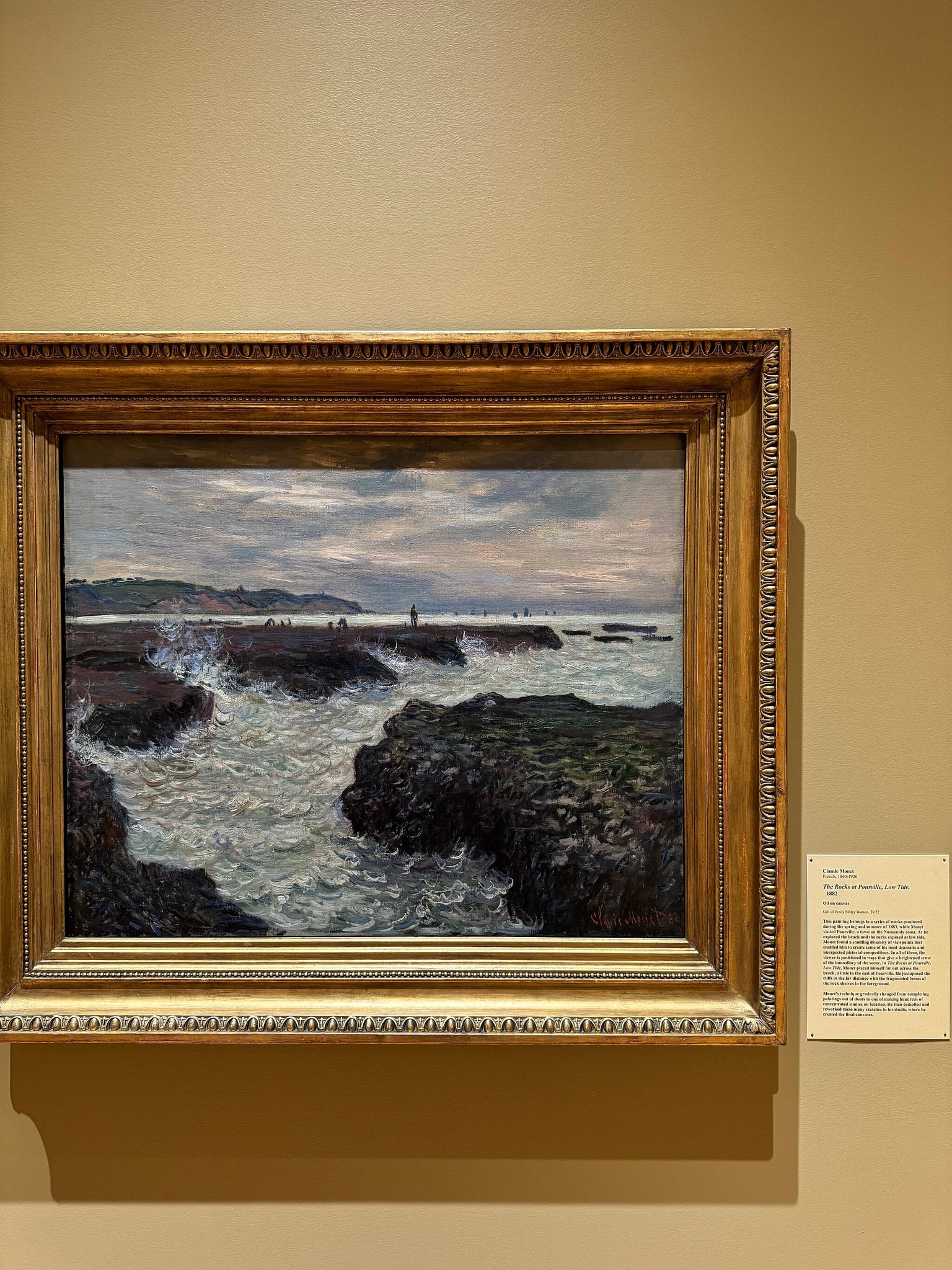
The Rocks at Pourville, Low Tide
Claude Monet (1882)
Claude Monet’s The Rocks at Pourville, Low Tide renders the Normandy foreshore as a meeting of <strong>endurance and flux</strong>—dark, seaweed-laden rocks cleave through <strong>foaming, mobile surf</strong> beneath a cool, <strong>pewter sky</strong>. Tiny silhouettes along the horizon reduce human presence to scale and rhythm, centering nature’s <strong>temporal pulse</strong>.
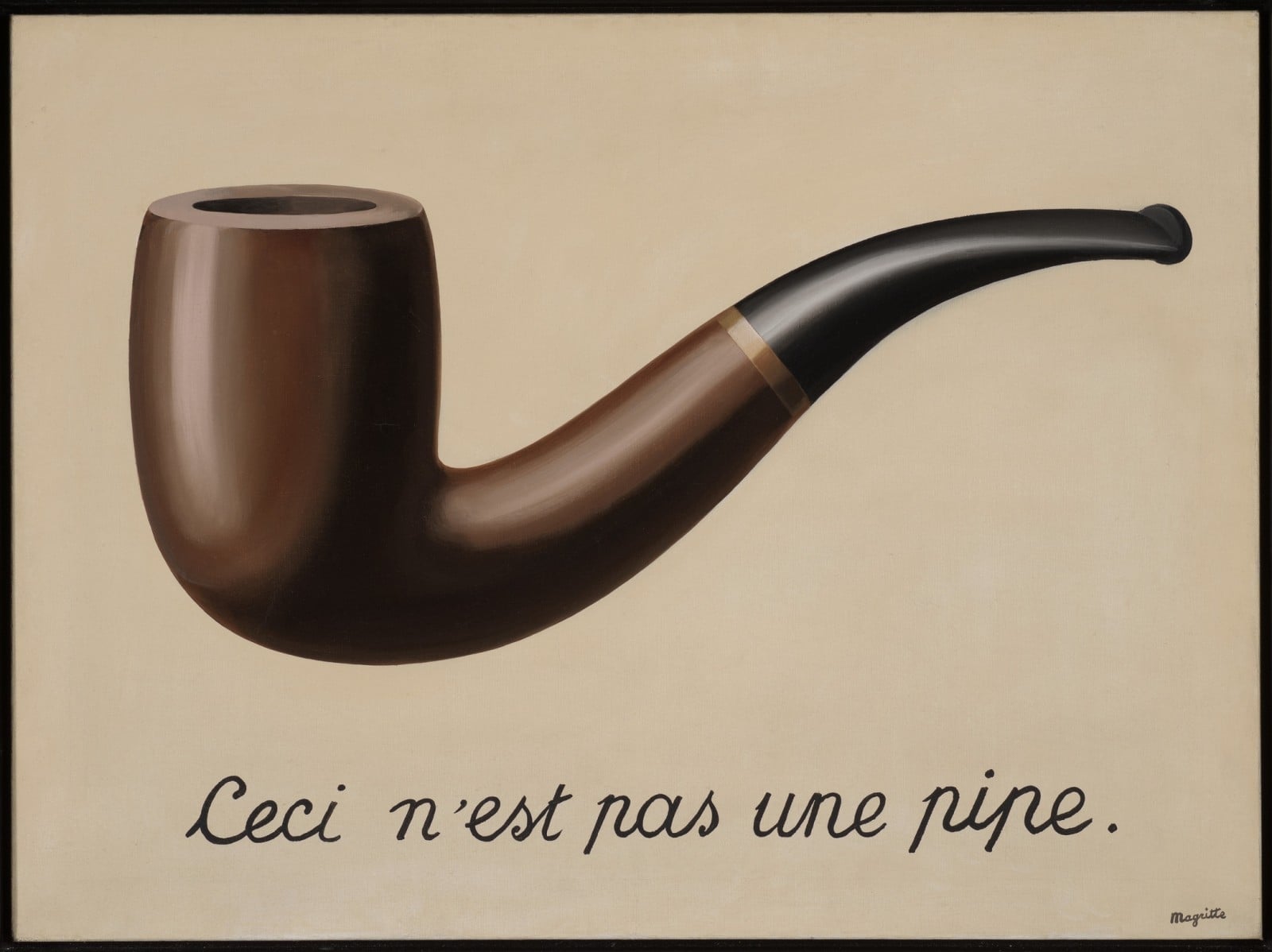
This is Not a Pipe
Rene Magritte (1929)
A crisply modeled tobacco pipe hovers over a blank beige field, while the cursive line "Ceci n’est pas une pipe" coolly denies what the eye assumes. The clash between image and sentence turns a familiar object into a <strong>thought experiment</strong> about signs and things. Magritte’s deadpan exactitude and ad‑like layout stage a <strong>philosophical trap</strong>: you can see a pipe, but you cannot smoke this picture. <sup>[1]</sup><sup>[2]</sup>
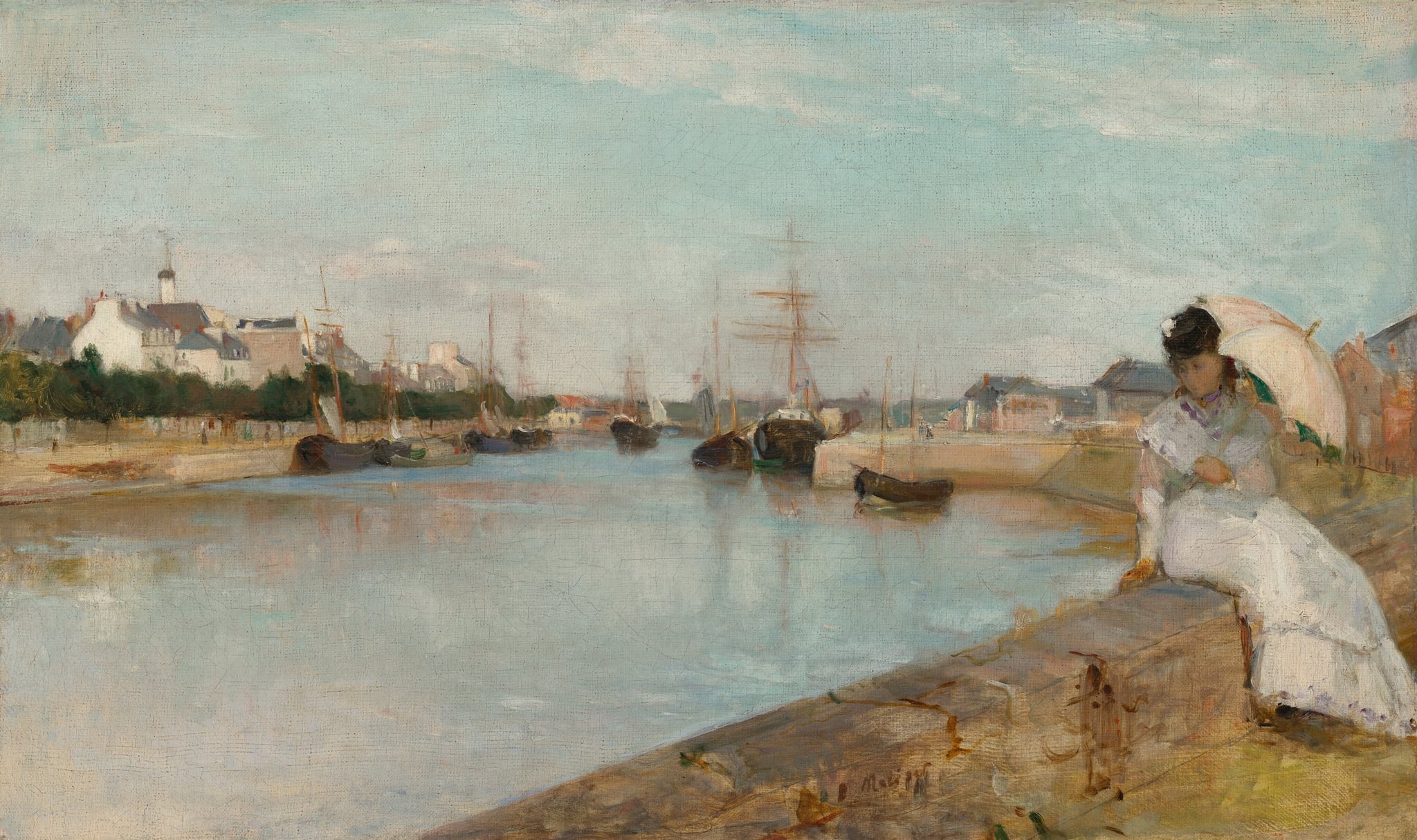
The Harbour at Lorient
Berthe Morisot (1869)
Berthe Morisot’s The Harbour at Lorient stages a quiet tension between <strong>private reverie</strong> and <strong>public movement</strong>. A woman under a pale parasol sits on the quay’s stone lip while a flotilla of masted boats idles across a silvery basin, their reflections dissolving into light. Morisot’s <strong>pearly palette</strong> and brisk brushwork make the water read as time itself, holding stillness and departure in the same breath <sup>[1]</sup>.
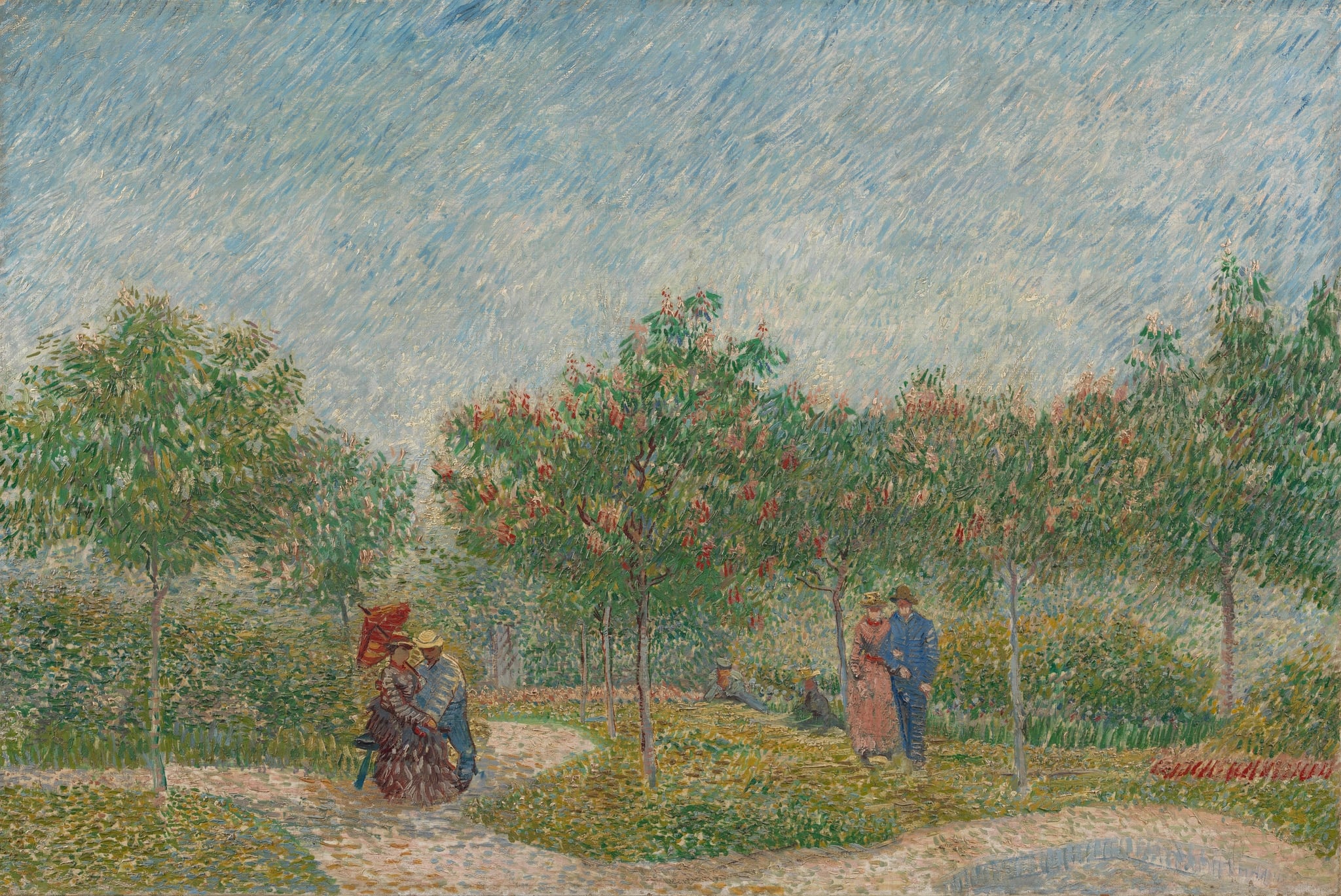
Garden with Courting Couples: Square Saint-Pierre
Vincent van Gogh (1887)
In Garden with Courting Couples: Square Saint-Pierre, Vincent van Gogh turns a small Montmartre park into a stage where <strong>spring</strong>, <strong>intimacy</strong>, and <strong>urban leisure</strong> converge. Short, shimmering strokes fuse pink chestnut blossoms, curving paths, and paired figures into one pulse of <strong>renewal</strong> and <strong>togetherness</strong> <sup>[1]</sup><sup>[2]</sup>.
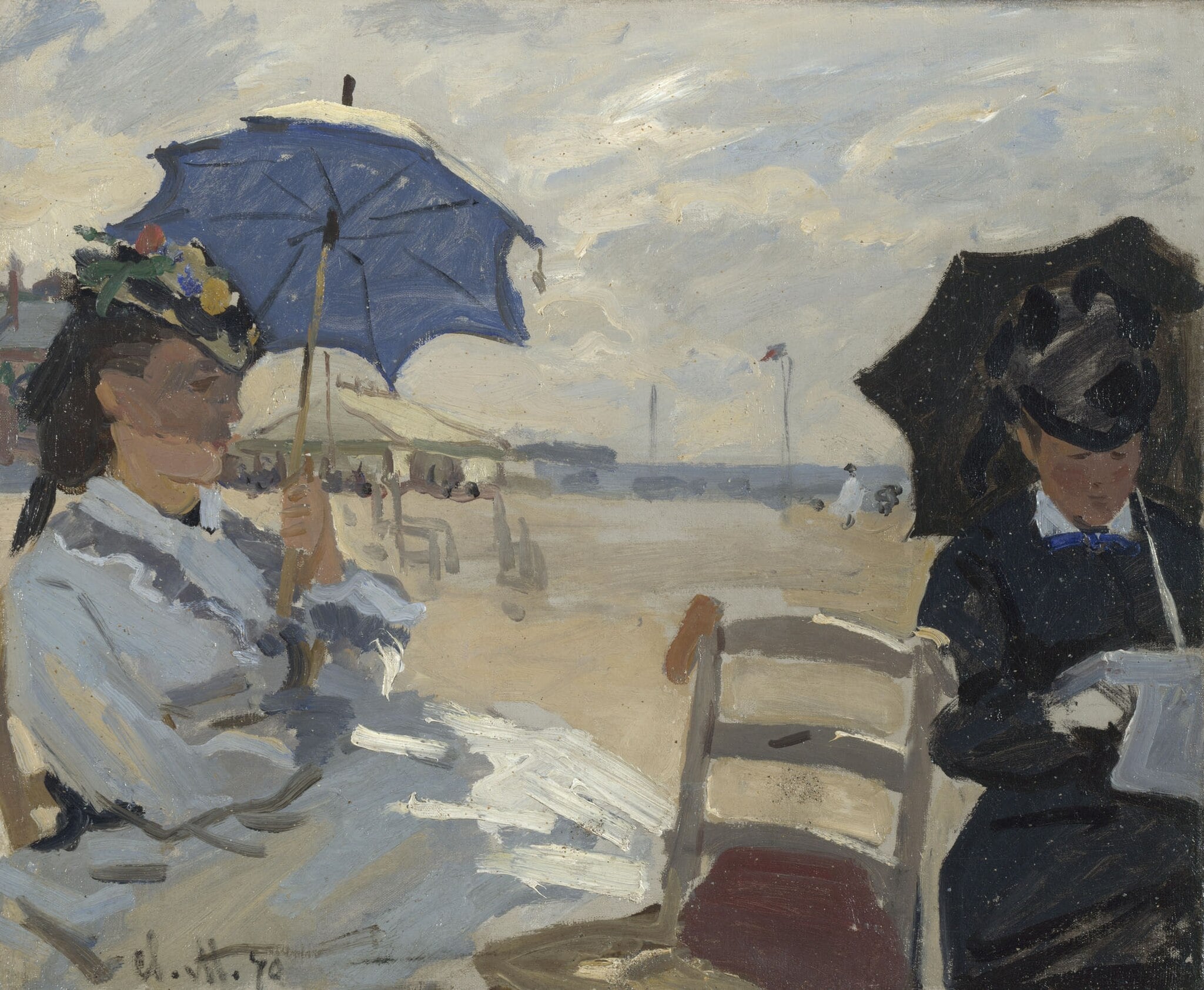
The Beach at Trouville
Claude Monet (1870)
Claude Monet’s The Beach at Trouville captures a wind-bright instant of <strong>modern leisure</strong> on the Normandy coast. Two women sit close to the viewer beneath a <strong>blue</strong> and a <strong>black parasol</strong>, their poses anchored against a hazy horizon where sea and sky fuse. Brisk strokes, embedded <strong>grains of sand</strong>, and snapshot-like <strong>cropping</strong> turn weather and time itself into the subject <sup>[1]</sup>.
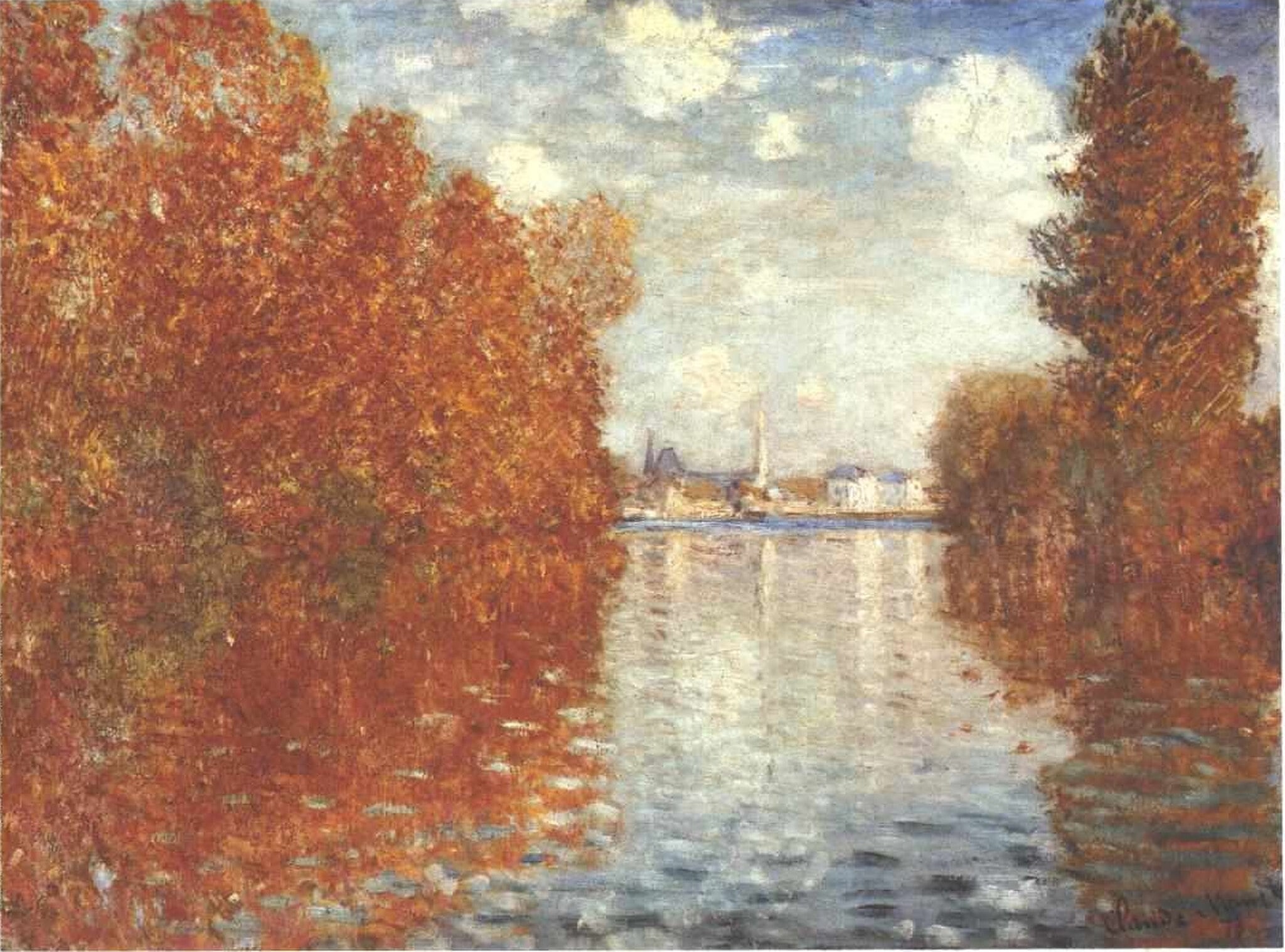
Autumn Effect at Argenteuil
Claude Monet (1873)
Autumn Effect at Argenteuil presents a luminous channel of the Seine flanked by blazing foliage, its surface vibrating with broken reflections. Monet turns the scene into an <strong>optical drama</strong> of complementary <strong>orange–blue</strong> contrasts, staging a passage from the narrowed banks to a light-struck town on the horizon. Painted from his <strong>studio boat</strong>, the work distills the Impressionist belief that truth resides in fleeting effects of light and air <sup>[1]</sup><sup>[2]</sup>.
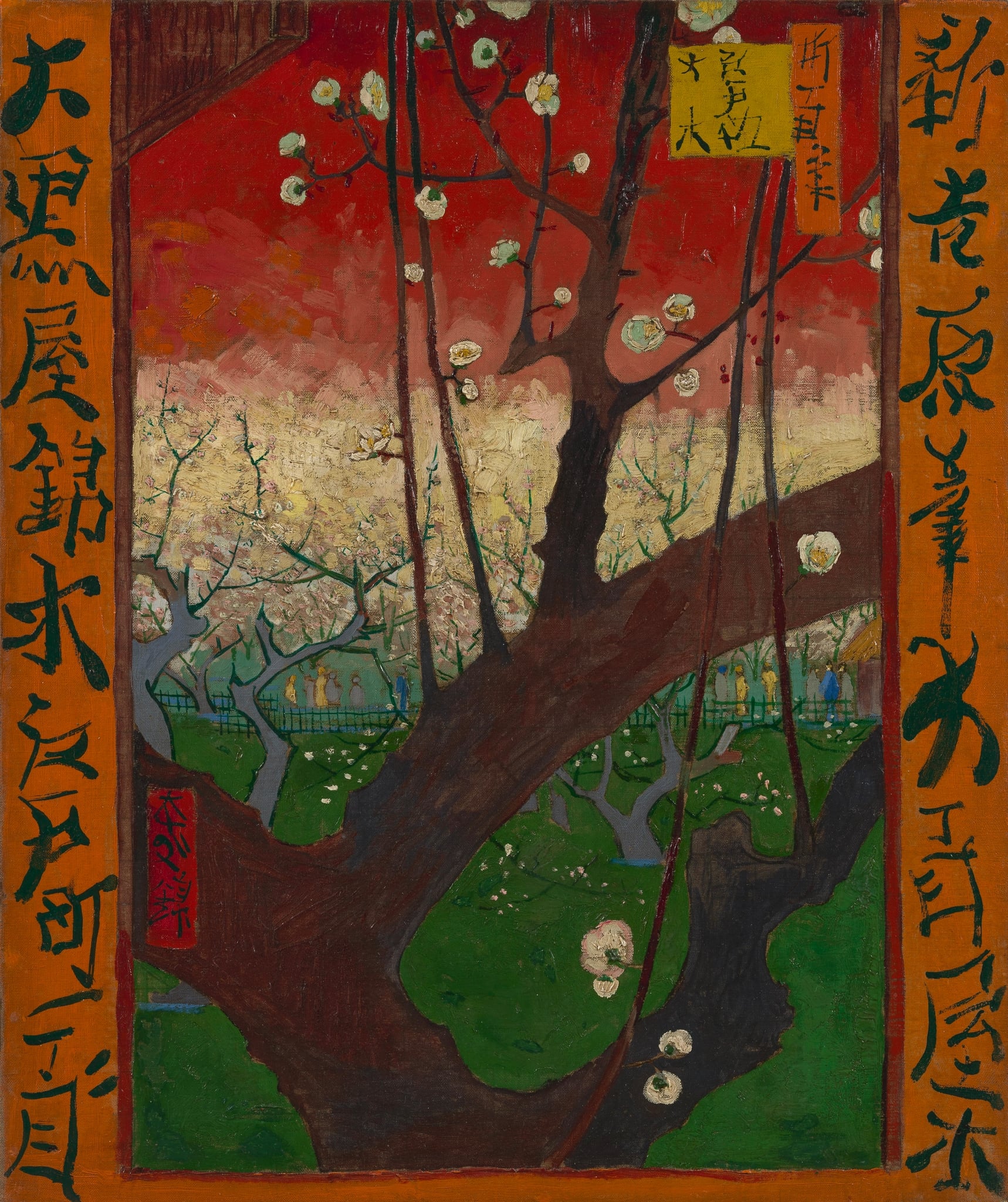
Flowering Plum Orchard (after Hiroshige)
Vincent van Gogh (1887)
In Flowering Plum Orchard (after Hiroshige), Vincent van Gogh fuses <strong>ukiyo-e design</strong> with <strong>post‑Impressionist color</strong>. A diagonal, calligraphic trunk cuts across a saturated green orchard, set against a <strong>blazing red sky</strong> and framed by <strong>orange borders with Japanese characters</strong>. The result is a vivid translation of Hiroshige’s motif into an oil painting charged with renewal and resolve <sup>[1]</sup><sup>[2]</sup>.
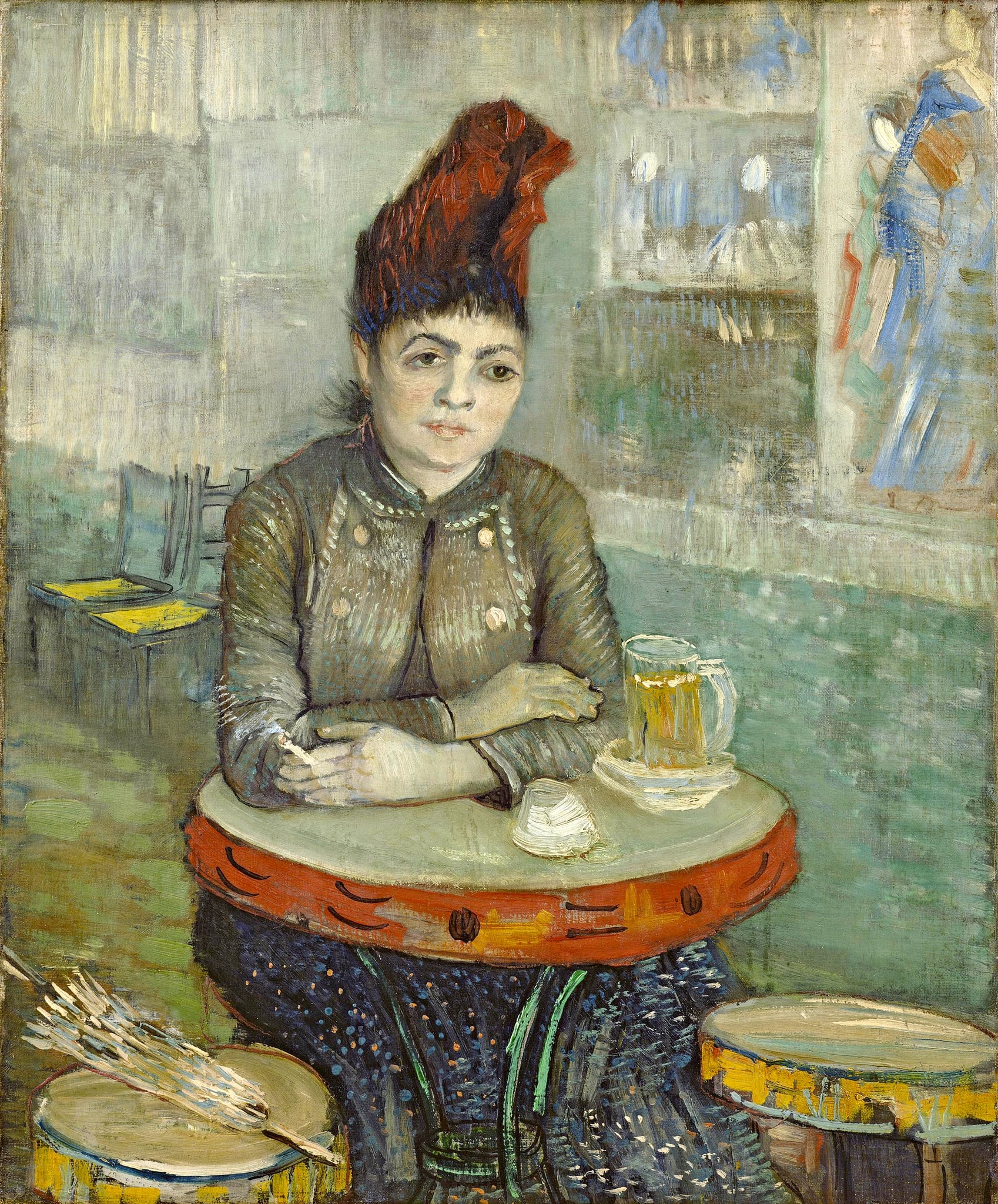
In the Café: Agostina Segatori in Le Tambourin
Vincent van Gogh (1887 (Jan–Mar))
Van Gogh casts Agostina Segatori at a tiny, tambourine‑like café table, turning Le Tambourin into a <strong>stage of modern life</strong>. Cool greens and greys make the red <strong>flame‑plume hat</strong> and the foaming <strong>beer</strong> flare, while folded arms and a set‑aside <strong>parasol</strong> register private fatigue amid public display <sup>[1]</sup><sup>[2]</sup><sup>[3]</sup>.
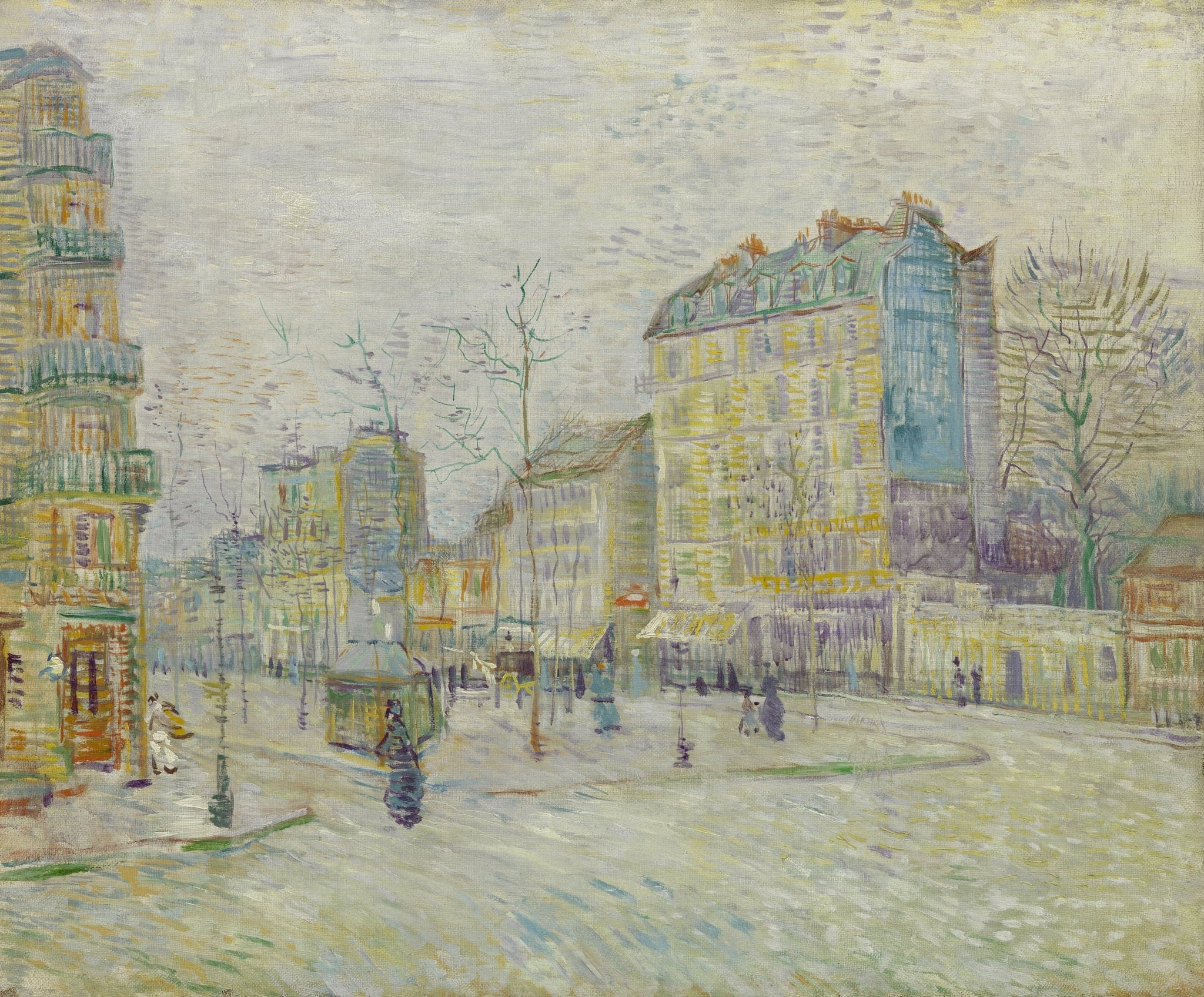
Boulevard de Clichy
Vincent van Gogh (1887)
Vincent van Gogh’s Boulevard de Clichy crystallizes a cool, wintry Paris into a <strong>vibrating field of light</strong> and motion. With leafless trees echoing lamp posts and façades stitched from lilac, blue, and sulfurous yellow strokes, the boulevard bends like a <strong>slow river of modernity</strong>. Tiny bundled figures drift across the cobbles, signaling the city’s <strong>anonymous flow</strong>.
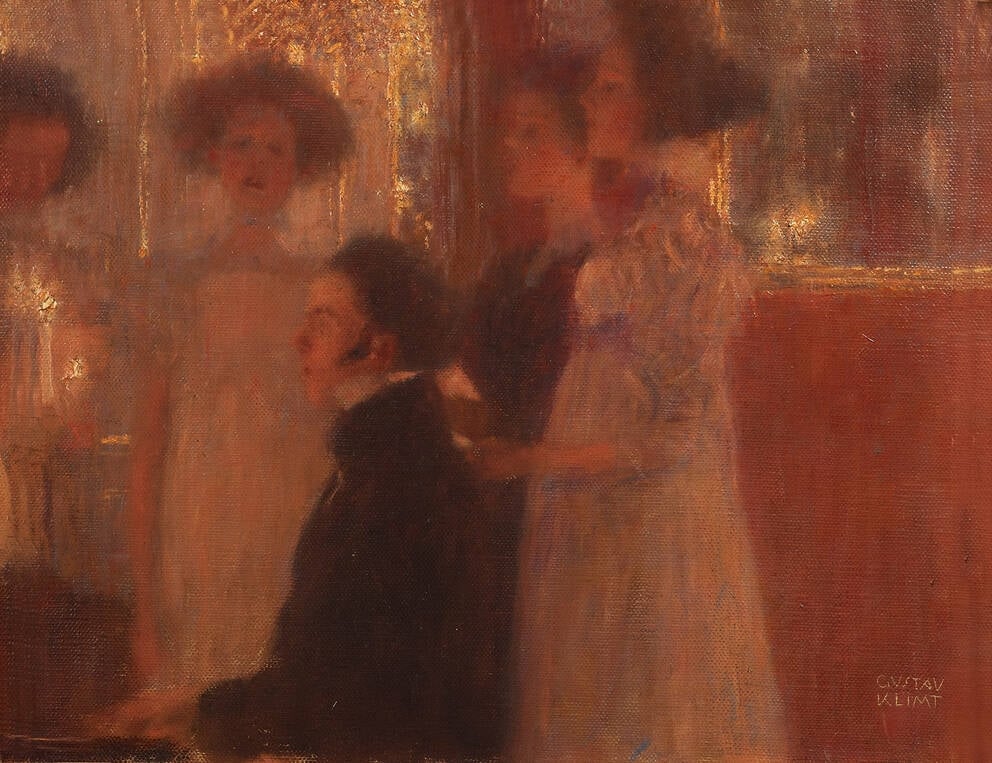
Schubert at the Piano. Design for the music room by Nikolaus Dumba
Gustav Klimt (1896)
Klimt’s 1896 oil study <strong>Schubert at the Piano. Design for the music room by Nikolaus Dumba</strong> turns a domestic recital into a glowing myth of listening. In dim, rosy-gold light, a dark-clad pianist is encircled by a soft choir of women whose blurred faces dissolve into the shimmer of the room. Klimt fuses contour and light so that sound seems to become <strong>radiance</strong>, anticipating his decorative modernism <sup>[1]</sup><sup>[2]</sup>.
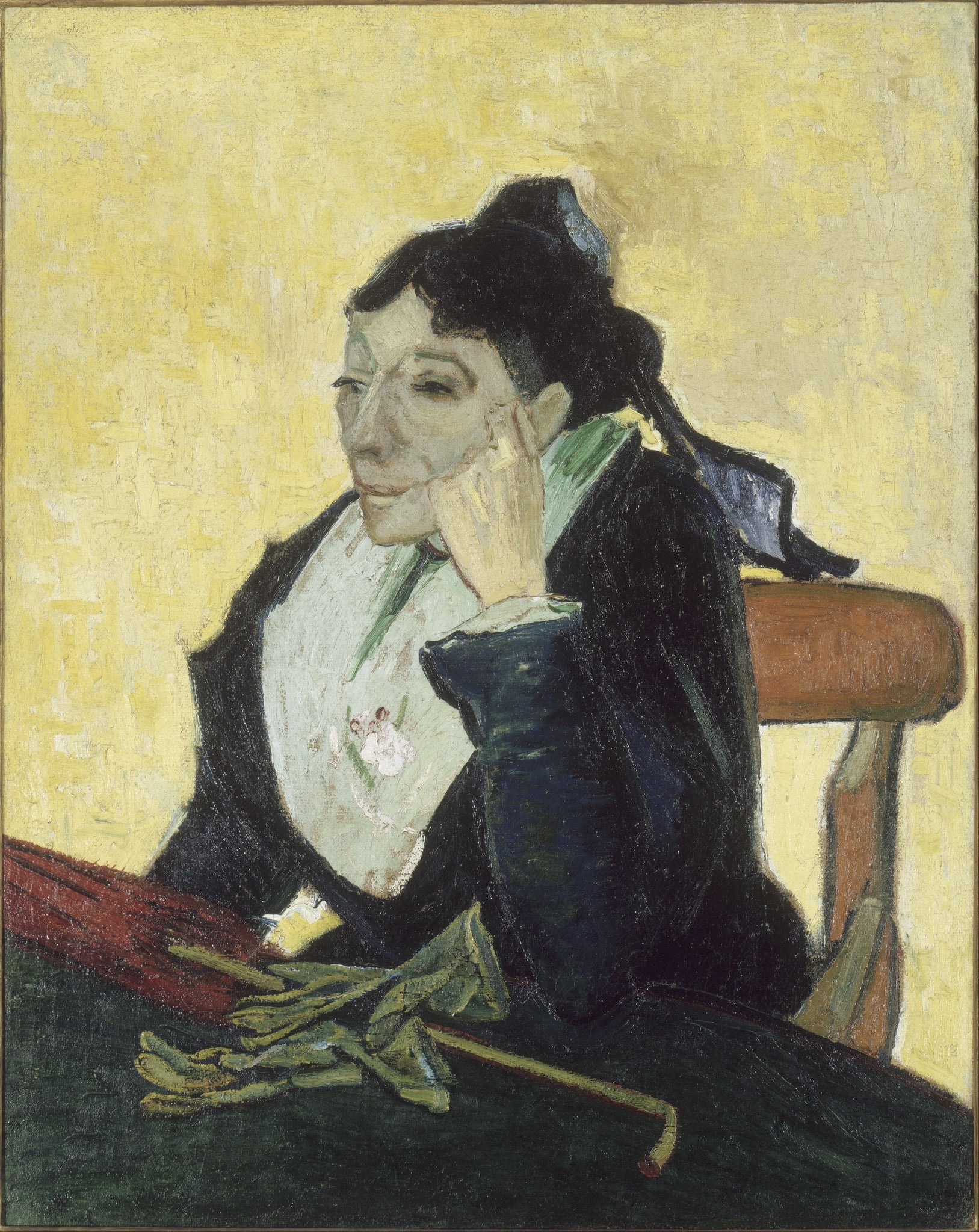
L'Arlésienne
Vincent van Gogh (1888)
In L'Arlésienne, Vincent van Gogh distills a moment of inward pause: a woman from Arles leans her cheek on her hand before a <strong>butter‑yellow wall</strong>, her <strong>black-and-blue silhouette</strong> set against a warm field. The <strong>red parasol</strong> and <strong>green gloves</strong> lie unused on the table, signaling a suspension of public persona in favor of private thought <sup>[1]</sup><sup>[3]</sup>.
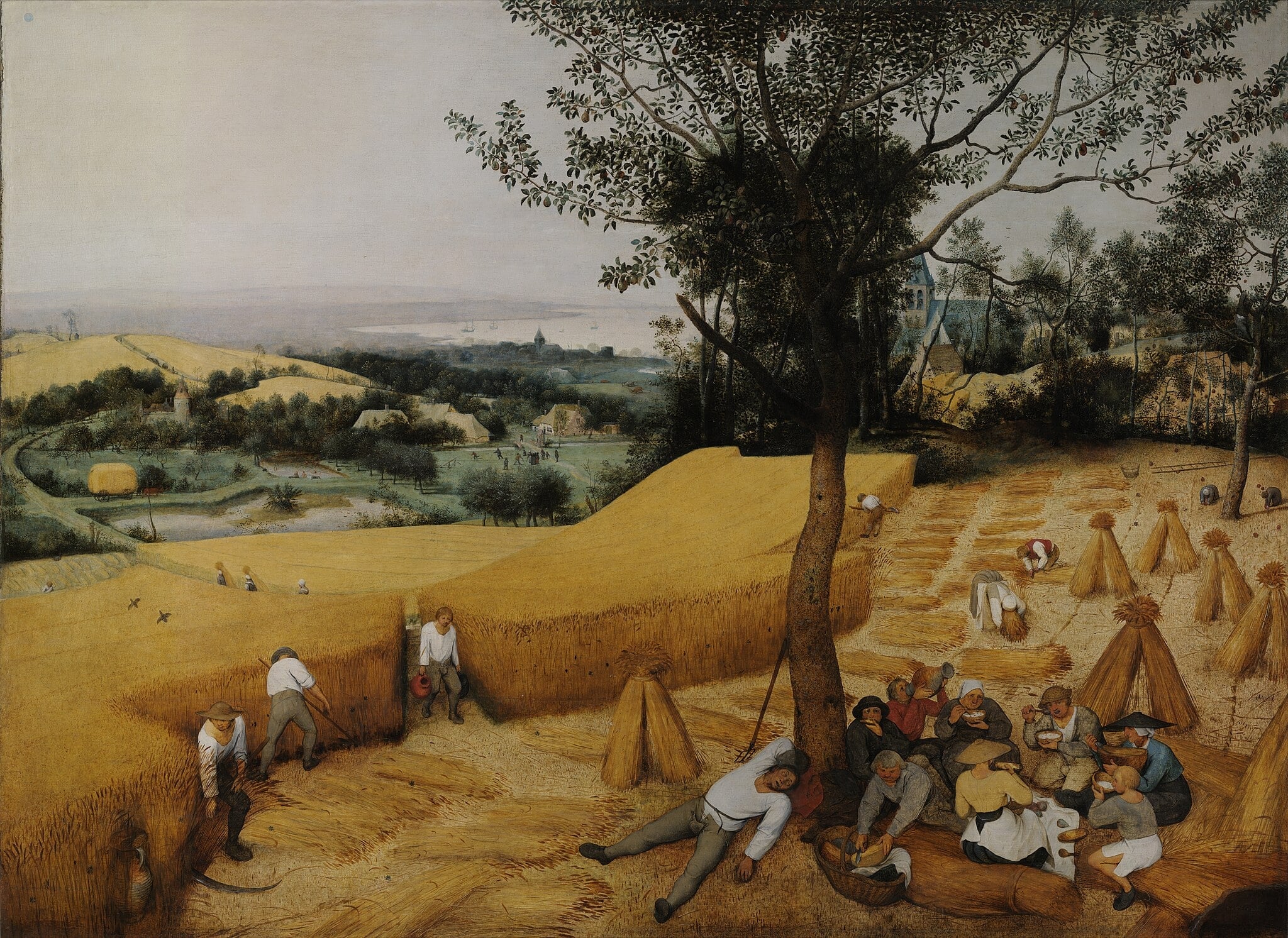
The Harvesters
Pieter Bruegel the Elder (1565)
The Harvesters distills late summer into a seamless weave of <strong>labor and reward</strong>: reapers bend to wheat while others eat and doze beneath a tree, and the world opens to roads, a village, and ships. Bruegel dignifies every action with <strong>even light</strong> and a democratic gaze, turning a specific day’s work into an image of <strong>cyclical time</strong> and shared sustenance <sup>[1]</sup><sup>[4]</sup>.
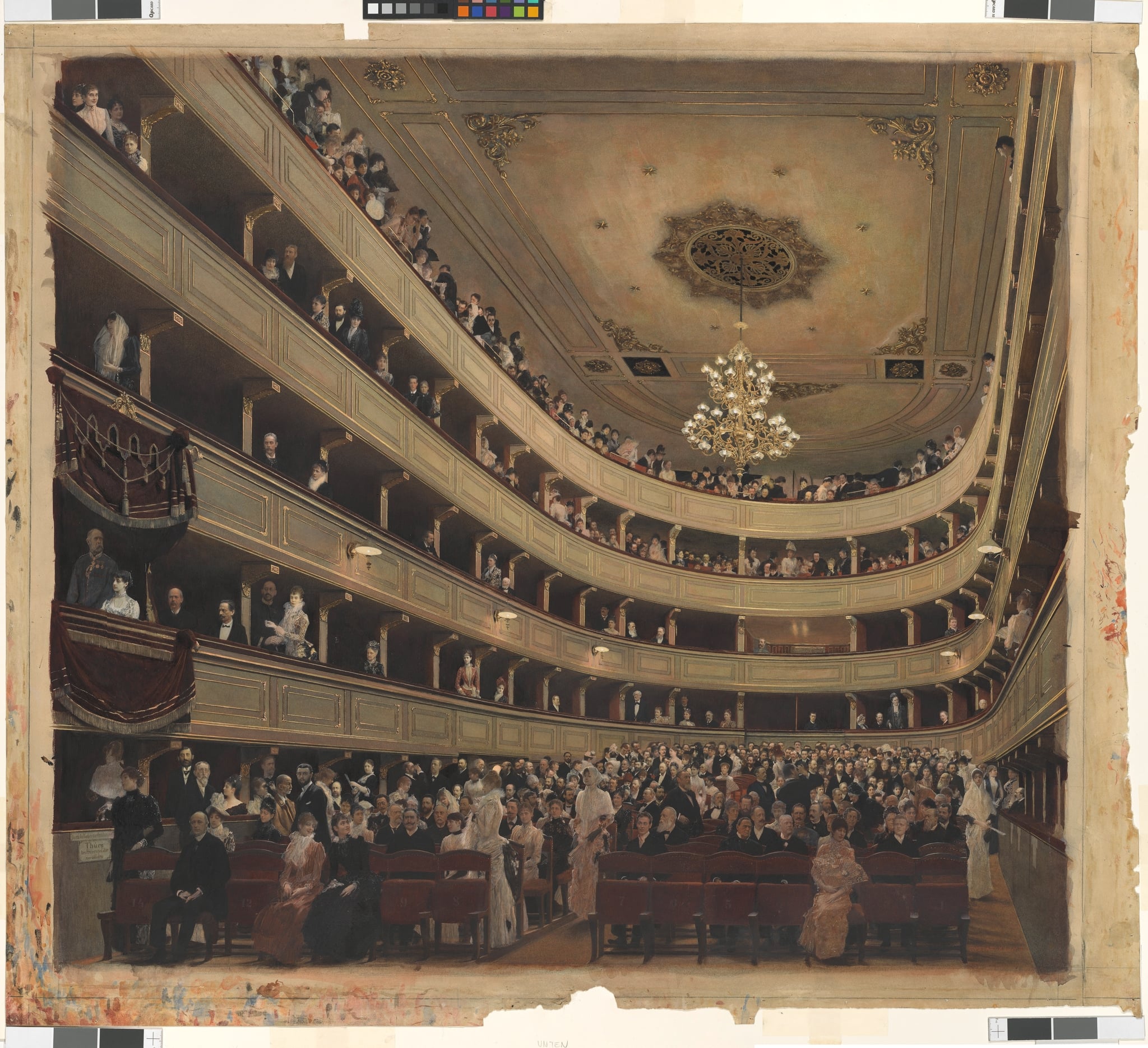
Auditorium of the Old Burgtheater
Gustav Klimt (1888–1889)
<strong>Auditorium of the Old Burgtheater</strong> turns the stage around: the audience becomes the show beneath a glowing chandelier and sweeping tiers. Klimt fuses hundreds of individualized faces into a single, wave‑like body of spectators, lit by gaslight and framed by gilded medallions. The result is a civic mirror—Vienna watching itself—at the very moment its old theater was disappearing.
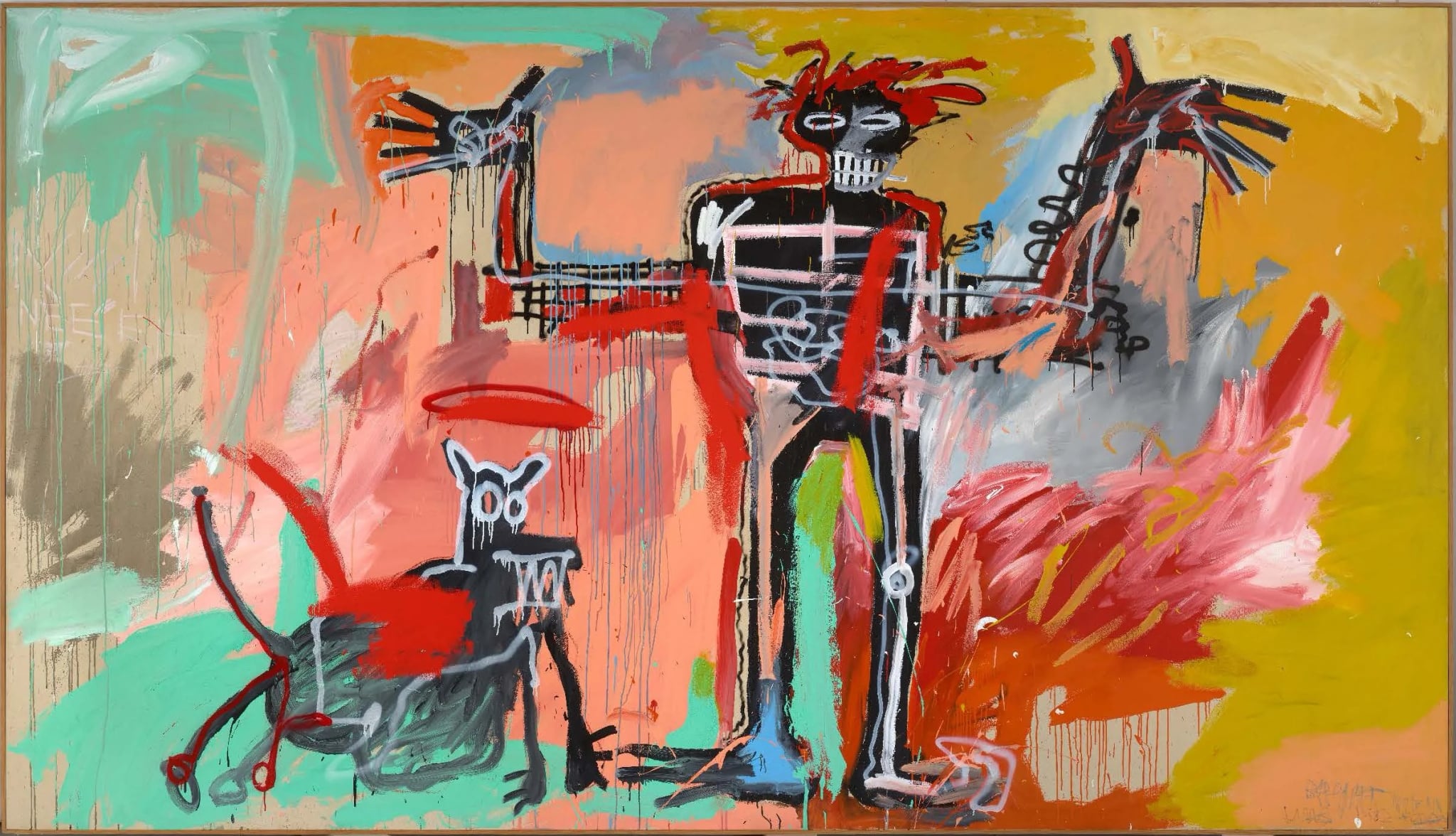
Boy and Dog in a Johnnypump
Jean-Michel Basquiat (1982)
<strong>Boy and Dog in a Johnnypump</strong> (1982) stages a wiry, x‑rayed boy with arms flung wide beside a bristling dog under a red arc that doubles as a halo and the spray of a New York <strong>johnnypump</strong>. Basquiat fuses <strong>childhood play</strong> and <strong>urban peril</strong> in a heat‑drenched field of oranges, yellows, and mints, emblematic of his breakthrough <strong>Neo‑Expressionism</strong> and the 1982 Modena cycle. The painting asserts Black presence and survival with ferocious scale and velocity <sup>[1]</sup><sup>[2]</sup>.
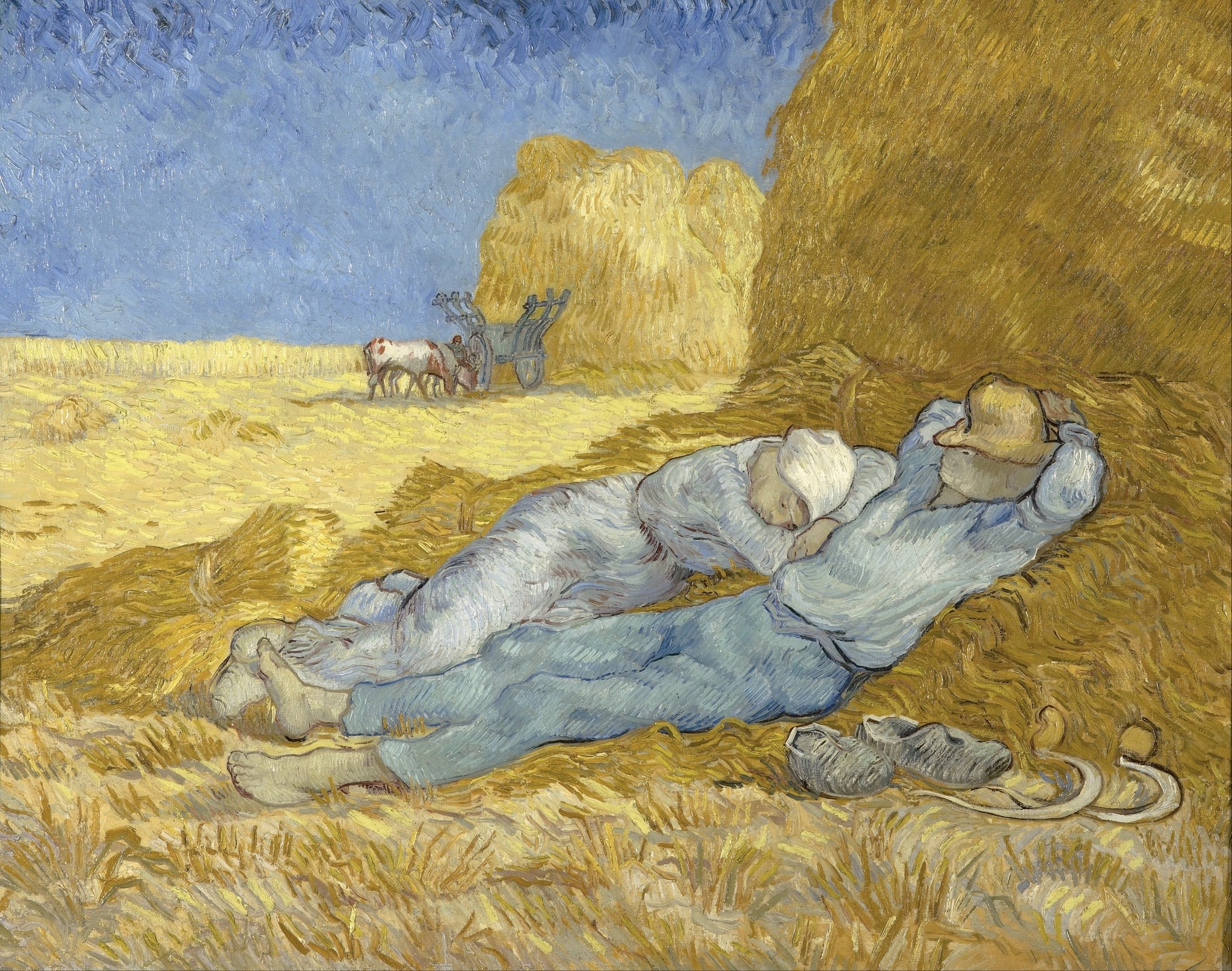
The Siesta
Vincent van Gogh (1889–1890)
The Siesta renders a midday pause as a scene of <strong>dignified repose</strong>: two harvesters sleep curved against a haystack while their scythes and shoes rest idle in the straw. Van Gogh’s complementary <strong>blue–yellow</strong> orchestration turns heat and light into rhythm, holding rest and labor in delicate equilibrium <sup>[1]</sup>. Painted at Saint‑Rémy as a color "translation" after Millet, it transforms a humble genre motif into an emblem of <strong>human need</strong> within work’s demands <sup>[1]</sup><sup>[3]</sup>.
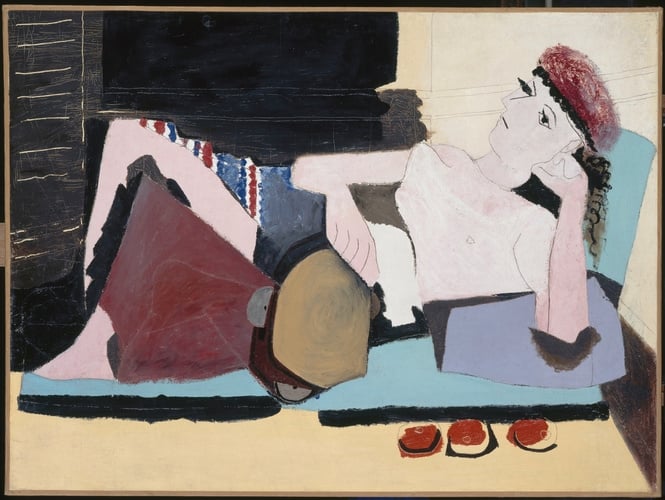
Femme au tambourin
Pablo Picasso (1925)
Picasso’s 1925 <strong>Femme au tambourin</strong> stages a reclining performer whose body is reduced to <strong>bold planes and hard contours</strong>. The circular tambourine across her lap and the <strong>three fruits</strong> aligned below create a visual rhythm that weighs <strong>pleasure against performance</strong> <sup>[1]</sup>.
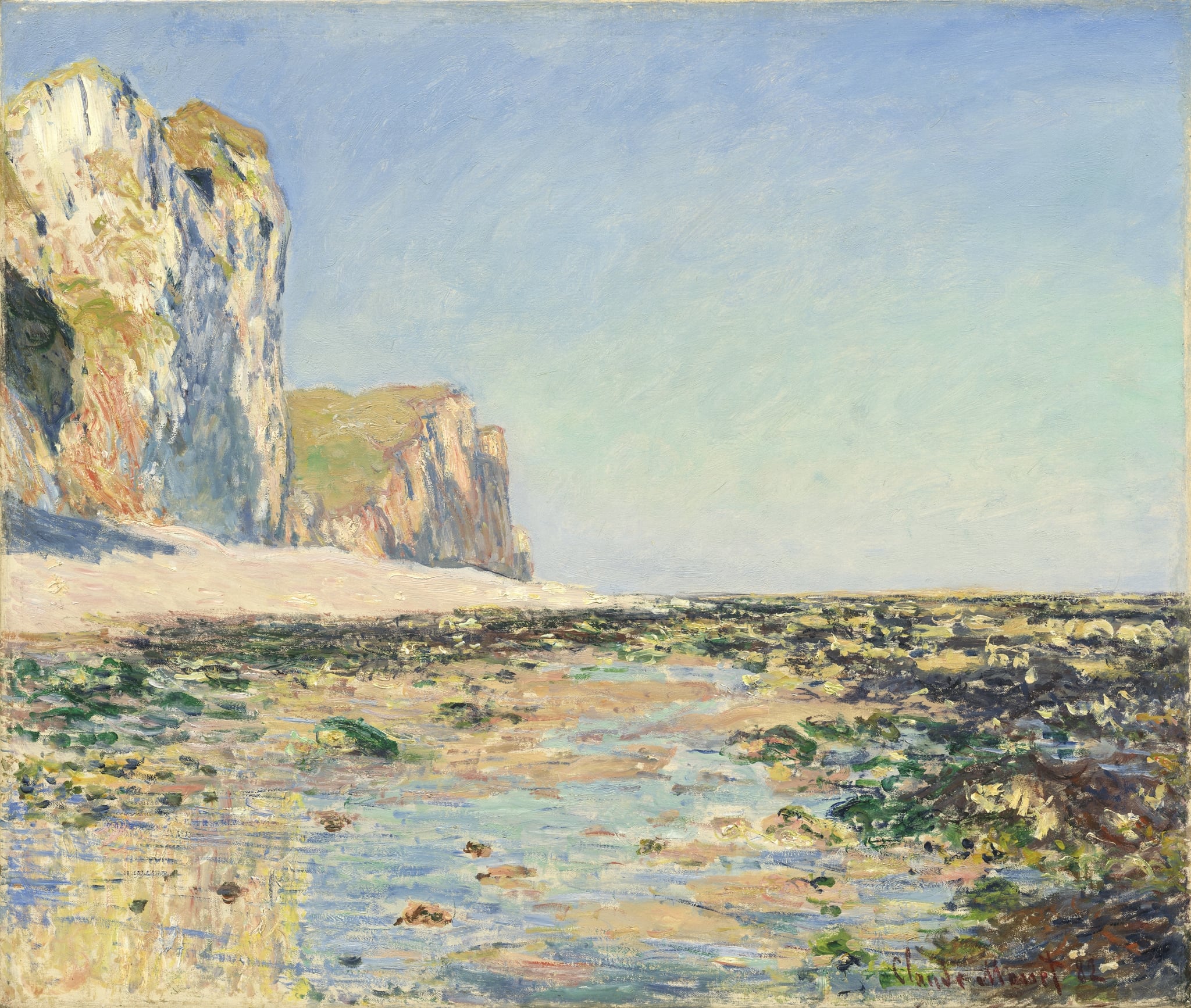
Seashore and Cliffs of Pourville in the Morning
Claude Monet (1882)
Claude Monet’s Seashore and Cliffs of Pourville in the Morning renders Normandy’s coast as a theater for <strong>ephemeral light</strong> and <strong>geologic permanence</strong>. A vast, pale sky and mirror-like tide pools counterbalance the chalk cliffs at left, turning a quiet morning into a statement about <strong>time and renewal</strong>.
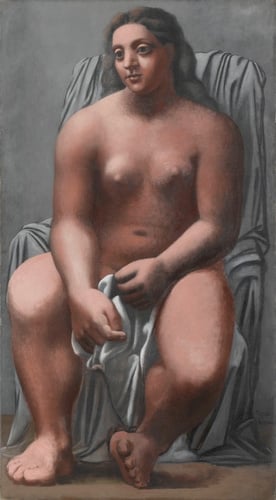
Grande baigneuse
Pablo Picasso (1921)
Picasso’s Grande baigneuse stages a monumental nude as an <strong>archetype of endurance</strong>, not a private individual. Seated frontally on a draped, stone-like chair, with <strong>downcast eyes</strong> and a towel clenched in her hand, she reads as a modernized classical statue—solid, calm, and timeless <sup>[1]</sup>. The painting fuses <strong>compressed modern space</strong> with antique gravitas to assert stability after wartime rupture <sup>[1]</sup><sup>[2]</sup>.
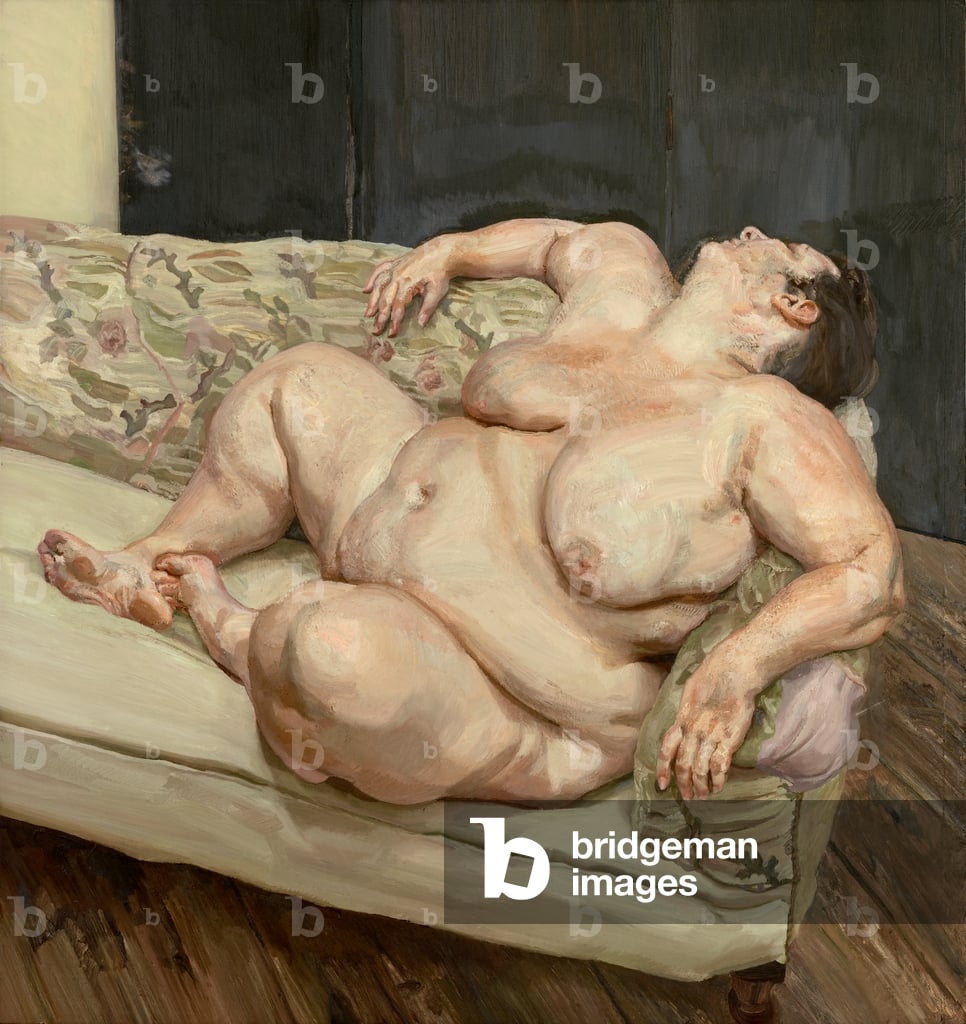
Benefits Supervisor Resting
Lucian Freud (1994)
Benefits Supervisor Resting confronts the reclining‑nude tradition with <strong>unvarnished corporeality</strong> and <strong>quiet dignity</strong>. Sprawled on a sagging floral sofa, the sitter’s tilted head and unarranged limbs shift attention from face to the <strong>landscape of flesh</strong>, rendered in dense, mottled strokes. The humble studio—scuffed wooden floor, dark wall—magnifies the body’s monumental presence rather than flattering it <sup>[1]</sup>.