The Terrace at Sainte-Adresse

by Claude Monet

Claude Monet’s The Terrace at Sainte-Adresse stages a sunlit garden against the Channel, where bourgeois leisure unfolds between two wind-whipped flags and a horizon shared by sail and steam. Bright flowers, wicker chairs, and a white parasol form an ordered foreground, while the busy harbor and snapping tricolor project a confident, modern nation. The banded design—garden, sea, sky—reveals Monet’s early Japonisme and his drive to fuse fleeting light with a consciously structured composition [1].

Fast Facts

Year
1867
Medium
Oil on canvas
Dimensions
98.1 × 129.9 cm
Location
The Metropolitan Museum of Art, New York
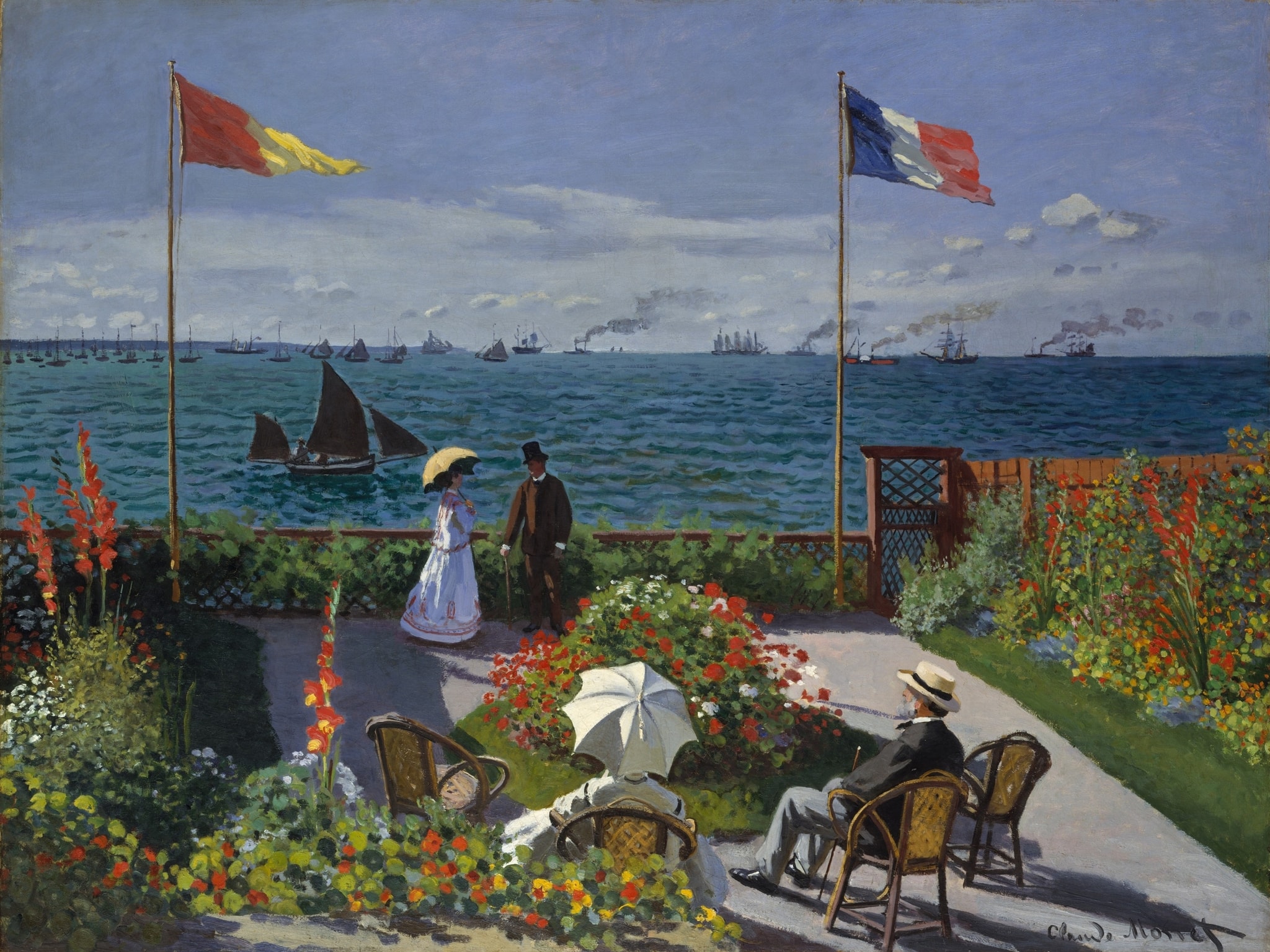
The Terrace at Sainte-Adresse by Claude Monet (1867) featuring French tricolor flag, Maritime signal pennant, Steamships with smoke, Sailing boats

Click on any numbered symbol to learn more about its meaning

Meaning & Symbolism

Monet composes the terrace as a deliberate triad—flowering garden, wind-creased sea, clouded sky—stacked like stripes and pinned by two flagpoles that read as emphatic vertical bars. This banded architecture, with its high horizon and planar clarity, signals his engagement with Japanese print aesthetics, a point he himself hinted at when he called the work his “Chinese painting with flags,” and which curators have tied to Hokusai’s example 1. The red blossoms echo the red of the French tricolor; the blue shadows in the path rhyme with the water’s cool planes; even the white parasol repeats the sky’s pale cloudlets. Color becomes connective tissue, stitching social decorum below to national emblem above. The left pole carries a red-and-yellow maritime signal pennant—likely a commercial or regatta-related signal of the period—so the painting’s heraldry belongs as much to nautical systems as to state symbolism 3. In this matrix of signs, the terrace is both literal garden and symbolic stage: a carefully cultivated foreground where modern manners sit under the scrutiny of flags and horizon. Against that stage, Monet juxtaposes two economies of motion. Near at hand, bodies are composed: a seated man in a straw hat turns inward to leisure; a couple promenades, their conversation contained by the low hedge; chairs are aligned to the view. Beyond the barrier, however, motion accelerates—sloops scud across choppy blue, and iron steamers cut the distance trailing smoke. By making sails and stacks share a single skyline, Monet compresses the shift from tradition to industry into one visual chord 2. The wind that animates the flags carries through the entire field—ruffling water, curling smoke, flicking at dresses—so that atmospheric force unifies disparate social worlds. The low fence, gate, and trellis quietly enforce separation: cultivation here, commerce there. Yet the sailboat that slices close to the terrace’s hedge and the smoke that drifts into the sky band blur that division, insisting that private pleasure is underwritten by public traffic. Formally, Monet’s brush treats time as a substance. The flicker on the parasol, the tremor of flower heads, and the short, decisive strokes on the sea make perception itself the subject. This is not reportage but orchestration: the two flags serve as metronomes for the eye, setting a rhythm that moves from vertical snap to horizontal sweep. Such structuring reveals why The Terrace at Sainte-Adresse is important: it fuses an advanced pictorial order—flat bands, abrupt verticals, calibrated color echoes—with an ethics of looking attuned to the instant 1. That fusion places the canvas at the threshold of Impressionism, but it also carries a social argument sharpened by Monet’s paired Sainte-Adresse subjects of 1867, which contrast bourgeois leisure with working-class shore life; here, regatta finery and wicker repose stand as the visible dividend of a harnessed sea 2. Finally, the tricolor’s dominance—framed sky, claimed view—casts the terrace as an overlook of national prospect, a claim made provisional by the sea’s depthless blue and the transient wind. Monet proposes that modern order is real, radiant, and carefully tended—yet it rests on currents that are mobile, mutable, and beyond the garden’s control.

Explore Deeper with AI

Ask questions about The Terrace at Sainte-Adresse

Popular questions:

Powered by AI • Get instant insights about this artwork

💬 Ask questions about this artwork!

Interpretations

Formal Analysis: Japonisme as Structural Engine

Monet’s elevated horizon, stacked horizontal bands, and emphatic flagpole verticals translate Japonisme from taste into structure. Rather than a scenic record, the terrace becomes a planar architecture—almost a print-like montage—where the eye toggles between surface order and receding space. The Met links this to Hokusai, noting Monet’s own quip about his “Chinese painting with flags,” and observes how color echoes stitch the zones: reds in blossoms mirror the tricolor; cool blues sync sea and shadow 1. This strategic flatness, with slight perspective anomalies in the fence and gate, is a self-conscious play with mimesis that anticipates Impressionism’s interest in the instant as a visual rhythm. The flags operate as visual metronomes, punctuating vertical “beats” against lateral flows, making the painting an essay in pictorial tempo as much as a seaside view 1.

Source: The Metropolitan Museum of Art

Social History: Resort Culture and Class Coding

The terrace reads as an index of the new coastal resort culture: parasols, wicker chairs, promenade dress, and regatta flags mark Sainte-Adresse as a bourgeois playground shaped by rail-enabled tourism. In 1867 Monet painted a related coastal pair that pits this cultivated leisure against working-class shore life, a contrast the Art Institute treats as central to the series’ modern-life argument 2. Here, the low hedge and gate are quiet instruments of class separation—manners in the foreground; maritime labor beyond. Yet the sailboat edging the terrace and the steamers’ smoke complicate that barrier, suggesting that private repose is economically tethered to public traffic and trade. Class thus appears not as an absolute divide but as a permeable threshold maintained by design, custom, and seasonal spectacle 2.

Source: Art Institute of Chicago

Semiotics of Flags: Nation Meets Nautical Code

The tricolor asserts national identity, but the red–yellow pennant is not a state emblem; vexillologists identify it as a 19th‑century maritime signal (linked to Reynold/Marryat codes), likely functioning as regatta decoration or local harbor signage 3. Monet therefore stages a double register of meaning: patriotic heraldry flanks a practical, commercial signal system. Read together, they fuse fête and function, leisure and logistics. This hybridity underscores the painting’s argument that modern sociability derives from maritime networks as much as from national symbolism. Flags are not mere color; they are linguistic devices that regulate bodies and boats, choreographing sightlines and traffic. Monet’s witty “flag-like” composition mirrors these codes, turning the whole canvas into a semiotic field where image structure and harbor systems rhyme 13.

Source: Flags of the World (with corroboration from The Met)

Psychological/Biographical Reading: Order Facing Uncertainty

In summer 1867, Monet was financially precarious, separated from Camille and their newborn in Paris while he stayed with family at Sainte‑Adresse. Curators note this as a threshold moment—professionally and personally 4. Read biographically, the clipped hedge, aligned chairs, and rhythmic flags model a crafted order confronting an unstable sea and wind. Brushwork that trembles on parasol and flowers renders time as a tactile substance—anxious, flickering, provisional. The painting’s controlled staging (likely with relatives) is not a family portrait so much as a tableau of composure, a psychic armature against contingency 14. That composure is fragile: smoke drifts into the sky band; a sail nicks the hedge; weather presses the flags. Monet’s poised terrace thus becomes a self-reflexive image of holding things together while currents—personal and historical—slide beneath.

Source: The Metropolitan Museum of Art (Met Perspectives; Object Record)

Modernity & Technology: Compressed Tempos

By aligning sails and steam stacks on a single horizon, Monet fuses pre-industrial propulsion with mechanized speed, making the skyline a ledger of temporalities. The wind that snaps the flags also drives the sloops, while smokestacks inscribe a different, industrial rhythm. This coexistence—leisure yachts beside working craft—condenses modernization into one optical chord, a reading the Art Institute develops for the Sainte‑Adresse pair 2. Formally, the flags act as tempo markers, accelerating the eye from vertical snaps to horizontal sweeps, mimicking how modern life toggles between pause and velocity. Monet’s orchestration of motion—near-still chairs, promenaders mid-conversation, scudding boats—renders the seascape as a theater of speeds, where bourgeois pastime is literally underwritten by the engine’s wake.

Source: Art Institute of Chicago

Related Themes

About Claude Monet

Claude Monet (1840–1926) led Impressionism’s pursuit of open-air painting and optical immediacy, especially during his Argenteuil years focused on modern leisure and light. He later developed serial studies of changing conditions, culminating in the Water Lilies cycle [2].
View all works by Claude Monet

More by Claude Monet

Haystacks Series by Claude Monet | Light, Time & Atmosphere by Claude Monet

Haystacks Series by Claude Monet | Light, Time & Atmosphere

Claude Monet

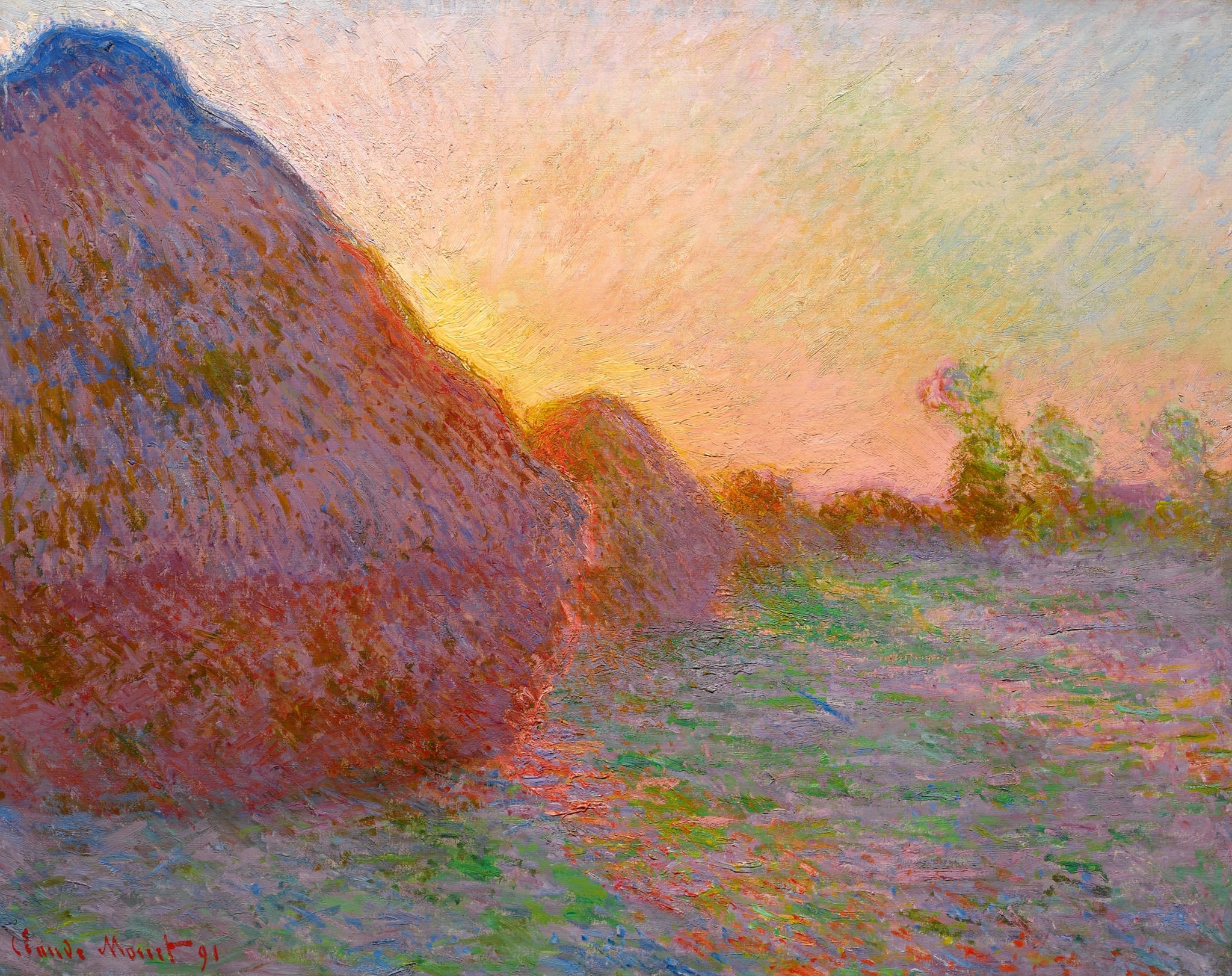
Claude Monet’s <strong>Haystacks Series</strong> transforms a routine rural subject into an inquiry into <strong>light, time, and perception</strong>. In this sunset view, the stacks swell at the left while the sun burns through the gap, making the field shimmer with <strong>apricot, lilac, and blue</strong> vibrations.
The Artist's Garden at Giverny by Claude Monet

The Artist's Garden at Giverny

Claude Monet (1900)

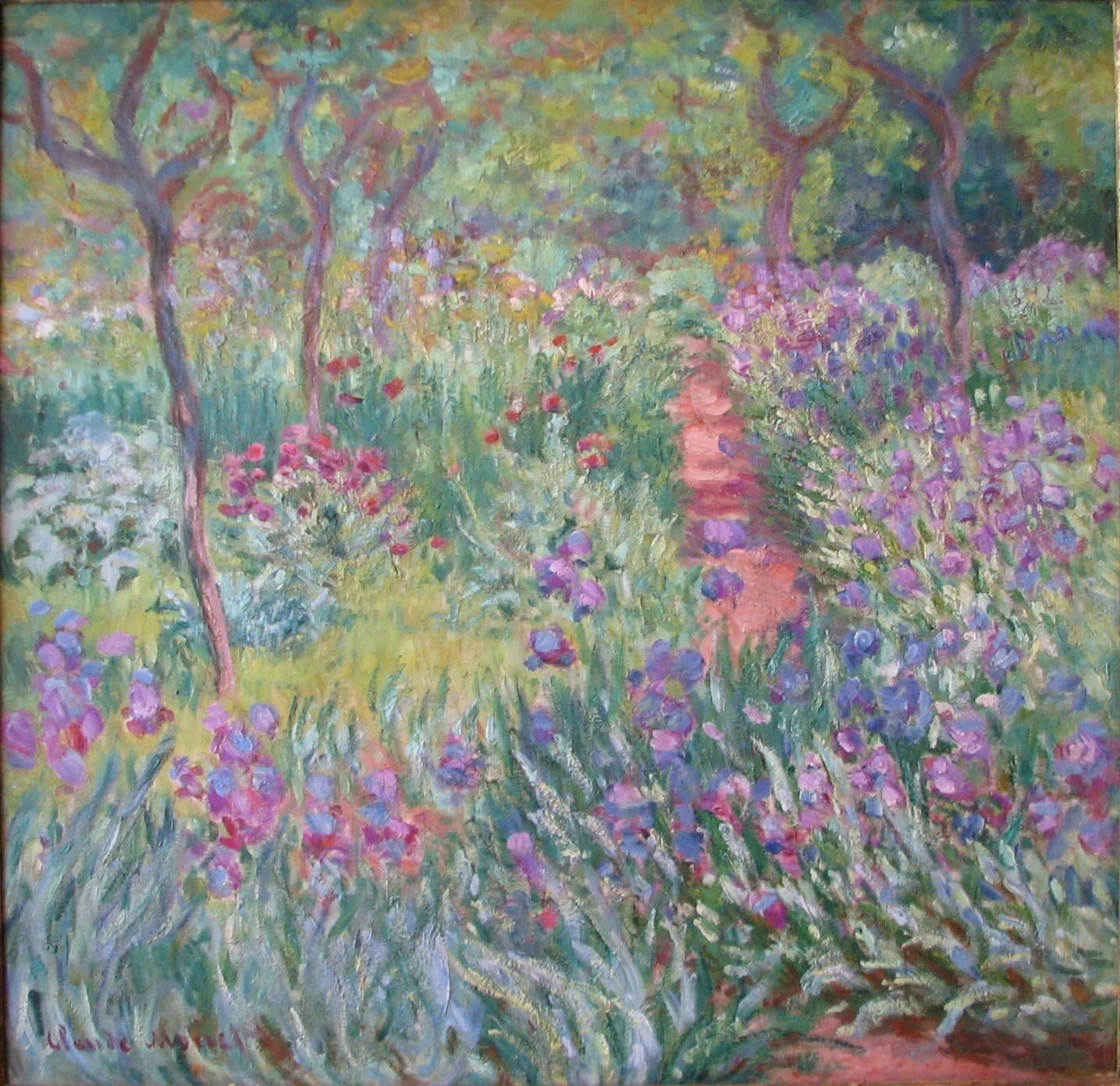
In The Artist's Garden at Giverny, Claude Monet turns his cultivated Clos Normand into a field of living color, where bands of violet <strong>irises</strong> surge toward a narrow, rose‑colored path. Broken, flickering strokes let greens, purples, and pinks mix optically so that light seems to tremble across the scene, while lilac‑toned tree trunks rhythmically guide the gaze inward <sup>[1]</sup><sup>[3]</sup>.
The Water Lily Pond by Claude Monet

The Water Lily Pond

Claude Monet (1899)

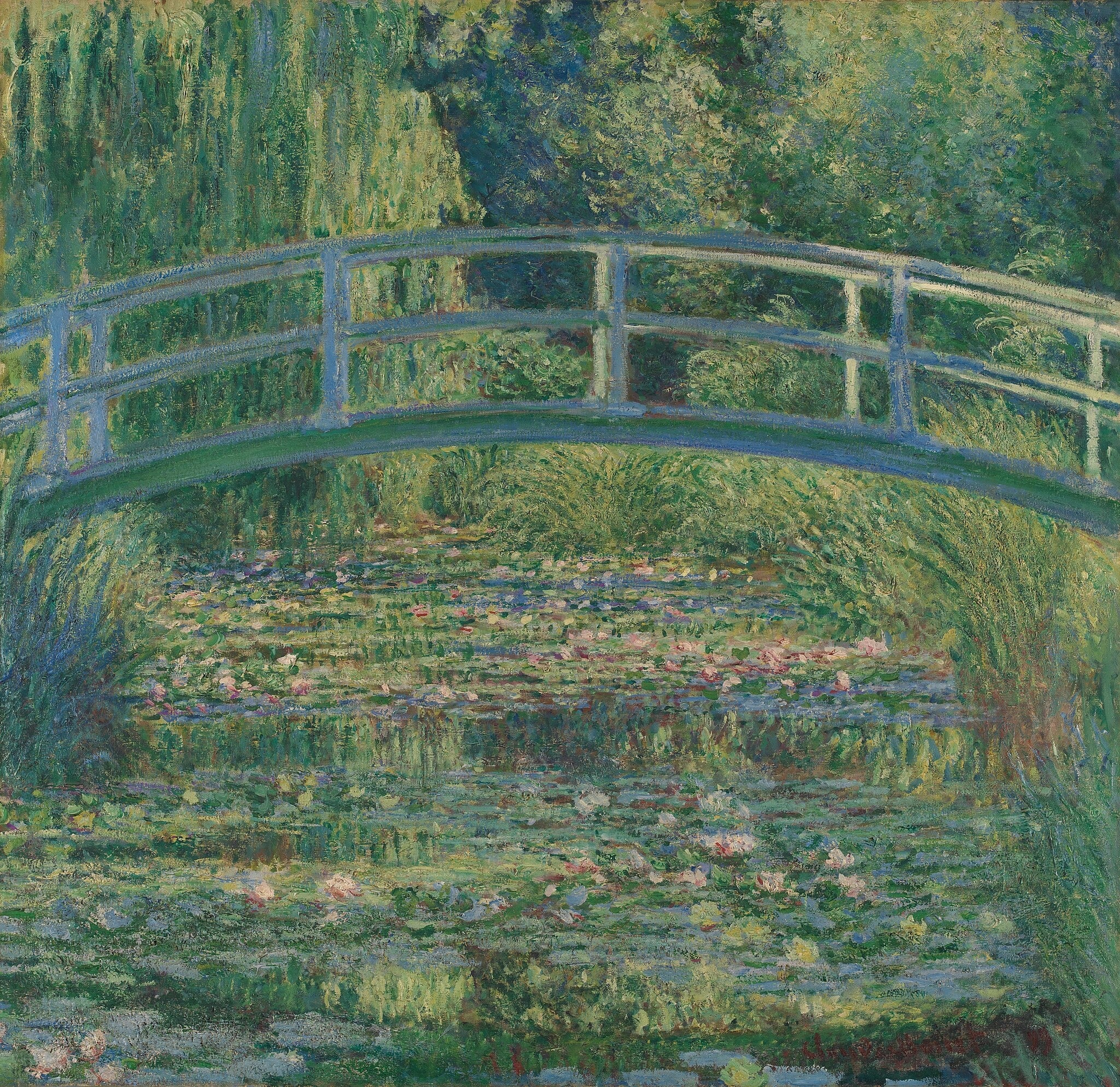
Claude Monet’s The Water Lily Pond transforms a designed garden into a theater of <strong>perception and reflection</strong>. The pale, arched <strong>Japanese bridge</strong> hovers over a surface where lilies, reeds, and mirrored willow fronds dissolve boundaries between water and sky, proposing <strong>seeing itself</strong> as the subject <sup>[1]</sup><sup>[3]</sup>.

Waterloo Bridge, Sunlight Effect by Claude Monet

Waterloo Bridge, Sunlight Effect

Claude Monet (1903 (begun 1900))

Claude Monet’s Waterloo Bridge, Sunlight Effect renders London as a <strong>lilac-blue atmosphere</strong> where form yields to light. The bridge’s stone arches persist as anchors, yet the span dissolves into mist while <strong>flecks of lemon and ember</strong> signal modern traffic crossing a city made weightless <sup>[1]</sup><sup>[2]</sup>. Vertical hints of chimneys haunt the distance, binding industry to beauty as the Thames shimmers with the same notes as the sky <sup>[1]</sup><sup>[3]</sup>.

Morning on the Seine (series) by Claude Monet

Morning on the Seine (series)

Claude Monet (1897)

Claude Monet’s Morning on the Seine (series) turns dawn into an inquiry about <strong>perception</strong> and <strong>time</strong>. In this canvas, the left bank’s shadowed foliage dissolves into lavender mist while a pale radiance opens at right, fusing sky and water into a single, reflective field <sup>[1]</sup><sup>[2]</sup>.

Woman with a Parasol by Claude Monet

Woman with a Parasol

Claude Monet (1875)

Claude Monet’s Woman with a Parasol fixes a breezy hillside instant in high, shifting light, setting a figure beneath a <strong>green parasol</strong> against a vast, vibrating sky. The low vantage and <strong>broken brushwork</strong> merge dress, clouds, and grasses into one atmosphere, while a child at the rise anchors depth and intimacy <sup>[1]</sup>. It is a manifesto of <strong>plein-air</strong> perception—painting the sensation of air in motion rather than the contours of things <sup>[2]</sup>.