Reading

by Berthe Morisot

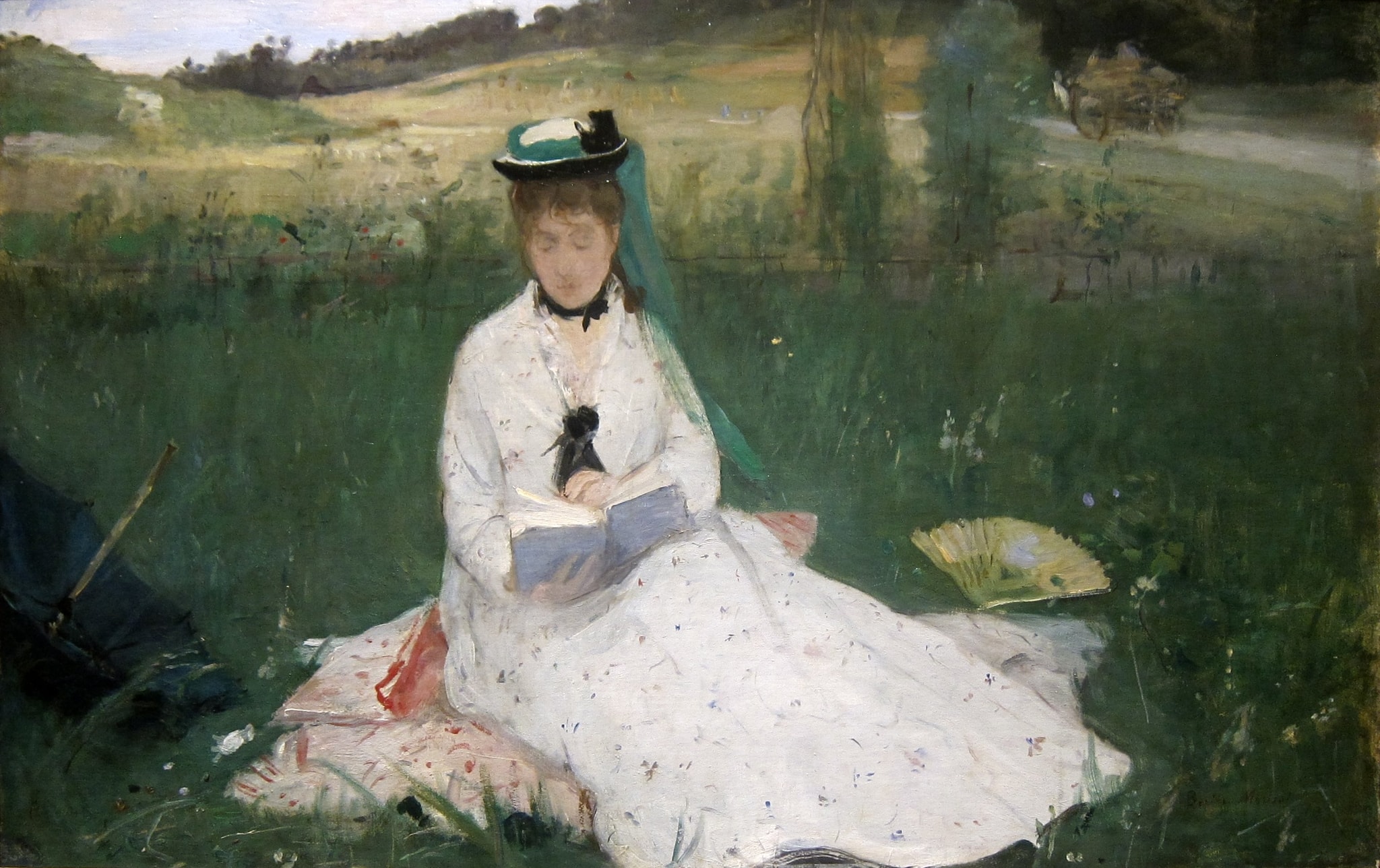
In Berthe Morisot’s Reading (1873), a woman in a pale, patterned dress sits on the grass, absorbed in a book while a green parasol and folded fan lie nearby. Morisot’s quick, luminous brushwork dissolves the landscape into atmospheric greens as a distant carriage passes, turning an outdoor scene into a study of interior life. The work makes female intellectual absorption its true subject, aligning modern leisure with private thought.

Fast Facts

Year
1873
Medium
Oil on canvas
Dimensions
46 × 71.8 cm
Location
Cleveland Museum of Art, Cleveland
Reading by Berthe Morisot (1873) featuring Book, Green Parasol, Folded fan, White dress catching color

Click on any numbered symbol to learn more about its meaning

Meaning & Symbolism

Morisot sets up a paradox: in an open field, the figure is wholly private. The pale dress acts as a screen that catches sky color, scattering cool violets and greens across the fabric; the face is deliberately unresolved, held to a few strokes that decline the conventions of portrait specificity. This refusal of minute finish is not negligence but a principle—the Impressionist non finito that insists on sensation over line—placing attention rather than appearance at the center of the picture 2. The book anchors that attention. Its weight in the sitter’s lap and the downcast gaze declare the primacy of reading as an autonomous act; the fan and parasol are not flirtatious codes but idle accessories of bourgeois outdoor life, temporarily displaced by the work of the mind 178. The green veil trails from the hat like a cool accent, echoing the umbrella’s dark green triangle at left. These rhymes of color bind attire to place, so that clothing, grass, and distant hedgerow form a single atmosphere—Corot’s legacy refracted through Morisot’s faster, sparer touch, visible in the sprinkled blossom-highlights in the lawn 2. The background stages a negotiation between modernity and retreat. A faint carriage moves along a pale road, a sign that this is not Arcadia but a lived landscape where people come and go; yet the reader does not look up 5. Morisot’s composition posits that a woman can claim a public patch of ground as a private sanctuary through concentration alone. This is not the ornamental femininity of fashion display; it is a record of mental absorption—a theme critics and scholars have recognized across Morisot’s oeuvre, where women “with minds of their own” replace passive types 56. In 1873, the choice was programmatic. Morisot, who would exhibit with the Impressionists in 1874, replaces Salon finish with a network of brisk strokes and open passages that let the canvas breathe, making immediacy the guarantee of truth 249. The white dress—Impressionism’s trial by light—serves as her laboratory, catching every chromatic reflection that proves the scene was seen, not manufactured in the studio 1. By softening the sitter’s features and clarifying the book, Morisot redirects narrative hierarchy: identity is inferred from action, not physiognomy. Reading becomes emblem and evidence of intellectual independence within the conditions of modern leisure 13. The painting’s quiet radicalism lies in how it fuses subject and method. Impressionist facture turns looking into time, and Morisot applies that temporality to a woman’s interior life, insisting that thought itself unfolds moment by moment. The green umbrella and folded fan, documented accessories of bourgeois outdoor etiquette, register class and comfort without overcoded symbolism; their very idleness marks the triumph of attention over display 78. The result is a modern ethics of seeing: the artist asks us to respect absorption rather than interrupt it. That stance, presented in 1873 and shown at the 1874 exhibition under the title La lecture, places Morisot at the core of Impressionism’s redefinition of significant subject matter—from history and spectacle to the here-and-now of a single thinking person in light 129.

Explore Deeper with AI

Ask questions about Reading

Popular questions:

Powered by AI • Get instant insights about this artwork

💬 Ask questions about this artwork!

Interpretations

Feminist Agency and Sisterhood

Casting Edma—who curtailed her own art after marriage—as an absorbed reader reframes women’s outdoor presence as intellectual sovereignty, not ornament. The work enacts a subtle redistribution of power: identity is inferred from action (reading) rather than physiognomy, subverting portrait conventions and the gendered gaze. Read alongside earlier family pictures, the painting marks a shift from depicting women as relational (daughter/sister/wife) to autonomous subjects claiming time and thought in public space. That Morisot selected La lecture for the 1874 debut signals a programmatic statement: Impressionism’s new content includes women’s self-directed attention as a modern right, not a courtesy of the setting 1238.

Source: Cleveland Museum of Art; The Metropolitan Museum of Art; Rizzoli (Berthe Morisot: Woman Impressionist); Encyclopaedia Britannica

Material Culture: Accessories Without Code

Parasol, fan, and veil are status-bearing objects of bourgeois outdoor etiquette, yet Morisot pointedly renders them idle, their functions suspended by reading. Rather than flirtatious semaphore, these items operate as social indices—evidence of comfort, mobility, and propriety—while ceding narrative primacy to the mind at work. The green parasol’s wedge and the trailing veil harmonize chromatically with the sward, binding class markers to place. Notably, the popular “language of the fan” is largely a later myth, so reading the folded fan as code is anachronistic; Morisot’s restraint aligns with a documentary, not allegorical, approach to fashion 1267.

Source: Cleveland Museum of Art; The Metropolitan Museum of Art; The Met Costume Institute; Fashion History Museum

Optical Experiment: White as a Field of Reflections

The white dress becomes an optical laboratory, catching cool violets and greens—a test of Impressionism’s premise that light and color articulate form. Morisot’s open facture and “non finito” prioritize perceptual events over contour, while Corot’s legacy surfaces in the sparked blossom-highlights across the grass. The book’s planar block anchors the chromatic flicker with a geometric counterweight, calibrating attention between transient light effects and structural emphasis. Such handling, exhibited in 1874, asserted immediacy as truth and challenged Salon finish, positioning Morisot’s surface as a record of looking in time rather than a mimetic replica of things 12.

Source: The Metropolitan Museum of Art; Cleveland Museum of Art

Exhibition Politics: Positioning a New Subject

Shown as La lecture at the First Impressionist Exhibition (1874), Reading functioned as a manifesto for new subject matter—the significance of everyday, mentally absorbed experience. Morisot, the only woman among the founding exhibitors, advanced an ethic of present-tense seeing that reoriented value away from history painting. Her submission of a woman thinking in light contested the Salon’s hierarchies while asserting a woman artist’s authority to define the terms of modernity. Recent commemorations of 1874 underscore how works like this helped “invent” Impressionism by shifting attention from spectacle to intimate observation, expanding who and what could count as the modern 289.

Source: The Metropolitan Museum of Art; Encyclopaedia Britannica; Musée d’Orsay (Paris 1874: Inventing Impressionism)

Public Ground, Private Mind

The faint carriage on the pale road marks a permeable, modern landscape—circulation without intrusion. Morisot stages a paradox of public privacy: through sustained attention, the sitter transforms a shared lawn into a private sanctuary. This counters prevailing tropes of female visibility (fashion display, flirtation) with a model of self-absorption legible from a distance. Critics have noted how Morisot repeatedly renders women as mentally self-possessed; here, urban mobility skirts the horizon while concentration seals the foreground. The scene thus maps a gendered right to urban-nature spaces: presence without performance, leisure without spectacle, intellect without apology 245.

Source: The Metropolitan Museum of Art; Philadelphia Inquirer; The New Yorker

Related Themes

About Berthe Morisot

Berthe Morisot (1841–1895) was a founding member of Impressionism and the only woman to exhibit in the group’s inaugural 1874 show [1][4]. Trained under Corot, she became known for intimate scenes of women, children, and interiors rendered with swift brushwork and luminous, restrained color [3][4]. Her focus on modern domestic life expanded Impressionism’s subjects and reoriented its gaze toward the private sphere.
View all works by Berthe Morisot

More by Berthe Morisot

The Cradle by Berthe Morisot

The Cradle

Berthe Morisot (1872)

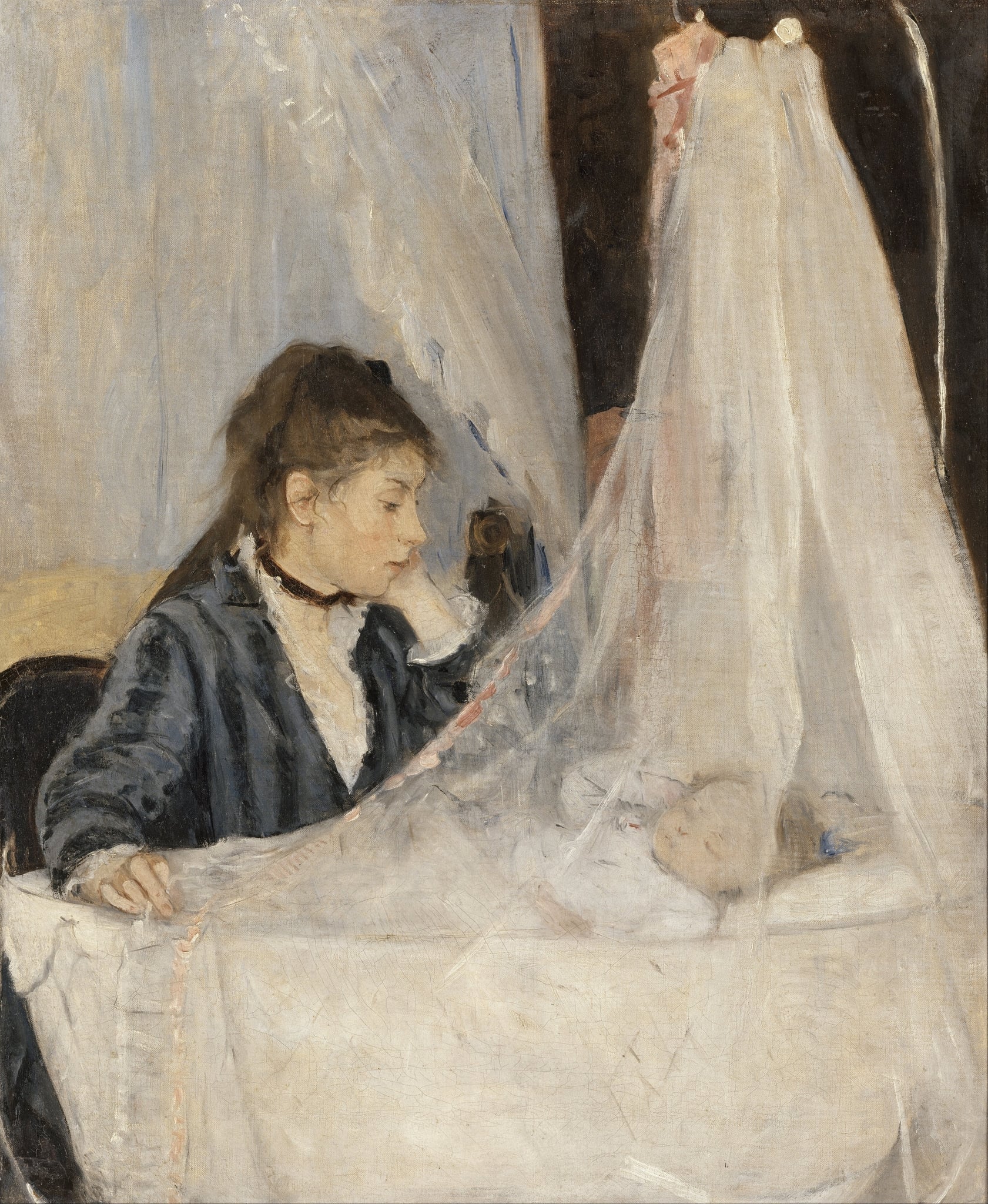
Berthe Morisot’s The Cradle turns a quiet nursery into a scene of <strong>vigilant love</strong>. A gauzy veil, lifted by the watcher’s hand, forms a <strong>protective boundary</strong> that cocoons the sleeping child in light while linking the two figures through a decisive diagonal <sup>[1]</sup><sup>[2]</sup>. The painting crystallizes modern maternity as a form of attentiveness rather than display—an <strong>unsentimental icon</strong> of care.

Summer's Day by Berthe Morisot

Summer's Day

Berthe Morisot (about 1879)

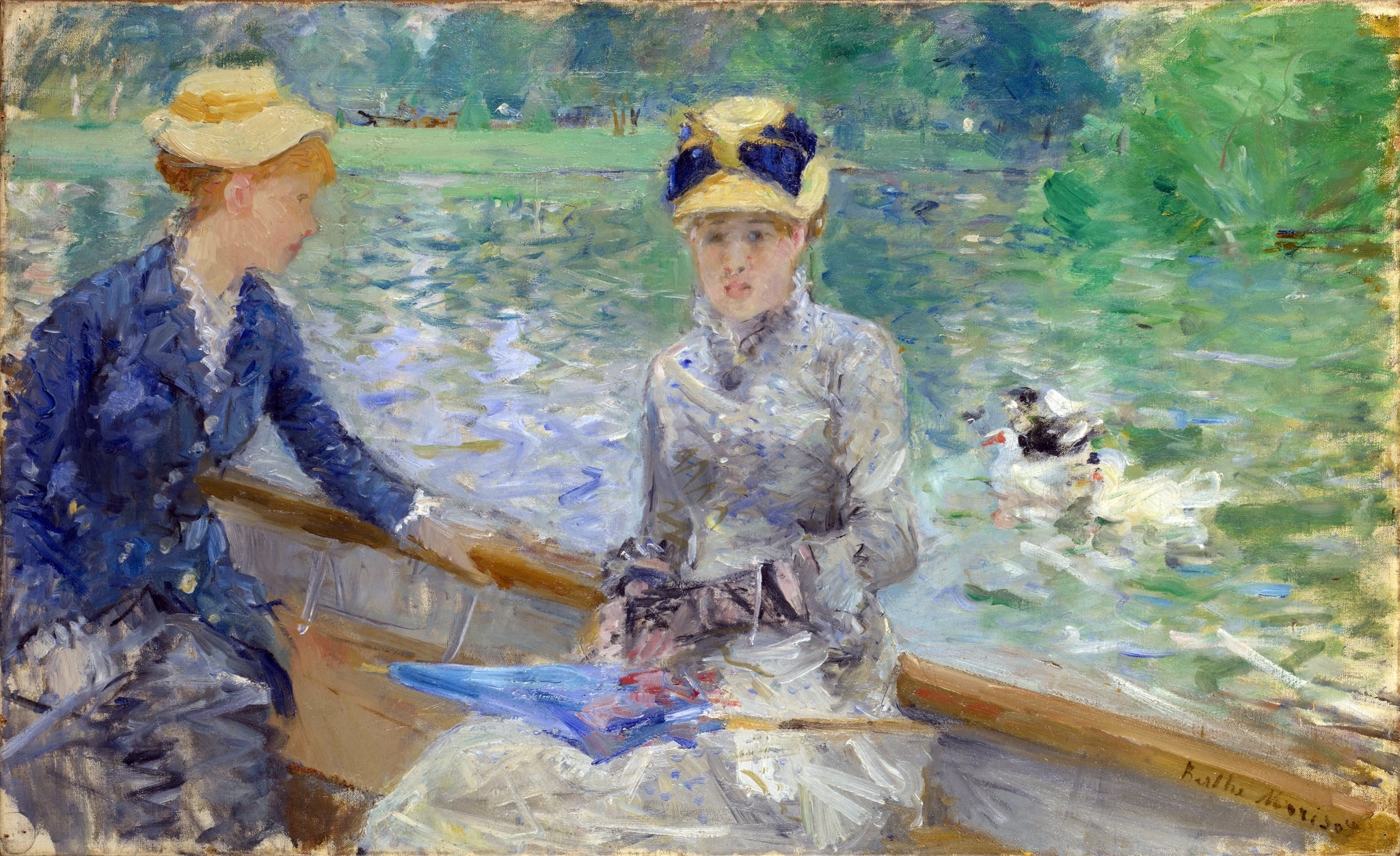
Two women drift on a boat in the Bois de Boulogne, their dresses, hats, and a bright blue parasol fused with the lake’s flicker by Morisot’s swift, <strong>zig‑zag brushwork</strong>. The scene turns a brief outing into a poised study of <strong>modern leisure</strong> and <strong>female companionship</strong> in public space <sup>[1]</sup>.
Woman at Her Toilette by Berthe Morisot

Woman at Her Toilette

Berthe Morisot (1875–1880)

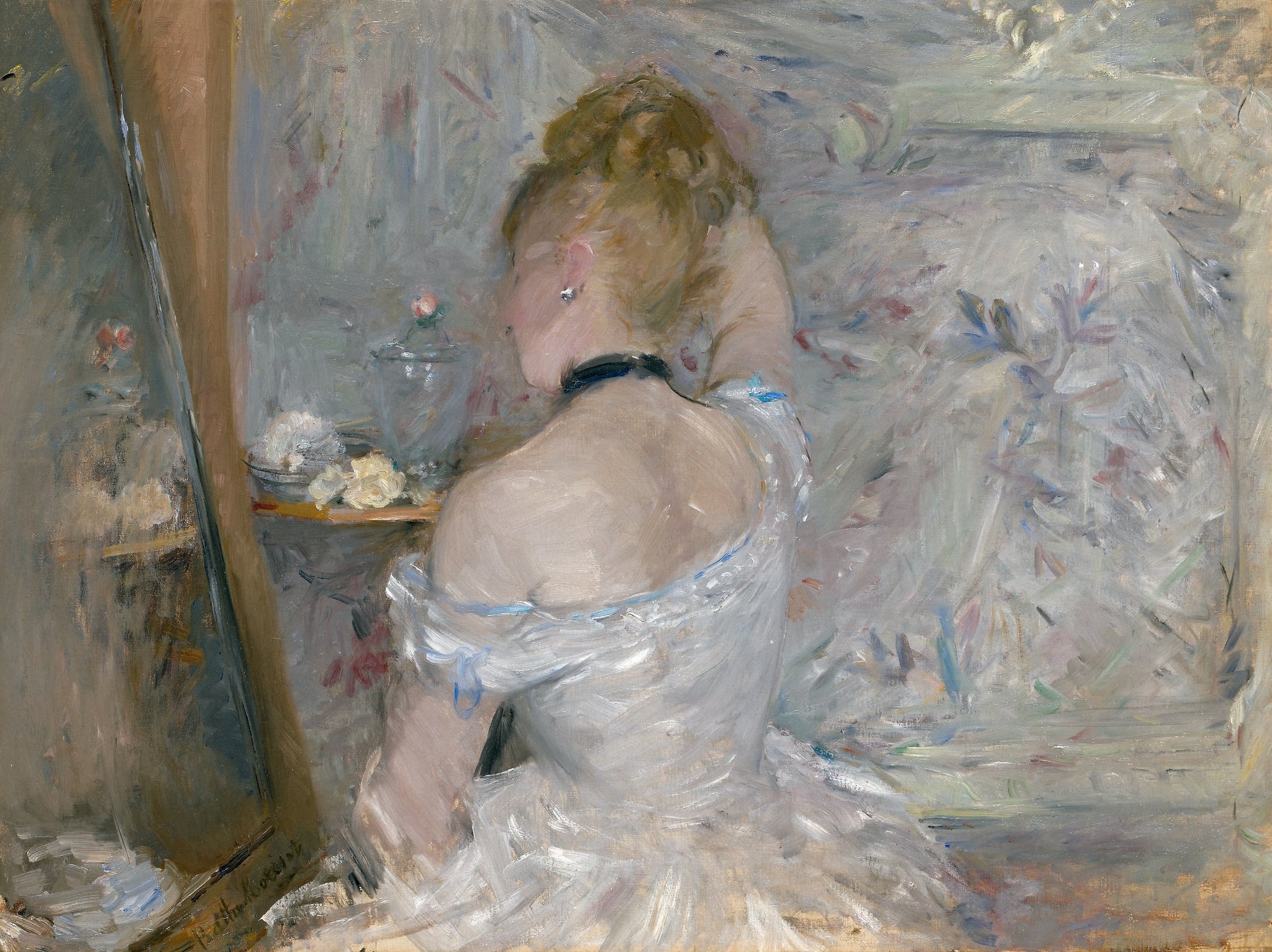
Woman at Her Toilette stages a private ritual of self-fashioning, not a spectacle of vanity. A woman, seen from behind, lifts her arm to adjust her hair as a <strong>black velvet choker</strong> punctuates Morisot’s silvery-violet haze; the <strong>mirror’s blurred reflection</strong> with powders, jars, and a white flower refuses a clear face. Morisot’s <strong>feathery facture</strong> turns a fleeting toilette into modern subjectivity made visible <sup>[1]</sup>.
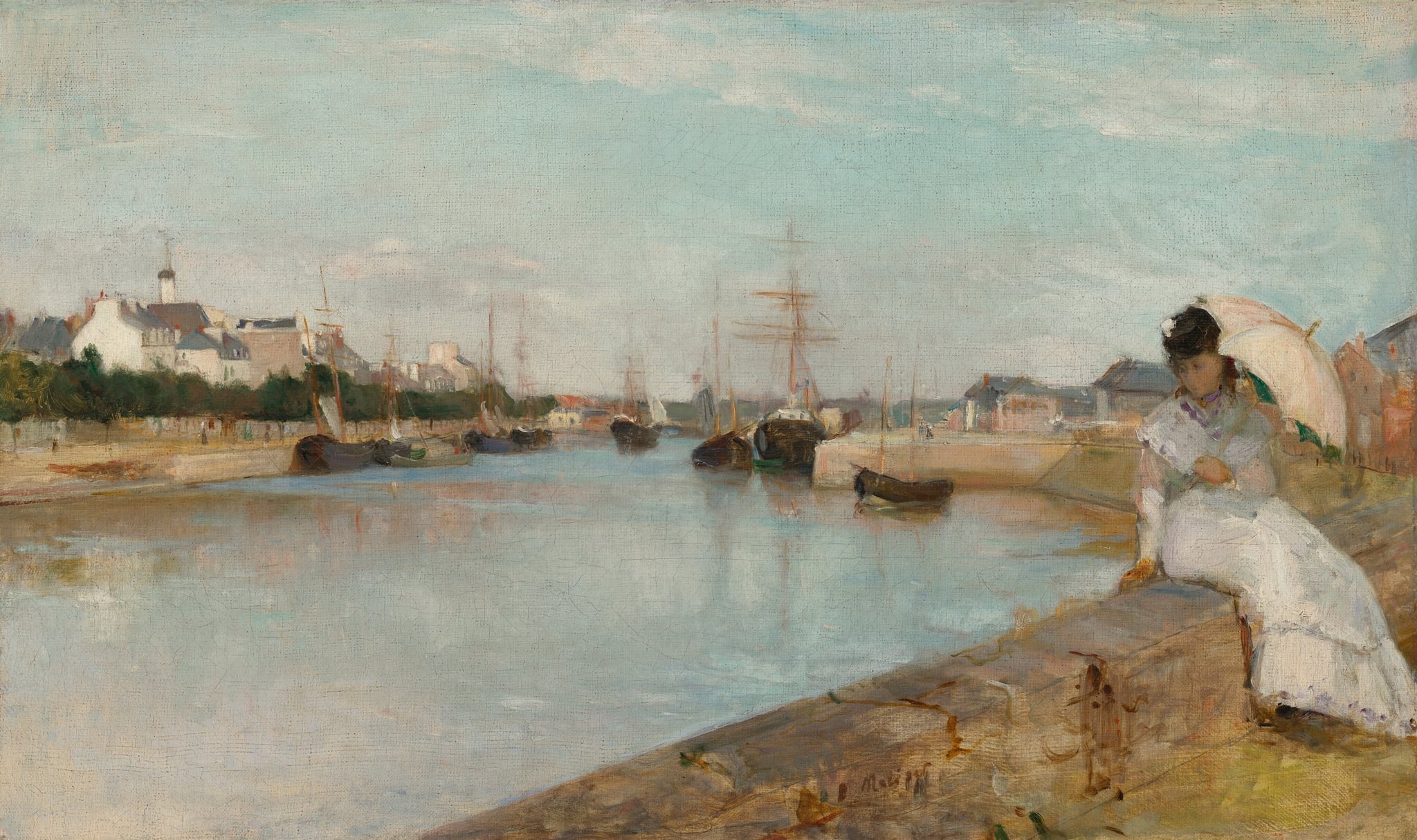
The Harbour at Lorient by Berthe Morisot

The Harbour at Lorient

Berthe Morisot (1869)

Berthe Morisot’s The Harbour at Lorient stages a quiet tension between <strong>private reverie</strong> and <strong>public movement</strong>. A woman under a pale parasol sits on the quay’s stone lip while a flotilla of masted boats idles across a silvery basin, their reflections dissolving into light. Morisot’s <strong>pearly palette</strong> and brisk brushwork make the water read as time itself, holding stillness and departure in the same breath <sup>[1]</sup>.