Everyday life as art (readymade, the ordinary)
Featured Artworks
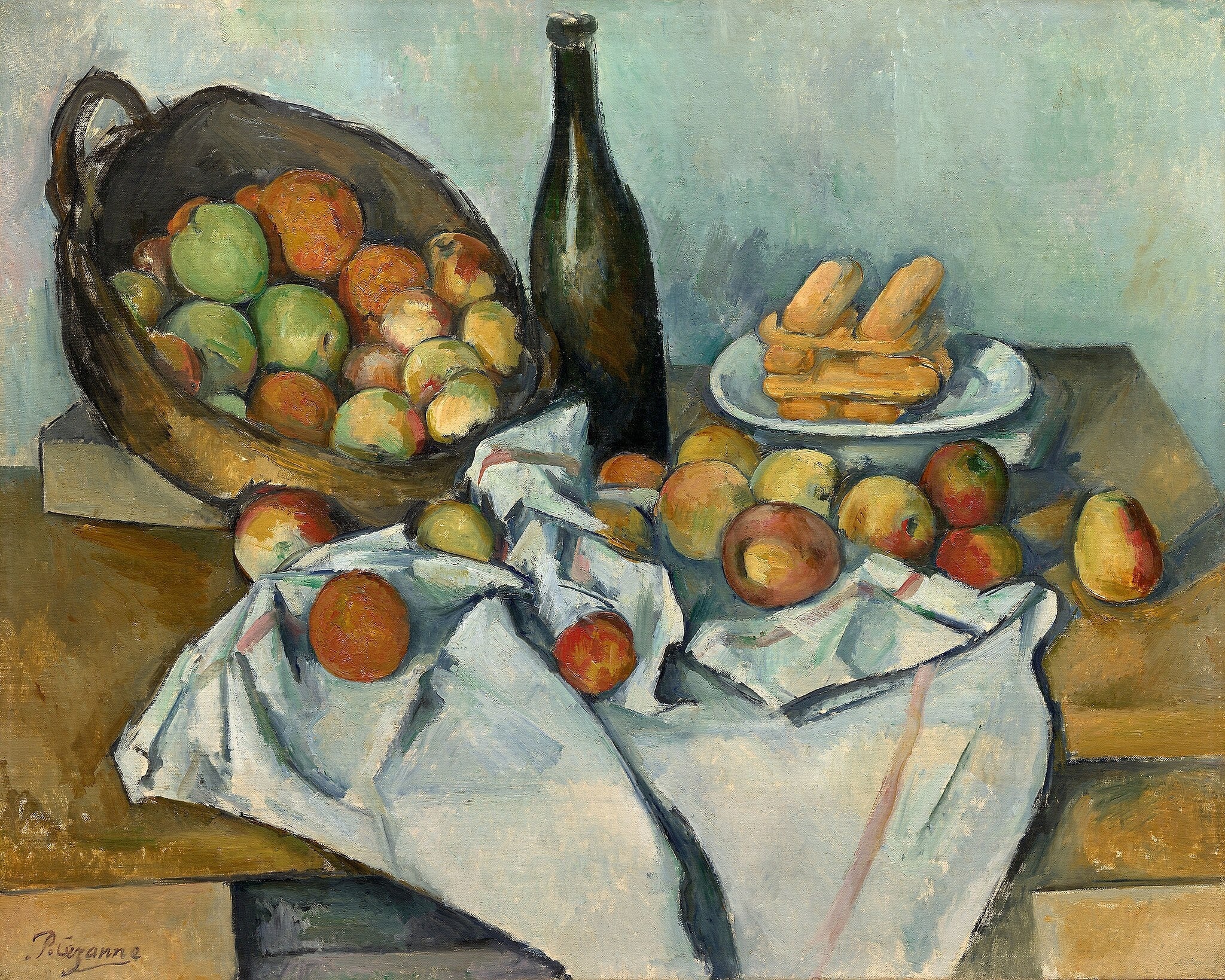
Still Life with a Basket of Apples
Paul Cézanne (c. 1893 (AIC range 1887–1900))
Paul Cezanne’s Still Life with a Basket of Apples stages a quiet crisis of balance: a basket tilts forward, a dark bottle leans, and a rumpled cloth surges like a ridge across the table. Through <strong>purposeful misalignments</strong> and <strong>constructed color</strong>, the painting turns ordinary fruit into an inquiry into how we see over time <sup>[1]</sup><sup>[3]</sup>.
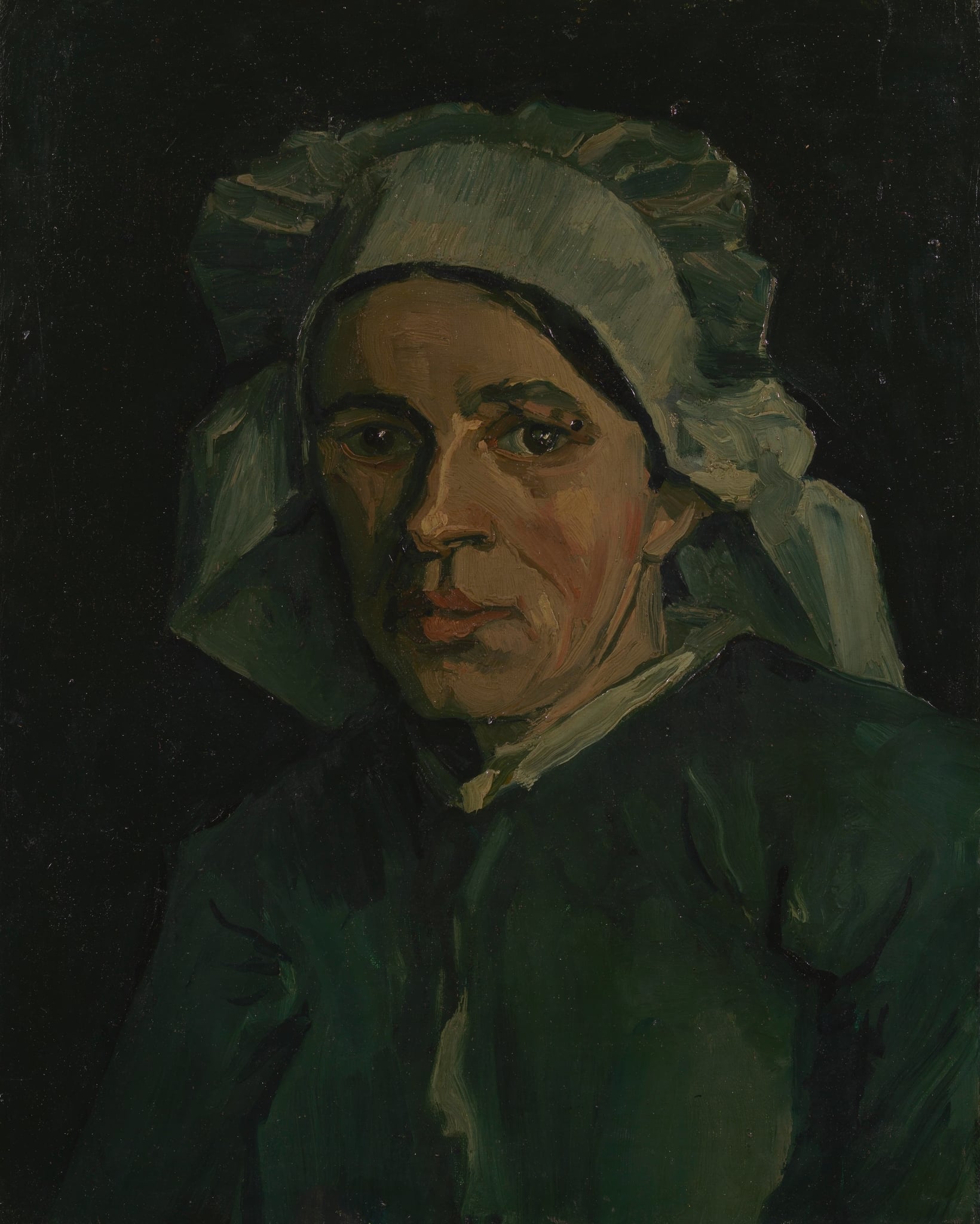
Head of a Woman
Vincent van Gogh (1885)
Van Gogh’s Head of a Woman turns a peasant’s face into a study of <strong>character and moral weight</strong>. With a near‑black ground, raking light from the left, and an earthbound range of greens and ochres, the painting asserts <strong>dignity without prettiness</strong>, anticipating the ethos of The Potato Eaters <sup>[1]</sup><sup>[2]</sup>.
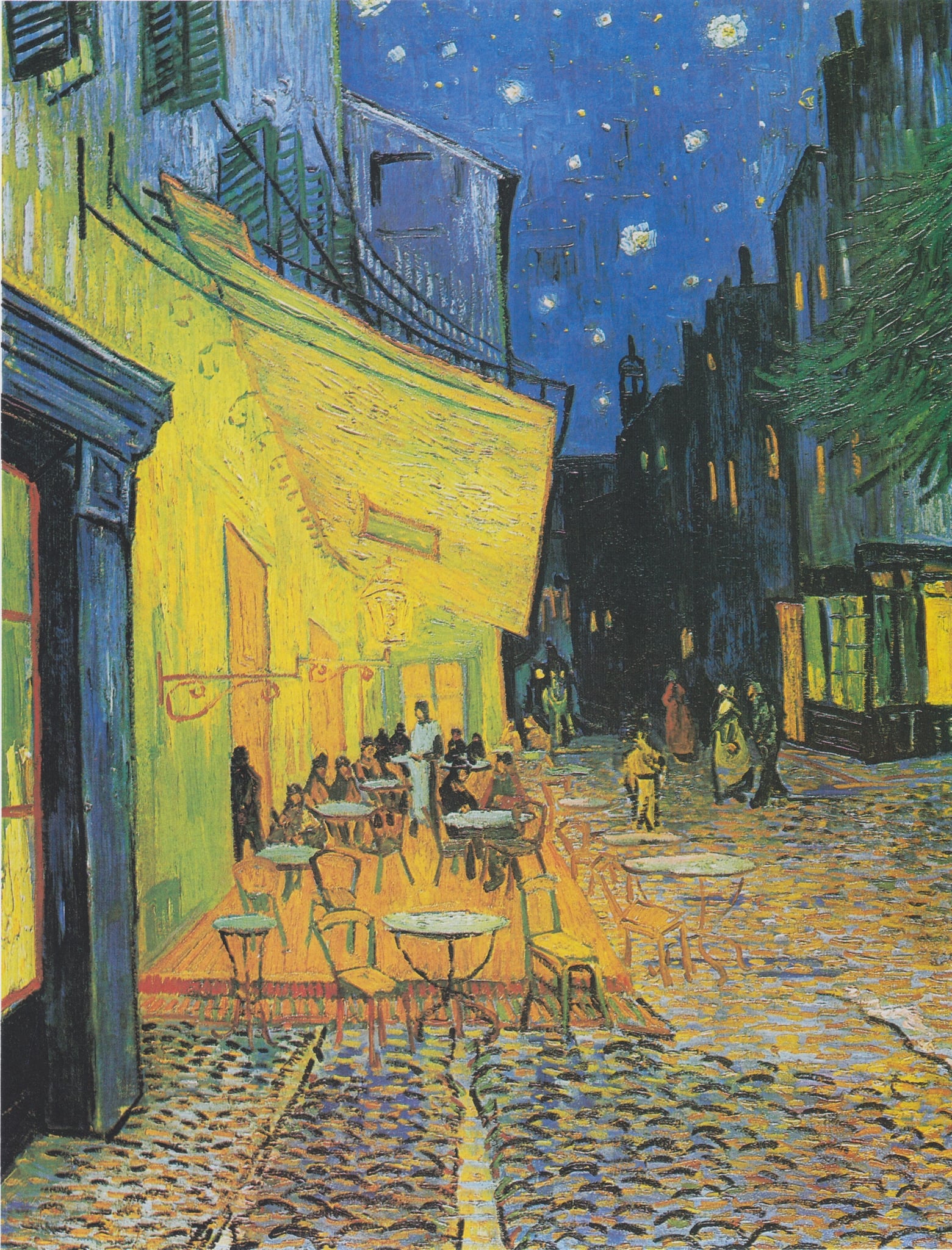
Café Terrace at Night
Vincent van Gogh (1888)
In Café Terrace at Night, Vincent van Gogh turns nocturne into <strong>luminous color</strong>: a gas‑lit terrace glows in yellows and oranges against a deep <strong>ultramarine sky</strong> pricked with stars. By building night “<strong>without black</strong>,” he stages a vivid encounter between human sociability and the vastness overhead <sup>[1]</sup><sup>[2]</sup>.
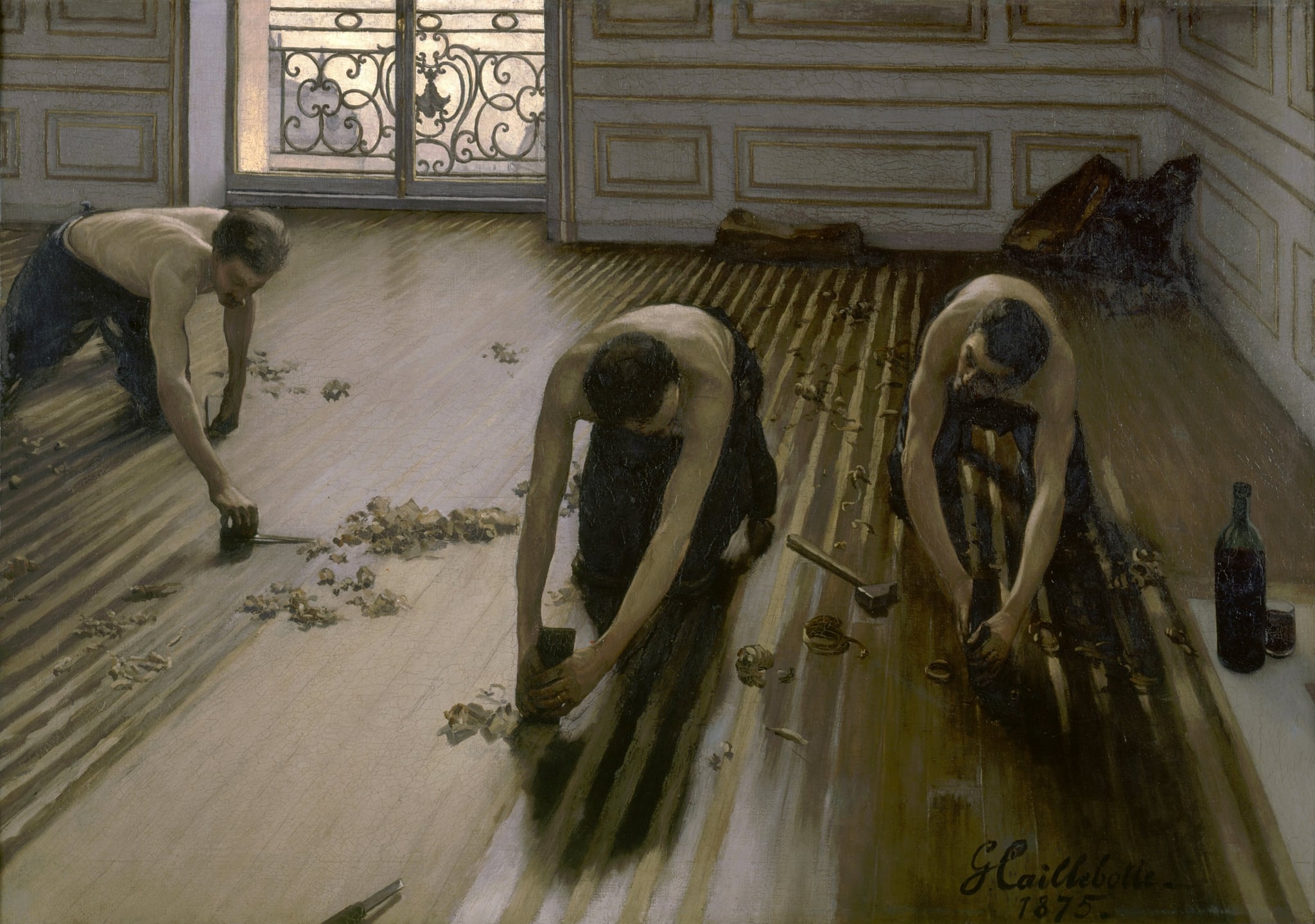
The Floor Scrapers
Gustave Caillebotte (1875)
Gustave Caillebotte’s The Floor Scrapers stages three shirtless workers planing a parquet floor as shafts of light pour through an ornate balcony door. The painting fuses <strong>rigorous perspective</strong> with <strong>modern urban labor</strong>, turning curls of wood and raking light into a ledger of time and effort <sup>[1]</sup><sup>[3]</sup>. Its cool, gilded interior makes visible how bourgeois elegance is built on bodily work.
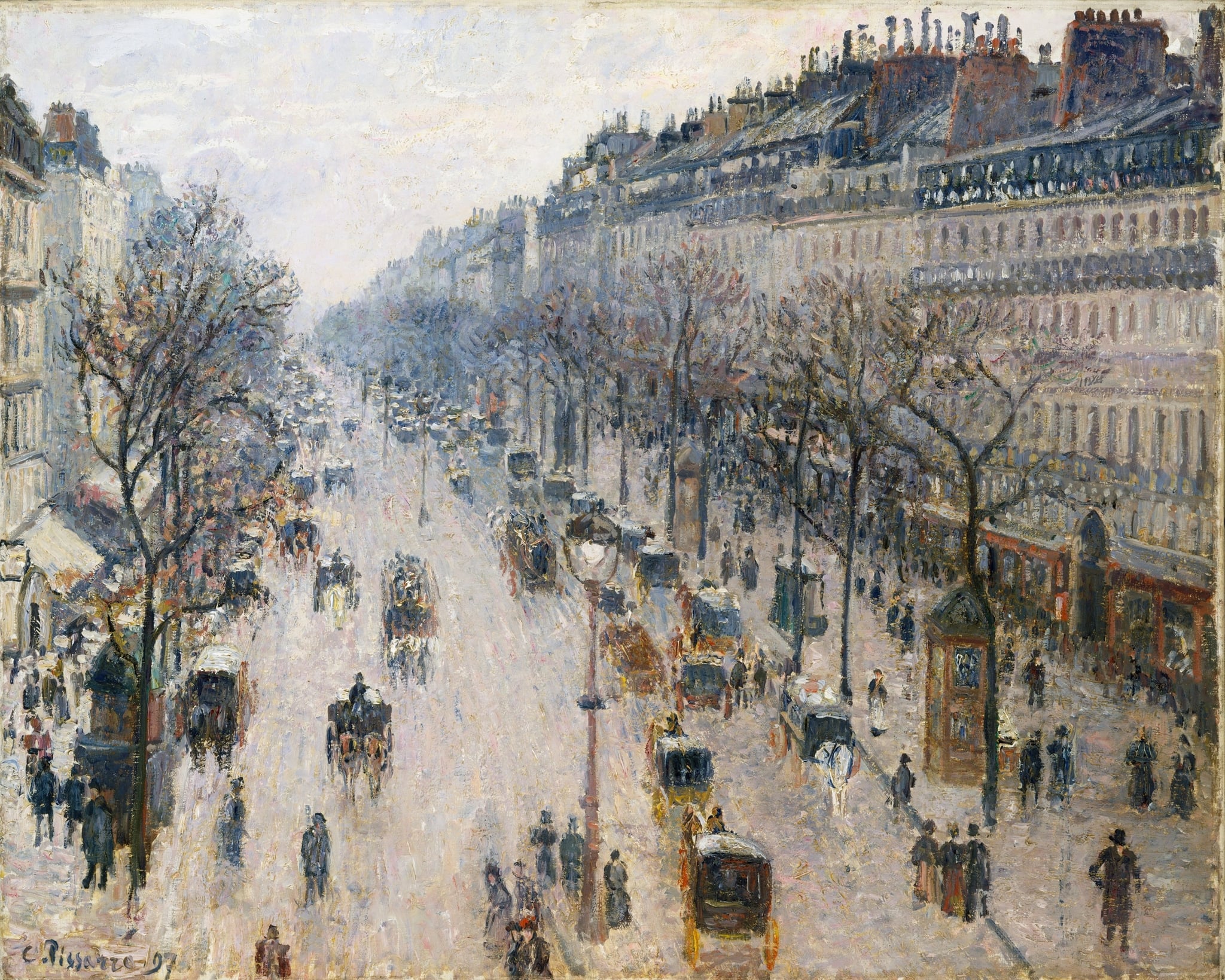
The Boulevard Montmartre on a Winter Morning
Camille Pissarro (1897)
From a high hotel window, Camille Pissarro renders Paris as a living system—its Haussmann boulevard dissolving into winter light, its crowds and vehicles fused into a soft, <strong>rhythmic flow</strong>. Broken strokes in cool grays, lilacs, and ochres turn fog, steam, and motion into <strong>texture of time</strong>, dignifying the city’s ordinary morning pulse <sup>[1]</sup><sup>[3]</sup>.
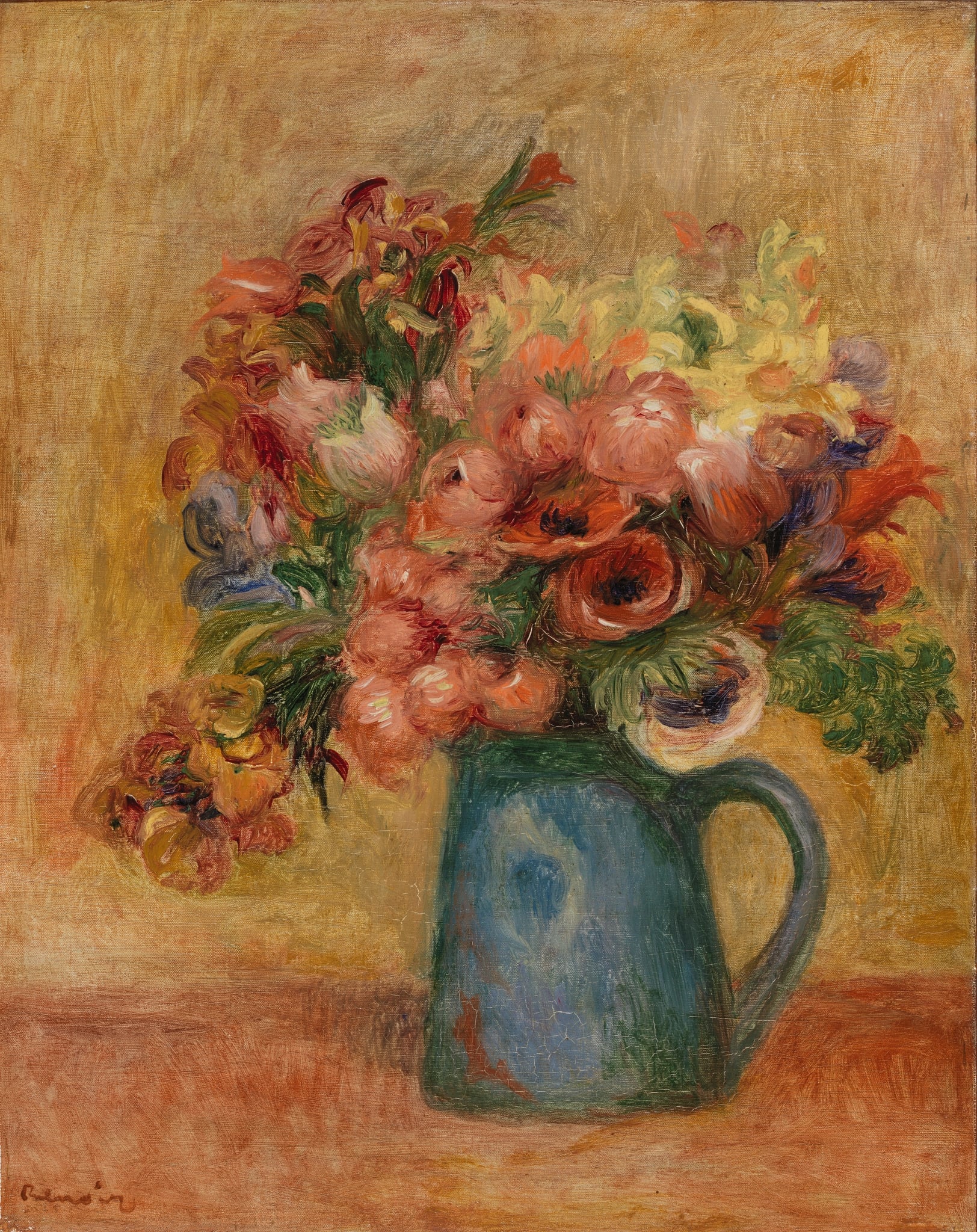
Vase of Flowers
Pierre-Auguste Renoir (c. 1889)
Vase of Flowers is a late‑1880s still life in which Pierre-Auguste Renoir turns a humble blue‑green jug and a tumbling bouquet into a <strong>laboratory of color and touch</strong>. Against a warm ocher wall and reddish tabletop, coral and vermilion blossoms flare while cool greens and violets anchor the mass, letting <strong>color function as drawing</strong> <sup>[1]</sup><sup>[4]</sup>. The work affirms Renoir’s belief that flower painting was a space for bold experimentation that fed his figure art.
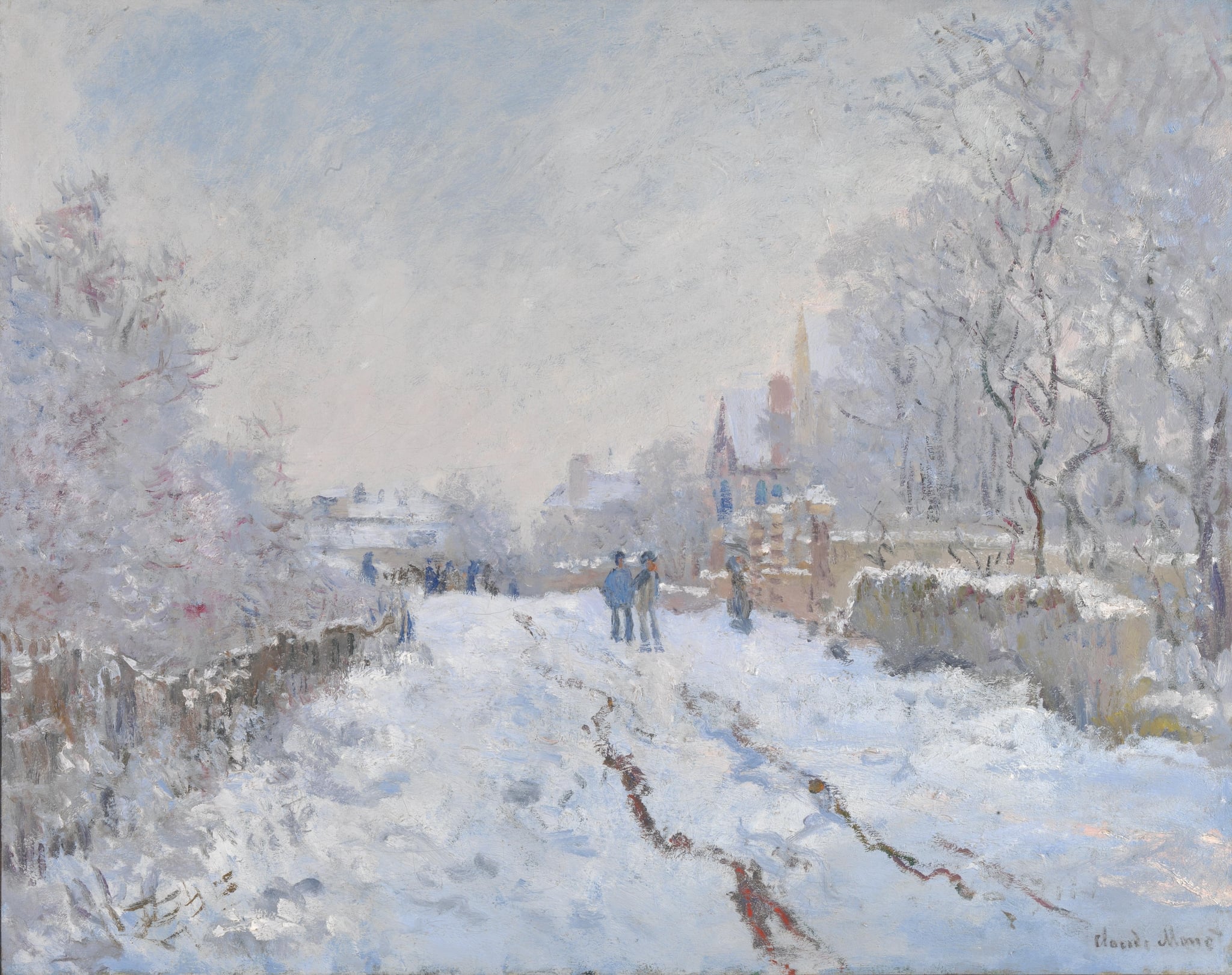
Snow at Argenteuil
Claude Monet (1875)
<strong>Snow at Argenteuil</strong> renders a winter boulevard where light overtakes solid form, turning snow into a luminous field of blues, violets, and pearly pinks. Reddish cart ruts pull the eye toward a faint church spire as small, blue-gray figures persist through the hush. Monet elevates atmosphere to the scene’s <strong>protagonist</strong>, making everyday passage a meditation on time and change <sup>[1]</sup><sup>[2]</sup>.
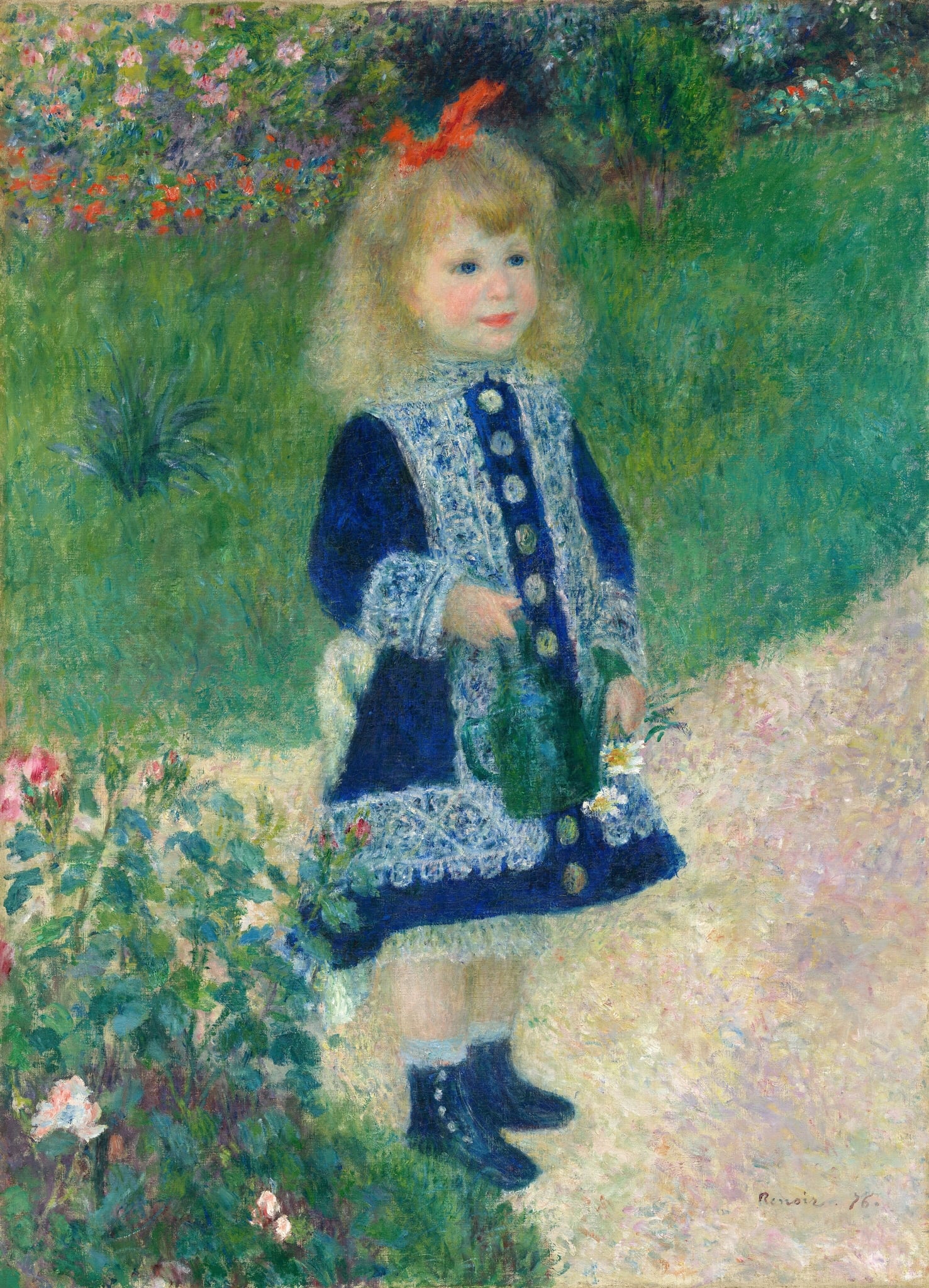
Girl with a Watering Can
Pierre-Auguste Renoir (1876)
Renoir’s 1876 Girl with a Watering Can fuses a crisply perceived child with a dissolving garden atmosphere, using <strong>prismatic color</strong> and <strong>controlled facial modeling</strong> to stage innocence within modern leisure <sup>[1]</sup>. The cobalt dress, red bow, and green can punctuate a haze of pinks and greens, making nurture and growth the scene’s quiet thesis.
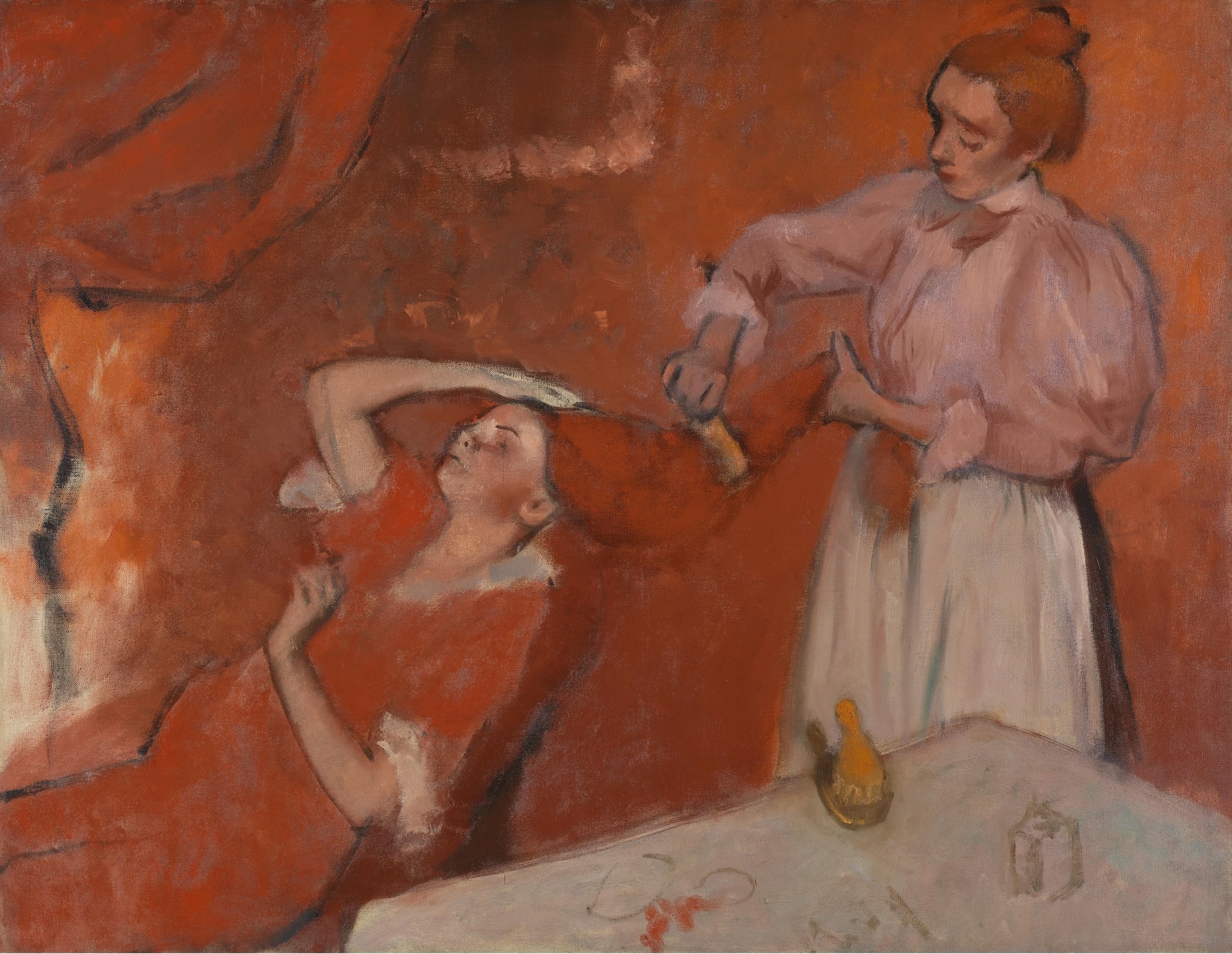
Combing the Hair
Edgar Degas (c.1896)
Edgar Degas’s Combing the Hair crystallizes a private ritual into a scene of <strong>compressed intimacy</strong> and <strong>classed labor</strong>. The incandescent field of red fuses figure and room, turning the hair into a <strong>binding ribbon</strong> between attendant and sitter <sup>[1]</sup>.
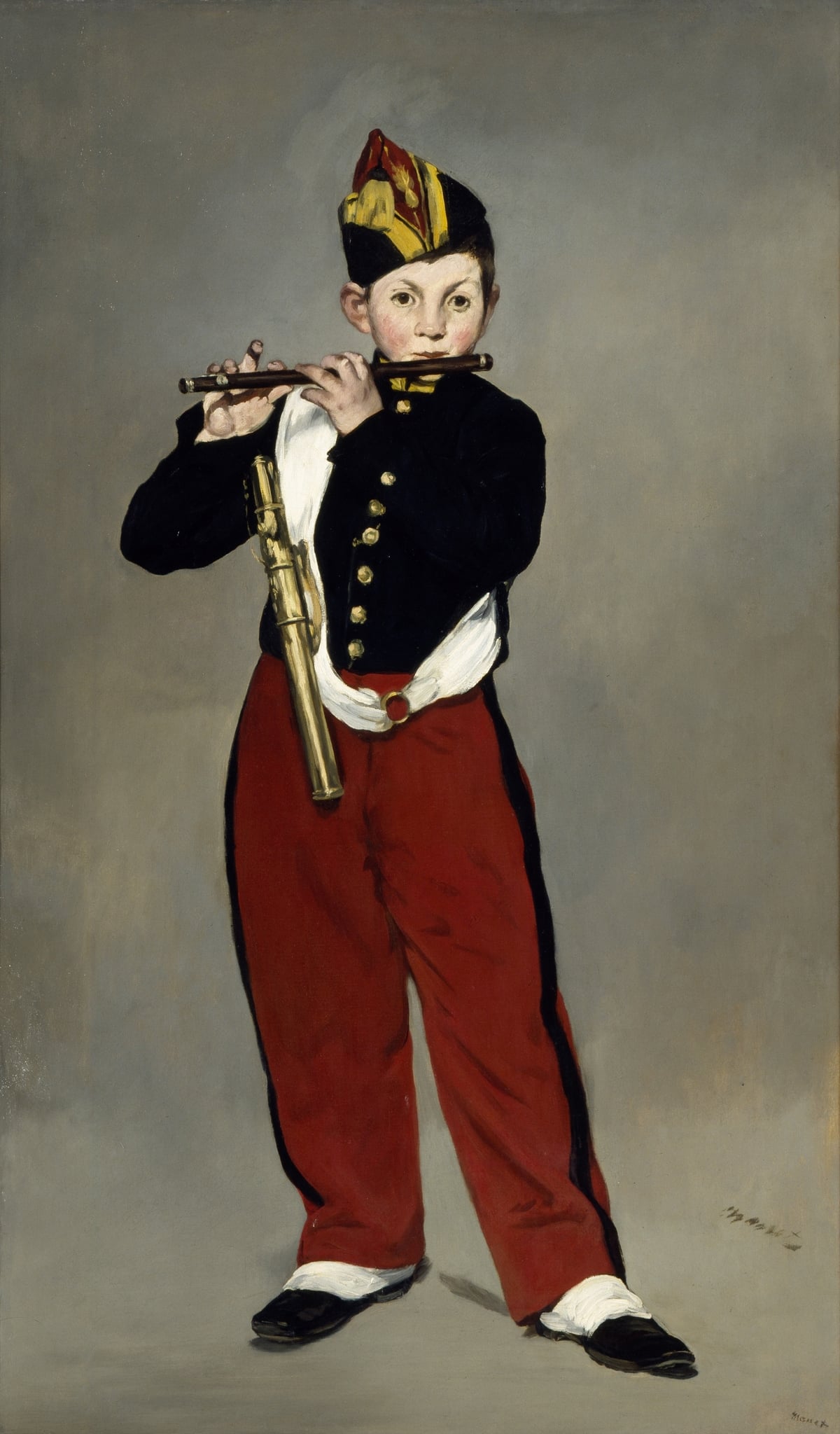
The Fifer
Édouard Manet (1866)
In The Fifer, <strong>Édouard Manet</strong> monumentalizes an anonymous military child by isolating him against a flat, gray field, converting everyday modern life into a subject of high pictorial dignity. The crisp <strong>silhouette</strong>, blocks of <strong>unmodulated color</strong> (black tunic, red trousers, white gaiters), and glints on the brass case make sound and discipline palpable without narrative scaffolding <sup>[1]</sup>. Drawing on <strong>Velázquez’s single-figure-in-air</strong> formula yet inflected by japonisme’s flatness, Manet forges a new modern image that the Salon rejected in 1866 <sup>[1]</sup><sup>[2]</sup><sup>[3]</sup>.
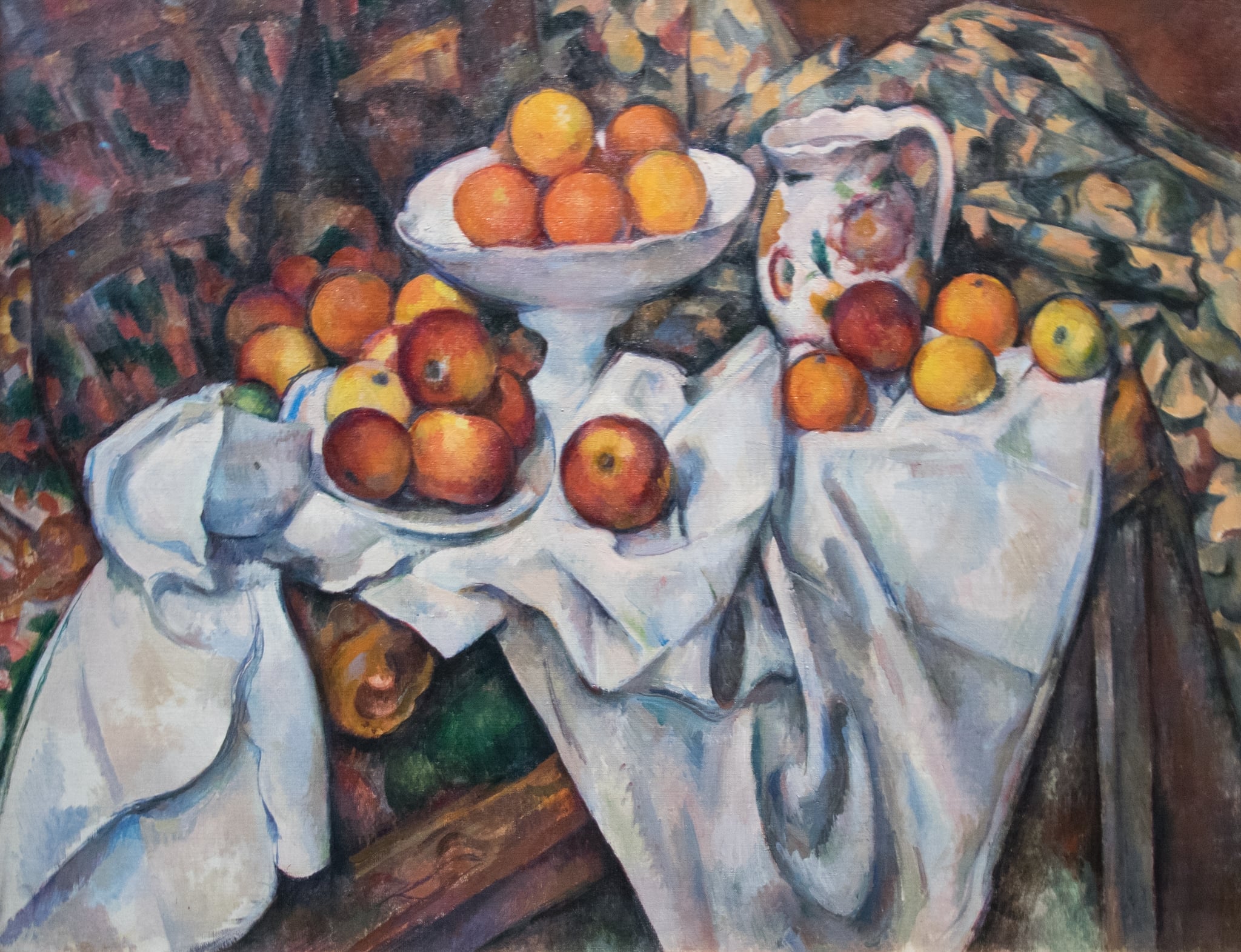
Still Life with Apples and Oranges
Paul Cézanne (c. 1899)
Paul Cézanne’s Still Life with Apples and Oranges builds a quietly monumental world from domestic things. A tilting table, a heaped white compote, a flowered jug, and cascading cloths turn fruit into <strong>durable forms</strong> stabilized by <strong>color relationships</strong> rather than single‑point perspective <sup>[1]</sup><sup>[2]</sup>. The result is a still life that feels both solid and subtly <strong>unstable</strong>, a meditation on how we construct vision.
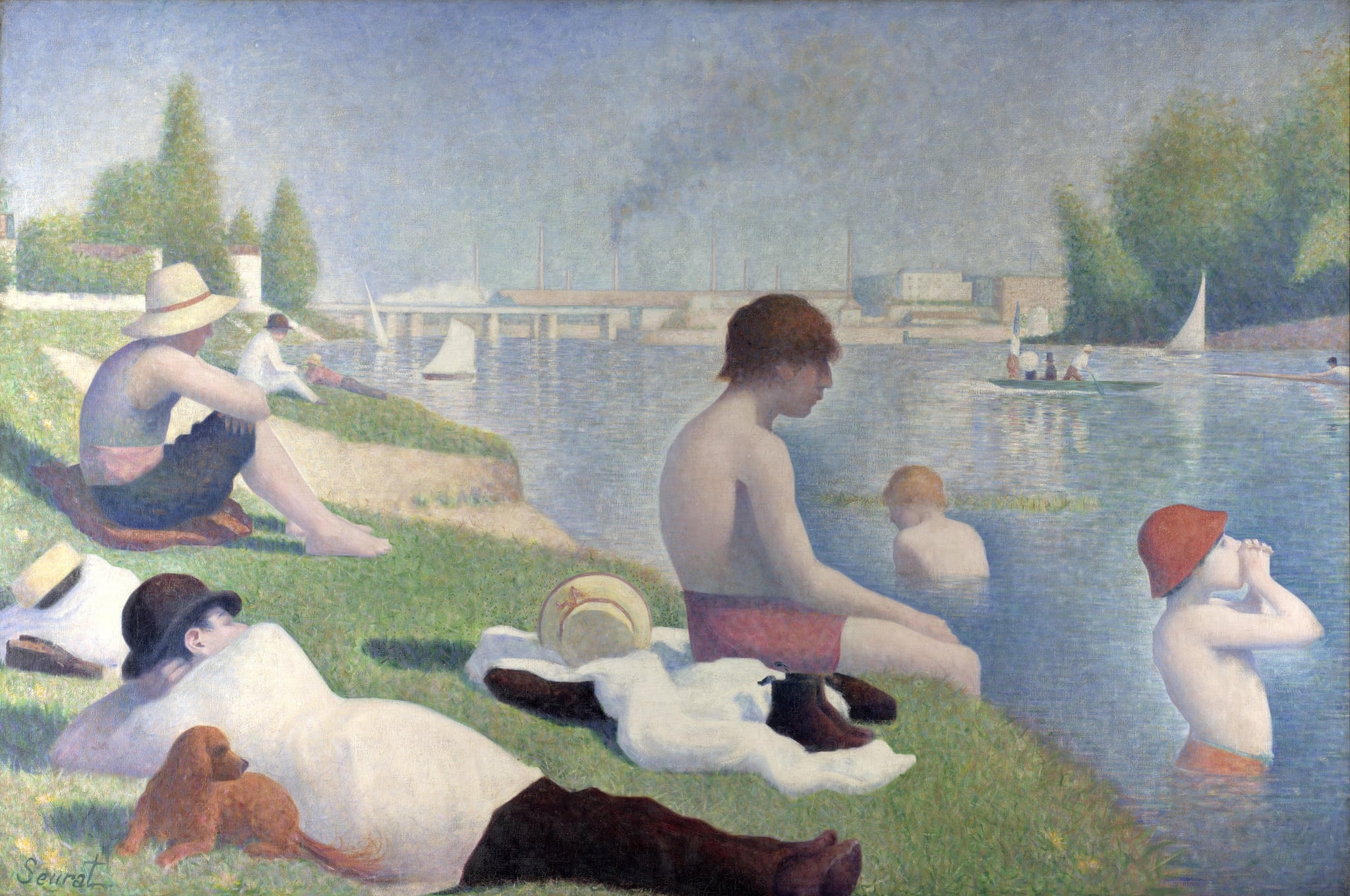
Bathers at Asnières
Georges Seurat (1884)
Bathers at Asnières stages a scene of <strong>modern leisure</strong> on the Seine, where workers recline and wade beneath a hazy, unified light. Seurat fuses <strong>classicizing stillness</strong> with an <strong>industrial backdrop</strong> of chimneys, bridges, and boats, turning ordinary rest into a monumental, ordered image of urban life <sup>[1]</sup><sup>[3]</sup>. The canvas balances soft greens and blues with geometric structures, producing a calm yet charged harmony.
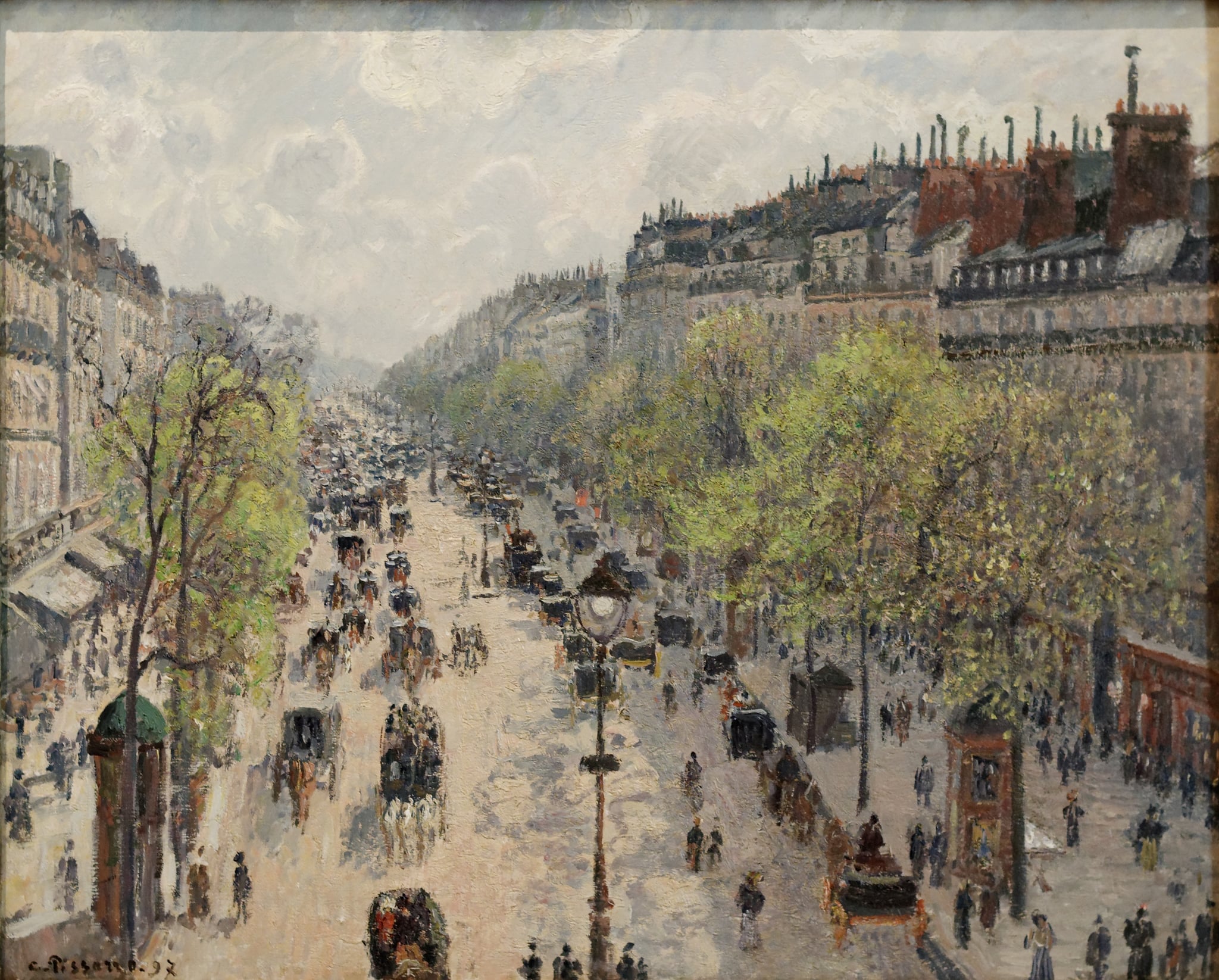
The Boulevard Montmartre on a Spring Morning
Camille Pissarro (1897)
From a high hotel window, Camille Pissarro turns Paris’s grands boulevards into a river of light and motion. In The Boulevard Montmartre on a Spring Morning, pale roadway, <strong>tender greens</strong>, and <strong>flickering brushwork</strong> fuse crowds, carriages, and iron streetlamps into a single urban current <sup>[1]</sup><sup>[2]</sup>. The scene demonstrates Impressionism’s commitment to time, weather, and modern life, distilled through a fixed vantage across a serial project <sup>[1]</sup><sup>[3]</sup>.
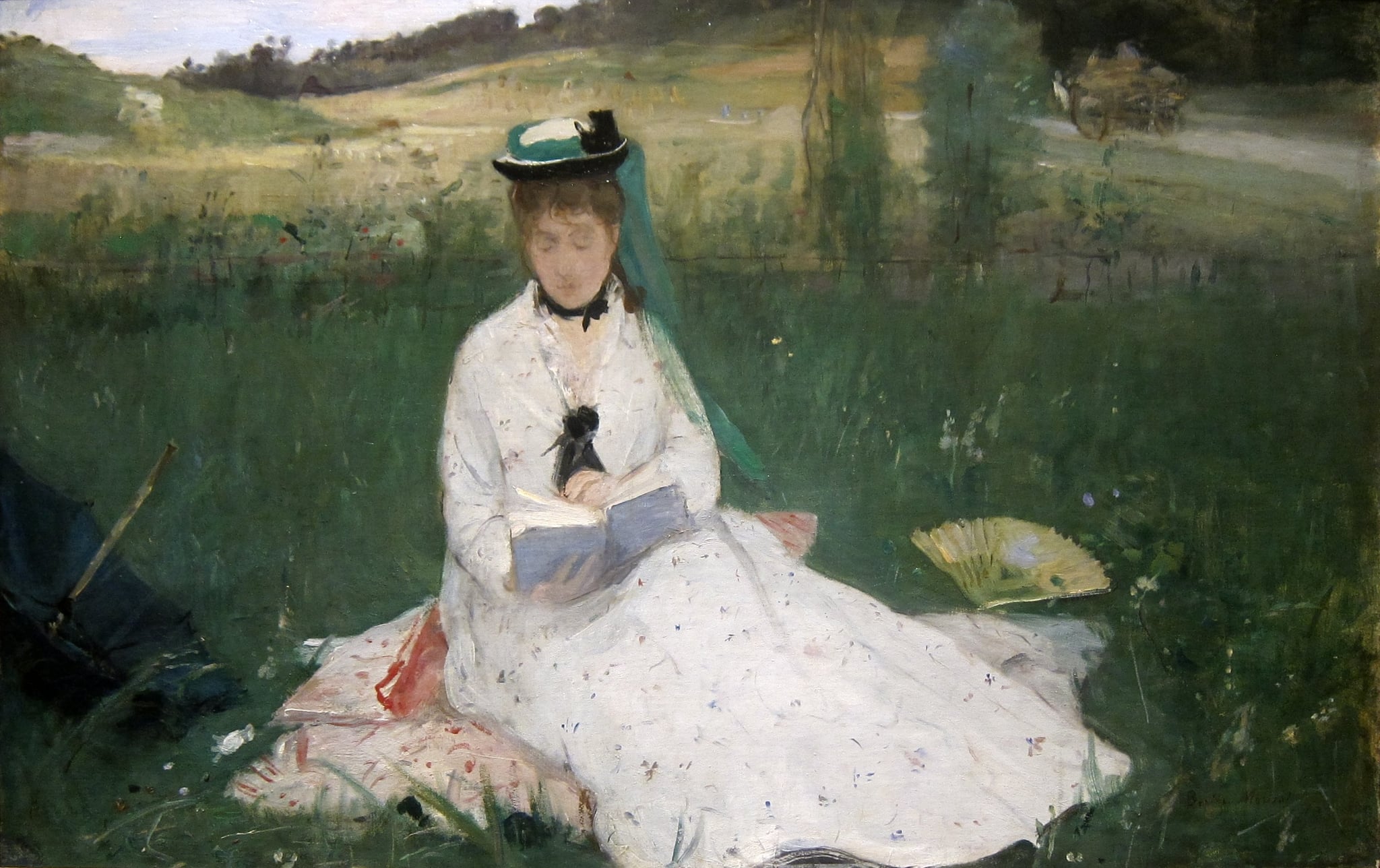
Reading
Berthe Morisot (1873)
In Berthe Morisot’s <strong>Reading</strong> (1873), a woman in a pale, patterned dress sits on the grass, absorbed in a book while a <strong>green parasol</strong> and <strong>folded fan</strong> lie nearby. Morisot’s quick, luminous brushwork dissolves the landscape into <strong>atmospheric greens</strong> as a distant carriage passes, turning an outdoor scene into a study of interior life. The work makes <strong>female intellectual absorption</strong> its true subject, aligning modern leisure with private thought.
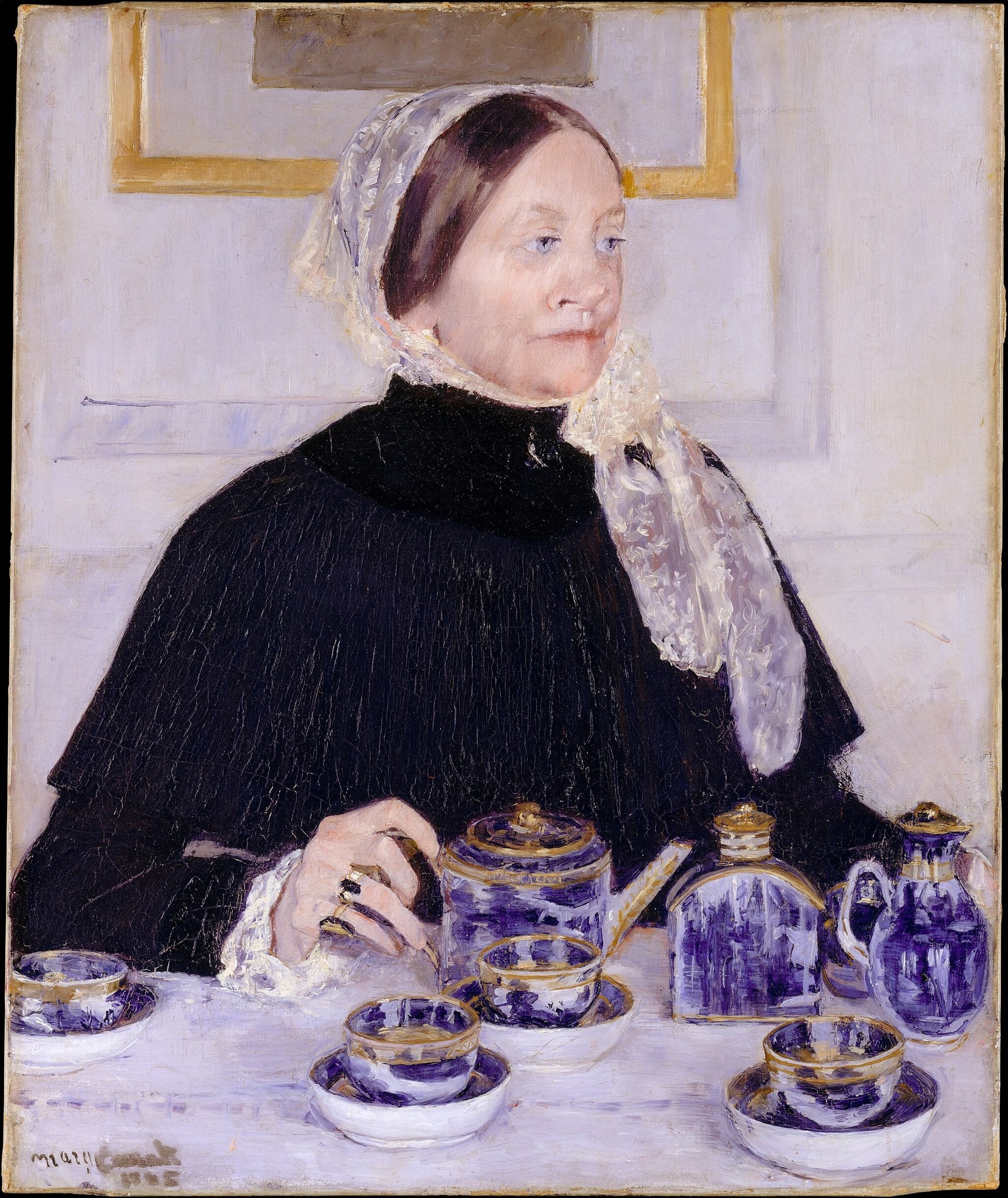
Lady at the Tea Table
Mary Cassatt (1883–85 (signed 1885))
Mary Cassatt’s Lady at the Tea Table distills a domestic rite into a scene of <strong>quiet authority</strong>. The sitter’s black silhouette, lace cap, and poised hand marshal a regiment of <strong>cobalt‑and‑gold Canton porcelain</strong>, while tight cropping and planar light convert hospitality into <strong>modern self‑possession</strong> <sup>[1]</sup><sup>[5]</sup>.
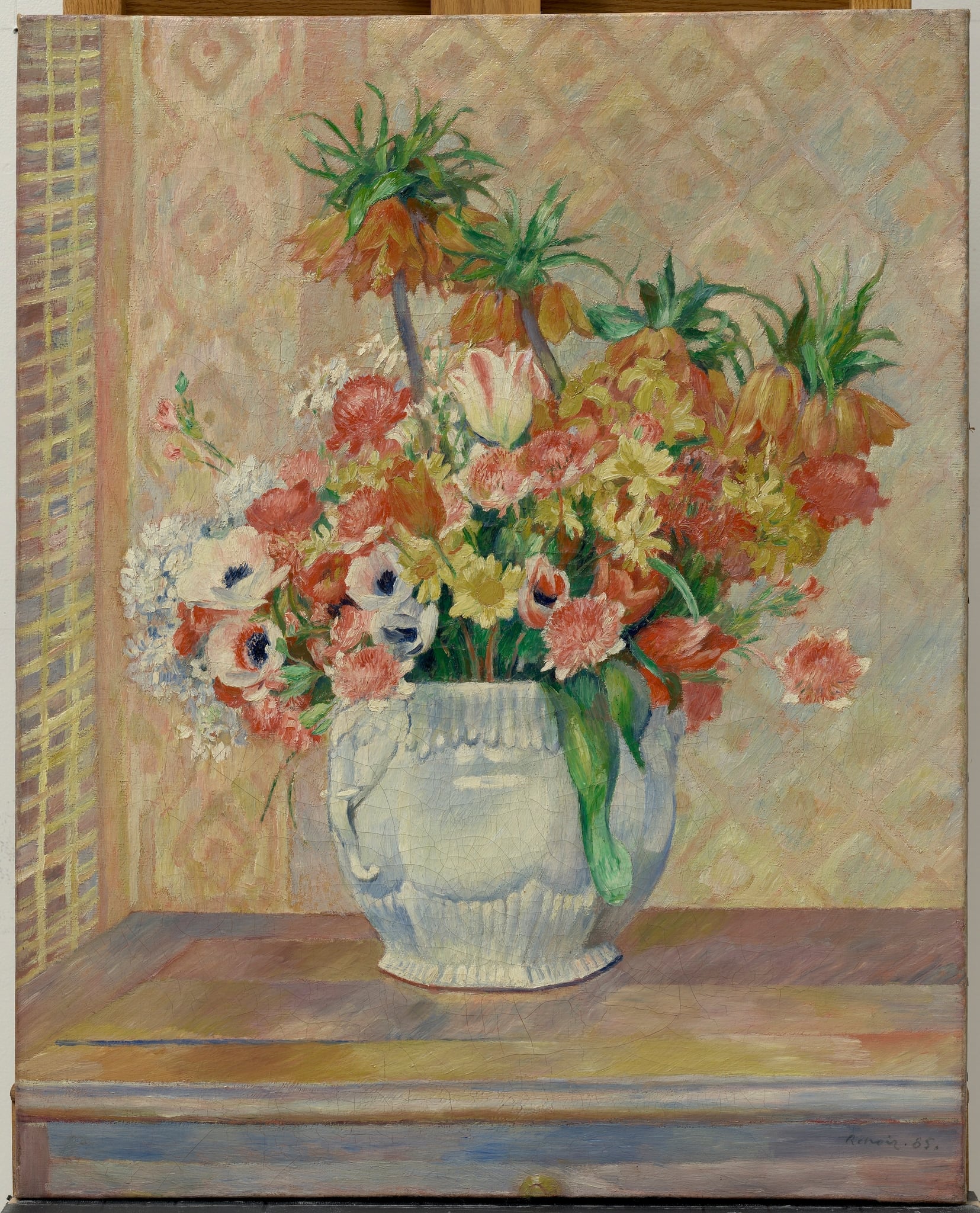
Still Life with Flowers
Pierre-Auguste Renoir (1885)
Pierre-Auguste Renoir’s Still Life with Flowers (1885) sets a jubilant bouquet in a pale, crackled vase against softly dissolving wallpaper and a wicker screen. With quick, clear strokes and a centered, oval mass, the painting unites <strong>Impressionist color</strong> with a <strong>classical, post-Italy structure</strong> <sup>[1]</sup><sup>[2]</sup><sup>[4]</sup>. The slight droop of blossoms turns the domestic scene into a gentle <strong>vanitas</strong>—a savoring of beauty before it fades <sup>[5]</sup>.
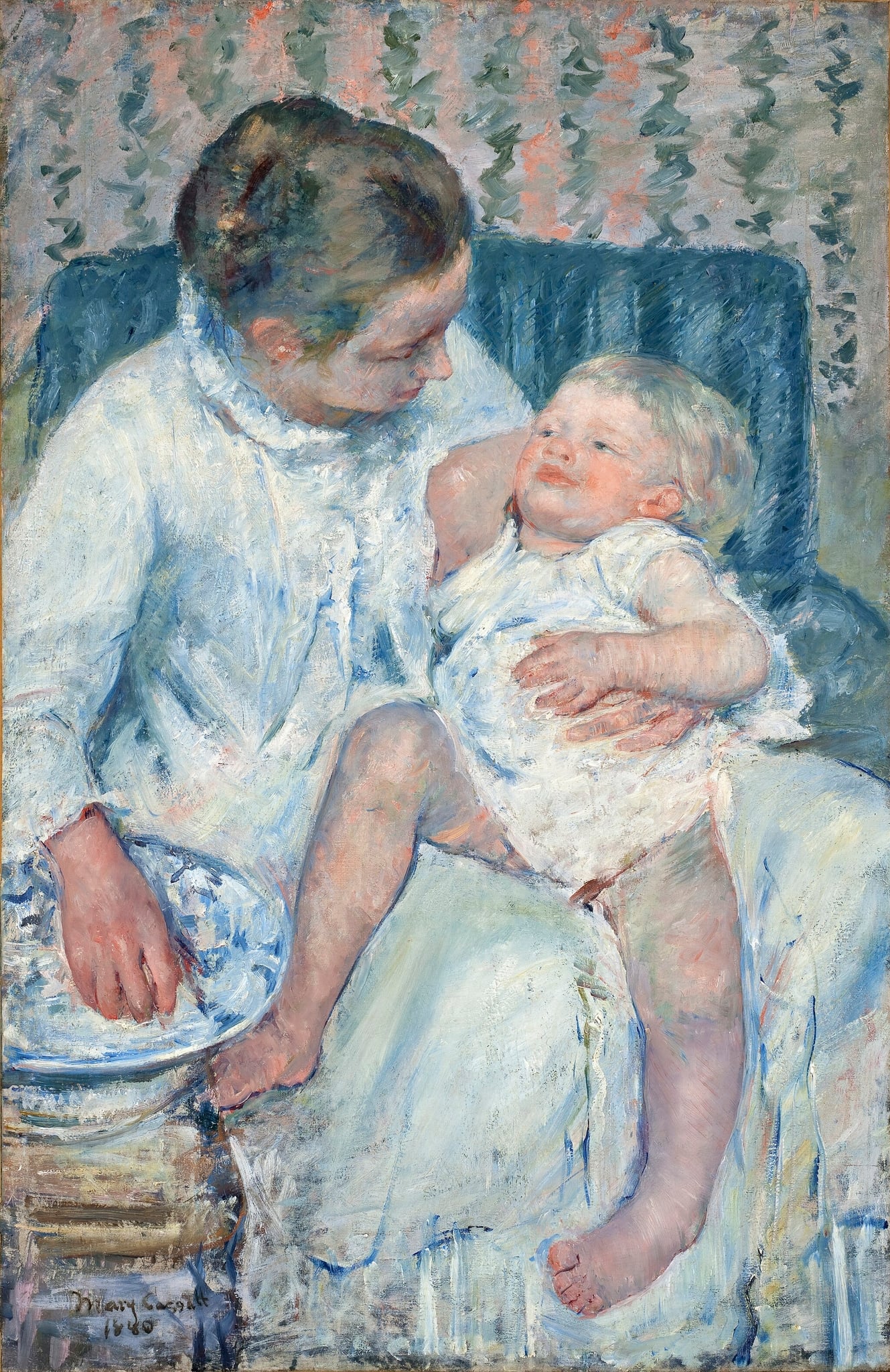
Mother About to Wash Her Sleepy Child
Mary Cassatt (1880)
Mary Cassatt’s Mother About to Wash Her Sleepy Child (1880) turns an ordinary bedtime ritual into a scene of <strong>caregiving, labor, and modern intimacy</strong>. Cropped close, with the child’s legs diagonally splayed and a tilted washbowl at the mother’s knee, the picture translates domestic routine into a <strong>modern Madonna</strong> for the bourgeois interior. Its flickering blues and milky whites, plus patterned upholstery and wallpaper, signal Cassatt’s <strong>Impressionist</strong> and japonisme-inflected design sense <sup>[2]</sup>.
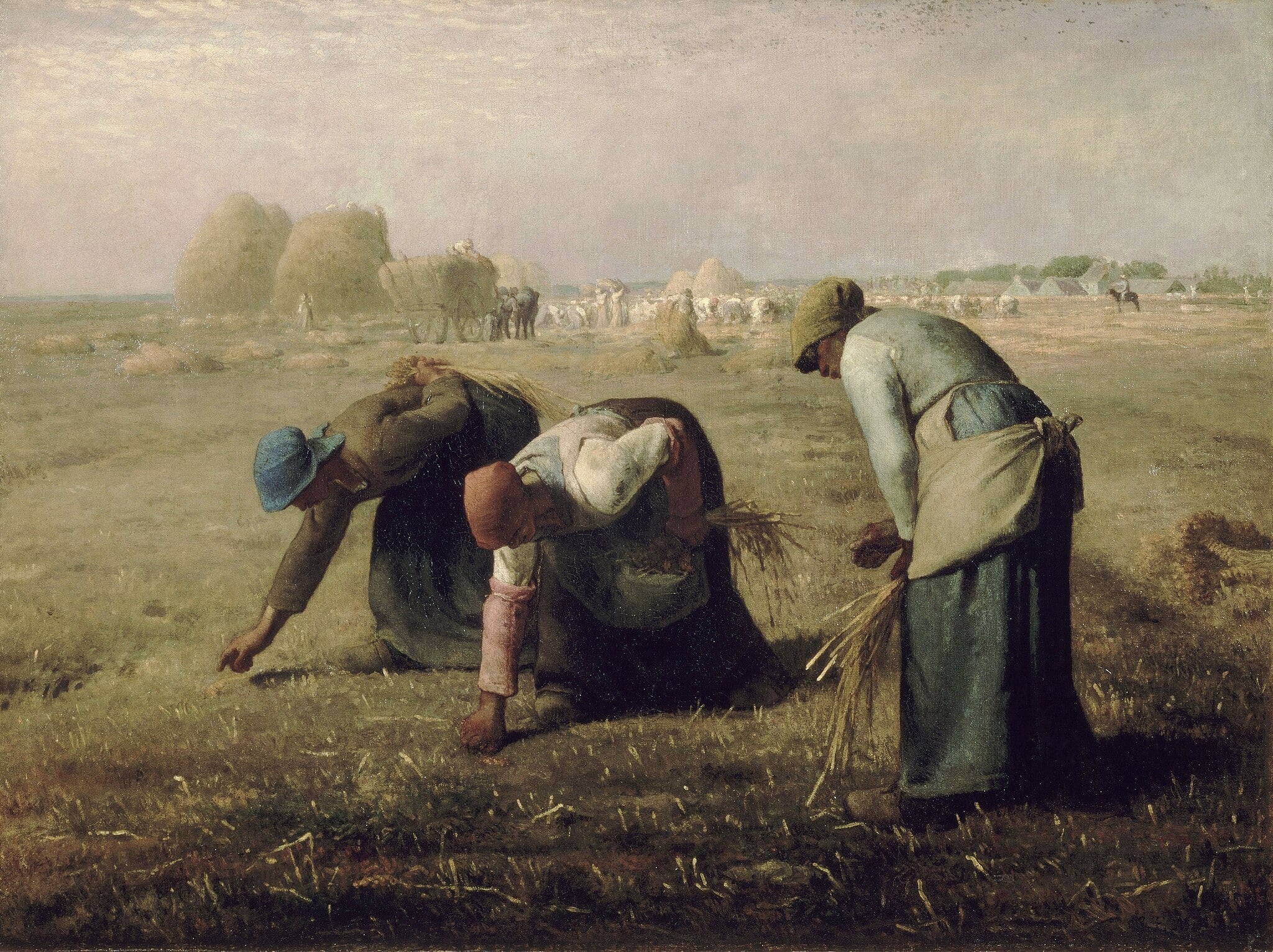
The Gleaners
Jean-Francois Millet (1857)
Three peasant women bend in a solemn rhythm, gleaning leftover stalks under a dry, late-afternoon light. In the far distance, tiny carts, haystacks, and an overseer on horseback signal abundance and authority, while the foreground figures loom with <strong>monumental gravity</strong>, asserting the dignity of labor amid inequality <sup>[1]</sup><sup>[2]</sup>.
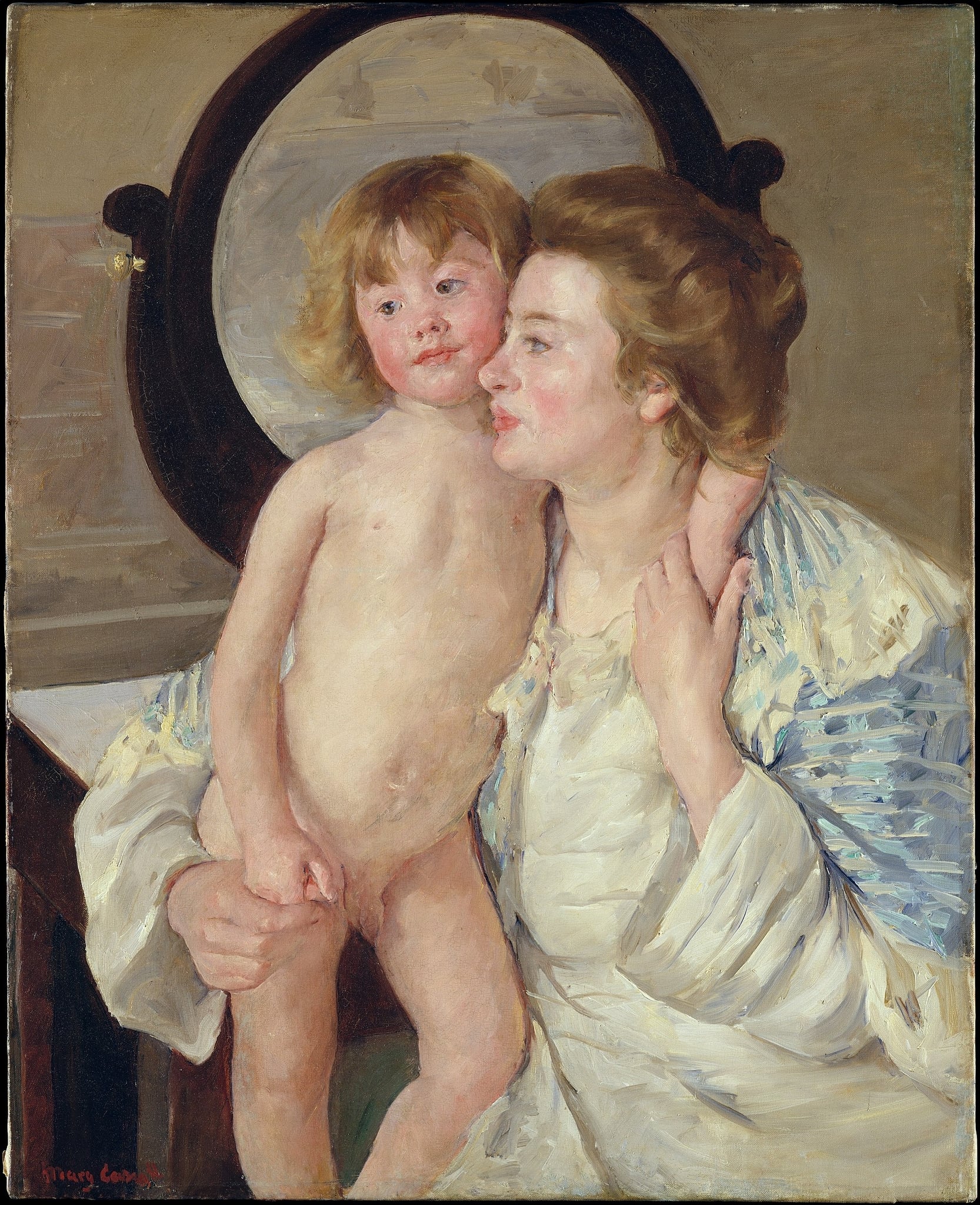
Mother and Child (The Oval Mirror)
Mary Cassatt (ca. 1899)
Mary Cassatt’s Mother and Child (The Oval Mirror) turns a routine act of care into a <strong>modern icon</strong>. An oval mirror <strong>haloes</strong> the child while interlaced hands and close bodies make <strong>touch</strong> the vehicle of meaning <sup>[1]</sup><sup>[3]</sup>.
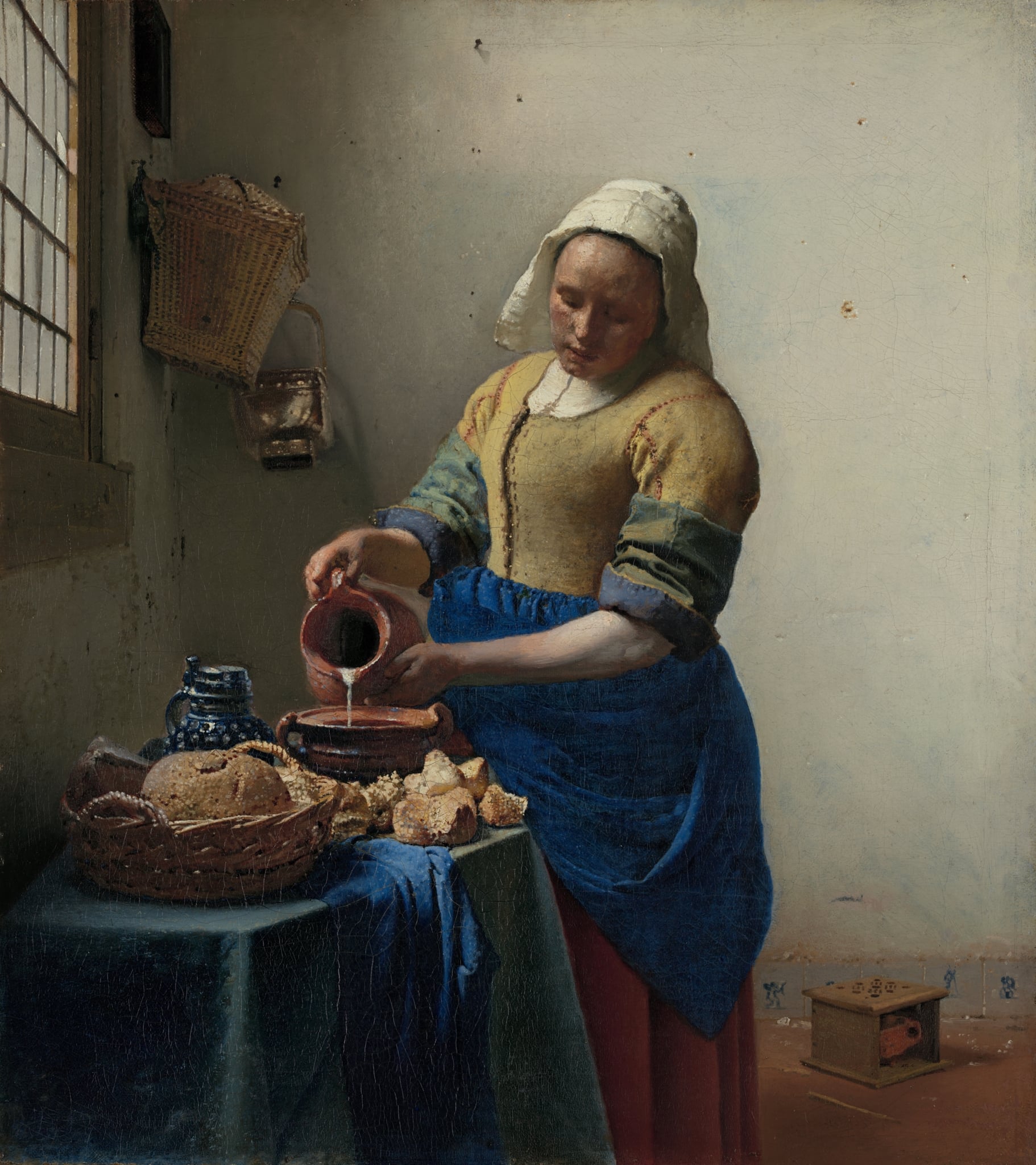
The Milkmaid
Johannes Vermeer (c. 1660)
In The Milkmaid, Vermeer turns an ordinary act—pouring milk—into a scene of <strong>quiet monumentality</strong>. Light from the left fixes the maid’s absorbed attention and ignites the <strong>saturated yellow and blue</strong> of her dress, while the slow thread of milk becomes the image’s pulse <sup>[1]</sup><sup>[2]</sup>. Bread, a Delft jug, nail holes, and a small <strong>foot warmer</strong> anchor a world where humble work is endowed with dignity and latent meaning <sup>[1]</sup><sup>[2]</sup>.
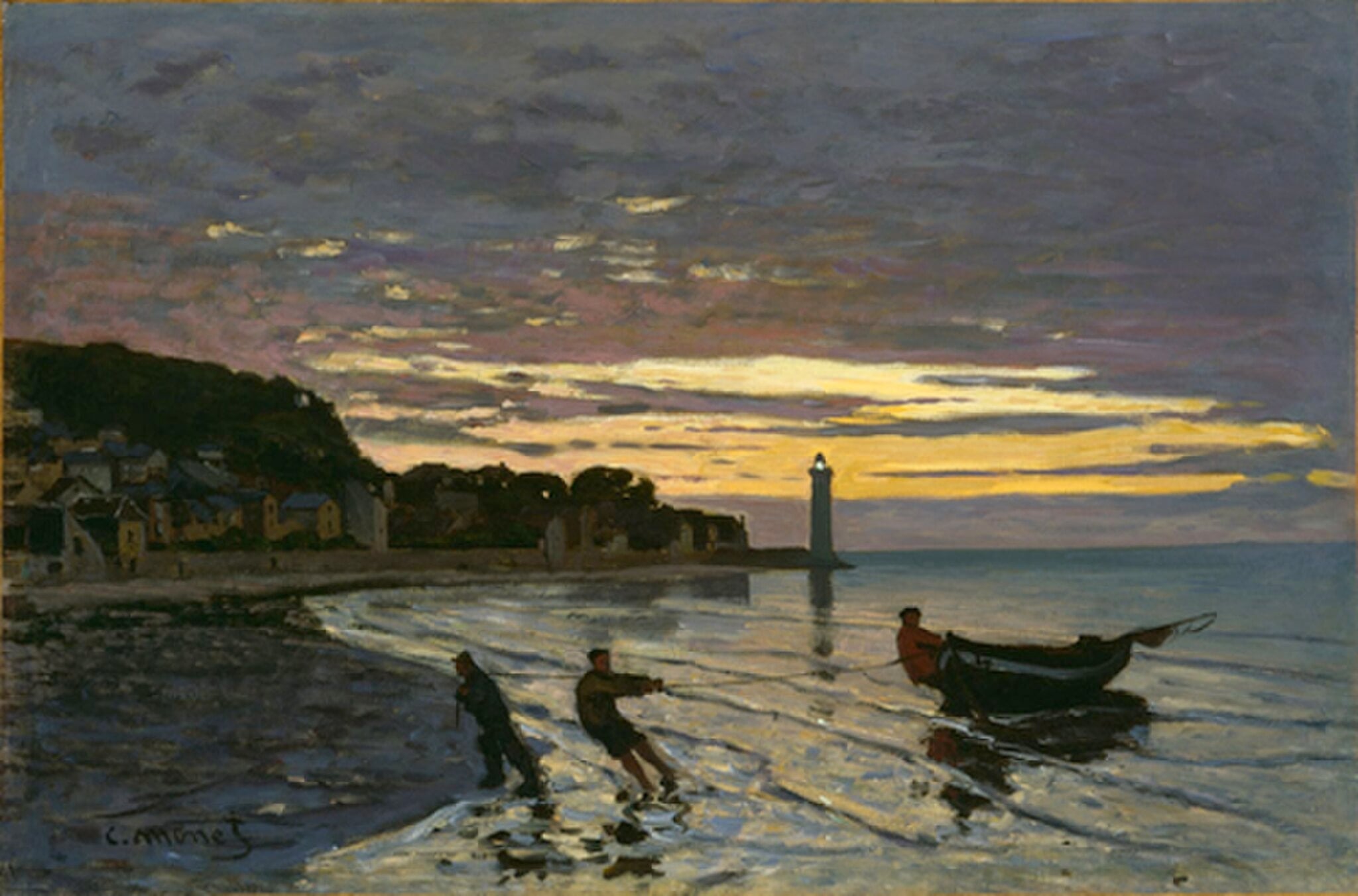
Towing a Boat, Honfleur
Claude Monet (1864)
Claude Monet’s Towing a Boat, Honfleur frames coastal labor against a dusk of <strong>fugitive light</strong> and <strong>reflective sands</strong>, where three figures strain on taut ropes as a lighthouse holds steady on the horizon. The canvas turns a routine task into a meditation on <strong>endurance, guidance, and time’s passage</strong>.
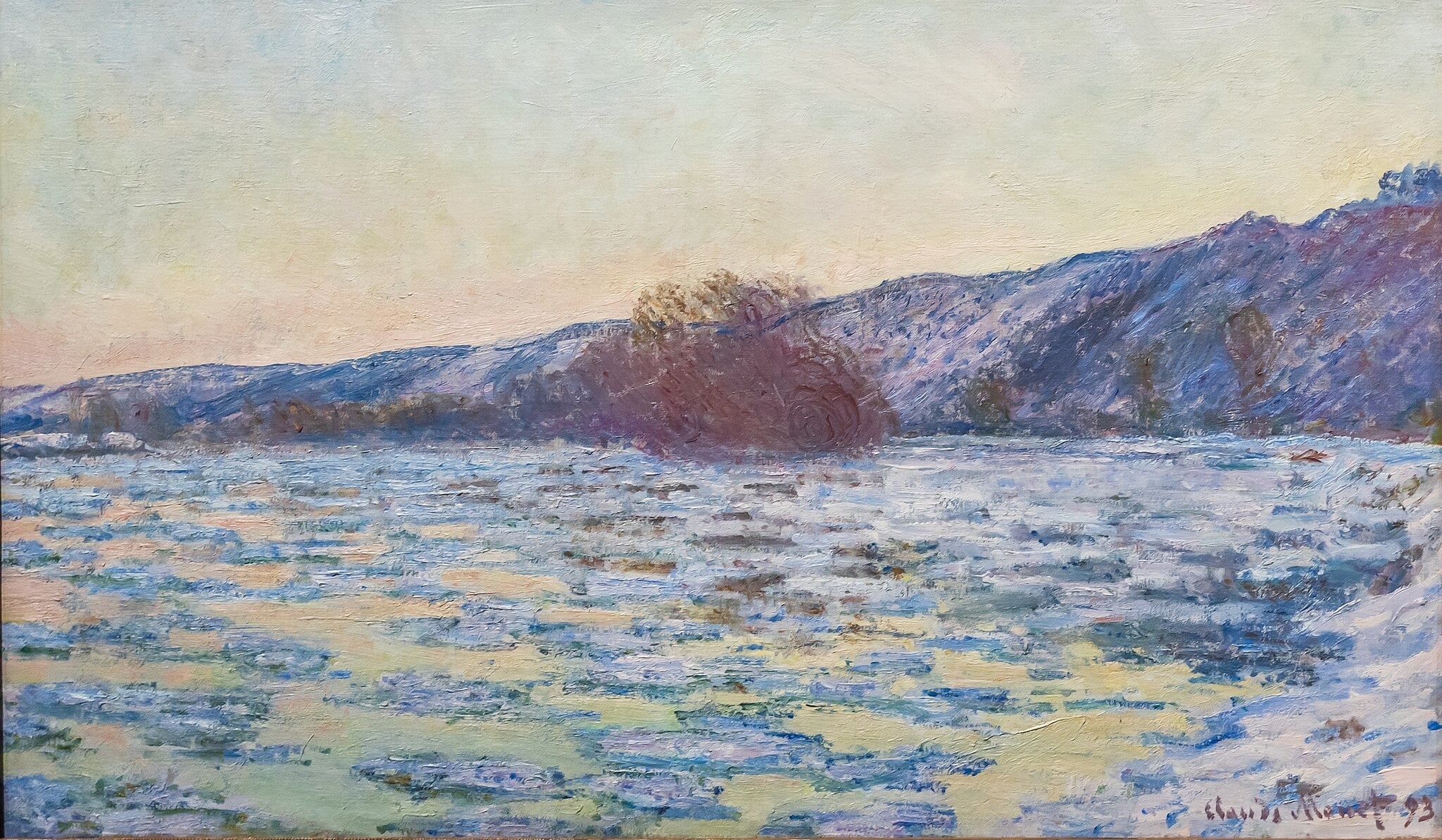
Ice Floes
Claude Monet (1893)
Claude Monet’s Ice Floes turns a thawing Seine into a <strong>theater of transition</strong>: pale ice plates drift over mint‑green water beneath a <strong>high horizon</strong> and a <strong>russet clump of trees</strong> that warms the scene’s chill palette. With short, glancing strokes, Monet makes the floes <strong>shimmer between stillness and motion</strong>, converting a winter morning into a meditation on change and endurance.
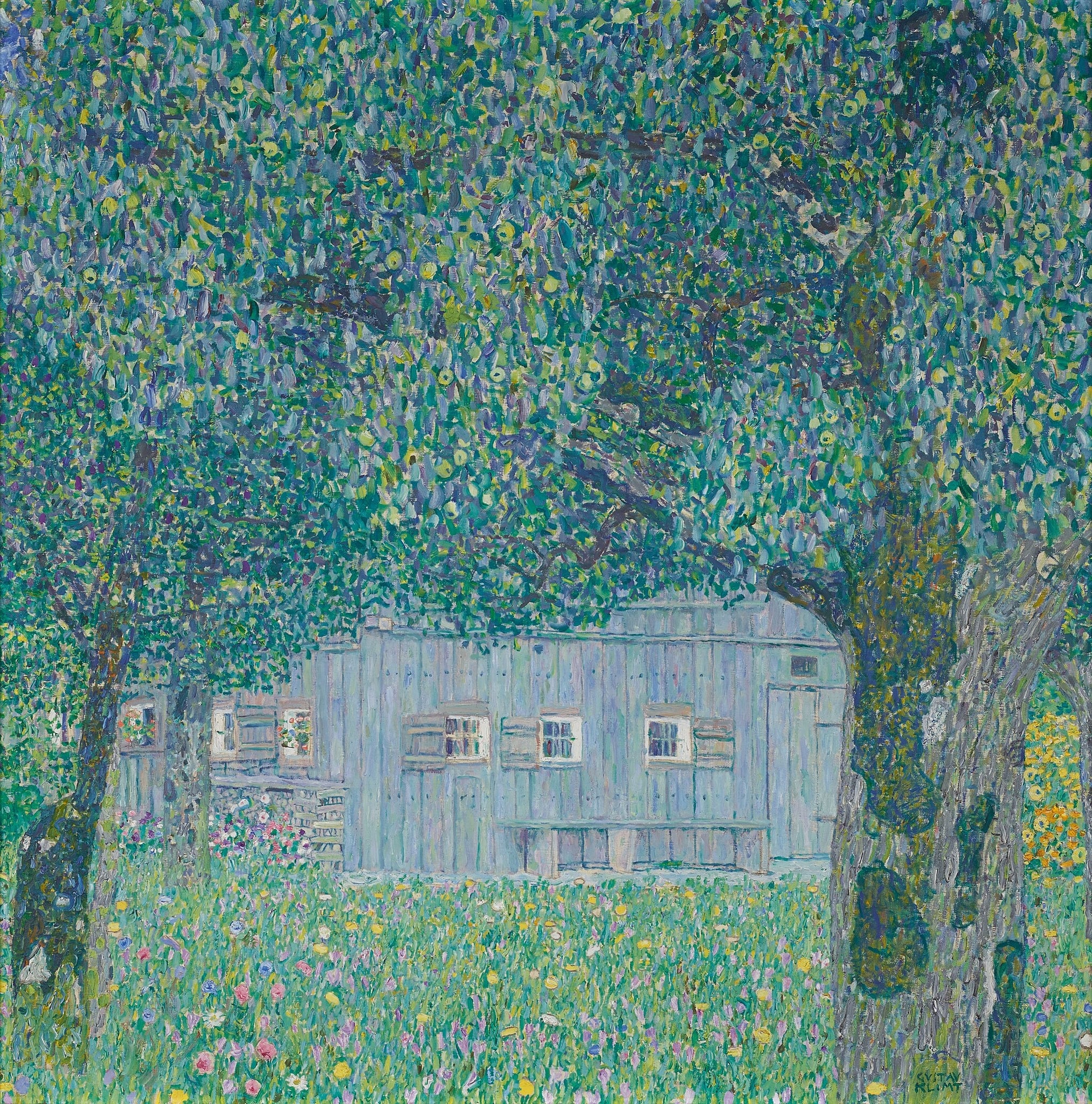
Farmhouse in Buchberg (Upper Austrian Farmhouse)
Gustav Klimt (1911)
Gustav Klimt’s Farmhouse in Buchberg (Upper Austrian Farmhouse) renders a rural dwelling almost absorbed by an orchard, its cool façade held in balance against a vibrating canopy of leaves and a jewel-like meadow. Through a square format and <strong>selective pointillism</strong>, Klimt fuses house, trees, and flowers into a contemplative, patterned field that privileges <strong>stillness</strong> over incident <sup>[1]</sup><sup>[6]</sup>. The work turns everyday architecture into an emblem of <strong>refuge within fecund nature</strong>.
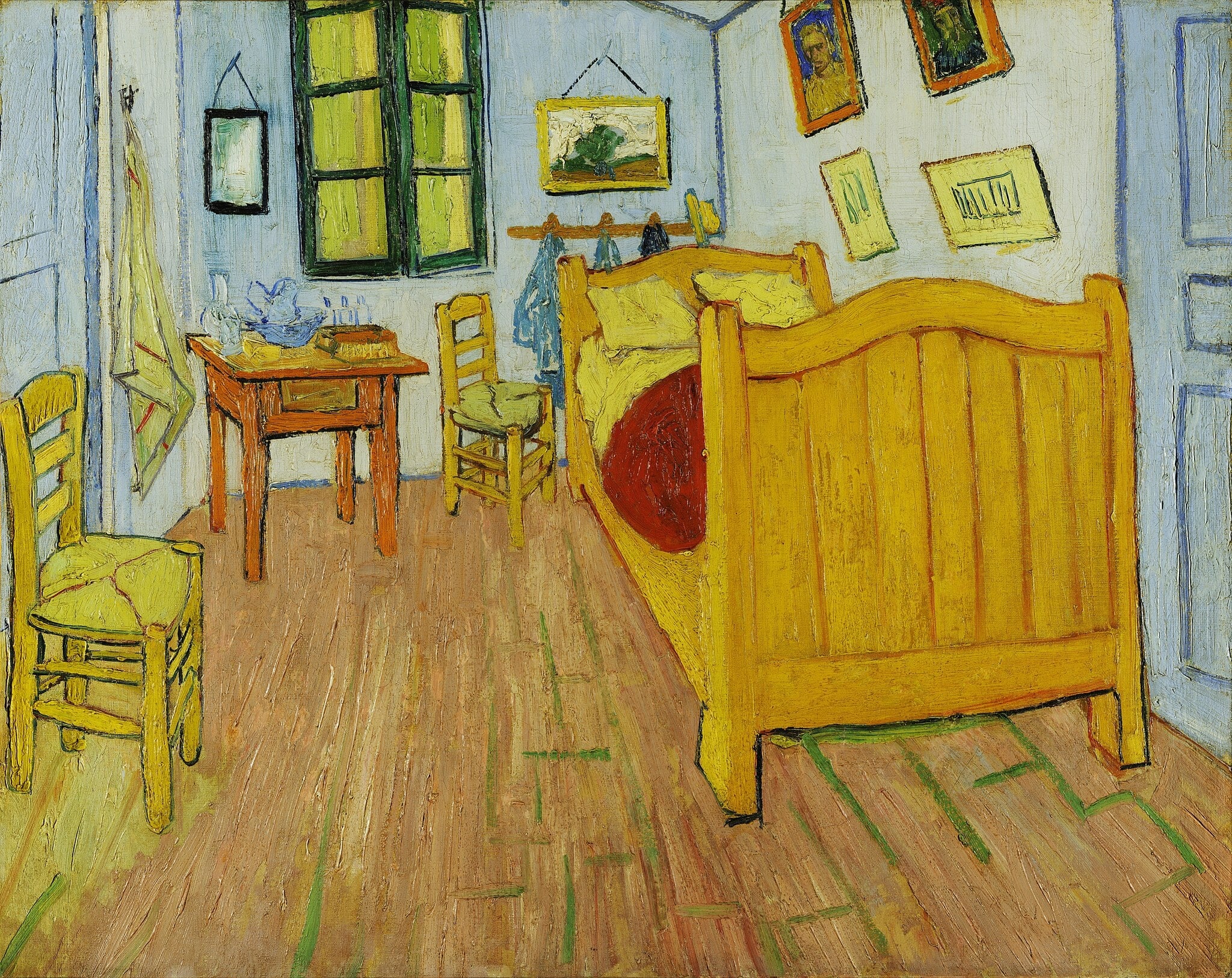
The Bedroom
Vincent van Gogh (1889)
Vincent van Gogh’s The Bedroom turns a modest room into a psychological stage, using <strong>clashing color</strong> and <strong>tilted space</strong> to test whether color alone can evoke rest. The bright yellow bed, twin chairs, and green‑shuttered window press forward as the floor tilts and pictures cant, so that <strong>refuge and unease</strong> exist side by side <sup>[1]</sup><sup>[2]</sup>.
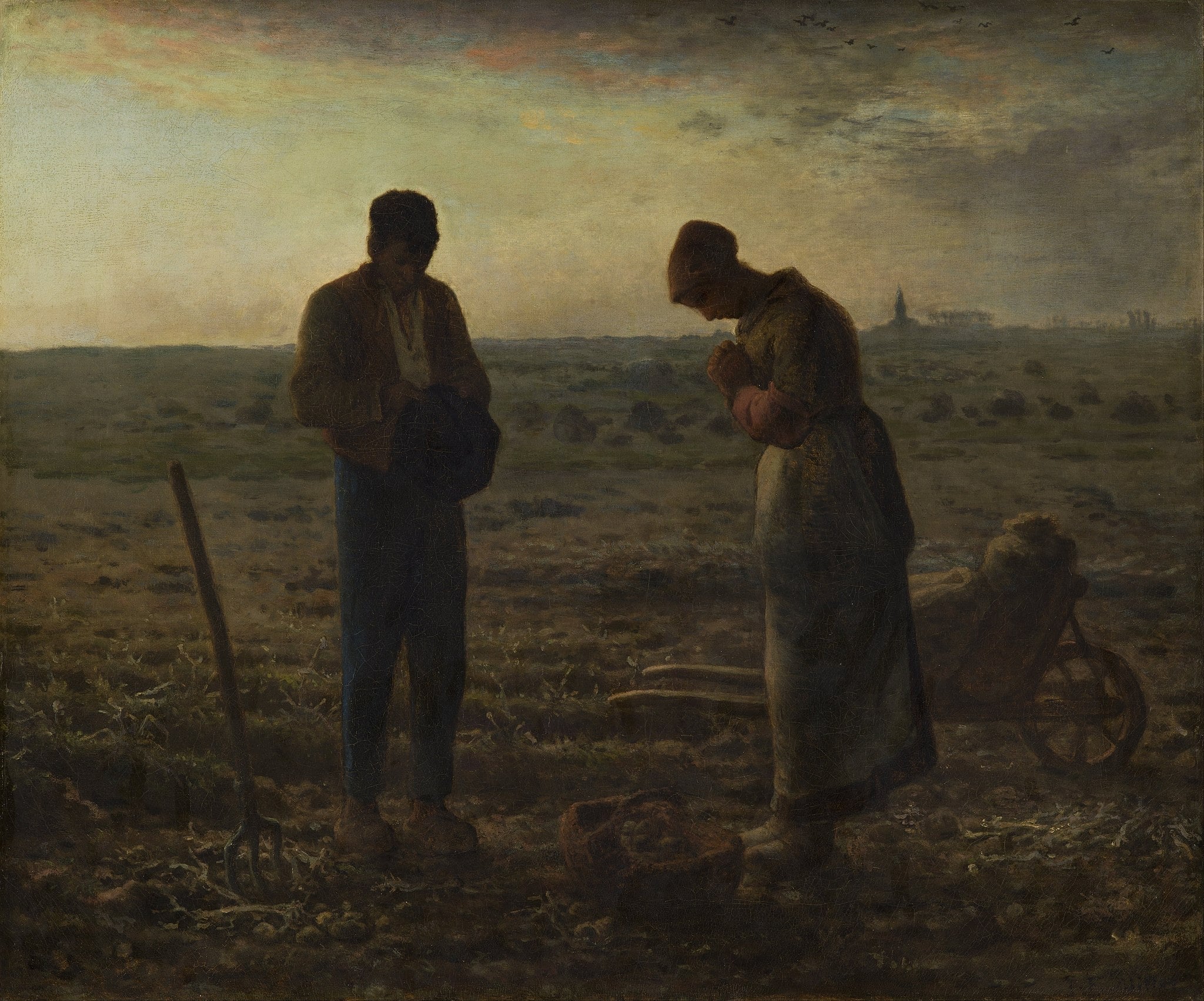
The Angelus
Jean-Francois Millet (1857–1859)
Jean-Francois Millet’s The Angelus (1857–1859) fuses <strong>devotion</strong> and <strong>labor</strong>: two peasants pause at dusk, heads bowed, as the Angelus bell sounds from a distant steeple. With a <strong>low horizon</strong>, earthen palette, and monumental silhouettes, the painting makes a brief pause in fieldwork feel timeless and sacred <sup>[1]</sup><sup>[2]</sup>.
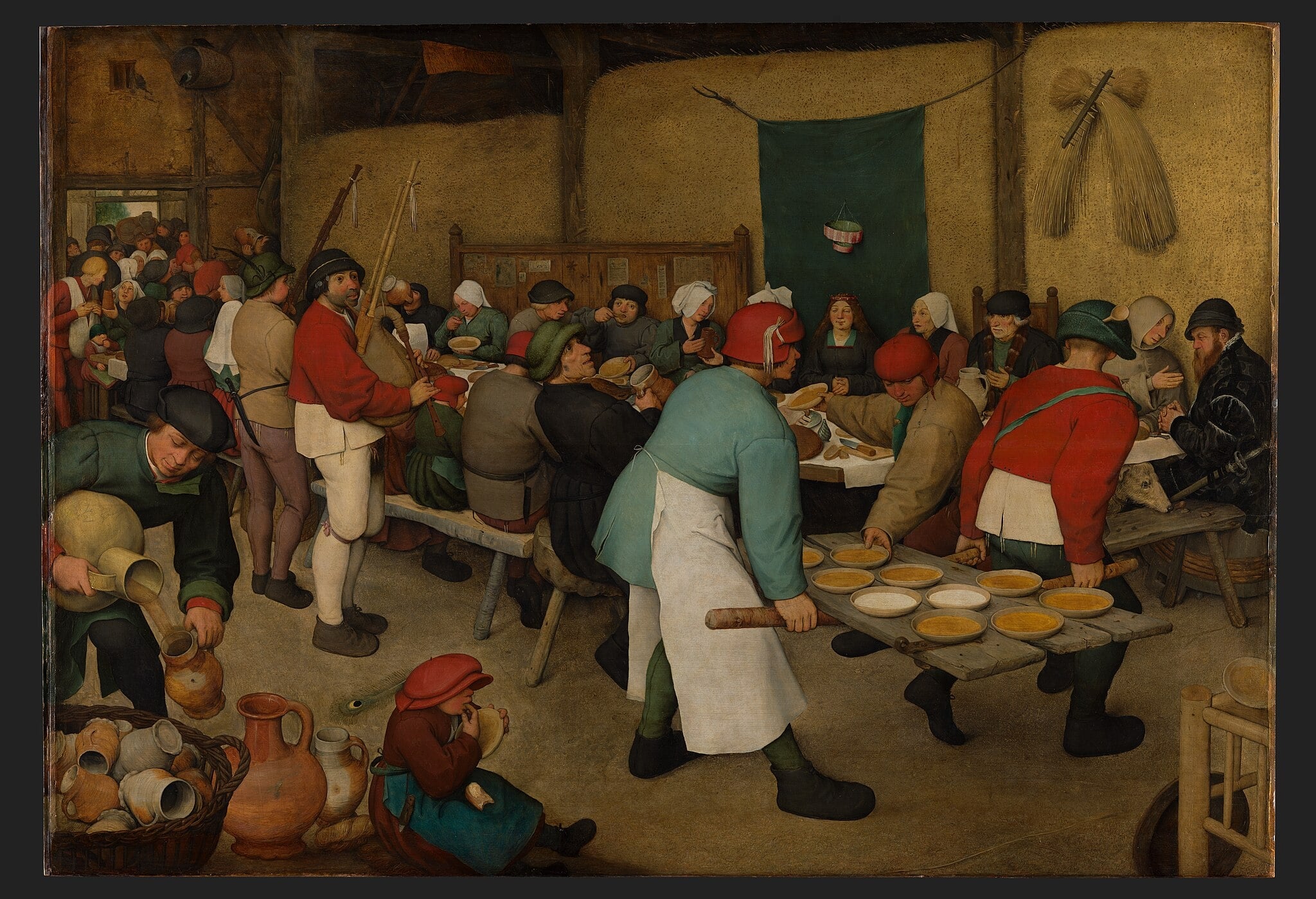
The Peasant Wedding
Pieter Bruegel the Elder (1568)
In The Peasant Wedding, Pieter Bruegel the Elder stages a <strong>communal rite</strong> inside a barn, where humble ingenuity and shared labor become the true spectacle. A bride sits beneath a <strong>green cloth of honor</strong> with a paper crown above, as servers balance bowls of porridge on a <strong>door turned into a tray</strong>, beer flows, and a bagpiper looks on <sup>[1]</sup><sup>[2]</sup>.
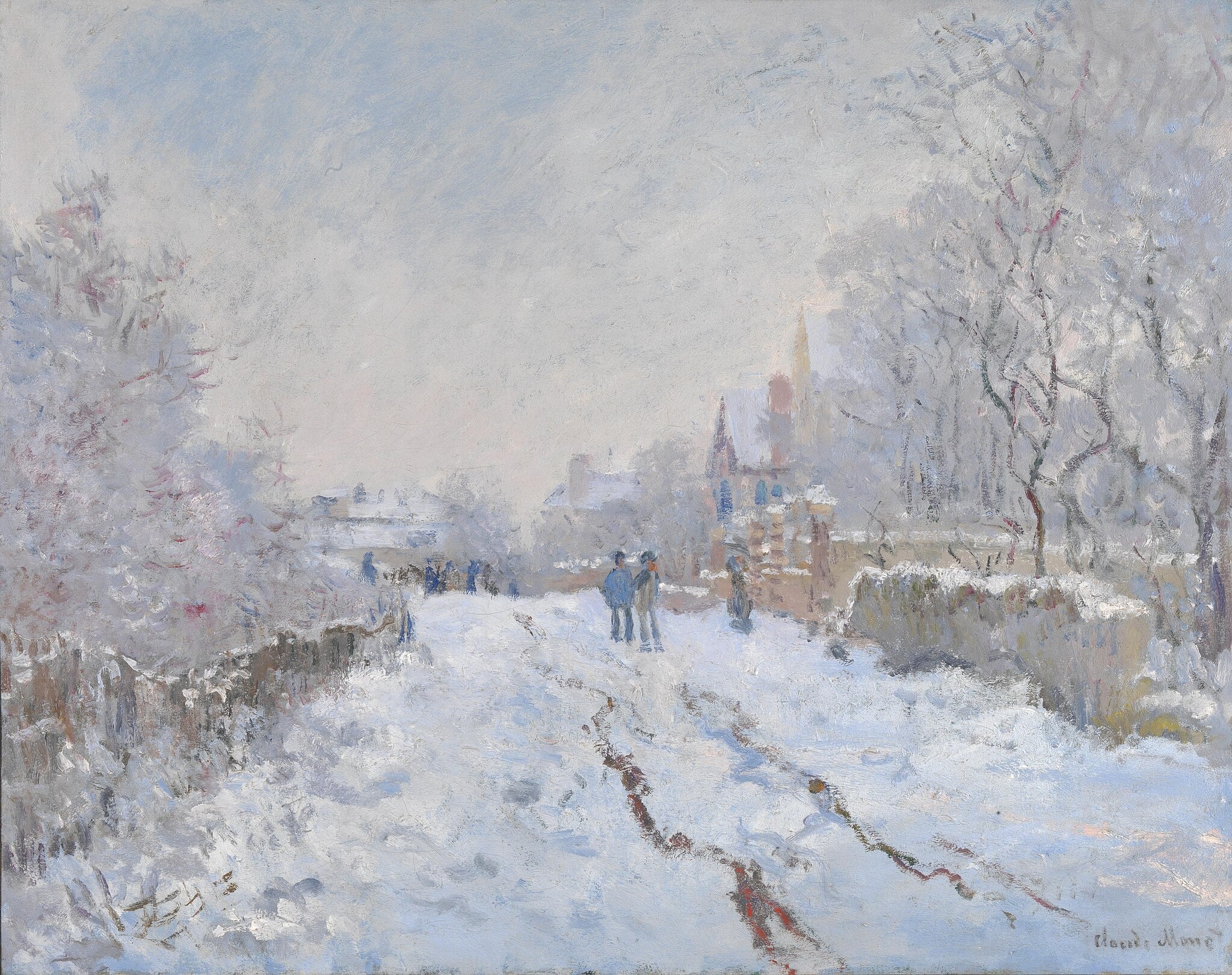
Snow Scene at Argenteuil
Claude Monet (1875)
Claude Monet’s Snow Scene at Argenteuil distills a winter afternoon into a field of shimmering perception, where <strong>air, light, and snow</strong> merge. Russet cart tracks vein the road while <strong>blue‑grey figures</strong> drift toward a misted <strong>church spire</strong>, binding ordinary movement to a larger atmospheric whole.
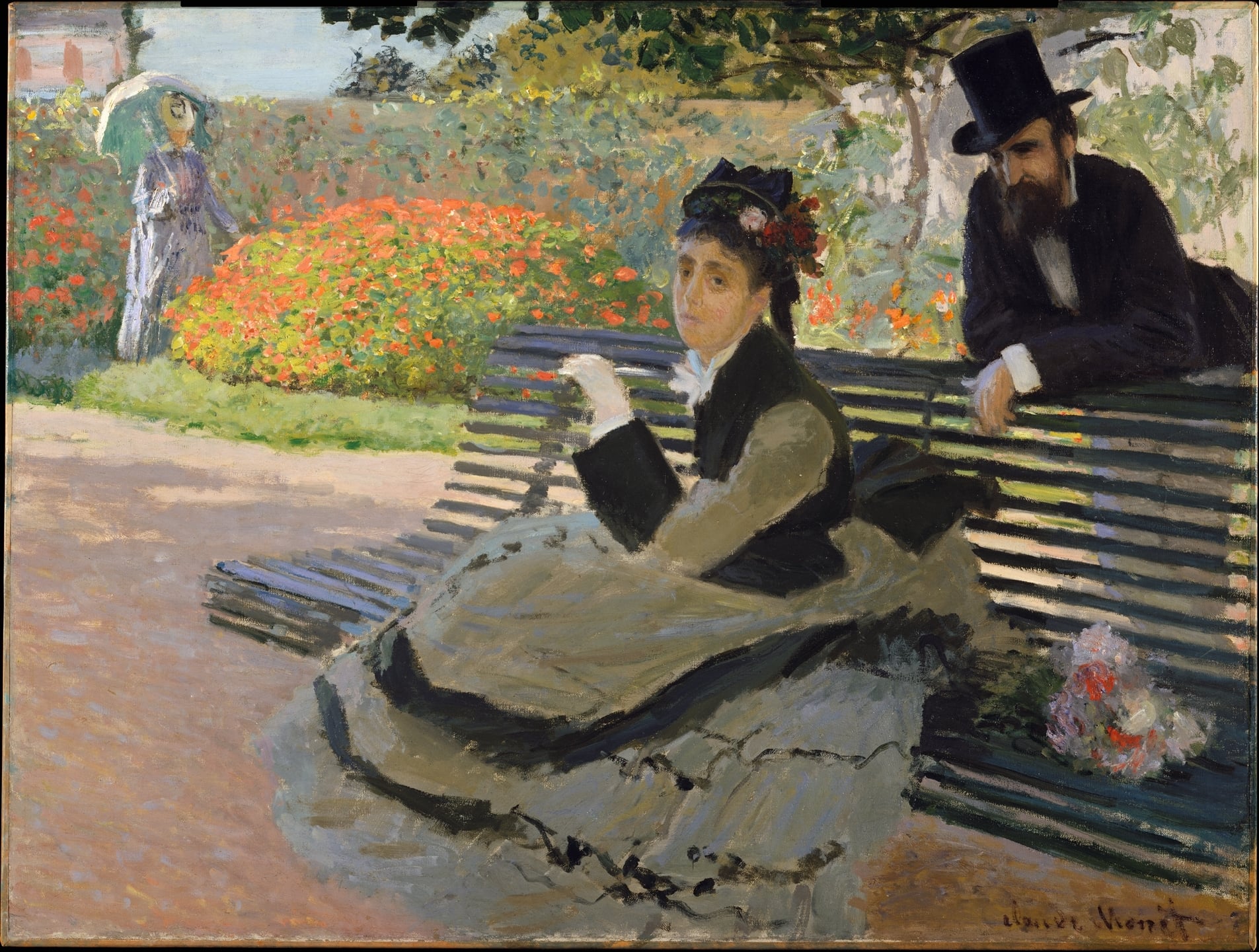
Camille Monet on a Garden Bench
Claude Monet (1873)
Claude Monet’s Camille Monet on a Garden Bench (1873) stages an intimate pause where <strong>light, grief, and modern leisure</strong> intersect. Camille, shaded and withdrawn, holds a letter while a <strong>top‑hatted neighbor</strong> hovers; a bright bank of <strong>red geraniums</strong> and a strolling woman with a parasol ignite the distance <sup>[1]</sup>. Monet converts a domestic garden into a scene about <strong>psychological distance</strong> amid fleeting sunlight.
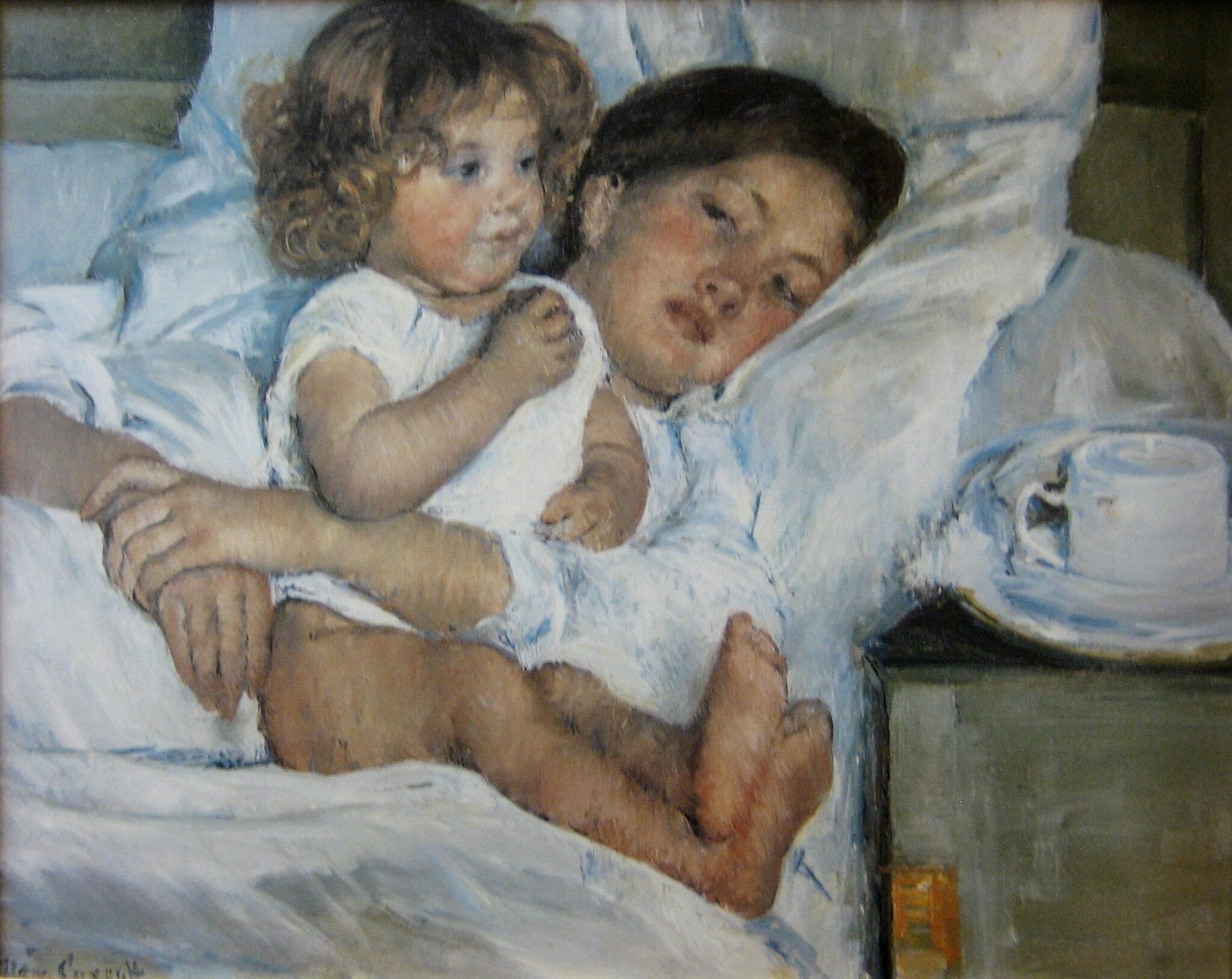
Breakfast in Bed
Mary Cassatt (1897)
Breakfast in Bed distills a <strong>tender modern intimacy</strong> into a tightly cropped sanctuary of rumpled white linens, protective embrace, and interrupted routine. Mary Cassatt uses <strong>cool light</strong> against <strong>warm flesh</strong> to anchor attention on the mother’s encircling arm and the child’s outward gaze, fusing care, curiosity, and the rhythms of <strong>everyday modern life</strong> <sup>[1]</sup><sup>[2]</sup>.
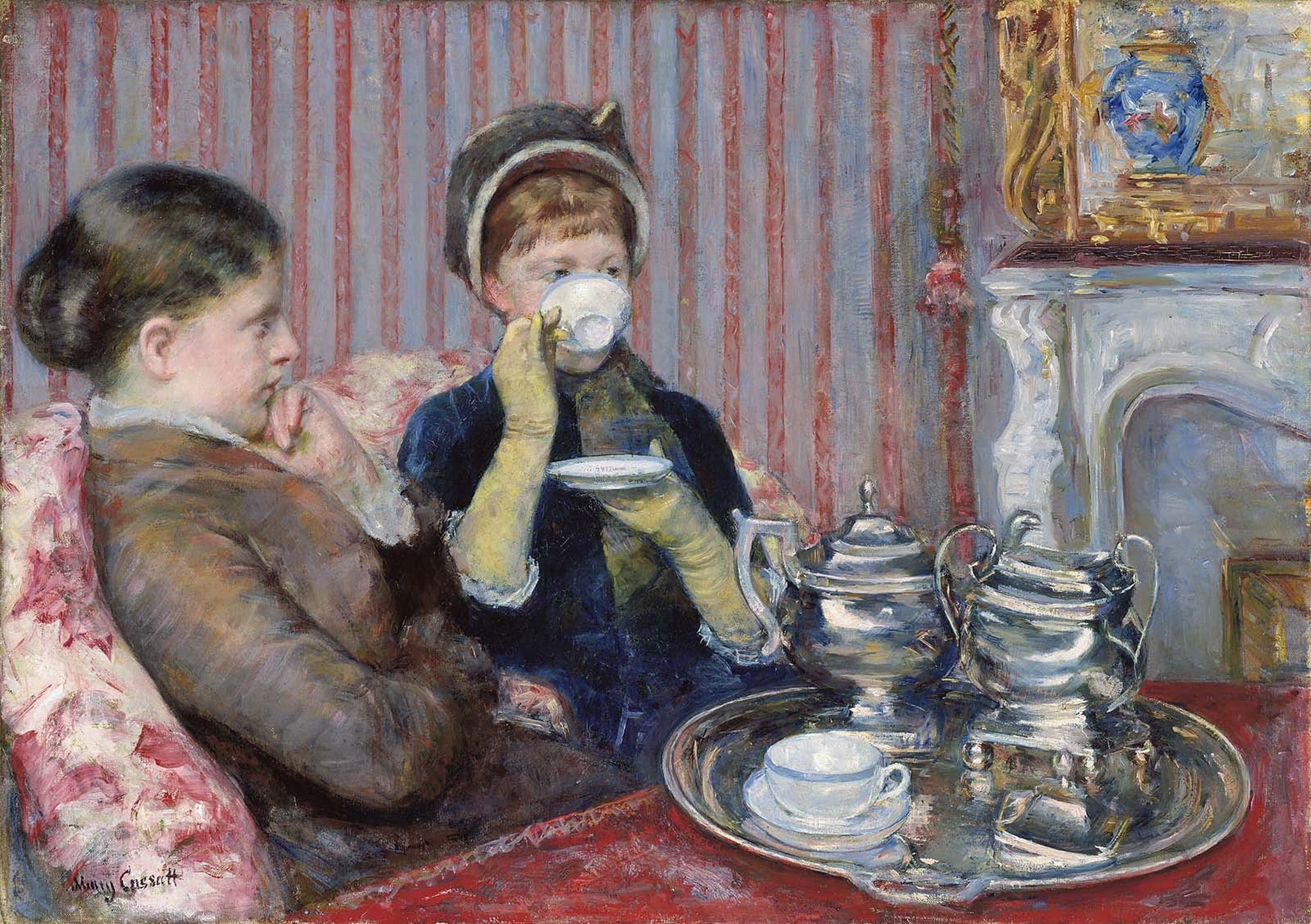
The Tea
Mary Cassatt (about 1880)
Mary Cassatt’s The Tea stages a poised, interior <strong>drama of manners</strong>: two women sit close yet feel apart, one thoughtful, the other raising a cup that <strong>veils her face</strong>. A gleaming, oversized <strong>silver tea service</strong> commands the foreground, its reflections turning ritual objects into actors in the scene <sup>[1]</sup>. The shallow, cropped room—striped wall, gilt mirror, marble mantel—compresses the atmosphere into <strong>intimacy edged by restraint</strong>.
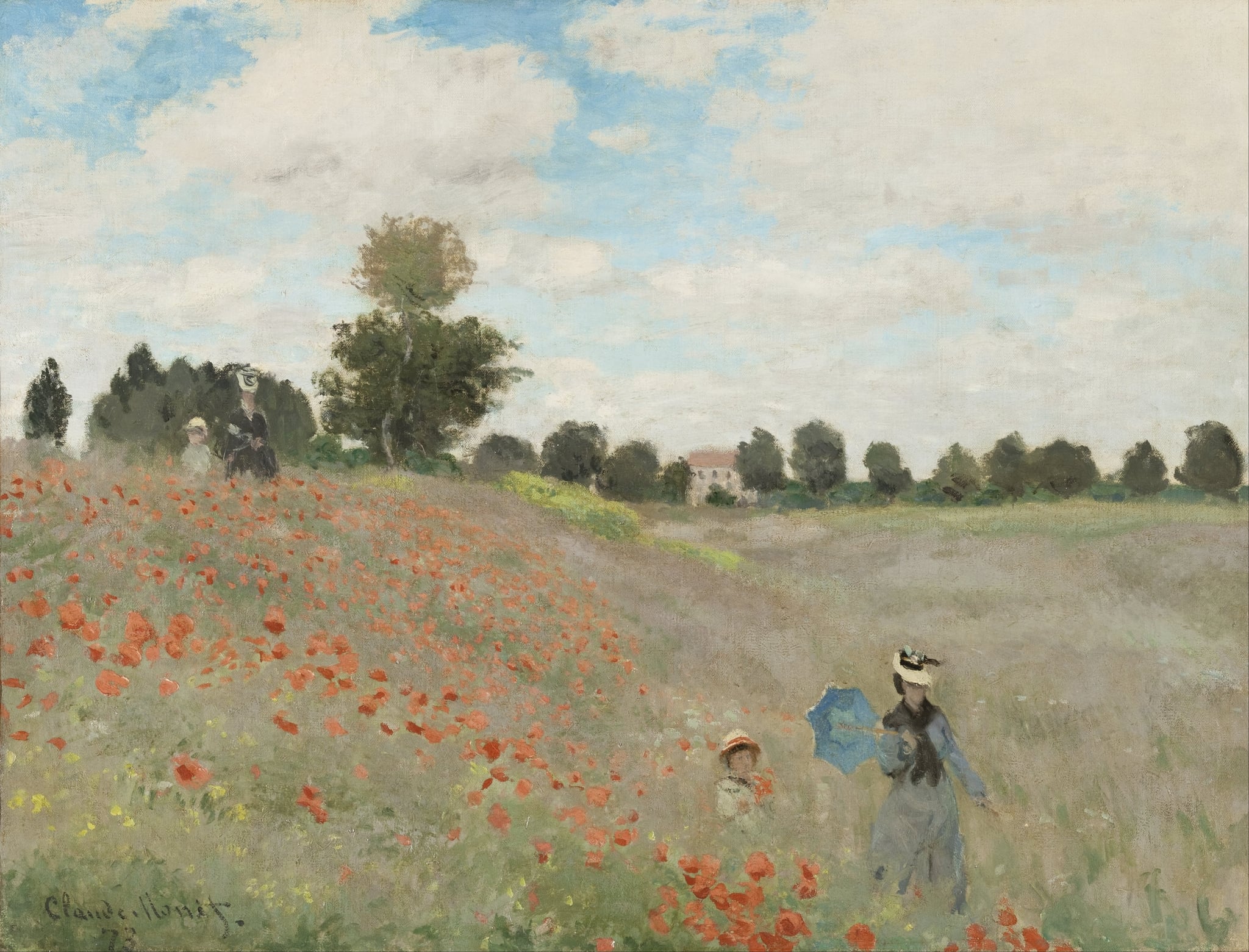
Poppies
Claude Monet (1873)
Claude Monet’s Poppies (1873) turns a suburban hillside into a theater of <strong>light, time, and modern leisure</strong>. A red diagonal of poppies counters cool fields and sky, while a woman with a <strong>blue parasol</strong> and a child appear twice along the slope, staging a gentle <strong>echo of moments</strong> rather than a single event <sup>[1]</sup>. The painting asserts sensation over contour, letting broken touches make the day itself the subject.
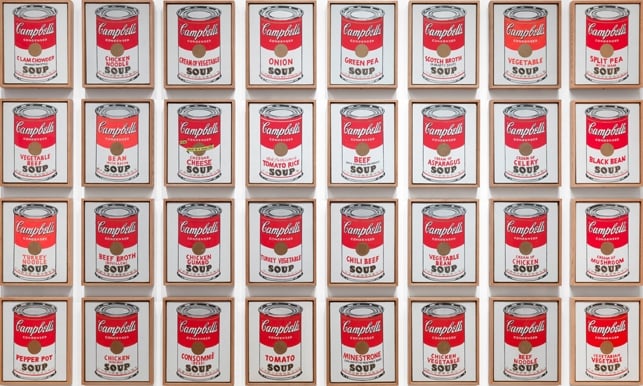
Campbell's Soup Cans
Andy Warhol (1962)
Warhol’s Campbell’s Soup Cans turns a shelf-staple into <strong>art</strong>, using a gridded array of near-identical red-and-white cans to fuse <strong>branding</strong> with <strong>painting</strong>. By repeating 32 flavors—Tomato, Clam Chowder, Chicken Noodle, and more—the work stages a clash between <strong>mass production</strong> and the artist’s hand <sup>[1]</sup><sup>[3]</sup>.
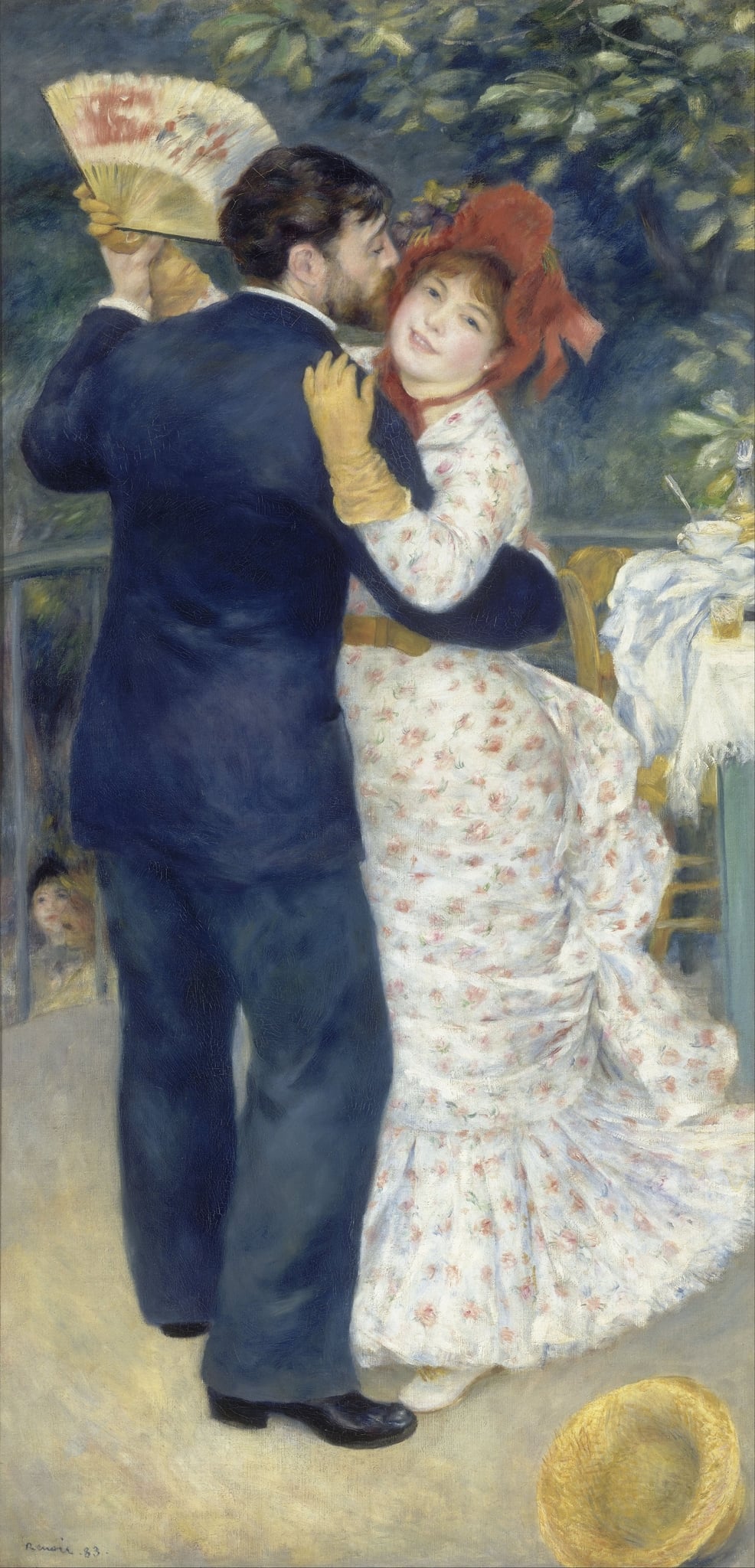
Dance in the Country
Pierre-Auguste Renoir (1883)
Dance in the Country shows a couple swept into a close embrace on a café terrace, their bodies turning in a soft spiral as foliage and sunlight dissolve into <strong>dappled color</strong>. Renoir orchestrates <strong>bourgeois leisure</strong>—the tossed straw boater, a small table with glass and napkin, the woman’s floral dress and red bonnet—to stage a moment where decorum and desire meet. The result is a modern emblem of shared pleasure, poised between Impressionist shimmer and a newly <strong>firm, linear touch</strong>.
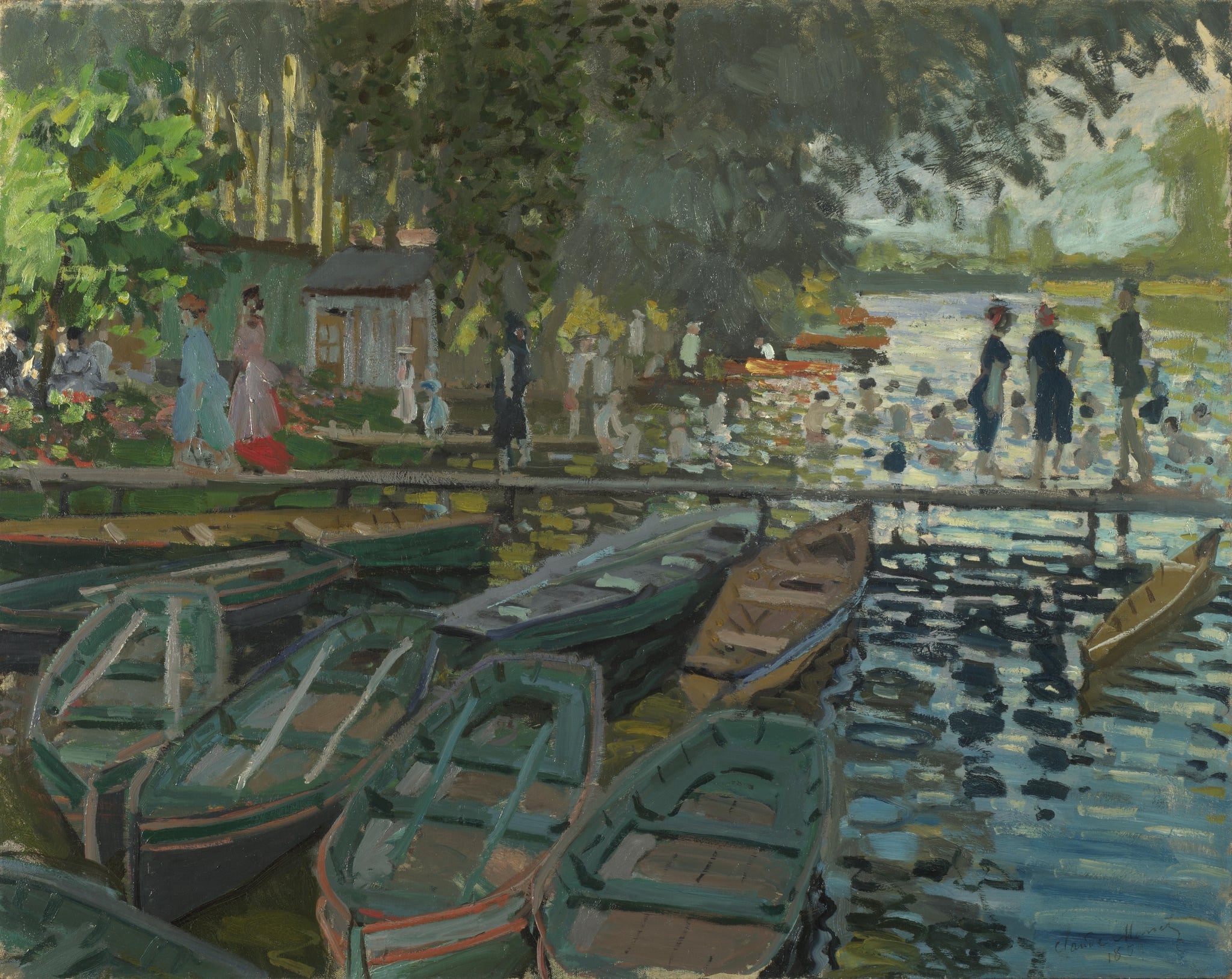
La Grenouillère
Claude Monet (1869)
Monet’s La Grenouillère crystallizes the new culture of <strong>modern leisure</strong> on the Seine: crowded bathers, promenading couples, and rental boats orbit a floating resort. With <strong>flickering brushwork</strong> and a high-key palette, Monet turns water, light, and movement into the true subjects, suspending the scene at the brink of dissolving.
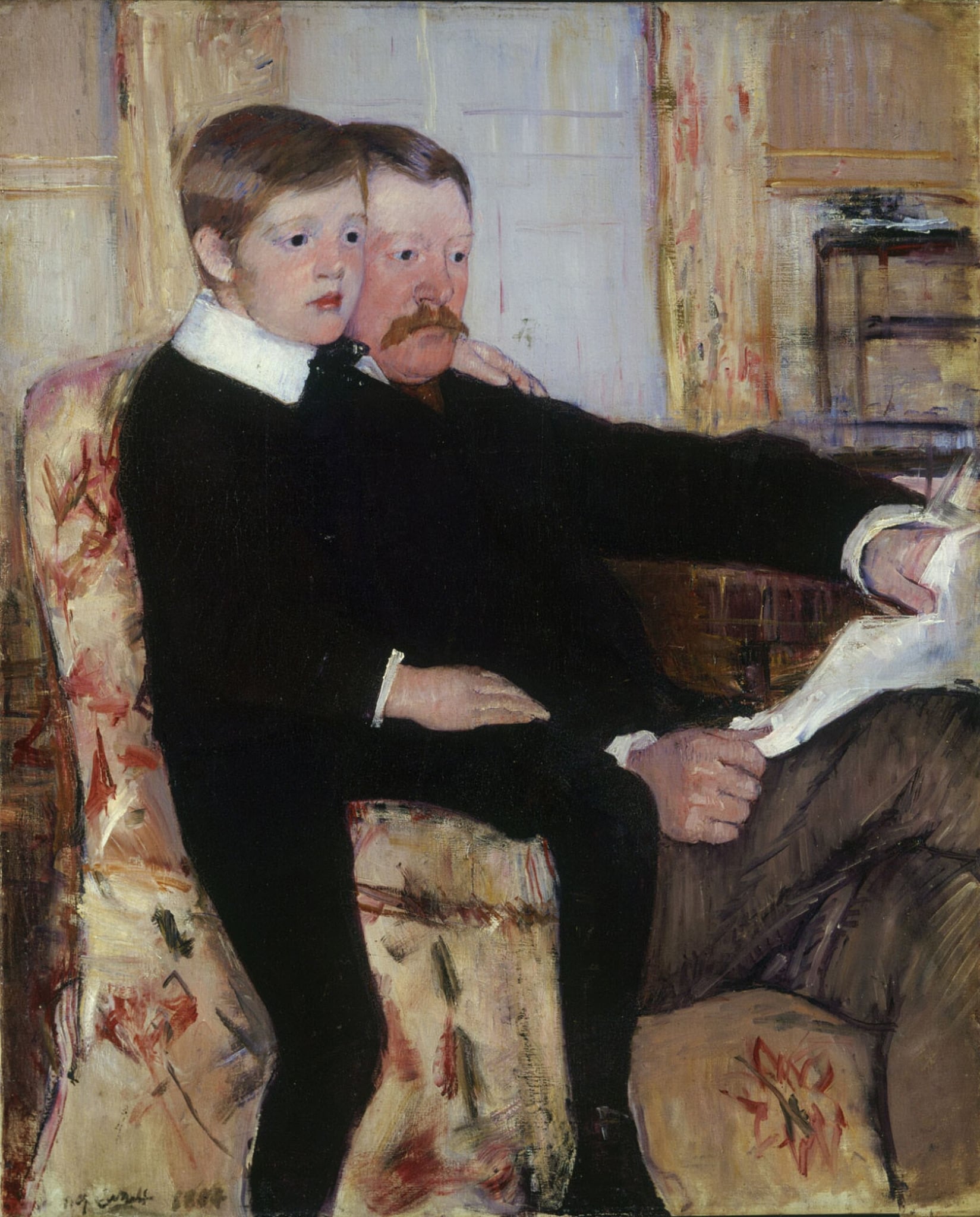
Portrait of Alexander J. Cassatt and His Son Robert Kelso Cassatt
Mary Cassatt (1884)
A quiet, domestic tableau becomes a study in <strong>authority tempered by affection</strong>. In Portrait of Alexander J. Cassatt and His Son Robert Kelso Cassatt, Mary Cassatt fuses father and child into a single dark silhouette against a luminous, brushed interior, their shared gaze fixed beyond the frame. The <strong>newspaper</strong>, <strong>linked hands</strong>, and <strong>cropped closeness</strong> transform a routine moment into a symbol of generational continuity and modern attentiveness.
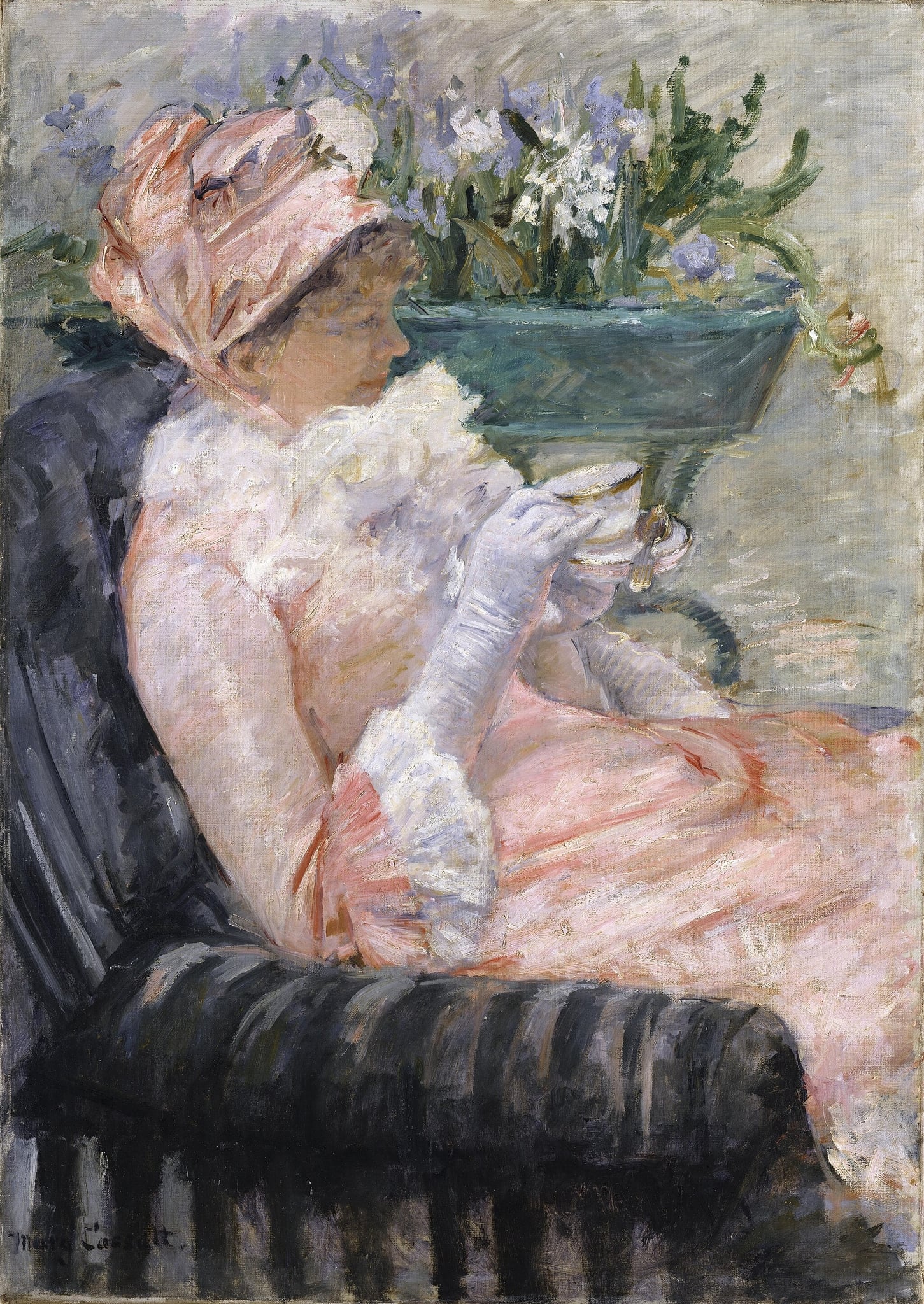
The Cup of Tea
Mary Cassatt (ca. 1880–81)
Mary Cassatt’s The Cup of Tea distills a moment of bourgeois leisure into a study of <strong>poise</strong>, <strong>etiquette</strong>, and <strong>private reflection</strong>. A woman in a rose‑pink dress and bonnet, white‑gloved, balances a gold‑rimmed cup against the shimmer of <strong>Impressionist</strong> brushwork, while a green planter of pale blossoms echoes her pastel palette <sup>[1]</sup>. The work turns an ordinary ritual into a modern emblem of women’s experience.
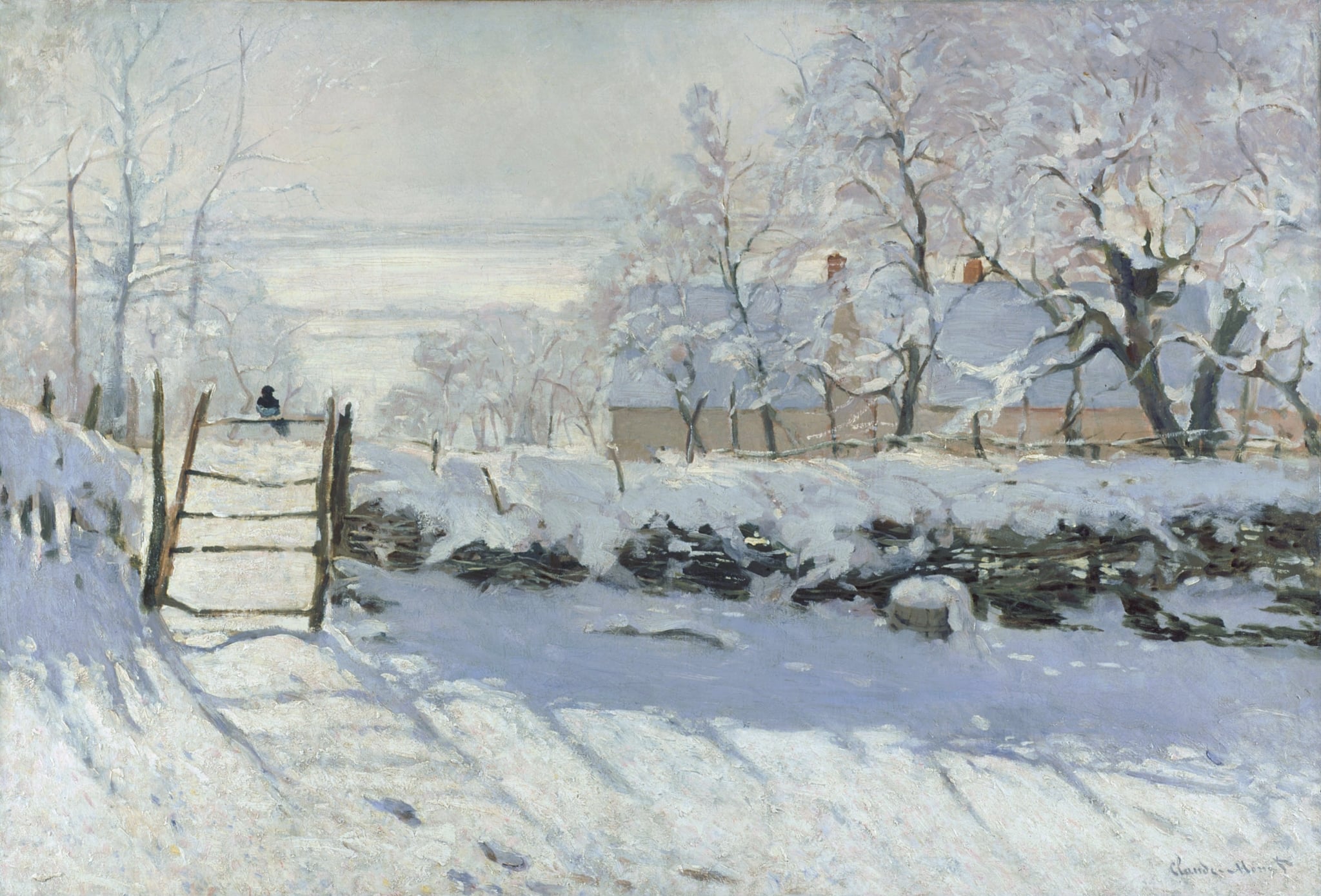
The Magpie
Claude Monet (1868–1869)
Claude Monet’s The Magpie turns a winter field into a study of <strong>luminous perception</strong>, where blue-violet shadows articulate snow’s light. A lone <strong>magpie</strong> perched on a wooden gate punctuates the silence, anchoring a scene that balances homestead and open countryside <sup>[1]</sup>.
![Triple Elvis [Ferus Type] by Andy Warhol](/_next/image?url=https%3A%2F%2Fstorage.googleapis.com%2Fsite-images-programmatic%2Fpaintings%2F1771915343451-6gzg8m.jpg&w=3840&q=85&dpl=dpl_ASiQPiqukSad84i91Tcm2dUShHhL)
Triple Elvis [Ferus Type]
Andy Warhol (1963)
In Triple Elvis [Ferus Type] (1963), Andy Warhol multiplies a gunslinging movie idol across a cool, metallic field, turning a singular persona into a <strong>serial commodity</strong>. The sharply printed figure at center flanked by fading, <strong>ghosted</strong> doubles collapses still image, filmic motion, and mass reproduction into one charged surface <sup>[1]</sup><sup>[2]</sup>.
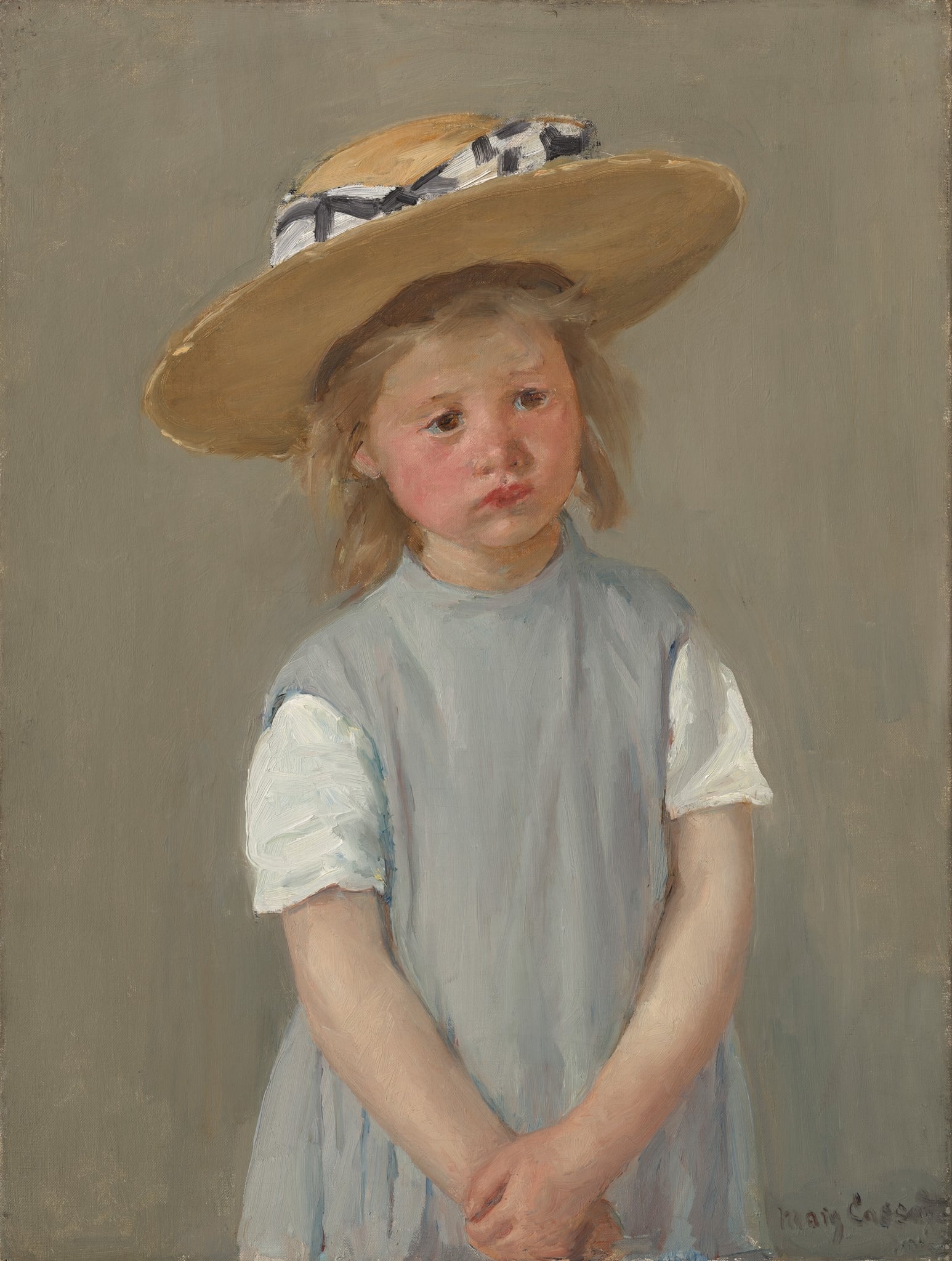
Little Girl in a Big Straw Hat and a Pinafore
Mary Cassatt (c. 1886)
Mary Cassatt’s Little Girl in a Big Straw Hat and a Pinafore distills childhood into a quiet drama of <strong>interiority</strong> and <strong>constraint</strong>. The oversized straw hat and plain pinafore bracket a flushed face, downcast eyes, and <strong>clasped hands</strong>, turning a simple pose into a study of modern self‑consciousness <sup>[1]</sup>. Cassatt’s cool grays and swift, luminous strokes make mood—not costume—the subject.
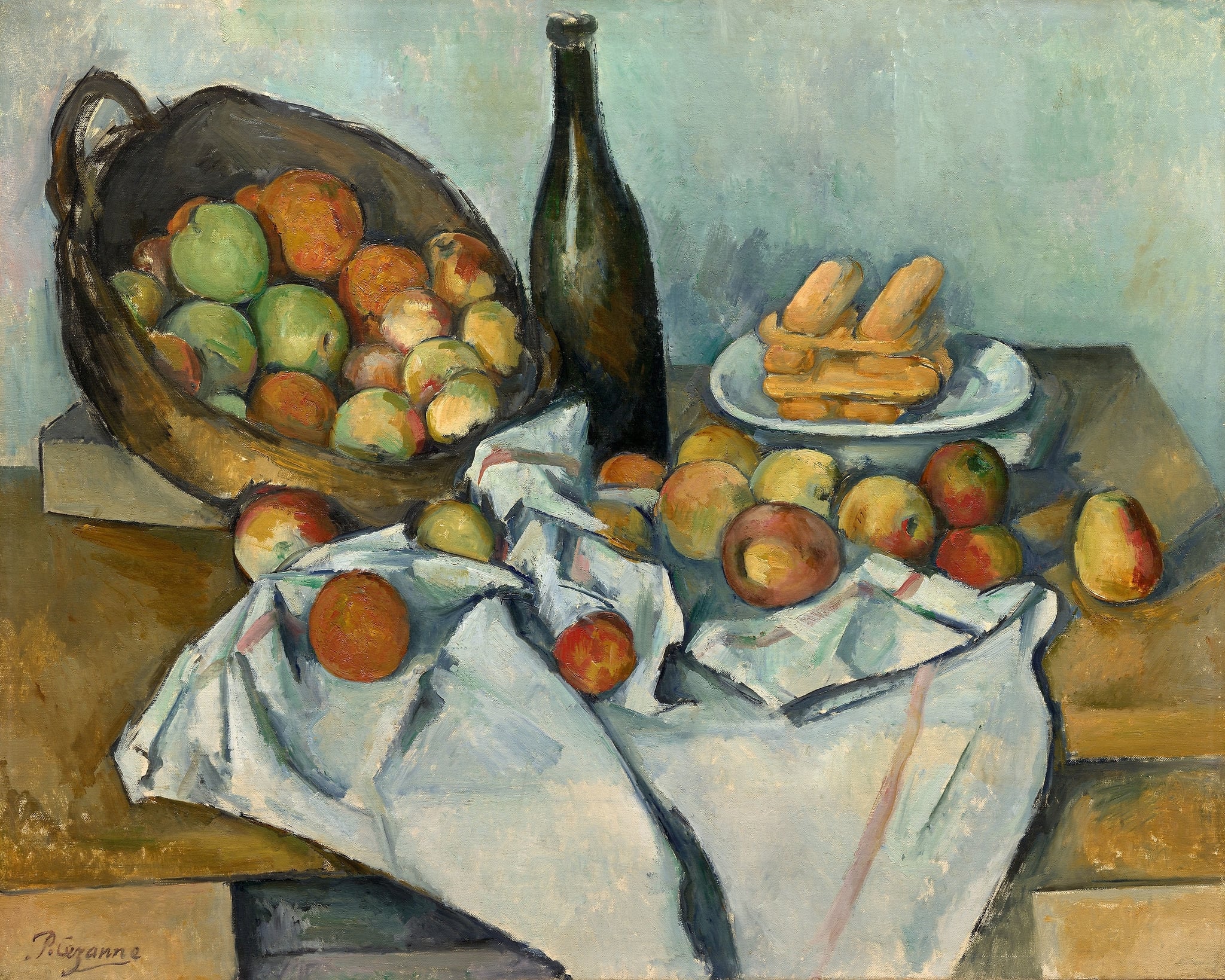
The Basket of Apples
Paul Cézanne (c. 1893)
Paul Cézanne’s The Basket of Apples stages a quiet drama of <strong>balance and perception</strong>. A tilted basket spills apples across a <strong>rumpled white cloth</strong> toward a <strong>dark vertical bottle</strong> and a plate of <strong>biscuits</strong>, while the tabletop’s edges refuse to align—an intentional play of <strong>multiple viewpoints</strong> <sup>[1]</sup><sup>[2]</sup><sup>[3]</sup>.
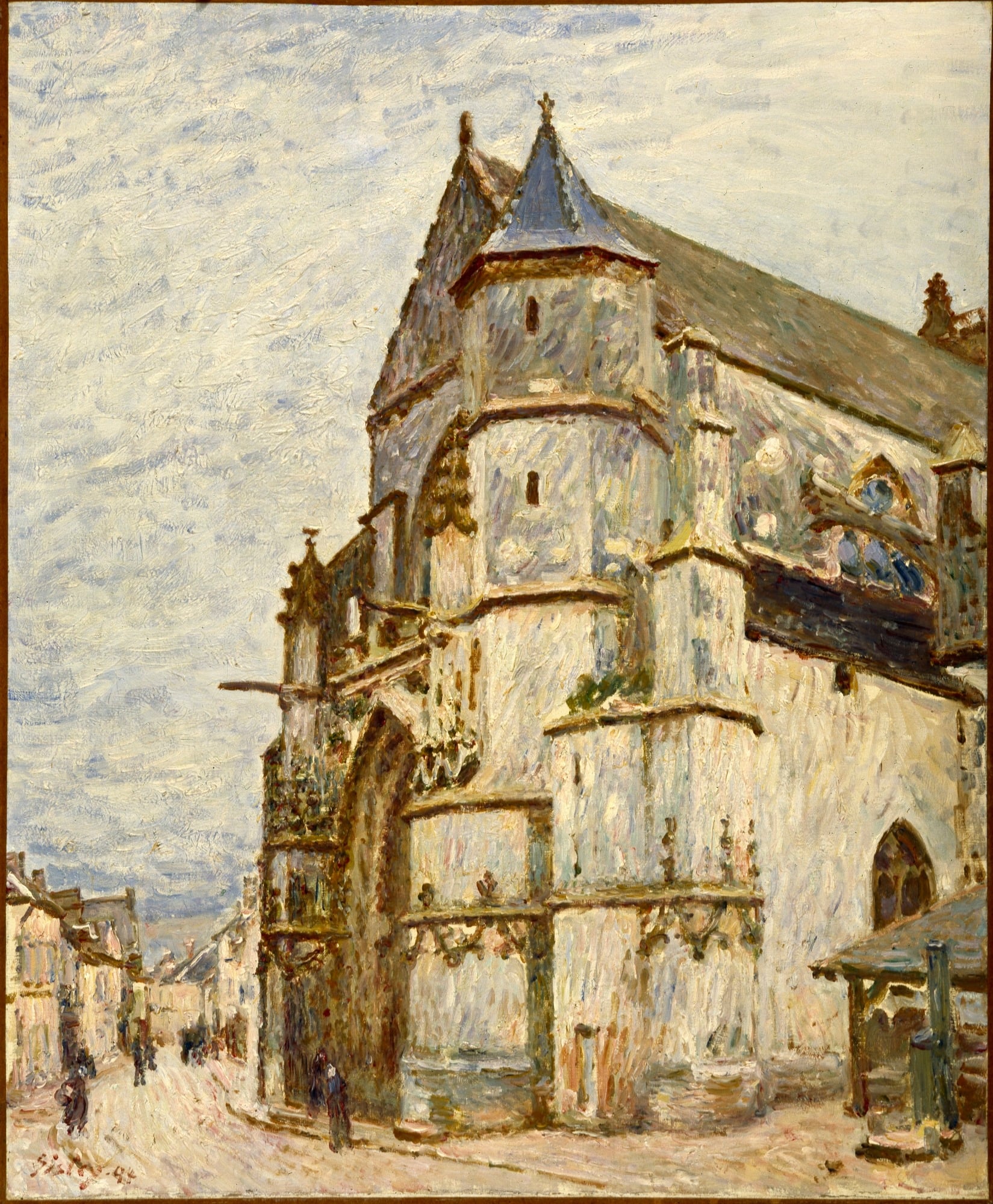
The Church at Moret
Alfred Sisley (1894)
Alfred Sisley’s The Church at Moret turns a Flamboyant Gothic façade into a living barometer of light, weather, and time. With <strong>cool blues, lilacs, and warm ochres</strong> laid in broken strokes, the stone seems to breathe as tiny townspeople drift along the street. The work asserts <strong>permanence meeting transience</strong>: a communal monument held steady while the day’s atmosphere endlessly remakes it <sup>[1]</sup><sup>[2]</sup><sup>[3]</sup>.
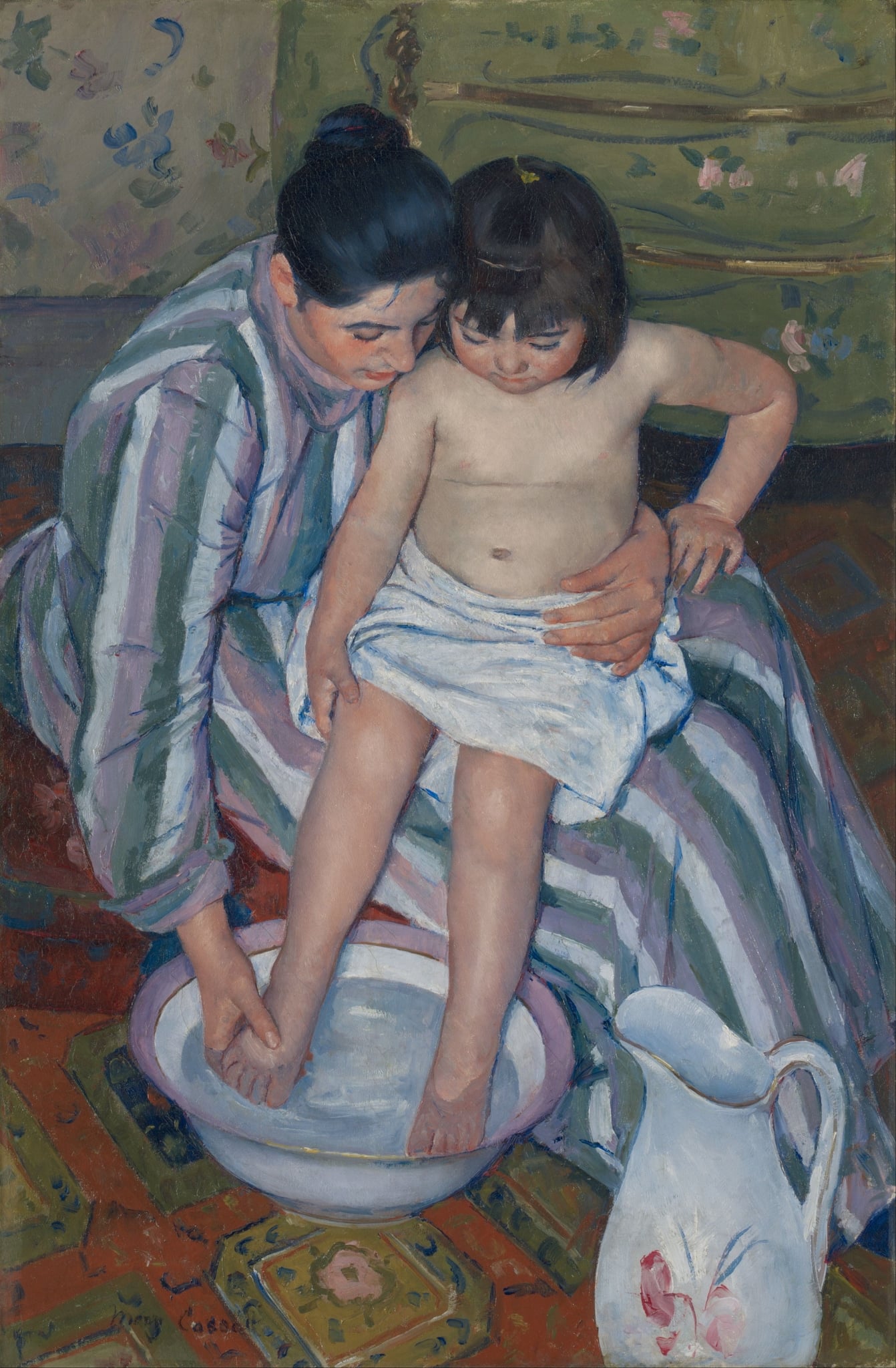
The Child's Bath
Mary Cassatt (1893)
Mary Cassatt’s The Child’s Bath (1893) recasts an ordinary ritual as <strong>modern devotion</strong>. From a steep, print-like vantage, interlocking stripes, circles, and diagonals focus attention on <strong>touch, care, and renewal</strong>, turning domestic labor into a subject of high art <sup>[1]</sup><sup>[3]</sup>. The work synthesizes Impressionist sensitivity with <strong>Japonisme</strong> design to monumentalize the private sphere <sup>[1]</sup><sup>[2]</sup>.
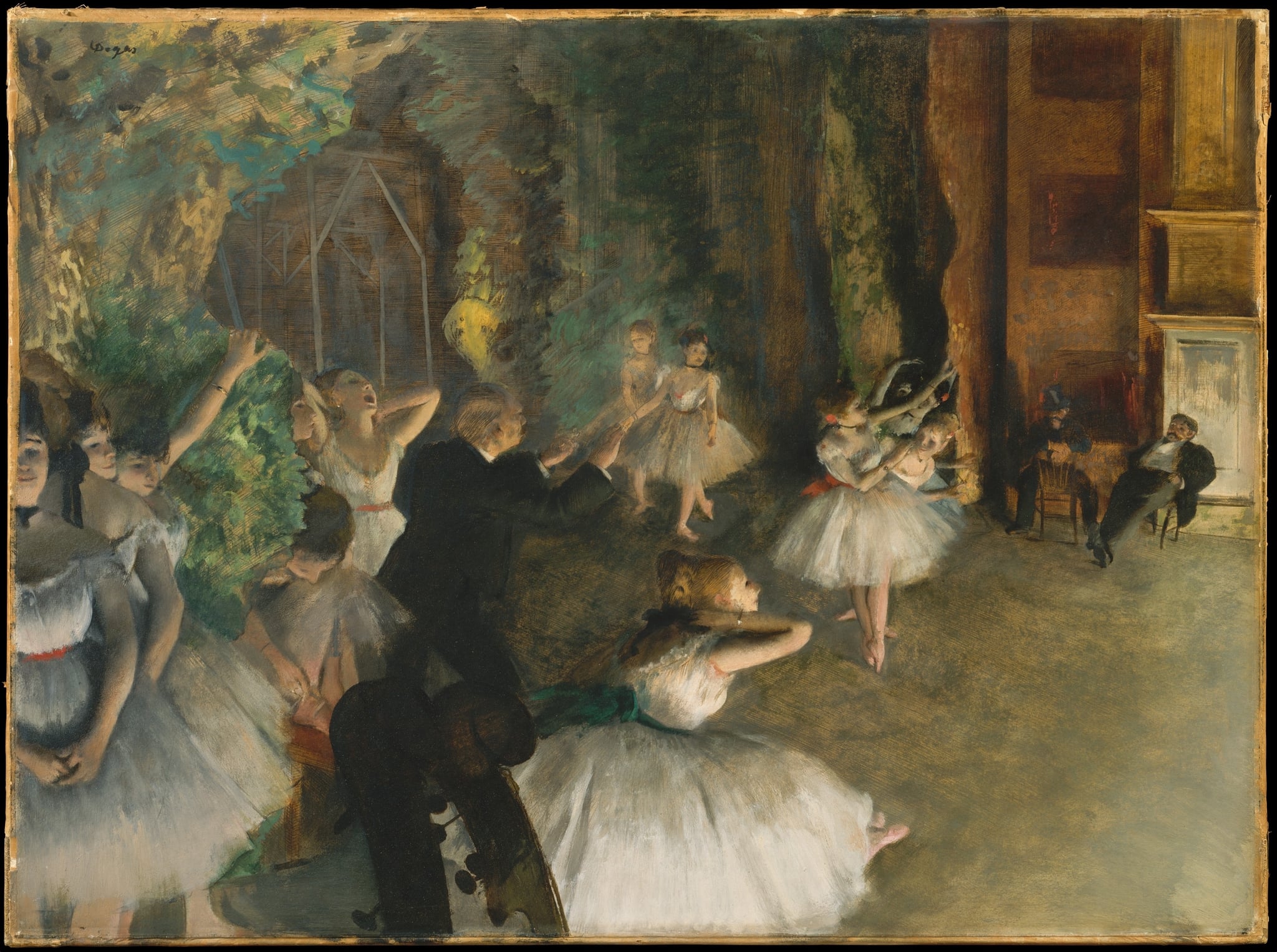
The Rehearsal of the Ballet Onstage
Edgar Degas (ca. 1874)
Degas’s The Rehearsal of the Ballet Onstage turns a moment of practice into a modern drama of work and power. Under <strong>harsh footlights</strong>, clustered ballerinas stretch, yawn, and repeat steps as a <strong>ballet master/conductor</strong> drives the tempo, while <strong>abonnés</strong> lounge in the wings and a looming <strong>double bass</strong> anchors the labor of music <sup>[1]</sup><sup>[3]</sup><sup>[4]</sup>.
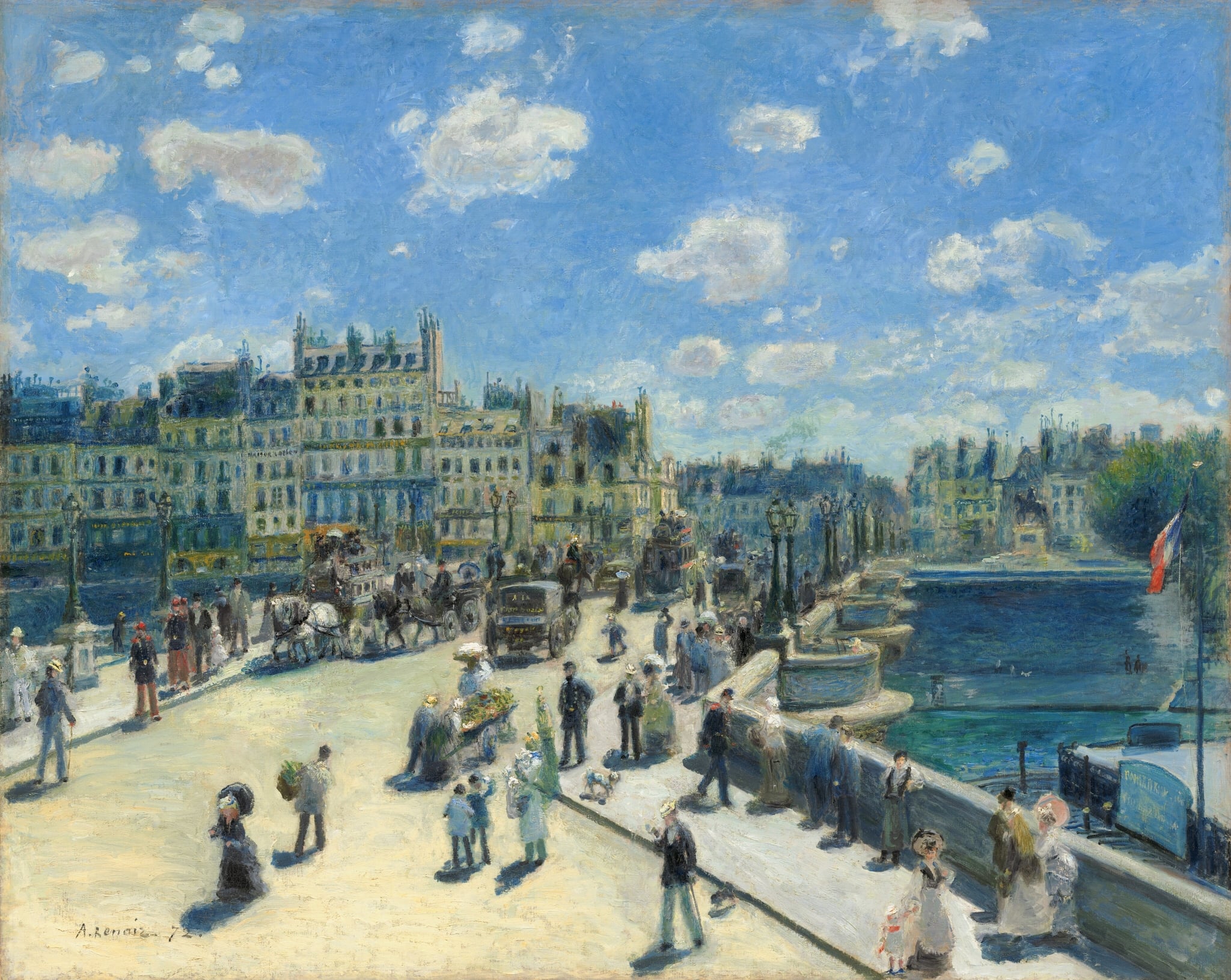
Pont Neuf Paris
Pierre-Auguste Renoir (1872)
In Pont Neuf Paris, Pierre-Auguste Renoir turns the oldest bridge in Paris into a stage where <strong>light</strong> and <strong>movement</strong> bind a city back together. From a high perch, he orchestrates crowds, carriages, gas lamps, the rippling Seine, and a fluttering <strong>tricolor</strong> so that everyday bustle reads as civic grace <sup>[1]</sup>.
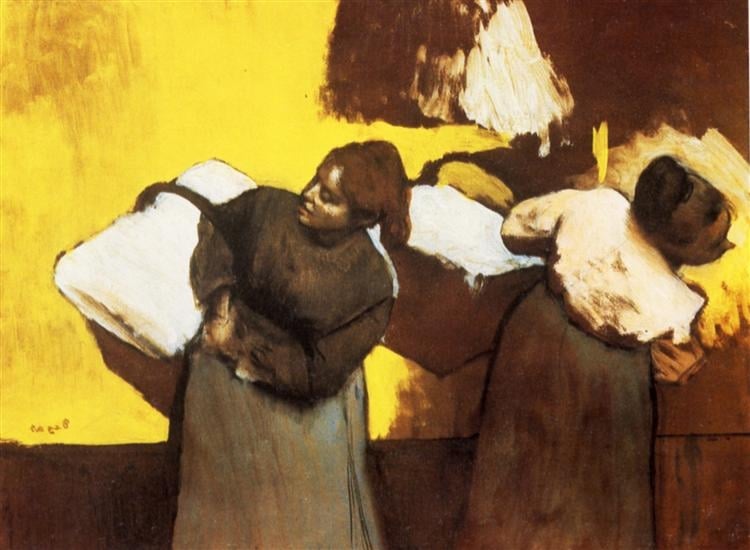
Laundresses Carrying Linen in Town
Camille Pissarro (1879)
In Laundresses Carrying Linen in Town, two working women strain under <strong>white bundles</strong> that flare against a <strong>flat yellow ground</strong> and a <strong>dark brown band</strong>. The abrupt cropping and opposing diagonals turn anonymous labor into a <strong>monumental, modern frieze</strong> of effort and motion.
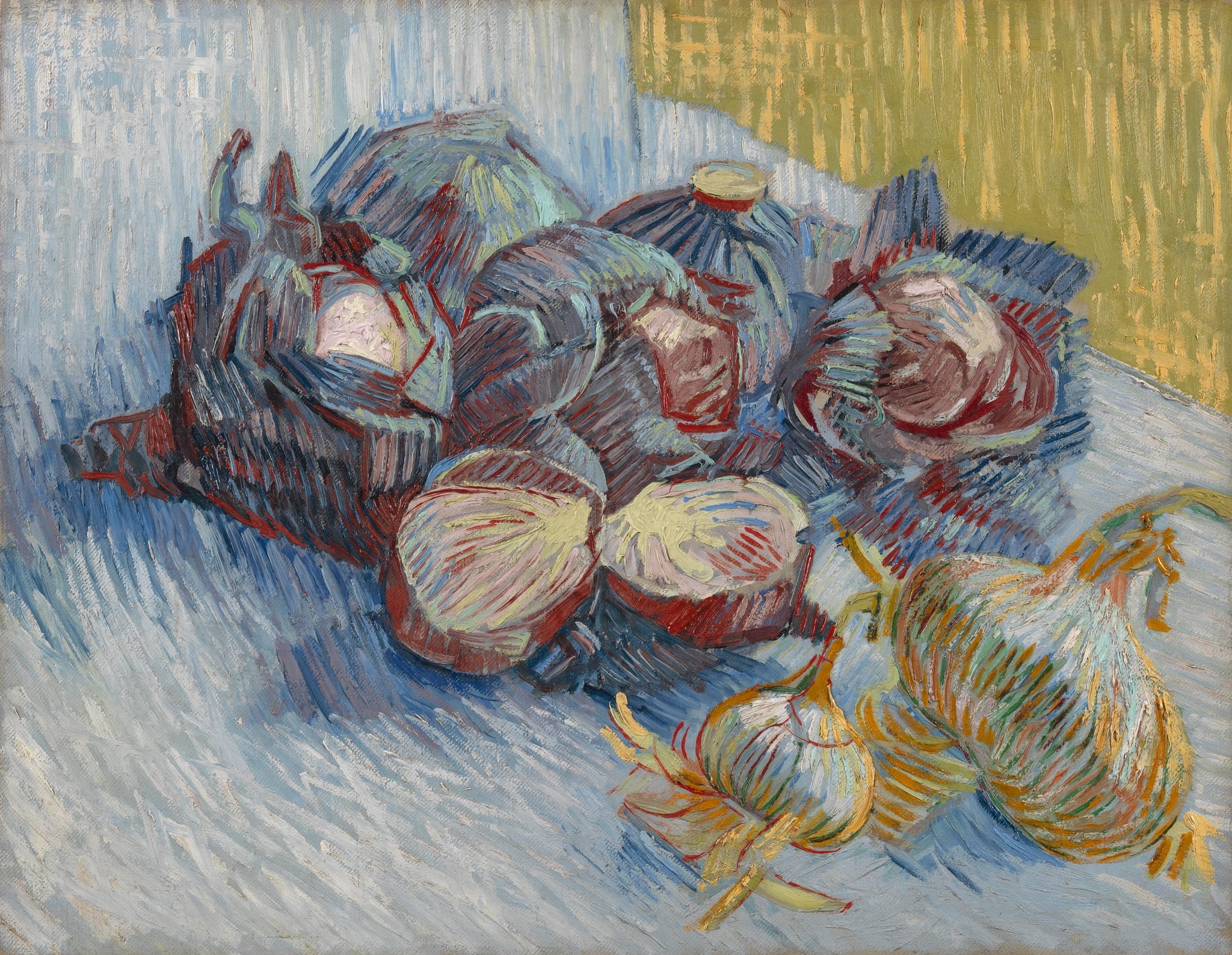
Red Cabbages and Onions
Vincent van Gogh (1887)
In Red Cabbages and Onions, Vincent van Gogh turns everyday produce into a drama of <strong>complementary color</strong> and <strong>restless brushwork</strong>. Hot red contours cinch violet cabbages and pale yellow bulbs against a cool, striated blue table, while a mustard‑yellow patch in the upper right tilts the space and sharpens the chromatic clash. The result asserts ordinary food as a locus of <strong>resilience</strong> and <strong>experimentation</strong> <sup>[1]</sup><sup>[2]</sup>.
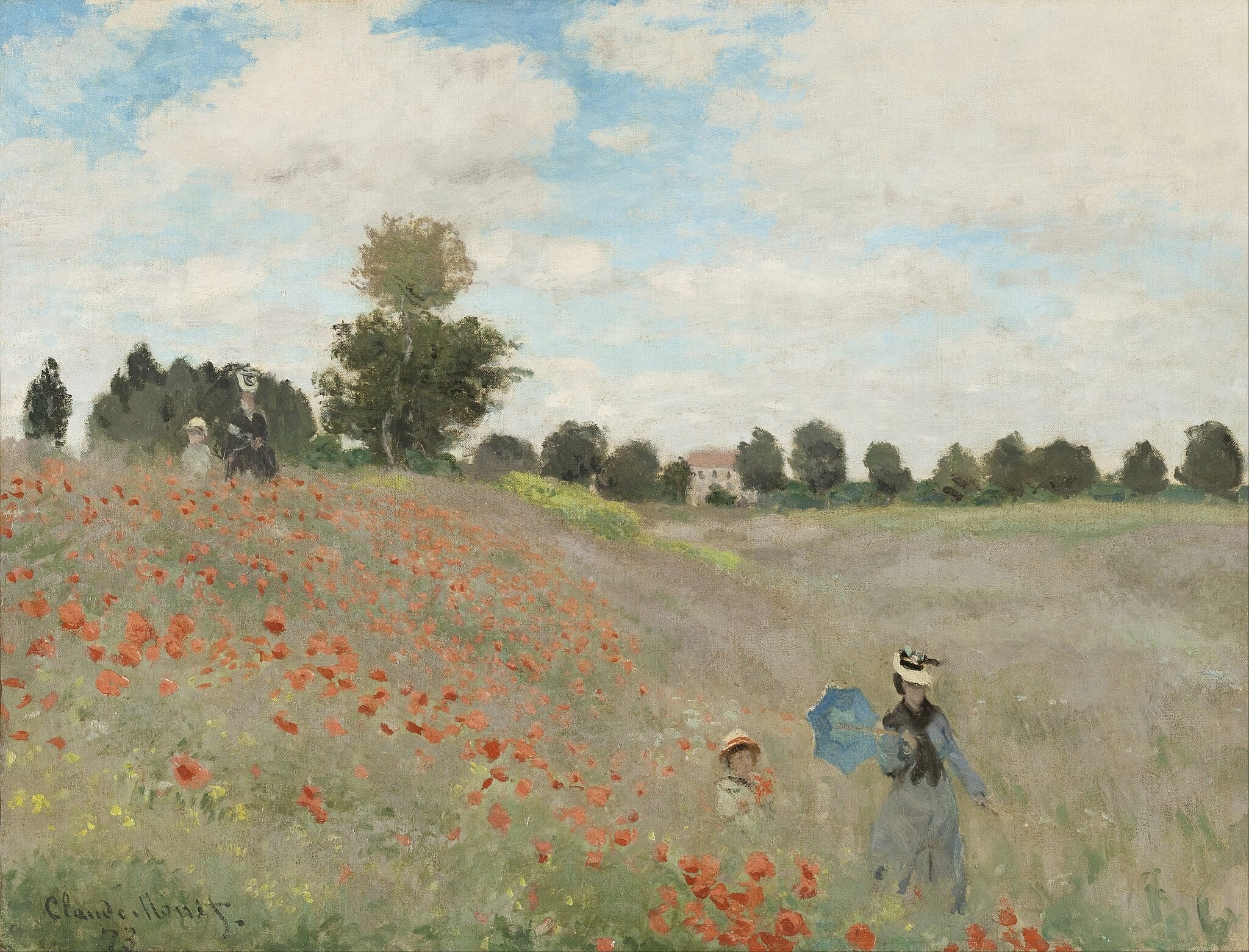
Poppy Fields near Argenteuil
Claude Monet (1873)
A modern pastoral where <strong>color and weather become the subject</strong>: in Poppy Fields near Argenteuil (1873), Monet arrays red poppies along a diagonal slope beneath an immense, changeable sky. Two promenading figures recur across the hill, turning a stroll into a <strong>rhythm of time and movement</strong> <sup>[1]</sup><sup>[2]</sup>.
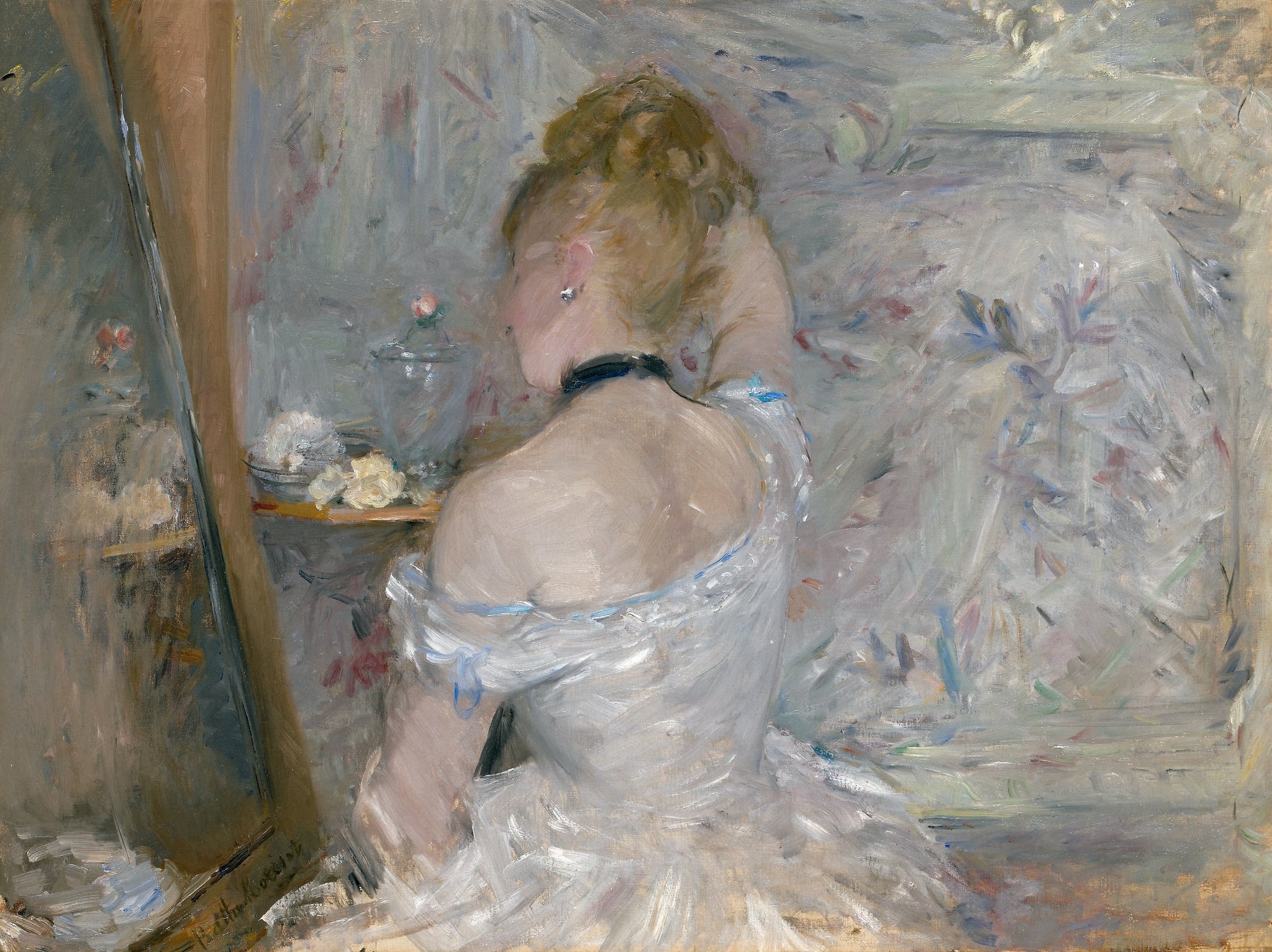
Woman at Her Toilette
Berthe Morisot (1875–1880)
Woman at Her Toilette stages a private ritual of self-fashioning, not a spectacle of vanity. A woman, seen from behind, lifts her arm to adjust her hair as a <strong>black velvet choker</strong> punctuates Morisot’s silvery-violet haze; the <strong>mirror’s blurred reflection</strong> with powders, jars, and a white flower refuses a clear face. Morisot’s <strong>feathery facture</strong> turns a fleeting toilette into modern subjectivity made visible <sup>[1]</sup>.
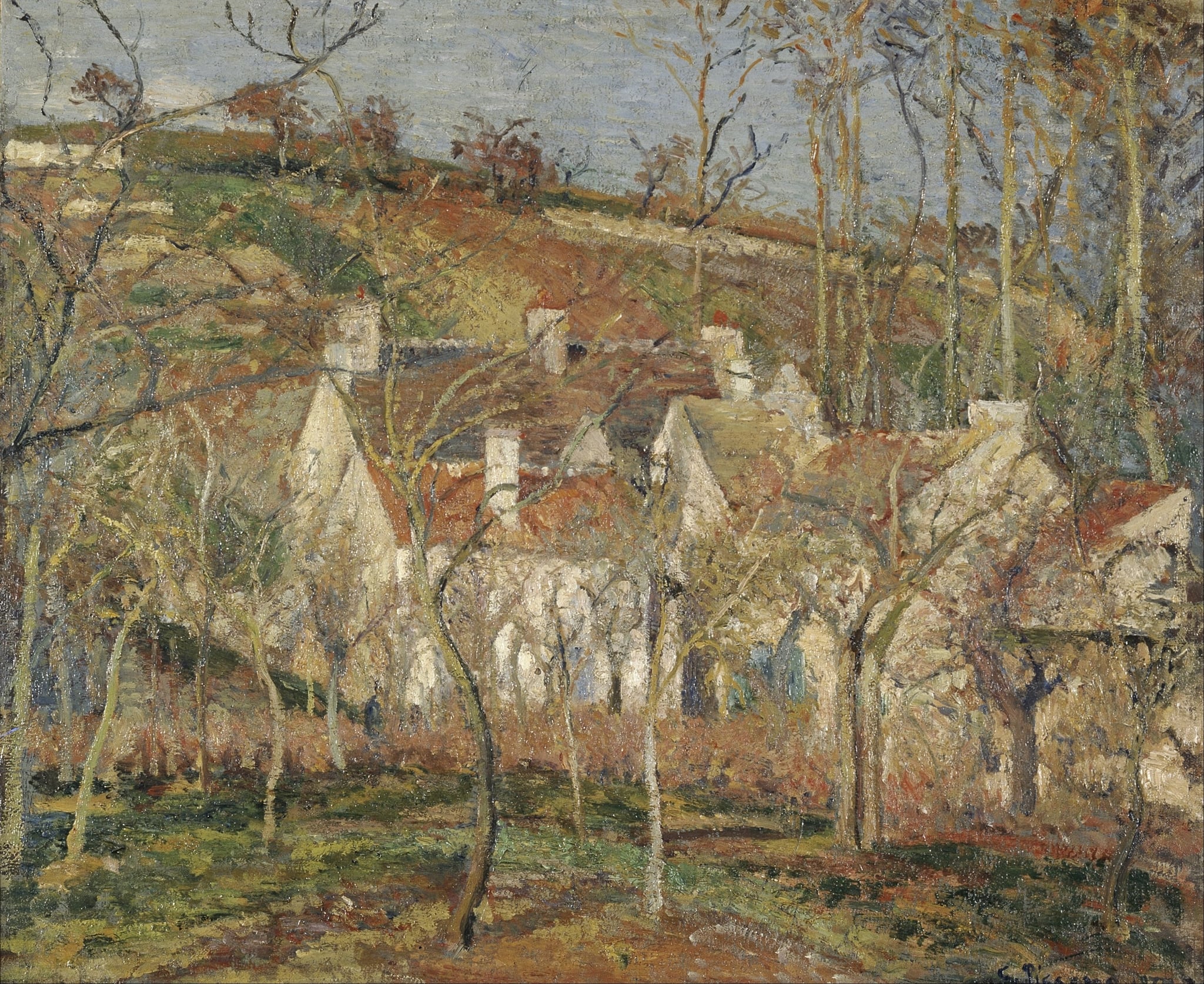
Red Roofs
Camille Pissarro (1877)
In Red Roofs, Camille Pissarro knits village and hillside into a single living fabric through a <strong>screen of winter trees</strong> and vibrating, tactile brushwork. The warm <strong>red-tiled roofs</strong> act as chromatic anchors within a cool, silvery atmosphere, asserting human shelter as part of nature’s rhythm rather than its negation <sup>[1]</sup><sup>[3]</sup>. The composition’s <strong>parallel planes</strong> and color echoes reveal a deliberate structural order that anticipates Post‑Impressionist concerns <sup>[1]</sup><sup>[2]</sup>.
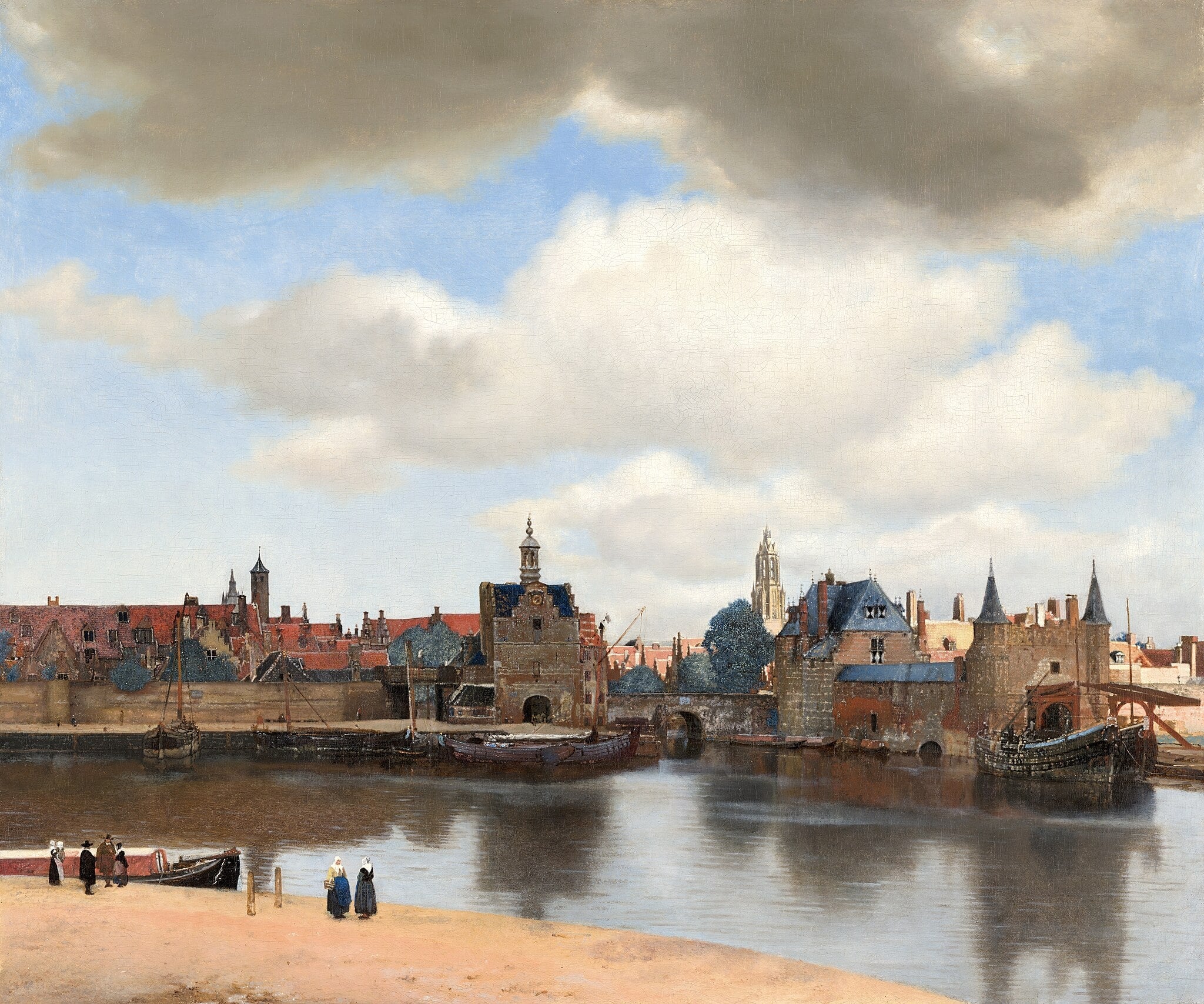
View of Delft
Johannes Vermeer (c. 1660–1661)
View of Delft turns a faithful city prospect into a meditation on <strong>civic order, resilience, and time</strong>. Beneath a low horizon, drifting clouds cast mobile shadows while shafts of sun ignite blue roofs and the bright spire of the <strong>Nieuwe Kerk</strong>, holding the scene’s moral center <sup>[1]</sup>. Small figures and moored boats ground prosperity in <strong>everyday community</strong> without breaking the hush.
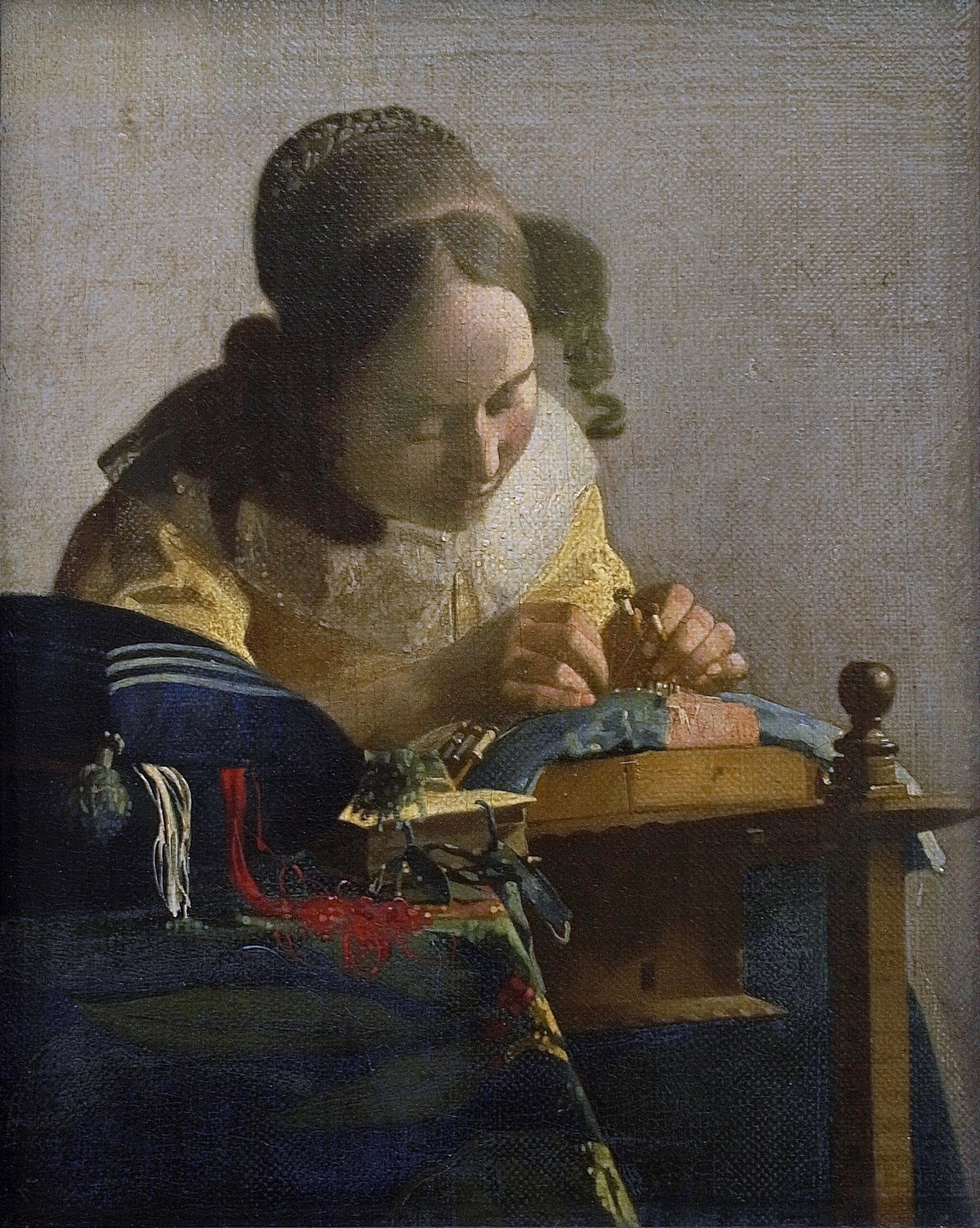
The Embroiderer
Johannes Vermeer (1669–1670)
In The Embroiderer, Johannes Vermeer condenses a world of work into a palm‑sized drama of <strong>attention</strong> and <strong>transformation</strong>. A young woman bends over a lace pillow as loose red and white threads spill in front, while a nascent pattern gathers under her poised fingers. Vermeer’s right‑hand light isolates the act of making and turns domestic labor into <strong>virtuous concentration</strong> <sup>[1]</sup>.
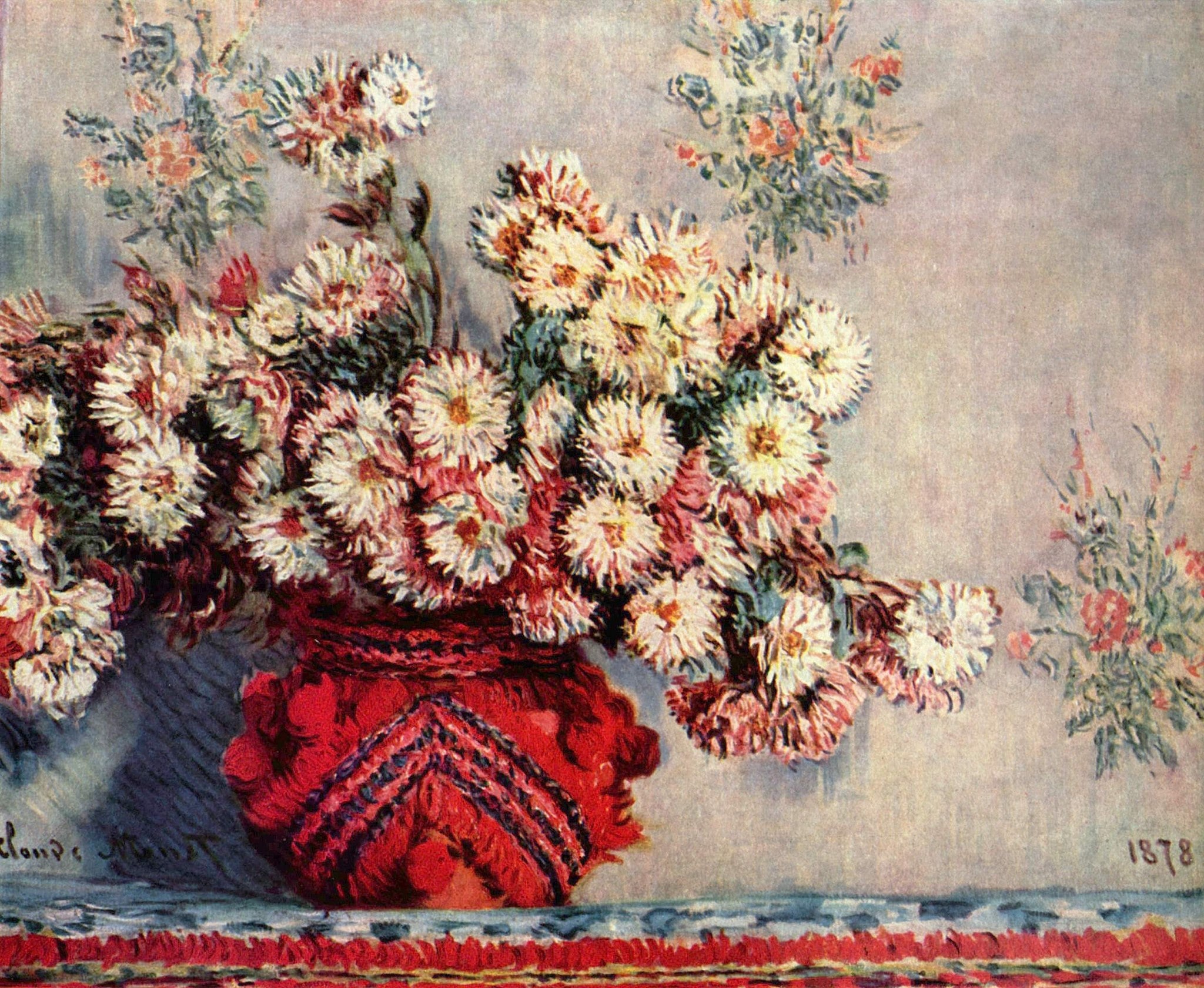
Chrysanthemums
Claude Monet (1878)
Claude Monet’s Chrysanthemums fixes a burst of late‑season bloom in a <strong>scarlet, plush‑textured vase</strong> against a cool <strong>blue‑gray wall</strong> where faint floral <strong>sprigs</strong> echo the bouquet. The painting privileges <strong>vibration of color</strong> over contour, turning still life into a decorative field. It condenses autumnal abundance and the fleetingness of light into a single, shimmering sensation <sup>[1]</sup><sup>[2]</sup>.
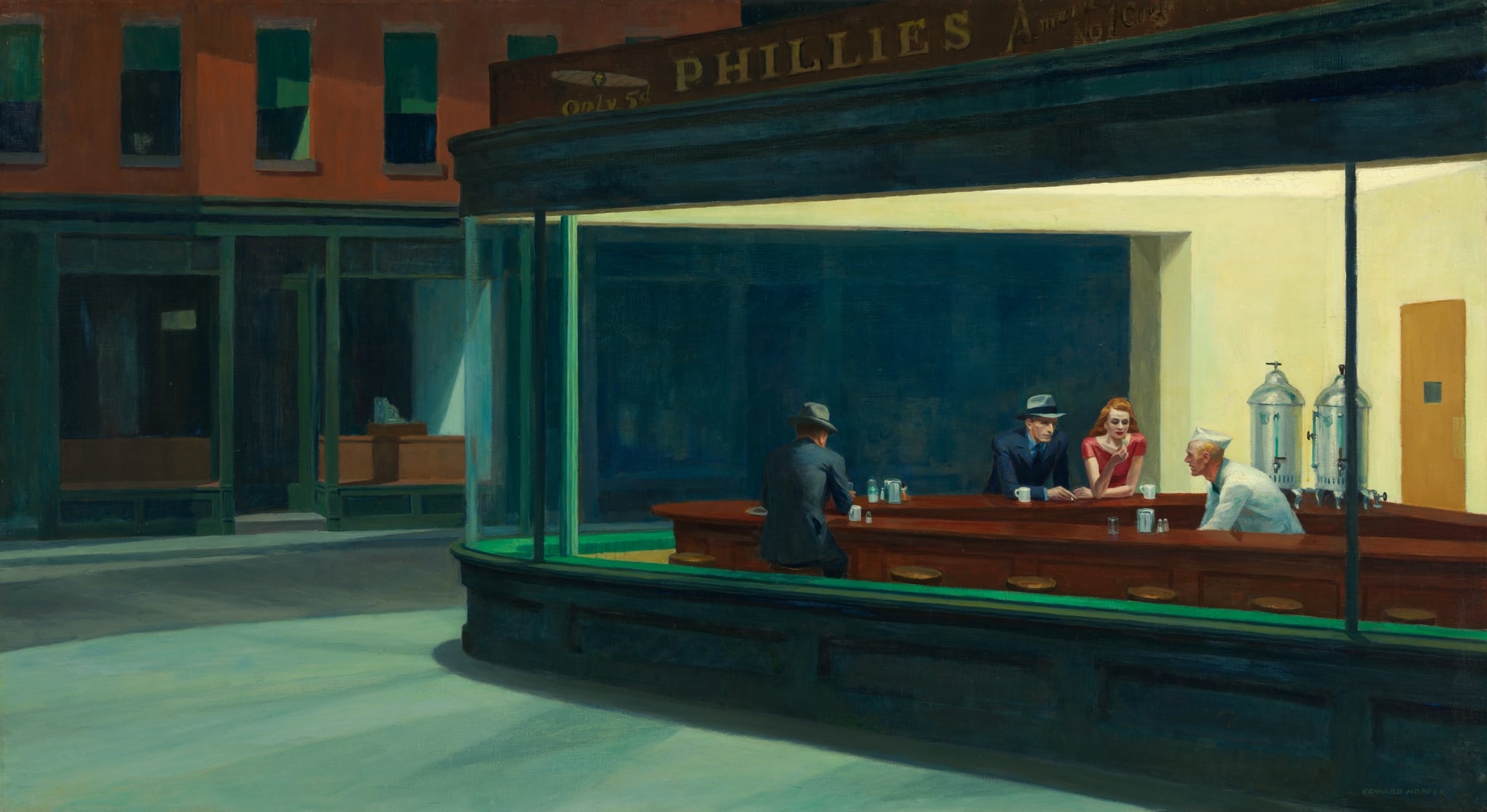
Nighthawks
Edward Hopper (1942)
Edward Hopper’s Nighthawks turns a corner diner into a sealed stage where <strong>fluorescent light</strong> and <strong>curved glass</strong> hold four figures in suspended time. The empty streets and the “PHILLIES” cigar sign sharpen the sense of <strong>urban solitude</strong> while hinting at wartime vigilance. The result is a cool, lucid image of modern life: illuminated, open to view, and emotionally out of reach.
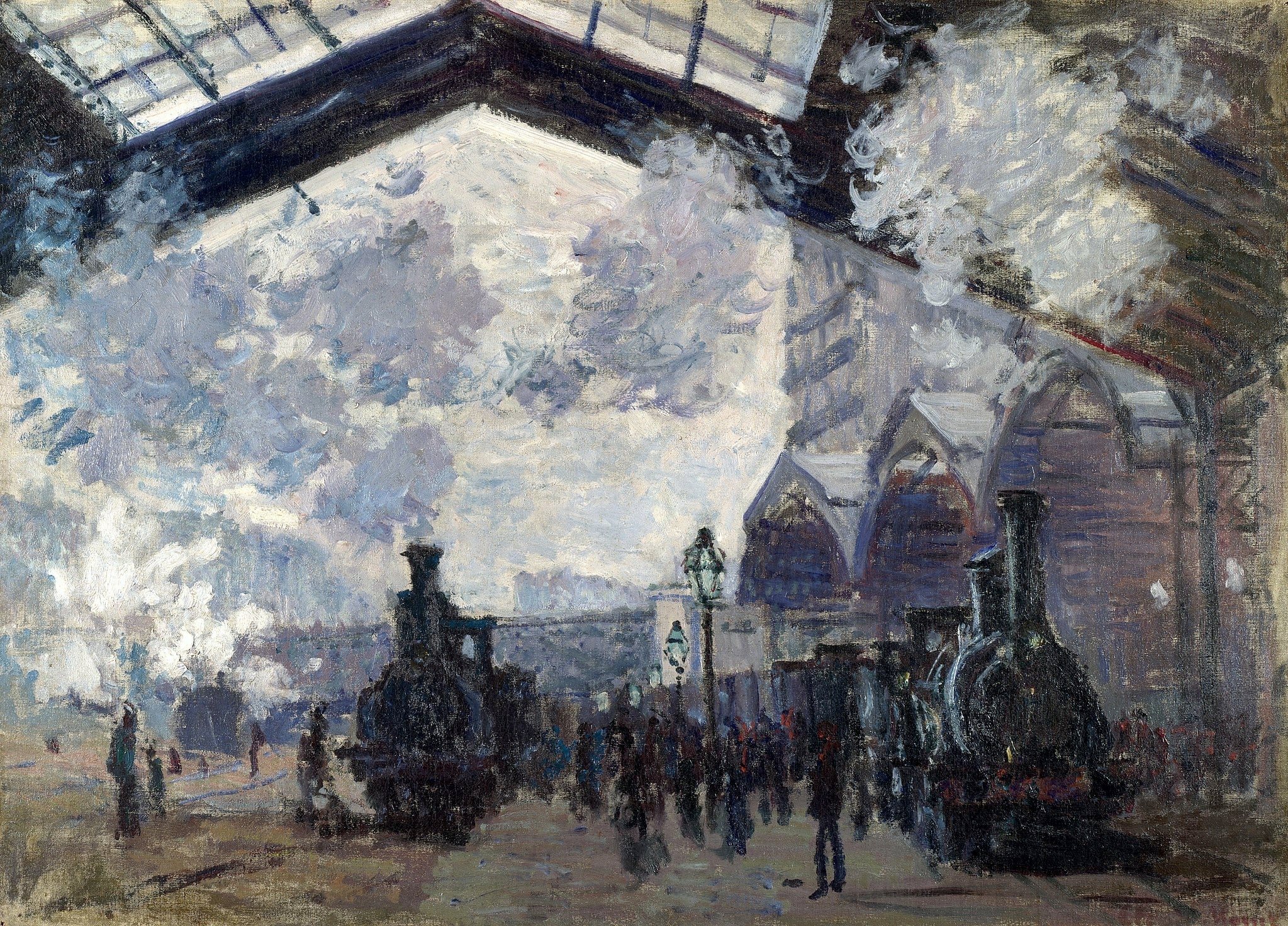
The Gare St-Lazare
Claude Monet (1877)
The Gare St-Lazare turns a bustling rail hub into a theater of <strong>light, steam, and speed</strong>. Under a nave-like iron-and-glass canopy, two dark locomotives loom as crowds and gas lamps dissolve into <strong>atmosphere</strong>, translating industry into sensation <sup>[1]</sup>.
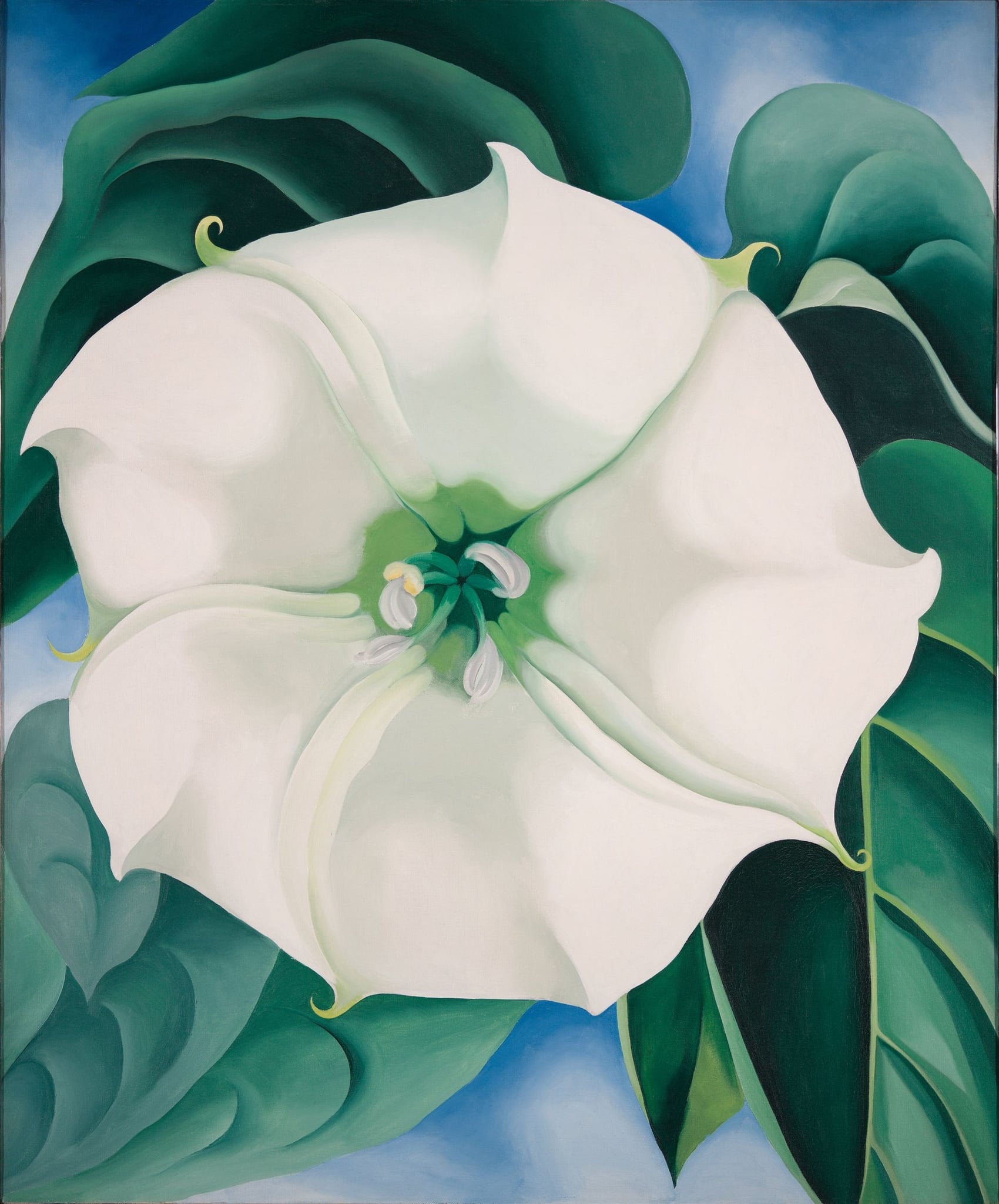
Jimson Weed/White Flower No. 1
Georgia O’Keeffe (1932)
Georgia O’Keeffe’s Jimson Weed/White Flower No. 1 turns a humble roadside blossom into a <strong>monumental icon</strong> of American modernism. The enlarged, close-cropped white trumpet radiates from a cool green throat, set against undulating leaves and a calm blue ground, so the viewer confronts <strong>form, scale, and stillness</strong> rather than botanical detail. Its immaculate bloom, drawn from the poisonous jimson weed, carries a charged tension between <strong>purity and peril</strong>.
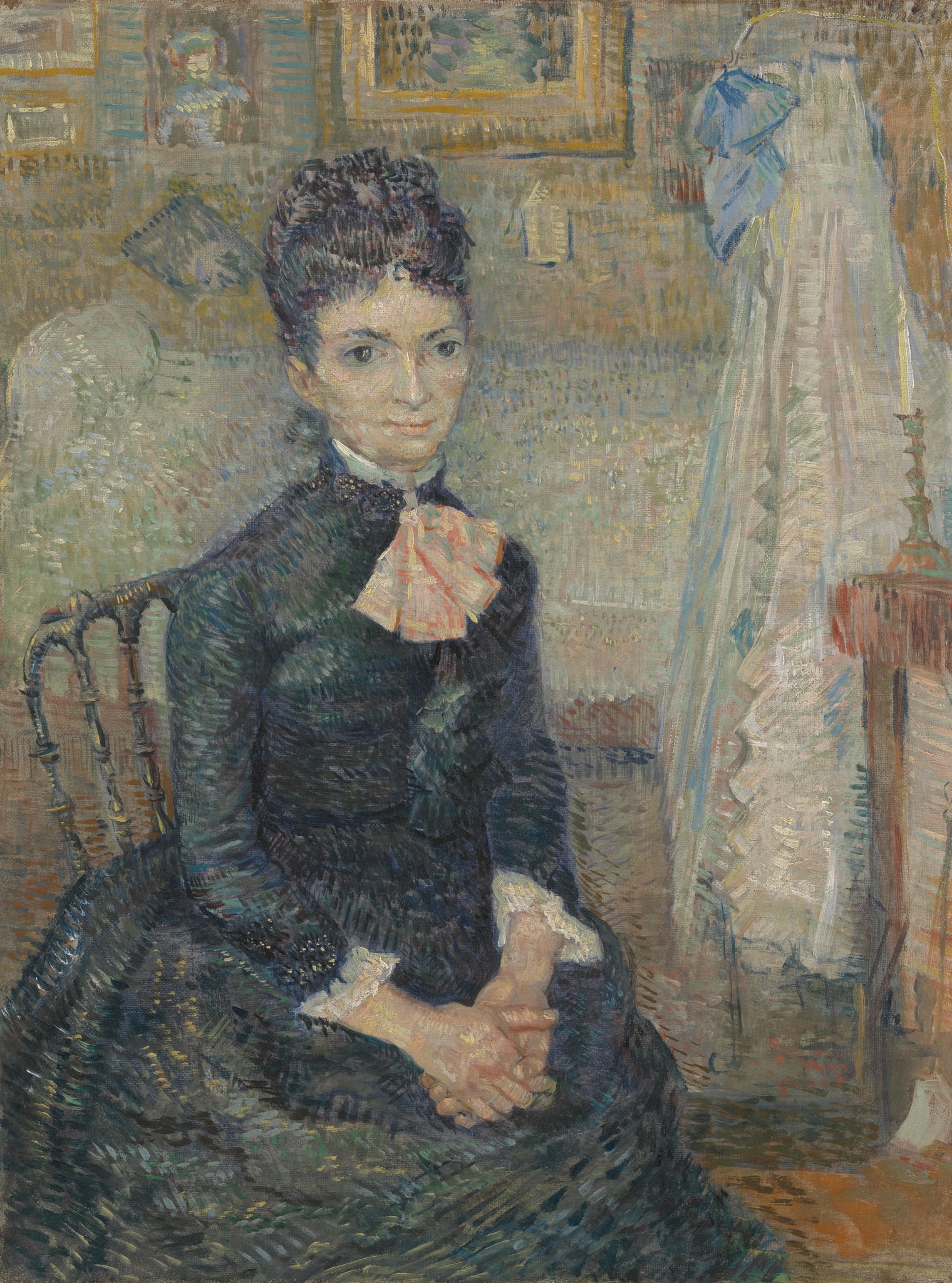
Portrait of Léonie Rose Charbuy-Davy
Vincent van Gogh (1887)
Vincent van Gogh’s Portrait of Léonie Rose Charbuy-Davy stages a composed, middle-class interior where a seated woman’s folded hands and dark blue-green dress meet a tremulous field of short, vibrating strokes. The cradle, fireplace glow, and dotted facture refract her poised exterior through <strong>modern, experimental color and touch</strong> <sup>[1]</sup><sup>[3]</sup>. The result is a portrait of <strong>maternal identity</strong> as much as a likeness, anchored by the hearth and cradle yet unsettled by the flicker of the paint itself <sup>[1]</sup>.
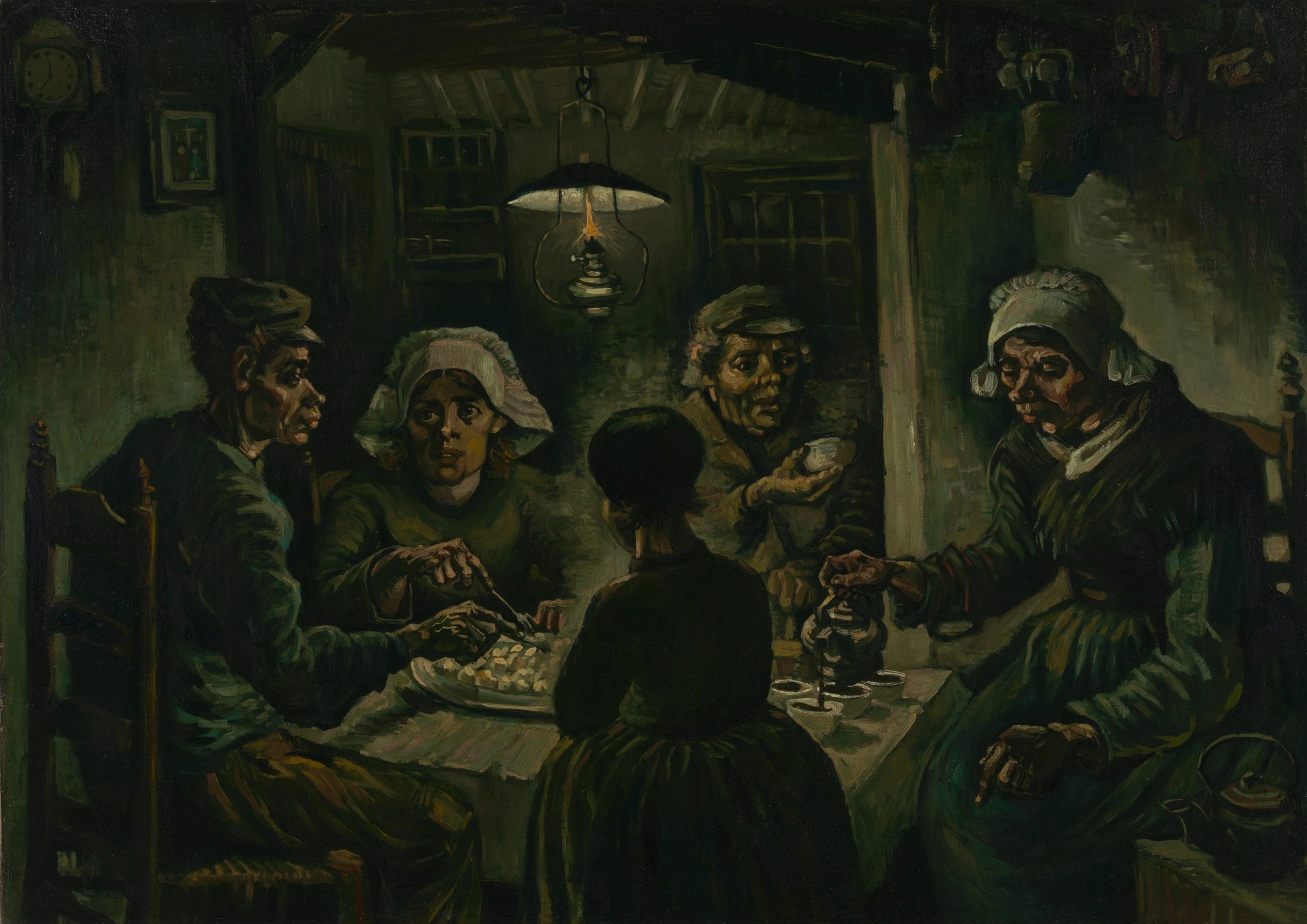
The Potato Eaters
Vincent van Gogh (1885)
In The Potato Eaters, five villagers huddle beneath a single oil lamp, their <strong>knotted hands</strong> reaching for a plate of potatoes and cups of coffee. The earthen palette and coarse brushwork forge a world of <strong>labor, humility, and solidarity</strong>, where the food on the table is the tangible outcome of the work in their hands <sup>[1]</sup><sup>[3]</sup>. Van Gogh turns scarcity into <strong>dignity</strong>, binding the group within the lamp’s modest halo <sup>[3]</sup><sup>[5]</sup>.
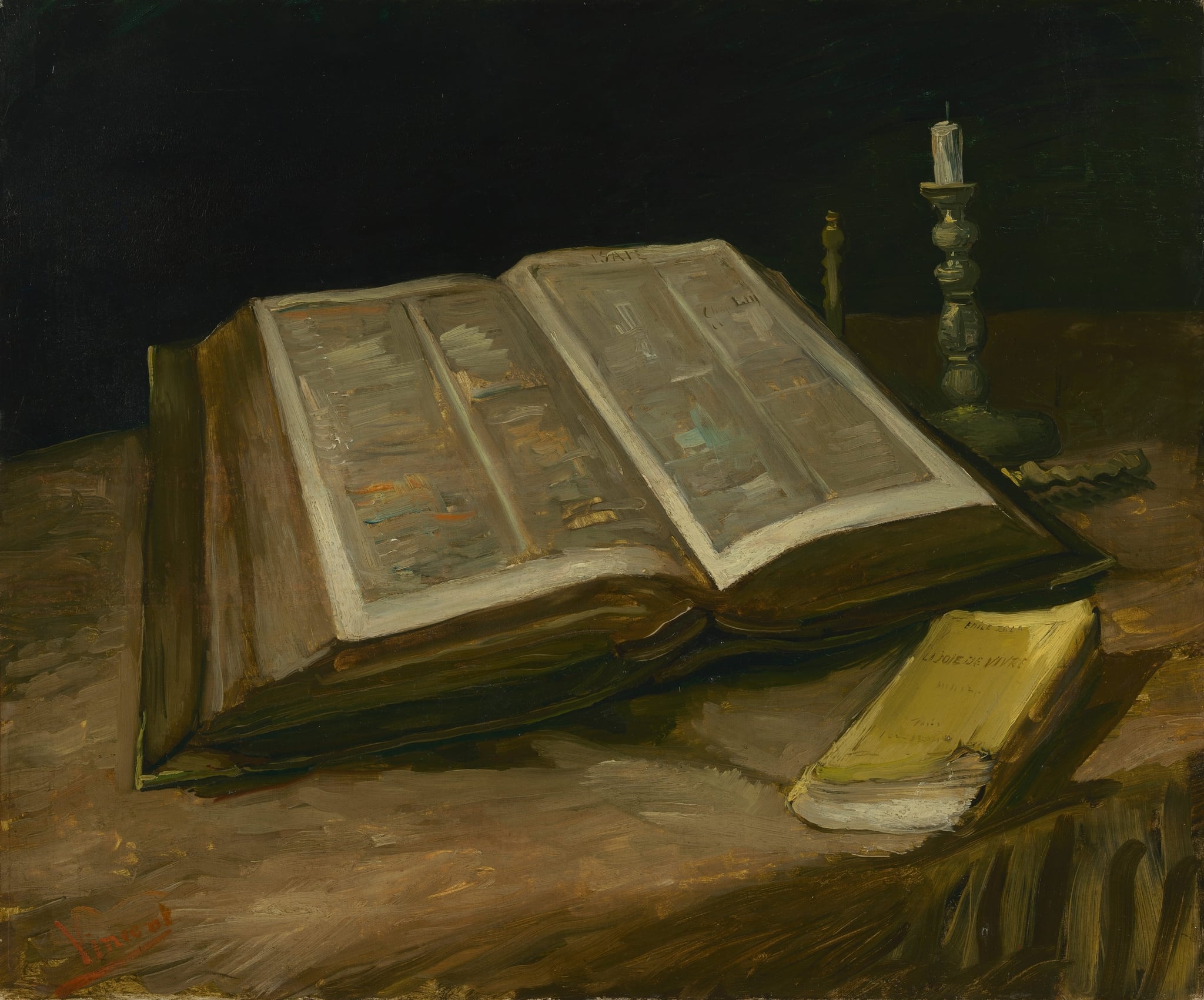
Still Life with Bible
Vincent van Gogh (1885)
Vincent van Gogh’s Still Life with Bible (1885) stages a stark encounter between a monumental family <strong>Bible</strong>, a snuffed <strong>candle</strong>, and Zola’s yellow‑covered <strong>La joie de vivre</strong>. The painting’s heavy, earthen brushwork and diagonal sweep forge a tense dialogue between <strong>inherited faith</strong> and <strong>modern experience</strong> <sup>[1]</sup><sup>[2]</sup>.
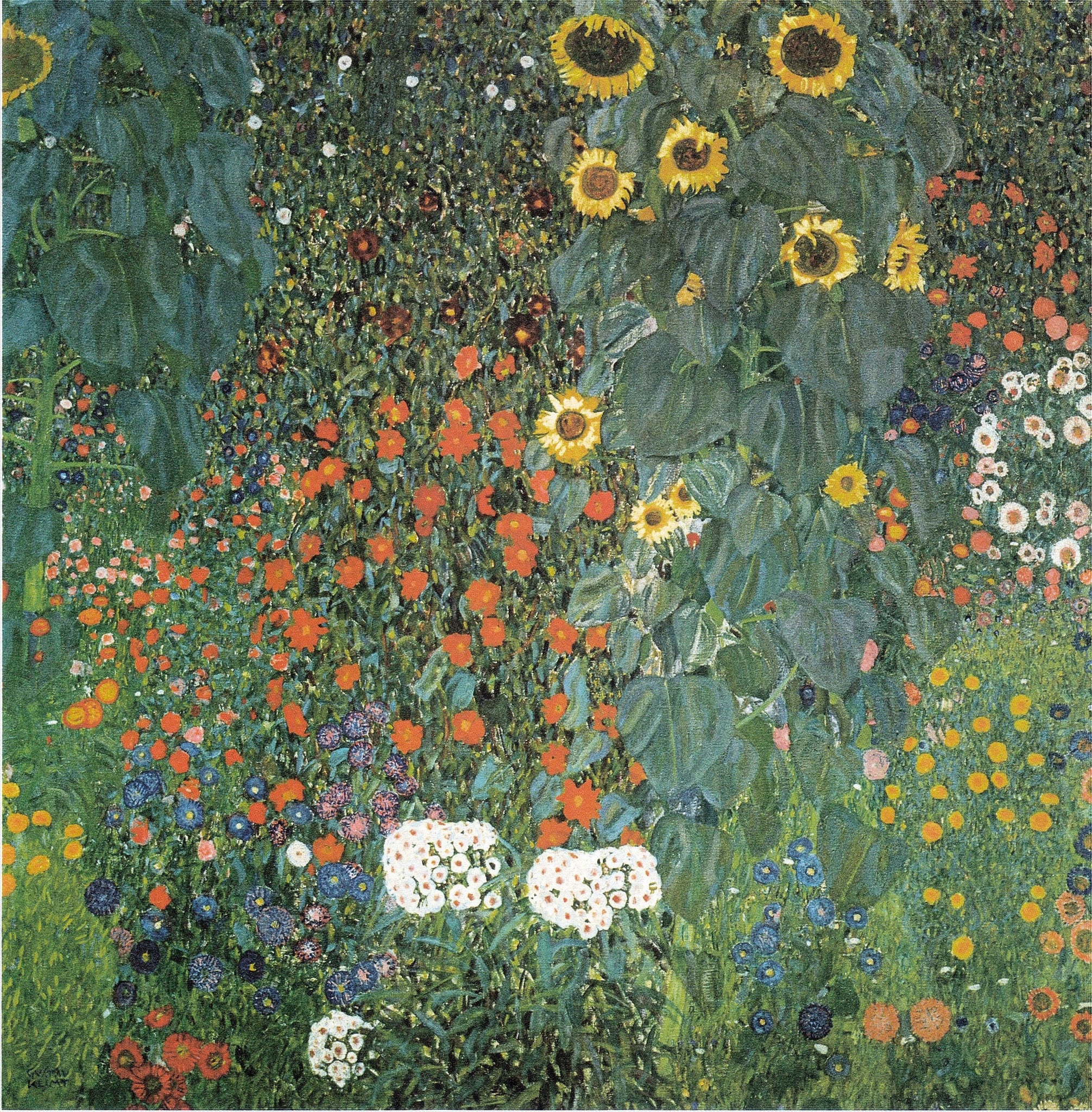
Cottage Garden with Sunflowers
Gustav Klimt (1906–1907 (signed 1907))
Cottage Garden with Sunflowers is a square, horizonless field of blooms where a vertical column of <strong>sunflowers</strong> anchors an all-over weave of color and pattern. Klimt fuses <strong>ornament and nature</strong>, turning a humble Litzlberg cottage plot into a radiant matrix of cyclical life and renewal <sup>[1]</sup><sup>[4]</sup><sup>[5]</sup>.
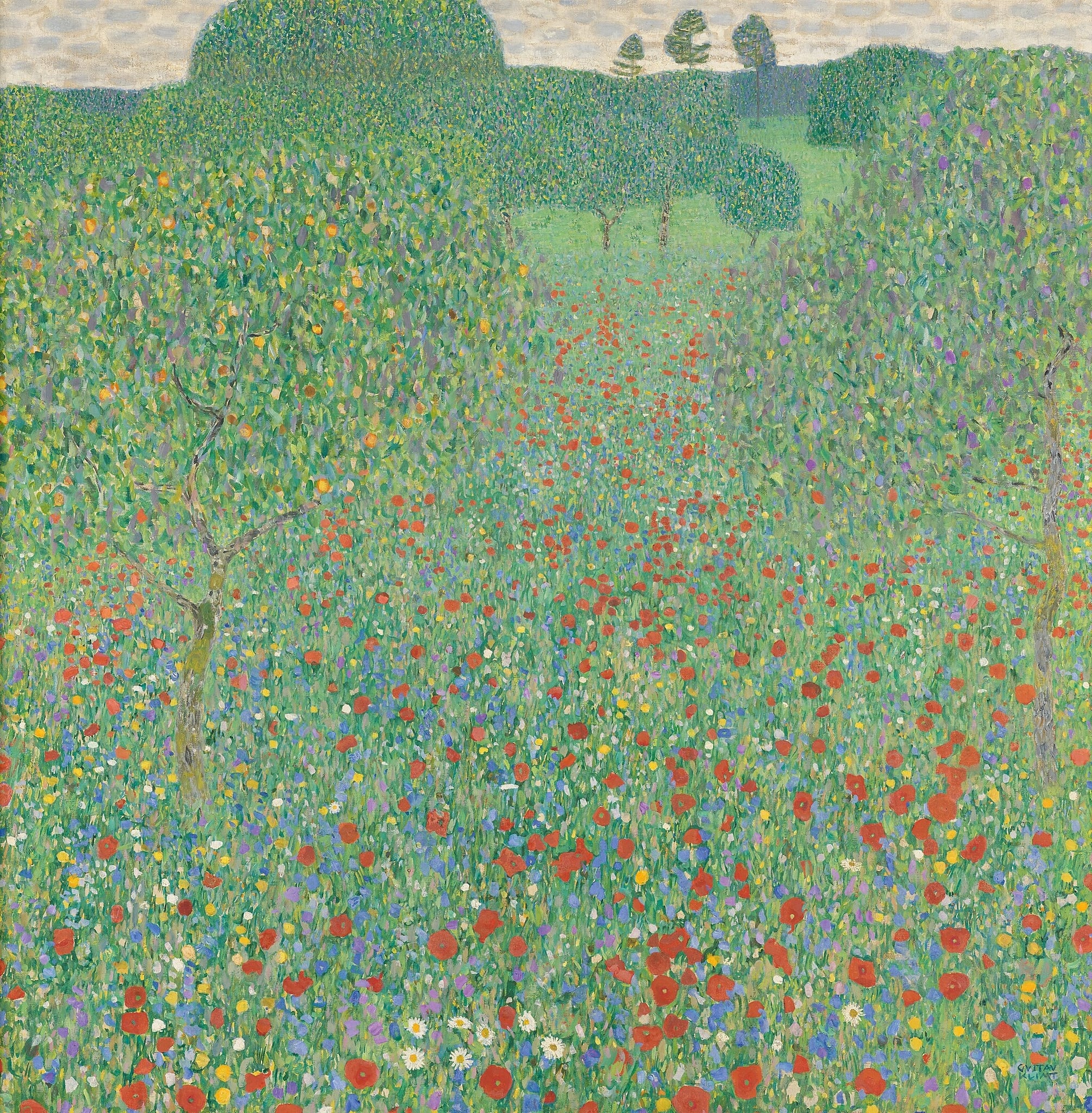
Flowering Poppies
Gustav Klimt (1907)
Gustav Klimt’s <strong>Flowering Poppies</strong> (1907) turns a meadow into a shimmering, all-over field where botany becomes <strong>ornament</strong>. A square canvas packed with red poppies, daisies, and fruiting trees compresses depth and invites a drifting gaze rather than linear recession <sup>[1]</sup><sup>[2]</sup>. The result is a sensuous, immersive vision that fuses observed nature with <strong>decorative abstraction</strong> <sup>[2]</sup>.
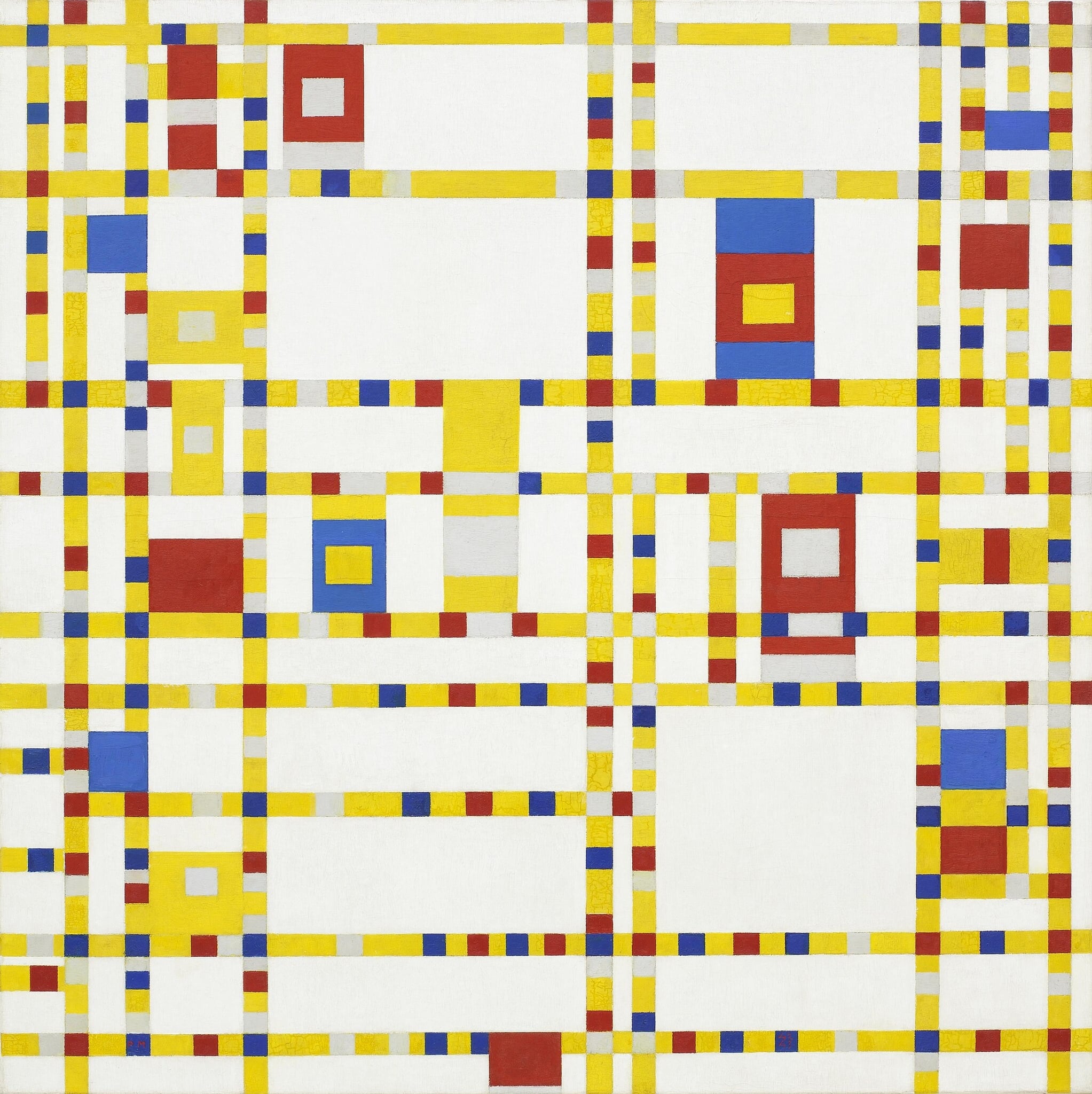
Broadway Boogie Woogie
Piet Mondrian (1942–1943)
Mondrian converts New York’s pulse into a <strong>vibrating grid</strong> of color. In place of black bars, intersecting <strong>yellow bands</strong> studded with red, blue, white, and light gray units generate a <strong>syncopated rhythm</strong> across wide white blocks that read as pauses and city blocks <sup>[1]</sup><sup>[2]</sup>.
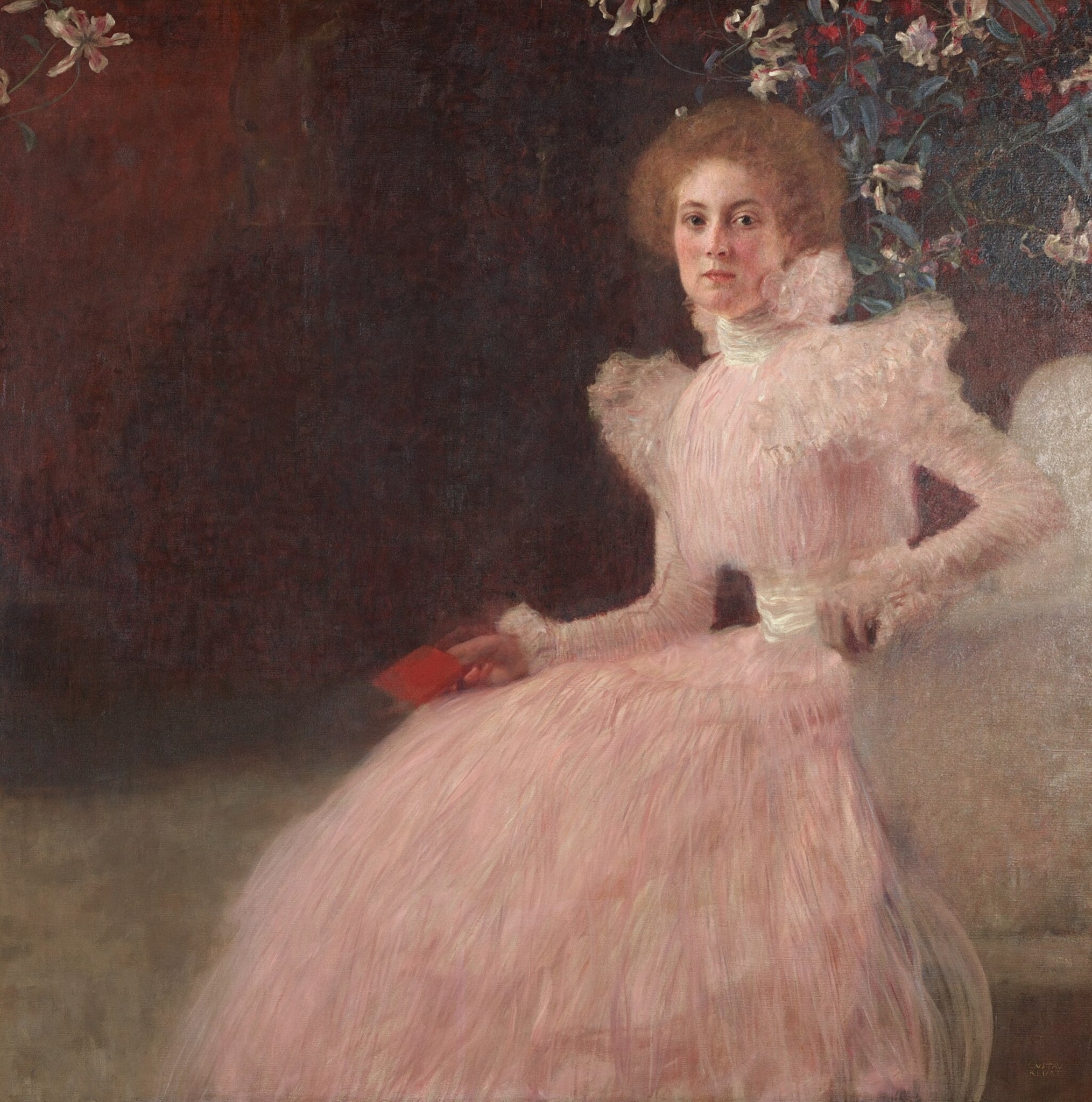
Sonja Knips
Gustav Klimt (1897/1898)
In Sonja Knips, Gustav Klimt stages a poised young woman as a modern self—held taut between <strong>lucid presence</strong> and <strong>ornamental dissolution</strong>. The square canvas, the feathery pink dress, the climbing white lilies, and the single <strong>red sketchbook</strong> in her hand crystallize an identity that is reflective, intelligent, and self‑aware within a decorous world <sup>[1]</sup><sup>[2]</sup><sup>[4]</sup>.
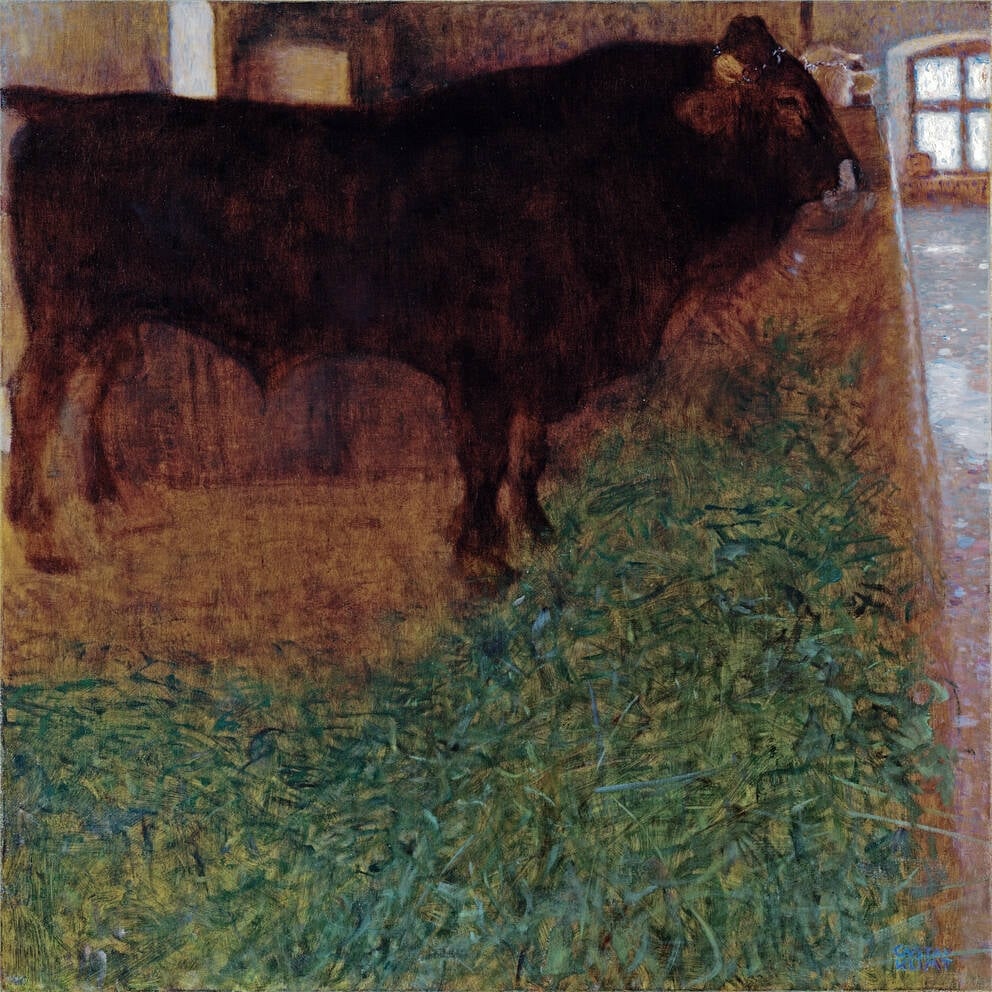
The Black Bull
Gustav Klimt (1900 (1900–1901 also cited))
<strong>The Black Bull</strong> distills raw animal power into a near-monolithic presence, its dark mass occupying the square field while a cool window flare touches the snout and horn. <strong>Gustav Klimt</strong> transforms a stable interior into a drama of force and limit, the diagonal swath of green fodder channeling energy toward the tethered head. The work finds grandeur in a local motif from Klimt’s first Attersee summer, uniting tactile surface with psychological tension <sup>[1]</sup><sup>[4]</sup>.
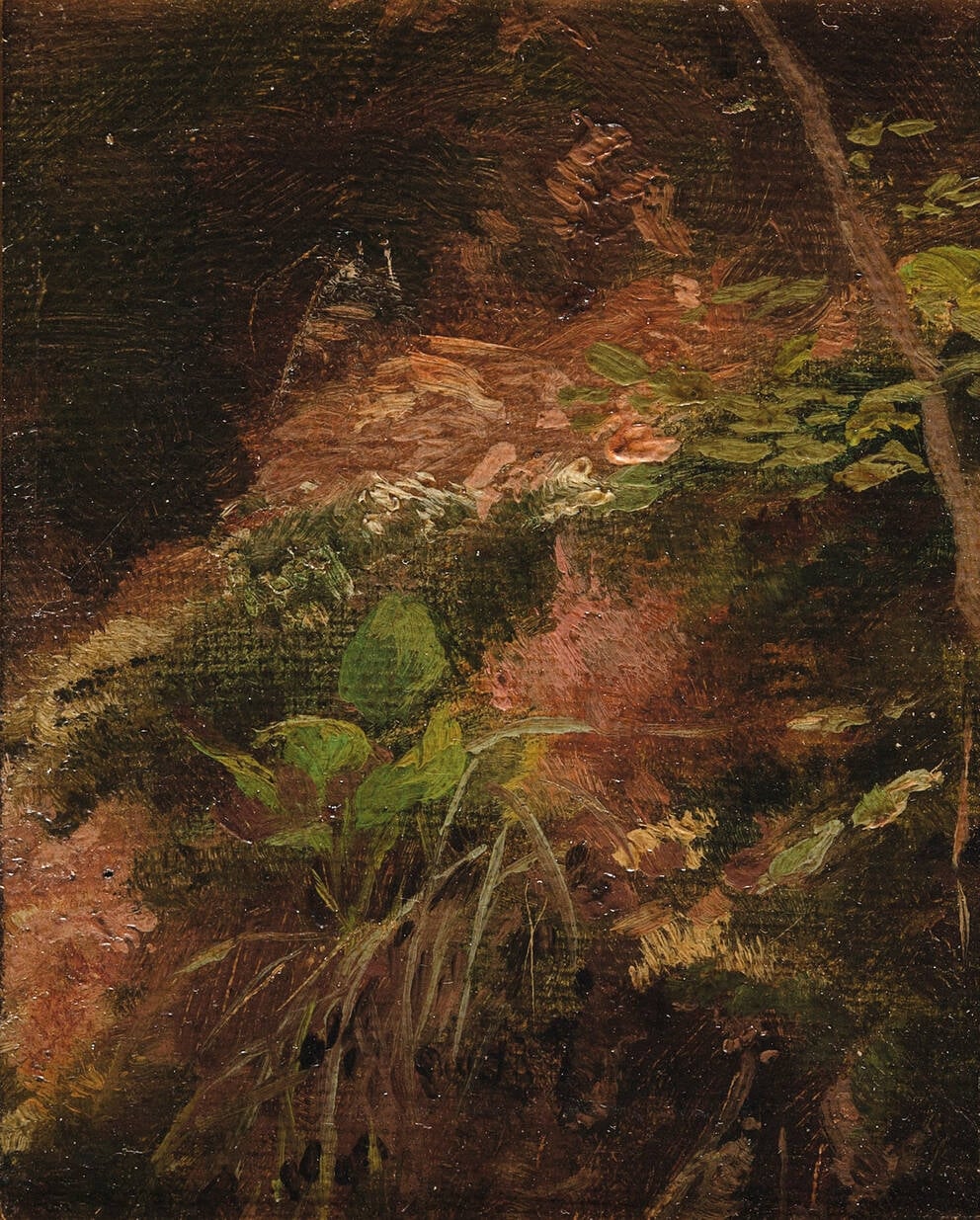
Forest Floor
Gustav Klimt (c. 1881/1882)
Forest Floor concentrates the eye on a miniature world of soil, moss, and leaf-litter rendered in tactile strokes and dark-to-amber light. Klimt frames a diagonal bank with a small sapling and sprouting leaves, turning the ground into a <strong>living tapestry</strong> of decay and renewal <sup>[1]</sup>. As an early oil sketch, it fuses <strong>academic chiaroscuro</strong> with a proto-decorative rhythm that hints at later developments <sup>[1]</sup>.
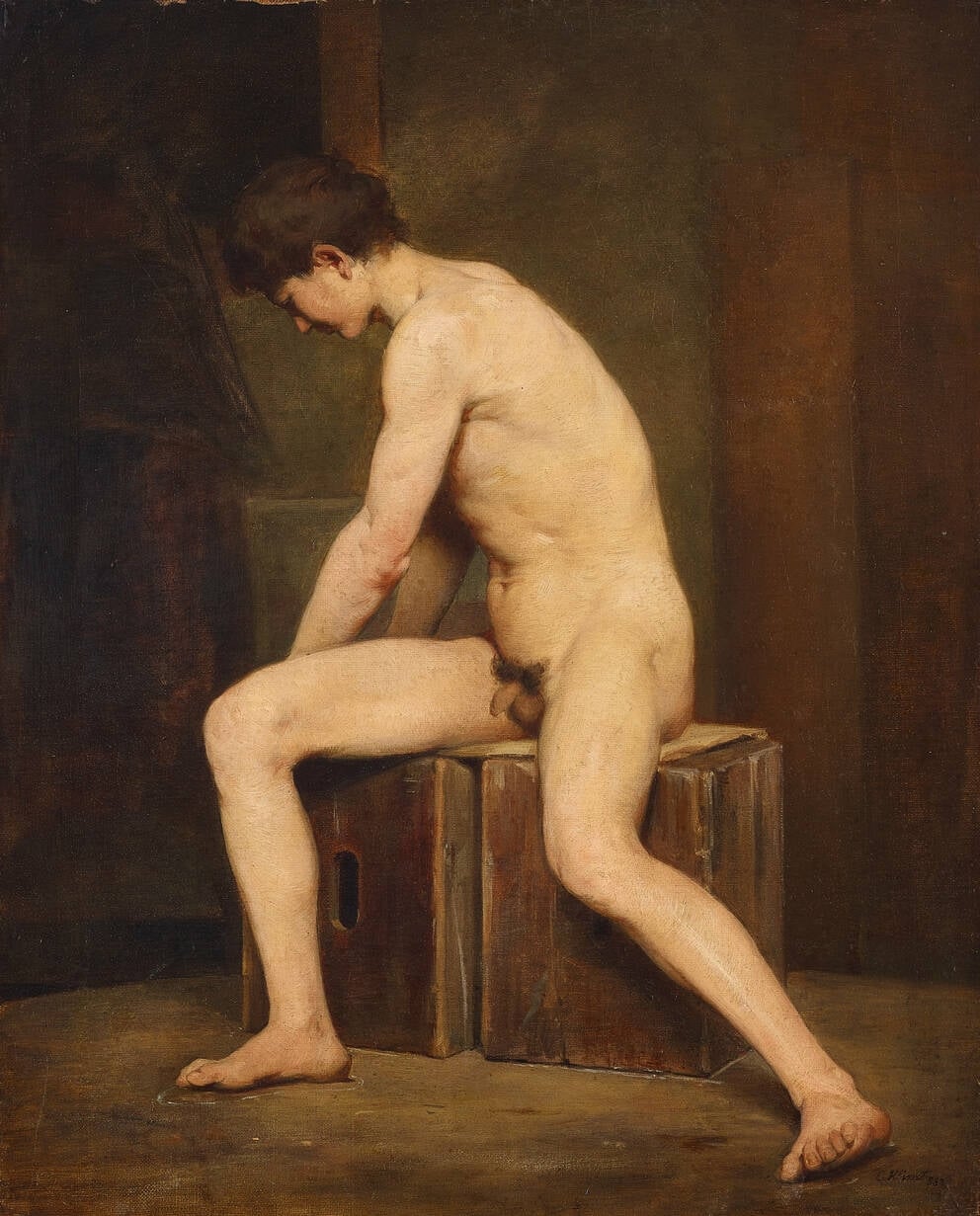
Sitting Nude Man Turned to the Left
Gustav Klimt (1883)
Painted in 1883, Sitting Nude Man Turned to the Left shows Klimt’s academic command of the male figure through a <strong>Naturalist/Realist</strong> approach. The model’s bowed head, splayed legs, and braced forearms form a taut <strong>triangular structure</strong> against rough wooden crates, where <strong>soft flesh meets hard geometry</strong> <sup>[1]</sup>. The restrained, earthy chiaroscuro isolates the body, turning a studio exercise into a quiet study of <strong>concentrated presence</strong>.
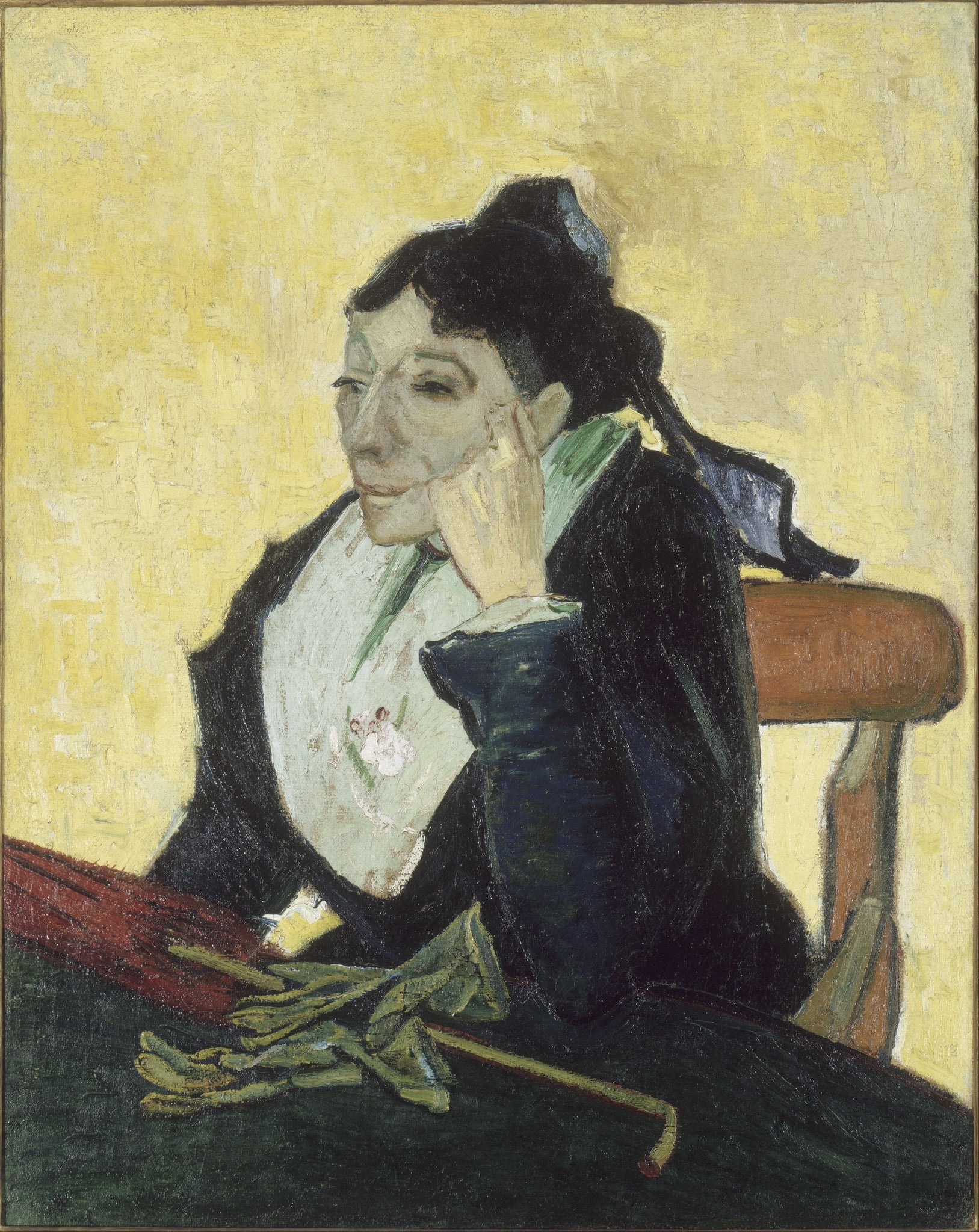
L'Arlésienne
Vincent van Gogh (1888)
In L'Arlésienne, Vincent van Gogh distills a moment of inward pause: a woman from Arles leans her cheek on her hand before a <strong>butter‑yellow wall</strong>, her <strong>black-and-blue silhouette</strong> set against a warm field. The <strong>red parasol</strong> and <strong>green gloves</strong> lie unused on the table, signaling a suspension of public persona in favor of private thought <sup>[1]</sup><sup>[3]</sup>.
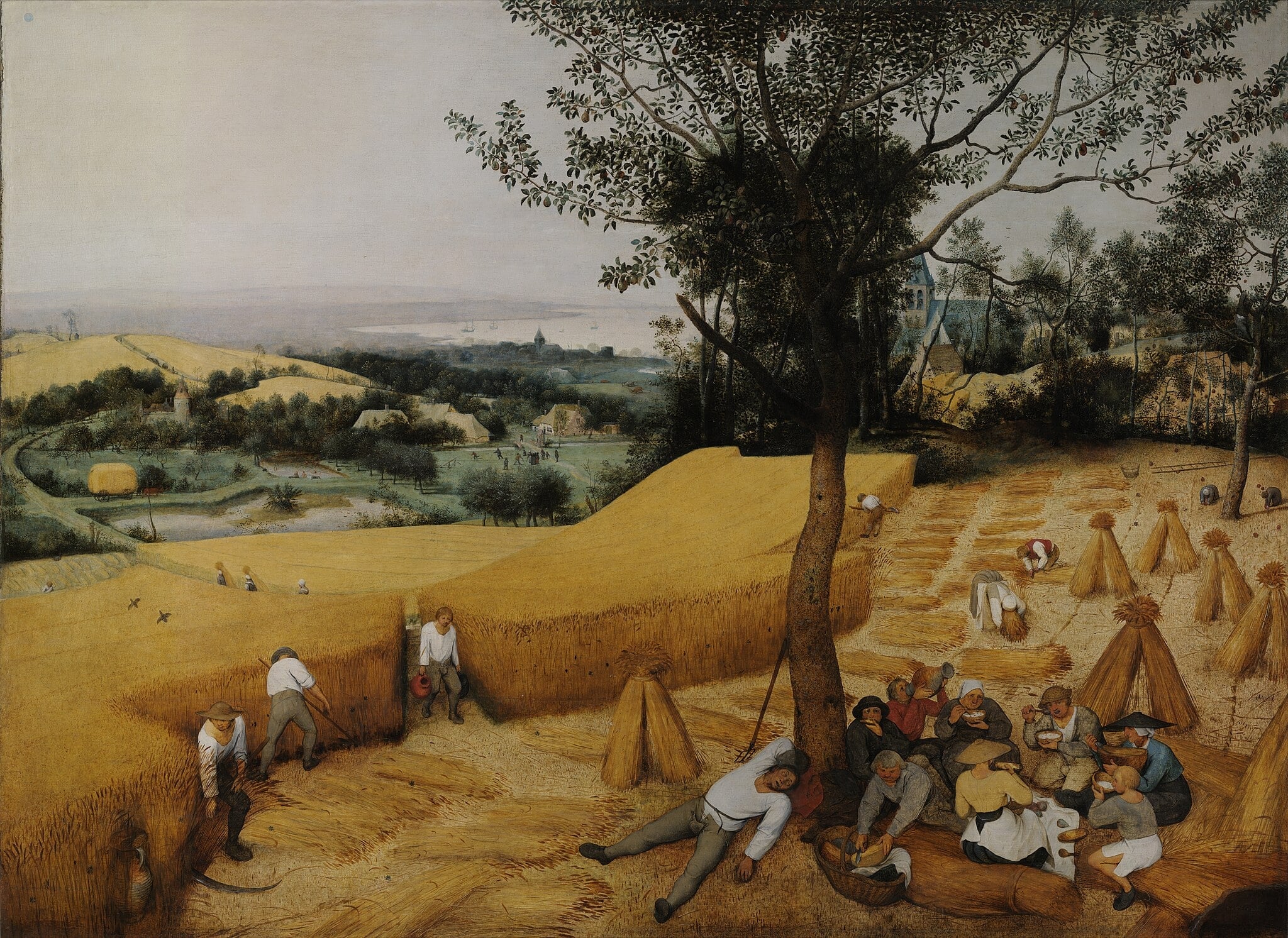
The Harvesters
Pieter Bruegel the Elder (1565)
The Harvesters distills late summer into a seamless weave of <strong>labor and reward</strong>: reapers bend to wheat while others eat and doze beneath a tree, and the world opens to roads, a village, and ships. Bruegel dignifies every action with <strong>even light</strong> and a democratic gaze, turning a specific day’s work into an image of <strong>cyclical time</strong> and shared sustenance <sup>[1]</sup><sup>[4]</sup>.
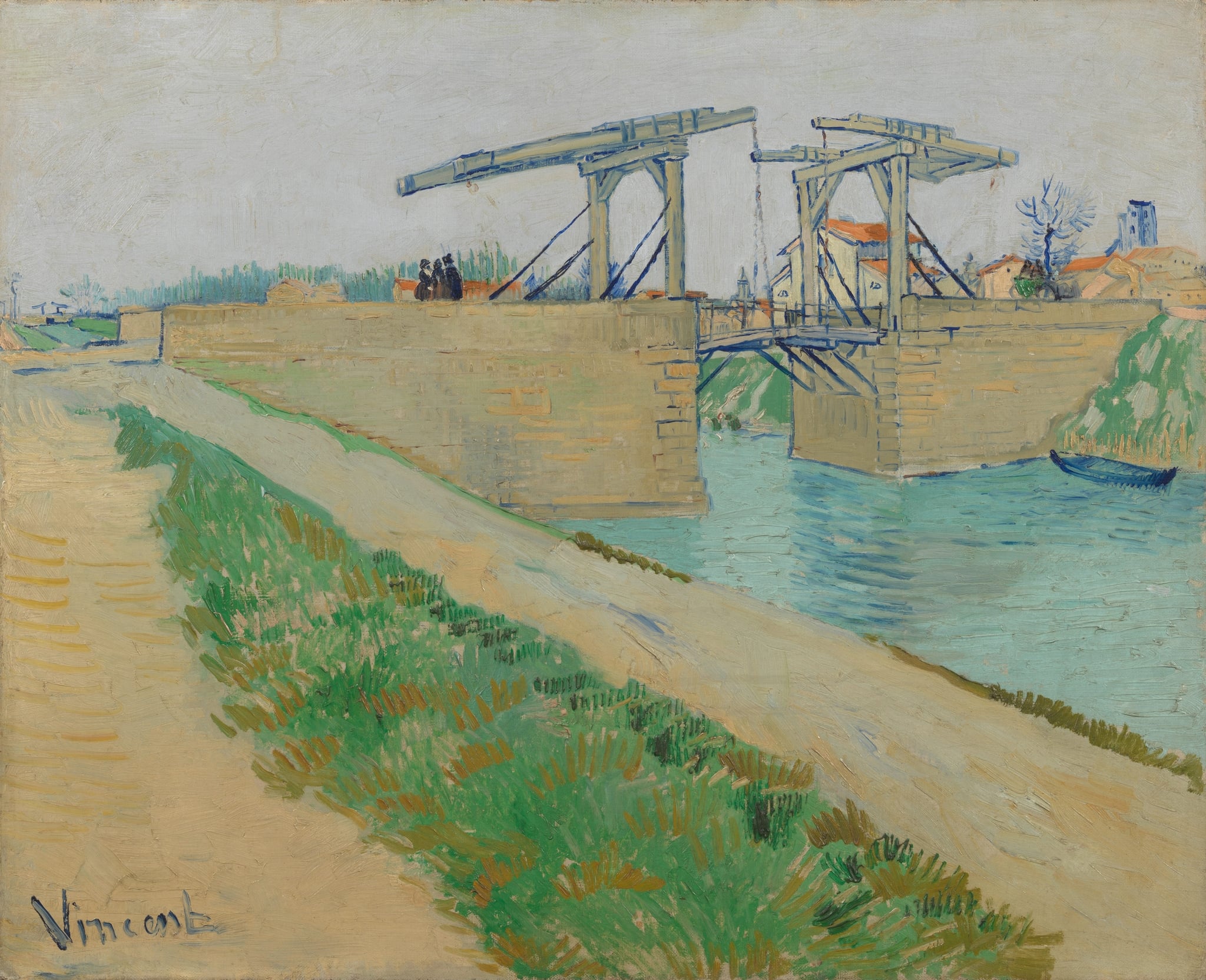
The Langlois Bridge
Vincent van Gogh (1888)
Van Gogh’s The Langlois Bridge turns a modest drawbridge into a <strong>symbol of connection</strong> and modern passage. With a sweeping towpath, <strong>firm blue contours</strong>, and turquoise water, the scene balances rural calm with engineered order <sup>[1]</sup><sup>[3]</sup>.
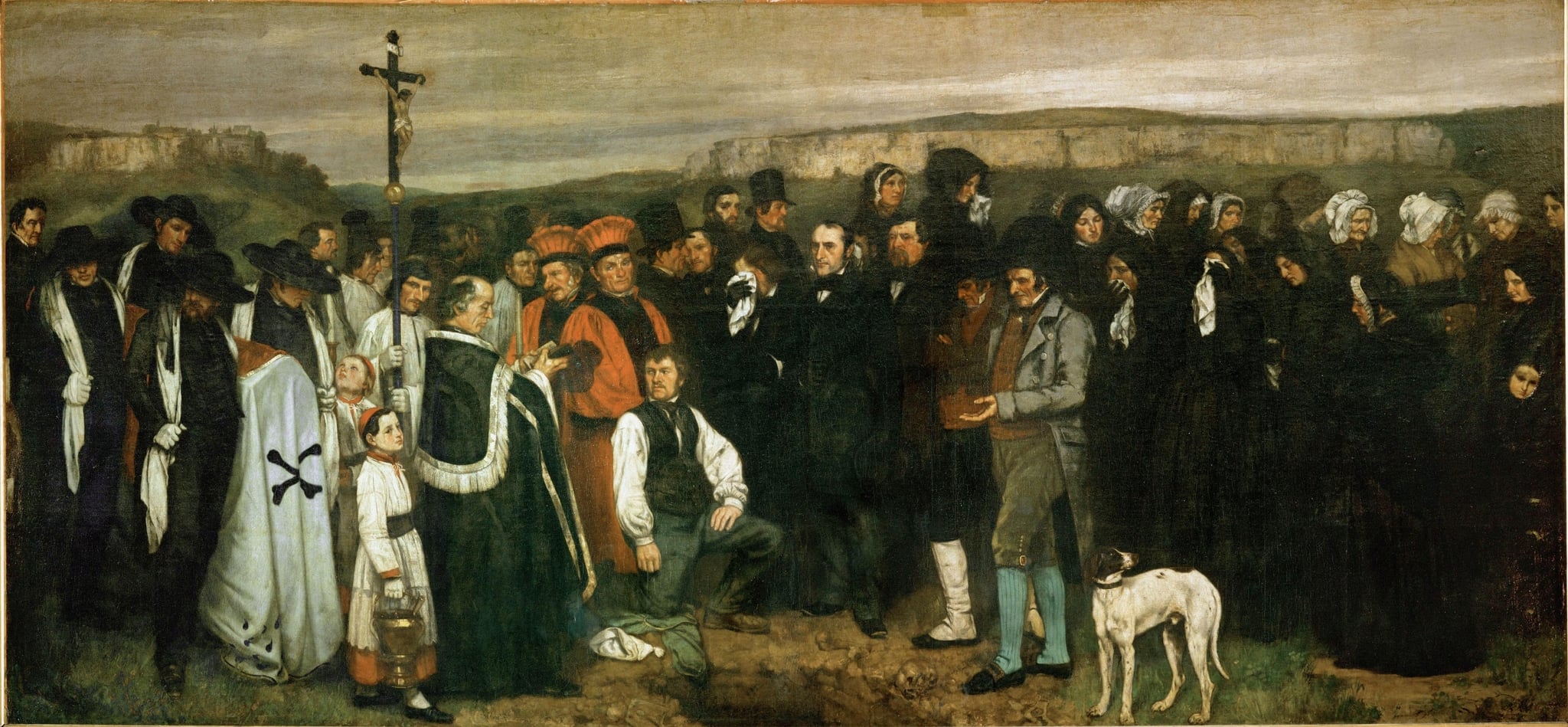
A Burial at Ornans
Gustave Courbet (1849–1850)
A Burial at Ornans turns a provincial funeral into a life‑size, horizontal <strong>frieze</strong> where clergy, officials, peasants, and mourners stand shoulder to shoulder before an <strong>open grave</strong> and skull. Courbet’s refusal of climax—despite the tall <strong>processional crucifix</strong>—and details like the <strong>kneeling gravedigger</strong> and indifferent <strong>dog</strong> make mortality the great equalizer, not piety or heroism. The limestone <strong>cliffs of Ornans</strong> close the horizon, sealing the scene’s weight and finality.
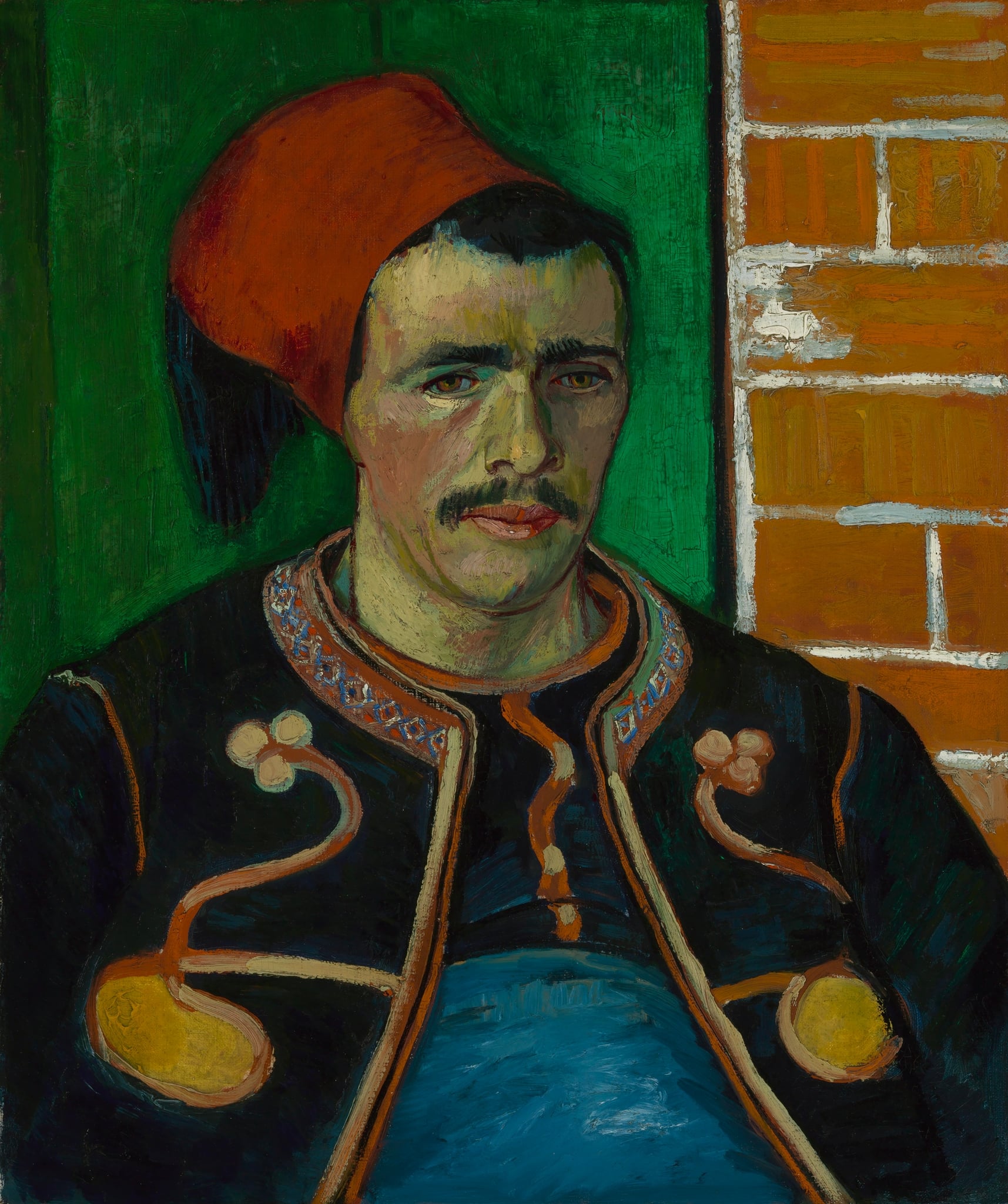
The Zouave
Vincent van Gogh (1888)
<strong>The Zouave</strong> crystallizes Van Gogh’s Arles project: a half-length soldier thrust forward by clashing complements—red, green, orange, blue—so color carries character. The flame-like <strong>fez</strong> ignites against a flat <strong>green door</strong> and a sliver of <strong>orange brick wall</strong>, while heavy outlines and simplified planes turn uniform into emblem. The work inaugurates his pursuit of the <strong>modern “character portrait,”</strong> where chromatic force outweighs likeness <sup>[1]</sup><sup>[2]</sup>.
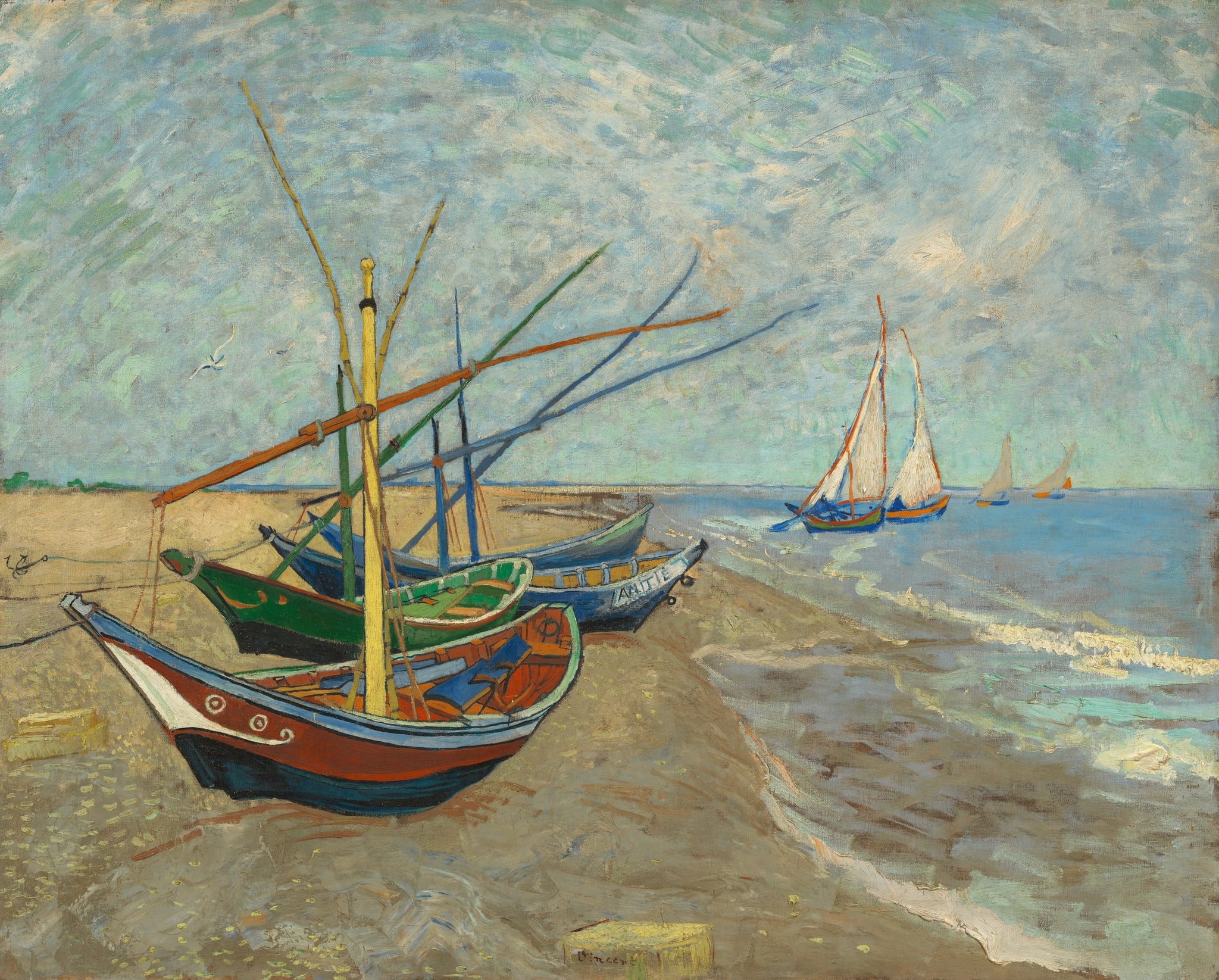
Fishing Boats on the Beach at Les Saintes-Maries-de-la-Mer
Vincent van Gogh (1888)
Vincent van Gogh lines up a file of beached craft like actors awaiting their cue, turning working boats into <strong>emblems of readiness and risk</strong>. Bold contours, flattened color, and the wind‑tossed sea and sky translate Mediterranean luminosity into a <strong>Japonisme/Cloisonnism</strong> idiom that clarifies form and heightens feeling. The scene suspends time at the edge of departure, where labor, hope, and the sea’s pull meet.
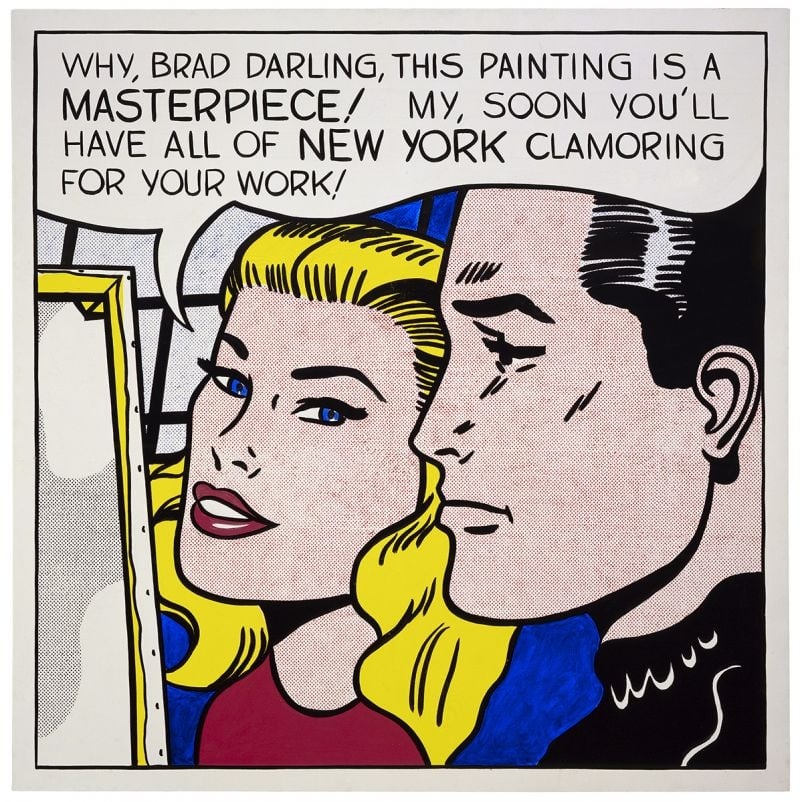
Masterpiece
Roy Lichtenstein (1962)
<strong>Masterpiece</strong> (1962) turns a romance‑comic close‑up into a cool exposé of how praise is manufactured. With a buoyant speech balloon and hand‑made Ben‑Day dots, Roy Lichtenstein converts private flattery into public <strong>promotion</strong>—an image about the image economy itself <sup>[1]</sup><sup>[2]</sup>.
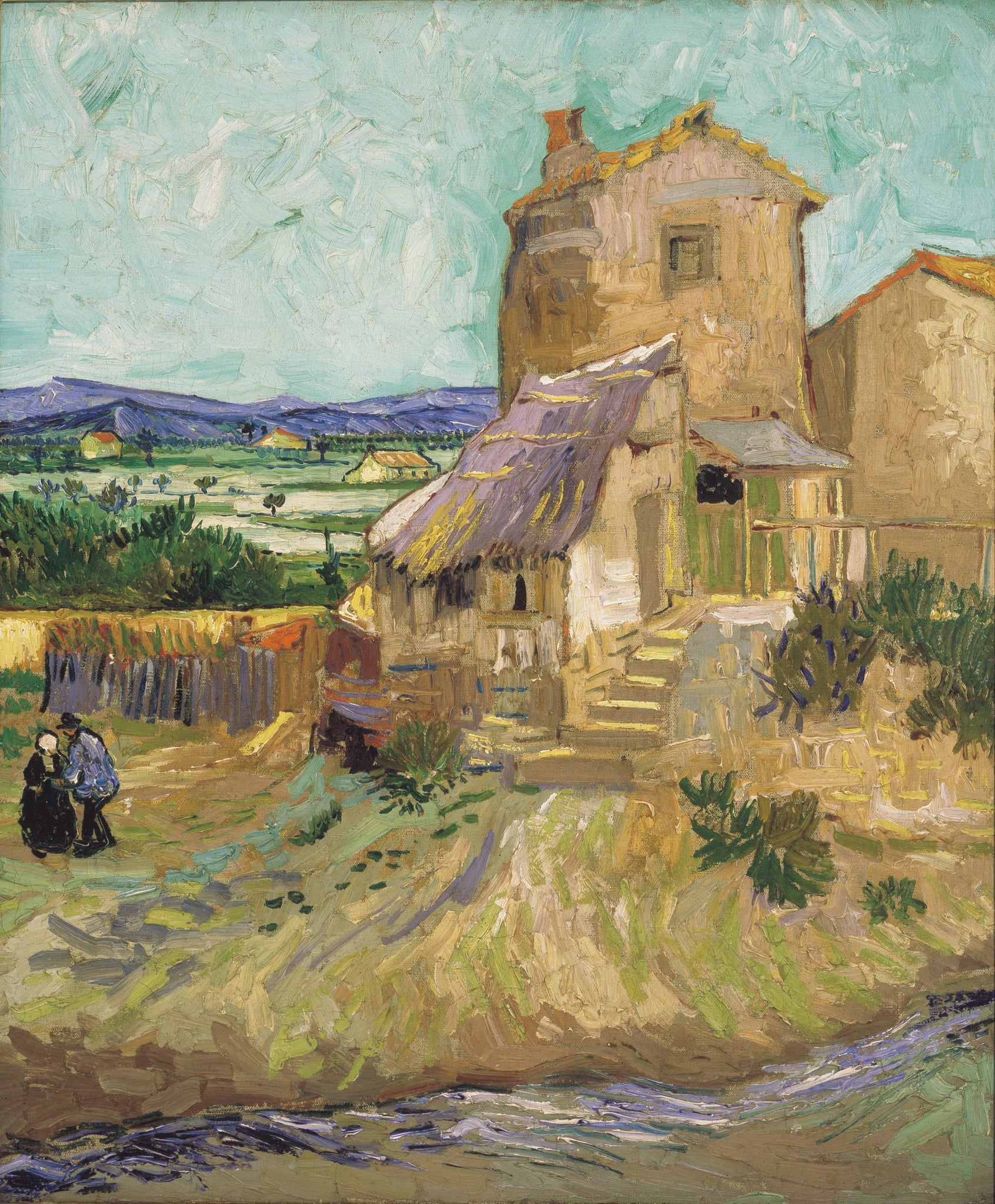
La Maison de La Crau (The Old Mill)
Vincent van Gogh (1888)
Van Gogh turns a modest Arles windmill into an emblem of <strong>resilience</strong> and <strong>human labor</strong> by staging its sun-baked tower against a <strong>wind-tossed, cool sky</strong> and the distant <strong>blue Alpilles</strong>. Rhythmic, directional strokes drive the eye from the <strong>rippling stream</strong> through the <strong>zigzag steps</strong> to the chimneyed tower, fusing workaday architecture with a modern language of <strong>expressive color</strong> and <strong>structure</strong> <sup>[1]</sup><sup>[3]</sup>.
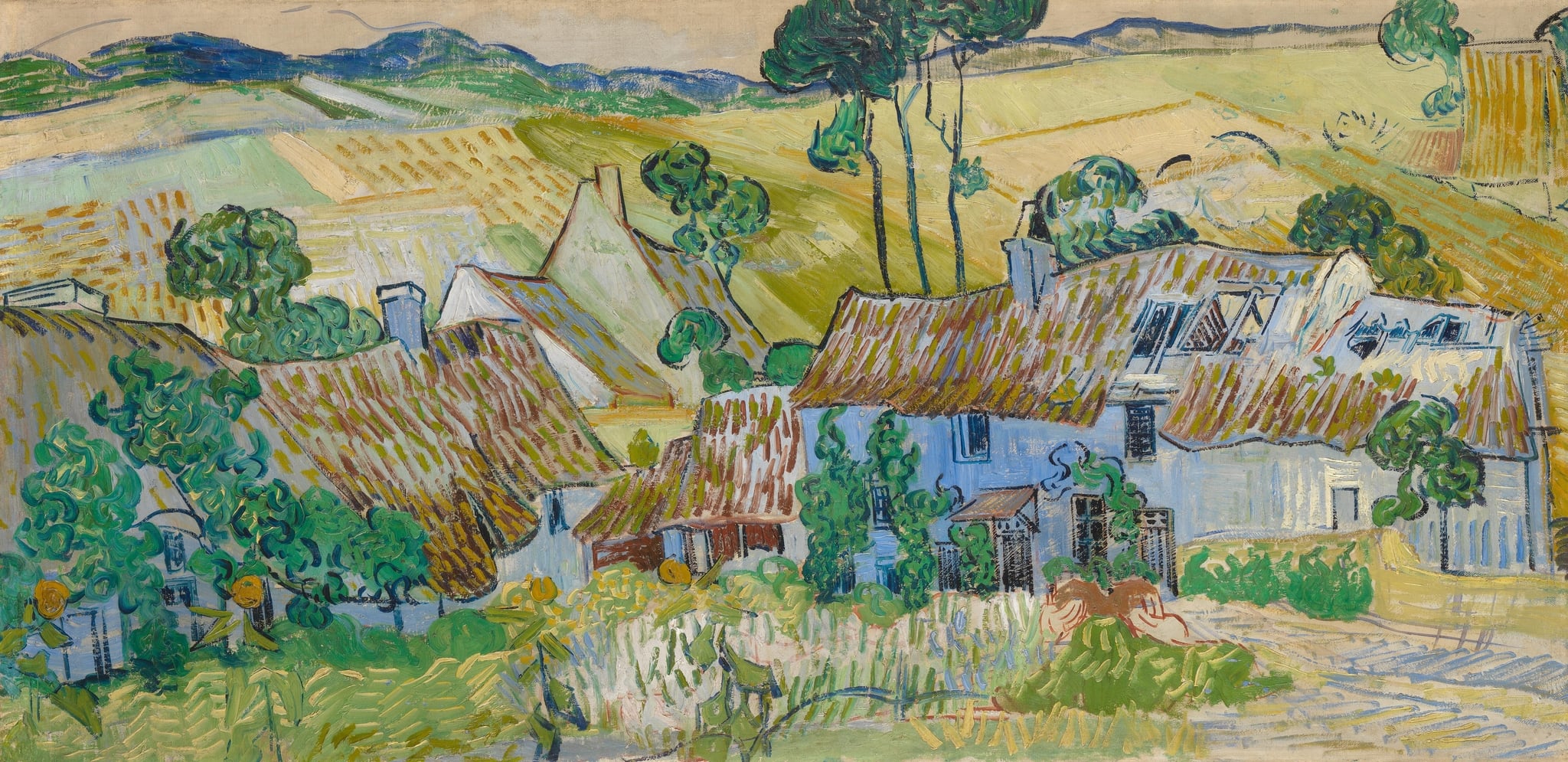
Farms near Auvers
Vincent van Gogh (1890)
Painted in July 1890, Vincent van Gogh’s Farms near Auvers is a late, "double‑square" panorama where thatched cottages, wheat plots, and wind‑bent trees pulse with <strong>rhythmic energy</strong>. The high horizon and criss‑crossing roofs compress the village into a living weave of color and line, turning ordinary farms into a scene of <strong>charged stillness</strong> <sup>[1]</sup><sup>[3]</sup>.
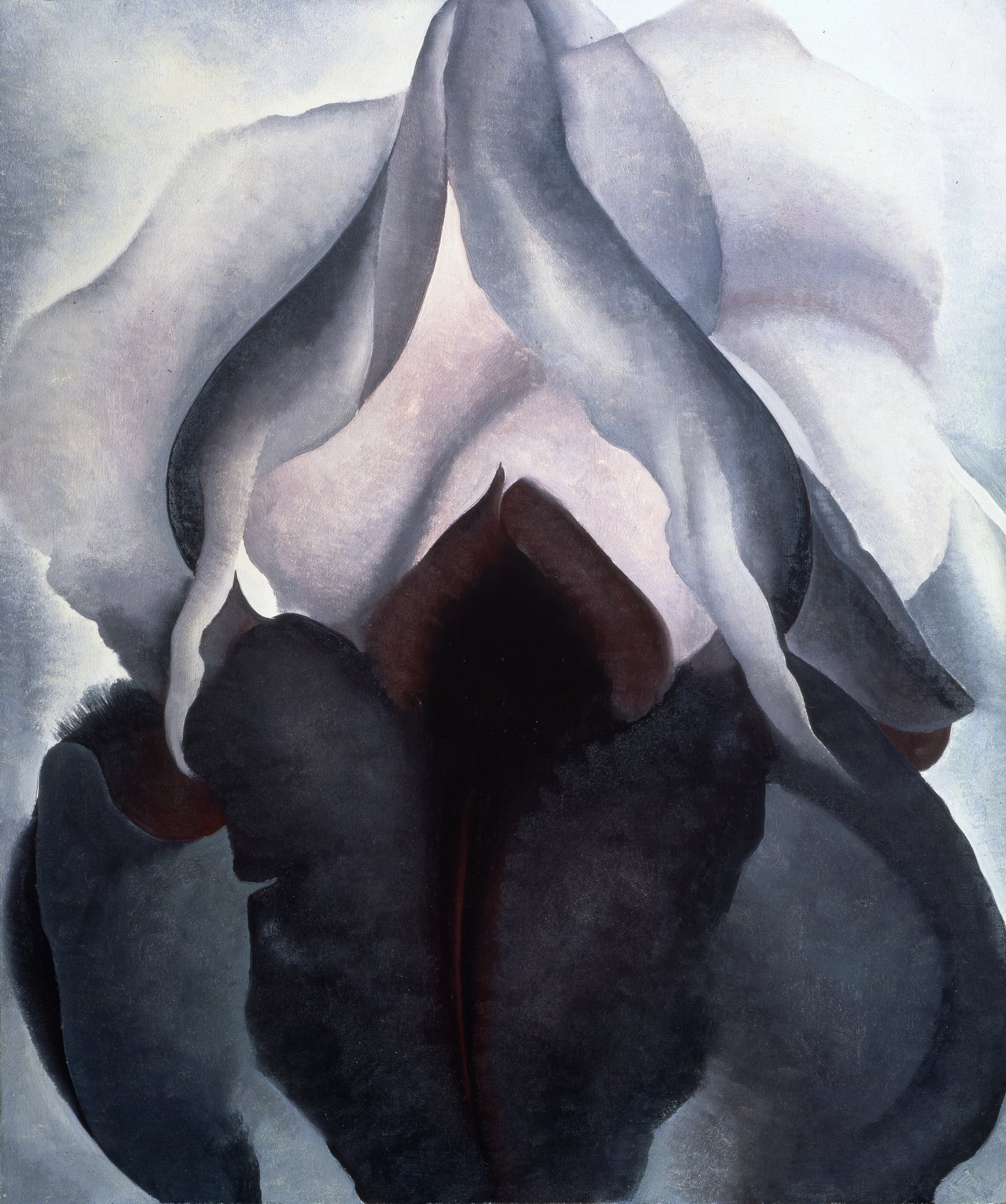
Black Iris
Georgia O’Keeffe (1926)
In Black Iris, Georgia O’Keeffe enlarges a single bloom to monumental scale, transforming it into <strong>luminous gradients</strong> and <strong>architectural folds</strong>. The pale, misted upper petals frame a velvety, wine‑black center, turning a familiar flower into an immersive field of <strong>abstraction and depth</strong> <sup>[1]</sup><sup>[3]</sup>.
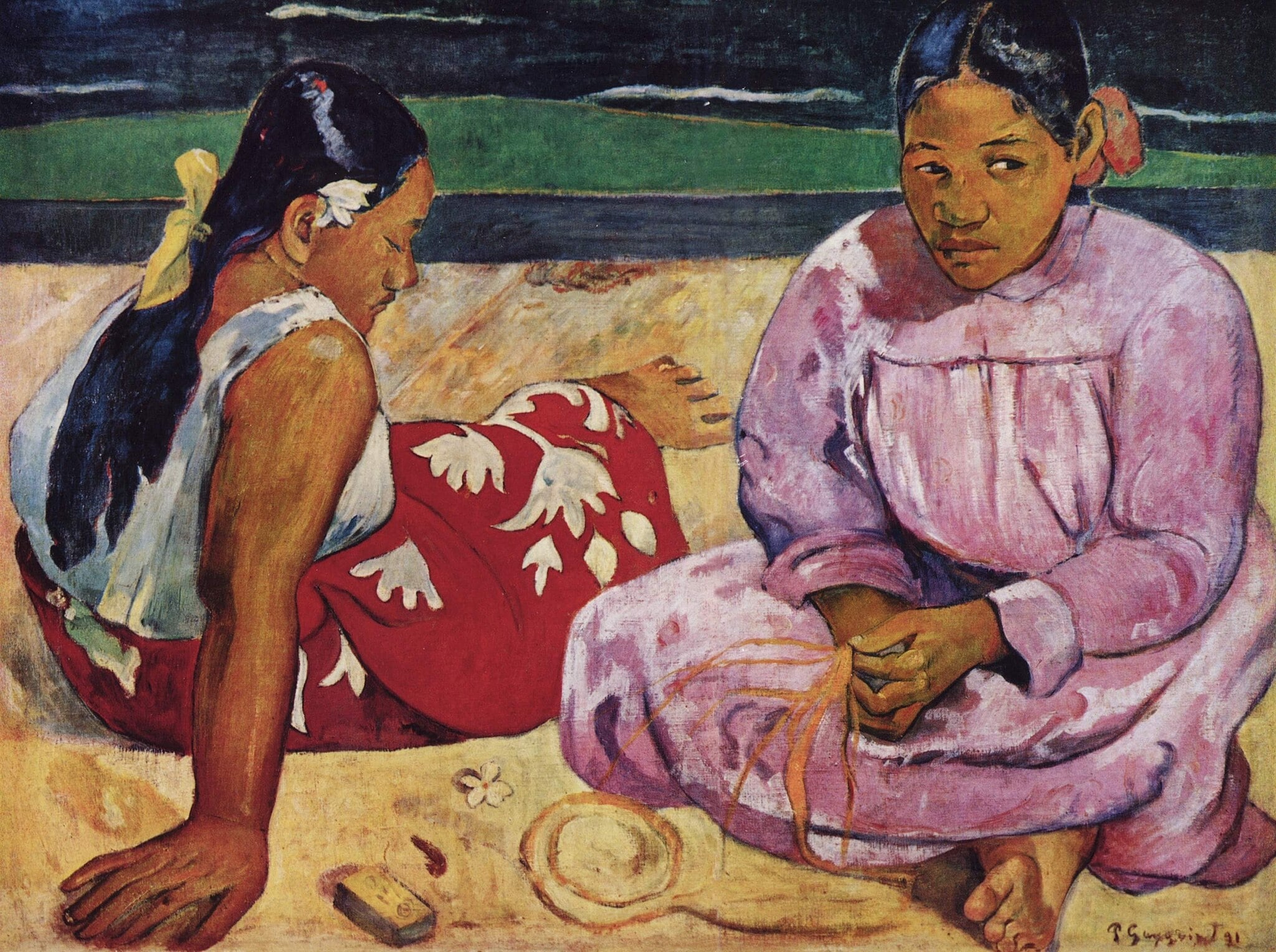
Tahitian Women on the Beach
Paul Gauguin (1891)
In Tahitian Women on the Beach, Paul Gauguin stages a tense duet between <strong>tradition</strong> and <strong>colonial modernity</strong>. Flat bands of sea and shore frame two monumental figures—one in a red <strong>pareo</strong>, the other in a pink <strong>missionary dress</strong>—whose guarded poses and averted gazes turn a casual beach scene into an <strong>iconic meditation on identity</strong> <sup>[1]</sup><sup>[2]</sup>. Modest objects on the sand—a flower, a coil, a bar-shaped stone—read like quiet <strong>tokens</strong> anchoring everyday life to ritual feeling <sup>[1]</sup>.
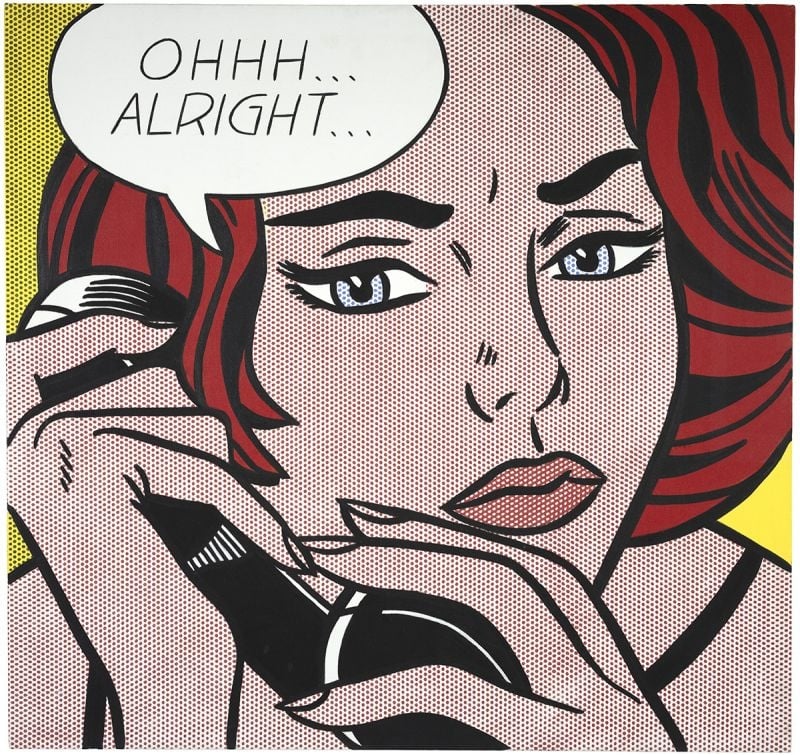
Ohhh...Alright...
Roy Lichtenstein (1964)
Roy Lichtenstein’s Ohhh...Alright... captures a suspended beat of romance‑comic melodrama in the cool idiom of <strong>Pop Art</strong>. A tightly cropped red‑haired woman grips a telephone as a speech balloon—“<strong>OHHH… ALRIGHT…</strong>”—signals reluctant acquiescence, while the hand‑painted <strong>Ben‑Day dots</strong> mimic mass printing to stage emotion as a commodity sign <sup>[1]</sup><sup>[2]</sup>.
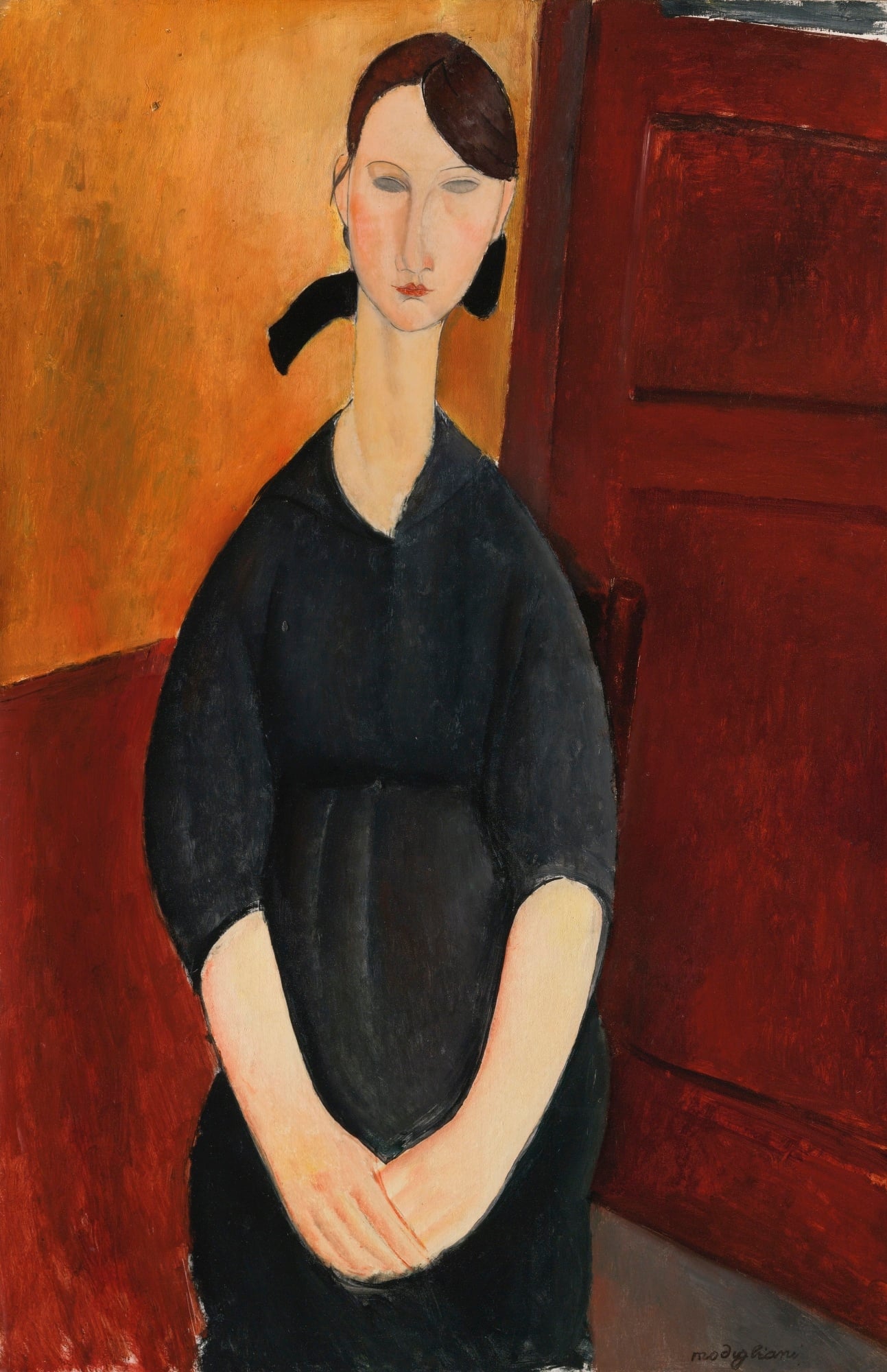
Portrait of Paulette Jourdain
Amedeo Modigliani (1919)
Portrait of Paulette Jourdain crystallizes a young sitter into a <strong>poised, timeless icon</strong>: an attenuated neck, mask-like almond eyes, and gently folded hands set before ochre walls and a <strong>slightly ajar red door</strong>. Modigliani’s sculptural contour and restrained palette turn likeness into an <strong>archetype of grace and inwardness</strong> <sup>[1]</sup><sup>[2]</sup><sup>[3]</sup>.
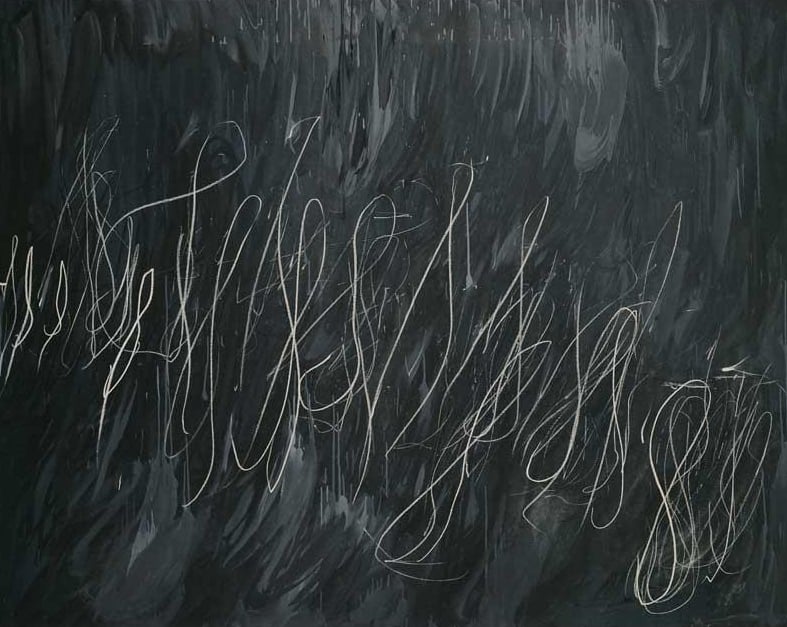
Untitled (New York City)
Cy Twombly (1968)
Cy Twombly’s Untitled (New York City) (1968) converts the city into <strong>tempo and gesture</strong>: white, looping lines lash across a slate field like cursive untethered from words. The work stages <strong>writing-as-motion</strong>, registering pressure shifts, drips, and erasures as a live record of urban time <sup>[1]</sup><sup>[5]</sup>.
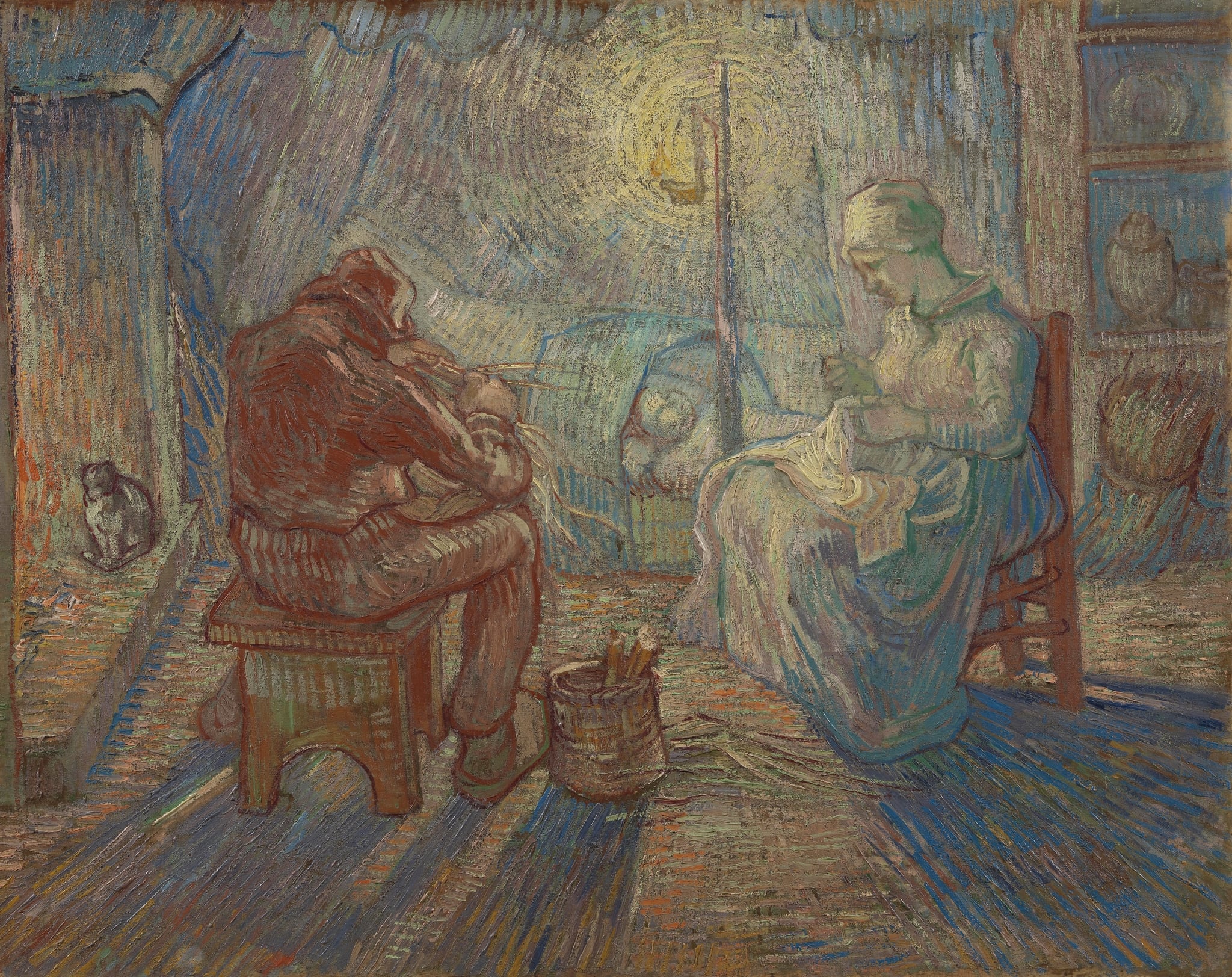
Evening (after Millet)
Vincent van Gogh (1889)
A peasant couple bends to evening tasks under a glowing lamp, its <strong>halo</strong> pulsing through the room while cool <strong>violets and blues</strong> pool across the floor. Van Gogh "<strong>translates</strong>" Millet’s print into a larger, color‑charged meditation on <strong>care, labor, and light</strong> at day’s end <sup>[1]</sup><sup>[2]</sup>.
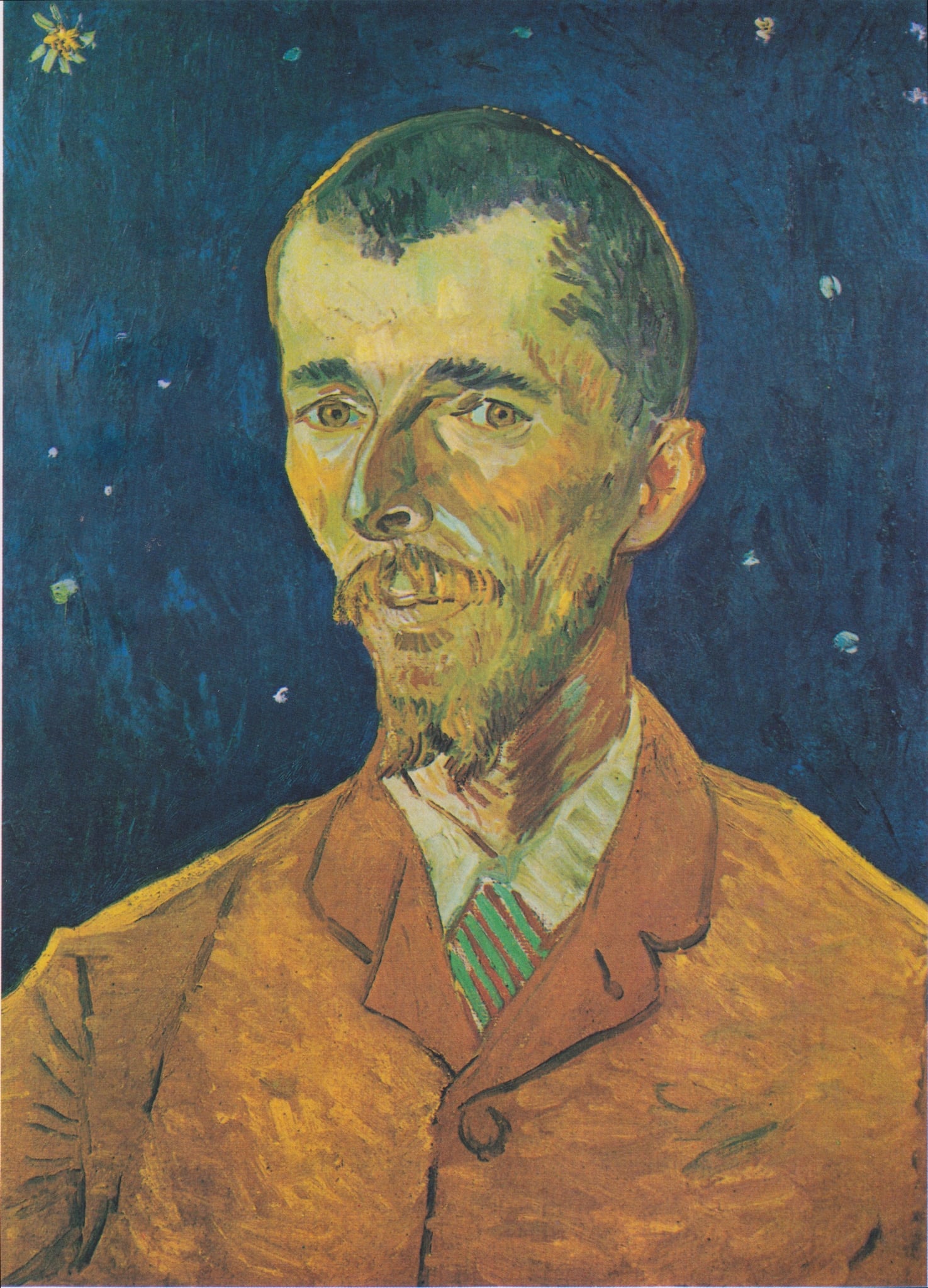
Eugène Boch
Vincent van Gogh (1888)
Vincent van Gogh’s 1888 portrait of <strong>Eugène Boch</strong> turns a friend into a visionary presence: a glowing, ocher head set before an <strong>infinite blue</strong> pricked with stars. The lone bright star at upper left and the cobalt field make the warm face and jacket <strong>vibrate</strong> from the night, declaring art as vocation rather than mere likeness <sup>[1]</sup><sup>[2]</sup>.
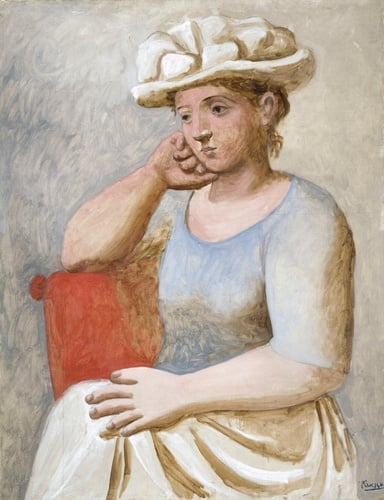
Femme au chapeau blanc
Pablo Picasso (1921)
Femme au chapeau blanc distills Picasso’s postwar <strong>neoclassical</strong> turn into a quiet yet monumental presence. A woman, elbow braced on a scarlet cushion and cheek in hand, sits beneath a <strong>billowing white hat</strong> whose cloudlike volume crowns her everyday dignity. The hushed whites and blues, anchored by the single red accent, assert <strong>calm, order, and permanence</strong> over experiment and fracture <sup>[1]</sup><sup>[2]</sup>.
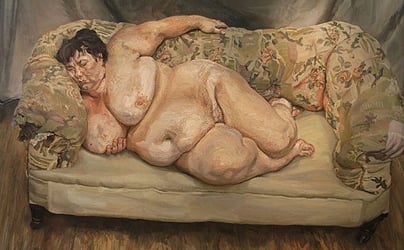
Benefits Supervisor Sleeping
Lucian Freud (1995)
Benefits Supervisor Sleeping is a 1995 oil painting in which Lucian Freud renders a sleeping, unidealized body across a sagging, floral sofa. With dense, tactile brushwork and a close, low vantage, the work asserts <strong>monumental presence</strong> while confronting viewers with the <strong>material truth of flesh</strong> and time’s imprint. It is a late‑century landmark of the School of London’s uncompromising figurative art <sup>[1]</sup><sup>[4]</sup>.
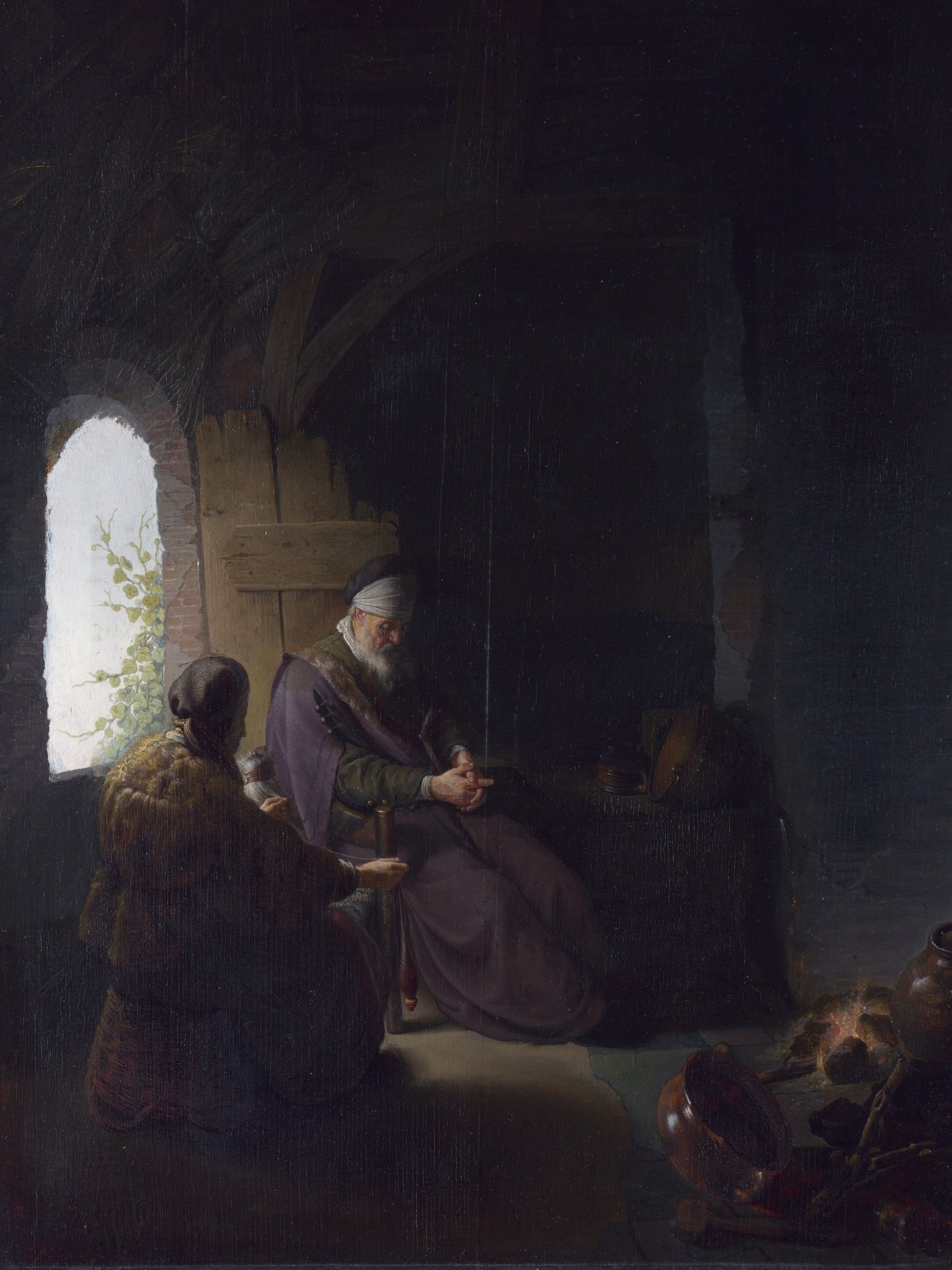
Anna and the Blind Tobit
Rembrandt van Rijn (about 1630)
In Rembrandt van Rijn’s Anna and the Blind Tobit, a cool beam from an unglazed window touches two aging figures while the room recedes into shadow. The painting compresses the Tobit story into a moment of <strong>patient endurance</strong>, where clasped hands, a staff, a smoldering hearth, and ivy at the window do the narrative work of <strong>faith under trial</strong> <sup>[1]</sup>.
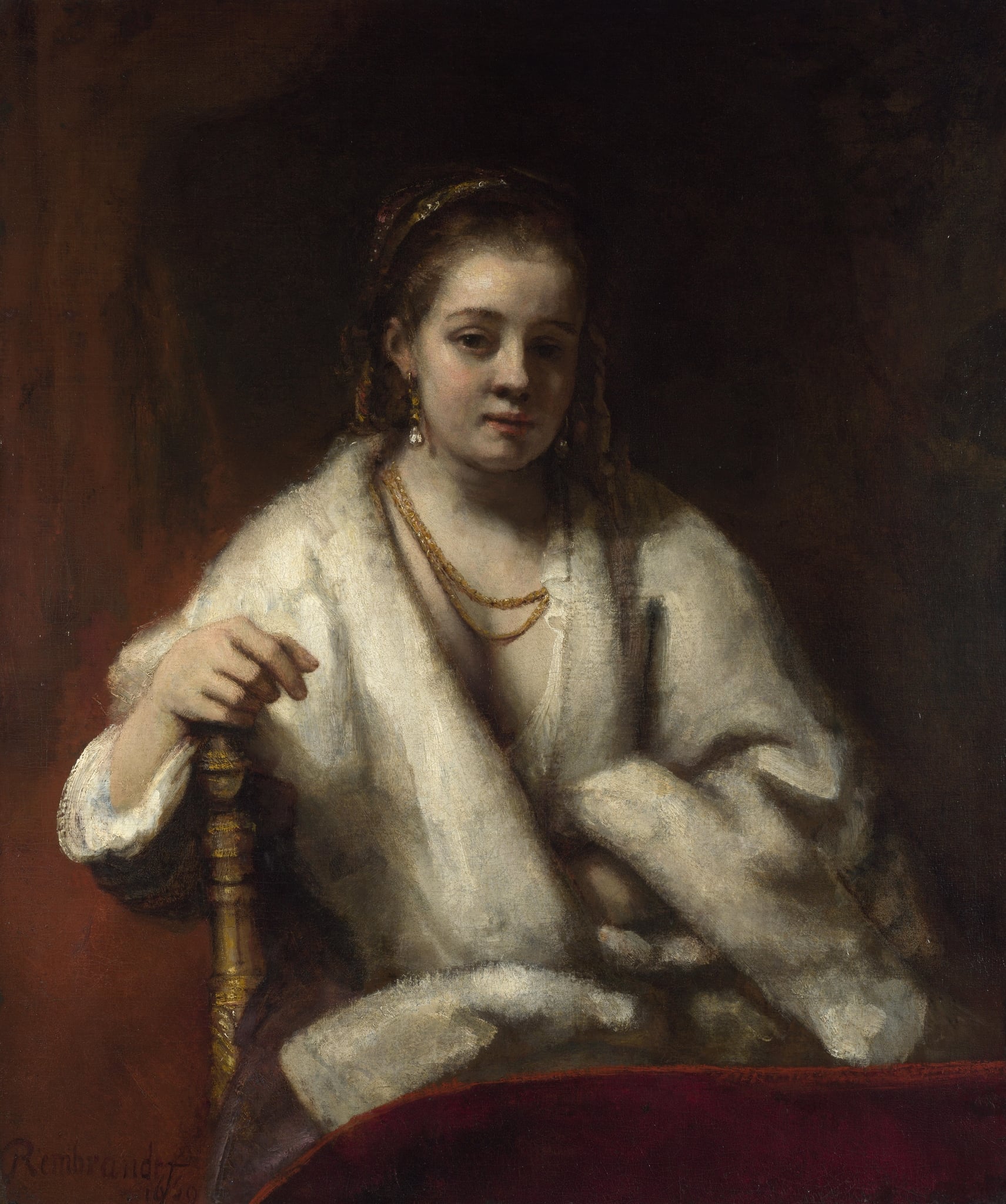
Portrait of Hendrickje Stoffels
Rembrandt van Rijn (c. 1654–1656)
In Portrait of Hendrickje Stoffels, Rembrandt van Rijn stages an intimate encounter in which a young woman leans from darkness into <strong>golden, directional light</strong>, her fur-trimmed wrap and jewelry catching the eye while her expression remains inward-looking. The thick impasto of the robe, the <strong>subtle glint of a gold chain and pearl earring</strong>, and the anchoring <strong>red table edge</strong> fuse touch, time, and tenderness into a single, contemplative presence <sup>[1]</sup>. Painted in the mid‑1650s, the work distills Rembrandt’s late style: psychological depth, restrained palette, and <strong>moral chiaroscuro</strong> <sup>[1]</sup>.