The Embroiderer

by Johannes Vermeer

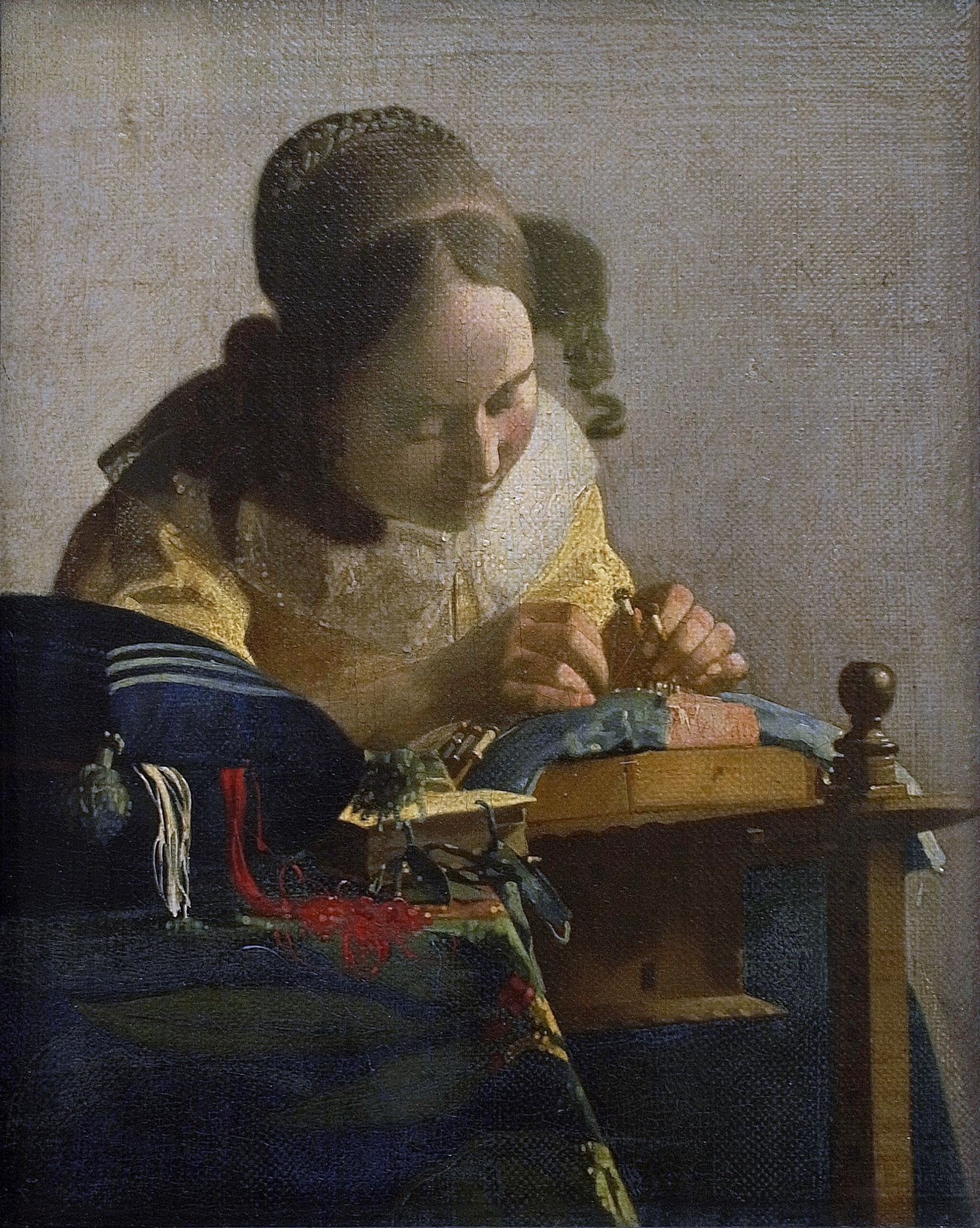
In The Embroiderer, Johannes Vermeer condenses a world of work into a palm‑sized drama of attention and transformation. A young woman bends over a lace pillow as loose red and white threads spill in front, while a nascent pattern gathers under her poised fingers. Vermeer’s right‑hand light isolates the act of making and turns domestic labor into virtuous concentration [1].

Fast Facts

Year
1669–1670
Medium
Oil on canvas, later laid down on panel
Dimensions
24 × 21 cm
Location
Musée du Louvre, Paris
The Embroiderer by Johannes Vermeer (1669–1670) featuring Lace pillow with bobbins and pins, Tangle of red and white threads

Click on any numbered symbol to learn more about its meaning

Meaning & Symbolism

Vermeer constructs The Embroiderer as a theorem of attention. The composition funnels our gaze to the junction of hands, pins, and bobbins; everything else recedes into a gentle haze. The scattered skeins of red and white thread on the blue cushion in the foreground form a deliberate tangle, visually “softened” so they hover at the edge of legibility. At the center, however, the bobbins, the lace pillow, and the small crossing pins snap into focus. This selective precision—now often compared to depth‑of‑field effects—has been linked to optical observation and possibly a camera obscura, not as a crutch but as a way to convert looking into meaning: the world is fuzzy until labor and attention bring it into form 24. Vermeer intensifies that argument with light from the right—unusual in his oeuvre—which skims the sitter’s yellow sleeve and lace collar before pooling on her fingertips. The light does not describe a room; it consecrates a task 1. Color and staging reinforce the moral program. Cool blues and greys create a near wall of “obstacles” in front: the sewing cushion, bundled cords, and furniture rail. Our eye must climb past these cool zones to reach the warm, honeyed triangle of head, bodice, and hands. This chromatic ascent mirrors the work’s ethical arc from confusion to harmonious order. The small ribbon‑tied book to the right—likely a prayer book—anchors that reading, binding diligence to piety and turning the act of making lace into a micro‑allegory of virtue practiced rather than merely professed 125. In the Dutch Republic, such lacemaker imagery signaled feminine industry and domestic rectitude; Vermeer radicalizes the type by shrinking the frame and erasing anecdote, so that craft itself becomes emblem and end 12. The painting’s scale—barely two dozen centimeters high—tightens the meditation. Within this miniature theater, textures become proof of mastery: satin sleeve, crisp lace collar, velvety cushion, gleaming bobbins. Yet Vermeer refuses mere description. He abstracts the foreground threads into soft, almost molten swirls, then renders the pins at the lace’s edge with needle‑point clarity. That alternation is not technical showmanship; it encodes a philosophy of making where clarity is earned. The sitter’s lowered gaze and gathered hairband lock her attention; the neutral wall scrubs away narrative distractions. Even the right‑hand illumination, atypical for Vermeer, serves the thesis by carving a lucid cone around the act of work, letting background dissolve into silence 12. Seen this way, The Embroiderer—though depicting bobbin lace rather than embroidery—becomes Vermeer’s most concentrated argument that the everyday can be a site of exalted seeing. The painting matters not because it dazzles with detail but because it disciplines detail, directing perception toward the ethics of care, patience, and quiet mastery that turn loose fibers into patterned light 1234.

Explore Deeper with AI

Ask questions about The Embroiderer

Popular questions:

Powered by AI • Get instant insights about this artwork

💬 Ask questions about this artwork!

Interpretations

Optical Method and the Camera Obscura Debate

The Lacemaker is often cited as Vermeer’s most concentrated experiment in selective precision, with a pin-sharp mid-plane and a melted, near-bokeh foreground. Rather than proving gadget-dependence, the image exemplifies how a painter could translate lens phenomena into poetics: a shallow depth-of-field that makes the act of work the focal truth. Philip Steadman’s geometric and perceptual analyses render camera-obscura use plausible, yet museums rightly present it as unproven but persuasive. What matters critically is how Vermeer converts optical behavior into ethics of attention: the world resolves where labor is most intense, and everything else accepts a soft humility at the edges 234.

Source: Philip Steadman; Louvre-Lens; Essential Vermeer

Gendered Labor and the Dutch Moral Economy

Lacemaking in the Dutch Republic signified female industry, order, and chastity, a counter-image to idle flirtation familiar in genre painting. Vermeer radicalizes this convention by erasing anecdote: no suitors, letters, or moralizing inscriptions intrude—only the woman’s hands and tools. This reduction aligns with a period taste for miniature, domestic virtues prized by middle-class patrons, yet it also centers skilled labor as the narrative. The work’s honeyed yellows against cool barriers of cushion and rail literalize a path from distraction to discipline, modeling a civic ideal in which private diligence underwrites public virtue. It is not a scene about seduction or spectacle; it is a treatise on craft as character 12.

Source: Musée du Louvre; Louvre-Lens

Devotional Framework: Work as Prayer

The small, ribbon-tied prayer book quietly reframes the task as devotional practice. In a household tied to Catholic circles in Delft, Vermeer’s alignment of light, focus, and task resonates with Catholic domestic piety, where repetitive, attentive actions could be read as meditations. The right-hand light does not map a room; it hallowed the fingertips. This convergence of craft and contemplation suggests an everyday form of ora et labora—prayer through labor—consonant with Vermeer’s documented Catholic milieu and proximity to Jesuit worship. The book anchors the moral program without overt allegory, letting the fidelity of the hand serve as the icon 15.

Source: Musée du Louvre; National Gallery of Art (artist biography)

Scale, Support, and Tactile Seeing

At roughly 24 × 21 cm, the painting functions as a handheld theater of touch. Its later transfer from canvas to panel stabilized a surface already worked to astonishing fineness. Scale here is not a constraint but a strategy: granularity of threads, the glint on bobbins, and the crisp lace edge demand near viewing, collapsing the gap between spectator and maker. The blurred skeins become a material veil one must visually part, echoing the lacemaker’s own negotiation of tangles. On this intimate stage, technique turns into theme: the paint’s tactility teaches the eye how to feel its way to order 12.

Source: Musée du Louvre; Louvre-Lens

Compositional Choreography: Obstacles and Ascent

Vermeer engineers the picture as an obstacle course of vision. The cool-toned cushion and furniture rail frontload the composition with impediments; the viewer must “climb” these planes to reach the warm, illuminated triangle of head–bodice–hands. This ascent is both spatial and ethical: from confusion to harmonious order. The cropping is unusually tight, eliminating windows, maps, and anecdotal décor, so that the act of coordination—hands, pins, bobbins—occupies the summit of attention. The result is a mise-en-abyme of looking: as the maker disentangles threads, the viewer disentangles pictorial space, rehearsing the same discipline in a different register 23.

Source: Louvre-Lens; Essential Vermeer

Title and Technique: From Embroidery to Bobbin Lace

Popular references to an Embroiderer blur a crucial distinction. Vermeer depicts bobbin lace, not embroidery: the lace pillow, paired bobbins, and pins identify a technique of interlacing wound threads rather than stitching onto fabric. Getting the craft right matters interpretively. Bobbin lace was prized for complex patterning built from repetition and control—precisely the virtues the painting visualizes in its pin-sharp center. Misnaming the subject flattens the work’s technical specificity and its cultural associations with feminine industry. The Louvre’s title, The Lacemaker, clarifies both iconography and meaning, tying the image to a robust 17th-century motif and its moral overtones 16.

Source: Musée du Louvre; Google Arts & Culture (based on museum texts)

Related Themes

About Johannes Vermeer

Johannes Vermeer (1632–1675) lived and worked in Delft, producing a small oeuvre of luminous interior scenes defined by meditative light and measured craft. Technical research shows he began with swift underpainting and then refined forms and light with exceptional deliberation, a method newly underscored by The Milkmaid’s imaging discoveries [1][3]. His art elevates everyday life into enduring models of clarity, quiet, and human presence.
View all works by Johannes Vermeer

More by Johannes Vermeer
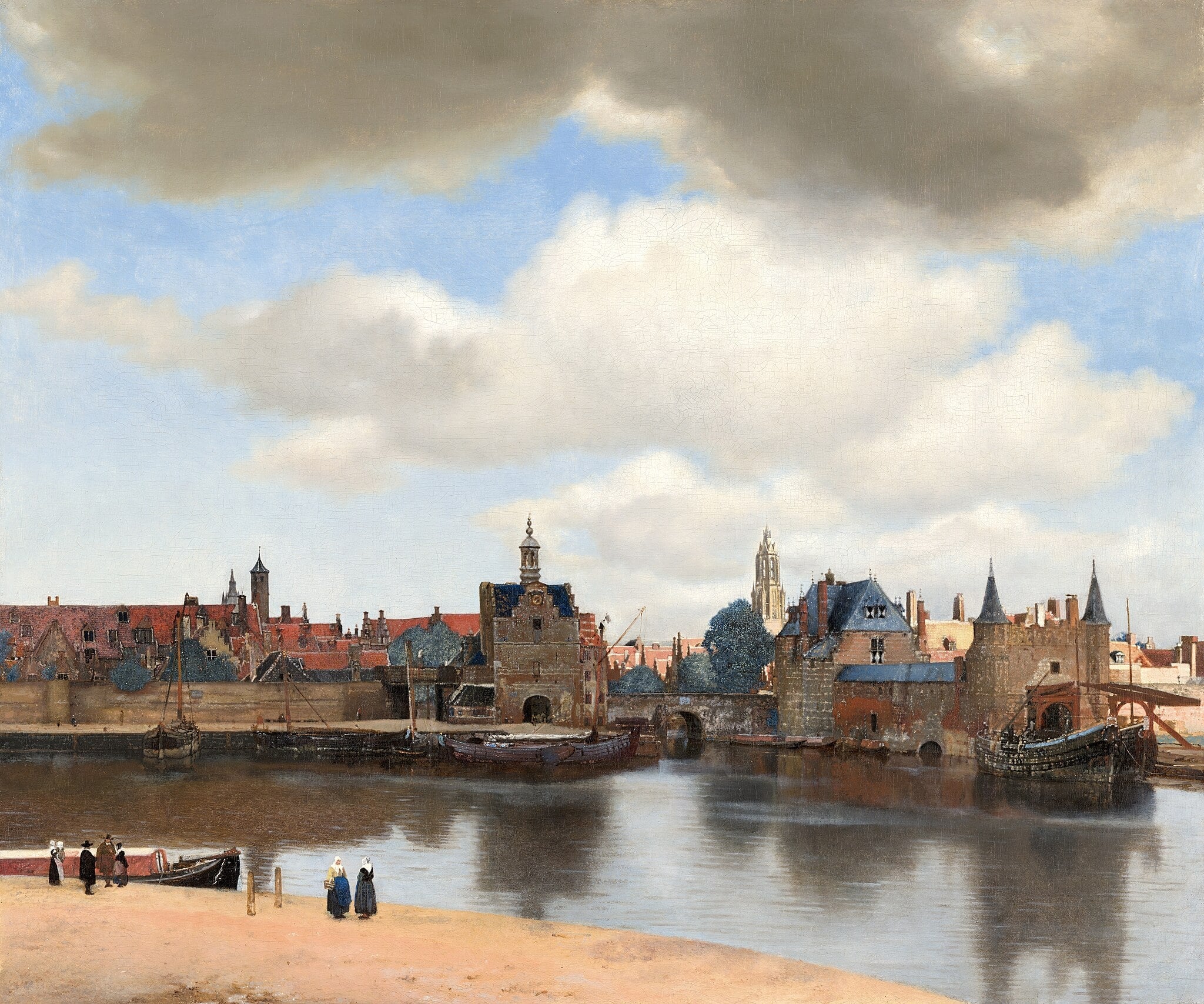
View of Delft by Johannes Vermeer

View of Delft

Johannes Vermeer (c. 1660–1661)

View of Delft turns a faithful city prospect into a meditation on <strong>civic order, resilience, and time</strong>. Beneath a low horizon, drifting clouds cast mobile shadows while shafts of sun ignite blue roofs and the bright spire of the <strong>Nieuwe Kerk</strong>, holding the scene’s moral center <sup>[1]</sup>. Small figures and moored boats ground prosperity in <strong>everyday community</strong> without breaking the hush.

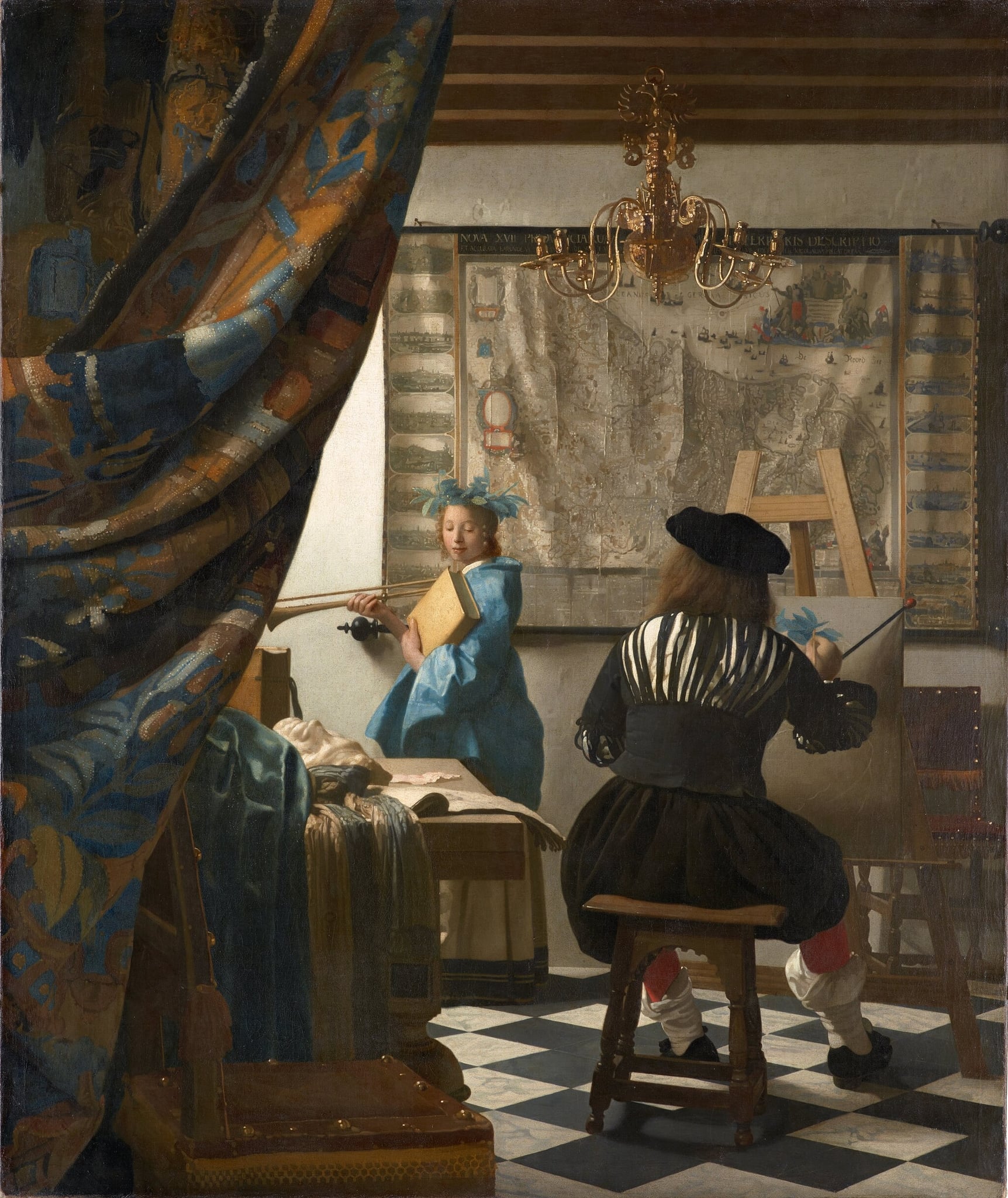
The Art of Painting by Johannes Vermeer

The Art of Painting

Johannes Vermeer (c. 1666–1668)

Johannes Vermeer’s The Art of Painting is a self-aware allegory that equates <strong>painting with history and fame</strong>. Framed by a parted <strong>tapestry</strong> like a stage curtain, an artist in historical dress paints the muse <strong>Clio</strong>, while a vast <strong>map of the Seventeen Provinces</strong> and a <strong>double‑headed eagle</strong> chandelier fold national memory into the studio scene <sup>[1]</sup><sup>[3]</sup>.
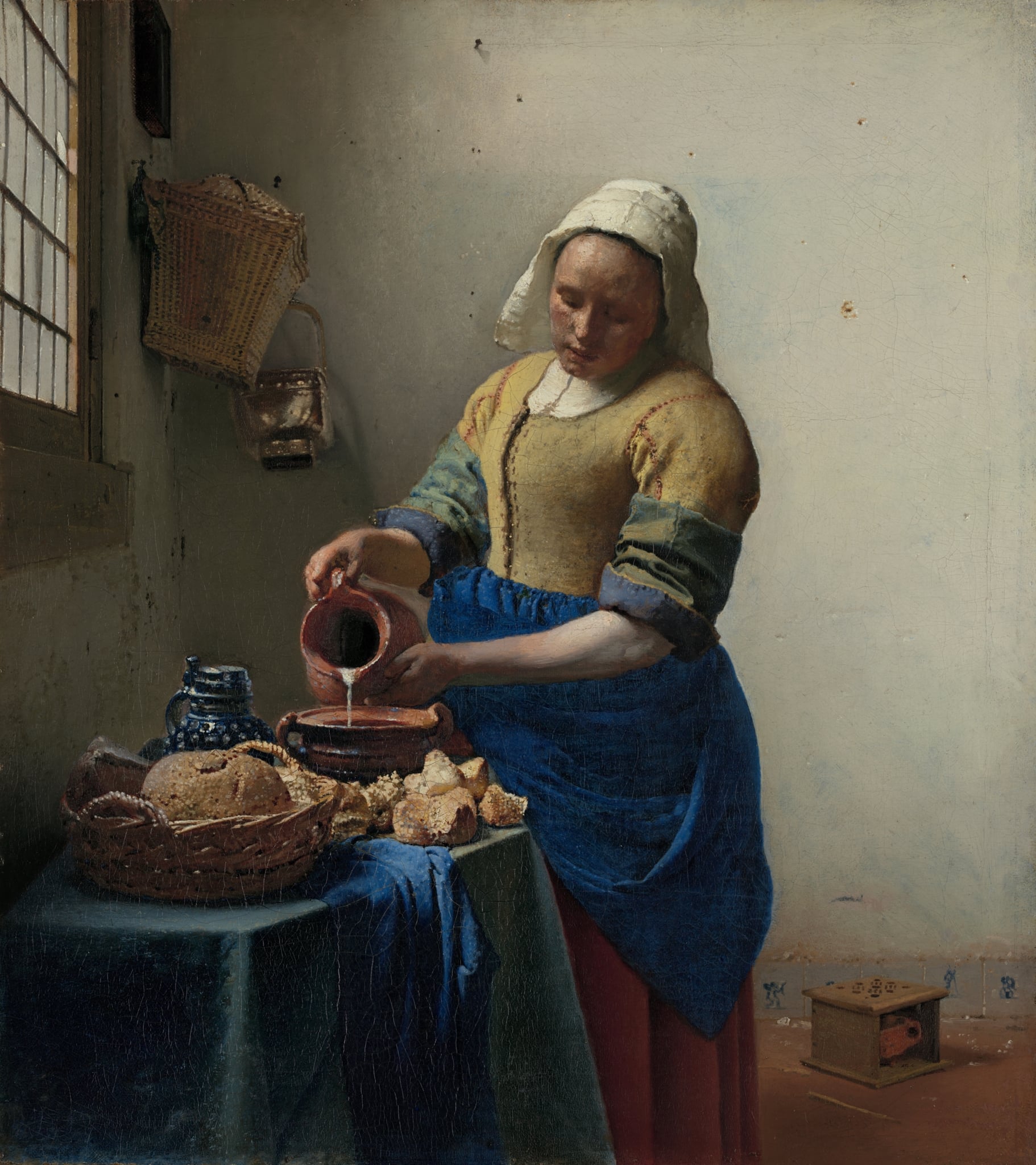
The Milkmaid by Johannes Vermeer

The Milkmaid

Johannes Vermeer (c. 1660)

In The Milkmaid, Vermeer turns an ordinary act—pouring milk—into a scene of <strong>quiet monumentality</strong>. Light from the left fixes the maid’s absorbed attention and ignites the <strong>saturated yellow and blue</strong> of her dress, while the slow thread of milk becomes the image’s pulse <sup>[1]</sup><sup>[2]</sup>. Bread, a Delft jug, nail holes, and a small <strong>foot warmer</strong> anchor a world where humble work is endowed with dignity and latent meaning <sup>[1]</sup><sup>[2]</sup>.