The Art of Painting

by Johannes Vermeer

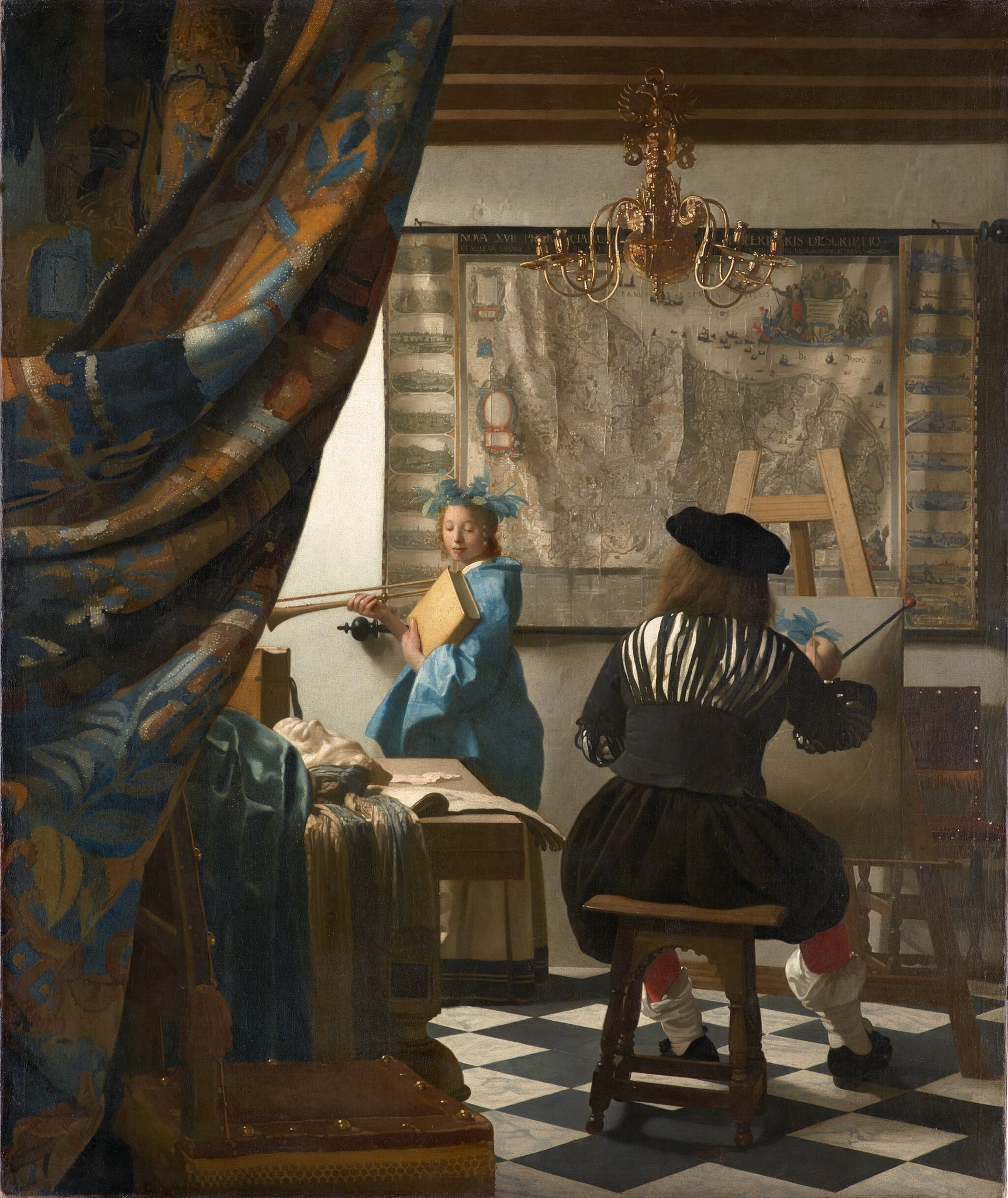
Johannes Vermeer’s The Art of Painting is a self-aware allegory that equates painting with history and fame. Framed by a parted tapestry like a stage curtain, an artist in historical dress paints the muse Clio, while a vast map of the Seventeen Provinces and a double‑headed eagle chandelier fold national memory into the studio scene [1][3].
💰

Market Value

$300-600 million

How much is The Art of Painting worth?

Fast Facts

Year
c. 1666–1668
Medium
Oil on canvas
Dimensions
120 x 100 cm
Location
Kunsthistorisches Museum, Vienna
The Art of Painting by Johannes Vermeer (c. 1666–1668) featuring Parted tapestry curtain, Map of the Seventeen Provinces, Double‑headed eagle chandelier

Click on any numbered symbol to learn more about its meaning

Meaning & Symbolism

Vermeer positions the viewer just behind the painter, whose slashed doublet and beret belong to an earlier Netherlandish fashion, signaling the timeless realm of history painting inside a contemporary Delft studio. That backward-facing figure is not a portrait but a thesis: the artist, absorbed and anonymous, serves History itself. Clio stands before him with a laurel wreath, trumpet, and a thick book—attributes codified in Ripa’s Iconologia—so the work explicitly binds pictura to the writing and proclamation of events and fame 23. Light from the unseen left window clarifies every hierarchy of matter—the cool sheen of the chessboard marble floor, the crisp crease of the wall map, the glinting arm of the brass chandelier—demonstrating painting’s power to render truth while claiming a higher task than imitation 25. The parted, tasseled tapestry at the left functions like a stage curtain, dramatizing entry and recalling early modern boasts about illusion’s power; it turns the studio into a proscenium where art performs its authority over time and memory 3. History is not only personified; it is geographic and political. The great wall map—legibly inscribed to Nicolaes Visscher within the painting—depicts the Seventeen Provinces “before their separation,” yet Vermeer emphasizes a vertical fold that viewers have long read as a quiet sign of later division between the Dutch Republic and the Habsburg south 14. Suspended before the map, the candleless chandelier bears the double‑headed eagle, the Habsburg emblem, a pointed reminder of former imperial rule that shades the scene with political retrospection even as Clio promises lasting fame 13. On the table lie a drawing, books, and a plaster mask: the paraphernalia of academic training and the paragone with sculpture, aligning painting with the liberal arts and learned imitation of antiquity 3. These tokens, together with the artist’s archaizing costume, assert that the studio is a republic of letters—a site where images converse with texts, casts, and maps to secure cultural memory 23. The meaning of The Art of Painting, then, is programmatic. Vermeer claims for his craft the status of history writing—anchored in the Dutch body politic and perfected through scholarly discipline. The meticulously plotted perspective grid of the tiled floor and the micro-theater of light become arguments: by mastering description, painting justifies its leap into commemoration and civic value 25. That Vermeer kept this large canvas in his possession reinforces its function as a showpiece manifesto of his art, a compact of national memory (map and eagle), poetic immortality (Clio’s laurel), and the artist’s learned labor (books, mask, drawing) 15. It is a serene interior that declares, with allegorical clarity, that images do not merely depict the world—they shape how a nation remembers itself.

Explore Deeper with AI

Ask questions about The Art of Painting

Popular questions:

Powered by AI • Get instant insights about this artwork

💬 Ask questions about this artwork!

Interpretations

Formal Analysis

Vermeer’s interior is a controlled optical theater: the parted tapestry acts as a repoussoir curtain, the black‑and‑white floor sets a rigorous perspective grid, and the raking left‑side light articulates micro‑hierarchies of sheen, fabric, and metal. These devices produce what Liedtke calls Delft’s refined descriptive poise, yet here they are marshaled toward an unusually layered allegory. The map’s crisp creases, the chandelier’s eagle finial, and the crisp silhouette of Clio’s laurel all read with legible clarity, modeling how description can serve concept. The staging courts the old paragone of illusion—inviting the viewer across the threshold—while the cool tonality and exact drawing restrain bravura, sustaining a sober authoritative presence rather than mere spectacle 23.

Source: Metropolitan Museum of Art (Walter Liedtke), Essential Vermeer

Symbolic Reading (Cartography and Empire)

The wall map is identified in the painting’s own inscription to Nicolaes Visscher, anchoring the canvas in the cartographic culture of the Seventeen Provinces. Scholars have long noted Vermeer’s emphasized vertical crease, often read as a tacit sign of the later North–South split—an allegory of political memory. Suspended before it, the candleless chandelier bearing the double‑headed eagle evokes Habsburg sovereignty, staging a dialogue between Dutch self‑imaging and imperial rule. Rather than a neutral backdrop, the map and chandelier coordinate a geo‑political iconography with Clio’s promise of fame, suggesting that painting’s claim to history is inseparable from mapping and heraldry—technologies of remembering and power 134.

Source: Kunsthistorisches Museum; George Welu (1975); Essential Vermeer

Historical Context

Vermeer appears to have kept this large allegory as a showpiece, a decision consistent with Wheelock’s view of the work as a summa of the artist’s ambitions. Its retention through Vermeer’s life and the difficult Rampjaar economy, then transfer by his widow to shield it from creditors, underscores its status as a personal and professional manifesto. Later, the painting’s fraught provenance—passing through Viennese collections, a 1940 purchase by Hitler, Allied recovery, and its postwar entry into the KHM—adds a second life of political entanglement to a canvas already about memory and nation. The object’s history mirrors its theme: images accrue civic meanings that outlast markets and regimes 156.

Source: Kunsthistorisches Museum; National Gallery of Art (Arthur K. Wheelock Jr.); National Gallery, London

Medium Reflexivity and the Paragone

On the table, a plaster mask, books, and a drawing stage the academic toolkit, invoking the paragone with sculpture and the claim that painting belongs among the liberal arts. Clio’s Ripa‑derived attributes—laurel, trumpet, book—bind pictura to historiography and fame, while Van Hoogstraten’s contemporaneous theory links such emblems to the hierarchy of genres. Vermeer’s painter wears archaic Netherlandish costume to align present practice with venerable history painting, even as he works in a domestic Delft studio. The result is a medium thinking about itself: an image that demonstrates skill in depiction to authorize its leap into historical commemoration, arguing that learned imitation and allegory elevate the painter’s labor to intellectual authorship 238.

Source: Metropolitan Museum of Art; Essential Vermeer (Ripa/Hoogstraten)

Psychological/Biographical Interpretation

A recent proposal tentatively identifies the model as Vermeer’s eldest daughter, Maria, recasting the scene as a familial collaboration in which domestic life becomes the matrix of historical imagination. While not a consensus view, this reading harmonizes with Vermeer’s Catholic milieu and the painting’s intimate studio scale: the anonymous, absorbed painter serves not only History but household memory, elevating the everyday into a vessel of fame. The backward‑facing artist performs self‑effacement—authorship without visage—while the model bears the public emblems of laurel and trumpet. Together they suggest a dialectic of private labor and public renown: an inner circle generating outward glory through disciplined craft 57.

Source: Nature Humanities & Social Sciences Communications; National Gallery of Art

Related Themes

About Johannes Vermeer

Johannes Vermeer (1632–1675) lived and worked in Delft, producing a small oeuvre of luminous interior scenes defined by meditative light and measured craft. Technical research shows he began with swift underpainting and then refined forms and light with exceptional deliberation, a method newly underscored by The Milkmaid’s imaging discoveries [1][3]. His art elevates everyday life into enduring models of clarity, quiet, and human presence.
View all works by Johannes Vermeer

More by Johannes Vermeer
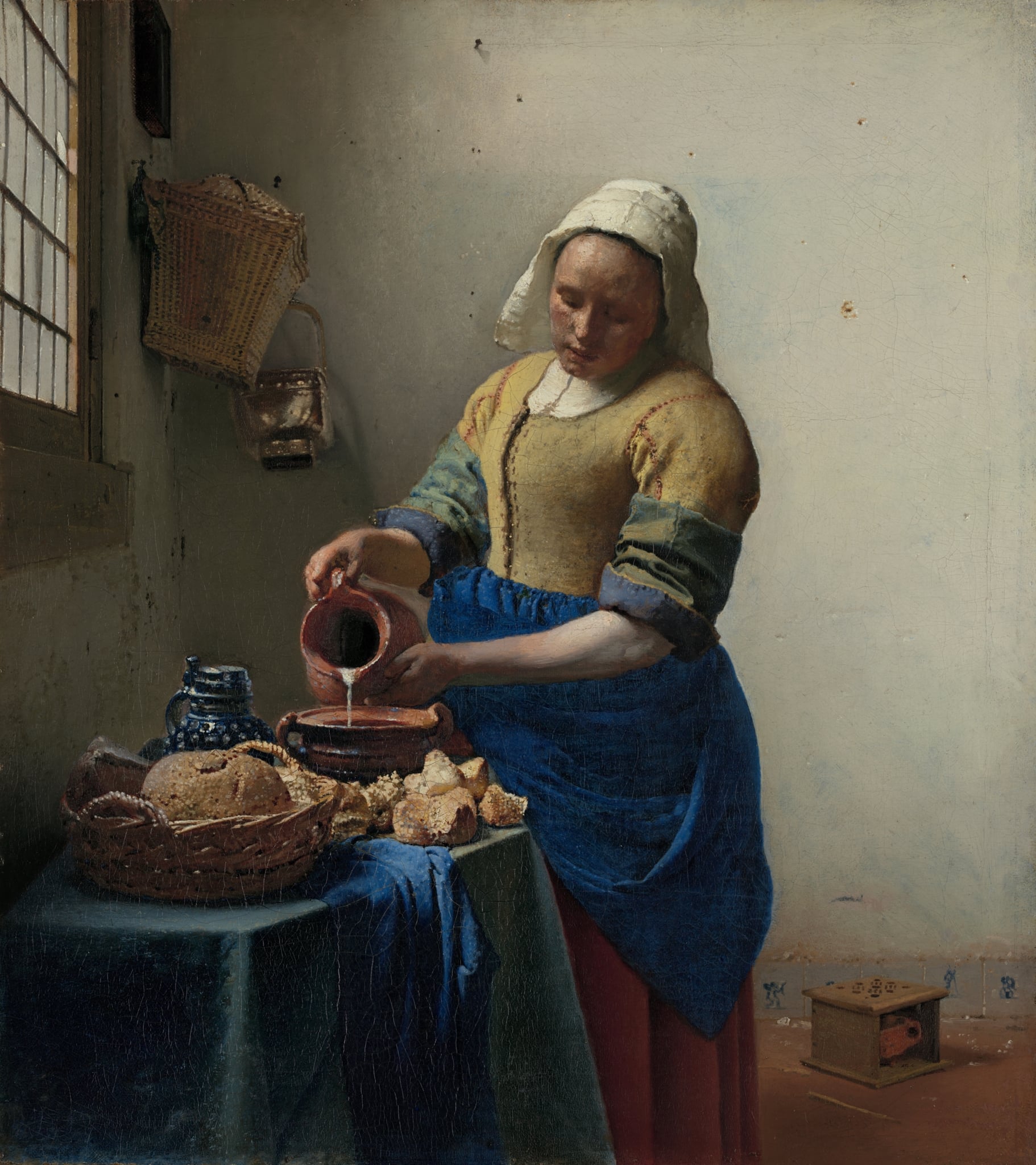
View of Delft by Johannes Vermeer

View of Delft

Johannes Vermeer (c. 1660–1661)

View of Delft turns a faithful city prospect into a meditation on <strong>civic order, resilience, and time</strong>. Beneath a low horizon, drifting clouds cast mobile shadows while shafts of sun ignite blue roofs and the bright spire of the <strong>Nieuwe Kerk</strong>, holding the scene’s moral center <sup>[1]</sup>. Small figures and moored boats ground prosperity in <strong>everyday community</strong> without breaking the hush.
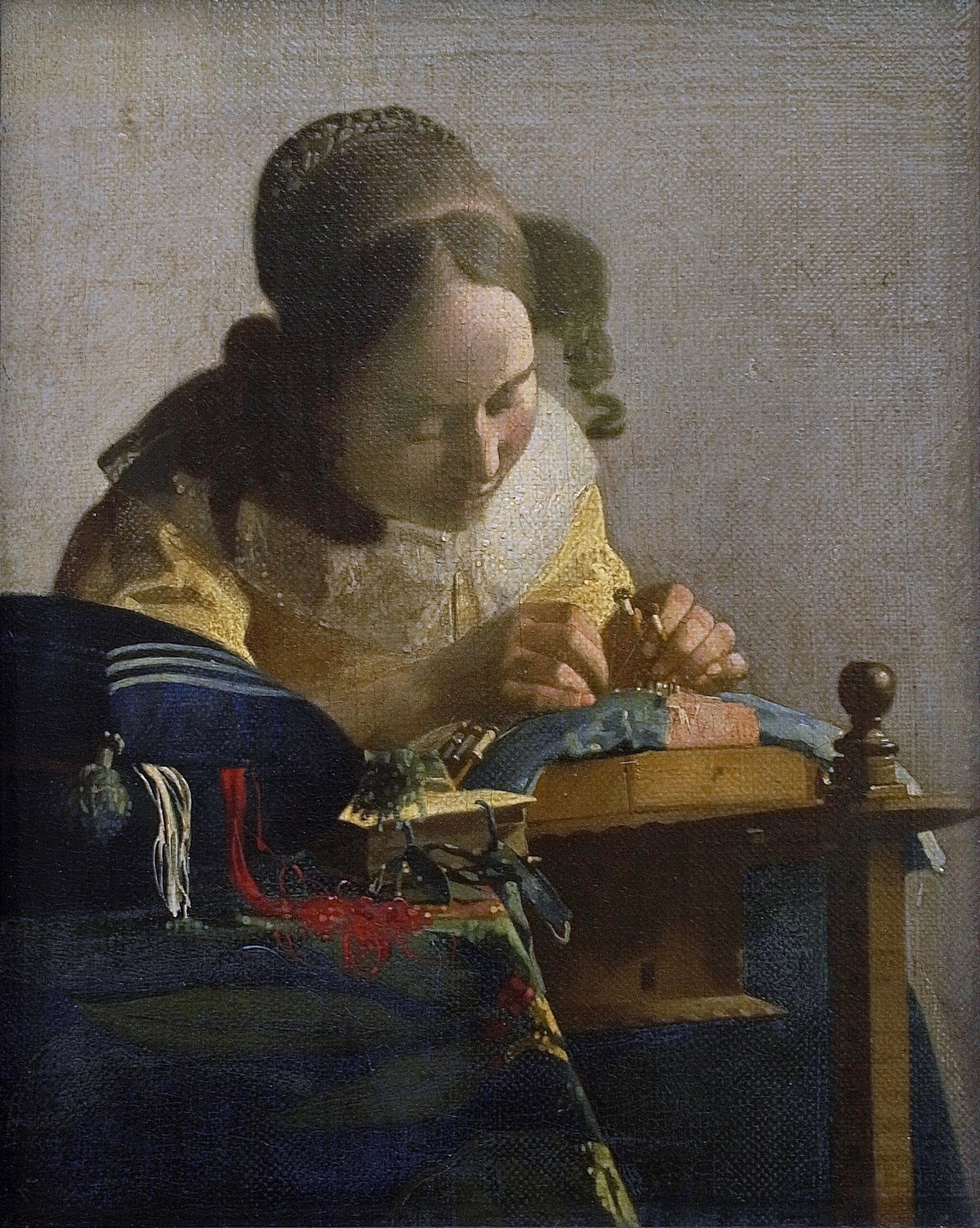
The Embroiderer by Johannes Vermeer

The Embroiderer

Johannes Vermeer (1669–1670)

In The Embroiderer, Johannes Vermeer condenses a world of work into a palm‑sized drama of <strong>attention</strong> and <strong>transformation</strong>. A young woman bends over a lace pillow as loose red and white threads spill in front, while a nascent pattern gathers under her poised fingers. Vermeer’s right‑hand light isolates the act of making and turns domestic labor into <strong>virtuous concentration</strong> <sup>[1]</sup>.

The Milkmaid by Johannes Vermeer

The Milkmaid

Johannes Vermeer (c. 1660)

In The Milkmaid, Vermeer turns an ordinary act—pouring milk—into a scene of <strong>quiet monumentality</strong>. Light from the left fixes the maid’s absorbed attention and ignites the <strong>saturated yellow and blue</strong> of her dress, while the slow thread of milk becomes the image’s pulse <sup>[1]</sup><sup>[2]</sup>. Bread, a Delft jug, nail holes, and a small <strong>foot warmer</strong> anchor a world where humble work is endowed with dignity and latent meaning <sup>[1]</sup><sup>[2]</sup>.