The Milkmaid

by Johannes Vermeer

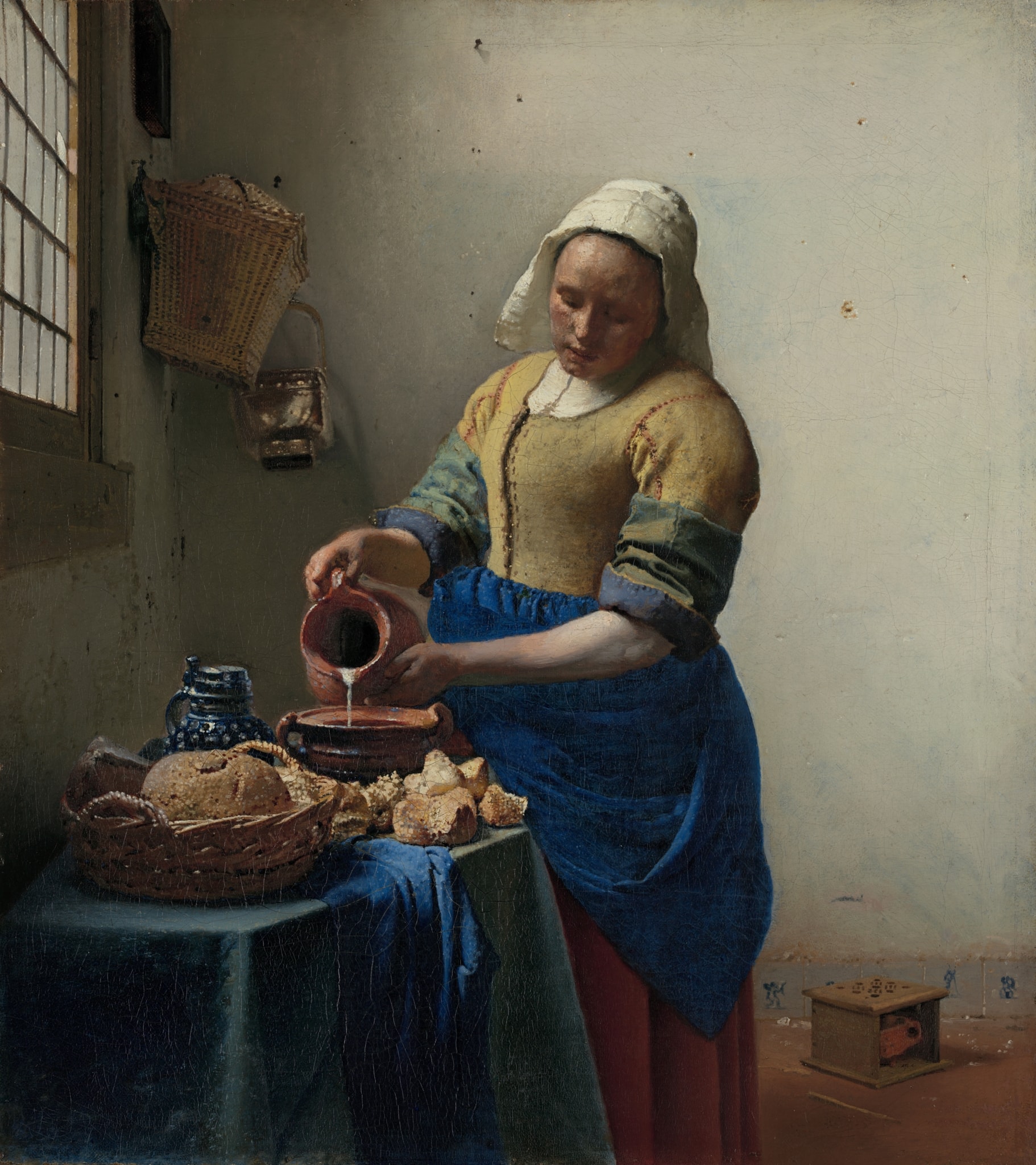
In The Milkmaid, Vermeer turns an ordinary act—pouring milk—into a scene of quiet monumentality. Light from the left fixes the maid’s absorbed attention and ignites the saturated yellow and blue of her dress, while the slow thread of milk becomes the image’s pulse [1][2]. Bread, a Delft jug, nail holes, and a small foot warmer anchor a world where humble work is endowed with dignity and latent meaning [1][2].

Fast Facts

Year
c. 1660
Medium
Oil on canvas
Dimensions
45.5 × 41 cm
Location
Rijksmuseum, Amsterdam
The Milkmaid by Johannes Vermeer (c. 1660) featuring Falling milk, Bread and crusts, Delft stoneware jug, Foot warmer (stoof)

Click on any numbered symbol to learn more about its meaning

Meaning & Symbolism

Vermeer constructs meaning through control of light, gesture, and reduction. The left window lays a firm diagonal that articulates the maid’s body against a cool wall, while tiny highlights on nails and plaster pocks certify the room’s plainness 1. Within this stripped stage, the act of pouring becomes a kind of measure: the thin, continuous ribbon of milk—caught exactly as it falls into an earthenware bowl—sets the tempo of the scene and models an ethic of concentration. The stacked loaf ends, broken crusts, and the heavy Delft jug read as emblems of thrift and nourishment; together with the maid’s rolled sleeves and sturdy stance, they declare useful virtue rather than display 12. Scholars have plausibly linked the abundance of bread to a frugal dish of bread porridge, underscoring economy and care in the household 2. The painting’s tactile surfaces—seeded crusts, cool glaze, the nap of the tablecloth—are less descriptive excess than moral rhetoric: they insist that reality, plainly attended to, yields sufficiency and grace. Vermeer balances that ethic with a whisper of feeling. On the baseboard tiles, a small Cupid brandishes a bow, while a wayfarer strides with a stick; nearby sits a compact foot warmer with its glowing coal visible through the perforations 2. In Dutch genre codes, such motifs could intimate amorous warmth or the prospect of encounter, yet here they are deliberately recessive, scaled to the floor and half-shadowed, so that desire remains a latent possibility rather than the subject itself 24. This compositional modesty is not accidental. Recent imaging shows that Vermeer first sketched more wall clutter—a jug rack—and a larger basket at lower right, then painted them out, substituting the small stoof and simplifying the wall to amplify the figure’s presence and the serenity of the design 3. The result is a clarified architecture of attention: the maid forms a compact pyramid; the blue apron anchors the composition; the milk’s vertical thread rhymes with the window muntins and the hanging basket’s strap, knitting labor, light, and line into an integrated whole. That integration explains the work’s enduring resonance. Interpreters who stress domestic virtue see a paragon of self-command and service, a moral portrait conveyed without allegorical grandstanding 15. Those who emphasize the erotic subtext find it encoded but restrained—acknowledged in the Cupid and foot warmer, yet subsumed by the central action of careful work 24. Vermeer’s triumph is to let both truths stand: the human world is orderly and sustaining, and it also harbors warmth and possibility. In granting sculptural dignity to a working woman and making a humble kitchen task the vessel of light’s slow revelation, The Milkmaid declares that grace belongs not to spectacle but to attention itself. That is why the painting continues to shape our imagination of everyday life: it makes the ordinary a site of transfiguration, and it does so with a discipline and tenderness that feel inexhaustible 123.

Explore Deeper with AI

Ask questions about The Milkmaid

Popular questions:

Powered by AI • Get instant insights about this artwork

💬 Ask questions about this artwork!

Interpretations

Technical Process & Revision (Pentimenti as Meaning)

Recent imaging shows Vermeer initially sketched a wall-mounted jug rack and a large fire basket, then painted them out, substituting the compact stoof and a cleared wall. This is not mere tidying: the subtractive design intensifies the figure’s monumentality and slows the viewing rhythm, so the falling milk becomes the work’s metronome. The discovery also revises the myth of Vermeer as only a painstaking finisher; he began with a brisk, assertive underpaint—the dark ‘draft’ under the maid’s arm—before calibrating edges and light. In other words, the painting’s serenity is engineered through revision and restraint, a clarifying edit that turns kitchen clutter into a disciplined architecture of attention 21.

Source: Rijksmuseum (2022 technical research; object entry)

Iconography of Warmth: Desire Coded, Duty Dominant

The tiny Cupid on the tile and the nearby foot warmer (stoof) carry well-known signals of love and bodily warmth in Dutch genre painting. In bawdier contexts these cues drive narrative; here they’re miniaturized and half-shadowed, yielding a faint erotic halo that never overtakes the scene. Liedtke stresses this discreet allusion to desire, yet the maid’s absorbed posture reframes such signs within an ethic of labor. The result is a calibrated tension between eros and decorum: desire is acknowledged as a social fact but domesticated by the cadence of work and the cool geometry of light. Vermeer’s iconographic minimalism turns what could be anecdote into a low hum of possibility 43.

Source: The Met (Walter Liedtke, 2009; Heilbrunn Timeline essay)

Foodways & Material Culture: Thrift as Aesthetic Program

The heap of bread crusts, sturdy earthenware, and Delft jug likely point to bread porridge—a thrifty dish built from stale bread and milk. This reading aligns the scene with Dutch household economy, where waste-not practices were a virtue as much as necessity. Vermeer’s haptic description—seeded crusts, glaze, coarse cloth—does more than mimic surfaces; it translates frugality into visual pleasure, arguing that careful seeing turns paucity into plenty. In this lens, the painting is an ethics of provision: simple means, attentively handled, become aesthetic sufficiency. The material culture is not background; it’s the argument, made tangible in bread’s rough sparkle and the jug’s cool sheen 31.

Source: The Met (Heilbrunn Timeline); Rijksmuseum object entry

Social History of Servitude: Monumentality without Rank

Seventeenth‑century imagery often eroticized maids or cast them as comic types. Vermeer counters with monumental stillness: a servant occupies center stage, her blue apron a chromatic keystone, her body a stable pyramid. Wheelock underscores how Vermeer’s genre scenes confer dignity without allegorical fanfare, making domestic virtue legible through pose, task, and light. This social reframing matters: within a stratified urban society, giving a working woman sculptural presence contests habits of looking that tether status to worth. The painting’s politics are quiet but firm—attention as recognition, form as respect 51.

Source: Arthur K. Wheelock Jr. (Britannica); Rijksmuseum object entry

Optics & Attention: How Light Thinks

The left-hand window casts a measured diagonal; tiny nail glints, plaster pocks, and particulate highlights articulate a microclimate of light. These optical decisions are not neutral description but attention-training: the eye rehearses the maid’s concentration by tracking the milk’s unbroken thread, the muntins’ verticals, the basket’s strap. Vermeer’s dots and glazes create a tactile ‘near’ that keeps spectacle at bay. In this sense the painting is about looking as labor—mimesis turned ethical. By refining sensory data into calm structure, Vermeer suggests that seeing well is a form of care, and that care, like milk, is delivered in a steady, continuous pour 136.

Source: Rijksmuseum object entry; The Met (Heilbrunn Timeline); Essential Vermeer

Related Themes

About Johannes Vermeer

Johannes Vermeer (1632–1675) lived and worked in Delft, producing a small oeuvre of luminous interior scenes defined by meditative light and measured craft. Technical research shows he began with swift underpainting and then refined forms and light with exceptional deliberation, a method newly underscored by The Milkmaid’s imaging discoveries [1][3]. His art elevates everyday life into enduring models of clarity, quiet, and human presence.
View all works by Johannes Vermeer

More by Johannes Vermeer